5 - Project Scope Management
Project Management Training
Created by ejlp12@gmail.com, June 2010
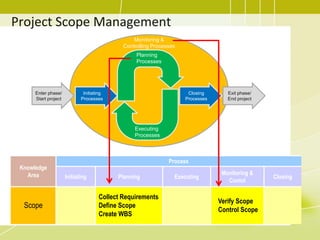
Project Scope Management
Knowledge
Area
Process
Initiating Planning Executing
Monitoring &
Contol
Closing
Scope
Collect Requirements
Define Scope
Create WBS
Verify Scope
Control Scope
Enter phase/
Start project
Exit phase/
End project
Initiating
Processes
Closing
Processes
Planning
Processes
Executing
Processes
Monitoring &
Controlling Processes
Project Scope Management
• Process to ensure that the project includes all-and-only the work
required, to complete the project successfully
• Scope can refer to Product Scope & Project Scope
• Scope Management Plan (part of Develop Project Mgmt Plan)
– How will I do the scope?
– Provides guidance on how project scope will be defines, documented, verified,
managed, and controlled by project management team
• Don’t assume that requirements were determined before project began (not part
of the project)
• Attitude to say no to unnecessary scope. It should go to project approval
process
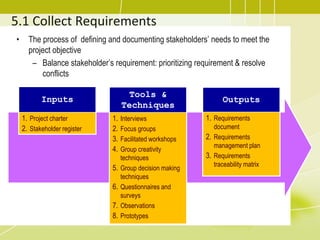
5.1 Collect Requirements
• The process of defining and documenting stakeholders’ needs to meet the
project objective
– Balance stakeholder’s requirement: prioritizing requirement & resolve
conflicts
Inputs
1. Project charter
2. Stakeholder register
Tools &
Techniques
1. Interviews
2. Focus groups
3. Facilitated workshops
4. Group creativity
techniques
5. Group decision making
techniques
6. Questionnaires and
surveys
7. Observations
8. Prototypes
Outputs
1. Requirements
document
2. Requirements
management plan
3. Requirements
traceability matrix
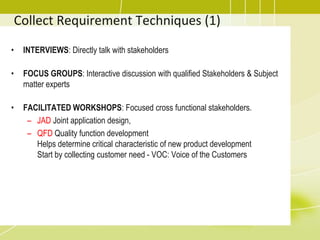
Collect Requirement Techniques (1)
• INTERVIEWS: Directly talk with stakeholders
• FOCUS GROUPS: Interactive discussion with qualified Stakeholders & Subject
matter experts
• FACILITATED WORKSHOPS: Focused cross functional stakeholders.
– JAD Joint application design,
– QFD Quality function development
Helps determine critical characteristic of new product development
Start by collecting customer need - VOC: Voice of the Customers
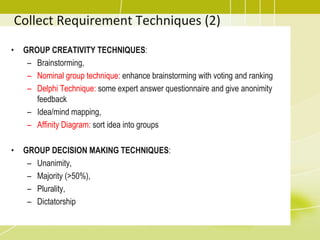
Collect Requirement Techniques (2)
• GROUP CREATIVITY TECHNIQUES:
– Brainstorming,
– Nominal group technique: enhance brainstorming with voting and ranking
– Delphi Technique: some expert answer questionnaire and give anonimity
feedback
– Idea/mind mapping,
– Affinity Diagram: sort idea into groups
• GROUP DECISION MAKING TECHNIQUES:
– Unanimity,
– Majority (>50%),
– Plurality,
– Dictatorship
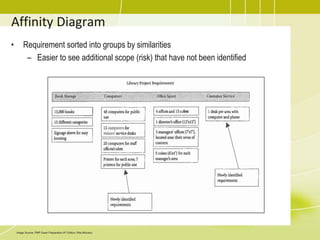
Affinity Diagram
• Requirement sorted into groups by similarities
– Easier to see additional scope (risk) that have not been identified
Image Source: PMP Exam Preparation 6th Edition, Rita Mulcahy
Collect Requirement Techniques (3)
• QUESTIONNAIRE AND SURVEYS: wide number of respondents
• OBSERVATION/JOB SHADOWING: viewing individual in their environment
• PROTOTYPES: early feedback by providing a working model
Balance Stakeholder’s Requirement
• There is a need to balance stakeholder’s requirement
• Some issue are so complex they cannot be resolved by PM alone
• Facilitate the resolution of competing requirement, consider:
• business case,
• project charter,
• project scope statement,
• project constraints
• What you can do:
• Conflict resolution, team building, meeting, problem solving skills, escalation,
approval from stakeholder
• Stakeholder request to do or add something that is not related to the
reason of project created should be rejected!
Requirement Document
• Output of the Collect Requirement process
• Helps make sure the requirements clear and unambiguous.
• How will we know if the work we do will acceptability meet this
requirement?
• Rule of thumb
– Specific (Unambiguous)
– Measurable (How will we know we have finished?)
– Achievable (Can we do it?)
– Relevant (Is it the right thing to do?)
– Timed (When will we do it?)
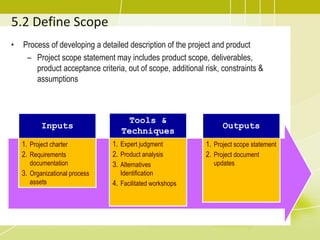
5.2 Define Scope
• Process of developing a detailed description of the project and product
– Project scope statement may includes product scope, deliverables,
product acceptance criteria, out of scope, additional risk, constraints &
assumptions
Inputs
1. Project charter
2. Requirements
documentation
3. Organizational process
assets
Tools &
Techniques
1. Expert judgment
2. Product analysis
3. Alternatives
Identification
4. Facilitated workshops
Outputs
1. Project scope statement
2. Project document
updates
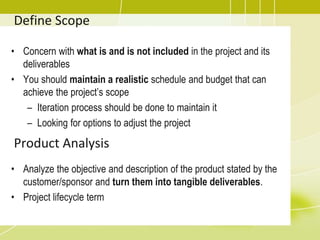
Define Scope
• Concern with what is and is not included in the project and its
deliverables
• You should maintain a realistic schedule and budget that can
achieve the project’s scope
– Iteration process should be done to maintain it
– Looking for options to adjust the project
• Analyze the objective and description of the product stated by the
customer/sponsor and turn them into tangible deliverables.
• Project lifecycle term
Product Analysis
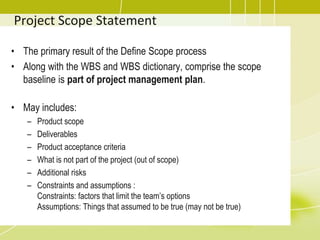
Project Scope Statement
• The primary result of the Define Scope process
• Along with the WBS and WBS dictionary, comprise the scope
baseline is part of project management plan.
• May includes:
– Product scope
– Deliverables
– Product acceptance criteria
– What is not part of the project (out of scope)
– Additional risks
– Constraints and assumptions :
Constraints: factors that limit the team’s options
Assumptions: Things that assumed to be true (may not be true)
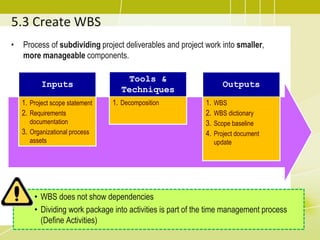
5.3 Create WBS
• Process of subdividing project deliverables and project work into smaller,
more manageable components.
Inputs
1. Project scope statement
2. Requirements
documentation
3. Organizational process
assets
Tools &
Techniques
1. Decomposition
Outputs
1. WBS
2. WBS dictionary
3. Scope baseline
4. Project document
update
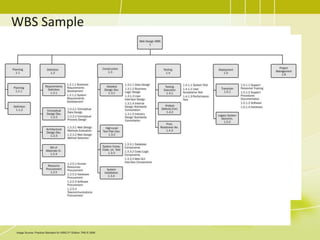
• WBS does not show dependencies
• Dividing work package into activities is part of the time management process
(Define Activities)
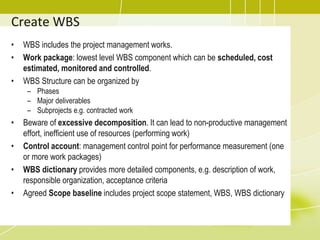
Create WBS
• WBS includes the project management works.
• Work package: lowest level WBS component which can be scheduled, cost
estimated, monitored and controlled.
• WBS Structure can be organized by
– Phases
– Major deliverables
– Subprojects e.g. contracted work
• Beware of excessive decomposition. It can lead to non-productive management
effort, inefficient use of resources (performing work)
• Control account: management control point for performance measurement (one
or more work packages)
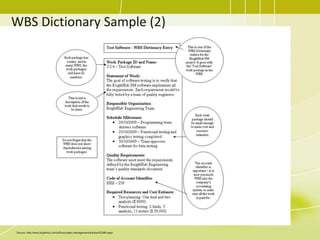
• WBS dictionary provides more detailed components, e.g. description of work,
responsible organization, acceptance criteria
• Agreed Scope baseline includes project scope statement, WBS, WBS dictionary
WBS Sample
Image Source: Practice Standard for WBS 2nd Edition. PMI © 2006
WBS
• 100% rule: WBS includes 100% of the work defined by project scope and
capture ALL deliverables (external, internal, interim) in term of work to be
completed including project management.
• WBS creation method:
– Top-Down
– Bottom up
– WBS Standard
– WBS Templates
• Don’t mind with WBS view
– Outline View
– Tabular View
– Tree structure view (vertical, horizontal, centralized)
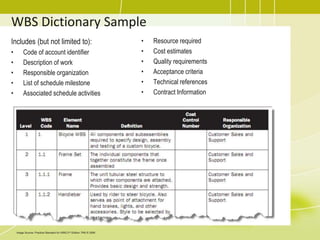
WBS Dictionary Sample
Includes (but not limited to):
• Code of account identifier
• Description of work
• Responsible organization
• List of schedule milestone
• Associated schedule activities
• Resource required
• Cost estimates
• Quality requirements
• Acceptance criteria
• Technical references
• Contract Information
Image Source: Practice Standard for WBS 2nd Edition. PMI © 2006
Source: http://www.brighthub.com/office/project-management/articles/52388.aspx
WBS Dictionary Sample (2)
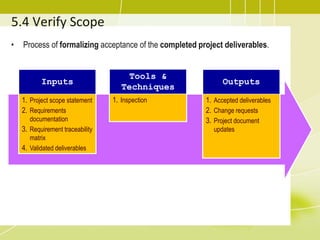
5.4 Verify Scope
• Process of formalizing acceptance of the completed project deliverables.
Inputs
1. Project scope statement
2. Requirements
documentation
3. Requirement traceability
matrix
4. Validated deliverables
Tools &
Techniques
1. Inspection
Outputs
1. Accepted deliverables
2. Change requests
3. Project document
updates
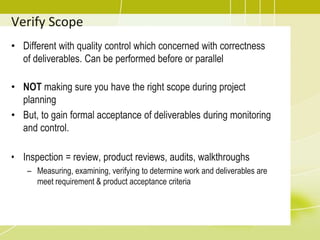
Verify Scope
• Different with quality control which concerned with correctness
of deliverables. Can be performed before or parallel
• NOT making sure you have the right scope during project
planning
• But, to gain formal acceptance of deliverables during monitoring
and control.
• Inspection = review, product reviews, audits, walkthroughs
– Measuring, examining, verifying to determine work and deliverables are
meet requirement & product acceptance criteria
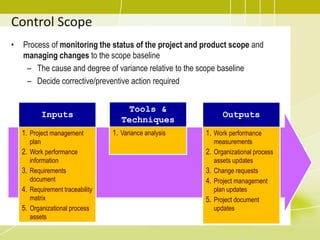
Control Scope
• Process of monitoring the status of the project and product scope and
managing changes to the scope baseline
– The cause and degree of variance relative to the scope baseline
– Decide corrective/preventive action required
Inputs
1. Project management
plan
2. Work performance
information
3. Requirements
document
4. Requirement traceability
matrix
5. Organizational process
assets
Tools &
Techniques
1. Variance analysis
Outputs
1. Work performance
measurements
2. Organizational process
assets updates
3. Change requests
4. Project management
plan updates
5. Project document
updates
Control Scope
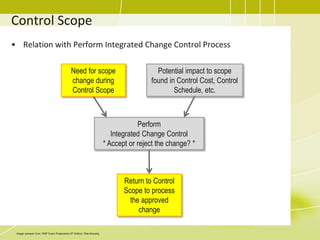
• Relation with Perform Integrated Change Control Process
Need for scope
change during
Control Scope
Potential impact to scope
found in Control Cost, Control
Schedule, etc.
Perform
Integrated Change Control
* Accept or reject the change? *
Return to Control
Scope to process
the approved
change
Image redrawn from: PMP Exam Preparation 6th Edition, Rita Mulcahy
Thank You
Next topic:
Project Time Management

04 projectintegrationmanagement

  • 1.
    5 - ProjectScope Management Project Management Training Created by ejlp12@gmail.com, June 2010
  • 2.
    Project Scope Management Knowledge Area Process InitiatingPlanning Executing Monitoring & Contol Closing Scope Collect Requirements Define Scope Create WBS Verify Scope Control Scope Enter phase/ Start project Exit phase/ End project Initiating Processes Closing Processes Planning Processes Executing Processes Monitoring & Controlling Processes
  • 3.
    Project Scope Management •Process to ensure that the project includes all-and-only the work required, to complete the project successfully • Scope can refer to Product Scope & Project Scope • Scope Management Plan (part of Develop Project Mgmt Plan) – How will I do the scope? – Provides guidance on how project scope will be defines, documented, verified, managed, and controlled by project management team • Don’t assume that requirements were determined before project began (not part of the project) • Attitude to say no to unnecessary scope. It should go to project approval process
  • 4.
    5.1 Collect Requirements •The process of defining and documenting stakeholders’ needs to meet the project objective – Balance stakeholder’s requirement: prioritizing requirement & resolve conflicts Inputs 1. Project charter 2. Stakeholder register Tools & Techniques 1. Interviews 2. Focus groups 3. Facilitated workshops 4. Group creativity techniques 5. Group decision making techniques 6. Questionnaires and surveys 7. Observations 8. Prototypes Outputs 1. Requirements document 2. Requirements management plan 3. Requirements traceability matrix
  • 5.
    Collect Requirement Techniques(1) • INTERVIEWS: Directly talk with stakeholders • FOCUS GROUPS: Interactive discussion with qualified Stakeholders & Subject matter experts • FACILITATED WORKSHOPS: Focused cross functional stakeholders. – JAD Joint application design, – QFD Quality function development Helps determine critical characteristic of new product development Start by collecting customer need - VOC: Voice of the Customers
  • 6.
    Collect Requirement Techniques(2) • GROUP CREATIVITY TECHNIQUES: – Brainstorming, – Nominal group technique: enhance brainstorming with voting and ranking – Delphi Technique: some expert answer questionnaire and give anonimity feedback – Idea/mind mapping, – Affinity Diagram: sort idea into groups • GROUP DECISION MAKING TECHNIQUES: – Unanimity, – Majority (>50%), – Plurality, – Dictatorship
  • 7.
    Affinity Diagram • Requirementsorted into groups by similarities – Easier to see additional scope (risk) that have not been identified Image Source: PMP Exam Preparation 6th Edition, Rita Mulcahy
  • 8.
    Collect Requirement Techniques(3) • QUESTIONNAIRE AND SURVEYS: wide number of respondents • OBSERVATION/JOB SHADOWING: viewing individual in their environment • PROTOTYPES: early feedback by providing a working model
  • 9.
    Balance Stakeholder’s Requirement •There is a need to balance stakeholder’s requirement • Some issue are so complex they cannot be resolved by PM alone • Facilitate the resolution of competing requirement, consider: • business case, • project charter, • project scope statement, • project constraints • What you can do: • Conflict resolution, team building, meeting, problem solving skills, escalation, approval from stakeholder • Stakeholder request to do or add something that is not related to the reason of project created should be rejected!
  • 10.
    Requirement Document • Outputof the Collect Requirement process • Helps make sure the requirements clear and unambiguous. • How will we know if the work we do will acceptability meet this requirement? • Rule of thumb – Specific (Unambiguous) – Measurable (How will we know we have finished?) – Achievable (Can we do it?) – Relevant (Is it the right thing to do?) – Timed (When will we do it?)
  • 11.
    5.2 Define Scope •Process of developing a detailed description of the project and product – Project scope statement may includes product scope, deliverables, product acceptance criteria, out of scope, additional risk, constraints & assumptions Inputs 1. Project charter 2. Requirements documentation 3. Organizational process assets Tools & Techniques 1. Expert judgment 2. Product analysis 3. Alternatives Identification 4. Facilitated workshops Outputs 1. Project scope statement 2. Project document updates
  • 12.
    Define Scope • Concernwith what is and is not included in the project and its deliverables • You should maintain a realistic schedule and budget that can achieve the project’s scope – Iteration process should be done to maintain it – Looking for options to adjust the project • Analyze the objective and description of the product stated by the customer/sponsor and turn them into tangible deliverables. • Project lifecycle term Product Analysis
  • 13.
    Project Scope Statement •The primary result of the Define Scope process • Along with the WBS and WBS dictionary, comprise the scope baseline is part of project management plan. • May includes: – Product scope – Deliverables – Product acceptance criteria – What is not part of the project (out of scope) – Additional risks – Constraints and assumptions : Constraints: factors that limit the team’s options Assumptions: Things that assumed to be true (may not be true)
  • 14.
    5.3 Create WBS •Process of subdividing project deliverables and project work into smaller, more manageable components. Inputs 1. Project scope statement 2. Requirements documentation 3. Organizational process assets Tools & Techniques 1. Decomposition Outputs 1. WBS 2. WBS dictionary 3. Scope baseline 4. Project document update • WBS does not show dependencies • Dividing work package into activities is part of the time management process (Define Activities)
  • 15.
    Create WBS • WBSincludes the project management works. • Work package: lowest level WBS component which can be scheduled, cost estimated, monitored and controlled. • WBS Structure can be organized by – Phases – Major deliverables – Subprojects e.g. contracted work • Beware of excessive decomposition. It can lead to non-productive management effort, inefficient use of resources (performing work) • Control account: management control point for performance measurement (one or more work packages) • WBS dictionary provides more detailed components, e.g. description of work, responsible organization, acceptance criteria • Agreed Scope baseline includes project scope statement, WBS, WBS dictionary
  • 16.
    WBS Sample Image Source:Practice Standard for WBS 2nd Edition. PMI © 2006
  • 17.
    WBS • 100% rule:WBS includes 100% of the work defined by project scope and capture ALL deliverables (external, internal, interim) in term of work to be completed including project management. • WBS creation method: – Top-Down – Bottom up – WBS Standard – WBS Templates • Don’t mind with WBS view – Outline View – Tabular View – Tree structure view (vertical, horizontal, centralized)
  • 18.
    WBS Dictionary Sample Includes(but not limited to): • Code of account identifier • Description of work • Responsible organization • List of schedule milestone • Associated schedule activities • Resource required • Cost estimates • Quality requirements • Acceptance criteria • Technical references • Contract Information Image Source: Practice Standard for WBS 2nd Edition. PMI © 2006
  • 19.
  • 20.
    5.4 Verify Scope •Process of formalizing acceptance of the completed project deliverables. Inputs 1. Project scope statement 2. Requirements documentation 3. Requirement traceability matrix 4. Validated deliverables Tools & Techniques 1. Inspection Outputs 1. Accepted deliverables 2. Change requests 3. Project document updates
  • 21.
    Verify Scope • Differentwith quality control which concerned with correctness of deliverables. Can be performed before or parallel • NOT making sure you have the right scope during project planning • But, to gain formal acceptance of deliverables during monitoring and control. • Inspection = review, product reviews, audits, walkthroughs – Measuring, examining, verifying to determine work and deliverables are meet requirement & product acceptance criteria
  • 22.
    Control Scope • Processof monitoring the status of the project and product scope and managing changes to the scope baseline – The cause and degree of variance relative to the scope baseline – Decide corrective/preventive action required Inputs 1. Project management plan 2. Work performance information 3. Requirements document 4. Requirement traceability matrix 5. Organizational process assets Tools & Techniques 1. Variance analysis Outputs 1. Work performance measurements 2. Organizational process assets updates 3. Change requests 4. Project management plan updates 5. Project document updates
  • 23.
    Control Scope • Relationwith Perform Integrated Change Control Process Need for scope change during Control Scope Potential impact to scope found in Control Cost, Control Schedule, etc. Perform Integrated Change Control * Accept or reject the change? * Return to Control Scope to process the approved change Image redrawn from: PMP Exam Preparation 6th Edition, Rita Mulcahy
  • 24.