Introduction to Project Management
2
2
1. What is Project Management
4Objectives
4
To set goals and expectations
To reduce project complexity and risks
To manage resources efficiently
To communicate with all stakeholders
To ensure business value and benefits are achieved
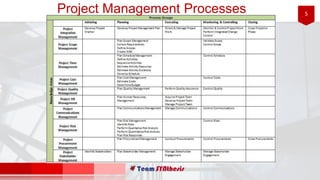
5Project Management
What is a Project?
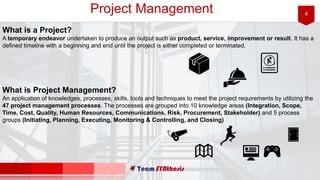
A temporary endeavor undertaken to produce an output such as product, service, improvement or result. It has a
defined timeline with a beginning and end until the project is either completed or terminated.
What is Project Management?
An application of knowledges, processes, skills, tools and techniques to meet the project requirements by utilizing the
47 project management processes. The processes are grouped into 10 knowledge areas (Integration, Scope,
Time, Cost, Quality, Human Resources, Communications, Risk, Procurement, Stakeholder) and 5 process
groups (Initiating, Planning, Executing, Monitoring & Controlling, and Closing)
6Project Management Processes
75 Process Groups
10KnowledgeAreas
49Processes
2. What is the Project Management Body
9Project, Program, Portfolio Management
9
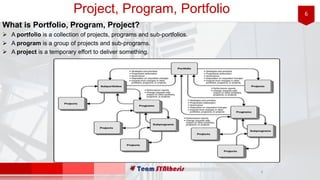
What is Portfolio, Program, Project?
 A portfolio is a collection of projects, programs and sub-portfolios.
 A program is a group of projects and sub-programs.
 A project is a temporary effort to deliver something.
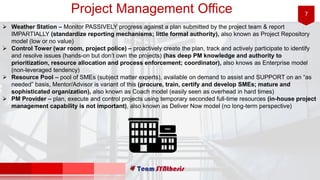
10Project Management Office (PMO)
 Weather Station – Monitor PASSIVELY progress against a plan submitted by the project team & report
IMPARTIALLY (standardize reporting mechanisms; little formal authority), also known as Project Repository
model (low or no value)
 Control Tower (war room, project police) – proactively create the plan, track and actively participate to identify
and resolve issues (hands-on but don’t own the projects) (has deep PM knowledge and authority to
prioritization, resource allocation and process enforcement; coordinator), also knows as Enterprise model
(non-leveraged tendency)
 Resource Pool – pool of SMEs (subject matter experts), available on demand to assist and SUPPORT on an “as
needed” basis, Mentor/Advisor is variant of this (procure, train, certify and develop SMEs; mature and
sophisticated organization), also known as Coach model (easily seen as overhead in hard times)
 PM Provider – plan, execute and control projects using temporary seconded full-time resources (in-house project
management capability is not important), also known as Deliver Now model (no long-term perspective)
PMO
3. How to Enable Business Outcome
12Project Outcome (Business Value)
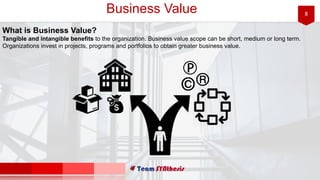
What is Business Value?
Tangible and intangible benefits to the organization. Business value scope can be short, medium or long term.
Organizations invest in projects, programs and portfolios to obtain greater business value.
13
"Project stakeholders are individuals and organizations who are actively involved to
meet the business outcome, or whose interests may be positively or negatively
affected as a result of project execution or successful project completion."
Key Project Stakeholders
14Project Management Plan
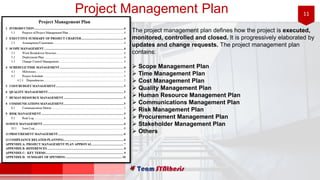
The project management plan defines how the project is executed,
monitored, controlled and closed. It is progressively elaborated by
updates and change requests. The project management plan
contains:
 Scope Management Plan
 Time Management Plan
 Cost Management Plan
 Quality Management Plan
 Human Resource Management Plan
 Communications Management Plan
 Risk Management Plan
 Procurement Management Plan
 Stakeholder Management Plan
 Others
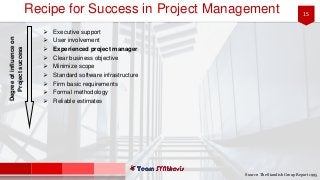
15
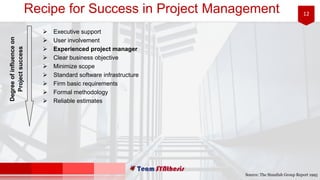
 Executive support
 User involvement
 Experienced project manager
 Clear business objective
 Minimize scope
 Standard software infrastructure
 Firm basic requirements
 Formal methodology
 Reliable estimates
Source: The Standish Group Report 1995
Degreeofinfluenceon
Projectsuccess
Recipe for Success in Project Management
16

Introduction to PM

  • 1.
  • 2.
  • 3.
    1. What isProject Management
  • 4.
    4Objectives 4 To set goalsand expectations To reduce project complexity and risks To manage resources efficiently To communicate with all stakeholders To ensure business value and benefits are achieved
  • 5.
    5Project Management What isa Project? A temporary endeavor undertaken to produce an output such as product, service, improvement or result. It has a defined timeline with a beginning and end until the project is either completed or terminated. What is Project Management? An application of knowledges, processes, skills, tools and techniques to meet the project requirements by utilizing the 47 project management processes. The processes are grouped into 10 knowledge areas (Integration, Scope, Time, Cost, Quality, Human Resources, Communications, Risk, Procurement, Stakeholder) and 5 process groups (Initiating, Planning, Executing, Monitoring & Controlling, and Closing)
  • 6.
  • 7.
  • 8.
    2. What isthe Project Management Body
  • 9.
    9Project, Program, PortfolioManagement 9 What is Portfolio, Program, Project?  A portfolio is a collection of projects, programs and sub-portfolios.  A program is a group of projects and sub-programs.  A project is a temporary effort to deliver something.
  • 10.
    10Project Management Office(PMO)  Weather Station – Monitor PASSIVELY progress against a plan submitted by the project team & report IMPARTIALLY (standardize reporting mechanisms; little formal authority), also known as Project Repository model (low or no value)  Control Tower (war room, project police) – proactively create the plan, track and actively participate to identify and resolve issues (hands-on but don’t own the projects) (has deep PM knowledge and authority to prioritization, resource allocation and process enforcement; coordinator), also knows as Enterprise model (non-leveraged tendency)  Resource Pool – pool of SMEs (subject matter experts), available on demand to assist and SUPPORT on an “as needed” basis, Mentor/Advisor is variant of this (procure, train, certify and develop SMEs; mature and sophisticated organization), also known as Coach model (easily seen as overhead in hard times)  PM Provider – plan, execute and control projects using temporary seconded full-time resources (in-house project management capability is not important), also known as Deliver Now model (no long-term perspective) PMO
  • 11.
    3. How toEnable Business Outcome
  • 12.
    12Project Outcome (BusinessValue) What is Business Value? Tangible and intangible benefits to the organization. Business value scope can be short, medium or long term. Organizations invest in projects, programs and portfolios to obtain greater business value.
  • 13.
    13 "Project stakeholders areindividuals and organizations who are actively involved to meet the business outcome, or whose interests may be positively or negatively affected as a result of project execution or successful project completion." Key Project Stakeholders
  • 14.
    14Project Management Plan Theproject management plan defines how the project is executed, monitored, controlled and closed. It is progressively elaborated by updates and change requests. The project management plan contains:  Scope Management Plan  Time Management Plan  Cost Management Plan  Quality Management Plan  Human Resource Management Plan  Communications Management Plan  Risk Management Plan  Procurement Management Plan  Stakeholder Management Plan  Others
  • 15.
    15  Executive support User involvement  Experienced project manager  Clear business objective  Minimize scope  Standard software infrastructure  Firm basic requirements  Formal methodology  Reliable estimates Source: The Standish Group Report 1995 Degreeofinfluenceon Projectsuccess Recipe for Success in Project Management
  • 16.