
Project Management Body of
Knowledge® Guide (Integration)5th Edition
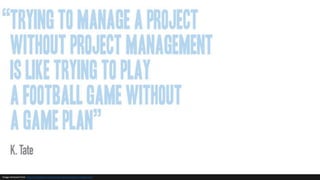
Image retrieved from http://quotesgram.com/quotes-about-project-management/
3
PMBOK Guide® (Integration)
Project Integration Management is an overall management of project by defining,
unifying, consolidating, communicating and coordinating the project processes. It is crucial to be
able to make resource allocation decisions so that the requirements and expectations are met. This
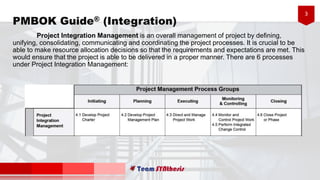
would ensure that the project is able to be delivered in a proper manner. There are 6 processes
under Project Integration Management:
4
PMBOK Guide® (Integration)
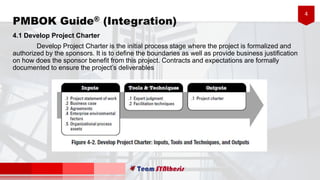
4.1 Develop Project Charter
Develop Project Charter is the initial process stage where the project is formalized and
authorized by the sponsors. It is to define the boundaries as well as provide business justification
on how does the sponsor benefit from this project. Contracts and expectations are formally
documented to ensure the project’s deliverables
5
PMBOK Guide® (Integration)
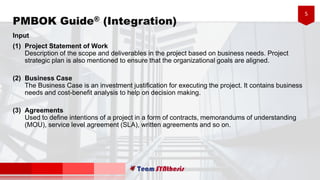
Input
(1) Project Statement of Work
Description of the scope and deliverables in the project based on business needs. Project
strategic plan is also mentioned to ensure that the organizational goals are aligned.
(2) Business Case
The Business Case is an investment justification for executing the project. It contains business
needs and cost-benefit analysis to help on decision making.
(3) Agreements
Used to define intentions of a project in a form of contracts, memorandums of understanding
(MOU), service level agreement (SLA), written agreements and so on.
6
PMBOK Guide® (Integration)
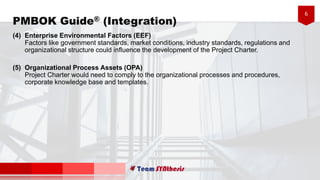
(4) Enterprise Environmental Factors (EEF)
Factors like government standards, market conditions, industry standards, regulations and
organizational structure could influence the development of the Project Charter.
(5) Organizational Process Assets (OPA)
Project Charter would need to comply to the organizational processes and procedures,
corporate knowledge base and templates.
7
PMBOK Guide® (Integration)
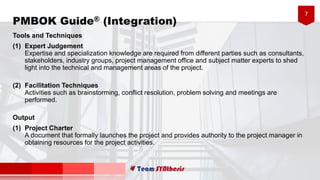
Tools and Techniques
(1) Expert Judgement
Expertise and specialization knowledge are required from different parties such as consultants,
stakeholders, industry groups, project management office and subject matter experts to shed
light into the technical and management areas of the project.
(2) Facilitation Techniques
Activities such as brainstorming, conflict resolution, problem solving and meetings are
performed.
Output
(1) Project Charter
A document that formally launches the project and provides authority to the project manager in
obtaining resources for the project activities.
8
PMBOK Guide® (Integration)
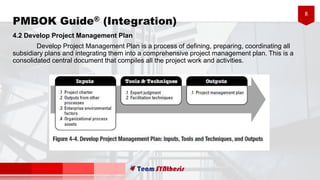
4.2 Develop Project Management Plan
Develop Project Management Plan is a process of defining, preparing, coordinating all
subsidiary plans and integrating them into a comprehensive project management plan. This is a
consolidated central document that compiles all the project work and activities.
9
PMBOK Guide® (Integration)
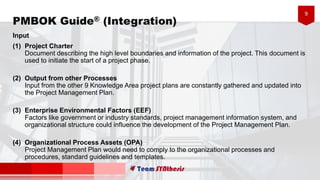
Input
(1) Project Charter
Document describing the high level boundaries and information of the project. This document is
used to initiate the start of a project phase.
(2) Output from other Processes
Input from the other 9 Knowledge Area project plans are constantly gathered and updated into
the Project Management Plan.
(3) Enterprise Environmental Factors (EEF)
Factors like government or industry standards, project management information system, and
organizational structure could influence the development of the Project Management Plan.
(4) Organizational Process Assets (OPA)
Project Management Plan would need to comply to the organizational processes and
procedures, standard guidelines and templates.
10
PMBOK Guide® (Integration)
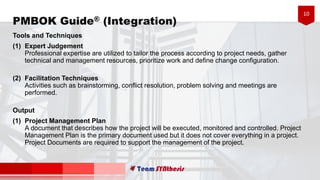
Tools and Techniques
(1) Expert Judgement
Professional expertise are utilized to tailor the process according to project needs, gather
technical and management resources, prioritize work and define change configuration.
(2) Facilitation Techniques
Activities such as brainstorming, conflict resolution, problem solving and meetings are
performed.
Output
(1) Project Management Plan
A document that describes how the project will be executed, monitored and controlled. Project
Management Plan is the primary document used but it does not cover everything in a project.
Project Documents are required to support the management of the project.
11
PMBOK Guide® (Integration)
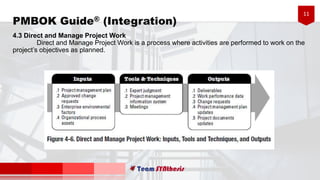
4.3 Direct and Manage Project Work
Direct and Manage Project Work is a process where activities are performed to work on the
project’s objectives as planned.
12
PMBOK Guide® (Integration)
Input
(1) Project Management Plan
A document containing the subsidiary plans related to the project work.
(2) Approved Change Requests
Output from the Perform Integrated Change Control process which includes reviewed and
approved requests from the Change Control Board (CCB).
(3) Enterprise Environmental Factors (EEF)
Factors like infrastructure, personnel administration, stakeholder risk tolerances, project
management information system and organizational structure could influence the project work.
(4) Organizational Process Assets (OPA)
Project Management Plan would need to comply to the organizational processes and
procedures, issue and defect management, standard guidelines, templates and communication
requirements.
13
PMBOK Guide® (Integration)
Tools and Techniques
(1) Expert Judgement
Technical and management expertise are needed to direct and manage the project. Such
expertise are applied to all processes throughout the entire project phase.
(2) Project Management Information System
Project Management Information System (PMIS) provides tools and utilities such as scheduling
tool, work authorization system, configuration management system, information collection and
distribution system or other automated systems.
(3) Meetings
Meetings are held to discuss and address work items by exchanging information,
brainstorming, evaluating options or making decisions. Meeting minutes and action items
should be properly recorded and kept in the project management plan.
14
PMBOK Guide® (Integration)
Output
(1) Deliverables
A verified end result produced to meet requirements of a project.
(2) Work Performance Data
Raw measurements or observations collected when carrying out the project work. Examples of
data includes key performance indicators, schedule dates, number of defects and so on.
(3) Change Requests
A proposal to modify any document, deliverable or baseline. There are 3 types of change
requests: (1) Corrective action; (2) Preventive action; (3) Defect repair
(4) Project Management Plan Updates
(5) Project Documents Updates
15
PMBOK Guide® (Integration)
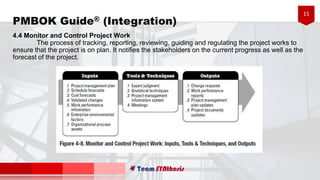
4.4 Monitor and Control Project Work
The process of tracking, reporting, reviewing, guiding and regulating the project works to
ensure that the project is on plan. It notifies the stakeholders on the current progress as well as the
forecast of the project.
16
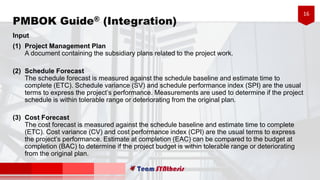
PMBOK Guide® (Integration)
Input
(1) Project Management Plan
A document containing the subsidiary plans related to the project work.
(2) Schedule Forecast
The schedule forecast is measured against the schedule baseline and estimate time to
complete (ETC). Schedule variance (SV) and schedule performance index (SPI) are the usual
terms to express the project’s performance. Measurements are used to determine if the project
schedule is within tolerable range or deteriorating from the original plan.
(3) Cost Forecast
The cost forecast is measured against the schedule baseline and estimate time to complete
(ETC). Cost variance (CV) and cost performance index (CPI) are the usual terms to express
the project’s performance. Estimate at completion (EAC) can be compared to the budget at
completion (BAC) to determine if the project budget is within tolerable range or deteriorating
from the original plan.
17
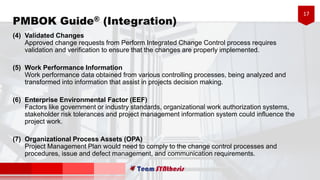
PMBOK Guide® (Integration)
(4) Validated Changes
Approved change requests from Perform Integrated Change Control process requires
validation and verification to ensure that the changes are properly implemented.
(5) Work Performance Information
Work performance data obtained from various controlling processes, being analyzed and
transformed into information that assist in projects decision making.
(6) Enterprise Environmental Factor (EEF)
Factors like government or industry standards, organizational work authorization systems,
stakeholder risk tolerances and project management information system could influence the
project work.
(7) Organizational Process Assets (OPA)
Project Management Plan would need to comply to the change control processes and
procedures, issue and defect management, and communication requirements.
18
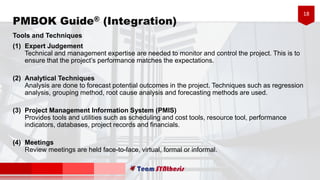
PMBOK Guide® (Integration)
Tools and Techniques
(1) Expert Judgement
Technical and management expertise are needed to monitor and control the project. This is to
ensure that the project’s performance matches the expectations.
(2) Analytical Techniques
Analysis are done to forecast potential outcomes in the project. Techniques such as regression
analysis, grouping method, root cause analysis and forecasting methods are used.
(3) Project Management Information System (PMIS)
Provides tools and utilities such as scheduling and cost tools, resource tool, performance
indicators, databases, project records and financials.
(4) Meetings
Review meetings are held face-to-face, virtual, formal or informal.
19
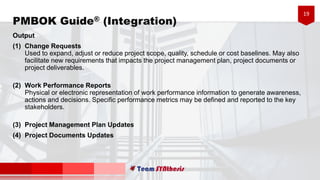
PMBOK Guide® (Integration)
Output
(1) Change Requests
Used to expand, adjust or reduce project scope, quality, schedule or cost baselines. May also
facilitate new requirements that impacts the project management plan, project documents or
project deliverables.
(2) Work Performance Reports
Physical or electronic representation of work performance information to generate awareness,
actions and decisions. Specific performance metrics may be defined and reported to the key
stakeholders.
(3) Project Management Plan Updates
(4) Project Documents Updates
20
PMBOK Guide® (Integration)
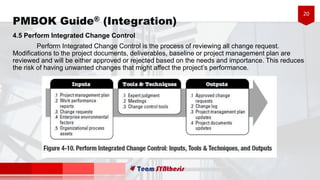
4.5 Perform Integrated Change Control
Perform Integrated Change Control is the process of reviewing all change request.
Modifications to the project documents, deliverables, baseline or project management plan are
reviewed and will be either approved or rejected based on the needs and importance. This reduces
the risk of having unwanted changes that might affect the project’s performance.
21
PMBOK Guide® (Integration)
Input
(1) Project Management Plan
A document containing the subsidiary plans related to the project work.
(2) Work Performance Reports
Reports such as resource availability, schedule and cost data, earned value management
(EVM) reports and burnup or burndown charts will be reviewed in this process.
(3) Change Requests
Change requests produced from the Executing, Monitoring and Controlling processes are taken
in for review. Types of change requests would include corrective action, preventive action and
defect repairs.
22
PMBOK Guide® (Integration)
(4) Enterprise Environmental Factor (EEF)
The Project Management Information System (PMIS) tools such as scheduling tool,
configuration management system, information and distribution system and automated systems
are factors that influences the enterprise environmental factor (EEF).
(5) Organizational Process Assets (OPA)
Project Management Plan would need to comply to the change control processes and
procedures, process management database, project documents, and configuration
management knowledge base.
23
PMBOK Guide® (Integration)
Tools and Techniques
(1) Expert Judgement
Expert panels are required to attend for the Change Control Board (CCB) to provide their
judgement and knowledge in regards to the change requests.
(2) Meetings
The Change Control Board (CCB) is responsible to host the meeting to review, approve or
reject all change requests. Meetings should be documented and communicated to the
stakeholders for information and follow-up actions.
(3) Change Control Tools
Manual or automated tools are used to facilitate the configuration and change management.
Tools are used for recording the change requests and resulting decisions.
24
PMBOK Guide® (Integration)
Output
(1) Approved Change Request
Process through the change control system, approved change requests are implemented
through the Direct and Manage Project Work process. All change requests, approved or
rejected, are recorded under the change log as part of the updates to the project documents.
(2) Change Log
A change log to record all actions performed on change requests. The impact and decisions of
all change request are communicated to the stakeholders.
(3) Project Management Plan Updates
(4) Project Documents Updates
25
PMBOK Guide® (Integration)
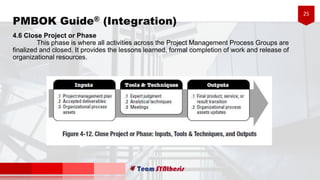
4.6 Close Project or Phase
This phase is where all activities across the Project Management Process Groups are
finalized and closed. It provides the lessons learned, formal completion of work and release of
organizational resources.
26
PMBOK Guide® (Integration)
Input
(1) Project Management Plan
A document containing the subsidiary plans related to the project work.
(2) Accepted Deliverables
Approved product specifications, delivery receipts or work performance documents. Partial or
interim deliverables may be accepted as well for phased or cancelled projects.
(3) Organizational Process Assets (OPA)
Project Management Plan would need to follow the project or phase closure guidelines or
requirements and also historical information and lessons learned knowledge base.
27
PMBOK Guide® (Integration)
Tools and Techniques
(1) Expert Judgement
Professional experts, project manager and project management office may be required to
ensure that the project or phase is closed according to proper standards.
(2) Analytical Techniques
Regression analysis and trend analysis are used to perform further insights on the project.
(3) Meetings
Types of meeting include lessons learned, closeout, user group and review meetings are
conducted either face-to-face, virtual, formal or informal.
28
PMBOK Guide® (Integration)
Output
(1) Final Product, Service or Result Transition
Authorized final product, service or result transition that was initiated by the project. Verification
and validation is required to be done before authorizing the output.
(2) Organizational Process Assets (OPA) Updates
Organizational Process Assets documents such as project files, project or phase closure
documents and historical information need to be updated.
Image retrieved from http://stockfresh.com/image/5091553/a-goal-without-a-plan-is-just-a-wish
Antoine de Saint-Exupry
30References
01 Project Management Institute (2013), A Guide to the Project Management
Body of Knowledge (PMBOK ® Guide) - 5th Edition

Project Management Body of Knowledge (Integration)

  • 1.
    Project Management Bodyof Knowledge® Guide (Integration)5th Edition
  • 2.
    Image retrieved fromhttp://quotesgram.com/quotes-about-project-management/
  • 3.
    3 PMBOK Guide® (Integration) ProjectIntegration Management is an overall management of project by defining, unifying, consolidating, communicating and coordinating the project processes. It is crucial to be able to make resource allocation decisions so that the requirements and expectations are met. This would ensure that the project is able to be delivered in a proper manner. There are 6 processes under Project Integration Management:
  • 4.
    4 PMBOK Guide® (Integration) 4.1Develop Project Charter Develop Project Charter is the initial process stage where the project is formalized and authorized by the sponsors. It is to define the boundaries as well as provide business justification on how does the sponsor benefit from this project. Contracts and expectations are formally documented to ensure the project’s deliverables
  • 5.
    5 PMBOK Guide® (Integration) Input (1)Project Statement of Work Description of the scope and deliverables in the project based on business needs. Project strategic plan is also mentioned to ensure that the organizational goals are aligned. (2) Business Case The Business Case is an investment justification for executing the project. It contains business needs and cost-benefit analysis to help on decision making. (3) Agreements Used to define intentions of a project in a form of contracts, memorandums of understanding (MOU), service level agreement (SLA), written agreements and so on.
  • 6.
    6 PMBOK Guide® (Integration) (4)Enterprise Environmental Factors (EEF) Factors like government standards, market conditions, industry standards, regulations and organizational structure could influence the development of the Project Charter. (5) Organizational Process Assets (OPA) Project Charter would need to comply to the organizational processes and procedures, corporate knowledge base and templates.
  • 7.
    7 PMBOK Guide® (Integration) Toolsand Techniques (1) Expert Judgement Expertise and specialization knowledge are required from different parties such as consultants, stakeholders, industry groups, project management office and subject matter experts to shed light into the technical and management areas of the project. (2) Facilitation Techniques Activities such as brainstorming, conflict resolution, problem solving and meetings are performed. Output (1) Project Charter A document that formally launches the project and provides authority to the project manager in obtaining resources for the project activities.
  • 8.
    8 PMBOK Guide® (Integration) 4.2Develop Project Management Plan Develop Project Management Plan is a process of defining, preparing, coordinating all subsidiary plans and integrating them into a comprehensive project management plan. This is a consolidated central document that compiles all the project work and activities.
  • 9.
    9 PMBOK Guide® (Integration) Input (1)Project Charter Document describing the high level boundaries and information of the project. This document is used to initiate the start of a project phase. (2) Output from other Processes Input from the other 9 Knowledge Area project plans are constantly gathered and updated into the Project Management Plan. (3) Enterprise Environmental Factors (EEF) Factors like government or industry standards, project management information system, and organizational structure could influence the development of the Project Management Plan. (4) Organizational Process Assets (OPA) Project Management Plan would need to comply to the organizational processes and procedures, standard guidelines and templates.
  • 10.
    10 PMBOK Guide® (Integration) Toolsand Techniques (1) Expert Judgement Professional expertise are utilized to tailor the process according to project needs, gather technical and management resources, prioritize work and define change configuration. (2) Facilitation Techniques Activities such as brainstorming, conflict resolution, problem solving and meetings are performed. Output (1) Project Management Plan A document that describes how the project will be executed, monitored and controlled. Project Management Plan is the primary document used but it does not cover everything in a project. Project Documents are required to support the management of the project.
  • 11.
    11 PMBOK Guide® (Integration) 4.3Direct and Manage Project Work Direct and Manage Project Work is a process where activities are performed to work on the project’s objectives as planned.
  • 12.
    12 PMBOK Guide® (Integration) Input (1)Project Management Plan A document containing the subsidiary plans related to the project work. (2) Approved Change Requests Output from the Perform Integrated Change Control process which includes reviewed and approved requests from the Change Control Board (CCB). (3) Enterprise Environmental Factors (EEF) Factors like infrastructure, personnel administration, stakeholder risk tolerances, project management information system and organizational structure could influence the project work. (4) Organizational Process Assets (OPA) Project Management Plan would need to comply to the organizational processes and procedures, issue and defect management, standard guidelines, templates and communication requirements.
  • 13.
    13 PMBOK Guide® (Integration) Toolsand Techniques (1) Expert Judgement Technical and management expertise are needed to direct and manage the project. Such expertise are applied to all processes throughout the entire project phase. (2) Project Management Information System Project Management Information System (PMIS) provides tools and utilities such as scheduling tool, work authorization system, configuration management system, information collection and distribution system or other automated systems. (3) Meetings Meetings are held to discuss and address work items by exchanging information, brainstorming, evaluating options or making decisions. Meeting minutes and action items should be properly recorded and kept in the project management plan.
  • 14.
    14 PMBOK Guide® (Integration) Output (1)Deliverables A verified end result produced to meet requirements of a project. (2) Work Performance Data Raw measurements or observations collected when carrying out the project work. Examples of data includes key performance indicators, schedule dates, number of defects and so on. (3) Change Requests A proposal to modify any document, deliverable or baseline. There are 3 types of change requests: (1) Corrective action; (2) Preventive action; (3) Defect repair (4) Project Management Plan Updates (5) Project Documents Updates
  • 15.
    15 PMBOK Guide® (Integration) 4.4Monitor and Control Project Work The process of tracking, reporting, reviewing, guiding and regulating the project works to ensure that the project is on plan. It notifies the stakeholders on the current progress as well as the forecast of the project.
  • 16.
    16 PMBOK Guide® (Integration) Input (1)Project Management Plan A document containing the subsidiary plans related to the project work. (2) Schedule Forecast The schedule forecast is measured against the schedule baseline and estimate time to complete (ETC). Schedule variance (SV) and schedule performance index (SPI) are the usual terms to express the project’s performance. Measurements are used to determine if the project schedule is within tolerable range or deteriorating from the original plan. (3) Cost Forecast The cost forecast is measured against the schedule baseline and estimate time to complete (ETC). Cost variance (CV) and cost performance index (CPI) are the usual terms to express the project’s performance. Estimate at completion (EAC) can be compared to the budget at completion (BAC) to determine if the project budget is within tolerable range or deteriorating from the original plan.
  • 17.
    17 PMBOK Guide® (Integration) (4)Validated Changes Approved change requests from Perform Integrated Change Control process requires validation and verification to ensure that the changes are properly implemented. (5) Work Performance Information Work performance data obtained from various controlling processes, being analyzed and transformed into information that assist in projects decision making. (6) Enterprise Environmental Factor (EEF) Factors like government or industry standards, organizational work authorization systems, stakeholder risk tolerances and project management information system could influence the project work. (7) Organizational Process Assets (OPA) Project Management Plan would need to comply to the change control processes and procedures, issue and defect management, and communication requirements.
  • 18.
    18 PMBOK Guide® (Integration) Toolsand Techniques (1) Expert Judgement Technical and management expertise are needed to monitor and control the project. This is to ensure that the project’s performance matches the expectations. (2) Analytical Techniques Analysis are done to forecast potential outcomes in the project. Techniques such as regression analysis, grouping method, root cause analysis and forecasting methods are used. (3) Project Management Information System (PMIS) Provides tools and utilities such as scheduling and cost tools, resource tool, performance indicators, databases, project records and financials. (4) Meetings Review meetings are held face-to-face, virtual, formal or informal.
  • 19.
    19 PMBOK Guide® (Integration) Output (1)Change Requests Used to expand, adjust or reduce project scope, quality, schedule or cost baselines. May also facilitate new requirements that impacts the project management plan, project documents or project deliverables. (2) Work Performance Reports Physical or electronic representation of work performance information to generate awareness, actions and decisions. Specific performance metrics may be defined and reported to the key stakeholders. (3) Project Management Plan Updates (4) Project Documents Updates
  • 20.
    20 PMBOK Guide® (Integration) 4.5Perform Integrated Change Control Perform Integrated Change Control is the process of reviewing all change request. Modifications to the project documents, deliverables, baseline or project management plan are reviewed and will be either approved or rejected based on the needs and importance. This reduces the risk of having unwanted changes that might affect the project’s performance.
  • 21.
    21 PMBOK Guide® (Integration) Input (1)Project Management Plan A document containing the subsidiary plans related to the project work. (2) Work Performance Reports Reports such as resource availability, schedule and cost data, earned value management (EVM) reports and burnup or burndown charts will be reviewed in this process. (3) Change Requests Change requests produced from the Executing, Monitoring and Controlling processes are taken in for review. Types of change requests would include corrective action, preventive action and defect repairs.
  • 22.
    22 PMBOK Guide® (Integration) (4)Enterprise Environmental Factor (EEF) The Project Management Information System (PMIS) tools such as scheduling tool, configuration management system, information and distribution system and automated systems are factors that influences the enterprise environmental factor (EEF). (5) Organizational Process Assets (OPA) Project Management Plan would need to comply to the change control processes and procedures, process management database, project documents, and configuration management knowledge base.
  • 23.
    23 PMBOK Guide® (Integration) Toolsand Techniques (1) Expert Judgement Expert panels are required to attend for the Change Control Board (CCB) to provide their judgement and knowledge in regards to the change requests. (2) Meetings The Change Control Board (CCB) is responsible to host the meeting to review, approve or reject all change requests. Meetings should be documented and communicated to the stakeholders for information and follow-up actions. (3) Change Control Tools Manual or automated tools are used to facilitate the configuration and change management. Tools are used for recording the change requests and resulting decisions.
  • 24.
    24 PMBOK Guide® (Integration) Output (1)Approved Change Request Process through the change control system, approved change requests are implemented through the Direct and Manage Project Work process. All change requests, approved or rejected, are recorded under the change log as part of the updates to the project documents. (2) Change Log A change log to record all actions performed on change requests. The impact and decisions of all change request are communicated to the stakeholders. (3) Project Management Plan Updates (4) Project Documents Updates
  • 25.
    25 PMBOK Guide® (Integration) 4.6Close Project or Phase This phase is where all activities across the Project Management Process Groups are finalized and closed. It provides the lessons learned, formal completion of work and release of organizational resources.
  • 26.
    26 PMBOK Guide® (Integration) Input (1)Project Management Plan A document containing the subsidiary plans related to the project work. (2) Accepted Deliverables Approved product specifications, delivery receipts or work performance documents. Partial or interim deliverables may be accepted as well for phased or cancelled projects. (3) Organizational Process Assets (OPA) Project Management Plan would need to follow the project or phase closure guidelines or requirements and also historical information and lessons learned knowledge base.
  • 27.
    27 PMBOK Guide® (Integration) Toolsand Techniques (1) Expert Judgement Professional experts, project manager and project management office may be required to ensure that the project or phase is closed according to proper standards. (2) Analytical Techniques Regression analysis and trend analysis are used to perform further insights on the project. (3) Meetings Types of meeting include lessons learned, closeout, user group and review meetings are conducted either face-to-face, virtual, formal or informal.
  • 28.
    28 PMBOK Guide® (Integration) Output (1)Final Product, Service or Result Transition Authorized final product, service or result transition that was initiated by the project. Verification and validation is required to be done before authorizing the output. (2) Organizational Process Assets (OPA) Updates Organizational Process Assets documents such as project files, project or phase closure documents and historical information need to be updated.
  • 29.
    Image retrieved fromhttp://stockfresh.com/image/5091553/a-goal-without-a-plan-is-just-a-wish Antoine de Saint-Exupry
  • 30.
    30References 01 Project ManagementInstitute (2013), A Guide to the Project Management Body of Knowledge (PMBOK ® Guide) - 5th Edition