Project Scope Management
Dr. Huy Nguyen
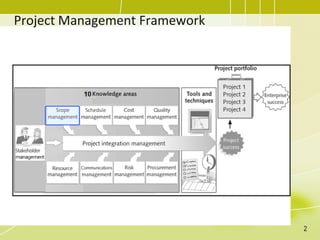
Project Management Framework
2
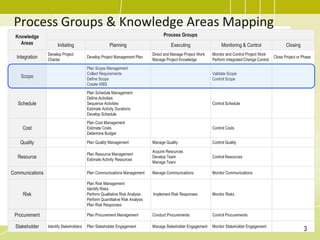
Process Groups & Knowledge Areas Mapping
Knowledge
Areas
Process Groups
Initiating Planning Executing Monitoring & Control Closing
Integration
Develop Project
Charter
Develop Project Management Plan
Direct and Manage Project Work
Manage Project Knowledge
Monitor and Control Project Work
Perform Integrated Change Control
Close Project or Phase
Scope
Plan Scope Management
Collect Requirements
Define Scope
Create WBS
Validate Scope
Control Scope
Schedule
Plan Schedule Management
Define Activities
Sequence Activities
Estimate Activity Durations
Develop Schedule
Control Schedule
Cost
Plan Cost Management
Estimate Costs
Determine Budget
Control Costs
Quality Plan Quality Management Manage Quality Control Quality
Resource
Plan Resource Management
Estimate Activity Resources
Acquire Resources
Develop Team
Manage Team
Control Resources
Communications Plan Communications Management Manage Communications Monitor Communications
Risk
Plan Risk Management
Identify Risks
Perform Qualitative Risk Analysis
Perform Quantitative Risk Analysis
Plan Risk Responses
Implement Risk Responses Monitor Risks
Procurement Plan Procurement Management Conduct Procurements Control Procurements
Stakeholder Identify Stakeholders Plan Stakeholder Engagement Manage Stakeholder Engagement Monitor Stakeholder Engagement
3
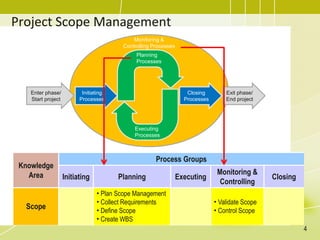
Project Scope Management
Knowledge
Area
Process Groups
Initiating Planning Executing
Monitoring &
Controlling
Closing
Scope
• Plan Scope Management
• Collect Requirements
• Define Scope
• Create WBS
• Validate Scope
• Control Scope
Enter phase/
Start project
Exit phase/
End project
Initiating
Processes
Closing
Processes
Planning
Processes
Executing
Processes
Monitoring &
Controlling Processes
4
Project Scope Management
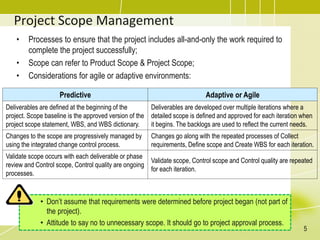
• Processes to ensure that the project includes all-and-only the work required to
complete the project successfully;
• Scope can refer to Product Scope & Project Scope;
• Considerations for agile or adaptive environments:
• Don’t assume that requirements were determined before project began (not part of
the project).
• Attitude to say no to unnecessary scope. It should go to project approval process.
5
Predictive Adaptive or Agile
Deliverables are defined at the beginning of the
project. Scope baseline is the approved version of the
project scope statement, WBS, and WBS dictionary.
Deliverables are developed over multiple iterations where a
detailed scope is defined and approved for each iteration when
it begins. The backlogs are used to reflect the current needs.
Changes to the scope are progressively managed by
using the integrated change control process.
Changes go along with the repeated processes of Collect
requirements, Define scope and Create WBS for each iteration.
Validate scope occurs with each deliverable or phase
review and Control scope, Control quality are ongoing
processes.
Validate scope, Control scope and Control quality are repeated
for each iteration.
Project Scope Management
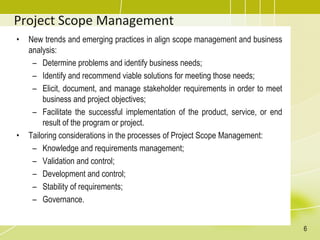
• New trends and emerging practices in align scope management and business
analysis:
– Determine problems and identify business needs;
– Identify and recommend viable solutions for meeting those needs;
– Elicit, document, and manage stakeholder requirements in order to meet
business and project objectives;
– Facilitate the successful implementation of the product, service, or end
result of the program or project.
• Tailoring considerations in the processes of Project Scope Management:
– Knowledge and requirements management;
– Validation and control;
– Development and control;
– Stability of requirements;
– Governance.
6
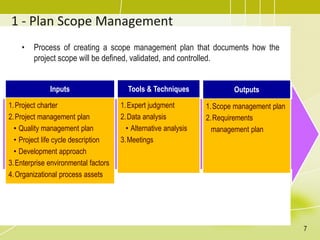
1 - Plan Scope Management
• Process of creating a scope management plan that documents how the
project scope will be defined, validated, and controlled.
Inputs
1.Project charter
2.Project management plan
• Quality management plan
• Project life cycle description
• Development approach
3.Enterprise environmental factors
4.Organizational process assets
Tools & Techniques
1.Expert judgment
2.Data analysis
• Alternative analysis
3.Meetings
Outputs
1.Scope management plan
2.Requirements
management plan
7
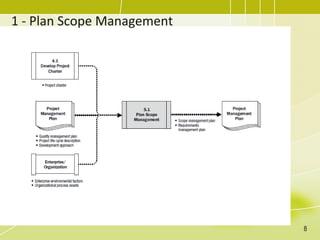
1 - Plan Scope Management
8
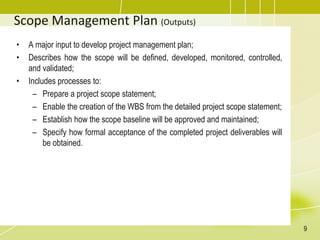
Scope Management Plan (Outputs)
• A major input to develop project management plan;
• Describes how the scope will be defined, developed, monitored, controlled,
and validated;
• Includes processes to:
– Prepare a project scope statement;
– Enable the creation of the WBS from the detailed project scope statement;
– Establish how the scope baseline will be approved and maintained;
– Specify how formal acceptance of the completed project deliverables will
be obtained.
9
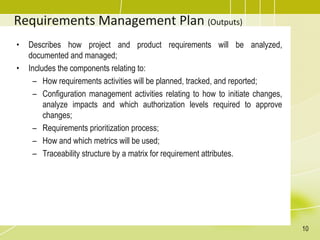
Requirements Management Plan (Outputs)
• Describes how project and product requirements will be analyzed,
documented and managed;
• Includes the components relating to:
– How requirements activities will be planned, tracked, and reported;
– Configuration management activities relating to how to initiate changes,
analyze impacts and which authorization levels required to approve
changes;
– Requirements prioritization process;
– How and which metrics will be used;
– Traceability structure by a matrix for requirement attributes.
10
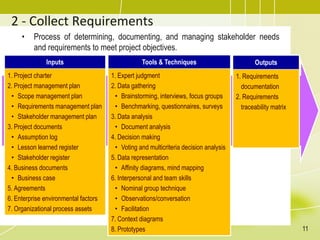
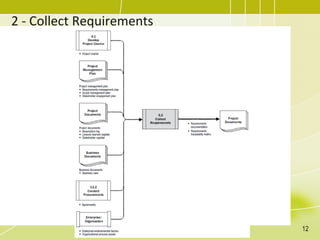
2 - Collect Requirements
• Process of determining, documenting, and managing stakeholder needs
and requirements to meet project objectives.
Inputs
1. Project charter
2. Project management plan
• Scope management plan
• Requirements management plan
• Stakeholder management plan
3. Project documents
• Assumption log
• Lesson learned register
• Stakeholder register
4. Business documents
• Business case
5. Agreements
6. Enterprise environmental factors
7. Organizational process assets
Tools & Techniques
1. Expert judgment
2. Data gathering
• Brainstorming, interviews, focus groups
• Benchmarking, questionnaires, surveys
3. Data analysis
• Document analysis
4. Decision making
• Voting and multicriteria decision analysis
5. Data representation
• Affinity diagrams, mind mapping
6. Interpersonal and team skills
• Nominal group technique
• Observations/conversation
• Facilitation
7. Context diagrams
8. Prototypes
Outputs
1. Requirements
documentation
2. Requirements
traceability matrix
11
2 - Collect Requirements
12
Requirements
• Requirements:
– Include conditions or capabilities that are to be met by the project or
present in the product, service, or result to satisfy an agreement or other
formally imposed specification;
– Discover, decompose, quantify and document needs and expectations of
the sponsor, customer, and other stakeholders;
– Need to be elicited, analyzed, and recorded in the scope baseline and to
be measured once project execution begins;
– Become the foundation of the WBS, cost, schedule, quality, and
procurement planning.
• Classification of requirements:
– Business;
– Stakeholder;
– Solution: Functional and nonfunctional;
– Transition and readiness;
– Project;
– Quality.
13
Collect Requirements (Tools & Techniques)
• Data gathering:
– Brainstorming: Generate and collect multiple ideas;
– Interviews: Directly talk with stakeholders;
– Focus groups: Interactive discussion with qualified stakeholders & subject
matter experts;
– Questionnaires and surveys: Wide number of respondents;
– Benchmarking: Comparison between planned and comparable practices
to identify best practices.
• Document analysis: Analyzing existing documentation and identifying
information relevant to the requirements.
• Data representation:
– Idea / mind mapping: Consolidate the brainstormed ideas into a single
map to generate new ideas;
– Affinity diagram: Classify ideas into groups.
14
Collect Requirements (Tools & Techniques) (cont.)
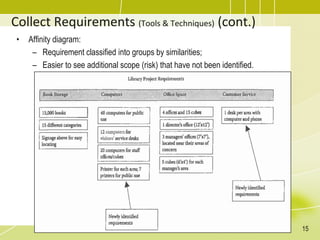
• Affinity diagram:
– Requirement classified into groups by similarities;
– Easier to see additional scope (risk) that have not been identified.
15
Collect Requirements (Tools & Techniques) (cont.)
• Interpersonal and team skills:
– Nominal group technique: Enhance brainstorming with voting and
ranking;
– Observation (or job shadowing) and conversation: Viewing individual in
their environment and how they perform their jobs or tasks and carry out
processes;
– Facilitated workshops: Focus cross functional requirements and
reconciling stakeholders differences:
• JAD (Joint application design);
• QFD (Quality function development);
• User stories.
16
Collect Requirements (Tools & Techniques) (cont.)
• Decision making:
– Voting:
• Unanimity: Decision is reached through a single course of action by Delphi
technique;
• Majority: Decision is reached by more than 50 % of the members of the
group;
• Plurality: Decision is reached by the largest block in a group, even if a
majority is not achieved;
– Autocratic decision making (or dictatorship): One individual makes the
decision for the group
– Multicriteria decision analysis: Provide a systematic analytical approach
to evaluate and rank ideas by decision matrix.
17
Collect Requirements (Tools & Techniques) (cont.)
• Prototypes: Early feedback by providing a working model of the expected product.
• Context diagrams: Example of a scope model.
18
Balance Stakeholder’s Requirements
• There is a need to balance stakeholder’s requirements.
• Some issues are so complex they cannot be resolved by project manager
alone.
• Facilitate the resolution of competing requirements by considering:
– Business case;
– Project charter;
– Project scope statement;
– Project constraints.
• What you can do:
– Conflict resolution, team building, meeting, problem solving skills,
escalation, approval from stakeholders.
• Stakeholders request to do or add something that is not related to the reason
of project created should be rejected!
19
Requirements Documentation (Outputs)
• Output of the Collect Requirements process;
• Helps make sure the requirements clear and unambiguous;
• How will we know if the work we do will acceptability meet the requirements?
• Rule of thumb for requirements:
– Specific (Unambiguous);
– Measurable (How will we know we have finished?);
– Achievable (Can we do it?);
– Relevant (Is it the right thing to do?);
– Timed (When will we do it?).
20
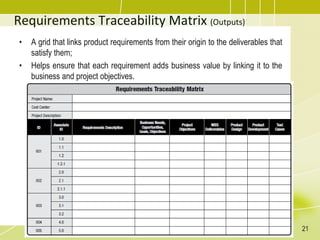
Requirements Traceability Matrix (Outputs)
• A grid that links product requirements from their origin to the deliverables that
satisfy them;
• Helps ensure that each requirement adds business value by linking it to the
business and project objectives.
21
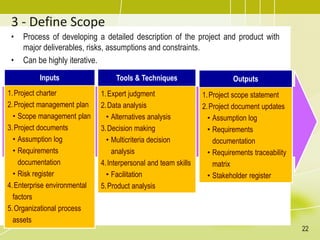
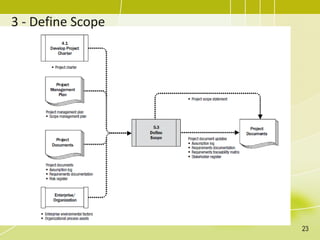
3 - Define Scope
• Process of developing a detailed description of the project and product with
major deliverables, risks, assumptions and constraints.
• Can be highly iterative.
Inputs
1.Project charter
2.Project management plan
• Scope management plan
3.Project documents
• Assumption log
• Requirements
documentation
• Risk register
4.Enterprise environmental
factors
5.Organizational process
assets
Tools & Techniques
1.Expert judgment
2.Data analysis
• Alternatives analysis
3.Decision making
• Multicriteria decision
analysis
4.Interpersonal and team skills
• Facilitation
5.Product analysis
Outputs
1.Project scope statement
2.Project document updates
• Assumption log
• Requirements
documentation
• Requirements traceability
matrix
• Stakeholder register
22
3 - Define Scope
23
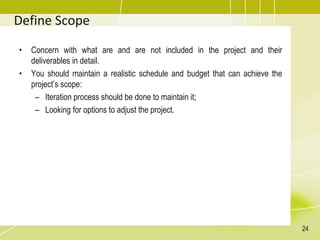
Define Scope
• Concern with what are and are not included in the project and their
deliverables in detail.
• You should maintain a realistic schedule and budget that can achieve the
project’s scope:
– Iteration process should be done to maintain it;
– Looking for options to adjust the project.
24
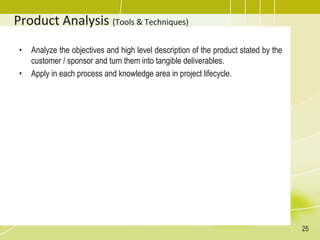
Product Analysis (Tools & Techniques)
• Analyze the objectives and high level description of the product stated by the
customer / sponsor and turn them into tangible deliverables.
• Apply in each process and knowledge area in project lifecycle.
25
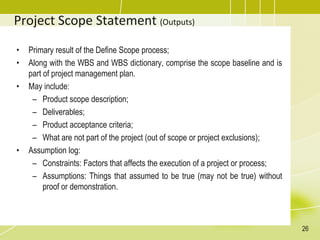
Project Scope Statement (Outputs)
• Primary result of the Define Scope process;
• Along with the WBS and WBS dictionary, comprise the scope baseline and is
part of project management plan.
• May include:
– Product scope description;
– Deliverables;
– Product acceptance criteria;
– What are not part of the project (out of scope or project exclusions);
• Assumption log:
– Constraints: Factors that affects the execution of a project or process;
– Assumptions: Things that assumed to be true (may not be true) without
proof or demonstration.
26
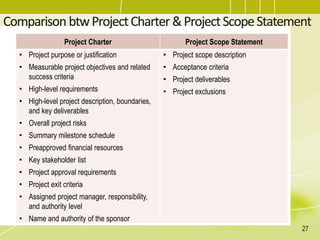
ComparisonbtwProjectCharter&ProjectScopeStatement
27
Project Charter Project Scope Statement
• Project purpose or justification
• Measurable project objectives and related
success criteria
• High-level requirements
• High-level project description, boundaries,
and key deliverables
• Overall project risks
• Summary milestone schedule
• Preapproved financial resources
• Key stakeholder list
• Project approval requirements
• Project exit criteria
• Assigned project manager, responsibility,
and authority level
• Name and authority of the sponsor
• Project scope description
• Acceptance criteria
• Project deliverables
• Project exclusions
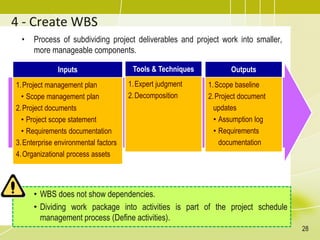
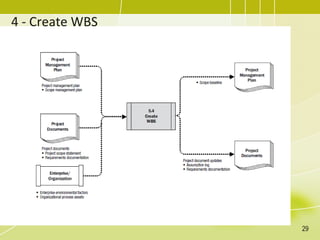
4 - Create WBS
• Process of subdividing project deliverables and project work into smaller,
more manageable components.
Inputs
1.Project management plan
• Scope management plan
2.Project documents
• Project scope statement
• Requirements documentation
3.Enterprise environmental factors
4.Organizational process assets
Tools & Techniques
1.Expert judgment
2.Decomposition
Outputs
1.Scope baseline
2.Project document
updates
• Assumption log
• Requirements
documentation
• WBS does not show dependencies.
• Dividing work package into activities is part of the project schedule
management process (Define activities).
28
4 - Create WBS
29
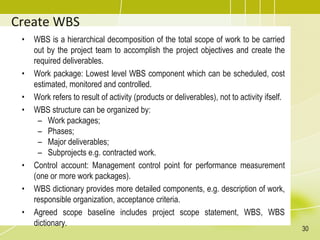
Create WBS
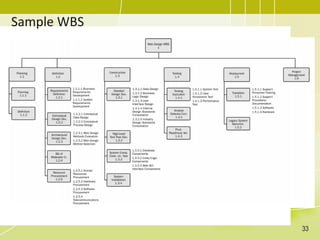
• WBS is a hierarchical decomposition of the total scope of work to be carried
out by the project team to accomplish the project objectives and create the
required deliverables.
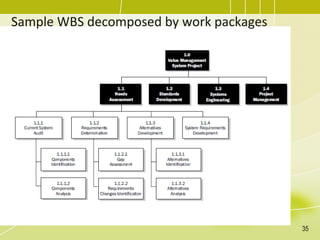
• Work package: Lowest level WBS component which can be scheduled, cost
estimated, monitored and controlled.
• Work refers to result of activity (products or deliverables), not to activity ifself.
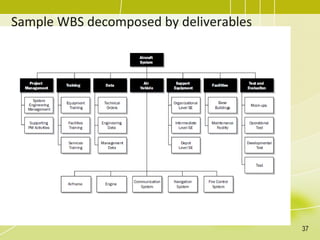
• WBS structure can be organized by:
– Work packages;
– Phases;
– Major deliverables;
– Subprojects e.g. contracted work.
• Control account: Management control point for performance measurement
(one or more work packages).
• WBS dictionary provides more detailed components, e.g. description of work,
responsible organization, acceptance criteria.
• Agreed scope baseline includes project scope statement, WBS, WBS
dictionary.
30
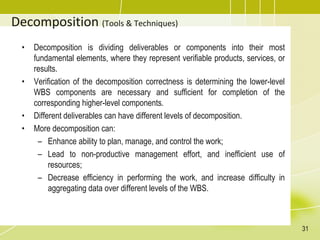
Decomposition (Tools & Techniques)
• Decomposition is dividing deliverables or components into their most
fundamental elements, where they represent verifiable products, services, or
results.
• Verification of the decomposition correctness is determining the lower-level
WBS components are necessary and sufficient for completion of the
corresponding higher-level components.
• Different deliverables can have different levels of decomposition.
• More decomposition can:
– Enhance ability to plan, manage, and control the work;
– Lead to non-productive management effort, and inefficient use of
resources;
– Decrease efficiency in performing the work, and increase difficulty in
aggregating data over different levels of the WBS.
31
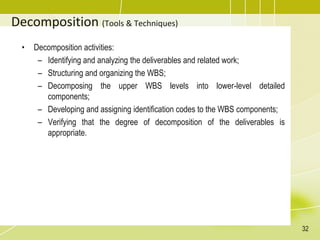
Decomposition (Tools & Techniques)
• Decomposition activities:
– Identifying and analyzing the deliverables and related work;
– Structuring and organizing the WBS;
– Decomposing the upper WBS levels into lower-level detailed
components;
– Developing and assigning identification codes to the WBS components;
– Verifying that the degree of decomposition of the deliverables is
appropriate.
32
Sample WBS
33
WBS
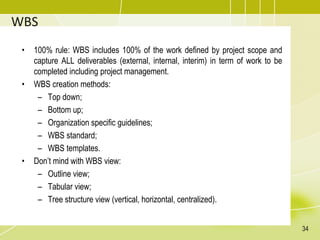
• 100% rule: WBS includes 100% of the work defined by project scope and
capture ALL deliverables (external, internal, interim) in term of work to be
completed including project management.
• WBS creation methods:
– Top down;
– Bottom up;
– Organization specific guidelines;
– WBS standard;
– WBS templates.
• Don’t mind with WBS view:
– Outline view;
– Tabular view;
– Tree structure view (vertical, horizontal, centralized).
34
Sample WBS decomposed by work packages
35
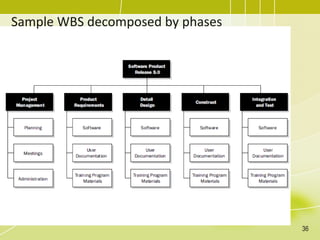
Sample WBS decomposed by phases
36
Sample WBS decomposed by deliverables
37
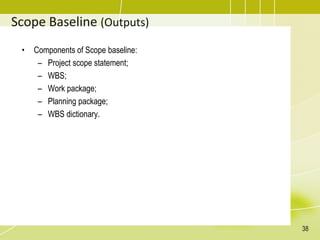
Scope Baseline (Outputs)
• Components of Scope baseline:
– Project scope statement;
– WBS;
– Work package;
– Planning package;
– WBS dictionary.
38
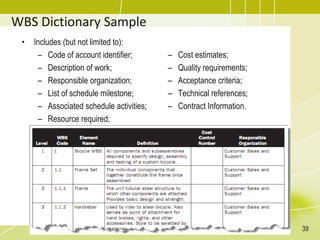
WBS Dictionary Sample
• Includes (but not limited to):
– Code of account identifier;
– Description of work;
– Responsible organization;
– List of schedule milestone;
– Associated schedule activities;
– Resource required;
– Cost estimates;
– Quality requirements;
– Acceptance criteria;
– Technical references;
– Contract Information.
39
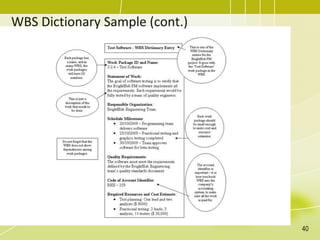
WBS Dictionary Sample (cont.)
40
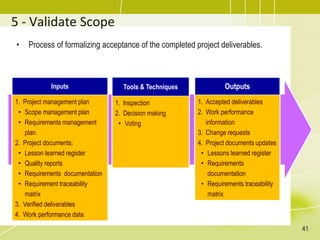
5 - Validate Scope
• Process of formalizing acceptance of the completed project deliverables.
Inputs
1. Project management plan
• Scope management plan
• Requirements management
plan
2. Project documents:
• Lesson learned register
• Quality reports
• Requirements documentation
• Requirement traceability
matrix
3. Verified deliverables
4. Work performance data
Tools & Techniques
1. Inspection
2. Decision making
• Voting
Outputs
1. Accepted deliverables
2. Work performance
information
3. Change requests
4. Project documents updates
• Lessons learned register
• Requirements
documentation
• Requirements traceability
matrix
41
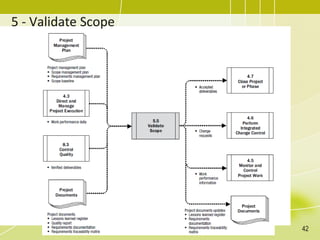
5 - Validate Scope
42
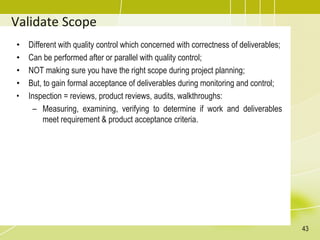
Validate Scope
• Different with quality control which concerned with correctness of deliverables;
• Can be performed after or parallel with quality control;
• NOT making sure you have the right scope during project planning;
• But, to gain formal acceptance of deliverables during monitoring and control;
• Inspection = reviews, product reviews, audits, walkthroughs:
– Measuring, examining, verifying to determine if work and deliverables
meet requirement & product acceptance criteria.
43
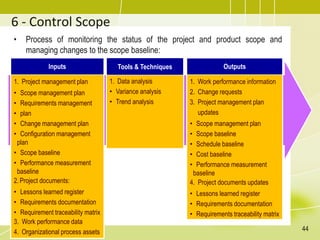
6 - Control Scope
• Process of monitoring the status of the project and product scope and
managing changes to the scope baseline:
Inputs
1. Project management plan
• Scope management plan
• Requirements management
• plan
• Change management plan
• Configuration management
plan
• Scope baseline
• Performance measurement
baseline
2.Project documents:
• Lessons learned register
• Requirements documentation
• Requirement traceability matrix
3. Work performance data
4. Organizational process assets
Tools & Techniques
1. Data analysis
• Variance analysis
• Trend analysis
Outputs
1. Work performance information
2. Change requests
3. Project management plan
updates
• Scope management plan
• Scope baseline
• Schedule baseline
• Cost baseline
• Performance measurement
baseline
4. Project documents updates
• Lessons learned register
• Requirements documentation
• Requirements traceability matrix
44
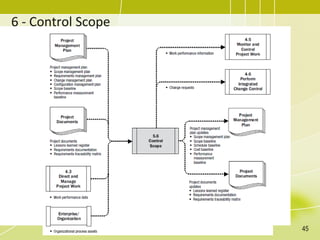
6 - Control Scope
45
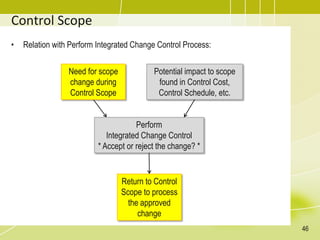
Control Scope
• Relation with Perform Integrated Change Control Process:
Need for scope
change during
Control Scope
Potential impact to scope
found in Control Cost,
Control Schedule, etc.
Perform
Integrated Change Control
* Accept or reject the change? *
Return to Control
Scope to process
the approved
change
46
Thank You
Next topic:
Project Quality Management
47

Topic 7 - Project Scope Management.pdf

  • 1.
  • 2.
  • 3.
    Process Groups &Knowledge Areas Mapping Knowledge Areas Process Groups Initiating Planning Executing Monitoring & Control Closing Integration Develop Project Charter Develop Project Management Plan Direct and Manage Project Work Manage Project Knowledge Monitor and Control Project Work Perform Integrated Change Control Close Project or Phase Scope Plan Scope Management Collect Requirements Define Scope Create WBS Validate Scope Control Scope Schedule Plan Schedule Management Define Activities Sequence Activities Estimate Activity Durations Develop Schedule Control Schedule Cost Plan Cost Management Estimate Costs Determine Budget Control Costs Quality Plan Quality Management Manage Quality Control Quality Resource Plan Resource Management Estimate Activity Resources Acquire Resources Develop Team Manage Team Control Resources Communications Plan Communications Management Manage Communications Monitor Communications Risk Plan Risk Management Identify Risks Perform Qualitative Risk Analysis Perform Quantitative Risk Analysis Plan Risk Responses Implement Risk Responses Monitor Risks Procurement Plan Procurement Management Conduct Procurements Control Procurements Stakeholder Identify Stakeholders Plan Stakeholder Engagement Manage Stakeholder Engagement Monitor Stakeholder Engagement 3
  • 4.
    Project Scope Management Knowledge Area ProcessGroups Initiating Planning Executing Monitoring & Controlling Closing Scope • Plan Scope Management • Collect Requirements • Define Scope • Create WBS • Validate Scope • Control Scope Enter phase/ Start project Exit phase/ End project Initiating Processes Closing Processes Planning Processes Executing Processes Monitoring & Controlling Processes 4
  • 5.
    Project Scope Management •Processes to ensure that the project includes all-and-only the work required to complete the project successfully; • Scope can refer to Product Scope & Project Scope; • Considerations for agile or adaptive environments: • Don’t assume that requirements were determined before project began (not part of the project). • Attitude to say no to unnecessary scope. It should go to project approval process. 5 Predictive Adaptive or Agile Deliverables are defined at the beginning of the project. Scope baseline is the approved version of the project scope statement, WBS, and WBS dictionary. Deliverables are developed over multiple iterations where a detailed scope is defined and approved for each iteration when it begins. The backlogs are used to reflect the current needs. Changes to the scope are progressively managed by using the integrated change control process. Changes go along with the repeated processes of Collect requirements, Define scope and Create WBS for each iteration. Validate scope occurs with each deliverable or phase review and Control scope, Control quality are ongoing processes. Validate scope, Control scope and Control quality are repeated for each iteration.
  • 6.
    Project Scope Management •New trends and emerging practices in align scope management and business analysis: – Determine problems and identify business needs; – Identify and recommend viable solutions for meeting those needs; – Elicit, document, and manage stakeholder requirements in order to meet business and project objectives; – Facilitate the successful implementation of the product, service, or end result of the program or project. • Tailoring considerations in the processes of Project Scope Management: – Knowledge and requirements management; – Validation and control; – Development and control; – Stability of requirements; – Governance. 6
  • 7.
    1 - PlanScope Management • Process of creating a scope management plan that documents how the project scope will be defined, validated, and controlled. Inputs 1.Project charter 2.Project management plan • Quality management plan • Project life cycle description • Development approach 3.Enterprise environmental factors 4.Organizational process assets Tools & Techniques 1.Expert judgment 2.Data analysis • Alternative analysis 3.Meetings Outputs 1.Scope management plan 2.Requirements management plan 7
  • 8.
    1 - PlanScope Management 8
  • 9.
    Scope Management Plan(Outputs) • A major input to develop project management plan; • Describes how the scope will be defined, developed, monitored, controlled, and validated; • Includes processes to: – Prepare a project scope statement; – Enable the creation of the WBS from the detailed project scope statement; – Establish how the scope baseline will be approved and maintained; – Specify how formal acceptance of the completed project deliverables will be obtained. 9
  • 10.
    Requirements Management Plan(Outputs) • Describes how project and product requirements will be analyzed, documented and managed; • Includes the components relating to: – How requirements activities will be planned, tracked, and reported; – Configuration management activities relating to how to initiate changes, analyze impacts and which authorization levels required to approve changes; – Requirements prioritization process; – How and which metrics will be used; – Traceability structure by a matrix for requirement attributes. 10
  • 11.
    2 - CollectRequirements • Process of determining, documenting, and managing stakeholder needs and requirements to meet project objectives. Inputs 1. Project charter 2. Project management plan • Scope management plan • Requirements management plan • Stakeholder management plan 3. Project documents • Assumption log • Lesson learned register • Stakeholder register 4. Business documents • Business case 5. Agreements 6. Enterprise environmental factors 7. Organizational process assets Tools & Techniques 1. Expert judgment 2. Data gathering • Brainstorming, interviews, focus groups • Benchmarking, questionnaires, surveys 3. Data analysis • Document analysis 4. Decision making • Voting and multicriteria decision analysis 5. Data representation • Affinity diagrams, mind mapping 6. Interpersonal and team skills • Nominal group technique • Observations/conversation • Facilitation 7. Context diagrams 8. Prototypes Outputs 1. Requirements documentation 2. Requirements traceability matrix 11
  • 12.
    2 - CollectRequirements 12
  • 13.
    Requirements • Requirements: – Includeconditions or capabilities that are to be met by the project or present in the product, service, or result to satisfy an agreement or other formally imposed specification; – Discover, decompose, quantify and document needs and expectations of the sponsor, customer, and other stakeholders; – Need to be elicited, analyzed, and recorded in the scope baseline and to be measured once project execution begins; – Become the foundation of the WBS, cost, schedule, quality, and procurement planning. • Classification of requirements: – Business; – Stakeholder; – Solution: Functional and nonfunctional; – Transition and readiness; – Project; – Quality. 13
  • 14.
    Collect Requirements (Tools& Techniques) • Data gathering: – Brainstorming: Generate and collect multiple ideas; – Interviews: Directly talk with stakeholders; – Focus groups: Interactive discussion with qualified stakeholders & subject matter experts; – Questionnaires and surveys: Wide number of respondents; – Benchmarking: Comparison between planned and comparable practices to identify best practices. • Document analysis: Analyzing existing documentation and identifying information relevant to the requirements. • Data representation: – Idea / mind mapping: Consolidate the brainstormed ideas into a single map to generate new ideas; – Affinity diagram: Classify ideas into groups. 14
  • 15.
    Collect Requirements (Tools& Techniques) (cont.) • Affinity diagram: – Requirement classified into groups by similarities; – Easier to see additional scope (risk) that have not been identified. 15
  • 16.
    Collect Requirements (Tools& Techniques) (cont.) • Interpersonal and team skills: – Nominal group technique: Enhance brainstorming with voting and ranking; – Observation (or job shadowing) and conversation: Viewing individual in their environment and how they perform their jobs or tasks and carry out processes; – Facilitated workshops: Focus cross functional requirements and reconciling stakeholders differences: • JAD (Joint application design); • QFD (Quality function development); • User stories. 16
  • 17.
    Collect Requirements (Tools& Techniques) (cont.) • Decision making: – Voting: • Unanimity: Decision is reached through a single course of action by Delphi technique; • Majority: Decision is reached by more than 50 % of the members of the group; • Plurality: Decision is reached by the largest block in a group, even if a majority is not achieved; – Autocratic decision making (or dictatorship): One individual makes the decision for the group – Multicriteria decision analysis: Provide a systematic analytical approach to evaluate and rank ideas by decision matrix. 17
  • 18.
    Collect Requirements (Tools& Techniques) (cont.) • Prototypes: Early feedback by providing a working model of the expected product. • Context diagrams: Example of a scope model. 18
  • 19.
    Balance Stakeholder’s Requirements •There is a need to balance stakeholder’s requirements. • Some issues are so complex they cannot be resolved by project manager alone. • Facilitate the resolution of competing requirements by considering: – Business case; – Project charter; – Project scope statement; – Project constraints. • What you can do: – Conflict resolution, team building, meeting, problem solving skills, escalation, approval from stakeholders. • Stakeholders request to do or add something that is not related to the reason of project created should be rejected! 19
  • 20.
    Requirements Documentation (Outputs) •Output of the Collect Requirements process; • Helps make sure the requirements clear and unambiguous; • How will we know if the work we do will acceptability meet the requirements? • Rule of thumb for requirements: – Specific (Unambiguous); – Measurable (How will we know we have finished?); – Achievable (Can we do it?); – Relevant (Is it the right thing to do?); – Timed (When will we do it?). 20
  • 21.
    Requirements Traceability Matrix(Outputs) • A grid that links product requirements from their origin to the deliverables that satisfy them; • Helps ensure that each requirement adds business value by linking it to the business and project objectives. 21
  • 22.
    3 - DefineScope • Process of developing a detailed description of the project and product with major deliverables, risks, assumptions and constraints. • Can be highly iterative. Inputs 1.Project charter 2.Project management plan • Scope management plan 3.Project documents • Assumption log • Requirements documentation • Risk register 4.Enterprise environmental factors 5.Organizational process assets Tools & Techniques 1.Expert judgment 2.Data analysis • Alternatives analysis 3.Decision making • Multicriteria decision analysis 4.Interpersonal and team skills • Facilitation 5.Product analysis Outputs 1.Project scope statement 2.Project document updates • Assumption log • Requirements documentation • Requirements traceability matrix • Stakeholder register 22
  • 23.
    3 - DefineScope 23
  • 24.
    Define Scope • Concernwith what are and are not included in the project and their deliverables in detail. • You should maintain a realistic schedule and budget that can achieve the project’s scope: – Iteration process should be done to maintain it; – Looking for options to adjust the project. 24
  • 25.
    Product Analysis (Tools& Techniques) • Analyze the objectives and high level description of the product stated by the customer / sponsor and turn them into tangible deliverables. • Apply in each process and knowledge area in project lifecycle. 25
  • 26.
    Project Scope Statement(Outputs) • Primary result of the Define Scope process; • Along with the WBS and WBS dictionary, comprise the scope baseline and is part of project management plan. • May include: – Product scope description; – Deliverables; – Product acceptance criteria; – What are not part of the project (out of scope or project exclusions); • Assumption log: – Constraints: Factors that affects the execution of a project or process; – Assumptions: Things that assumed to be true (may not be true) without proof or demonstration. 26
  • 27.
    ComparisonbtwProjectCharter&ProjectScopeStatement 27 Project Charter ProjectScope Statement • Project purpose or justification • Measurable project objectives and related success criteria • High-level requirements • High-level project description, boundaries, and key deliverables • Overall project risks • Summary milestone schedule • Preapproved financial resources • Key stakeholder list • Project approval requirements • Project exit criteria • Assigned project manager, responsibility, and authority level • Name and authority of the sponsor • Project scope description • Acceptance criteria • Project deliverables • Project exclusions
  • 28.
    4 - CreateWBS • Process of subdividing project deliverables and project work into smaller, more manageable components. Inputs 1.Project management plan • Scope management plan 2.Project documents • Project scope statement • Requirements documentation 3.Enterprise environmental factors 4.Organizational process assets Tools & Techniques 1.Expert judgment 2.Decomposition Outputs 1.Scope baseline 2.Project document updates • Assumption log • Requirements documentation • WBS does not show dependencies. • Dividing work package into activities is part of the project schedule management process (Define activities). 28
  • 29.
    4 - CreateWBS 29
  • 30.
    Create WBS • WBSis a hierarchical decomposition of the total scope of work to be carried out by the project team to accomplish the project objectives and create the required deliverables. • Work package: Lowest level WBS component which can be scheduled, cost estimated, monitored and controlled. • Work refers to result of activity (products or deliverables), not to activity ifself. • WBS structure can be organized by: – Work packages; – Phases; – Major deliverables; – Subprojects e.g. contracted work. • Control account: Management control point for performance measurement (one or more work packages). • WBS dictionary provides more detailed components, e.g. description of work, responsible organization, acceptance criteria. • Agreed scope baseline includes project scope statement, WBS, WBS dictionary. 30
  • 31.
    Decomposition (Tools &Techniques) • Decomposition is dividing deliverables or components into their most fundamental elements, where they represent verifiable products, services, or results. • Verification of the decomposition correctness is determining the lower-level WBS components are necessary and sufficient for completion of the corresponding higher-level components. • Different deliverables can have different levels of decomposition. • More decomposition can: – Enhance ability to plan, manage, and control the work; – Lead to non-productive management effort, and inefficient use of resources; – Decrease efficiency in performing the work, and increase difficulty in aggregating data over different levels of the WBS. 31
  • 32.
    Decomposition (Tools &Techniques) • Decomposition activities: – Identifying and analyzing the deliverables and related work; – Structuring and organizing the WBS; – Decomposing the upper WBS levels into lower-level detailed components; – Developing and assigning identification codes to the WBS components; – Verifying that the degree of decomposition of the deliverables is appropriate. 32
  • 33.
  • 34.
    WBS • 100% rule:WBS includes 100% of the work defined by project scope and capture ALL deliverables (external, internal, interim) in term of work to be completed including project management. • WBS creation methods: – Top down; – Bottom up; – Organization specific guidelines; – WBS standard; – WBS templates. • Don’t mind with WBS view: – Outline view; – Tabular view; – Tree structure view (vertical, horizontal, centralized). 34
  • 35.
    Sample WBS decomposedby work packages 35
  • 36.
  • 37.
    Sample WBS decomposedby deliverables 37
  • 38.
    Scope Baseline (Outputs) •Components of Scope baseline: – Project scope statement; – WBS; – Work package; – Planning package; – WBS dictionary. 38
  • 39.
    WBS Dictionary Sample •Includes (but not limited to): – Code of account identifier; – Description of work; – Responsible organization; – List of schedule milestone; – Associated schedule activities; – Resource required; – Cost estimates; – Quality requirements; – Acceptance criteria; – Technical references; – Contract Information. 39
  • 40.
  • 41.
    5 - ValidateScope • Process of formalizing acceptance of the completed project deliverables. Inputs 1. Project management plan • Scope management plan • Requirements management plan 2. Project documents: • Lesson learned register • Quality reports • Requirements documentation • Requirement traceability matrix 3. Verified deliverables 4. Work performance data Tools & Techniques 1. Inspection 2. Decision making • Voting Outputs 1. Accepted deliverables 2. Work performance information 3. Change requests 4. Project documents updates • Lessons learned register • Requirements documentation • Requirements traceability matrix 41
  • 42.
    5 - ValidateScope 42
  • 43.
    Validate Scope • Differentwith quality control which concerned with correctness of deliverables; • Can be performed after or parallel with quality control; • NOT making sure you have the right scope during project planning; • But, to gain formal acceptance of deliverables during monitoring and control; • Inspection = reviews, product reviews, audits, walkthroughs: – Measuring, examining, verifying to determine if work and deliverables meet requirement & product acceptance criteria. 43
  • 44.
    6 - ControlScope • Process of monitoring the status of the project and product scope and managing changes to the scope baseline: Inputs 1. Project management plan • Scope management plan • Requirements management • plan • Change management plan • Configuration management plan • Scope baseline • Performance measurement baseline 2.Project documents: • Lessons learned register • Requirements documentation • Requirement traceability matrix 3. Work performance data 4. Organizational process assets Tools & Techniques 1. Data analysis • Variance analysis • Trend analysis Outputs 1. Work performance information 2. Change requests 3. Project management plan updates • Scope management plan • Scope baseline • Schedule baseline • Cost baseline • Performance measurement baseline 4. Project documents updates • Lessons learned register • Requirements documentation • Requirements traceability matrix 44
  • 45.
    6 - ControlScope 45
  • 46.
    Control Scope • Relationwith Perform Integrated Change Control Process: Need for scope change during Control Scope Potential impact to scope found in Control Cost, Control Schedule, etc. Perform Integrated Change Control * Accept or reject the change? * Return to Control Scope to process the approved change 46
  • 47.
    Thank You Next topic: ProjectQuality Management 47