SECTION III
Project Management Knowledge Areas
Ch.5 to Ch. 14
Scope Management
Ch.5 Project Scope Management
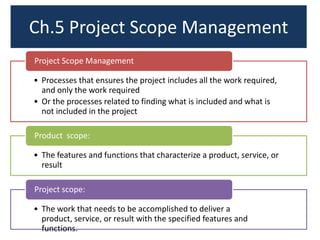
Project Scope Management
• Processes that ensures the project includes all the work required,
and only the work required
• Or the processes related to finding what is included and what is
not included in the project

Product scope:
• The features and functions that characterize a product, service, or
result
Project scope:
• The work that needs to be accomplished to deliver a
product, service, or result with the specified features and
functions.
Project Scope Vs Product Scope
Project Scope

Product Scope

The work needed to create
product of the project

Features and functions of the
product of the project

Completion of a project is
measured against the plan

Completion of product scope is
measured against the
requirements
Processes of Scope Management
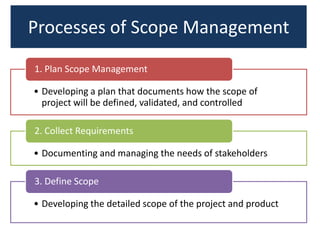
1. Plan Scope Management
• Developing a plan that documents how the scope of
project will be defined, validated, and controlled

2. Collect Requirements
• Documenting and managing the needs of stakeholders
3. Define Scope
• Developing the detailed scope of the project and product
Processes of Scope Management
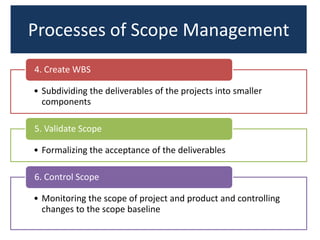
4. Create WBS

• Subdividing the deliverables of the projects into smaller
components
5. Validate Scope
• Formalizing the acceptance of the deliverables
6. Control Scope
• Monitoring the scope of project and product and controlling
changes to the scope baseline
5.1 Plan Scope Management
1.The process of developing project scope
management plan
2. Scope Management Plan documents how the
project scope will be defined, validated, and
controlled
3. It provide guidance on how the project scope
will be managed throughout the project
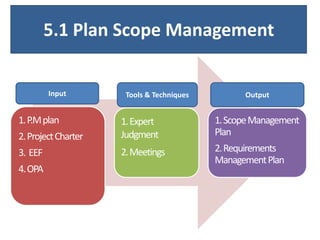
5.1 Plan Scope Management

Input

1. P.M plan

Tools & Techniques

Output

2. Project Charter

1. Expert
Judgment

1. Scope Management
Plan

3. EEF

2. Meetings

2. Requirements
Management Plan

4. OPA
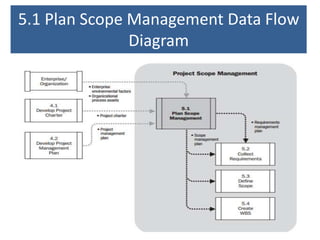
5.1 Plan Scope Management Data Flow
Diagram
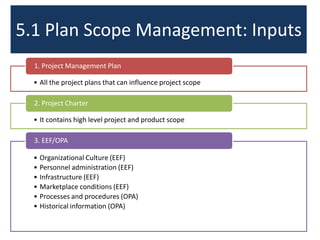
5.1 Plan Scope Management: Inputs
1. Project Management Plan
• All the project plans that can influence project scope
2. Project Charter
• It contains high level project and product scope
3. EEF/OPA
• Organizational Culture (EEF)
• Personnel administration (EEF)
• Infrastructure (EEF)
• Marketplace conditions (EEF)
• Processes and procedures (OPA)
• Historical information (OPA)
5.1 Plan Scope Management: T&T
1. Expert Judgment
• Consulting those who are expert in the area
2. Meetings
• Meetings attended by project
teams, sponsor, stakeholders, etc
5.1 Plan Scope Management: Output
1. Scope Management Plan
• It describes how the scope will be
defined, developed, monitored, controlled, and verified.
• Depending on the project scope management plan can be in detail or
at high level

Scope Management Plan can include the following items:
1.
2.
3.
4.
5.

Process for preparing a detailed project scope statement
Process for how to create WBS
Process that establishes how the WBS will be maintained and approved
Process for validating scope
Process for proper processing change request related project scope
5.1 Plan Scope Management: Output
2. Requirements Management Plan
• The plan describes how requirements will be identified,
analyzed, documented, and managed
Elements of Requirement Management Plan can as follow:
1.
2.
3.
4.

How requirements activities will be planned, tracked, and reported
Requirements prioritization process
Product metrics that will be used and the rationale for using them
Traceability structure to reflect which requirement attributes will be captured on the
traceability matrix
5. How will the configuration management related to requirements work
5.2 Collect Requirements
1.The process of determining, and documenting
stakeholder’s needs and requirements
2. Requirements provide the foundation for WBS
or project scope
3. Project scope, cost, schedule, quality, and
sometimes procurement are all based on the
requirements
5.2 Collect Requirements
Requirements can be classified as follow:
1.

Business requirements: These tells us why the project is undertaken or what is the
product needed for or what aspect of business is needed to be changed or improved

2.

Stakeholder requirements: Specific needs of some of the stakeholders

3.

Solution or product requirements: This tell us about the functions and characteristic of
the product, service, or results for which the project is undertaken

4.

Transition requirement: Temporary capabilities, such data conversation or training to
needed for transition from current state to the state where the customer wan to be

5.

Project requirement: Process and conditions the project need to meet

6.

Quality requirements: Condition or criteria which indicates the successful completion
of the project or delivery of its product
5.2 Collect Requirements
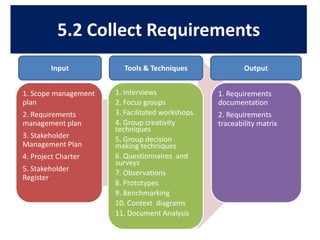
Input

Tools & Techniques

1. Scope management
plan

1. Interviews
2. Focus groups
3. Facilitated workshops
4. Group creativity
techniques
5. Group decision
making techniques
6. Questionnaires and
surveys
7. Observations
8. Prototypes
9. Benchmarking
10. Context diagrams
11. Document Analysis

2. Requirements
management plan
3. Stakeholder
Management Plan
4. Project Charter
5. Stakeholder
Register

Output
1. Requirements
documentation

2. Requirements
traceability matrix
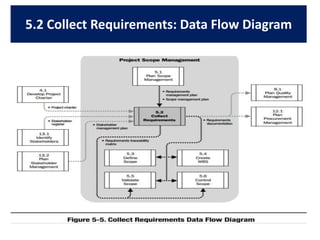
5.2 Collect Requirements: Data Flow Diagram
5.2 Collect Requirements: Inputs
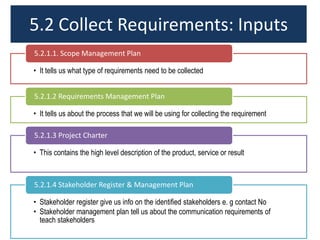
5.2.1.1. Scope Management Plan
• It tells us what type of requirements need to be collected
5.2.1.2 Requirements Management Plan
• It tells us about the process that we will be using for collecting the requirement
5.2.1.3 Project Charter
• This contains the high level description of the product, service or result

5.2.1.4 Stakeholder Register & Management Plan
• Stakeholder register give us info on the identified stakeholders e. g contact No
• Stakeholder management plan tell us about the communication requirements of
teach stakeholders
5.2 Collect Requirements: T&T
5.2.2.1. Interviews
• Best for receiving confidential information
• Best for detailed information
5.2.2.2 Focus Group Discussion
• Bringing together many experts at one place
• More conversational than individual interviews
5.2.2.3 Facilitated workshops

• Good for defining cross-functional requirements gathering
• Good for reconciling between stakeholder differences

5.2.2.4 Group creativity technique
• Several methods can be used to identify product/project requirement through group
techniques
5.2.2.4 Group Creativity Techniques
1. Brainstorming………?
• Generating and collecting multiple ideas
• Used in conjunction with other techniques
5.2.2.4 Group Creativity Techniques
2. Nominal group technique
• Ranking ideas for further brainstorming
through voting
5.2.2.4 Group Creativity Techniques
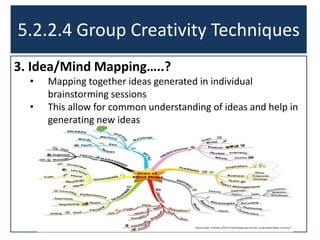
3. Idea/Mind Mapping…..?
•
•

Mapping together ideas generated in individual
brainstorming sessions
This allow for common understanding of ideas and help in
generating new ideas
5.2.2.4 Group Creativity Techniques
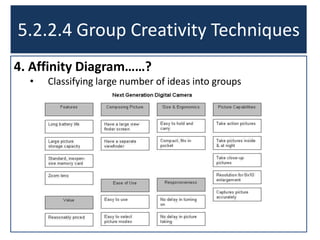
4. Affinity Diagram……?
•

Classifying large number of ideas into groups
5.2.2.4 Group Creativity Techniques
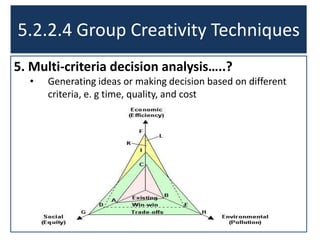
5. Multi-criteria decision analysis…..?
•

Generating ideas or making decision based on different
criteria, e. g time, quality, and cost
5.2 Collect Requirements: T&T
5.2.2.5 Group decision making technique
• Decision making in a group for future actions
• The decisions can be reached through: 1. Unanimity, 2. Majority, 3. Plurality, 4.
Dictatorship
• The technique can be applied to group creativity technique

5.2.2.6 Questionnaires and surveys
• Best when quick turn around from many stakeholders living in many different
places is needed.
5.2.2.7 Observation
• Observing the environment or job of the customer
• Practically performing job of a customer requiring a product
5.2 Collect Requirements: T&T
5.2.2.8 Prototypes
• Obtaining feedback on requirements by providing a working model of the product

5.2.2.9 Benchmarking
• Comparing the planned products to actual similar products.

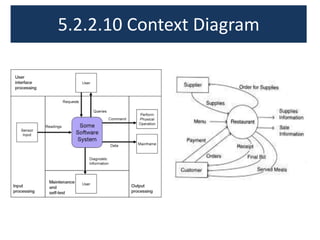
5.2.2.10 Context Diagram
• It visually shows the scope of the product by showing the business system (processes,
equipments, computer system, etc).

5.2.2.11 Document Analysis
• Analyzing existing documents such as market literature, business plans, proposals, process
flow, etc to identify requirements.
5.2.2.10 Context Diagram
5.2 Collect Requirements: Outputs
5.2.3.1 Requirements Documentation
• It shows how each requirement will meet business need of the
project
• Requirement needs to be clear, tangible, testable, traceable and
measurable.
• Requirements can be documented as a list or in much detail

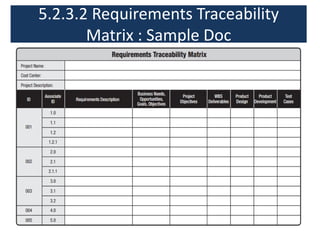
5.2.3.2 Requirements Traceability Matrix
• This document links each requirement to the deliverable that
fulfill the particularly requirement
• It helps in tracing the requirement throughout the project
• It helps in making changes to the project
5.2.3.2 Requirements Traceability
Matrix : Sample Doc
5.3 Define Scope
1.Developing the detailed description of the
project and product
2. Specifying the boundaries of the project

3. Specifying the requirements that are included
in the project scope.

The stakeholders may have lots of
requirements but not all the
requirements will be part of the
project. Here you specify the
requirements that will be part of the
project.
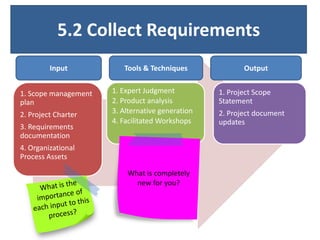
5.2 Collect Requirements
Input
1. Scope management
plan
2. Project Charter
3. Requirements
documentation

Tools & Techniques
1. Expert Judgment
2. Product analysis
3. Alternative generation
4. Facilitated Workshops

4. Organizational
Process Assets
What is completely
new for you?

Output
1. Project Scope
Statement
2. Project document
updates
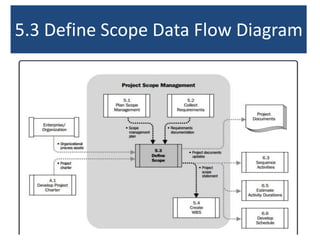
5.3 Define Scope Data Flow Diagram
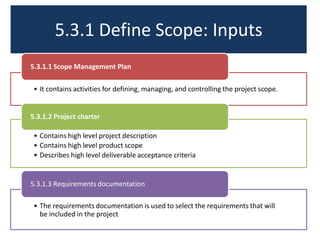
5.3.1 Define Scope: Inputs
5.3.1.1 Scope Management Plan
• It contains activities for defining, managing, and controlling the project scope.

5.3.1.2 Project charter
• Contains high level project description
• Contains high level product scope
• Describes high level deliverable acceptance criteria

5.3.1.3 Requirements documentation
• The requirements documentation is used to select the requirements that will
be included in the project
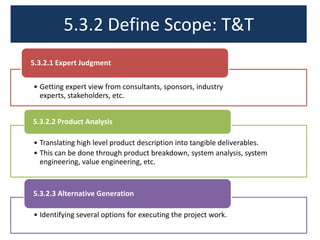
5.3.2 Define Scope: T&T
5.3.2.1 Expert Judgment
• Getting expert view from consultants, sponsors, industry
experts, stakeholders, etc.
5.3.2.2 Product Analysis
• Translating high level product description into tangible deliverables.
• This can be done through product breakdown, system analysis, system
engineering, value engineering, etc.

5.3.2.3 Alternative Generation
• Identifying several options for executing the project work.
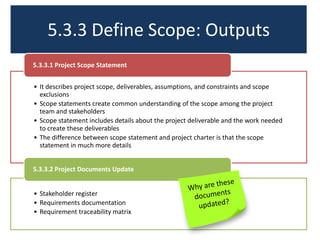
5.3.3 Define Scope: Outputs
5.3.3.1 Project Scope Statement
• It describes project scope, deliverables, assumptions, and constraints and scope
exclusions
• Scope statements create common understanding of the scope among the project
team and stakeholders
• Scope statement includes details about the project deliverable and the work needed
to create these deliverables
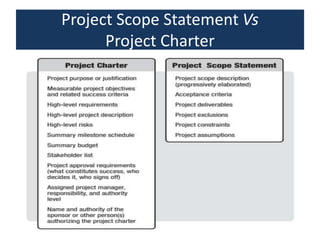
• The difference between scope statement and project charter is that the scope
statement in much more details
5.3.3.2 Project Documents Update
• Stakeholder register
• Requirements documentation
• Requirement traceability matrix
Project Scope Statement Vs
Project Charter
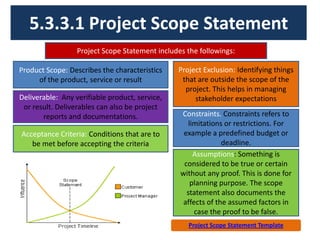
5.3.3.1 Project Scope Statement
Project Scope Statement includes the followings:
Product Scope: Describes the characteristics
of the product, service or result
Deliverable: Any verifiable product, service,
or result. Deliverables can also be project
reports and documentations.

Acceptance Criteria: Conditions that are to
be met before accepting the criteria

Project Exclusion: Identifying things
that are outside the scope of the
project. This helps in managing
stakeholder expectations
Constraints. Constraints refers to
limitations or restrictions. For
example a predefined budget or
deadline.
Assumptions: Something is
considered to be true or certain
without any proof. This is done for
planning purpose. The scope
statement also documents the
affects of the assumed factors in
case the proof to be false.
Project Scope Statement Template
Read Pages 125-140 of the
PMBOK Guide

Project scope management 1

  • 1.
    SECTION III Project ManagementKnowledge Areas Ch.5 to Ch. 14 Scope Management
  • 2.
    Ch.5 Project ScopeManagement Project Scope Management • Processes that ensures the project includes all the work required, and only the work required • Or the processes related to finding what is included and what is not included in the project Product scope: • The features and functions that characterize a product, service, or result Project scope: • The work that needs to be accomplished to deliver a product, service, or result with the specified features and functions.
  • 3.
    Project Scope VsProduct Scope Project Scope Product Scope The work needed to create product of the project Features and functions of the product of the project Completion of a project is measured against the plan Completion of product scope is measured against the requirements
  • 4.
    Processes of ScopeManagement 1. Plan Scope Management • Developing a plan that documents how the scope of project will be defined, validated, and controlled 2. Collect Requirements • Documenting and managing the needs of stakeholders 3. Define Scope • Developing the detailed scope of the project and product
  • 5.
    Processes of ScopeManagement 4. Create WBS • Subdividing the deliverables of the projects into smaller components 5. Validate Scope • Formalizing the acceptance of the deliverables 6. Control Scope • Monitoring the scope of project and product and controlling changes to the scope baseline
  • 6.
    5.1 Plan ScopeManagement 1.The process of developing project scope management plan 2. Scope Management Plan documents how the project scope will be defined, validated, and controlled 3. It provide guidance on how the project scope will be managed throughout the project
  • 7.
    5.1 Plan ScopeManagement Input 1. P.M plan Tools & Techniques Output 2. Project Charter 1. Expert Judgment 1. Scope Management Plan 3. EEF 2. Meetings 2. Requirements Management Plan 4. OPA
  • 8.
    5.1 Plan ScopeManagement Data Flow Diagram
  • 9.
    5.1 Plan ScopeManagement: Inputs 1. Project Management Plan • All the project plans that can influence project scope 2. Project Charter • It contains high level project and product scope 3. EEF/OPA • Organizational Culture (EEF) • Personnel administration (EEF) • Infrastructure (EEF) • Marketplace conditions (EEF) • Processes and procedures (OPA) • Historical information (OPA)
  • 10.
    5.1 Plan ScopeManagement: T&T 1. Expert Judgment • Consulting those who are expert in the area 2. Meetings • Meetings attended by project teams, sponsor, stakeholders, etc
  • 11.
    5.1 Plan ScopeManagement: Output 1. Scope Management Plan • It describes how the scope will be defined, developed, monitored, controlled, and verified. • Depending on the project scope management plan can be in detail or at high level Scope Management Plan can include the following items: 1. 2. 3. 4. 5. Process for preparing a detailed project scope statement Process for how to create WBS Process that establishes how the WBS will be maintained and approved Process for validating scope Process for proper processing change request related project scope
  • 12.
    5.1 Plan ScopeManagement: Output 2. Requirements Management Plan • The plan describes how requirements will be identified, analyzed, documented, and managed Elements of Requirement Management Plan can as follow: 1. 2. 3. 4. How requirements activities will be planned, tracked, and reported Requirements prioritization process Product metrics that will be used and the rationale for using them Traceability structure to reflect which requirement attributes will be captured on the traceability matrix 5. How will the configuration management related to requirements work
  • 13.
    5.2 Collect Requirements 1.Theprocess of determining, and documenting stakeholder’s needs and requirements 2. Requirements provide the foundation for WBS or project scope 3. Project scope, cost, schedule, quality, and sometimes procurement are all based on the requirements
  • 14.
    5.2 Collect Requirements Requirementscan be classified as follow: 1. Business requirements: These tells us why the project is undertaken or what is the product needed for or what aspect of business is needed to be changed or improved 2. Stakeholder requirements: Specific needs of some of the stakeholders 3. Solution or product requirements: This tell us about the functions and characteristic of the product, service, or results for which the project is undertaken 4. Transition requirement: Temporary capabilities, such data conversation or training to needed for transition from current state to the state where the customer wan to be 5. Project requirement: Process and conditions the project need to meet 6. Quality requirements: Condition or criteria which indicates the successful completion of the project or delivery of its product
  • 15.
    5.2 Collect Requirements Input Tools& Techniques 1. Scope management plan 1. Interviews 2. Focus groups 3. Facilitated workshops 4. Group creativity techniques 5. Group decision making techniques 6. Questionnaires and surveys 7. Observations 8. Prototypes 9. Benchmarking 10. Context diagrams 11. Document Analysis 2. Requirements management plan 3. Stakeholder Management Plan 4. Project Charter 5. Stakeholder Register Output 1. Requirements documentation 2. Requirements traceability matrix
  • 16.
    5.2 Collect Requirements:Data Flow Diagram
  • 17.
    5.2 Collect Requirements:Inputs 5.2.1.1. Scope Management Plan • It tells us what type of requirements need to be collected 5.2.1.2 Requirements Management Plan • It tells us about the process that we will be using for collecting the requirement 5.2.1.3 Project Charter • This contains the high level description of the product, service or result 5.2.1.4 Stakeholder Register & Management Plan • Stakeholder register give us info on the identified stakeholders e. g contact No • Stakeholder management plan tell us about the communication requirements of teach stakeholders
  • 18.
    5.2 Collect Requirements:T&T 5.2.2.1. Interviews • Best for receiving confidential information • Best for detailed information 5.2.2.2 Focus Group Discussion • Bringing together many experts at one place • More conversational than individual interviews 5.2.2.3 Facilitated workshops • Good for defining cross-functional requirements gathering • Good for reconciling between stakeholder differences 5.2.2.4 Group creativity technique • Several methods can be used to identify product/project requirement through group techniques
  • 19.
    5.2.2.4 Group CreativityTechniques 1. Brainstorming………? • Generating and collecting multiple ideas • Used in conjunction with other techniques
  • 20.
    5.2.2.4 Group CreativityTechniques 2. Nominal group technique • Ranking ideas for further brainstorming through voting
  • 21.
    5.2.2.4 Group CreativityTechniques 3. Idea/Mind Mapping…..? • • Mapping together ideas generated in individual brainstorming sessions This allow for common understanding of ideas and help in generating new ideas
  • 22.
    5.2.2.4 Group CreativityTechniques 4. Affinity Diagram……? • Classifying large number of ideas into groups
  • 23.
    5.2.2.4 Group CreativityTechniques 5. Multi-criteria decision analysis…..? • Generating ideas or making decision based on different criteria, e. g time, quality, and cost
  • 24.
    5.2 Collect Requirements:T&T 5.2.2.5 Group decision making technique • Decision making in a group for future actions • The decisions can be reached through: 1. Unanimity, 2. Majority, 3. Plurality, 4. Dictatorship • The technique can be applied to group creativity technique 5.2.2.6 Questionnaires and surveys • Best when quick turn around from many stakeholders living in many different places is needed. 5.2.2.7 Observation • Observing the environment or job of the customer • Practically performing job of a customer requiring a product
  • 25.
    5.2 Collect Requirements:T&T 5.2.2.8 Prototypes • Obtaining feedback on requirements by providing a working model of the product 5.2.2.9 Benchmarking • Comparing the planned products to actual similar products. 5.2.2.10 Context Diagram • It visually shows the scope of the product by showing the business system (processes, equipments, computer system, etc). 5.2.2.11 Document Analysis • Analyzing existing documents such as market literature, business plans, proposals, process flow, etc to identify requirements.
  • 26.
  • 27.
    5.2 Collect Requirements:Outputs 5.2.3.1 Requirements Documentation • It shows how each requirement will meet business need of the project • Requirement needs to be clear, tangible, testable, traceable and measurable. • Requirements can be documented as a list or in much detail 5.2.3.2 Requirements Traceability Matrix • This document links each requirement to the deliverable that fulfill the particularly requirement • It helps in tracing the requirement throughout the project • It helps in making changes to the project
  • 28.
  • 29.
    5.3 Define Scope 1.Developingthe detailed description of the project and product 2. Specifying the boundaries of the project 3. Specifying the requirements that are included in the project scope. The stakeholders may have lots of requirements but not all the requirements will be part of the project. Here you specify the requirements that will be part of the project.
  • 30.
    5.2 Collect Requirements Input 1.Scope management plan 2. Project Charter 3. Requirements documentation Tools & Techniques 1. Expert Judgment 2. Product analysis 3. Alternative generation 4. Facilitated Workshops 4. Organizational Process Assets What is completely new for you? Output 1. Project Scope Statement 2. Project document updates
  • 31.
    5.3 Define ScopeData Flow Diagram
  • 32.
    5.3.1 Define Scope:Inputs 5.3.1.1 Scope Management Plan • It contains activities for defining, managing, and controlling the project scope. 5.3.1.2 Project charter • Contains high level project description • Contains high level product scope • Describes high level deliverable acceptance criteria 5.3.1.3 Requirements documentation • The requirements documentation is used to select the requirements that will be included in the project
  • 33.
    5.3.2 Define Scope:T&T 5.3.2.1 Expert Judgment • Getting expert view from consultants, sponsors, industry experts, stakeholders, etc. 5.3.2.2 Product Analysis • Translating high level product description into tangible deliverables. • This can be done through product breakdown, system analysis, system engineering, value engineering, etc. 5.3.2.3 Alternative Generation • Identifying several options for executing the project work.
  • 34.
    5.3.3 Define Scope:Outputs 5.3.3.1 Project Scope Statement • It describes project scope, deliverables, assumptions, and constraints and scope exclusions • Scope statements create common understanding of the scope among the project team and stakeholders • Scope statement includes details about the project deliverable and the work needed to create these deliverables • The difference between scope statement and project charter is that the scope statement in much more details 5.3.3.2 Project Documents Update • Stakeholder register • Requirements documentation • Requirement traceability matrix
  • 35.
    Project Scope StatementVs Project Charter
  • 36.
    5.3.3.1 Project ScopeStatement Project Scope Statement includes the followings: Product Scope: Describes the characteristics of the product, service or result Deliverable: Any verifiable product, service, or result. Deliverables can also be project reports and documentations. Acceptance Criteria: Conditions that are to be met before accepting the criteria Project Exclusion: Identifying things that are outside the scope of the project. This helps in managing stakeholder expectations Constraints. Constraints refers to limitations or restrictions. For example a predefined budget or deadline. Assumptions: Something is considered to be true or certain without any proof. This is done for planning purpose. The scope statement also documents the affects of the assumed factors in case the proof to be false. Project Scope Statement Template
  • 38.
    Read Pages 125-140of the PMBOK Guide