CHATER 5 PROJECT SCOPE MANAGEMENT
Projects can be completed in two ways: Planned and then executed or  Executed, stopped, planned and then executed.
Project Scope Management includes the processes required to ensure that the project includes all the work required, and only the work required, to complete the project successfully.  Managing the project scope is primarily concerned with defining and controlling what is and is not included in the project.
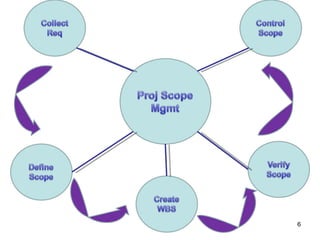
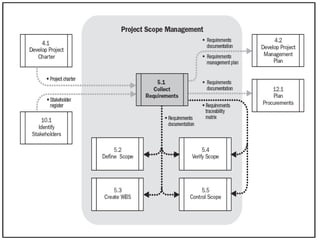
Project Scope Management Processes Collect Requirements:   The process of defining and documenting stakeholders’ needs to meet the project objectives.  Define Scope:  The process of developing a detailed description of the project and product .  Create WBS:  The process of subdividing project deliverables and project work into smaller, more manageable components.
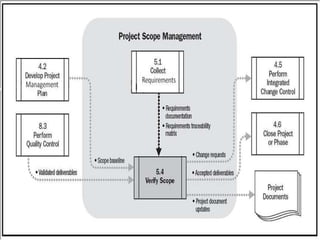
Project Scope Management Processes Verify Scope :   The process of formalizing acceptance of the completed project deliverables.  Control Scope :   The process of monitoring the status of the project and product scope and managing changes to the scope baseline
Context of Scope Product scope . The features and functions that characterize a product, service, or result Completion of the product scope is measured against the product requirements Project scope . The work that needs to be accomplished to deliver a product, service, or result with the specified features and functions. Completion of the project scope is measured against the project management plan
Scope Baseline The approved detailed project scope statement and  its associated WBS and WBS dictionary are the scope baseline for the project. This base lined scope is then monitored, verified, and controlled throughout the lifecycle of the project.
Collect Requirements
Collect Requirements  Collect Requirements is the process of defining and documenting stakeholders’ needs to meet the project objectives. Requirements become the foundation of the WBS.  Product requirements can include information on technical requirements, security requirements, performance requirements etc.
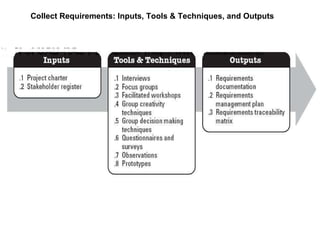
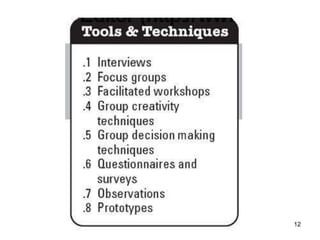
Collect Requirements: Inputs, Tools & Techniques, and Outputs
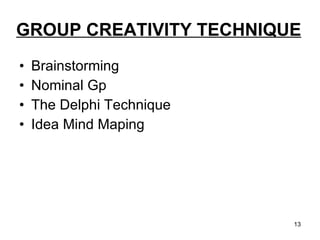
GROUP CREATIVITY TECHNIQUE Brainstorming  Nominal Gp The Delphi Technique Idea Mind Maping
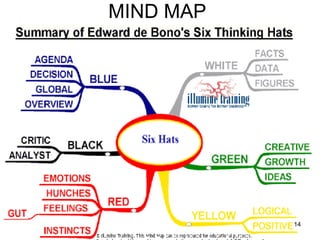
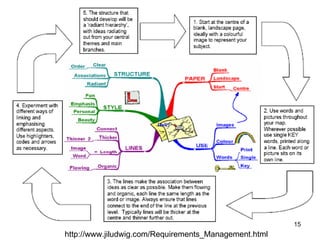
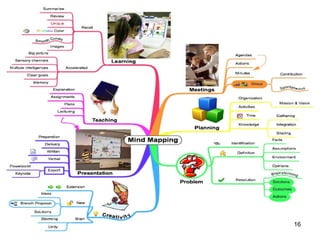
MIND MAP
http://www.jiludwig.com/Requirements_Management.html
GROUP CREATIVITY TECHNIQUE Brainstorming  Nominal Gp The Delphi Technique Idea Mind Maping Affinity Diagram
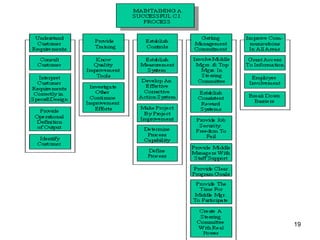
Affinity Diagram Affinity diagrams are great tools for assimilating and understanding large amounts of information.  When you work through the process of creating relationships and working backward from detailed information to broad themes, you get an insight you would not otherwise find.
Group Decision Making Techniques Unanimity Majority Plurality Dictatorship
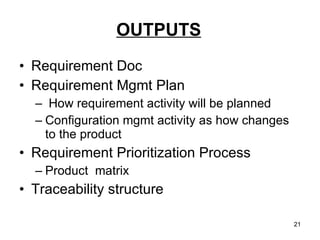
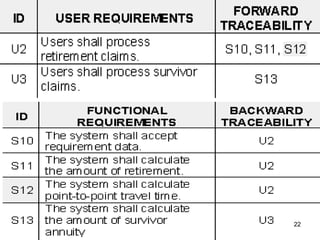
OUTPUTS Requirement Doc Requirement Mgmt Plan How requirement activity will be planned Configuration mgmt activity as how changes to the product  Requirement Prioritization Process Product  matrix Traceability structure
 
Define Scope
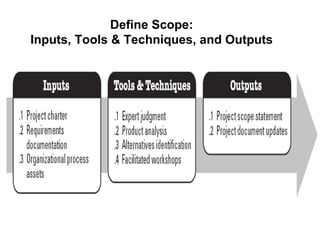
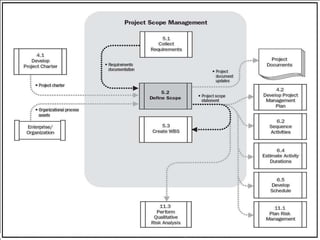
Define Scope:  Inputs, Tools & Techniques, and Outputs
 
WBS
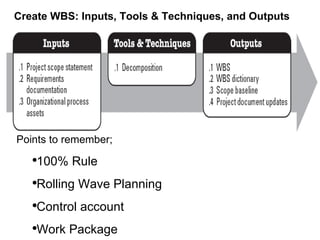
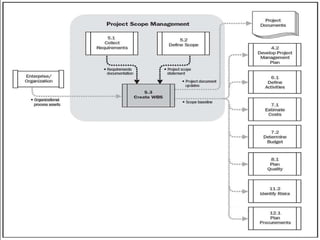
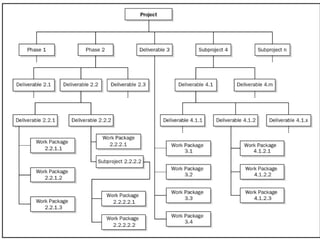
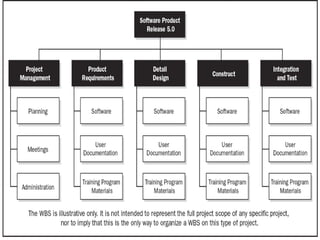
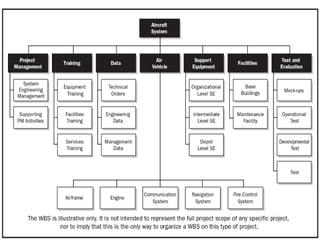
Create WBS: Inputs, Tools & Techniques, and Outputs  Points to remember; 100% Rule Rolling Wave Planning Control account  Work Package


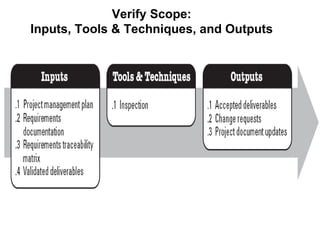
Verify Scope:  Inputs, Tools & Techniques, and Outputs
 
CONTROL SCOPE
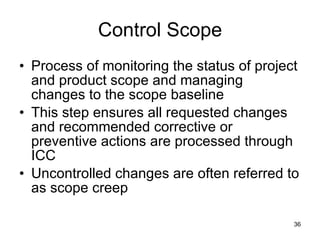
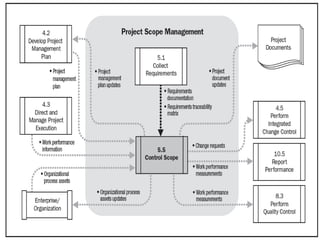
Control Scope Process of monitoring the status of project and product scope and managing changes to the scope baseline This step ensures all requested changes and recommended corrective or preventive actions are processed through ICC Uncontrolled changes are often referred to as scope creep
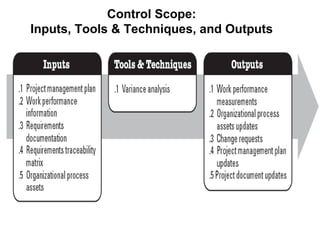
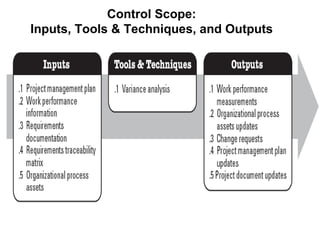
Control Scope:  Inputs, Tools & Techniques, and Outputs
 
Control Scope:  Inputs, Tools & Techniques, and Outputs

802003 634318955109991250

  • 1.
    CHATER 5 PROJECTSCOPE MANAGEMENT
  • 2.
    Projects can becompleted in two ways: Planned and then executed or Executed, stopped, planned and then executed.
  • 3.
    Project Scope Managementincludes the processes required to ensure that the project includes all the work required, and only the work required, to complete the project successfully. Managing the project scope is primarily concerned with defining and controlling what is and is not included in the project.
  • 4.
    Project Scope ManagementProcesses Collect Requirements: The process of defining and documenting stakeholders’ needs to meet the project objectives. Define Scope: The process of developing a detailed description of the project and product . Create WBS: The process of subdividing project deliverables and project work into smaller, more manageable components.
  • 5.
    Project Scope ManagementProcesses Verify Scope : The process of formalizing acceptance of the completed project deliverables. Control Scope : The process of monitoring the status of the project and product scope and managing changes to the scope baseline
  • 7.
    Context of ScopeProduct scope . The features and functions that characterize a product, service, or result Completion of the product scope is measured against the product requirements Project scope . The work that needs to be accomplished to deliver a product, service, or result with the specified features and functions. Completion of the project scope is measured against the project management plan
  • 8.
    Scope Baseline Theapproved detailed project scope statement and its associated WBS and WBS dictionary are the scope baseline for the project. This base lined scope is then monitored, verified, and controlled throughout the lifecycle of the project.
  • 9.
  • 10.
    Collect Requirements Collect Requirements is the process of defining and documenting stakeholders’ needs to meet the project objectives. Requirements become the foundation of the WBS. Product requirements can include information on technical requirements, security requirements, performance requirements etc.
  • 11.
    Collect Requirements: Inputs,Tools & Techniques, and Outputs
  • 13.
    GROUP CREATIVITY TECHNIQUEBrainstorming Nominal Gp The Delphi Technique Idea Mind Maping
  • 14.
  • 15.
  • 17.
    GROUP CREATIVITY TECHNIQUEBrainstorming Nominal Gp The Delphi Technique Idea Mind Maping Affinity Diagram
  • 18.
    Affinity Diagram Affinitydiagrams are great tools for assimilating and understanding large amounts of information. When you work through the process of creating relationships and working backward from detailed information to broad themes, you get an insight you would not otherwise find.
  • 20.
    Group Decision MakingTechniques Unanimity Majority Plurality Dictatorship
  • 21.
    OUTPUTS Requirement DocRequirement Mgmt Plan How requirement activity will be planned Configuration mgmt activity as how changes to the product Requirement Prioritization Process Product matrix Traceability structure
  • 23.
  • 24.
  • 25.
    Define Scope: Inputs, Tools & Techniques, and Outputs
  • 26.
  • 27.
  • 28.
    Create WBS: Inputs,Tools & Techniques, and Outputs Points to remember; 100% Rule Rolling Wave Planning Control account Work Package
  • 29.
  • 30.
  • 31.
  • 32.
  • 33.
    Verify Scope: Inputs, Tools & Techniques, and Outputs
  • 34.
  • 35.
  • 36.
    Control Scope Processof monitoring the status of project and product scope and managing changes to the scope baseline This step ensures all requested changes and recommended corrective or preventive actions are processed through ICC Uncontrolled changes are often referred to as scope creep
  • 37.
    Control Scope: Inputs, Tools & Techniques, and Outputs
  • 38.
  • 39.
    Control Scope: Inputs, Tools & Techniques, and Outputs