

Day 1 Revision
2
1. Integration Management
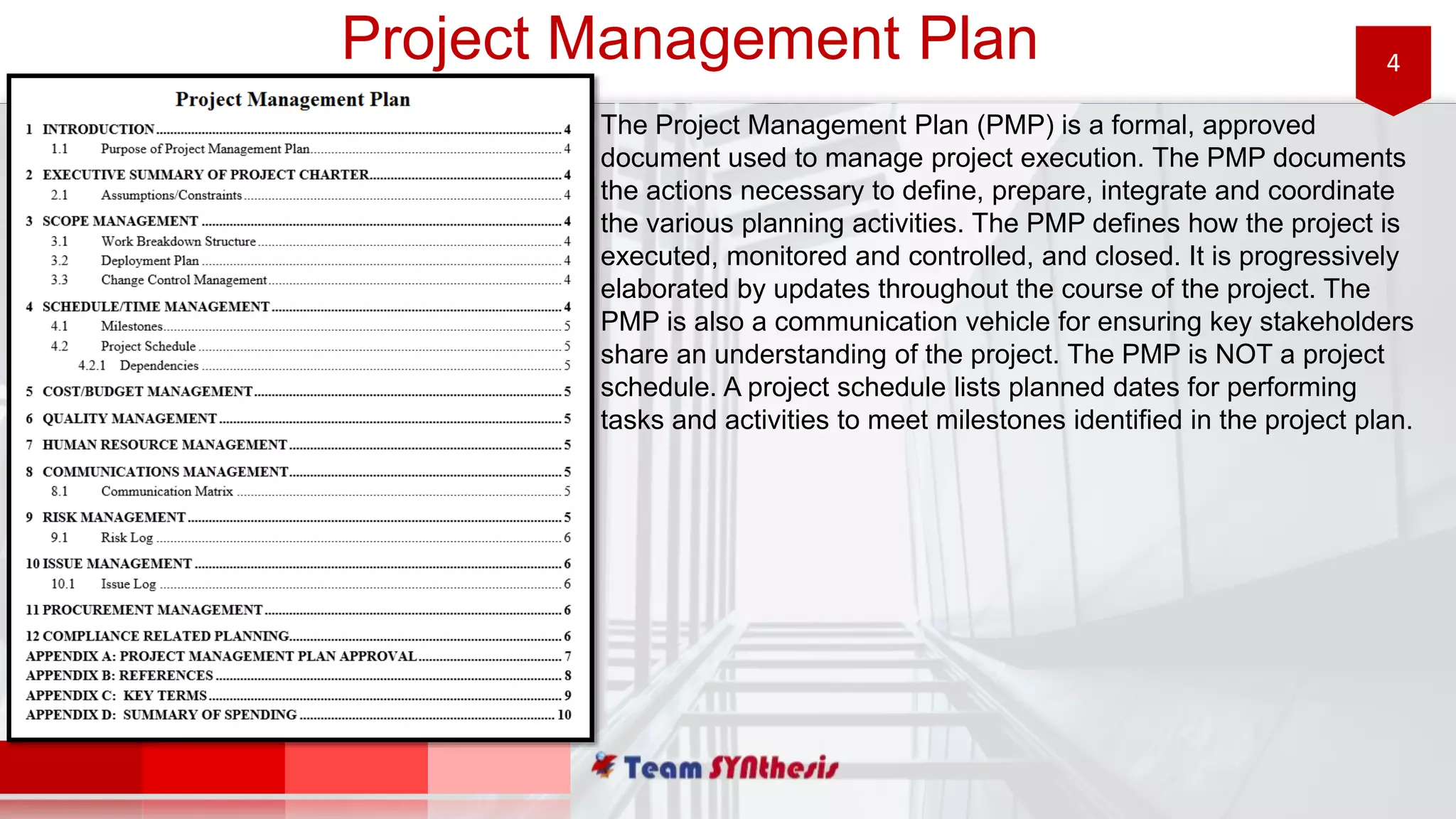
4Project Management Plan
The Project Management Plan (PMP) is a formal, approved
document used to manage project execution. The PMP documents
the actions necessary to define, prepare, integrate and coordinate
the various planning activities. The PMP defines how the project is
executed, monitored and controlled, and closed. It is progressively
elaborated by updates throughout the course of the project. The
PMP is also a communication vehicle for ensuring key stakeholders
share an understanding of the project. The PMP is NOT a project
schedule. A project schedule lists planned dates for performing
tasks and activities to meet milestones identified in the project plan.
2. Scope Management
6Scope Management Plan
Scope management plan is a component that describes how the
scope will be defined, developed, monitored, controlled and verified.
The development of the scope management plan and detailing of
the project scope begin with the analysis of information contained in
the project charter, project management plan, organizational
process assets and relevant enterprise environmental factors. This
plan helps to reduce the risk of project scope creep.
3. Time Management
8Develop Schedule
To develop your project schedule, you'll need to do three things first...
 Define Activity
 Sequence Activity
 Estimate Activity Durations
1. Define Activity
The first step to developing your schedule is to define the specific activities that need to be performed in order to
complete the project.
2. Sequence Activity
Once your activity list is ready, the next step is to determine the order each of the activities needs to be completed in.
3. Estimate Activity Durations
The third step is to estimate how long each activity will take to complete. This needs to take into account the type,
amount, and availability of people, material, equipment and supplies that are needed to perform each activity.
9Activity Dependency
10Critical Path Method
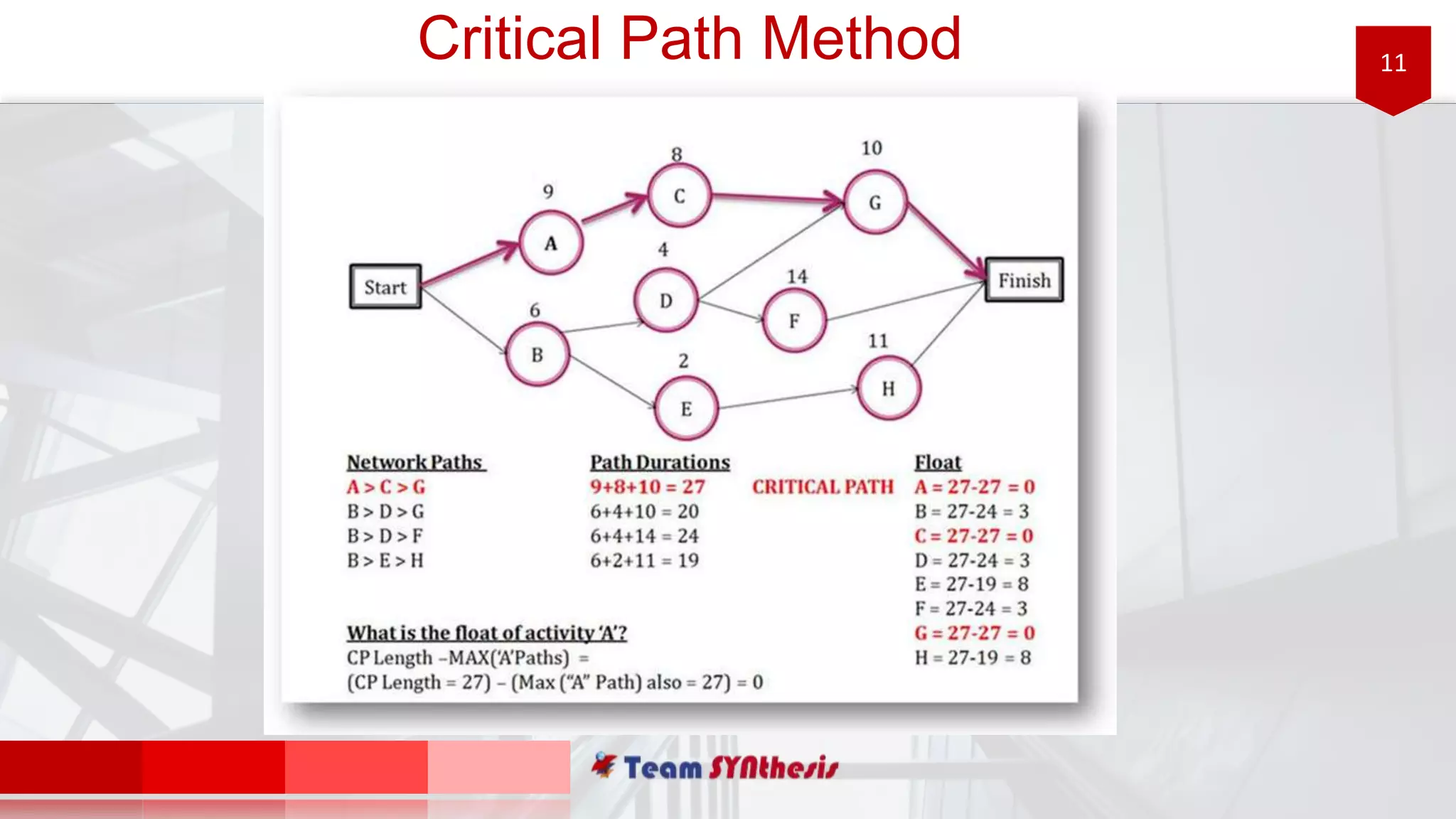
Critical path schedules...
 Help you identify the activities that must be completed on time in order to complete the whole project on time.
 Show you which activities can be delayed and for how long without impacting the overall project schedule.
 Calculate the minimum amount of time it will take to complete the project.
 Tell you the earliest and latest dates each activity can start on in order to maintain the schedule.
The CPM has four key elements...
 Critical Path Analysis
 Float Determination
 Early Start & Early Finish Calculation
 Late Start & Late Finish Calculation
11Critical Path Method
12Early Start & Early Finish Calculation
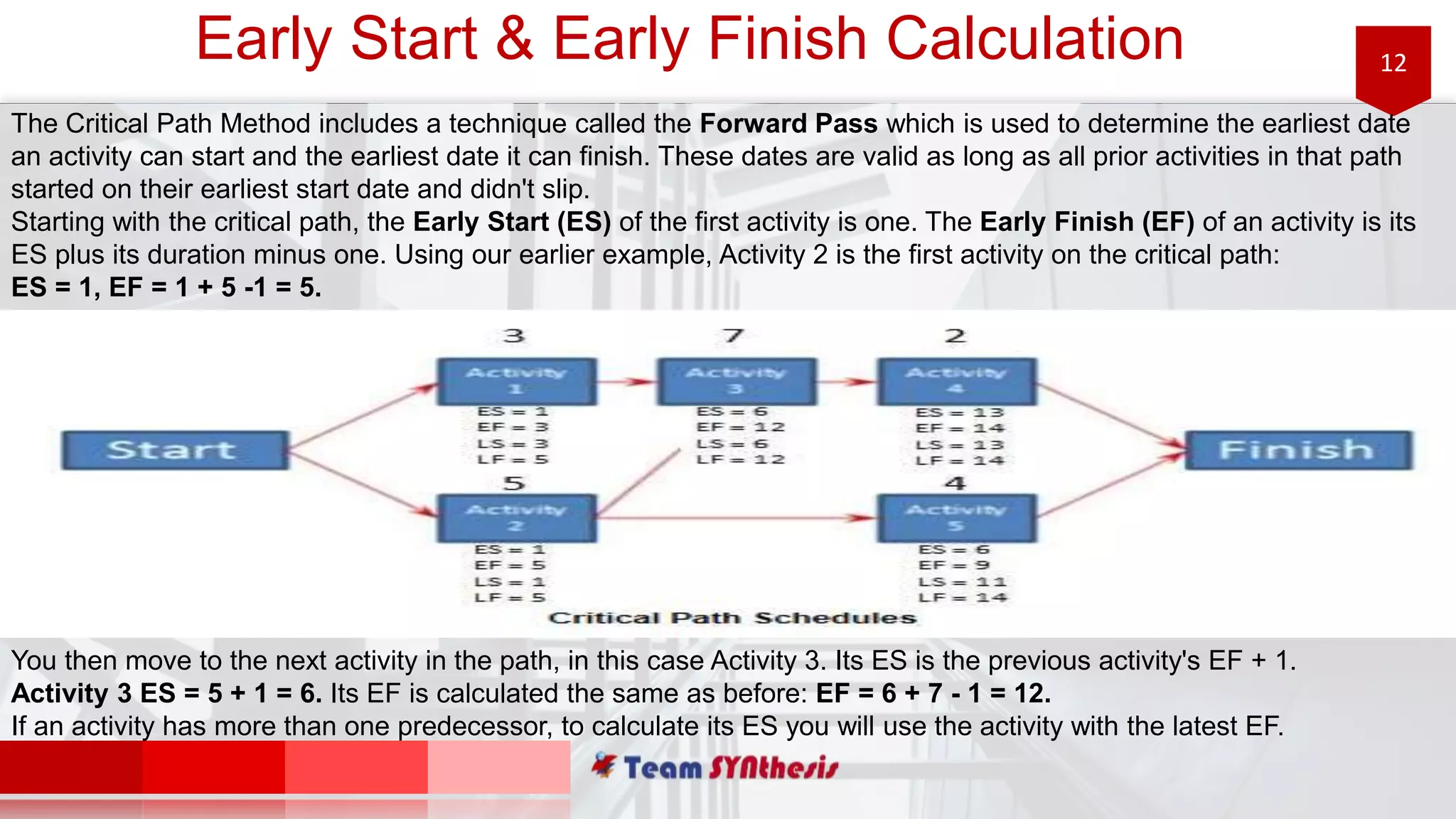
The Critical Path Method includes a technique called the Forward Pass which is used to determine the earliest date
an activity can start and the earliest date it can finish. These dates are valid as long as all prior activities in that path
started on their earliest start date and didn't slip.
Starting with the critical path, the Early Start (ES) of the first activity is one. The Early Finish (EF) of an activity is its
ES plus its duration minus one. Using our earlier example, Activity 2 is the first activity on the critical path:
ES = 1, EF = 1 + 5 -1 = 5.
You then move to the next activity in the path, in this case Activity 3. Its ES is the previous activity's EF + 1.
Activity 3 ES = 5 + 1 = 6. Its EF is calculated the same as before: EF = 6 + 7 - 1 = 12.
If an activity has more than one predecessor, to calculate its ES you will use the activity with the latest EF.
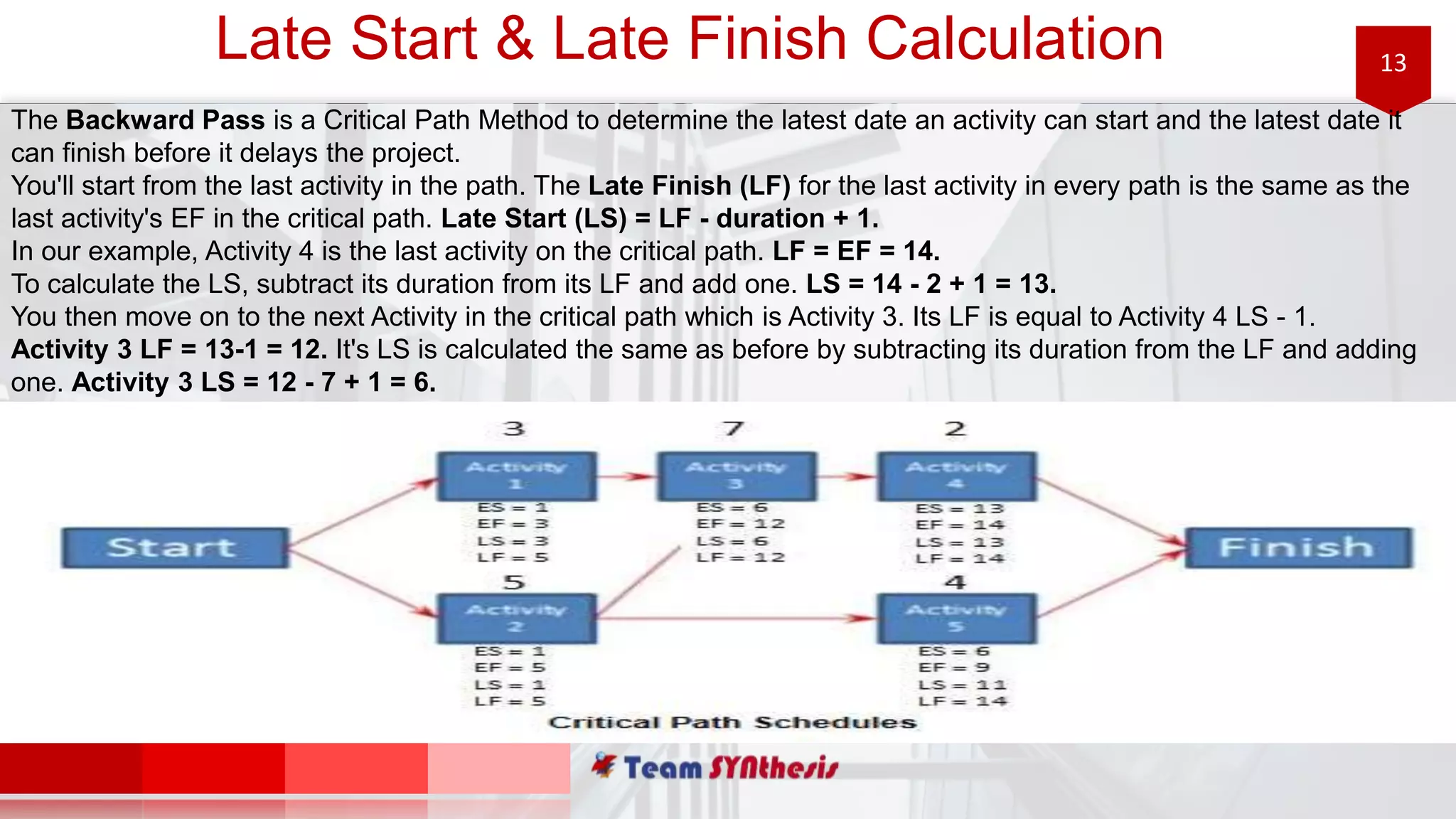
13Late Start & Late Finish Calculation
The Backward Pass is a Critical Path Method to determine the latest date an activity can start and the latest date it
can finish before it delays the project.
You'll start from the last activity in the path. The Late Finish (LF) for the last activity in every path is the same as the
last activity's EF in the critical path. Late Start (LS) = LF - duration + 1.
In our example, Activity 4 is the last activity on the critical path. LF = EF = 14.
To calculate the LS, subtract its duration from its LF and add one. LS = 14 - 2 + 1 = 13.
You then move on to the next Activity in the critical path which is Activity 3. Its LF is equal to Activity 4 LS - 1.
Activity 3 LF = 13-1 = 12. It's LS is calculated the same as before by subtracting its duration from the LF and adding
one. Activity 3 LS = 12 - 7 + 1 = 6.
4. Cost Management
15Earn Value Management (EVM)
Term Full Name Meaning
PV Planned Value Estimated value of the work planned to be done
EV Earned Value Estimated value of the work actually accomplished
AC Actual Costs Actual Costs Incurred
BAC Budget At Completion Amount budgeted for total project
EAC Estimate At Completion Currently expected total for project
ETC Estimate To Complete How much More to finish
VAC Variance At Completion How much over/under we expect to be
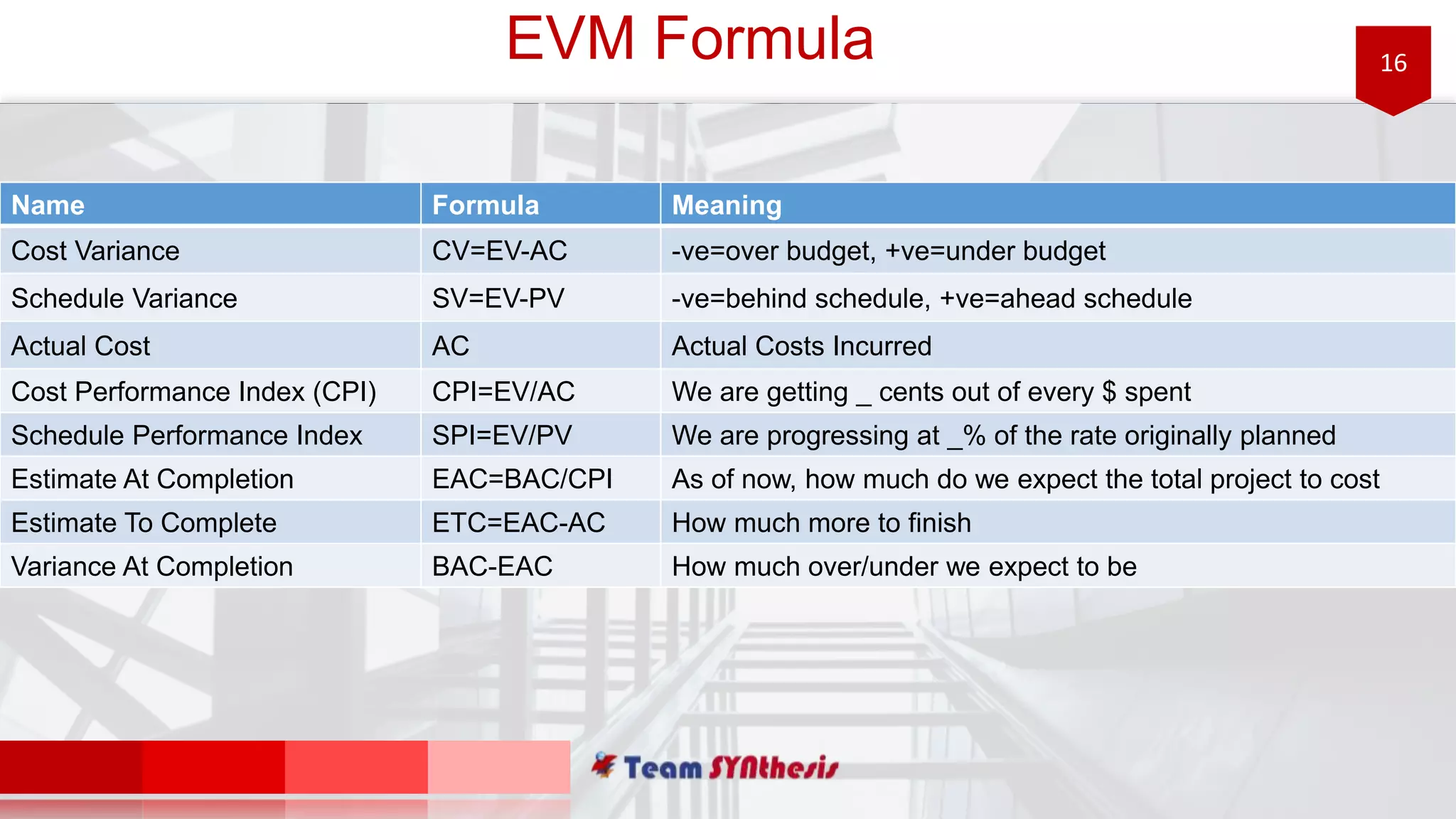
16EVM Formula
Name Formula Meaning
Cost Variance CV=EV-AC -ve=over budget, +ve=under budget
Schedule Variance SV=EV-PV -ve=behind schedule, +ve=ahead schedule
Actual Cost AC Actual Costs Incurred
Cost Performance Index (CPI) CPI=EV/AC We are getting _ cents out of every $ spent
Schedule Performance Index SPI=EV/PV We are progressing at _% of the rate originally planned
Estimate At Completion EAC=BAC/CPI As of now, how much do we expect the total project to cost
Estimate To Complete ETC=EAC-AC How much more to finish
Variance At Completion BAC-EAC How much over/under we expect to be
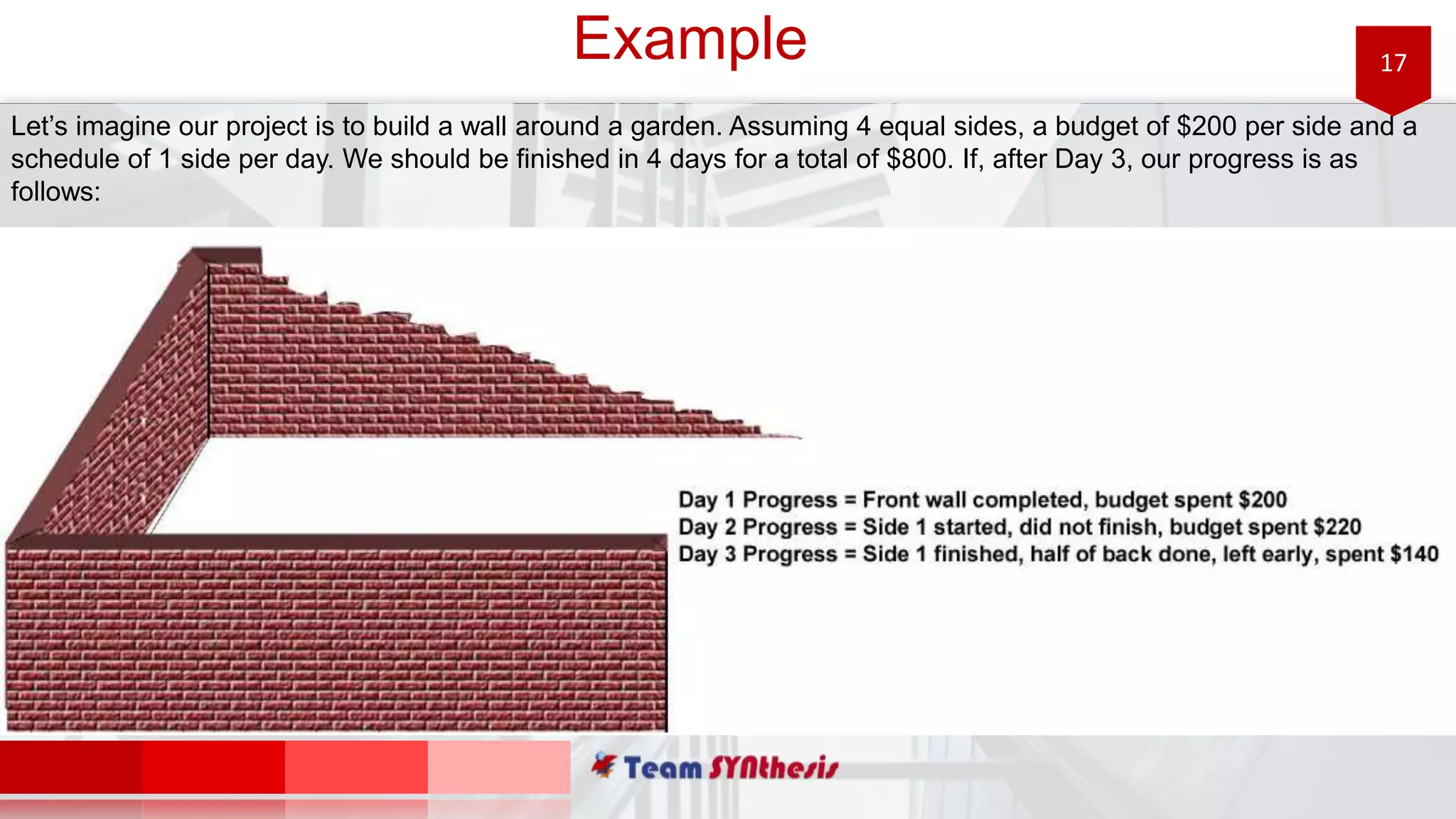
17Example
Let’s imagine our project is to build a wall around a garden. Assuming 4 equal sides, a budget of $200 per side and a
schedule of 1 side per day. We should be finished in 4 days for a total of $800. If, after Day 3, our progress is as
follows:
18Calculation
Name Formula Day 3 Value
PV - Planned Value
Estimated value of the work
planned to be done
Should have done 3 x $200 = $600 or
Percentage Complete 75%
SV=EV-PV
Estimated value of the work
actually accomplished
Actually done 2.5 sides $200+$200+$100 = $500
or
Actual Percentage Complete 62.5%
AC - Actual Costs Actual Costs Incurred $200+$220+$140=$560
Cost Performance Index
Over / Under Budget factor CPI =
EV / AC
$500 / $560 = 0.89
Schedule Performance Index
Ahead / Behind Schedule factor
SPI = EV / PV
$500 / $600 = 0.83 0r
62.5%/75%% = 0.83
BAC - Budget At Completion Amount budgeted for total project $800
EAC - Estimate At
Completion
ETC=EAC-AC
Currently expected total for project EAC=BAC /
CPI
ETC - Estimate To Complete
How much more to finish? ETC =
EAC - AC
$899 - $560 = $339
VAC - Variance At
Completion
How much over/under we expect
to be VAC = BAC – EAC
$800 - $899 = -$99
19
Without Goals and Plans to Reach Them,
You are Like a Ship that has Set Sail with No Destination

Day 1 - Revision

  • 1.
  • 2.
  • 3.
  • 4.
    4Project Management Plan TheProject Management Plan (PMP) is a formal, approved document used to manage project execution. The PMP documents the actions necessary to define, prepare, integrate and coordinate the various planning activities. The PMP defines how the project is executed, monitored and controlled, and closed. It is progressively elaborated by updates throughout the course of the project. The PMP is also a communication vehicle for ensuring key stakeholders share an understanding of the project. The PMP is NOT a project schedule. A project schedule lists planned dates for performing tasks and activities to meet milestones identified in the project plan.
  • 5.
  • 6.
    6Scope Management Plan Scopemanagement plan is a component that describes how the scope will be defined, developed, monitored, controlled and verified. The development of the scope management plan and detailing of the project scope begin with the analysis of information contained in the project charter, project management plan, organizational process assets and relevant enterprise environmental factors. This plan helps to reduce the risk of project scope creep.
  • 7.
  • 8.
    8Develop Schedule To developyour project schedule, you'll need to do three things first...  Define Activity  Sequence Activity  Estimate Activity Durations 1. Define Activity The first step to developing your schedule is to define the specific activities that need to be performed in order to complete the project. 2. Sequence Activity Once your activity list is ready, the next step is to determine the order each of the activities needs to be completed in. 3. Estimate Activity Durations The third step is to estimate how long each activity will take to complete. This needs to take into account the type, amount, and availability of people, material, equipment and supplies that are needed to perform each activity.
  • 9.
  • 10.
    10Critical Path Method Criticalpath schedules...  Help you identify the activities that must be completed on time in order to complete the whole project on time.  Show you which activities can be delayed and for how long without impacting the overall project schedule.  Calculate the minimum amount of time it will take to complete the project.  Tell you the earliest and latest dates each activity can start on in order to maintain the schedule. The CPM has four key elements...  Critical Path Analysis  Float Determination  Early Start & Early Finish Calculation  Late Start & Late Finish Calculation
  • 11.
  • 12.
    12Early Start &Early Finish Calculation The Critical Path Method includes a technique called the Forward Pass which is used to determine the earliest date an activity can start and the earliest date it can finish. These dates are valid as long as all prior activities in that path started on their earliest start date and didn't slip. Starting with the critical path, the Early Start (ES) of the first activity is one. The Early Finish (EF) of an activity is its ES plus its duration minus one. Using our earlier example, Activity 2 is the first activity on the critical path: ES = 1, EF = 1 + 5 -1 = 5. You then move to the next activity in the path, in this case Activity 3. Its ES is the previous activity's EF + 1. Activity 3 ES = 5 + 1 = 6. Its EF is calculated the same as before: EF = 6 + 7 - 1 = 12. If an activity has more than one predecessor, to calculate its ES you will use the activity with the latest EF.
  • 13.
    13Late Start &Late Finish Calculation The Backward Pass is a Critical Path Method to determine the latest date an activity can start and the latest date it can finish before it delays the project. You'll start from the last activity in the path. The Late Finish (LF) for the last activity in every path is the same as the last activity's EF in the critical path. Late Start (LS) = LF - duration + 1. In our example, Activity 4 is the last activity on the critical path. LF = EF = 14. To calculate the LS, subtract its duration from its LF and add one. LS = 14 - 2 + 1 = 13. You then move on to the next Activity in the critical path which is Activity 3. Its LF is equal to Activity 4 LS - 1. Activity 3 LF = 13-1 = 12. It's LS is calculated the same as before by subtracting its duration from the LF and adding one. Activity 3 LS = 12 - 7 + 1 = 6.
  • 14.
  • 15.
    15Earn Value Management(EVM) Term Full Name Meaning PV Planned Value Estimated value of the work planned to be done EV Earned Value Estimated value of the work actually accomplished AC Actual Costs Actual Costs Incurred BAC Budget At Completion Amount budgeted for total project EAC Estimate At Completion Currently expected total for project ETC Estimate To Complete How much More to finish VAC Variance At Completion How much over/under we expect to be
  • 16.
    16EVM Formula Name FormulaMeaning Cost Variance CV=EV-AC -ve=over budget, +ve=under budget Schedule Variance SV=EV-PV -ve=behind schedule, +ve=ahead schedule Actual Cost AC Actual Costs Incurred Cost Performance Index (CPI) CPI=EV/AC We are getting _ cents out of every $ spent Schedule Performance Index SPI=EV/PV We are progressing at _% of the rate originally planned Estimate At Completion EAC=BAC/CPI As of now, how much do we expect the total project to cost Estimate To Complete ETC=EAC-AC How much more to finish Variance At Completion BAC-EAC How much over/under we expect to be
  • 17.
    17Example Let’s imagine ourproject is to build a wall around a garden. Assuming 4 equal sides, a budget of $200 per side and a schedule of 1 side per day. We should be finished in 4 days for a total of $800. If, after Day 3, our progress is as follows:
  • 18.
    18Calculation Name Formula Day3 Value PV - Planned Value Estimated value of the work planned to be done Should have done 3 x $200 = $600 or Percentage Complete 75% SV=EV-PV Estimated value of the work actually accomplished Actually done 2.5 sides $200+$200+$100 = $500 or Actual Percentage Complete 62.5% AC - Actual Costs Actual Costs Incurred $200+$220+$140=$560 Cost Performance Index Over / Under Budget factor CPI = EV / AC $500 / $560 = 0.89 Schedule Performance Index Ahead / Behind Schedule factor SPI = EV / PV $500 / $600 = 0.83 0r 62.5%/75%% = 0.83 BAC - Budget At Completion Amount budgeted for total project $800 EAC - Estimate At Completion ETC=EAC-AC Currently expected total for project EAC=BAC / CPI ETC - Estimate To Complete How much more to finish? ETC = EAC - AC $899 - $560 = $339 VAC - Variance At Completion How much over/under we expect to be VAC = BAC – EAC $800 - $899 = -$99
  • 19.
    19 Without Goals andPlans to Reach Them, You are Like a Ship that has Set Sail with No Destination