Project	
  Scope	
  
Management	
  
Presented By:
Anit Kumar Roy
1
Project	
  Scope	
  Management	
  
O Scope refers to all the work involved in creating the
products of the project and the processes used to create
them. It defines what is or is not to be done
O Deliverables are products produced as part of a project,
such as hardware or software, planning documents, or
meeting minutes
O The project team and stakeholders must have the same
understanding of what products will be produced as a
result of a project and how they’ll be produced
2
Processes	
  in	
  Project	
  Scope	
  
Management	
  
O Collecting requirements: stakeholder requirements
documentation, a requirements management plan
and a requirements traceability matrix
O Defining scope
O Creating the Work Breakdown Structure (WBS): WBS
dictionary, a scope baseline, and updates to project
documents
O Verifying scope
O Controlling scope
3
STEP	
  1:	
  Collecting	
  
Requirements	
  
O IEEE Standard Glossary of Software Engineering
Terminology:
O A condition or capability that must be met or processed
by a system or system component to satisfy a contract,
standard, specification, or other formally imposed
document
O E.g.: Opening case: Upgrading IT assets to meet
corporate standards.
O Some IT projects divide requirements development into
categories: elicitation, analysis, specification and
validation
4
Ways	
  of	
  Collecting	
  
Requirements	
  
O Interviewing stakeholders one-on-one
O Holding focus groups, facilitated workshops and using group
creativity and decision making techniques to collect
requirements
O Questionnaires and surveys
O Observations
O Prototyping
O Software tools
The project size, complexity, importance and other factors will
affect how much effort is spent on collecting requirements
5
Documenting	
  Requirements	
  
O Project teams should first review the project charter
O Review stakeholders register
O People involved in complex projects
O Software generated
O Broken down into different categories: functional
requirements, service requirements, performance
requirements, quality requirements, training
requirements.
O Requirement Management Plan
O Requirement Traceability Matrix (RTM) 6
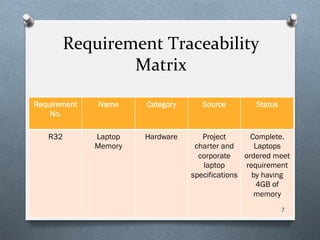
Requirement	
  Traceability	
  
Matrix	


Requirement
No.
Name Category Source Status
R32 Laptop
Memory
Hardware Project
charter and
corporate
laptop
specifications
Complete.
Laptops
ordered meet
requirement
by having
4GB of
memory
7
STEP	
  2:	
  Defining	
  Scope	
  
O Good scope definition
O helps improve the accuracy of time, cost, and resource
estimates
O defines a baseline for performance measurement and project
control
O aids in communicating clear work responsibilities
O Tools: expert judgment, product analysis, alternative
identification and facilitated workshops
O Inputs: Project charter, requirements documentation,
organizational process assets (policies and procedures)
and also previous project files and lessons learned.
O Outputs: The project scope statement and project document
updates 8
Project	
  Charters	
  
O After deciding what project to work on, it is
important to formalize projects
O A project charter is a document that formally
recognizes the existence of a project and provides
direction on the project’s objectives and
management
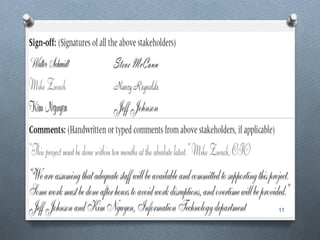
O Key project stakeholders should sign a project
charter to acknowledge agreement on the need
and intent of the project
9
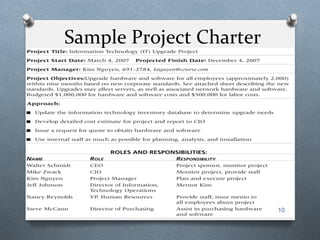
Sample	
  Project	
  Charter	
  
10
11
Scope	
  Planning	
  and	
  the	
  Scope	
  
Statement	
  
O A scope statement is a document used to develop and
confirm a common understanding of the project
scope. It should include
O a project justification
O a brief description of the project’s products
O a summary of all project deliverables
O a statement of what determines project success
O E.g.: Servers: This project will require purchasing ten new
servers to support Web, network, database, application,
and printing functions. Virtualization will be used to
maximize efficiency. Detailed description of the servers
are provided in a product brochure in Appendix 8 along
with a plan describing where they will be located 12
Work	
  Breakdown	
  Structure	
  
O After completing scope planning, the next step is to
further define the work by breaking it into
manageable pieces
O Good scope definition
O helps improve the accuracy of time, cost, and
resource estimates
O defines a baseline for performance measurement
and project control
O aids in communicating clear work responsibilities
13
The	
  Work	
  Breakdown	
  Structure	
  
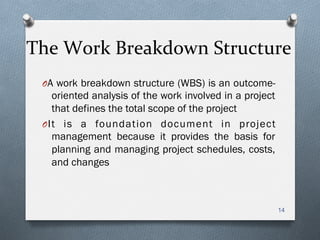
O A work breakdown structure (WBS) is an outcome-
oriented analysis of the work involved in a project
that defines the total scope of the project
O It is a foundation document in project
management because it provides the basis for
planning and managing project schedules, costs,
and changes
14
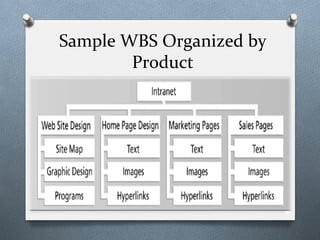
Sample	
  WBS	
  Organized	
  by	
  
Product	
  	
  
15
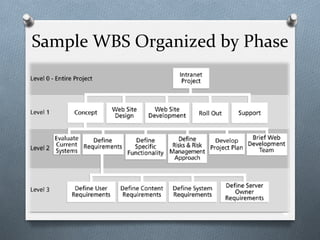
Sample	
  WBS	
  Organized	
  by	
  Phase	
  
16
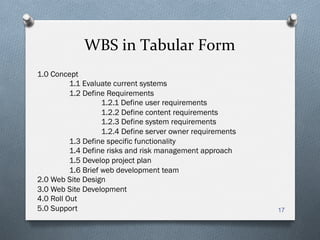
WBS	
  in	
  Tabular	
  Form	
  
17
1.0 Concept
1.1 Evaluate current systems
1.2 Define Requirements
1.2.1 Define user requirements
1.2.2 Define content requirements
1.2.3 Define system requirements
1.2.4 Define server owner requirements
1.3 Define specific functionality
1.4 Define risks and risk management approach
1.5 Develop project plan
1.6 Brief web development team
2.0 Web Site Design
3.0 Web Site Development
4.0 Roll Out
5.0 Support
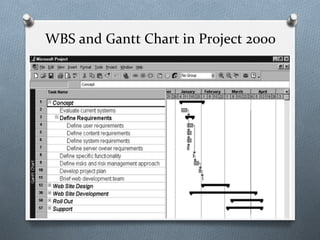
WBS	
  and	
  Gantt	
  Chart	
  in	
  Project	
  2000	
  
18
Project 98 file
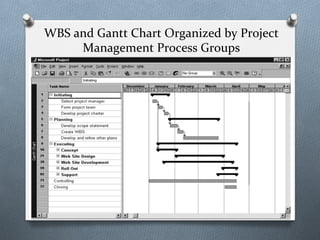
WBS	
  and	
  Gantt	
  Chart	
  Organized	
  by	
  Project	
  
Management	
  Process	
  Groups	
  
19
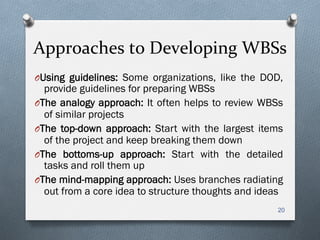
Approaches	
  to	
  Developing	
  WBSs	
  
O Using guidelines: Some organizations, like the DOD,
provide guidelines for preparing WBSs
O The analogy approach: It often helps to review WBSs
of similar projects
O The top-down approach: Start with the largest items
of the project and keep breaking them down
O The bottoms-up approach: Start with the detailed
tasks and roll them up
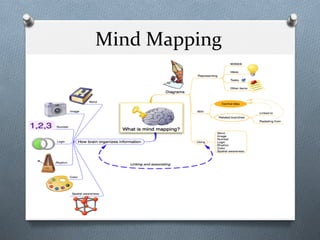
O The mind-mapping approach: Uses branches radiating
out from a core idea to structure thoughts and ideas
20
Mind	
  Mapping	
  
21
Advice	
  for	
  Creating	
  WBS	
  and	
  WBS	
  
Dictionary	
  
O A unit of work should appear at only one place in the WBS
O The work content of a WBS item is the sum of the WBS items below it
O A WBS item is the responsibility of only one individual, even though
many people may be working on it
O The WBS must be consistent with the way in which work is actually
going to be performed; it should serve the project team first and
other purposes only if practical
O Project team members should be involved in developing the WBS to
ensure consistency and buy-in
O Each WBS item must be documented to ensure accurate
understanding of the scope of work included and not included in that
item
O The WBS must be a flexible tool to accommodate inevitable changes
while properly maintaining control of the work content in the project
according to the scope statement 22
Verifying	
  and	
  Controlling	
  Scope	
  
O It is very difficult to create a good scope statement and
WBS for a project
O It is even more difficult to verify project scope and
minimize scope changes
O Many IT projects suffer from scope creep and poor
scope verification
23
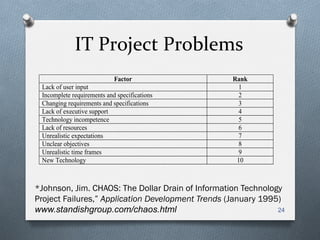
IT	
  Project	
  Problems	
  
24
Factor Rank
Lack of user input 1
Incomplete requirements and specifications 2
Changing requirements and specifications 3
Lack of executive support 4
Technology incompetence 5
Lack of resources 6
Unrealistic expectations 7
Unclear objectives 8
Unrealistic time frames 9
New Technology 10
*Johnson, Jim. CHAOS: The Dollar Drain of Information Technology
Project Failures,” Application Development Trends (January 1995)
www.standishgroup.com/chaos.html
Suggestions	
  for	
  Improving	
  
User	
  Input	
  
O Insist that all projects have a sponsor from the
user organization
O Have users on the project team
O Have regular meetings
O Deliver something to project users and sponsor
on a regular basis
O Co-locate users with the developers
25
Suggestions	
  for	
  Reducing	
  Incomplete	
  
and	
  Changing	
  Requirements	
  
O Develop and follow a requirements management
process
O Employ techniques such as prototyping, use case
modeling, and Joint Application Design to thoroughly
understand user requirements
O Put all requirements in writing and current
O Create a requirements management database
O Provide adequate testing
O Use a process for reviewing requested changes from a
systems perspective
O Emphasize completion dates 26
Using	
  Software	
  to	
  Assist	
  in	
  	
  
Project	
  Scope	
  Management	
  
O Word-processing software helps create several scope-
related documents
O Spreadsheets help to perform financial calculations
and weighed scoring models, and develop charts and
graphs
O Communication software like e-mail and the Web help
clarify and communicate scope information
O Project management software helps in creating a WBS,
the basis for tasks on a Gantt chart
O Specialized software is available to assist in project
scope management 27
28

Project scope management

  • 1.
    Project  Scope   Management   Presented By: Anit Kumar Roy 1
  • 2.
    Project  Scope  Management   O Scope refers to all the work involved in creating the products of the project and the processes used to create them. It defines what is or is not to be done O Deliverables are products produced as part of a project, such as hardware or software, planning documents, or meeting minutes O The project team and stakeholders must have the same understanding of what products will be produced as a result of a project and how they’ll be produced 2
  • 3.
    Processes  in  Project  Scope   Management   O Collecting requirements: stakeholder requirements documentation, a requirements management plan and a requirements traceability matrix O Defining scope O Creating the Work Breakdown Structure (WBS): WBS dictionary, a scope baseline, and updates to project documents O Verifying scope O Controlling scope 3
  • 4.
    STEP  1:  Collecting   Requirements   O IEEE Standard Glossary of Software Engineering Terminology: O A condition or capability that must be met or processed by a system or system component to satisfy a contract, standard, specification, or other formally imposed document O E.g.: Opening case: Upgrading IT assets to meet corporate standards. O Some IT projects divide requirements development into categories: elicitation, analysis, specification and validation 4
  • 5.
    Ways  of  Collecting   Requirements   O Interviewing stakeholders one-on-one O Holding focus groups, facilitated workshops and using group creativity and decision making techniques to collect requirements O Questionnaires and surveys O Observations O Prototyping O Software tools The project size, complexity, importance and other factors will affect how much effort is spent on collecting requirements 5
  • 6.
    Documenting  Requirements   O Projectteams should first review the project charter O Review stakeholders register O People involved in complex projects O Software generated O Broken down into different categories: functional requirements, service requirements, performance requirements, quality requirements, training requirements. O Requirement Management Plan O Requirement Traceability Matrix (RTM) 6
  • 7.
    Requirement  Traceability   Matrix     Requirement No. Name Category Source Status R32 Laptop Memory Hardware Project charter and corporate laptop specifications Complete. Laptops ordered meet requirement by having 4GB of memory 7
  • 8.
    STEP  2:  Defining  Scope   O Good scope definition O helps improve the accuracy of time, cost, and resource estimates O defines a baseline for performance measurement and project control O aids in communicating clear work responsibilities O Tools: expert judgment, product analysis, alternative identification and facilitated workshops O Inputs: Project charter, requirements documentation, organizational process assets (policies and procedures) and also previous project files and lessons learned. O Outputs: The project scope statement and project document updates 8
  • 9.
    Project  Charters   O Afterdeciding what project to work on, it is important to formalize projects O A project charter is a document that formally recognizes the existence of a project and provides direction on the project’s objectives and management O Key project stakeholders should sign a project charter to acknowledge agreement on the need and intent of the project 9
  • 10.
  • 11.
  • 12.
    Scope  Planning  and  the  Scope   Statement   O A scope statement is a document used to develop and confirm a common understanding of the project scope. It should include O a project justification O a brief description of the project’s products O a summary of all project deliverables O a statement of what determines project success O E.g.: Servers: This project will require purchasing ten new servers to support Web, network, database, application, and printing functions. Virtualization will be used to maximize efficiency. Detailed description of the servers are provided in a product brochure in Appendix 8 along with a plan describing where they will be located 12
  • 13.
    Work  Breakdown  Structure   O After completing scope planning, the next step is to further define the work by breaking it into manageable pieces O Good scope definition O helps improve the accuracy of time, cost, and resource estimates O defines a baseline for performance measurement and project control O aids in communicating clear work responsibilities 13
  • 14.
    The  Work  Breakdown  Structure   O A work breakdown structure (WBS) is an outcome- oriented analysis of the work involved in a project that defines the total scope of the project O It is a foundation document in project management because it provides the basis for planning and managing project schedules, costs, and changes 14
  • 15.
    Sample  WBS  Organized  by   Product     15
  • 16.
    Sample  WBS  Organized  by  Phase   16
  • 17.
    WBS  in  Tabular  Form   17 1.0 Concept 1.1 Evaluate current systems 1.2 Define Requirements 1.2.1 Define user requirements 1.2.2 Define content requirements 1.2.3 Define system requirements 1.2.4 Define server owner requirements 1.3 Define specific functionality 1.4 Define risks and risk management approach 1.5 Develop project plan 1.6 Brief web development team 2.0 Web Site Design 3.0 Web Site Development 4.0 Roll Out 5.0 Support
  • 18.
    WBS  and  Gantt  Chart  in  Project  2000   18 Project 98 file
  • 19.
    WBS  and  Gantt  Chart  Organized  by  Project   Management  Process  Groups   19
  • 20.
    Approaches  to  Developing  WBSs   O Using guidelines: Some organizations, like the DOD, provide guidelines for preparing WBSs O The analogy approach: It often helps to review WBSs of similar projects O The top-down approach: Start with the largest items of the project and keep breaking them down O The bottoms-up approach: Start with the detailed tasks and roll them up O The mind-mapping approach: Uses branches radiating out from a core idea to structure thoughts and ideas 20
  • 21.
  • 22.
    Advice  for  Creating  WBS  and  WBS   Dictionary   O A unit of work should appear at only one place in the WBS O The work content of a WBS item is the sum of the WBS items below it O A WBS item is the responsibility of only one individual, even though many people may be working on it O The WBS must be consistent with the way in which work is actually going to be performed; it should serve the project team first and other purposes only if practical O Project team members should be involved in developing the WBS to ensure consistency and buy-in O Each WBS item must be documented to ensure accurate understanding of the scope of work included and not included in that item O The WBS must be a flexible tool to accommodate inevitable changes while properly maintaining control of the work content in the project according to the scope statement 22
  • 23.
    Verifying  and  Controlling  Scope   O It is very difficult to create a good scope statement and WBS for a project O It is even more difficult to verify project scope and minimize scope changes O Many IT projects suffer from scope creep and poor scope verification 23
  • 24.
    IT  Project  Problems   24 Factor Rank Lack of user input 1 Incomplete requirements and specifications 2 Changing requirements and specifications 3 Lack of executive support 4 Technology incompetence 5 Lack of resources 6 Unrealistic expectations 7 Unclear objectives 8 Unrealistic time frames 9 New Technology 10 *Johnson, Jim. CHAOS: The Dollar Drain of Information Technology Project Failures,” Application Development Trends (January 1995) www.standishgroup.com/chaos.html
  • 25.
    Suggestions  for  Improving   User  Input   O Insist that all projects have a sponsor from the user organization O Have users on the project team O Have regular meetings O Deliver something to project users and sponsor on a regular basis O Co-locate users with the developers 25
  • 26.
    Suggestions  for  Reducing  Incomplete   and  Changing  Requirements   O Develop and follow a requirements management process O Employ techniques such as prototyping, use case modeling, and Joint Application Design to thoroughly understand user requirements O Put all requirements in writing and current O Create a requirements management database O Provide adequate testing O Use a process for reviewing requested changes from a systems perspective O Emphasize completion dates 26
  • 27.
    Using  Software  to  Assist  in     Project  Scope  Management   O Word-processing software helps create several scope- related documents O Spreadsheets help to perform financial calculations and weighed scoring models, and develop charts and graphs O Communication software like e-mail and the Web help clarify and communicate scope information O Project management software helps in creating a WBS, the basis for tasks on a Gantt chart O Specialized software is available to assist in project scope management 27
  • 28.