PRODUCT AND PROCESS
LAYOUT
PRODUCT LAYOUT
• Arranged in one line depending upon the sequence of operations.
• Materials move sequentially.
• Output of one machine becoming input of the next.
a) All the machine tools or other items of equipment's must be placed at the point
demanded by the sequence of operations
b) There should no points where one line crossed another line.
c) Materials may be fed where they are required for assembly but not necessarily at one
point.
d) All the operations including assembly, testing packing must be included in the line
PRINCIPLES OF GROUPING OF MACHINES
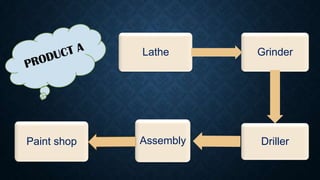
Lathe Grinder
DrillerAssemblyPaint shop
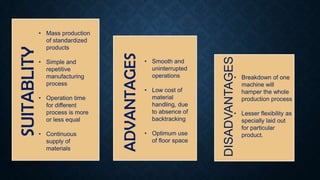
SUITABLITY• Mass production
of standardized
products
• Simple and
repetitive
manufacturing
process
• Operation time
for different
process is more
or less equal
• Continuous
supply of
materials
ADVANTAGES
• Smooth and
uninterrupted
operations
• Low cost of
material
handling, due
to absence of
backtracking
• Optimum use
of floor space
DISADVANTAGES
• Breakdown of one
machine will
hamper the whole
production process
• Lesser flexibility as
specially laid out
for particular
product.
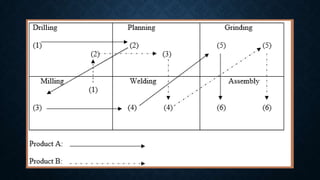
PROCESS LAYOUT
Machines of a similar type are arranged together at one place.
The work, which has to be done, is allocated to the machines according to loading
schedules with the object of ensuring that each machine is fully loaded.
PRINCIPLES OF GROUPING OF MACHINES
a) The distance between departments should be as short as possible for avoiding long
distance movement of materials
b) The departments should be in sequence of operations
c) The arrangement should be convenient for inspection and supervision
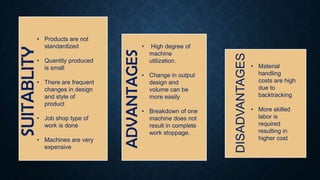
SUITABLITY
ADVANTAGES
DISADVANTAGES
• Products are not
standardized
• Quantity produced
is small
• There are frequent
changes in design
and style of
product
• Job shop type of
work is done
• Machines are very
expensive
• High degree of
machine
utilization.
• Change in output
design and
volume can be
more easily
• Breakdown of one
machine does not
result in complete
work stoppage.
• Material
handling
costs are high
due to
backtracking
• More skilled
labor is
required
resulting in
higher cost

Product and Process Layout

  • 1.
  • 2.
    PRODUCT LAYOUT • Arrangedin one line depending upon the sequence of operations. • Materials move sequentially. • Output of one machine becoming input of the next. a) All the machine tools or other items of equipment's must be placed at the point demanded by the sequence of operations b) There should no points where one line crossed another line. c) Materials may be fed where they are required for assembly but not necessarily at one point. d) All the operations including assembly, testing packing must be included in the line PRINCIPLES OF GROUPING OF MACHINES
  • 3.
  • 4.
    SUITABLITY• Mass production ofstandardized products • Simple and repetitive manufacturing process • Operation time for different process is more or less equal • Continuous supply of materials ADVANTAGES • Smooth and uninterrupted operations • Low cost of material handling, due to absence of backtracking • Optimum use of floor space DISADVANTAGES • Breakdown of one machine will hamper the whole production process • Lesser flexibility as specially laid out for particular product.
  • 5.
    PROCESS LAYOUT Machines ofa similar type are arranged together at one place. The work, which has to be done, is allocated to the machines according to loading schedules with the object of ensuring that each machine is fully loaded. PRINCIPLES OF GROUPING OF MACHINES a) The distance between departments should be as short as possible for avoiding long distance movement of materials b) The departments should be in sequence of operations c) The arrangement should be convenient for inspection and supervision
  • 7.
    SUITABLITY ADVANTAGES DISADVANTAGES • Products arenot standardized • Quantity produced is small • There are frequent changes in design and style of product • Job shop type of work is done • Machines are very expensive • High degree of machine utilization. • Change in output design and volume can be more easily • Breakdown of one machine does not result in complete work stoppage. • Material handling costs are high due to backtracking • More skilled labor is required resulting in higher cost