PRODUCTION MANAGEMENT
PLANT LAYOUT
Dr.T.Sivakami
Assistant Professor
Department of Management Studies
Bon Secours college for Women
Thanjavur
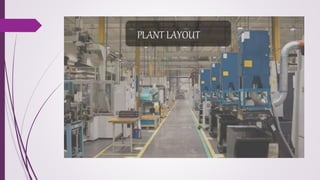
PLANT LAYOUT
MEANING:
Arrangement of
 Machinery
 Equipment
 Other industrial facilities
 Achieving quick production at least cost.
What is a plant layout:
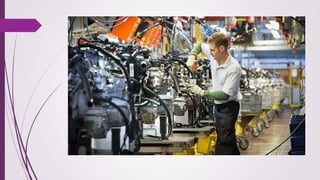
Plant layout refers to the arrangement of physical
facilities such as machinery, equipment, furniture
etc. With in the factory building in such a manner so
as to have quickest flow of material at the lowest cost
and with the least amount of handling in processing
the product form the receipt of material to the
shipment of the finished product.
OBJECTIVES OF A GOOD PLANT LAYOUT:
 Provide enough production capacity
 Reduce material handling cost
 Reduce hazards to personnel/ reduce accidents
 Increase employee moral
 Utilize available space
 Provide ease of maintenance
 Provide ease of production
 Provide ease of supervision
 Improve productivity
 Allow high machine utilization.
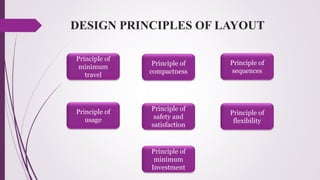
DESIGN PRINCIPLES OF LAYOUT
Principle of
minimum
travel
Principle of
usage
Principle of
compactness
Principle of
sequences
Principle of
safety and
satisfaction
Principle of
flexibility
Principle of
minimum
Investment
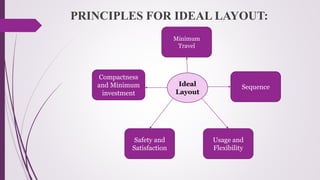
PRINCIPLES FOR IDEAL LAYOUT:
Minimum
Travel
Sequence
Compactness
and Minimum
investment
Usage and
Flexibility
Safety and
Satisfaction
Ideal
Layout
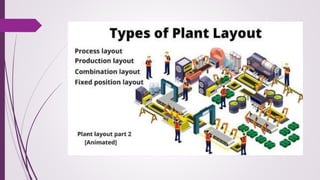
TYPE OF PLANT LAYOUT:
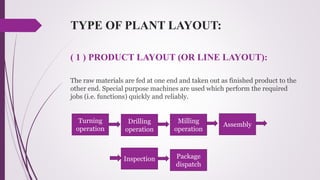
( 1 ) PRODUCT LAYOUT (OR LINE LAYOUT):
The raw materials are fed at one end and taken out as finished product to the
other end. Special purpose machines are used which perform the required
jobs (i.e. functions) quickly and reliably.
Turning
operation
Milling
operation
Drilling
operation
Inspection
Assembly
Package
dispatch
 ADVANTAGES:
 Short manufacturing cycle due to uninterrupted flow of materials
 Simplified production planning and control; and simple and effective
inspection of work.
 Small amount of work-in-progress inventory
 Lesser wage cost, as unskilled workers can learn and manage production.
 DISADVANTAGES:
 Lack of flexibility of operations, as layout cannot be adapted to the
manufacture of any other type of product.
 Large capital investment, because of special purpose machines.
 Dependence of whole activity on each part; any breakdown of one machine
in the sequence may result in stoppage of production.
 Same machines duplicated for manufacture of different products; leading
to high overall operational costs.
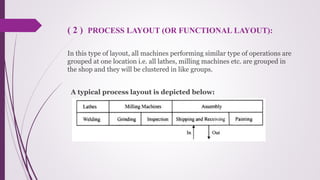
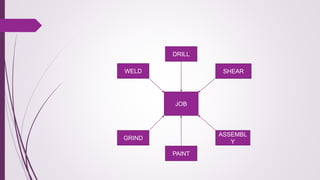
( 2 ) PROCESS LAYOUT (OR FUNCTIONAL LAYOUT):
In this type of layout, all machines performing similar type of operations are
grouped at one location i.e. all lathes, milling machines etc. are grouped in
the shop and they will be clustered in like groups.
A typical process layout is depicted below:
 ADVANTAGES:
 Lower investment due to general purpose machines; which usually are less
costly than special purpose machines.
 Higher utilization of production facilities; which can be adapted to a
variety of products.
 Variety of jobs makes the work challenging and interesting.
 DISADVANTAGES:
 Mechanization of material handling is not possible.
 Production planning and control is difficult
 More space requirement; as work-in-progress inventory is high-requiring
greater storage space.
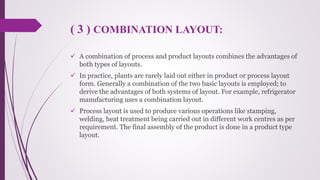
( 3 ) COMBINATION LAYOUT:
 A combination of process and product layouts combines the advantages of
both types of layouts.
 In practice, plants are rarely laid out either in product or process layout
form. Generally a combination of the two basic layouts is employed; to
derive the advantages of both systems of layout. For example, refrigerator
manufacturing uses a combination layout.
 Process layout is used to produce various operations like stamping,
welding, heat treatment being carried out in different work centres as per
requirement. The final assembly of the product is done in a product type
layout.
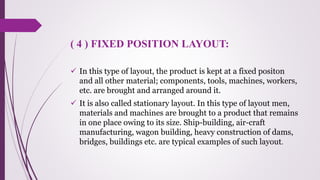
( 4 ) FIXED POSITION LAYOUT:
 In this type of layout, the product is kept at a fixed positon
and all other material; components, tools, machines, workers,
etc. are brought and arranged around it.
 It is also called stationary layout. In this type of layout men,
materials and machines are brought to a product that remains
in one place owing to its size. Ship-building, air-craft
manufacturing, wagon building, heavy construction of dams,
bridges, buildings etc. are typical examples of such layout.
JOB
WELD
GRIND
ASSEMBL
Y
PAINT
SHEAR
DRILL
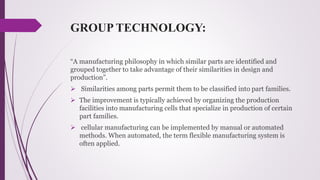
GROUP TECHNOLOGY:
“A manufacturing philosophy in which similar parts are identified and
grouped together to take advantage of their similarities in design and
production”.
 Similarities among parts permit them to be classified into part families.
 The improvement is typically achieved by organizing the production
facilities into manufacturing cells that specialize in production of certain
part families.
 cellular manufacturing can be implemented by manual or automated
methods. When automated, the term flexible manufacturing system is
often applied.
MATERIAL HANDLING:
“Material handling is the movement, protection, storage and control of
materials and products throughout manufacturing, warehousing, distribution
consumption and disposal”.
IMPORTANCE OF MATERIAL HANDLING:
 For efficient space utilization.
 To reduce costs by improving material handling.
 To improve working conditions.
 It helps to increase productivity & thereby increases profitability of an
industry.
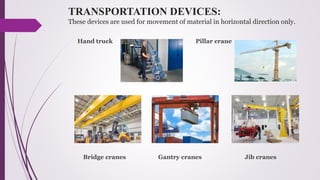
TRANSPORTATION DEVICES:
These devices are used for movement of material in horizontal direction only.
Hand truck Pillar crane
Bridge cranes Gantry cranes Jib cranes
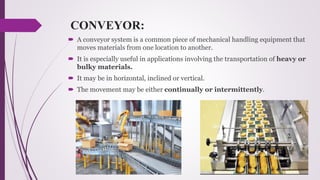
CONVEYOR:
 A conveyor system is a common piece of mechanical handling equipment that
moves materials from one location to another.
 It is especially useful in applications involving the transportation of heavy or
bulky materials.
 It may be in horizontal, inclined or vertical.
 The movement may be either continually or intermittently.
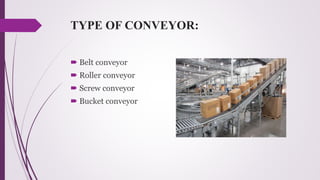
TYPE OF CONVEYOR:
 Belt conveyor
 Roller conveyor
 Screw conveyor
 Bucket conveyor
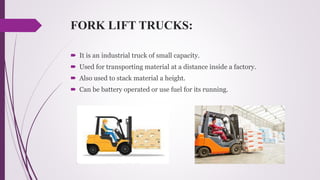
FORK LIFT TRUCKS:
 It is an industrial truck of small capacity.
 Used for transporting material at a distance inside a factory.
 Also used to stack material a height.
 Can be battery operated or use fuel for its running.
Plant Layout.pptx

Plant Layout.pptx

  • 1.
    PRODUCTION MANAGEMENT PLANT LAYOUT Dr.T.Sivakami AssistantProfessor Department of Management Studies Bon Secours college for Women Thanjavur
  • 3.
    PLANT LAYOUT MEANING: Arrangement of Machinery  Equipment  Other industrial facilities  Achieving quick production at least cost.
  • 4.
    What is aplant layout: Plant layout refers to the arrangement of physical facilities such as machinery, equipment, furniture etc. With in the factory building in such a manner so as to have quickest flow of material at the lowest cost and with the least amount of handling in processing the product form the receipt of material to the shipment of the finished product.
  • 5.
    OBJECTIVES OF AGOOD PLANT LAYOUT:  Provide enough production capacity  Reduce material handling cost  Reduce hazards to personnel/ reduce accidents  Increase employee moral  Utilize available space  Provide ease of maintenance  Provide ease of production  Provide ease of supervision  Improve productivity  Allow high machine utilization.
  • 7.
    DESIGN PRINCIPLES OFLAYOUT Principle of minimum travel Principle of usage Principle of compactness Principle of sequences Principle of safety and satisfaction Principle of flexibility Principle of minimum Investment
  • 8.
    PRINCIPLES FOR IDEALLAYOUT: Minimum Travel Sequence Compactness and Minimum investment Usage and Flexibility Safety and Satisfaction Ideal Layout
  • 10.
    TYPE OF PLANTLAYOUT: ( 1 ) PRODUCT LAYOUT (OR LINE LAYOUT): The raw materials are fed at one end and taken out as finished product to the other end. Special purpose machines are used which perform the required jobs (i.e. functions) quickly and reliably. Turning operation Milling operation Drilling operation Inspection Assembly Package dispatch
  • 11.
     ADVANTAGES:  Shortmanufacturing cycle due to uninterrupted flow of materials  Simplified production planning and control; and simple and effective inspection of work.  Small amount of work-in-progress inventory  Lesser wage cost, as unskilled workers can learn and manage production.  DISADVANTAGES:  Lack of flexibility of operations, as layout cannot be adapted to the manufacture of any other type of product.  Large capital investment, because of special purpose machines.  Dependence of whole activity on each part; any breakdown of one machine in the sequence may result in stoppage of production.  Same machines duplicated for manufacture of different products; leading to high overall operational costs.
  • 12.
    ( 2 )PROCESS LAYOUT (OR FUNCTIONAL LAYOUT): In this type of layout, all machines performing similar type of operations are grouped at one location i.e. all lathes, milling machines etc. are grouped in the shop and they will be clustered in like groups. A typical process layout is depicted below:
  • 13.
     ADVANTAGES:  Lowerinvestment due to general purpose machines; which usually are less costly than special purpose machines.  Higher utilization of production facilities; which can be adapted to a variety of products.  Variety of jobs makes the work challenging and interesting.  DISADVANTAGES:  Mechanization of material handling is not possible.  Production planning and control is difficult  More space requirement; as work-in-progress inventory is high-requiring greater storage space.
  • 14.
    ( 3 )COMBINATION LAYOUT:  A combination of process and product layouts combines the advantages of both types of layouts.  In practice, plants are rarely laid out either in product or process layout form. Generally a combination of the two basic layouts is employed; to derive the advantages of both systems of layout. For example, refrigerator manufacturing uses a combination layout.  Process layout is used to produce various operations like stamping, welding, heat treatment being carried out in different work centres as per requirement. The final assembly of the product is done in a product type layout.
  • 15.
    ( 4 )FIXED POSITION LAYOUT:  In this type of layout, the product is kept at a fixed positon and all other material; components, tools, machines, workers, etc. are brought and arranged around it.  It is also called stationary layout. In this type of layout men, materials and machines are brought to a product that remains in one place owing to its size. Ship-building, air-craft manufacturing, wagon building, heavy construction of dams, bridges, buildings etc. are typical examples of such layout.
  • 16.
  • 17.
    GROUP TECHNOLOGY: “A manufacturingphilosophy in which similar parts are identified and grouped together to take advantage of their similarities in design and production”.  Similarities among parts permit them to be classified into part families.  The improvement is typically achieved by organizing the production facilities into manufacturing cells that specialize in production of certain part families.  cellular manufacturing can be implemented by manual or automated methods. When automated, the term flexible manufacturing system is often applied.
  • 18.
    MATERIAL HANDLING: “Material handlingis the movement, protection, storage and control of materials and products throughout manufacturing, warehousing, distribution consumption and disposal”. IMPORTANCE OF MATERIAL HANDLING:  For efficient space utilization.  To reduce costs by improving material handling.  To improve working conditions.  It helps to increase productivity & thereby increases profitability of an industry.
  • 19.
    TRANSPORTATION DEVICES: These devicesare used for movement of material in horizontal direction only. Hand truck Pillar crane Bridge cranes Gantry cranes Jib cranes
  • 20.
    CONVEYOR:  A conveyorsystem is a common piece of mechanical handling equipment that moves materials from one location to another.  It is especially useful in applications involving the transportation of heavy or bulky materials.  It may be in horizontal, inclined or vertical.  The movement may be either continually or intermittently.
  • 21.
    TYPE OF CONVEYOR: Belt conveyor  Roller conveyor  Screw conveyor  Bucket conveyor
  • 22.
    FORK LIFT TRUCKS: It is an industrial truck of small capacity.  Used for transporting material at a distance inside a factory.  Also used to stack material a height.  Can be battery operated or use fuel for its running.