PLANT LAYOUT & TYPES
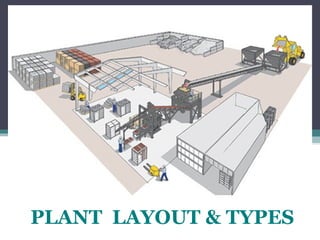
Plantlayout
Plant layout
• Meaning-
Plant layout is the physical arrangement of
industrial facilities. It involves the allocation
of space & the arrangement of equipment in
such a manner that overall operating costs are
minimized.
Factors affecting plant layout
1. Management Policy
2. Manufacturing process
3. Nature of product
4. Volume of production
5. Type of Equipment
6. Type of building
7. Availability of Total floor area
8. Arrangement of Material Handling Equipment
9. Service facilities
10. Possibility of future expansion
Types of plant layout
1. Product layout
2. Process layout
3. Fixed Position/ Stationary layout
4. Combination lay out
Product Layout
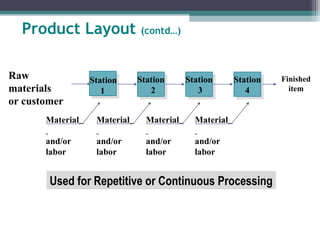
▫ Layout that uses standardized processing
operations to achieve smooth, rapid, high-
volume flow
▫ Here machines are arranged acc. to the needs
of product & in the same sequence as the
operations are necessary for manufacture. E.g.
‘back office’ of services such as banks and
insurance companies.
Raw
materials
or customer
Finished
item
Station
2
Station
2
Station
3
Station
3
Station
4
Station
4
Material
and/or
labor
Station
1
Material
and/or
labor
Material
and/or
labor
Material
and/or
labor
Used for Repetitive or Continuous Processing
Product Layout (contd…)
Advantages of Product Layout
1. High rate of output
2. Low unit cost
3. Labor specialization
4. Low material handling cost
5. High utilization of labor and equipment
6. Established routing and scheduling
7. Short processing time
Disadvantages of Product Layout
1. Creates dull, repetitive jobs
2. Poorly skilled workers may not maintain
equipment or quality of output
3. Fairly inflexible to changes in volume
4. Highly susceptible to shutdowns
5. Needs preventive maintenance
6. Require large capital investment
Layout that can handle varied processing
requirements
Here all machines performing similar type of
operations are grouped together at one location
in the process layout. Thus here facilities are
grouped together acc. To their functions. E.g. all
drilling machines are located at one place
known as drilling section.
Process layout
Dept. A
Dept. B Dept. D
Dept. C
Dept. F
Dept. E
Used for Intermittent processing
Job Shop or Batch
Process Layout
(functional)
Advantages of Process Layouts
1. Can handle a variety of processing requirements
2. Machines breakdown doesn’t result in shutdown.
3. Equipment used is less costly
4. Wide flexibility in production facilities.
5. Each production unit of system works
independently.
6. High utilization of facilities
7. Variety makes the job interesting.
Disadvantages of Process Layouts
1. In-process inventory costs can be high
2. Challenging routing and scheduling
3. Equipment utilization rates are low
4. Material handling is slow and inefficient
& is more.
5. More space is required
6. Longer processing time
7. Back tracking may occur.
Comparison of product & process layout
Factors Product layout Process layout
1. nature Sequence of facilities Similar are grouped together
2. Machines utilization Not to full capacity Better utilization
3. product standardized diversified
4. Processing time less more
5. Material handling less more
6. inventory High WIP Low WIP
7. breakdown Can’t tolerate Can tolerate
8. Production centre simple complex
9.flexibilty low high
10. floor space Requires less more
11. investment high low
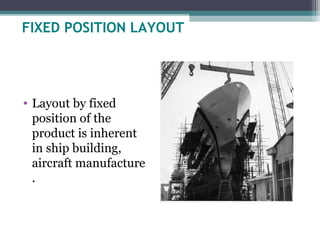
FIXED POSITION LAYOUT
• Layout by fixed
position of the
product is inherent
in ship building,
aircraft manufacture
.
ADVANTAGES OF FIXED LAYOUT
• It is possible to assign one or more skilled
workers to a project from start to finish in order
to ensure continuity of work
• It involves least movement of materials
• A number of quite different projects can be
taken with the same layout
DISADVANTAGES OF FIXED LAYOUT
 There appears to be low utilization of labor
and equipment
 It involves high equipment handling costs
COMBINATION LAYOUT
• A combination of process and product layouts
combines the advantages of the both types of
layouts.
• A combination layout is possible where an item
is being made in different types and sizes.
• examples: wood saws, files etc
THANK YOU

Plant layouts

  • 1.
  • 2.
  • 3.
    Plant layout • Meaning- Plantlayout is the physical arrangement of industrial facilities. It involves the allocation of space & the arrangement of equipment in such a manner that overall operating costs are minimized.
  • 4.
    Factors affecting plantlayout 1. Management Policy 2. Manufacturing process 3. Nature of product 4. Volume of production 5. Type of Equipment 6. Type of building 7. Availability of Total floor area 8. Arrangement of Material Handling Equipment 9. Service facilities 10. Possibility of future expansion
  • 5.
    Types of plantlayout 1. Product layout 2. Process layout 3. Fixed Position/ Stationary layout 4. Combination lay out
  • 6.
    Product Layout ▫ Layoutthat uses standardized processing operations to achieve smooth, rapid, high- volume flow ▫ Here machines are arranged acc. to the needs of product & in the same sequence as the operations are necessary for manufacture. E.g. ‘back office’ of services such as banks and insurance companies.
  • 7.
  • 8.
    Advantages of ProductLayout 1. High rate of output 2. Low unit cost 3. Labor specialization 4. Low material handling cost 5. High utilization of labor and equipment 6. Established routing and scheduling 7. Short processing time
  • 9.
    Disadvantages of ProductLayout 1. Creates dull, repetitive jobs 2. Poorly skilled workers may not maintain equipment or quality of output 3. Fairly inflexible to changes in volume 4. Highly susceptible to shutdowns 5. Needs preventive maintenance 6. Require large capital investment
  • 10.
    Layout that canhandle varied processing requirements Here all machines performing similar type of operations are grouped together at one location in the process layout. Thus here facilities are grouped together acc. To their functions. E.g. all drilling machines are located at one place known as drilling section. Process layout
  • 11.
    Dept. A Dept. BDept. D Dept. C Dept. F Dept. E Used for Intermittent processing Job Shop or Batch Process Layout (functional)
  • 12.
    Advantages of ProcessLayouts 1. Can handle a variety of processing requirements 2. Machines breakdown doesn’t result in shutdown. 3. Equipment used is less costly 4. Wide flexibility in production facilities. 5. Each production unit of system works independently. 6. High utilization of facilities 7. Variety makes the job interesting.
  • 13.
    Disadvantages of ProcessLayouts 1. In-process inventory costs can be high 2. Challenging routing and scheduling 3. Equipment utilization rates are low 4. Material handling is slow and inefficient & is more. 5. More space is required 6. Longer processing time 7. Back tracking may occur.
  • 14.
    Comparison of product& process layout Factors Product layout Process layout 1. nature Sequence of facilities Similar are grouped together 2. Machines utilization Not to full capacity Better utilization 3. product standardized diversified 4. Processing time less more 5. Material handling less more 6. inventory High WIP Low WIP 7. breakdown Can’t tolerate Can tolerate 8. Production centre simple complex 9.flexibilty low high 10. floor space Requires less more 11. investment high low
  • 15.
    FIXED POSITION LAYOUT •Layout by fixed position of the product is inherent in ship building, aircraft manufacture .
  • 17.
    ADVANTAGES OF FIXEDLAYOUT • It is possible to assign one or more skilled workers to a project from start to finish in order to ensure continuity of work • It involves least movement of materials • A number of quite different projects can be taken with the same layout
  • 18.
    DISADVANTAGES OF FIXEDLAYOUT  There appears to be low utilization of labor and equipment  It involves high equipment handling costs
  • 19.
    COMBINATION LAYOUT • Acombination of process and product layouts combines the advantages of the both types of layouts. • A combination layout is possible where an item is being made in different types and sizes. • examples: wood saws, files etc
  • 20.