FACILITY
LAYOUT
(Process.
Product and
services
layout)
CAPACITY PLANNING
AND CONTROL
January 30, 2016
ANALYZE THE COMMON TYPES OF
MANUFACTURING LAYOUTS
ILLUSTRATE LAYOUTS USED IN
NONMANUFACTURING SETTINGS
LEARNING OBJECTIVES
MCDONALD’S
QSR Philosophy
11,000 restaurants (7,000 in USA, remaining
in 50 countries)
700 seat McDonald’s in Pushkin Square,
Moscow
$60 million food plant combining a bakery,
lettuce plant, meat plant, chicken plant, fish
plant and a distribution center, each owned
and operated independently at same location
Food taste must be the same at any
McDonald, yet food must be secured locally
Strong logistical chain, with no weak links
between
Close monitoring for logistical performance
300 in Australia
Central distribution since 1974 with the help
of F.J. Walker Foods in Sydney
Then distribution centers opened in several
cities
MCDONALD’S CONT...
MCDONALD’S CONT...
2000 ingredients, from 48 food plants,
shipment of 200 finished products from
suppliers to DC’s, 6 million cases of food and
paper products plus 500 operating items to
restaurants across Australia
Delivery of frozen, dry and chilled foods twice
a week to each of the 300 restaurants 98% of
the time within 15 minutes of promised
delivery time, 99.8% within 2 days of order
placement
No stock-outs, but less inventory
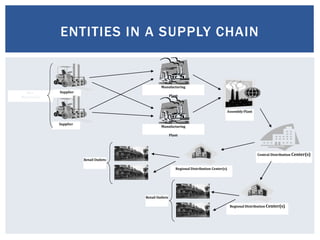
ENTITIES IN A SUPPLY CHAIN
Supplier
Supplier
Manufacturing
Plant
Manufacturing
Plant
Raw
Material(s)
Assembly Plant
Central Distribution Center(s)
Regional Distribution Center(s)
Retail Outlets
Retail Outlets
AGENDA
 Concepts
- Introduction
 Facility layout
- Factors affecting the Layout
- Scope of Facility layout
- Types of Facility layout
-Operations
 Review
 Video presentation
 Q&A
The systematic layout planning (SLP) is a
tool used to arrange a workplace in a
plant by locating two areas with high
frequency and logical relationships close
to each other. The process permits the
quickest material flow in processing the
product at the lowest cost and least
amount of handling.
WHAT DO YOU MEAN BY LAYOUT
PLANNING?
 The physical location of various
department/units of the facility
within the premises of the facility.
The departments may be located
based on the considerations such as:
WHAT IS A FACILITY LAYOUT
Less walking distance
Logical sequence of the processing
requirements of the product
Emergency services, etc.
 Facility layout is simply the
way a facility is arranged in
order to maximize processes
that are not only efficient but
effective towards the overall
organizational goal
WHAT IS THE MEANING OF FACILITY
LAYOUT?
Material
Product
Machinery
Managerial Policies
Type of Industry
Labor
Location
FACTORS AFFECTING LAYOUT
Related to Material
Related to workplace
SCOPE OF FACILITY LAYOUT
o Less material handling & minimum
transportation cost
o Less waiting time for in-process inventory
o Safe work ventilation, lighting etc.
o Minimum movement of workers
o Less chances of accidents, fire, etc.
o Proper space for machines, worker, tools, etc.
Simpler plant maintenance
Increased productivity, better quality,
and reduced cost
Least set-up and minimal change-
over
Objective related to flexibility
Scope for future expansion
PERFORMANCE OBJECTIVES
PROCESS LAYOUT
PRODUCT LAYOUT
GROUPING TECHNOLOGY LAYOUT
FIXED POSITION LAYOUT
TYPES OF LAYOUTS
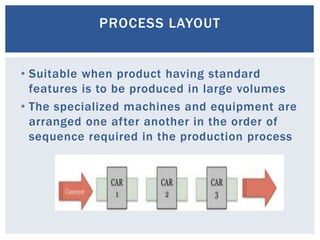
PROCESS LAYOUT
• Suitable when product having standard
features is to be produced in large volumes
• The specialized machines and equipment are
arranged one after another in the order of
sequence required in the production process
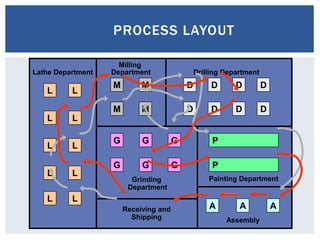
PROCESS LAYOUT
L
L
L
L
L
L
L
L
L
L
M
M
M
M
D
D
D
D
D
D
D
D
G
G
G
G
G
G
A A AReceiving and
Shipping Assembly
Painting Department
Lathe Department
Milling
Department Drilling Department
Grinding
Department
P
P
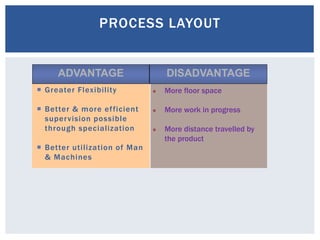
 More floor space
 More work in progress
 More distance travelled by
the product
 Greater Flexibility
 Better & more efficient
supervision possible
through specialization
 Better utilization of Man
& Machines
ADVANTAGE DISADVANTAGE
PROCESS LAYOUT
PROCESS LAYOUTS
Equipment that perform similar
processes are grouped together
Used when the operations system
must handle a wide variety of
products in relatively small volumes
(i.e. flexibility is necessary)
CHARACTERISTICS OF PROCESS LAYOUTS
General-purpose equipment is used
Changeover is rapid
Material flow is intermittent
Material handling equipment is flexible
Operators are highly skilled
CHARACTERISTICS OF PROCESS LAYOUTS
Technical supervision is required
Planning, scheduling and controlling functions
are challenging
Production time is relatively long
In-process inventory is relatively high
PROCESS LAYOUT
PRODUCT LAYOUT
GROUPING TECHNOLOGY LAYOUT
FIXED POSITION LAYOUT
TYPES OF LAYOUTS
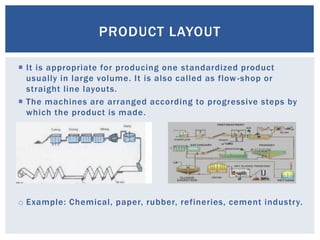
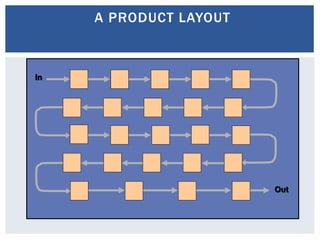
 It is appropriate for producing one standardized product
usually in large volume. It is also called as flow -shop or
straight line layouts.
 The machines are arranged according to progressive steps by
which the product is made.
o Example: Chemical, paper, rubber, refineries, cement industry.
PRODUCT LAYOUT
A PRODUCT LAYOUT
In
Out
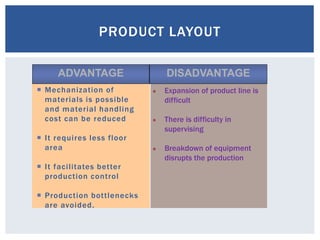
PRODUCT LAYOUT
 Expansion of product line is
difficult
 There is difficulty in
supervising
 Breakdown of equipment
disrupts the production
 Mechanization of
materials is possible
and material handling
cost can be reduced
 It requires less floor
area
 It facilitates better
production control
 Production bottlenecks
are avoided.
ADVANTAGE DISADVANTAGE
PRODUCT (ASSEMBLY LINE) LAYOUTS
Operations are arranged in the sequence
required to make the product
Used when the operations system must handle
a narrow variety of products in relatively high
volumes
Operations and personnel are dedicated to
producing one or a small number of products
CHARACTERISTICS OF PRODUCT LAYOUTS
Special-purpose equipment are used
Changeover is expensive and lengthy
Material flow approaches continuous
Material handling equipment is fixed
Operators need not be as skilled
CHARACTERISTICS OF PRODUCT LAYOUTS
Little direct supervision is required
Planning, scheduling and controlling
functions are relatively straight-
forward
Production time for a unit is relatively
short
In-process inventory is relatively low
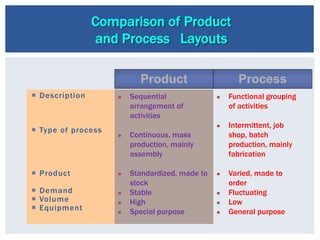
 Description
 Type of process
 Product
 Demand
 Volume
 Equipment
 Sequential
arrangement of
activities
 Continuous, mass
production, mainly
assembly
 Standardized, made to
stock
 Stable
 High
 Special purpose
Process
Comparison of Product
and Process Layouts
 Functional grouping
of activities
 Intermittent, job
shop, batch
production, mainly
fabrication
 Varied, made to
order
 Fluctuating
 Low
 General purpose
Product
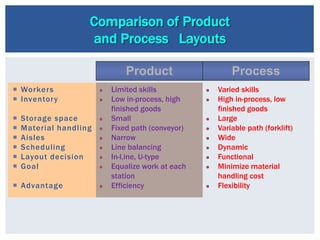
 Workers
 Inventory
 Storage space
 Material handling
 Aisles
 Scheduling
 Layout decision
 Goal
 Advantage
 Limited skills
 Low in-process, high
finished goods
 Small
 Fixed path (conveyor)
 Narrow
 Line balancing
 In-l,ine, U-type
 Equalize work at each
station
 Efficiency
Process
Comparison of Product
and Process Layouts
 Varied skills
 High in-process, low
finished goods
 Large
 Variable path (forklift)
 Wide
 Dynamic
 Functional
 Minimize material
handling cost
 Flexibility
Product
PROCESS LAYOUT
PRODUCT LAYOUT
GROUPING TECHNOLOGY LAYOUT
FIXED POSITION LAYOUT
TYPES OF LAYOUTS
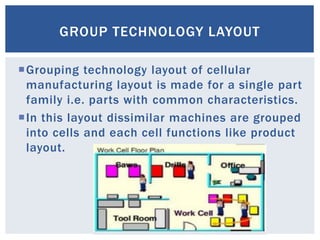
Grouping technology layout of cellular
manufacturing layout is made for a single part
family i.e. parts with common characteristics.
In this layout dissimilar machines are grouped
into cells and each cell functions like product
layout.
GROUP TECHNOLOGY LAYOUT
CELLULAR MANUFACTURING (CM)
LAYOUTS
 Grouping of machines in cells
 Each cell results in the production of particular part
family.
 Similar parts are identified and grouped together.
 Similarity can be either in shape, size or in
manufacturing process
 Operations required to produce a particular family
(group) of parts are arranged in the sequence
required to make that family
 Used when the operations system must handle a
moderate variety of products in moderate volumes
PART FAMILIES
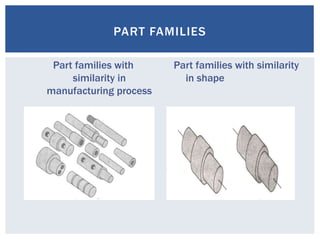
Part families with similarity
in shape
Part families with
similarity in
manufacturing process
GROUP TECHNOLOGY LAYOUT
 Reduces the flexibility It reduces handling cost
 It simplifies machine
change-overs
 It reduces in-process
inventory and automate
the production
ADVANTAGE DISADVANTAGE
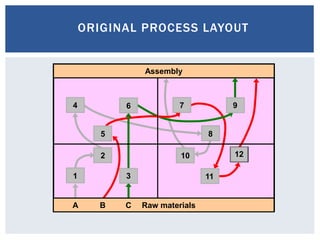
ORIGINAL PROCESS LAYOUT
CA B Raw materials
Assembly
1
2
3
4
5
6 7
8
9
10
11
12
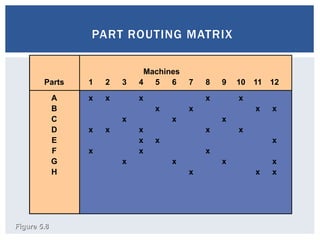
PART ROUTING MATRIX
Machines
Parts 1 2 3 4 5 6 7 8 9 10 11 12
A x x x x x
B x x x x
C x x x
D x x x x x
E x x x
F x x x
G x x x x
H x x x
Figure 5.8
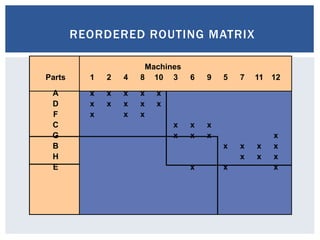
REORDERED ROUTING MATRIX
Machines
Parts 1 2 4 8 10 3 6 9 5 7 11 12
A x x x x x
D x x x x x
F x x x
C x x x
G x x x x
B x x x x
H x x x
E x x x
PROCESS LAYOUT
PRODUCT LAYOUT
GROUPING TECHNOLOGY LAYOUT
FIXED POSITION LAYOUT
TYPES OF LAYOUTS
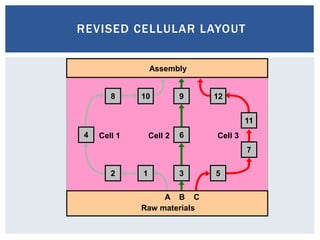
REVISED CELLULAR LAYOUT
3
6
9
Assembly
12
4
8 10
5
7
11
12
A B C
Raw materials
Cell 1 Cell 2 Cell 3
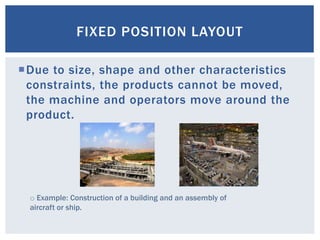
Due to size, shape and other characteristics
constraints, the products cannot be moved,
the machine and operators move around the
product.
FIXED POSITION LAYOUT
o Example: Construction of a building and an assembly of
aircraft or ship.
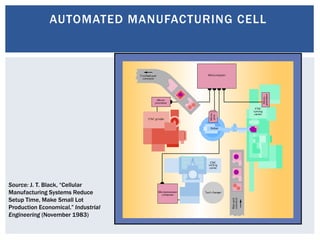
AUTOMATED MANUFACTURING CELL
Source: J. T. Black, “Cellular
Manufacturing Systems Reduce
Setup Time, Make Small Lot
Production Economical.” Industrial
Engineering (November 1983)
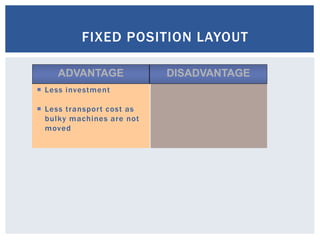
 Less investment
 Less transport cost as
bulky machines are not
moved
ADVANTAGE DISADVANTAGE
FIXED POSITION LAYOUT
CHARACTERISTICS OF CM
RELATIVE TO PROCESS LAYOUTS
 Equipment can be less general-purpose
 Material handling costs are reduced
 Training periods for operators are shortened
 In-process inventory is lower
 Parts can be made faster and shipped more quickly
 Equipment can be less special-purpose
 Changeovers are simplified
FLEXIBLE MANUFACTURING SYSTEMS (FMS)
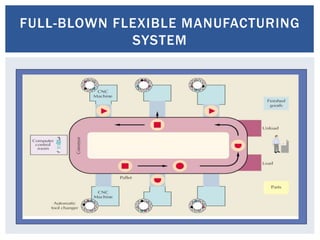
 FMS consists of numerous programmable machine tools
connected by an automated material handling system and
controlled by a common computer network
 FMS combines flexibility with efficiency
 FMS layouts differ based on
 variety of parts that the system can process
 size of parts processed
 average processing time required for part completion
FULL-BLOWN FLEXIBLE MANUFACTURING
SYSTEM
PHOTOS
FACILITY LAYOUT
(PROCESS. PRODUCT AND SERVICES
LAYOUT)
FOR YOUR EYES ONLY
VIDEO PRESENTATION
Plant design.rev.02
Plant design.rev.02
Plant design.rev.02
Plant design.rev.02

Plant design.rev.02

  • 1.
  • 2.
    ANALYZE THE COMMONTYPES OF MANUFACTURING LAYOUTS ILLUSTRATE LAYOUTS USED IN NONMANUFACTURING SETTINGS LEARNING OBJECTIVES
  • 3.
    MCDONALD’S QSR Philosophy 11,000 restaurants(7,000 in USA, remaining in 50 countries) 700 seat McDonald’s in Pushkin Square, Moscow $60 million food plant combining a bakery, lettuce plant, meat plant, chicken plant, fish plant and a distribution center, each owned and operated independently at same location
  • 4.
    Food taste mustbe the same at any McDonald, yet food must be secured locally Strong logistical chain, with no weak links between Close monitoring for logistical performance 300 in Australia Central distribution since 1974 with the help of F.J. Walker Foods in Sydney Then distribution centers opened in several cities MCDONALD’S CONT...
  • 5.
    MCDONALD’S CONT... 2000 ingredients,from 48 food plants, shipment of 200 finished products from suppliers to DC’s, 6 million cases of food and paper products plus 500 operating items to restaurants across Australia Delivery of frozen, dry and chilled foods twice a week to each of the 300 restaurants 98% of the time within 15 minutes of promised delivery time, 99.8% within 2 days of order placement No stock-outs, but less inventory
  • 6.
    ENTITIES IN ASUPPLY CHAIN Supplier Supplier Manufacturing Plant Manufacturing Plant Raw Material(s) Assembly Plant Central Distribution Center(s) Regional Distribution Center(s) Regional Distribution Center(s) Retail Outlets Retail Outlets
  • 7.
    AGENDA  Concepts - Introduction Facility layout - Factors affecting the Layout - Scope of Facility layout - Types of Facility layout -Operations  Review  Video presentation  Q&A
  • 8.
    The systematic layoutplanning (SLP) is a tool used to arrange a workplace in a plant by locating two areas with high frequency and logical relationships close to each other. The process permits the quickest material flow in processing the product at the lowest cost and least amount of handling. WHAT DO YOU MEAN BY LAYOUT PLANNING?
  • 9.
     The physicallocation of various department/units of the facility within the premises of the facility. The departments may be located based on the considerations such as: WHAT IS A FACILITY LAYOUT Less walking distance Logical sequence of the processing requirements of the product Emergency services, etc.
  • 10.
     Facility layoutis simply the way a facility is arranged in order to maximize processes that are not only efficient but effective towards the overall organizational goal WHAT IS THE MEANING OF FACILITY LAYOUT?
  • 12.
    Material Product Machinery Managerial Policies Type ofIndustry Labor Location FACTORS AFFECTING LAYOUT
  • 13.
    Related to Material Relatedto workplace SCOPE OF FACILITY LAYOUT o Less material handling & minimum transportation cost o Less waiting time for in-process inventory o Safe work ventilation, lighting etc. o Minimum movement of workers o Less chances of accidents, fire, etc. o Proper space for machines, worker, tools, etc.
  • 14.
    Simpler plant maintenance Increasedproductivity, better quality, and reduced cost Least set-up and minimal change- over Objective related to flexibility Scope for future expansion PERFORMANCE OBJECTIVES
  • 15.
    PROCESS LAYOUT PRODUCT LAYOUT GROUPINGTECHNOLOGY LAYOUT FIXED POSITION LAYOUT TYPES OF LAYOUTS
  • 16.
    PROCESS LAYOUT • Suitablewhen product having standard features is to be produced in large volumes • The specialized machines and equipment are arranged one after another in the order of sequence required in the production process
  • 17.
    PROCESS LAYOUT L L L L L L L L L L M M M M D D D D D D D D G G G G G G A AAReceiving and Shipping Assembly Painting Department Lathe Department Milling Department Drilling Department Grinding Department P P
  • 18.
     More floorspace  More work in progress  More distance travelled by the product  Greater Flexibility  Better & more efficient supervision possible through specialization  Better utilization of Man & Machines ADVANTAGE DISADVANTAGE PROCESS LAYOUT
  • 19.
    PROCESS LAYOUTS Equipment thatperform similar processes are grouped together Used when the operations system must handle a wide variety of products in relatively small volumes (i.e. flexibility is necessary)
  • 20.
    CHARACTERISTICS OF PROCESSLAYOUTS General-purpose equipment is used Changeover is rapid Material flow is intermittent Material handling equipment is flexible Operators are highly skilled
  • 21.
    CHARACTERISTICS OF PROCESSLAYOUTS Technical supervision is required Planning, scheduling and controlling functions are challenging Production time is relatively long In-process inventory is relatively high
  • 22.
    PROCESS LAYOUT PRODUCT LAYOUT GROUPINGTECHNOLOGY LAYOUT FIXED POSITION LAYOUT TYPES OF LAYOUTS
  • 23.
     It isappropriate for producing one standardized product usually in large volume. It is also called as flow -shop or straight line layouts.  The machines are arranged according to progressive steps by which the product is made. o Example: Chemical, paper, rubber, refineries, cement industry. PRODUCT LAYOUT
  • 24.
  • 25.
    PRODUCT LAYOUT  Expansionof product line is difficult  There is difficulty in supervising  Breakdown of equipment disrupts the production  Mechanization of materials is possible and material handling cost can be reduced  It requires less floor area  It facilitates better production control  Production bottlenecks are avoided. ADVANTAGE DISADVANTAGE
  • 26.
    PRODUCT (ASSEMBLY LINE)LAYOUTS Operations are arranged in the sequence required to make the product Used when the operations system must handle a narrow variety of products in relatively high volumes Operations and personnel are dedicated to producing one or a small number of products
  • 27.
    CHARACTERISTICS OF PRODUCTLAYOUTS Special-purpose equipment are used Changeover is expensive and lengthy Material flow approaches continuous Material handling equipment is fixed Operators need not be as skilled
  • 28.
    CHARACTERISTICS OF PRODUCTLAYOUTS Little direct supervision is required Planning, scheduling and controlling functions are relatively straight- forward Production time for a unit is relatively short In-process inventory is relatively low
  • 29.
     Description  Typeof process  Product  Demand  Volume  Equipment  Sequential arrangement of activities  Continuous, mass production, mainly assembly  Standardized, made to stock  Stable  High  Special purpose Process Comparison of Product and Process Layouts  Functional grouping of activities  Intermittent, job shop, batch production, mainly fabrication  Varied, made to order  Fluctuating  Low  General purpose Product
  • 30.
     Workers  Inventory Storage space  Material handling  Aisles  Scheduling  Layout decision  Goal  Advantage  Limited skills  Low in-process, high finished goods  Small  Fixed path (conveyor)  Narrow  Line balancing  In-l,ine, U-type  Equalize work at each station  Efficiency Process Comparison of Product and Process Layouts  Varied skills  High in-process, low finished goods  Large  Variable path (forklift)  Wide  Dynamic  Functional  Minimize material handling cost  Flexibility Product
  • 31.
    PROCESS LAYOUT PRODUCT LAYOUT GROUPINGTECHNOLOGY LAYOUT FIXED POSITION LAYOUT TYPES OF LAYOUTS
  • 32.
    Grouping technology layoutof cellular manufacturing layout is made for a single part family i.e. parts with common characteristics. In this layout dissimilar machines are grouped into cells and each cell functions like product layout. GROUP TECHNOLOGY LAYOUT
  • 33.
    CELLULAR MANUFACTURING (CM) LAYOUTS Grouping of machines in cells  Each cell results in the production of particular part family.  Similar parts are identified and grouped together.  Similarity can be either in shape, size or in manufacturing process  Operations required to produce a particular family (group) of parts are arranged in the sequence required to make that family  Used when the operations system must handle a moderate variety of products in moderate volumes
  • 34.
    PART FAMILIES Part familieswith similarity in shape Part families with similarity in manufacturing process
  • 35.
    GROUP TECHNOLOGY LAYOUT Reduces the flexibility It reduces handling cost  It simplifies machine change-overs  It reduces in-process inventory and automate the production ADVANTAGE DISADVANTAGE
  • 36.
    ORIGINAL PROCESS LAYOUT CAB Raw materials Assembly 1 2 3 4 5 6 7 8 9 10 11 12
  • 37.
    PART ROUTING MATRIX Machines Parts1 2 3 4 5 6 7 8 9 10 11 12 A x x x x x B x x x x C x x x D x x x x x E x x x F x x x G x x x x H x x x Figure 5.8
  • 38.
    REORDERED ROUTING MATRIX Machines Parts1 2 4 8 10 3 6 9 5 7 11 12 A x x x x x D x x x x x F x x x C x x x G x x x x B x x x x H x x x E x x x
  • 39.
    PROCESS LAYOUT PRODUCT LAYOUT GROUPINGTECHNOLOGY LAYOUT FIXED POSITION LAYOUT TYPES OF LAYOUTS
  • 40.
    REVISED CELLULAR LAYOUT 3 6 9 Assembly 12 4 810 5 7 11 12 A B C Raw materials Cell 1 Cell 2 Cell 3
  • 41.
    Due to size,shape and other characteristics constraints, the products cannot be moved, the machine and operators move around the product. FIXED POSITION LAYOUT o Example: Construction of a building and an assembly of aircraft or ship.
  • 42.
    AUTOMATED MANUFACTURING CELL Source:J. T. Black, “Cellular Manufacturing Systems Reduce Setup Time, Make Small Lot Production Economical.” Industrial Engineering (November 1983)
  • 43.
     Less investment Less transport cost as bulky machines are not moved ADVANTAGE DISADVANTAGE FIXED POSITION LAYOUT
  • 44.
    CHARACTERISTICS OF CM RELATIVETO PROCESS LAYOUTS  Equipment can be less general-purpose  Material handling costs are reduced  Training periods for operators are shortened  In-process inventory is lower  Parts can be made faster and shipped more quickly  Equipment can be less special-purpose  Changeovers are simplified
  • 45.
    FLEXIBLE MANUFACTURING SYSTEMS(FMS)  FMS consists of numerous programmable machine tools connected by an automated material handling system and controlled by a common computer network  FMS combines flexibility with efficiency  FMS layouts differ based on  variety of parts that the system can process  size of parts processed  average processing time required for part completion
  • 46.
  • 47.
    PHOTOS FACILITY LAYOUT (PROCESS. PRODUCTAND SERVICES LAYOUT) FOR YOUR EYES ONLY
  • 49.