PROCESS PLANNING ACTIVITIES
RESPONSIBLITIES OF A PROCESS
PLANNER
• Process planner – A specialist managing the
process planning task
• Responsibilities
– Interpreting part print analysis and symbols
– Gathering the fundamental details of product
design
• Dimensional tolerances
• Type of finish
• Production rate
• Product volume
• Scrap and losses
• Change of design etc.,
• Selecting machining processes
• Selecting machining with proper tolling
– Required machine capabilities
– Set up time
– Practical lot size
– Quality of parts
– Cost of tooling
– Type of tooling
• Sequencing operation
• Deciding the inspection equipment
• Determining proper cutting tool
• Determining the overall timing using work measurement techniques
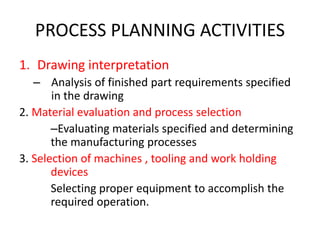
PROCESS PLANNING ACTIVITIES
1. Drawing interpretation
– Analysis of finished part requirements specified
in the drawing
2. Material evaluation and process selection
–Evaluating materials specified and determining
the manufacturing processes
3. Selection of machines , tooling and work holding
devices
Selecting proper equipment to accomplish the
required operation.
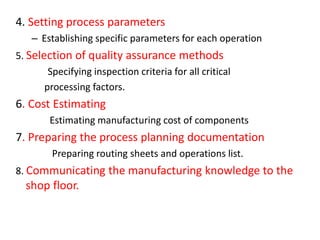
4. Setting process parameters
– Establishing specific parameters for each operation
5. Selection of quality assurance methods
Specifying inspection criteria for all critical
processing factors.
6. Cost Estimating
Estimating manufacturing cost of components
7. Preparing the process planning documentation
Preparing routing sheets and operations list.
8. Communicating the manufacturing knowledge to the
shop floor.

Process planning activities

  • 1.
  • 2.
    RESPONSIBLITIES OF APROCESS PLANNER • Process planner – A specialist managing the process planning task • Responsibilities – Interpreting part print analysis and symbols – Gathering the fundamental details of product design • Dimensional tolerances • Type of finish • Production rate
  • 3.
    • Product volume •Scrap and losses • Change of design etc., • Selecting machining processes • Selecting machining with proper tolling – Required machine capabilities – Set up time – Practical lot size – Quality of parts – Cost of tooling – Type of tooling • Sequencing operation • Deciding the inspection equipment • Determining proper cutting tool • Determining the overall timing using work measurement techniques
  • 4.
    PROCESS PLANNING ACTIVITIES 1.Drawing interpretation – Analysis of finished part requirements specified in the drawing 2. Material evaluation and process selection –Evaluating materials specified and determining the manufacturing processes 3. Selection of machines , tooling and work holding devices Selecting proper equipment to accomplish the required operation.
  • 5.
    4. Setting processparameters – Establishing specific parameters for each operation 5. Selection of quality assurance methods Specifying inspection criteria for all critical processing factors. 6. Cost Estimating Estimating manufacturing cost of components 7. Preparing the process planning documentation Preparing routing sheets and operations list. 8. Communicating the manufacturing knowledge to the shop floor.