Process Planning & Cost Estimation
UNIT - III
Introduction to Cost Estimation
B.Prabhu
AP /Mechanical,
Kamaraj College of Engineering & Technology,
Madurai
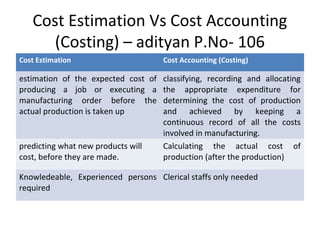
Cost Estimation Vs Cost Accounting
(Costing) – adityan P.No- 106
Cost Estimation Cost Accounting (Costing)
estimation of the expected cost of
producing a job or executing a
manufacturing order before the
actual production is taken up
classifying, recording and allocating
the appropriate expenditure for
determining the cost of production
and achieved by keeping a
continuous record of all the costs
involved in manufacturing.
predicting what new products will
cost, before they are made.
Calculating the actual cost of
production (after the production)
Knowledeable, Experienced persons
required
Clerical staffs only needed
Methods of costing (Your text book ;
Pno: 82)
Job Costing
• method of costing applicable to industrial
manufacture in which the cost figures are
determined for each job or a batch of jobs.
• Applicable for Job shop production (Lower
order quantity)
Output Costing
• cost figures for a job or a batch may not be
easy to isolate (e.g. in the case of foundry
operations, chemical plants)
• cost figures are usually expressed in terms of
overall output, viz. Rs. per ton, or Rs. per kg,
or Rs. per litre
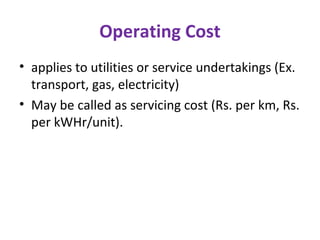
Operating Cost
• applies to utilities or service undertakings (Ex.
transport, gas, electricity)
• May be called as servicing cost (Rs. per km, Rs.
per kWHr/unit).
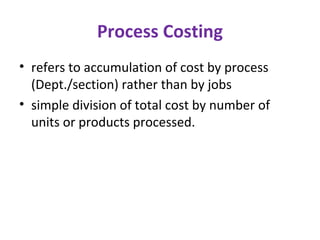
Process Costing
• refers to accumulation of cost by process
(Dept./section) rather than by jobs
• simple division of total cost by number of
units or products processed.
Importance of costing (Adityan book ;
Pno: 113)
• To determine the actual cost of each component and cost
of the final product.
• To form a basis for fixing the selling price.
• To analyse the expenses incurred in production, so that
control can be kept over them.
• To check the accuracy of estimates.
• To decide which of the components to manufacture and
which ones to buy from outside.
• To ascertain which product/products are profitable to
manufacture.
• Manufacturer may compare the cost of manufacturing an
article by different processes and thus arrive at the most
efficient and economical process.
Elements of Cost (Refer Adityan book
P.No 113)
Direct Cost
In Direct
Cost
Material
Labour
Expenses
Material
Labour
Expenses
Adityan book ; Pno: 113
Direct Cost
• directly contribute to the final product and can be directly
allocated to the manufacture of a specific product.
• Ex: cost of raw materials, cost of labour processing the
materials and cost of equipment (machine tools) and
special toolings (jigs and fixtures) etc.
Indirect Cost
• can not be directly allocated to the manufacture of a
particular product
• Ex: wages of supervisory and inspection staff, selling and
distribution expenses, administrative expenses and costs of
indirect materials like grease, lubricants, coolants and
repair and maintenance cost etc.
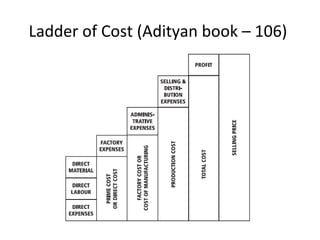
Ladder of Cost (Adityan book – 106)
Elements of cost Estimation – Adityan
pNo: 107,108
• Cost of design.
• Cost of drafting.
• Cost of research and development.
• Cost of raw materials.
• Cost of labour.
• Cost of inspection.
• Cost of tools, jigs and fixtures.
• Overhead cost.
Types of cost Estimates - Your Text
book ; Pno: 92
• Guesstimates
relies on the estimators experience and
judgment
Budgetary
• is used for planning the cost of a piece part,
assembly, or project.
• Using Past History
developing estimates for new work
Estimating in Some Detail – Ex: Contract jobs
Estimating in Complete Detail Ex: Department
machinery operations
Parametric Estimating
Project Estimating
Cost Estimating Procedure – your book
– P.No: 100
• BOM – prepare the list of components of the
product
• Weight of the material – with various
allowances (Volume * Density)
• Calculation of Material cost – Weight *
Material price
• Outside purchases – Determination of prices
of outside purchases
• Machinery / Processing data: Determination of cutting
speeds, feeds for the materials and machining time
• Labour cost
• Cost of tools and equipment
• Prime cost – Labour cost + material cost + expenses
• Factory overheads, Administrative overheads
• Package & Delivery charges
• Total cost
• Standard profit & sales price
• Discount to be allowed
• Time of delivery
• Approval of Management
Allowances in Cost Estimation –
Adityan book, P.No-136
• Relaxation Allowance (Rest Allowance) 5% to 10% of normal
time
– Fatigue
– Personal need
• Process Allowance : Idleness of worker ; 5% of the normal
time
• Interference Allowance – operator working on several
machines
• Contingency Allowance – due to delay of raw materials - 5%
of the normal time
• Special Allowances – depends on working
conditions
Allocation / Distribution of Overhead
Cost – your text book – P.No134
• Percentage on direct material cost:
– Overhead rate = (Total Overhead expenses / Total
Direct material cost)
• Percentage on direct labour cost:
- Overhead rate = (Total Overhead for a period /
Total Direct labour for that
period)
• Percentage on Prime cost:
• Overhead rate = (Total Overhead for a period /
Prime cost over a period)
• Man hour Rate:
– Total overheads / Total direct man hour spent
• Machine hour Rate:
– Total overheads / Total productive m/c hour spent
• Combination of Man & Machine hour Rate:
• Unit Rate method: (Total overheads / Qty of
prodn)
• Space Rate method: (Total Overhead assigned
to the dept / Total area of the prodn dept in
Problems on Ladder of cost,
Material cost, Labour cost
• Problems on Material Cost
Refer Your text book p.No: 118 to 123
• Problems on Ladder cost
Refer Adityan book p.No: 121, 120, 118
QUESTIONS
• Methods of costing – Refer Slide No 3
• Elements (Types) of cost – Slide No 8
• Ladder of cost – slide No 10 (write with
examples)
• Methods (types) of cost estimation – slide No 12
• Elements of cost estimation – slide No 11
• Cost Estimation Procedure – slide No 14,15,16
• Costing problems – refer notes & Slide No 19
• Allocation (Distribution) of overhead cost – slide
No 17

Process Planning & Cost Estimation

  • 1.
    Process Planning &Cost Estimation UNIT - III Introduction to Cost Estimation B.Prabhu AP /Mechanical, Kamaraj College of Engineering & Technology, Madurai
  • 2.
    Cost Estimation VsCost Accounting (Costing) – adityan P.No- 106 Cost Estimation Cost Accounting (Costing) estimation of the expected cost of producing a job or executing a manufacturing order before the actual production is taken up classifying, recording and allocating the appropriate expenditure for determining the cost of production and achieved by keeping a continuous record of all the costs involved in manufacturing. predicting what new products will cost, before they are made. Calculating the actual cost of production (after the production) Knowledeable, Experienced persons required Clerical staffs only needed
  • 3.
    Methods of costing(Your text book ; Pno: 82) Job Costing • method of costing applicable to industrial manufacture in which the cost figures are determined for each job or a batch of jobs. • Applicable for Job shop production (Lower order quantity)
  • 4.
    Output Costing • costfigures for a job or a batch may not be easy to isolate (e.g. in the case of foundry operations, chemical plants) • cost figures are usually expressed in terms of overall output, viz. Rs. per ton, or Rs. per kg, or Rs. per litre
  • 5.
    Operating Cost • appliesto utilities or service undertakings (Ex. transport, gas, electricity) • May be called as servicing cost (Rs. per km, Rs. per kWHr/unit).
  • 6.
    Process Costing • refersto accumulation of cost by process (Dept./section) rather than by jobs • simple division of total cost by number of units or products processed.
  • 7.
    Importance of costing(Adityan book ; Pno: 113) • To determine the actual cost of each component and cost of the final product. • To form a basis for fixing the selling price. • To analyse the expenses incurred in production, so that control can be kept over them. • To check the accuracy of estimates. • To decide which of the components to manufacture and which ones to buy from outside. • To ascertain which product/products are profitable to manufacture. • Manufacturer may compare the cost of manufacturing an article by different processes and thus arrive at the most efficient and economical process.
  • 8.
    Elements of Cost(Refer Adityan book P.No 113) Direct Cost In Direct Cost Material Labour Expenses Material Labour Expenses
  • 9.
    Adityan book ;Pno: 113 Direct Cost • directly contribute to the final product and can be directly allocated to the manufacture of a specific product. • Ex: cost of raw materials, cost of labour processing the materials and cost of equipment (machine tools) and special toolings (jigs and fixtures) etc. Indirect Cost • can not be directly allocated to the manufacture of a particular product • Ex: wages of supervisory and inspection staff, selling and distribution expenses, administrative expenses and costs of indirect materials like grease, lubricants, coolants and repair and maintenance cost etc.
  • 10.
    Ladder of Cost(Adityan book – 106)
  • 11.
    Elements of costEstimation – Adityan pNo: 107,108 • Cost of design. • Cost of drafting. • Cost of research and development. • Cost of raw materials. • Cost of labour. • Cost of inspection. • Cost of tools, jigs and fixtures. • Overhead cost.
  • 12.
    Types of costEstimates - Your Text book ; Pno: 92 • Guesstimates relies on the estimators experience and judgment Budgetary • is used for planning the cost of a piece part, assembly, or project.
  • 13.
    • Using PastHistory developing estimates for new work Estimating in Some Detail – Ex: Contract jobs Estimating in Complete Detail Ex: Department machinery operations Parametric Estimating Project Estimating
  • 14.
    Cost Estimating Procedure– your book – P.No: 100 • BOM – prepare the list of components of the product • Weight of the material – with various allowances (Volume * Density) • Calculation of Material cost – Weight * Material price • Outside purchases – Determination of prices of outside purchases
  • 15.
    • Machinery /Processing data: Determination of cutting speeds, feeds for the materials and machining time • Labour cost • Cost of tools and equipment • Prime cost – Labour cost + material cost + expenses • Factory overheads, Administrative overheads • Package & Delivery charges • Total cost • Standard profit & sales price • Discount to be allowed • Time of delivery • Approval of Management
  • 16.
    Allowances in CostEstimation – Adityan book, P.No-136 • Relaxation Allowance (Rest Allowance) 5% to 10% of normal time – Fatigue – Personal need • Process Allowance : Idleness of worker ; 5% of the normal time • Interference Allowance – operator working on several machines • Contingency Allowance – due to delay of raw materials - 5% of the normal time • Special Allowances – depends on working conditions
  • 17.
    Allocation / Distributionof Overhead Cost – your text book – P.No134 • Percentage on direct material cost: – Overhead rate = (Total Overhead expenses / Total Direct material cost) • Percentage on direct labour cost: - Overhead rate = (Total Overhead for a period / Total Direct labour for that period) • Percentage on Prime cost: • Overhead rate = (Total Overhead for a period / Prime cost over a period)
  • 18.
    • Man hourRate: – Total overheads / Total direct man hour spent • Machine hour Rate: – Total overheads / Total productive m/c hour spent • Combination of Man & Machine hour Rate: • Unit Rate method: (Total overheads / Qty of prodn) • Space Rate method: (Total Overhead assigned to the dept / Total area of the prodn dept in
  • 19.
    Problems on Ladderof cost, Material cost, Labour cost • Problems on Material Cost Refer Your text book p.No: 118 to 123 • Problems on Ladder cost Refer Adityan book p.No: 121, 120, 118
  • 20.
    QUESTIONS • Methods ofcosting – Refer Slide No 3 • Elements (Types) of cost – Slide No 8 • Ladder of cost – slide No 10 (write with examples) • Methods (types) of cost estimation – slide No 12 • Elements of cost estimation – slide No 11 • Cost Estimation Procedure – slide No 14,15,16 • Costing problems – refer notes & Slide No 19 • Allocation (Distribution) of overhead cost – slide No 17