Nishant Wasatkar MOM
   Production Systems
   Plant Location & Layout
   Production Planning & Control
   Maintenance Management
   Inspection
   Work Study
   Lean Production Systems


                            Nishant Wasatkar MOM
   Production can be defined as the process of
    converting inputs into desired output thereby
    adding value to some entity.

   Production function brings together people,
    machines & materials to provide goods &
    services satisfying the wants of people.


                             Nishant Wasatkar MOM
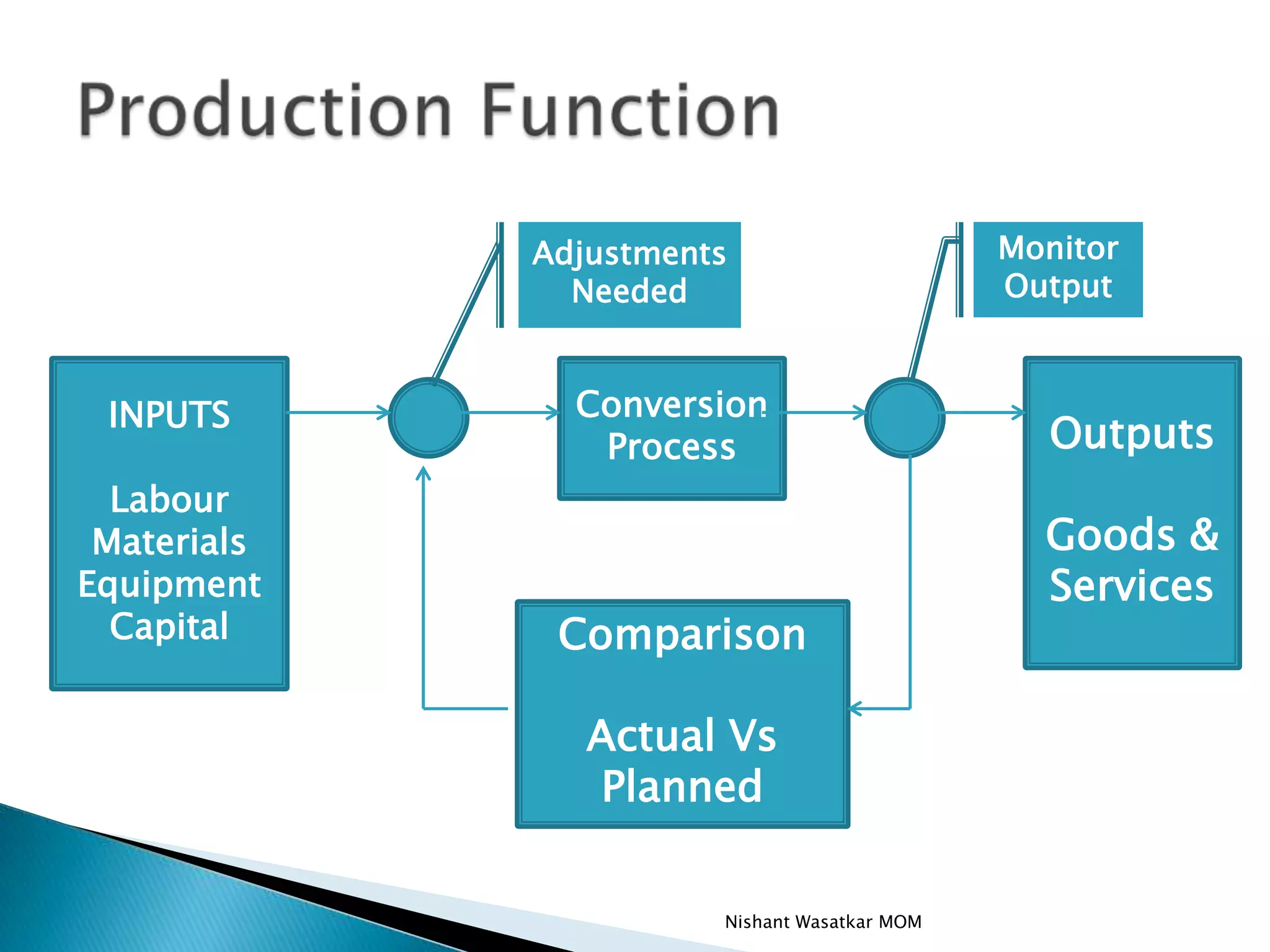
Adjustments                      Monitor
               Needed                         Output


 INPUTS        Conversion
                Process                         Outputs
  Labour
 Materials                                      Goods &
Equipment                                       Services
  Capital     Comparison

                Actual Vs
                Planned

                       Nishant Wasatkar MOM
   Manufacturing Cycle Time/ Lead Time
   Inventory
   Work in progress (WIP)
   Material Handling (Manual/Automated)
   General Purpose Machines (GPM)
   Special Purpose Machines (SPM)
   Product Layout
   Process Layout


                           Nishant Wasatkar MOM
Nishant Wasatkar MOM
Milling


Assembly
 & Test                                 Grinding


       Drilling                       Plating


           Process Layout - work travels
           to dedicated process centers


                              Nishant Wasatkar MOM
   Primary Objective:
       To produce goods & services of quality
    accepted by customer, in desired quantities,
    according to time schedules & at minimum
    cost.


                             Nishant Wasatkar MOM
   Effectiveness:
        Producing right kind of goods & services
    that satisfy customers needs.
   Efficiency :
        Maximizing output of goods & services
    with minimum resource inputs.
   Quality:
        Ensuring that goods & services produced
    conform to pre-set quality specifications.


                             Nishant Wasatkar MOM
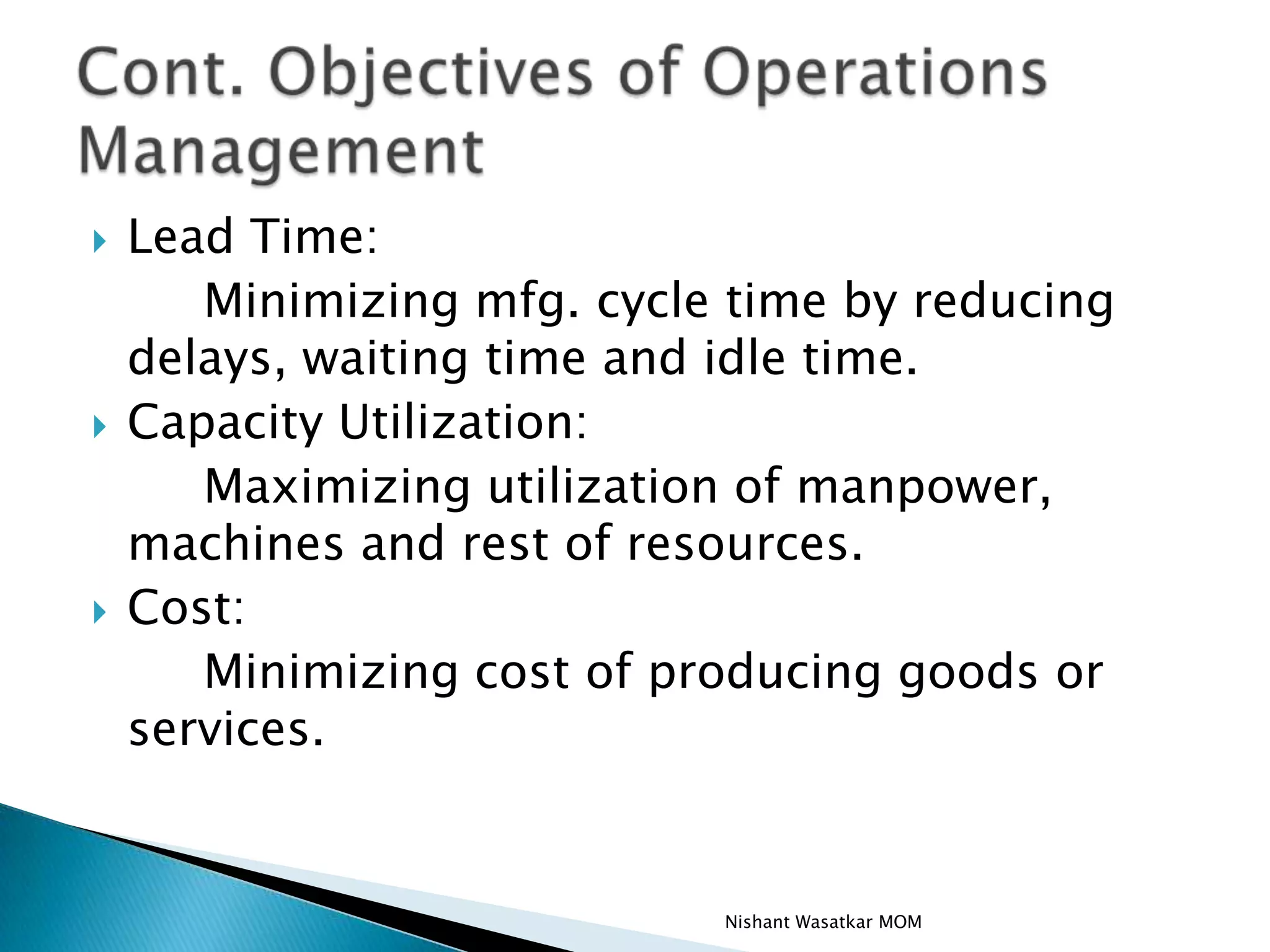
   Lead Time:
       Minimizing mfg. cycle time by reducing
    delays, waiting time and idle time.
   Capacity Utilization:
       Maximizing utilization of manpower,
    machines and rest of resources.
   Cost:
       Minimizing cost of producing goods or
    services.


                            Nishant Wasatkar MOM
   Planning:
    ◦   Product selection & design
    ◦   Process selection & planning
    ◦   Facility Location
    ◦   Facility layout and materials handling
    ◦   Capacity planning
    ◦   Forecasting
    ◦   Production Planning


                                     Nishant Wasatkar MOM
   Organizing
     Work study & job design

   Controlling
    ◦   Production control
    ◦   Inventory control
    ◦   Quality control
    ◦   Maintenance & replacement
    ◦   Cost reduction & cost Control


                                   Nishant Wasatkar MOM
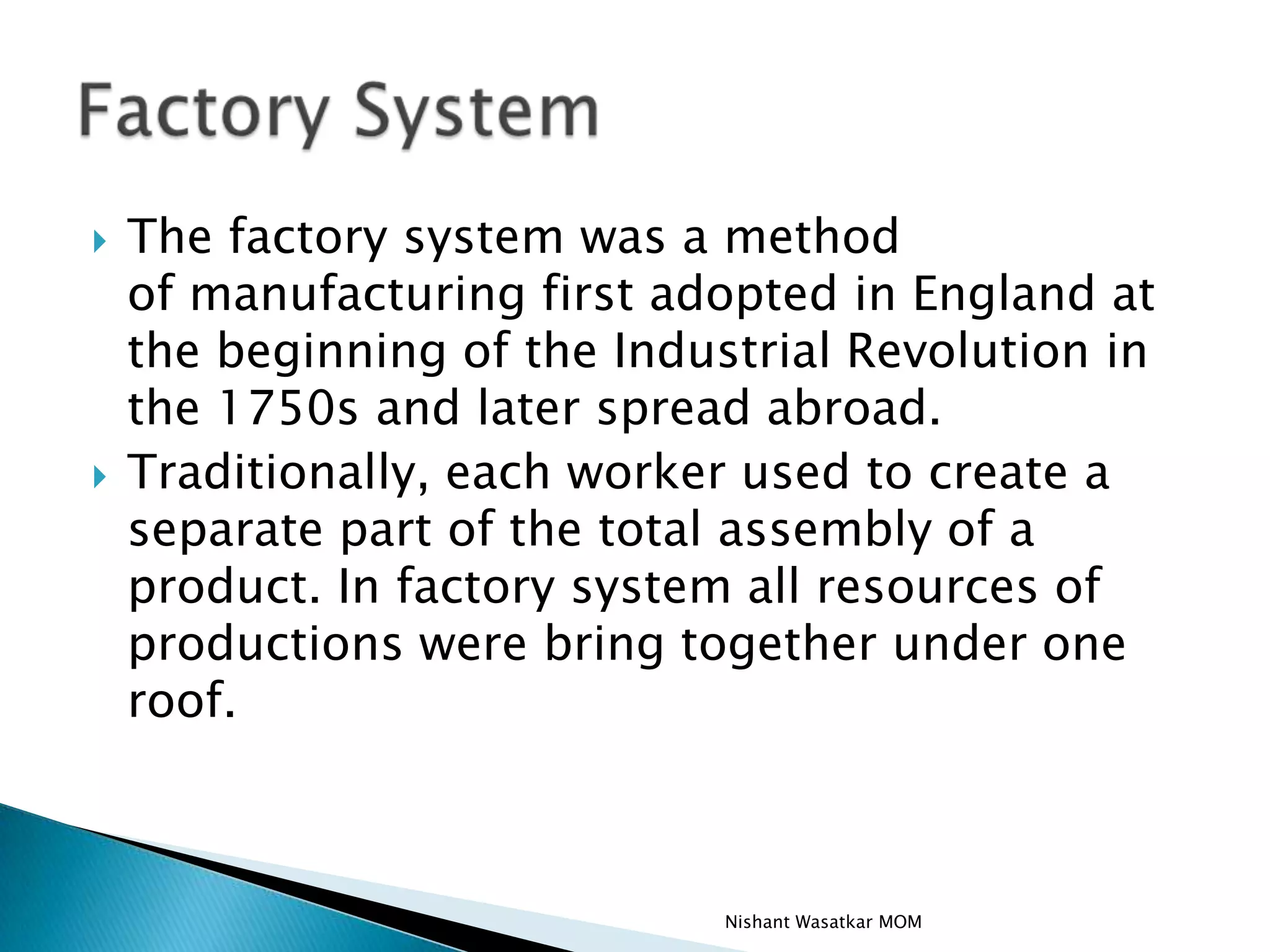
   The factory system was a method
    of manufacturing first adopted in England at
    the beginning of the Industrial Revolution in
    the 1750s and later spread abroad.
   Traditionally, each worker used to create a
    separate part of the total assembly of a
    product. In factory system all resources of
    productions were bring together under one
    roof.


                              Nishant Wasatkar MOM
Manufacturing system need to interact with both
internal & external environment.

   Internal                  External
    Environment:               Environment:
    ◦   Engineering            ◦   Customers
    ◦   Marketing              ◦   Competitors
    ◦   Personnel              ◦   Suppliers
    ◦   Accounts/Finance       ◦   Labor Unions


                               Nishant Wasatkar MOM
   The selection of manufacturing system is a
    strategic decision. The system selected
    should ensure
    ◦ Desired output
    ◦ Required Quality
    ◦ Cost effectiveness


                             Nishant Wasatkar MOM
TYPES OF MANUFACTURING
                            SYSTEMS


             INTERMITTENT                                CONTINUOUS
              PRIDUCTION                                 PRODUCTION


  PROJECT       JOBBING        BATCH             MASS/FLOW        PROCESS
PRODUCTION    PRODUCTION    PRODUCTION          PRODUCTION      PRODUCTION


                                         Nishant Wasatkar MOM
   Definite beginning and definite end.
   Non uniform requirement of resources
   Involvement of different agencies
   Fixed Position layout
    ◦ E.g. production of ships, aircrafts, construction of
      buildings, bridge etc.
   High cost overruns
    ◦ Often delays takes place in projects which are very
      expensive due to cost of factors of production &
      penalties.


                                   Nishant Wasatkar MOM
   Personnel Problems
    ◦ If labor are borrowed from outside for short
      duration, involvement in project will be limited.
    ◦ Since project has a limited period, the staff starts
      spending more time for getting prepared for next
      project.
    ◦ Generally sites of project are in underdeveloped region &
      it may change from project to project which causes
      dislocation of the normal life.
   Scheduling & Control
    ◦ As large number of activities involve in project
      completion by different agencies with strict
      precedence, scheduling & control becomes complex &
      very important.


                                     Nishant Wasatkar MOM
   Small production runs.
   Discontinuous flow of materials
    ◦ Imbalance in operation wise work content leads to
      discontinuity in materials flow.
   Disproportionate manufacturing cycle time
    ◦ Lack of materials/components, imbalanced work
      flow, design changes, design errors detected during
      manufacture, inaccurate work measurements etc
      will lead to extended mfg cycle time.
   General purpose machines & process layout.


                                 Nishant Wasatkar MOM
   Highly skilled labor
   Highly competent knowledgeable supervision
   Large work in progress
   Limited functions of production planning &
    control
    ◦ Materials are indented & purchased on receipt of orders.
    ◦ Tools control function is simple. Standard tools are
      stocked while special tools are either made or purchased
      on request.
    ◦ Process planning activity is almost absent.
    ◦ The scheduling activity is decentralized. A schedule is
      prepared to show the start and completion date of each
      major component of the product.

                                    Nishant Wasatkar MOM
   Short runs
   Skilled labor in specific trades
   Supervisor to possess knowledge of a specific
    process.
   General purpose machines & process type
    layout.
   Manual material handling
   Mfg cycle time affected due to queues
   Large work in progress
   Flexibility of production schedules
   Need to have production planning & control.

                             Nishant Wasatkar MOM
   Continuous flow of materials
   Special purpose machines & product type
    layout
   Mechanized materials material handling
   Low skilled labor
   Short manufacturing cycle time
   Easy supervision
   Limited work in progress
   Lesser flexibility in production schedules.


                              Nishant Wasatkar MOM
   Process production is characterized by
    manufacture of a single product produced
    and stocked.
   Special purpose machines with built in
    controls
   Highly mechanized materials handling
   Virtually zero manufacturing cycle time
   Low skilled labor
   Supervisor to be process specialist
   Negligible work in progress

                            Nishant Wasatkar MOM
Nishant Wasatkar MOM
   High product variety require highly skilled
    labor, general purpose machinery, detailed &
    sophisticated production planning & control
    systems.
   Low product variety enables the use of low
    skilled labor, highly automated mass
    production processes using special purpose
    machinery and simple production planning &
    control systems


                             Nishant Wasatkar MOM
JOBBING

                 BATCH

                             MASS

                                          PROCESS


ONE             DEGREE OF REPETITIVENESS                MANY


                                 Nishant Wasatkar MOM
   Fixed cost are high for continuous process &
    low for intermittent process
   While variable costs are more for intermittent
    process & less for continuous process.
   Intermittent process therefore will be cheaper
    to install and operate at low volumes &
    continuous process will be economical to use
    at high volumes.


                              Nishant Wasatkar MOM
Total Cost (Intermittent)                  Total Cost
                                                  (Continuous)
                                                   Variable Cost
                                                   (Intermittent)

                                                   Variable Cost
                                                   (Continuous)


                                                             Fixed Cost
Cost
                                                             (Continuous)

                                                             Fixed Cost
                                                             (Intermittent)


       Intermittent                 Continuous
       Manufacturing                Manufacturing Range
       Range               Volume     Nishant Wasatkar MOM
   Flexibility implies ability of manufacturing
    system to manufacture variety of products.
   Greater flexibility will be achieved in
    intermittent production which also results in
    higher inventories, long mfg lead times &
    complex planning & control.


                              Nishant Wasatkar MOM
   Efficiency measures the speed and the cost of
    manufacturing system.
   Depending on sales volume & product variety
    process has to be considered which will give
    the best efficiency in terms of machines &
    manpower utilization.
   Environment brings new technologies, as
    market preferences change the
    manufacturing system has to be changed
    accordingly. E.g. Furniture manufacturer.


                             Nishant Wasatkar MOM

Manufacturing & operations management

  • 1.
  • 2.
    Production Systems  Plant Location & Layout  Production Planning & Control  Maintenance Management  Inspection  Work Study  Lean Production Systems Nishant Wasatkar MOM
  • 3.
    Production can be defined as the process of converting inputs into desired output thereby adding value to some entity.  Production function brings together people, machines & materials to provide goods & services satisfying the wants of people. Nishant Wasatkar MOM
  • 4.
    Adjustments Monitor Needed Output INPUTS Conversion Process Outputs Labour Materials Goods & Equipment Services Capital Comparison Actual Vs Planned Nishant Wasatkar MOM
  • 5.
    Manufacturing Cycle Time/ Lead Time  Inventory  Work in progress (WIP)  Material Handling (Manual/Automated)  General Purpose Machines (GPM)  Special Purpose Machines (SPM)  Product Layout  Process Layout Nishant Wasatkar MOM
  • 6.
  • 7.
  • 8.
  • 9.
  • 10.
    Milling Assembly & Test Grinding Drilling Plating Process Layout - work travels to dedicated process centers Nishant Wasatkar MOM
  • 11.
    Primary Objective: To produce goods & services of quality accepted by customer, in desired quantities, according to time schedules & at minimum cost. Nishant Wasatkar MOM
  • 12.
    Effectiveness: Producing right kind of goods & services that satisfy customers needs.  Efficiency : Maximizing output of goods & services with minimum resource inputs.  Quality: Ensuring that goods & services produced conform to pre-set quality specifications. Nishant Wasatkar MOM
  • 13.
    Lead Time: Minimizing mfg. cycle time by reducing delays, waiting time and idle time.  Capacity Utilization: Maximizing utilization of manpower, machines and rest of resources.  Cost: Minimizing cost of producing goods or services. Nishant Wasatkar MOM
  • 14.
    Planning: ◦ Product selection & design ◦ Process selection & planning ◦ Facility Location ◦ Facility layout and materials handling ◦ Capacity planning ◦ Forecasting ◦ Production Planning Nishant Wasatkar MOM
  • 15.
    Organizing  Work study & job design  Controlling ◦ Production control ◦ Inventory control ◦ Quality control ◦ Maintenance & replacement ◦ Cost reduction & cost Control Nishant Wasatkar MOM
  • 16.
    The factory system was a method of manufacturing first adopted in England at the beginning of the Industrial Revolution in the 1750s and later spread abroad.  Traditionally, each worker used to create a separate part of the total assembly of a product. In factory system all resources of productions were bring together under one roof. Nishant Wasatkar MOM
  • 17.
    Manufacturing system needto interact with both internal & external environment.  Internal  External Environment: Environment: ◦ Engineering ◦ Customers ◦ Marketing ◦ Competitors ◦ Personnel ◦ Suppliers ◦ Accounts/Finance ◦ Labor Unions Nishant Wasatkar MOM
  • 18.
    The selection of manufacturing system is a strategic decision. The system selected should ensure ◦ Desired output ◦ Required Quality ◦ Cost effectiveness Nishant Wasatkar MOM
  • 19.
    TYPES OF MANUFACTURING SYSTEMS INTERMITTENT CONTINUOUS PRIDUCTION PRODUCTION PROJECT JOBBING BATCH MASS/FLOW PROCESS PRODUCTION PRODUCTION PRODUCTION PRODUCTION PRODUCTION Nishant Wasatkar MOM
  • 20.
    Definite beginning and definite end.  Non uniform requirement of resources  Involvement of different agencies  Fixed Position layout ◦ E.g. production of ships, aircrafts, construction of buildings, bridge etc.  High cost overruns ◦ Often delays takes place in projects which are very expensive due to cost of factors of production & penalties. Nishant Wasatkar MOM
  • 21.
    Personnel Problems ◦ If labor are borrowed from outside for short duration, involvement in project will be limited. ◦ Since project has a limited period, the staff starts spending more time for getting prepared for next project. ◦ Generally sites of project are in underdeveloped region & it may change from project to project which causes dislocation of the normal life.  Scheduling & Control ◦ As large number of activities involve in project completion by different agencies with strict precedence, scheduling & control becomes complex & very important. Nishant Wasatkar MOM
  • 22.
    Small production runs.  Discontinuous flow of materials ◦ Imbalance in operation wise work content leads to discontinuity in materials flow.  Disproportionate manufacturing cycle time ◦ Lack of materials/components, imbalanced work flow, design changes, design errors detected during manufacture, inaccurate work measurements etc will lead to extended mfg cycle time.  General purpose machines & process layout. Nishant Wasatkar MOM
  • 23.
    Highly skilled labor  Highly competent knowledgeable supervision  Large work in progress  Limited functions of production planning & control ◦ Materials are indented & purchased on receipt of orders. ◦ Tools control function is simple. Standard tools are stocked while special tools are either made or purchased on request. ◦ Process planning activity is almost absent. ◦ The scheduling activity is decentralized. A schedule is prepared to show the start and completion date of each major component of the product. Nishant Wasatkar MOM
  • 24.
    Short runs  Skilled labor in specific trades  Supervisor to possess knowledge of a specific process.  General purpose machines & process type layout.  Manual material handling  Mfg cycle time affected due to queues  Large work in progress  Flexibility of production schedules  Need to have production planning & control. Nishant Wasatkar MOM
  • 25.
    Continuous flow of materials  Special purpose machines & product type layout  Mechanized materials material handling  Low skilled labor  Short manufacturing cycle time  Easy supervision  Limited work in progress  Lesser flexibility in production schedules. Nishant Wasatkar MOM
  • 26.
    Process production is characterized by manufacture of a single product produced and stocked.  Special purpose machines with built in controls  Highly mechanized materials handling  Virtually zero manufacturing cycle time  Low skilled labor  Supervisor to be process specialist  Negligible work in progress Nishant Wasatkar MOM
  • 27.
  • 28.
    High product variety require highly skilled labor, general purpose machinery, detailed & sophisticated production planning & control systems.  Low product variety enables the use of low skilled labor, highly automated mass production processes using special purpose machinery and simple production planning & control systems Nishant Wasatkar MOM
  • 29.
    JOBBING BATCH MASS PROCESS ONE DEGREE OF REPETITIVENESS MANY Nishant Wasatkar MOM
  • 30.
    Fixed cost are high for continuous process & low for intermittent process  While variable costs are more for intermittent process & less for continuous process.  Intermittent process therefore will be cheaper to install and operate at low volumes & continuous process will be economical to use at high volumes. Nishant Wasatkar MOM
  • 31.
    Total Cost (Intermittent) Total Cost (Continuous) Variable Cost (Intermittent) Variable Cost (Continuous) Fixed Cost Cost (Continuous) Fixed Cost (Intermittent) Intermittent Continuous Manufacturing Manufacturing Range Range Volume Nishant Wasatkar MOM
  • 32.
    Flexibility implies ability of manufacturing system to manufacture variety of products.  Greater flexibility will be achieved in intermittent production which also results in higher inventories, long mfg lead times & complex planning & control. Nishant Wasatkar MOM
  • 33.
    Efficiency measures the speed and the cost of manufacturing system.  Depending on sales volume & product variety process has to be considered which will give the best efficiency in terms of machines & manpower utilization.  Environment brings new technologies, as market preferences change the manufacturing system has to be changed accordingly. E.g. Furniture manufacturer. Nishant Wasatkar MOM