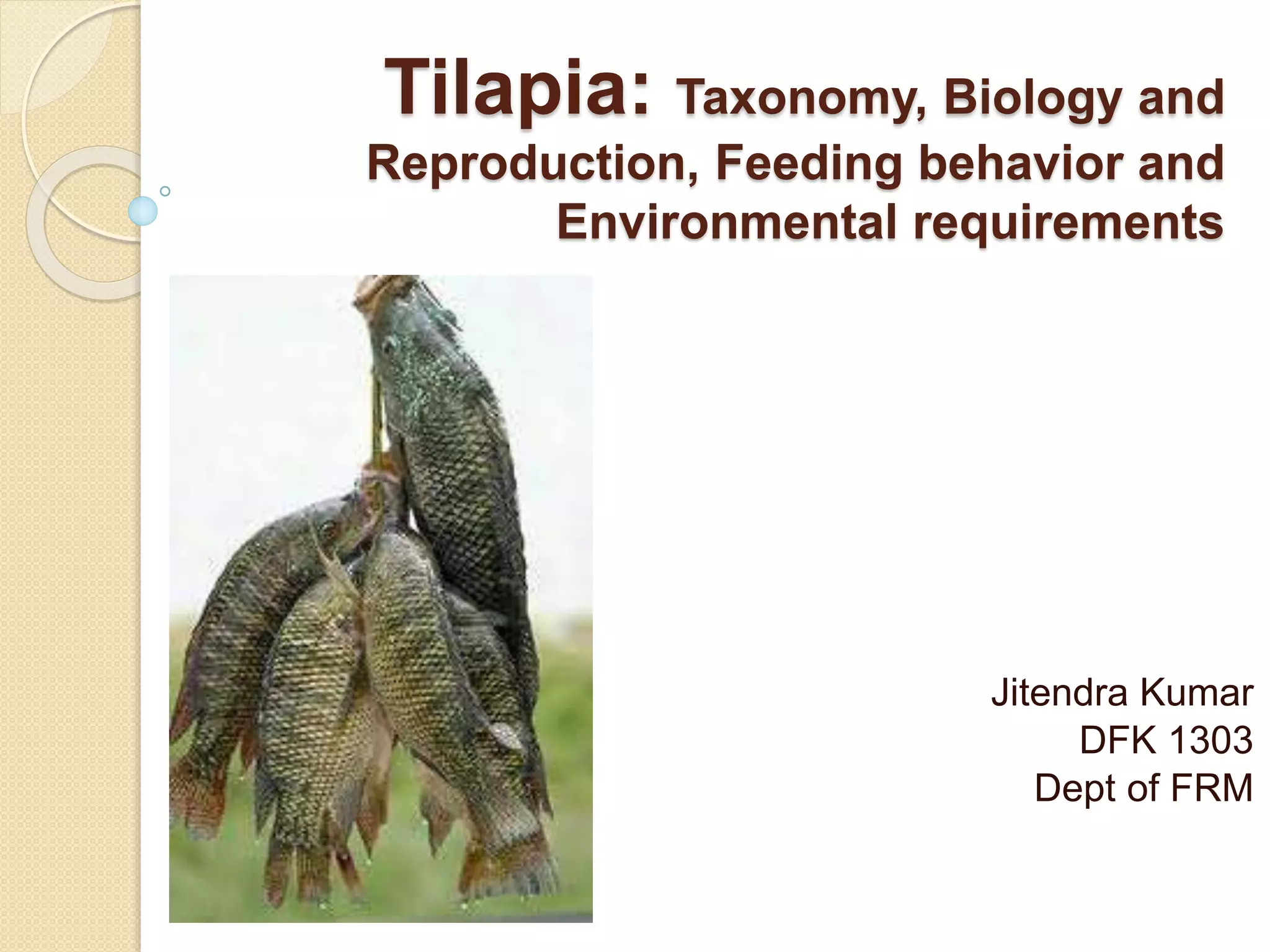
Tilapia: Taxonomy, Biology and
Reproduction, Feeding behavior and
Environmental requirements
Jitendra Kumar
DFK 1303
Dept of FRM
TAXONOMIC CLASSIFICATION
 Phylum: Chordata
 Subphylum:
Vertebrata
 Class: Osteichthyes
 Order: Perciformes
 Family: Cichlidae
“Tilapia” is the generic name of a group of cichlids
endemic to Africa.
Introduction
 Tilapia is one of the most widely cultured fish in the
world.
 Currently, farmed tilapia represents more than 75% of
world tilapia production (FAO, 2009),
 Several factors have contributed to the rapid global growth
of tilapia.
 Tilapia are easily cultured and highly adaptable to a wide
range of environmental conditions.
 Genus Tilapia: Includes those species which
are substrate spawners and do not keep the
eggs in the mouth for incubation
 Genus Sarotherodon: Includes those species
which are mostly paternal mouth brooders and
sometimes eggs and hatched larvae.
 Genus Oreochromis: Includes those species
which are exclusively maternal mouth brooders.
In this group the males construct and defend a
mating territory in an arena with other males in
adjacent terrirories, and females come to find
spawning partners, e.g. O. niloticus, O. aureus,
O. mossambicus.
 A total of about 70 species of tilapia have
been so far listed as native to Africa.
 Only a few species are suitable and
popular for farming in ponds and other
culture systems, which include-:
 Nile tilapia(Oreochromis niloticus)
 Mozambique tilapia (O. mossambicus)
 Blue tilapia (O. aureus)
 three spotted tilapia (O. andersonii) etc..
There are also some genetically improved strains such as Genetically
Improved Farmed Tilapia (GIFT), red tilapia strains and hybrids.
Mozambique tilapia,
Oreochromis
mossambicus
 Oreochromis mossambicus is native to Malawi,
Mozambique, Swaziland, Zambia, Zimbabwe and
South Africa.
 Oreochromis mossambicus is a popular fish among
fish farmers since it is hardy and easy to grow.
 The fish is a popular food fish with white, mild flesh.
It is however far from the most common tilapia
species in aquacultures;
 roughly 4 percent of the total global tilapia
aquaculture production is made up by Oreochromis
mossambicus.
Mozambique Tilapia in Aquacultures
 Mozambique tilapia can be kept in
aquariums but only if you have a big
aquarium since it can exceed 40 cm (16
inches) in length as an adult.
 It grows really fast, so you will need that
large aquarium fairly soon even if you
purchase small juvenile specimens.
 The Mozambique tilapia is a hardy species,
Mozambique Tilapia in Aquariums
Conservation Status for Oreochromis Mossambicus
The Mozambique tilapia, Oreochromis mossambicus, is listed
as Near Threatened (NT) on the IUCN Red List of Threatened
Species.
This is a problem, since this two species readily mates with
each other which leads to hybridization.
According to IUCN, the Mozambique tilapia is likely to
become locally extinct in those systems.
Hybridization is not the only problem; competition can also
pose a threat to the Mozambique tilapia.
Nile tilapia, Oreochromis
niloticus
Morphology
 Caudal fin with regular dark vertical stripes
 Dorsal fin with dark margin
 Red coloration on head and lower part of
the body in breeding males
 Variable coloration in females dependent
on subspecies- some may show coloration
similar to males during breeding season
Behaviour
 During the day fish may form large
schools that break up during the night
and reform at dawn
Diet
Juveniles
Diurnal feeding pattern
Omnivorous as fry consuming primarily copepods,
and insects
By 6 cm TL, diet becomes primarily phytoplankton
Adults
Diurnal feeding pattern
Primarily utilize phytoplankton (blue-green algae and
diatoms) but may also consume macrophytes
when phytoplankton densities are low
Life
Cycle
 Maximum size of 64 mm TL
 Typically obtain a total length of 25 cm
by second year
Maturity
 first sexual maturity 9 to 15 cm TL
 Age at maturity occurs in first year between 5
and 10 months of age
Habitat Characteristics
 Prefers temperatures between 28 –30
deg C depending on acclimation
temperature
 Can tolerate low dissolved oxygen
(0.1ppm)
Genetically Improved Farmed
Tilapia (GIFT) strain.
In Bangladesh, comparative growth and production potential of GIFT
and existing Nile tilapia strains (O. niloticus) was evaluated both
under on-station and on-farm conditions.
Total yield of the GIFT was significantly higher (57%
more; P<0.05) than that of the existing strain.
GIFT strain for aquaculture
 High yielding
 Excellent breeder
 Efficient converter of organic and
agricultural wastes in to high quality protein
 Resistant to disease
 Very hardy
 Tolerant to over crowding conditions
 Able to grow in either fresh or brackish
water
 Nile tilapia is an important food fish that has been
introduced to many different parts of the world by
man.
 It can today be found on all continents except
Antarctica.
 In several countries, Nile tilapia has become a
problematic invasive species after its introduction.
Tolerance to ecological
conditions
 Water temperatures 12 to 35oC
 pH 6.5 – 8.0
 Dissolve oxygen 2.0 – 8.0 mg/l
 Salinity 3 - 25 ppt
Growth
 Nile tilapia can grow to
 150 – 250 g in 4 to 6 months,
 500 to 800 g in 10 to 12 months and
 2 – 3 kg in 2 years.
Food
 O. niloticus is capable of using a wide
range of food materials from tiny plankton
(phytoplanton and zooplankton) to
macrophytes.
 It grows well on artificial feeds.
Fecundity
 Colour of ripe and fertilized eggs is pale
yellow orange
 size ranges between 1.0-2.0 mm x 1.5-
3.0 mm in diameter,
 and 2.3 – 2.8 mm in length
 The fecundity fluctuates widely from a
few hundred to several thousand eggs,
depending on the size and age of the
female.
O. niloticus embryonic development
there are five easily observed
developmental stages (Hussain
1992)
• Morula stage: 6-8 hrs. after fertilization (a.f.)
• Pigmentation stage: 45-50 hrs. a.f.
• Hatching stage: 70-90 hrs. a.f.
• Yolk sac resorption stage: 6-10 days a.f.
• First feeding stage: 12 – 14 days a.f.
Production and Economics for
Culture of Tilapia in
Semi-intensive System
(Area of Pond :1 Ha Duration : 7-8 months)
Sr.
No.
particulars Rate of
Appli.(/ha)
Unit
price(Rs.)
Quantity
(1ha)
Amount
(Rs)
1 Dewatering of pond (Diesel) 40 lit. 50/- 40 lit. 2000/-
2 Drying of pond - - - -
3 Ploughing of pond (Tractor) - 300/-per hr. 8 hr. 2400/-
4 Lime application 300 kg 5/- 300 1500/-
5 Fertilizer(Organic) 5000kg o.5/- 4 ton 2000/-
6 Fertilizer( Urea) 25 kg 5/- 25 kg 125/-
7 Fertilizer (SSP) 75 kg 5/- 75 kg 375/-
8 Fertilizer (GOC) 200 kg 20/- 200 kg 4000/-
9 Seed (Fingerling) 2/m2 0.5 20,000 10,000/-
10 Feed (GOC + RB) /A.F.(25-32% protein) 2-3% 18/-/Kg 7000kg 1,26,ooo/-
11 Miscellaneous Expenditure - - - 5,000/-
12 FCR - - 2.0 -
13 Average Growth - - 220 (g) -
14 Survival - - 80% -
15 Production - - 3500 Kg -
16 Sale Price (Rs./kg) - - - Rs 80/kg
17 Total Income (Rs) - - - 2,81,600/-
18 Total Expenditure - - - 1,53,400/-
19 Net Income (Rs) (17 – 18) - - - 1,28,200/-
Production and Economics for Culture of Tilapia in Semi-intensive System
Conclusions
 Tilapia are a good fish for warm water aquaculture.
 They are easily spawned, use a wide variety of natural
foods as well as artificial feeds, tolerate poor water
quality, and grow rapidly at warm temperatures.
 These attributes, along with relatively low input costs,
have made tilapia the most widely cultured freshwater
fish in tropical and subtropical countries.
 Consumers like tilapia’s firm flesh and mild flavor, so
markets have expanded rapidly in U.S. during the last
10 years, mostly based on foreign imports.
Thank You

Tilapia bio &amp; cul jitendra

  • 1.
    Tilapia: Taxonomy, Biologyand Reproduction, Feeding behavior and Environmental requirements Jitendra Kumar DFK 1303 Dept of FRM
  • 2.
    TAXONOMIC CLASSIFICATION  Phylum:Chordata  Subphylum: Vertebrata  Class: Osteichthyes  Order: Perciformes  Family: Cichlidae “Tilapia” is the generic name of a group of cichlids endemic to Africa.
  • 3.
    Introduction  Tilapia isone of the most widely cultured fish in the world.  Currently, farmed tilapia represents more than 75% of world tilapia production (FAO, 2009),  Several factors have contributed to the rapid global growth of tilapia.  Tilapia are easily cultured and highly adaptable to a wide range of environmental conditions.
  • 4.
     Genus Tilapia:Includes those species which are substrate spawners and do not keep the eggs in the mouth for incubation  Genus Sarotherodon: Includes those species which are mostly paternal mouth brooders and sometimes eggs and hatched larvae.  Genus Oreochromis: Includes those species which are exclusively maternal mouth brooders. In this group the males construct and defend a mating territory in an arena with other males in adjacent terrirories, and females come to find spawning partners, e.g. O. niloticus, O. aureus, O. mossambicus.
  • 5.
     A totalof about 70 species of tilapia have been so far listed as native to Africa.  Only a few species are suitable and popular for farming in ponds and other culture systems, which include-:  Nile tilapia(Oreochromis niloticus)  Mozambique tilapia (O. mossambicus)  Blue tilapia (O. aureus)  three spotted tilapia (O. andersonii) etc.. There are also some genetically improved strains such as Genetically Improved Farmed Tilapia (GIFT), red tilapia strains and hybrids.
  • 6.
  • 7.
     Oreochromis mossambicusis native to Malawi, Mozambique, Swaziland, Zambia, Zimbabwe and South Africa.  Oreochromis mossambicus is a popular fish among fish farmers since it is hardy and easy to grow.  The fish is a popular food fish with white, mild flesh. It is however far from the most common tilapia species in aquacultures;  roughly 4 percent of the total global tilapia aquaculture production is made up by Oreochromis mossambicus. Mozambique Tilapia in Aquacultures
  • 8.
     Mozambique tilapiacan be kept in aquariums but only if you have a big aquarium since it can exceed 40 cm (16 inches) in length as an adult.  It grows really fast, so you will need that large aquarium fairly soon even if you purchase small juvenile specimens.  The Mozambique tilapia is a hardy species, Mozambique Tilapia in Aquariums
  • 9.
    Conservation Status forOreochromis Mossambicus The Mozambique tilapia, Oreochromis mossambicus, is listed as Near Threatened (NT) on the IUCN Red List of Threatened Species. This is a problem, since this two species readily mates with each other which leads to hybridization. According to IUCN, the Mozambique tilapia is likely to become locally extinct in those systems. Hybridization is not the only problem; competition can also pose a threat to the Mozambique tilapia.
  • 10.
  • 11.
    Morphology  Caudal finwith regular dark vertical stripes  Dorsal fin with dark margin  Red coloration on head and lower part of the body in breeding males  Variable coloration in females dependent on subspecies- some may show coloration similar to males during breeding season
  • 12.
    Behaviour  During theday fish may form large schools that break up during the night and reform at dawn Diet Juveniles Diurnal feeding pattern Omnivorous as fry consuming primarily copepods, and insects By 6 cm TL, diet becomes primarily phytoplankton Adults Diurnal feeding pattern Primarily utilize phytoplankton (blue-green algae and diatoms) but may also consume macrophytes when phytoplankton densities are low
  • 13.
    Life Cycle  Maximum sizeof 64 mm TL  Typically obtain a total length of 25 cm by second year Maturity  first sexual maturity 9 to 15 cm TL  Age at maturity occurs in first year between 5 and 10 months of age
  • 14.
    Habitat Characteristics  Preferstemperatures between 28 –30 deg C depending on acclimation temperature  Can tolerate low dissolved oxygen (0.1ppm)
  • 15.
    Genetically Improved Farmed Tilapia(GIFT) strain. In Bangladesh, comparative growth and production potential of GIFT and existing Nile tilapia strains (O. niloticus) was evaluated both under on-station and on-farm conditions. Total yield of the GIFT was significantly higher (57% more; P<0.05) than that of the existing strain.
  • 16.
    GIFT strain foraquaculture  High yielding  Excellent breeder  Efficient converter of organic and agricultural wastes in to high quality protein  Resistant to disease  Very hardy  Tolerant to over crowding conditions  Able to grow in either fresh or brackish water
  • 17.
     Nile tilapiais an important food fish that has been introduced to many different parts of the world by man.  It can today be found on all continents except Antarctica.  In several countries, Nile tilapia has become a problematic invasive species after its introduction.
  • 18.
    Tolerance to ecological conditions Water temperatures 12 to 35oC  pH 6.5 – 8.0  Dissolve oxygen 2.0 – 8.0 mg/l  Salinity 3 - 25 ppt
  • 19.
    Growth  Nile tilapiacan grow to  150 – 250 g in 4 to 6 months,  500 to 800 g in 10 to 12 months and  2 – 3 kg in 2 years. Food  O. niloticus is capable of using a wide range of food materials from tiny plankton (phytoplanton and zooplankton) to macrophytes.  It grows well on artificial feeds.
  • 20.
    Fecundity  Colour ofripe and fertilized eggs is pale yellow orange  size ranges between 1.0-2.0 mm x 1.5- 3.0 mm in diameter,  and 2.3 – 2.8 mm in length  The fecundity fluctuates widely from a few hundred to several thousand eggs, depending on the size and age of the female.
  • 21.
    O. niloticus embryonicdevelopment there are five easily observed developmental stages (Hussain 1992) • Morula stage: 6-8 hrs. after fertilization (a.f.) • Pigmentation stage: 45-50 hrs. a.f. • Hatching stage: 70-90 hrs. a.f. • Yolk sac resorption stage: 6-10 days a.f. • First feeding stage: 12 – 14 days a.f.
  • 22.
    Production and Economicsfor Culture of Tilapia in Semi-intensive System (Area of Pond :1 Ha Duration : 7-8 months)
  • 23.
    Sr. No. particulars Rate of Appli.(/ha) Unit price(Rs.) Quantity (1ha) Amount (Rs) 1Dewatering of pond (Diesel) 40 lit. 50/- 40 lit. 2000/- 2 Drying of pond - - - - 3 Ploughing of pond (Tractor) - 300/-per hr. 8 hr. 2400/- 4 Lime application 300 kg 5/- 300 1500/- 5 Fertilizer(Organic) 5000kg o.5/- 4 ton 2000/- 6 Fertilizer( Urea) 25 kg 5/- 25 kg 125/- 7 Fertilizer (SSP) 75 kg 5/- 75 kg 375/- 8 Fertilizer (GOC) 200 kg 20/- 200 kg 4000/- 9 Seed (Fingerling) 2/m2 0.5 20,000 10,000/- 10 Feed (GOC + RB) /A.F.(25-32% protein) 2-3% 18/-/Kg 7000kg 1,26,ooo/- 11 Miscellaneous Expenditure - - - 5,000/- 12 FCR - - 2.0 - 13 Average Growth - - 220 (g) - 14 Survival - - 80% - 15 Production - - 3500 Kg - 16 Sale Price (Rs./kg) - - - Rs 80/kg 17 Total Income (Rs) - - - 2,81,600/- 18 Total Expenditure - - - 1,53,400/- 19 Net Income (Rs) (17 – 18) - - - 1,28,200/- Production and Economics for Culture of Tilapia in Semi-intensive System
  • 24.
    Conclusions  Tilapia area good fish for warm water aquaculture.  They are easily spawned, use a wide variety of natural foods as well as artificial feeds, tolerate poor water quality, and grow rapidly at warm temperatures.  These attributes, along with relatively low input costs, have made tilapia the most widely cultured freshwater fish in tropical and subtropical countries.  Consumers like tilapia’s firm flesh and mild flavor, so markets have expanded rapidly in U.S. during the last 10 years, mostly based on foreign imports.
  • 25.