
hreats & onservation tatusFRM - 601
ASSESSMENT OF AQUATIC BIODIVERSITY
Bio- Diversity
 Refers to the numbers, variety and variability of
living organisms and ecosystem
 Includes all terrestrial, marine and other aquatic
organisms
 Covers diversity within species, between species as
well as variations among ecosystems.
Biodiversity is the degree of variation of life forms within a given ecosystem, biome, or an
entire planet.
 Chilika lagoon is situated on the east coast of India between 19O 54’ North
latitude and 85O 35’ East longitude connecting the Bay of Bengal
 Extends from Southwest corner of Puri and Khurda districts to the adjoining
Ganjam District in the state of Orissa
 Lake Chilika, Asia’s biggest salt water lake in the eastern coast of India,
 The Lake itself can be broadly divided into four ecological sectors based on
salinity and depth
 Southern zone
 Central zone
 Northern zone
Introduction- Chilika Lake
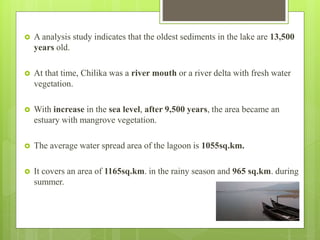
 A analysis study indicates that the oldest sediments in the lake are 13,500
years old.
 At that time, Chilika was a river mouth or a river delta with fresh water
vegetation.
 With increase in the sea level, after 9,500 years, the area became an
estuary with mangrove vegetation.
 The average water spread area of the lagoon is 1055sq.km.
 It covers an area of 1165sq.km. in the rainy season and 965 sq.km. during
summer.
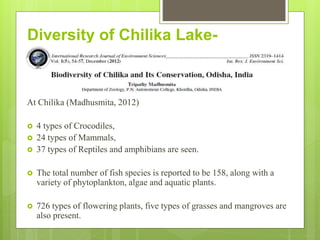
At Chilika (Madhusmita, 2012)
 4 types of Crocodiles,
 24 types of Mammals,
 37 types of Reptiles and amphibians are seen.
 The total number of fish species is reported to be 158, along with a
variety of phytoplankton, algae and aquatic plants.
 726 types of flowering plants, five types of grasses and mangroves are
also present.
Diversity of Chilika Lake-
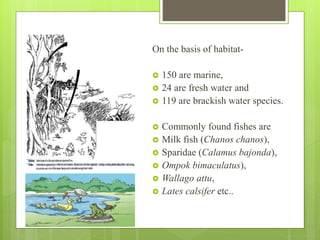
On the basis of habitat-
 150 are marine,
 24 are fresh water and
 119 are brackish water species.
 Commonly found fishes are
 Milk fish (Chanos chanos),
 Sparidae (Calamus bajonda),
 Ompok bimaculatus),
 Wallago attu,
 Lates calsifer etc..
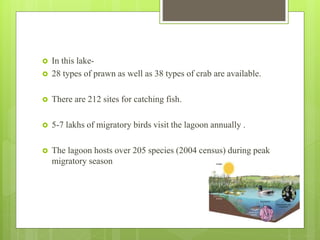
 In this lake-
 28 types of prawn as well as 38 types of crab are available.
 There are 212 sites for catching fish.
 5-7 lakhs of migratory birds visit the lagoon annually .
 The lagoon hosts over 205 species (2004 census) during peak
migratory season
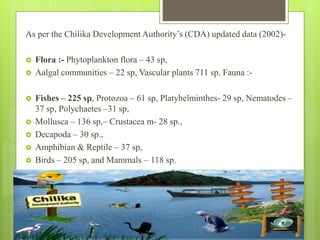
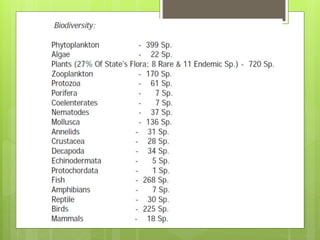
As per the Chilika Development Authority’s (CDA) updated data (2002)-
 Flora :- Phytoplankton flora – 43 sp,
 Aalgal communities – 22 sp, Vascular plants 711 sp. Fauna :-
 Fishes – 225 sp, Protozoa – 61 sp, Platyhelminthes- 29 sp, Nematodes –
37 sp, Polychaetes –31 sp,
 Mollusca – 136 sp,– Crustacea m- 28 sp.,
 Decapoda – 30 sp.,
 Amphibian & Reptile – 37 sp,
 Birds – 205 sp, and Mammals – 118 sp.
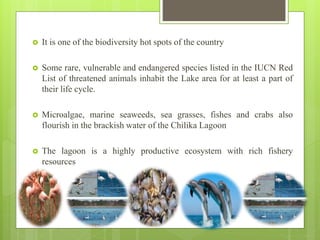
 It is one of the biodiversity hot spots of the country
 Some rare, vulnerable and endangered species listed in the IUCN Red
List of threatened animals inhabit the Lake area for at least a part of
their life cycle.
 Microalgae, marine seaweeds, sea grasses, fishes and crabs also
flourish in the brackish water of the Chilika Lagoon
 The lagoon is a highly productive ecosystem with rich fishery
resources
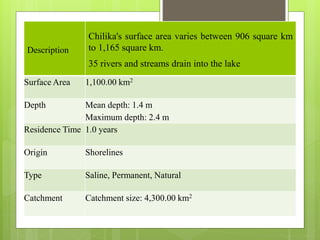
Physical CharacteristicsDescription
Chilika's surface area varies between 906 square km
to 1,165 square km.
35 rivers and streams drain into the lake
Surface Area 1,100.00 km2
Depth Mean depth: 1.4 m
Maximum depth: 2.4 m
Residence Time 1.0 years
Origin Shorelines
Type Saline, Permanent, Natural
Catchment Catchment size: 4,300.00 km2
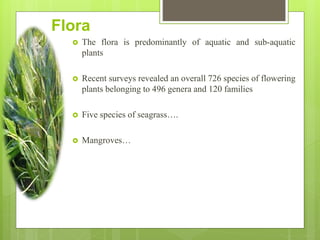
Flora
 The flora is predominantly of aquatic and sub-aquatic
plants
 Recent surveys revealed an overall 726 species of flowering
plants belonging to 496 genera and 120 families
 Five species of seagrass….
 Mangroves…
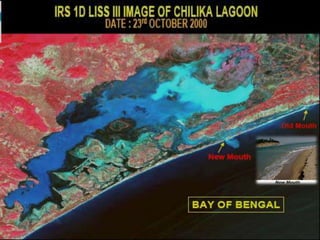
 After reopening of the lake mouth in 2000, six
threatened species have reappeared, including:
 Milk fish (Seba khainga),
 Indo-Pacific tarpon (Panialehio),
 Ten pounder (Nahama),
 Bream (Kala khuranti),
 Hilsa
 Mullet
Commercial fisheries
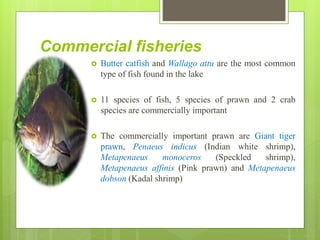
 Butter catfish and Wallago attu are the most common
type of fish found in the lake
 11 species of fish, 5 species of prawn and 2 crab
species are commercially important
 The commercially important prawn are Giant tiger
prawn, Penaeus indicus (Indian white shrimp),
Metapenaeus monoceros (Speckled shrimp),
Metapenaeus affinis (Pink prawn) and Metapenaeus
dobson (Kadal shrimp)
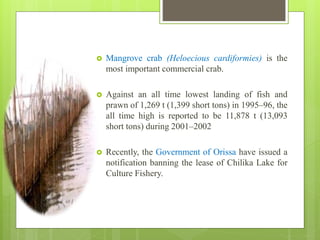
 Mangrove crab (Heloecious cardiformies) is the
most important commercial crab.
 Against an all time lowest landing of fish and
prawn of 1,269 t (1,399 short tons) in 1995–96, the
all time high is reported to be 11,878 t (13,093
short tons) during 2001–2002
 Recently, the Government of Orissa have issued a
notification banning the lease of Chilika Lake for
Culture Fishery.
Dolphins
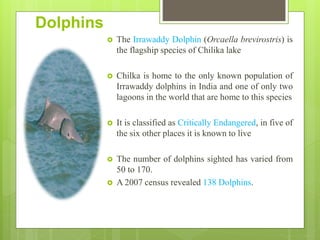
 The Irrawaddy Dolphin (Orcaella brevirostris) is
the flagship species of Chilika lake
 Chilka is home to the only known population of
Irrawaddy dolphins in India and one of only two
lagoons in the world that are home to this species
 It is classified as Critically Endangered, in five of
the six other places it is known to live
 The number of dolphins sighted has varied from
50 to 170.
 A 2007 census revealed 138 Dolphins.
Conservation — threats and
management
 In 1981, Chilika Lake was designated the first
Indian wetland of international importance under
the Ramsar Convention due to its rich
biodiversity.
Threats
 Siltation due to littoral drift and sediments from the
inland river systems Shrinkage of water surface area
 Choking of the inlet channel as well as shifting of the
mouth connecting to the sea
 An overall loss of biodiversity with decline in productivity
adversely affecting the livelihood of the community that
depended on it
 The rapid expansion of commercial aquaculture of
prawn has contributed significantly to the decline of the
lakes fisheries and bird population.
Conservation status
 Wetlands are vital ecosystems that provide livelihood
for the millions of people who live in and around them.
 The area of Chilika lake in the early nineties was
914sq.km.
 Today it is restricted to only 800 sq.km. Its
 degradation is so severe that the Chilika
Devlopment Authority was formed to restore and
conserve the lake.
Cont..
 A study published by the Salim Ali Centre for
Ornithology and Natural History, Coimbatore
says that between 1991-2001, India lost 40%
of its wetland.
Conclusion
 Chilika is one of the hotspots of biodiversity in India
with unique ecological status having both the fresh
water and salt water characteristics creating an
extremely productive environment due to efficient
nutrient cycle.
 The lagoon, in view of its biodiversity, has turned out to
be an excellent centre for research and tourist
attraction.
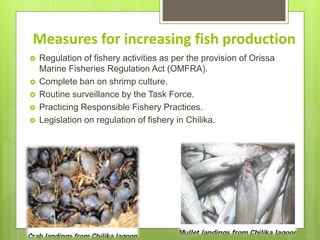
Measures for increasing fish production
 Regulation of fishery activities as per the provision of Orissa
Marine Fisheries Regulation Act (OMFRA).
 Complete ban on shrimp culture.
 Routine surveillance by the Task Force.
 Practicing Responsible Fishery Practices.
 Legislation on regulation of fishery in Chilika.
Biodiversity  chilika

Biodiversity chilika

  • 1.
    hreats & onservationtatusFRM - 601 ASSESSMENT OF AQUATIC BIODIVERSITY
  • 2.
    Bio- Diversity  Refersto the numbers, variety and variability of living organisms and ecosystem  Includes all terrestrial, marine and other aquatic organisms  Covers diversity within species, between species as well as variations among ecosystems. Biodiversity is the degree of variation of life forms within a given ecosystem, biome, or an entire planet.
  • 3.
     Chilika lagoonis situated on the east coast of India between 19O 54’ North latitude and 85O 35’ East longitude connecting the Bay of Bengal  Extends from Southwest corner of Puri and Khurda districts to the adjoining Ganjam District in the state of Orissa  Lake Chilika, Asia’s biggest salt water lake in the eastern coast of India,  The Lake itself can be broadly divided into four ecological sectors based on salinity and depth  Southern zone  Central zone  Northern zone Introduction- Chilika Lake
  • 4.
     A analysisstudy indicates that the oldest sediments in the lake are 13,500 years old.  At that time, Chilika was a river mouth or a river delta with fresh water vegetation.  With increase in the sea level, after 9,500 years, the area became an estuary with mangrove vegetation.  The average water spread area of the lagoon is 1055sq.km.  It covers an area of 1165sq.km. in the rainy season and 965 sq.km. during summer.
  • 5.
    At Chilika (Madhusmita,2012)  4 types of Crocodiles,  24 types of Mammals,  37 types of Reptiles and amphibians are seen.  The total number of fish species is reported to be 158, along with a variety of phytoplankton, algae and aquatic plants.  726 types of flowering plants, five types of grasses and mangroves are also present. Diversity of Chilika Lake-
  • 6.
    On the basisof habitat-  150 are marine,  24 are fresh water and  119 are brackish water species.  Commonly found fishes are  Milk fish (Chanos chanos),  Sparidae (Calamus bajonda),  Ompok bimaculatus),  Wallago attu,  Lates calsifer etc..
  • 7.
     In thislake-  28 types of prawn as well as 38 types of crab are available.  There are 212 sites for catching fish.  5-7 lakhs of migratory birds visit the lagoon annually .  The lagoon hosts over 205 species (2004 census) during peak migratory season
  • 8.
    As per theChilika Development Authority’s (CDA) updated data (2002)-  Flora :- Phytoplankton flora – 43 sp,  Aalgal communities – 22 sp, Vascular plants 711 sp. Fauna :-  Fishes – 225 sp, Protozoa – 61 sp, Platyhelminthes- 29 sp, Nematodes – 37 sp, Polychaetes –31 sp,  Mollusca – 136 sp,– Crustacea m- 28 sp.,  Decapoda – 30 sp.,  Amphibian & Reptile – 37 sp,  Birds – 205 sp, and Mammals – 118 sp.
  • 9.
     It isone of the biodiversity hot spots of the country  Some rare, vulnerable and endangered species listed in the IUCN Red List of threatened animals inhabit the Lake area for at least a part of their life cycle.  Microalgae, marine seaweeds, sea grasses, fishes and crabs also flourish in the brackish water of the Chilika Lagoon  The lagoon is a highly productive ecosystem with rich fishery resources
  • 10.
    Physical CharacteristicsDescription Chilika's surfacearea varies between 906 square km to 1,165 square km. 35 rivers and streams drain into the lake Surface Area 1,100.00 km2 Depth Mean depth: 1.4 m Maximum depth: 2.4 m Residence Time 1.0 years Origin Shorelines Type Saline, Permanent, Natural Catchment Catchment size: 4,300.00 km2
  • 11.
    Flora  The florais predominantly of aquatic and sub-aquatic plants  Recent surveys revealed an overall 726 species of flowering plants belonging to 496 genera and 120 families  Five species of seagrass….  Mangroves…
  • 12.
     After reopeningof the lake mouth in 2000, six threatened species have reappeared, including:  Milk fish (Seba khainga),  Indo-Pacific tarpon (Panialehio),  Ten pounder (Nahama),  Bream (Kala khuranti),  Hilsa  Mullet
  • 15.
    Commercial fisheries  Buttercatfish and Wallago attu are the most common type of fish found in the lake  11 species of fish, 5 species of prawn and 2 crab species are commercially important  The commercially important prawn are Giant tiger prawn, Penaeus indicus (Indian white shrimp), Metapenaeus monoceros (Speckled shrimp), Metapenaeus affinis (Pink prawn) and Metapenaeus dobson (Kadal shrimp)
  • 16.
     Mangrove crab(Heloecious cardiformies) is the most important commercial crab.  Against an all time lowest landing of fish and prawn of 1,269 t (1,399 short tons) in 1995–96, the all time high is reported to be 11,878 t (13,093 short tons) during 2001–2002  Recently, the Government of Orissa have issued a notification banning the lease of Chilika Lake for Culture Fishery.
  • 17.
    Dolphins  The IrrawaddyDolphin (Orcaella brevirostris) is the flagship species of Chilika lake  Chilka is home to the only known population of Irrawaddy dolphins in India and one of only two lagoons in the world that are home to this species  It is classified as Critically Endangered, in five of the six other places it is known to live  The number of dolphins sighted has varied from 50 to 170.  A 2007 census revealed 138 Dolphins.
  • 18.
    Conservation — threatsand management  In 1981, Chilika Lake was designated the first Indian wetland of international importance under the Ramsar Convention due to its rich biodiversity.
  • 19.
    Threats  Siltation dueto littoral drift and sediments from the inland river systems Shrinkage of water surface area  Choking of the inlet channel as well as shifting of the mouth connecting to the sea  An overall loss of biodiversity with decline in productivity adversely affecting the livelihood of the community that depended on it  The rapid expansion of commercial aquaculture of prawn has contributed significantly to the decline of the lakes fisheries and bird population.
  • 20.
    Conservation status  Wetlandsare vital ecosystems that provide livelihood for the millions of people who live in and around them.  The area of Chilika lake in the early nineties was 914sq.km.  Today it is restricted to only 800 sq.km. Its  degradation is so severe that the Chilika Devlopment Authority was formed to restore and conserve the lake.
  • 21.
    Cont..  A studypublished by the Salim Ali Centre for Ornithology and Natural History, Coimbatore says that between 1991-2001, India lost 40% of its wetland.
  • 22.
    Conclusion  Chilika isone of the hotspots of biodiversity in India with unique ecological status having both the fresh water and salt water characteristics creating an extremely productive environment due to efficient nutrient cycle.  The lagoon, in view of its biodiversity, has turned out to be an excellent centre for research and tourist attraction.
  • 23.
    Measures for increasingfish production  Regulation of fishery activities as per the provision of Orissa Marine Fisheries Regulation Act (OMFRA).  Complete ban on shrimp culture.  Routine surveillance by the Task Force.  Practicing Responsible Fishery Practices.  Legislation on regulation of fishery in Chilika.

Editor's Notes

  • #2 jitenderanduat@gmail.com