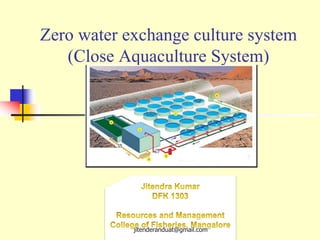
Zero water exchange culture system
(Close Aquaculture System)
jitenderanduat@gmail.com
Closed Aquaculture Systems
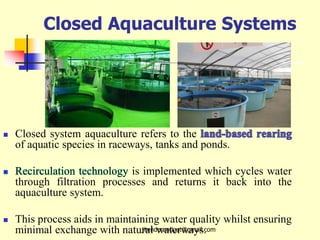
 Closed system aquaculture refers to the
of aquatic species in raceways, tanks and ponds.
 Recirculation technology is implemented which cycles water
through filtration processes and returns it back into the
aquaculture system.
 This process aids in maintaining water quality whilst ensuring
minimal exchange with natural waterways.jitenderanduat@gmail.com
Types of Culture
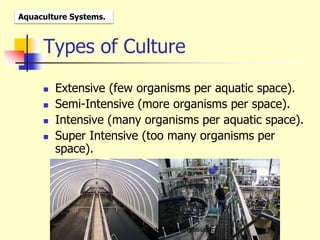
 Extensive (few organisms per aquatic space).
 Semi-Intensive (more organisms per space).
 Intensive (many organisms per aquatic space).
 Super Intensive (too many organisms per
space).
Aquaculture Systems.
jitenderanduat@gmail.com
Tank Culture.
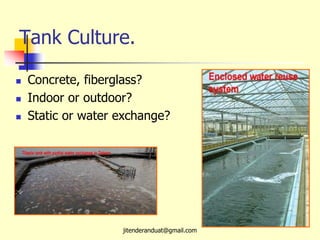
 Concrete, fiberglass?
 Indoor or outdoor?
 Static or water exchange?
jitenderanduat@gmail.com
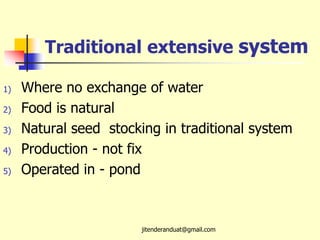
Traditional extensive system
1) Where no exchange of water
2) Food is natural
3) Natural seed stocking in traditional system
4) Production - not fix
5) Operated in - pond
jitenderanduat@gmail.com
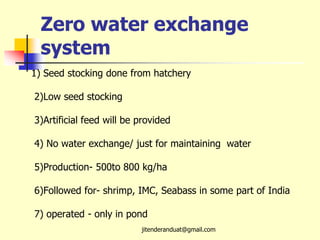
Zero water exchange
system
1) Seed stocking done from hatchery
2)Low seed stocking
3)Artificial feed will be provided
4) No water exchange/ just for maintaining water
5)Production- 500to 800 kg/ha
6)Followed for- shrimp, IMC, Seabass in some part of India
7) operated - only in pond
jitenderanduat@gmail.com
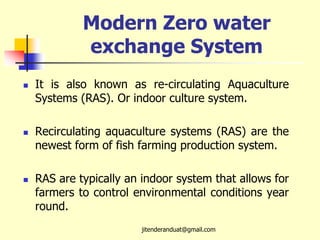
Modern Zero water
exchange System
 It is also known as re-circulating Aquaculture
Systems (RAS). Or indoor culture system.
 Recirculating aquaculture systems (RAS) are the
newest form of fish farming production system.
 RAS are typically an indoor system that allows for
farmers to control environmental conditions year
round.
jitenderanduat@gmail.com
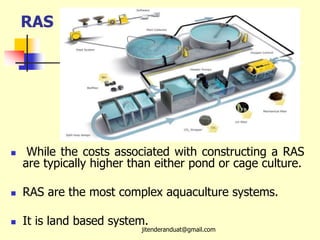
RAS
 While the costs associated with constructing a RAS
are typically higher than either pond or cage culture.
 RAS are the most complex aquaculture systems.
 It is land based system.
jitenderanduat@gmail.com
Conducted in
 Circular cement tanks
 Reinforcement circular cement tank
 Reinforcements Rectangular tank
 Circular fiber tank
 Circular rectangular tanks.
jitenderanduat@gmail.com
Background
 The most intensive systems used for production of
aquatic organisms are re-circulating systems
 Total environment is controlled
 Key operating parameters: minimal energy input
and proper water quality management
 Water circulates through the entire system and only
a small portion of new water is added daily
jitenderanduat@gmail.com
Cont..
 Physio-chemical parameters must be
controlled: temperature, salinity, pH, alkalinity,
chemical composition, oxygen
 Solid wastes are filtered, water is re-
oxygenated and re-circulated water undergoes
nitrification
 Re-circulating aquaculture systems are more
capital-intensive than most other types of
traditional production systems
 Rely on economic productivity per unit volume of
rearing space for profitabilityjitenderanduat@gmail.com
Cont..
 Must have support facilities (e.g., backup
generators) whose cost is also part of overall
production costs for the farm
 Large production levels are achieve via
modulation of individual self-sustaining units
 Production units are also designed for species
flexibility – essential now-a-days!
jitenderanduat@gmail.com
THE RAS DESIGN
 (1) Growing tank,
 (2) Sump of particulate removal device,
 (3) Biofilter,
 (4) Oxygen injection with U-tube aeration and,
 (5) Water circulation pump.
Depending on the water temperature and fish
species selected. A water heating system may be
necessary.
o 6) Ozone and ultraviolet sterilization also may be
advantageous to reduce organic and bacteria loads.
jitenderanduat@gmail.com
Water supply
 Quality and Quantity water.
 Ground water obtained from deep wells.
 Springs is the best source of water
 Free of pollutants.
 Municipal water supplies also can be used
after chlorine, floride, and other chemicals
areremoved.
jitenderanduat@gmail.com
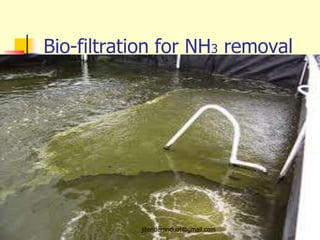
Bio-filtration
 The biological filter (biofilter) is the heart of the RAS.
 Two primary water pollutants that need to be removed
 (1) fish waste(toxic ammonia compounds) excreted into
the water.
 (2) uneaten fish feed particles
 The biofilter is the site where beneficial bacteria remove
(detoxify) fish excretory products, primarily ammonia.
jitenderanduat@gmail.com
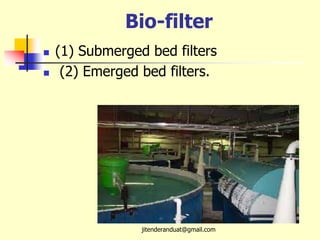
Bio-filter
 (1) Submerged bed filters
 (2) Emerged bed filters.
jitenderanduat@gmail.com
Bio-filtration for NH3 removal
jitenderanduat@gmail.com
AQUAGRIS WORKSHOP (Bremen, GERMANY) - Saturday 9th February2008
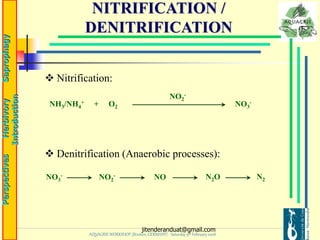
NITRIFICATION /
DENITRIFICATION
NO3
- N2NO2
- NO N2O
NH3/NH4
+ NO3
-+ O2
NO2
-
 Nitrification:
 Denitrification (Anaerobic processes):
PerspectivesHerbivorySaprophagy
Introduction
jitenderanduat@gmail.com
Water requirements
Most RAS require less than 10% of the water and much less
land than ponds to grow the same amount of product
At the same time, produce continuous crops (i.e., no seasonal
impacts)
RAS offer a high degree of environmental control,
mitigating risks such as natural disaster, pollution and disease
Other at production systems with low environmental impact
Effect: production brought closer to the consumer
jitenderanduat@gmail.com
How Much Water is
Required?
For site selection of RAS, one must think in
terms of the initial facility and eventual modular
expansion
Source capacity:
fill all tanks within 24-48 h
provide for routine/emergency flushing of
tanks
filter backwashing
washdown and clean-up
domestic requirements
This is usually over 100,000 gpd with a process
flow rate of >70 gpm
jitenderanduat@gmail.com
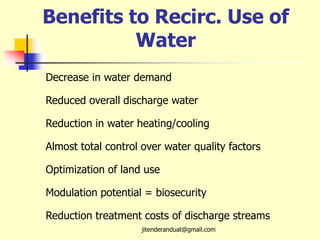
Benefits to Recirc. Use of
Water
Decrease in water demand
Reduced overall discharge water
Reduction in water heating/cooling
Almost total control over water quality factors
Optimization of land use
Modulation potential = biosecurity
Reduction treatment costs of discharge streams
jitenderanduat@gmail.com
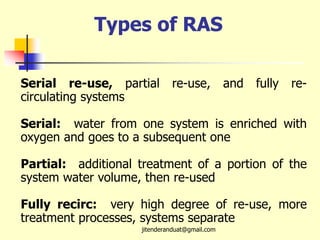
Types of RAS
Serial re-use, partial re-use, and fully re-
circulating systems
Serial: water from one system is enriched with
oxygen and goes to a subsequent one
Partial: additional treatment of a portion of the
system water volume, then re-used
Fully recirc: very high degree of re-use, more
treatment processes, systems separate
jitenderanduat@gmail.com
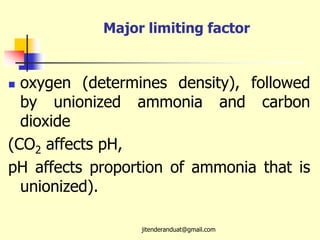
Major limiting factor
 oxygen (determines density), followed
by unionized ammonia and carbon
dioxide
(CO2 affects pH,
pH affects proportion of ammonia that is
unionized).
jitenderanduat@gmail.com
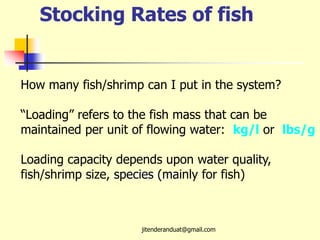
Stocking Rates of fish
L = 0.06(Dfish/R)
How many fish/shrimp can I put in the system?
“Loading” refers to the fish mass that can be
maintained per unit of flowing water: kg/l or lbs/g
Loading capacity depends upon water quality,
fish/shrimp size, species (mainly for fish)
jitenderanduat@gmail.com
SPECIES TO BE CULTURED
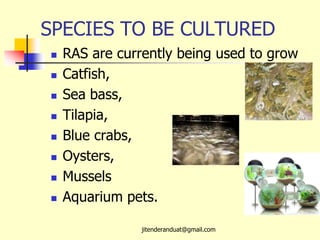
 RAS are currently being used to grow
 Catfish,
 Sea bass,
 Tilapia,
 Blue crabs,
 Oysters,
 Mussels
 Aquarium pets.
jitenderanduat@gmail.com
Recirculation Rates
 45 gallons per minute (63,360 gallons
per day)
Feeds and Feeding
 A complete feed, containing all the
essential minerals and vitamins.
 Feed of dry, floating pellets
 Are fed 3 to 5 percent of their body
weight
 Automatic feeders and demand feeders
jitenderanduat@gmail.com
Major problems in
aquaculture.
 Environment needs filtering.
 Oxygen needs to be replenished.
 Organisms cannot be seen.
 Diseases spread too fast.
 The inside of organisms is constantly in
contact with outside medium.
jitenderanduat@gmail.com
Therefore, the systems
should:
 Keep the medium acceptable for survival
and optimal growth.
 Replenish oxygen and remove carbon
dioxide.
 Make organisms accessible for inspection.
 Fight diseases.
 Just make it comfortable for the organisms.
jitenderanduat@gmail.com
Thank You
jitenderanduat@gmail.com