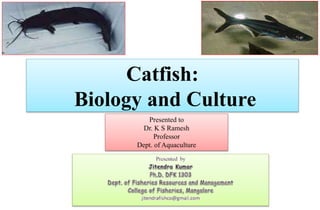
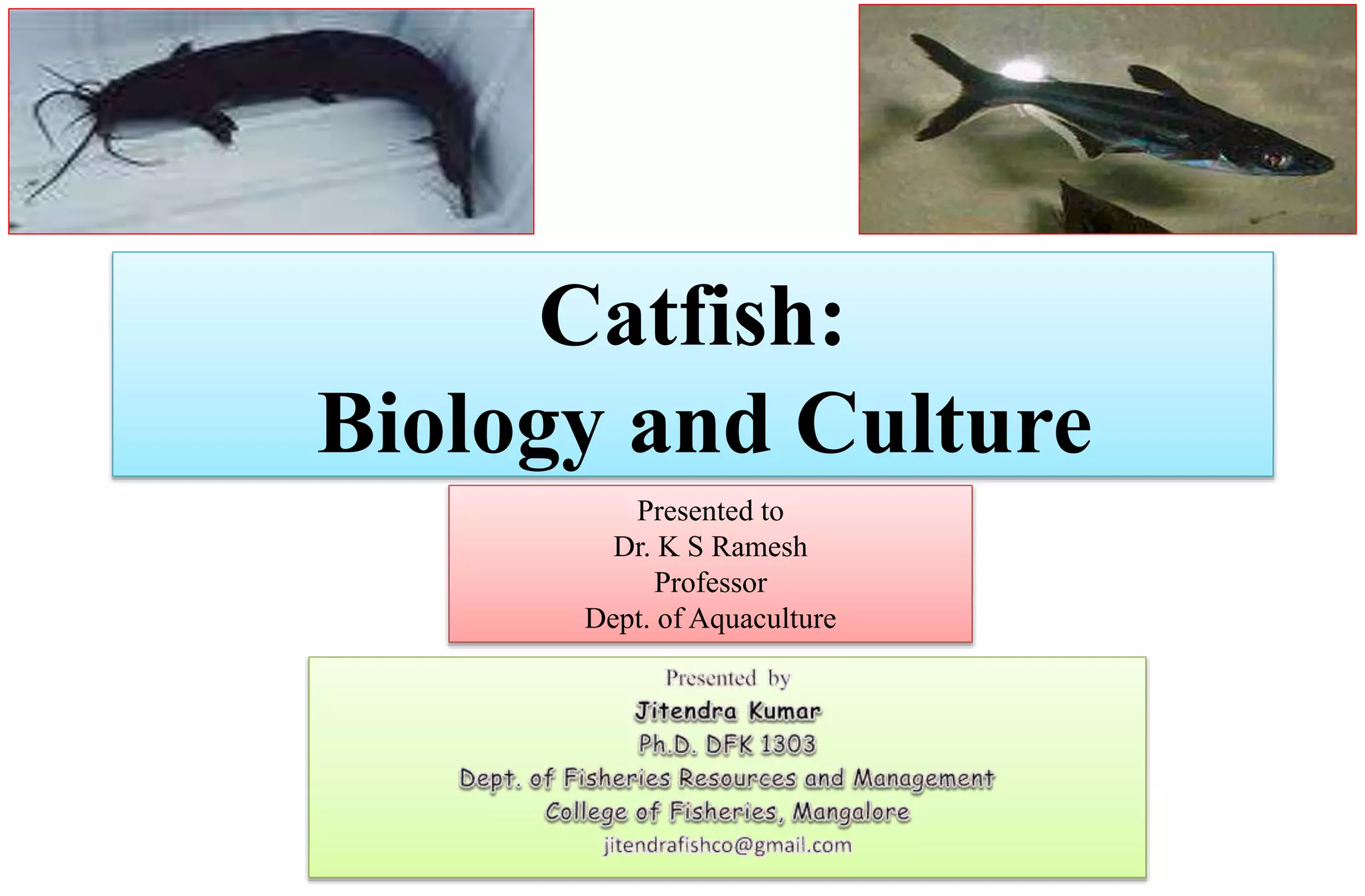
Catfish:
Biology and Culture
Presented to
Dr. K S Ramesh
Professor
Dept. of Aquaculture
Classification
Phylum - Chordata
S. Phylum - Vertebrata
Su. Class - Gnathostomata
Grades - Pisces
Class - Osteichthyes
Sub division - Teleosts
Su. Order - Ostariophysi
Order - Siluriformes
Why catfish farming?
• Grows fast and feeds on a large variety of agriculture by-
products.
• Can be raised in high densities resulting in high net yields
(6–10 t/ha/year).
• Sold live at the market.
• Hardy and can tolerate adverse water quality conditions.
Global commercially cultivable catfish
Spp.
• 1) Ictalurus punctatus - (Channel catfish)
• 2) Clarias gariepinus- (Thai magur /
African sharptooth catfish)
• 3) Pangasius sutchi or P. hypophthalmus -
(River/silver stripped/sutchi/swai catfish
/siamese shark).
1) Family-Pangasiidae
(Pangasius sutchi) or P. hypophthalmus
• C. Name- River/silver
Stripped/Sutchi/Swai catfish/Siamese
shark
• Characters-
Body elongate & compressed
Small adipose dorsal
Barbless - 4
Body greyish- Black, white band
• Distribution-
Fresh waters
Thailand, Combodia,Vietnam.
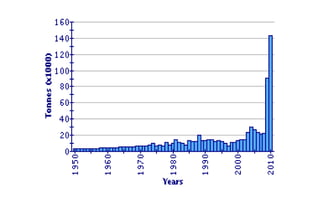
Production
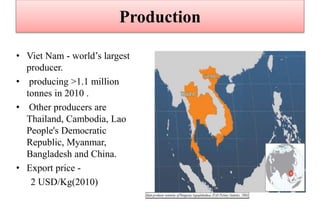
• Viet Nam - world’s largest
producer.
• producing >1.1 million
tonnes in 2010 .
• Other producers are
Thailand, Cambodia, Lao
People's Democratic
Republic, Myanmar,
Bangladesh and China.
• Export price -
2 USD/Kg(2010)
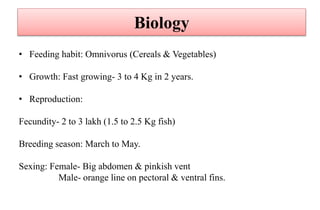
Biology
• Feeding habit: Omnivorus (Cereals & Vegetables)
• Growth: Fast growing- 3 to 4 Kg in 2 years.
• Reproduction:
Fecundity- 2 to 3 lakh (1.5 to 2.5 Kg fish)
Breeding season: March to May.
Sexing: Female- Big abdomen & pinkish vent
Male- orange line on pectoral & ventral fins.
• Body long, latterly flattened with no scales.
• Head relatively small.
• Mouth broad with small sharp teeth on jaw
• Eyes relatively large.
• Two pairs of barbels, upper shorter than the lower.
• Fins dark grey or black.
• Gill rakers normally developed.
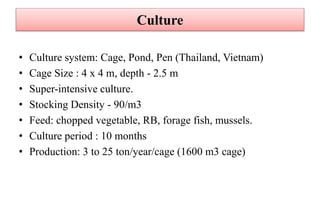
Culture
• Culture system: Cage, Pond, Pen (Thailand, Vietnam)
• Cage Size : 4 x 4 m, depth - 2.5 m
• Super-intensive culture.
• Stocking Density - 90/m3
• Feed: chopped vegetable, RB, forage fish, mussels.
• Culture period : 10 months
• Production: 3 to 25 ton/year/cage (1600 m3 cage)
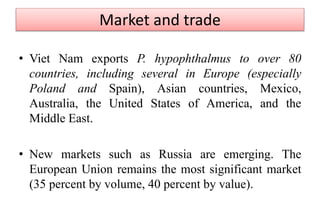
Market and trade
• Viet Nam exports P. hypophthalmus to over 80
countries, including several in Europe (especially
Poland and Spain), Asian countries, Mexico,
Australia, the United States of America, and the
Middle East.
• New markets such as Russia are emerging. The
European Union remains the most significant market
(35 percent by volume, 40 percent by value).
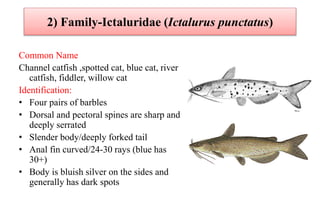
2) Family-Ictaluridae (Ictalurus punctatus)
Common Name
Channel catfish ,spotted cat, blue cat, river
catfish, fiddler, willow cat
Identification:
• Four pairs of barbles
• Dorsal and pectoral spines are sharp and
deeply serrated
• Slender body/deeply forked tail
• Anal fin curved/24-30 rays (blue has
30+)
• Body is bluish silver on the sides and
generally has dark spots
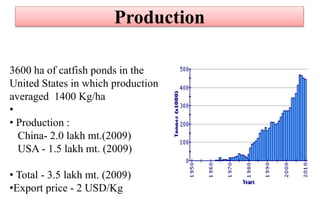
Production
3600 ha of catfish ponds in the
United States in which production
averaged 1400 Kg/ha
•
• Production :
China- 2.0 lakh mt.(2009)
USA - 1.5 lakh mt. (2009)
• Total - 3.5 lakh mt. (2009)
•Export price - 2 USD/Kg
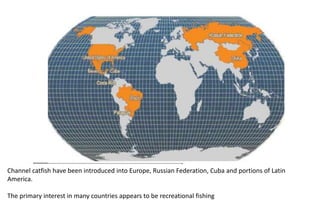
Channel catfish have been introduced into Europe, Russian Federation, Cuba and portions of Latin
America.
The primary interest in many countries appears to be recreational fishing
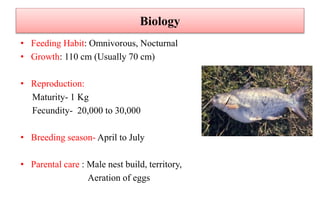
Biology
• Feeding Habit: Omnivorous, Nocturnal
• Growth: 110 cm (Usually 70 cm)
• Reproduction:
Maturity- 1 Kg
Fecundity- 20,000 to 30,000
• Breeding season- April to July
• Parental care : Male nest build, territory,
Aeration of eggs
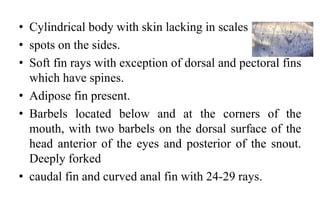
• Cylindrical body with skin lacking in scales
• spots on the sides.
• Soft fin rays with exception of dorsal and pectoral fins
which have spines.
• Adipose fin present.
• Barbels located below and at the corners of the
mouth, with two barbels on the dorsal surface of the
head anterior of the eyes and posterior of the snout.
Deeply forked
• caudal fin and curved anal fin with 24-29 rays.
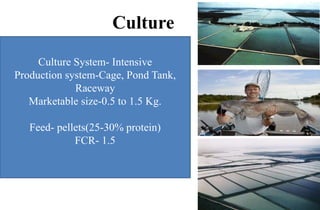
Culture
Culture System- Intensive
Production system-Cage, Pond Tank,
Raceway
Marketable size-0.5 to 1.5 Kg.
Feed- pellets(25-30% protein)
FCR- 1.5
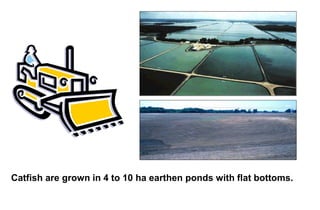
Catfish are grown in 4 to 10 ha earthen ponds with flat bottoms.
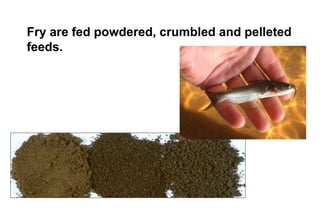
Fry are fed powdered, crumbled and pelleted
feeds.
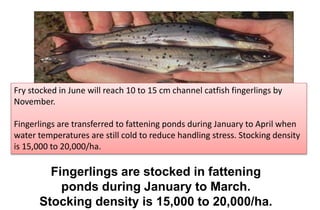
Fingerlings are stocked in fattening
ponds during January to March.
Stocking density is 15,000 to 20,000/ha.
Fry stocked in June will reach 10 to 15 cm channel catfish fingerlings by
November.
Fingerlings are transferred to fattening ponds during January to April when
water temperatures are still cold to reduce handling stress. Stocking density
is 15,000 to 20,000/ha.
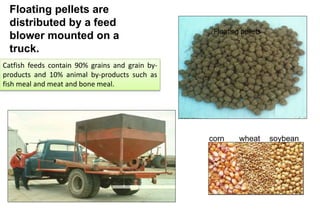
corn wheat soybean
Floating pellets
Floating pellets are
distributed by a feed
blower mounted on a
truck.
Catfish feeds contain 90% grains and grain by-
products and 10% animal by-products such as
fish meal and meat and bone meal.
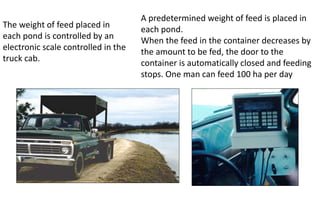
The weight of feed placed in
each pond is controlled by an
electronic scale controlled in the
truck cab.
A predetermined weight of feed is placed in
each pond.
When the feed in the container decreases by
the amount to be fed, the door to the
container is automatically closed and feeding
stops. One man can feed 100 ha per day
Dissolved oxygen concentration is
checked night and day to assure
that levels remain above 2 mg/l.
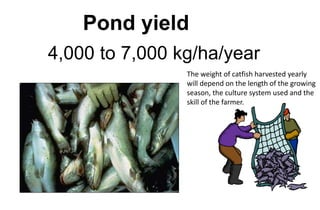
4,000 to 7,000 kg/ha/year
Pond yield
The weight of catfish harvested yearly
will depend on the length of the growing
season, the culture system used and the
skill of the farmer.
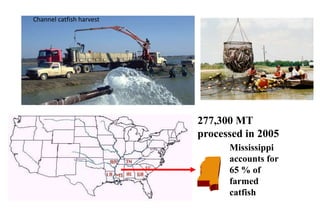
Mississippi
accounts for
65 % of
farmed
catfish
277,300 MT
processed in 2005
Channel catfish harvest
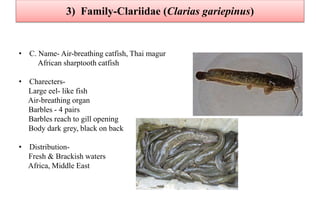
3) Family-Clariidae (Clarias gariepinus)
• C. Name- Air-breathing catfish, Thai magur
African sharptooth catfish
• Charecters-
Large eel- like fish
Air-breathing organ
Barbles - 4 pairs
Barbles reach to gill opening
Body dark grey, black on back
• Distribution-
Fresh & Brackish waters
Africa, Middle East
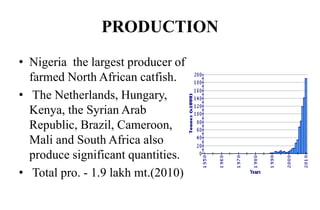
PRODUCTION
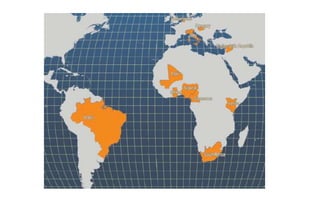
• Nigeria the largest producer of
farmed North African catfish.
• The Netherlands, Hungary,
Kenya, the Syrian Arab
Republic, Brazil, Cameroon,
Mali and South Africa also
produce significant quantities.
• Total pro. - 1.9 lakh mt.(2010)
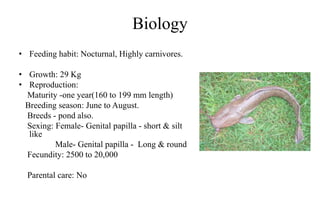
Biology
• Feeding habit: Nocturnal, Highly carnivores.
• Growth: 29 Kg
• Reproduction:
Maturity -one year(160 to 199 mm length)
Breeding season: June to August.
Breeds - pond also.
Sexing: Female- Genital papilla - short & silt
like
Male- Genital papilla - Long & round
Fecundity: 2500 to 20,000
Parental care: No
Culture
• Culture system: Monoculture (tank, pond, cage)
• It grows fast and feeds on a large variety of agriculture by-
products.
• It is hardy and can tolerate adverse water quality conditions.
• It can be raised in high densities resulting in high net yields
(6–16 t/ha/year).
• In most countries it fetch a higher price than tilapia as it can
be sold live at the market.
• It matures and is relatively easy to reproduce in captivity.
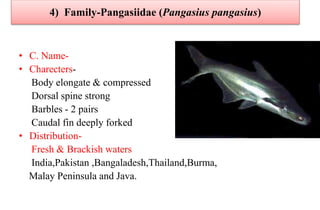
4) Family-Pangasiidae (Pangasius pangasius)
• C. Name-
• Charecters-
Body elongate & compressed
Dorsal spine strong
Barbles - 2 pairs
Caudal fin deeply forked
• Distribution-
Fresh & Brackish waters
India,Pakistan ,Bangaladesh,Thailand,Burma,
Malay Peninsula and Java.
Biology
• Feeding habit: Omnivorus(insects,molluscs,offal)
• Growth: 725 to 802 mm
• Reproduction:
Maturity -one year(630 to 640 mm length)
Fecundity- 0.75 to 1.5 lakh (1.5 to 2.5 Kg fish)
Breeding season: March to June.
Sexing: Female- Genital papilla - pinkish red & rim like
Male- Genital papilla - Small & blunt .
Culture: Not that much
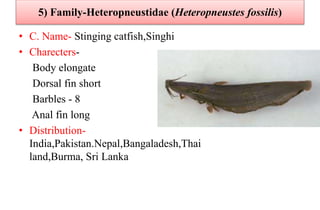
5) Family-Heteropneustidae (Heteropneustes fossilis)
• C. Name- Stinging catfish,Singhi
• Charecters-
Body elongate
Dorsal fin short
Barbles - 8
Anal fin long
• Distribution-
India,Pakistan.Nepal,Bangaladesh,Thai
land,Burma, Sri Lanka
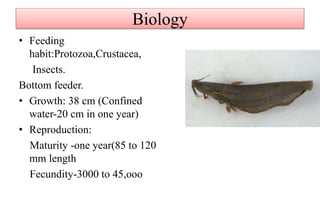
Biology
• Feeding
habit:Protozoa,Crustacea,
Insects.
Bottom feeder.
• Growth: 38 cm (Confined
water-20 cm in one year)
• Reproduction:
Maturity -one year(85 to 120
mm length
Fecundity-3000 to 45,ooo
• Adults found mainly in ponds, ditches, swamps and
marshes, but sometimes occur in muddy rivers.
• Can tolerate slightly brackish water.
• Omnivorous.
• Breed in confined waters during the monsoon months,
• but can breed in ponds, derelict ponds and ditches
when sufficient rain-water accumulates.
• Oviparous,
• great demand due to its medicinal value.
Culture
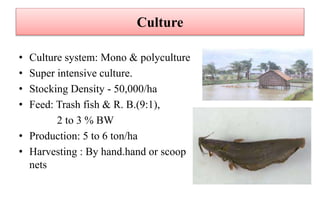
• Culture system: Mono & polyculture
• Super intensive culture.
• Stocking Density - 50,000/ha
• Feed: Trash fish & R. B.(9:1),
2 to 3 % BW
• Production: 5 to 6 ton/ha
• Harvesting : By hand.hand or scoop
nets
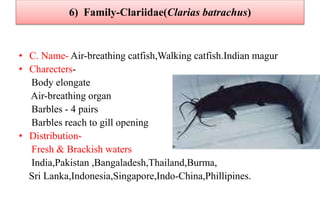
6) Family-Clariidae(Clarias batrachus)
• C. Name- Air-breathing catfish,Walking catfish.Indian magur
• Charecters-
Body elongate
Air-breathing organ
Barbles - 4 pairs
Barbles reach to gill opening
• Distribution-
Fresh & Brackish waters
India,Pakistan ,Bangaladesh,Thailand,Burma,
Sri Lanka,Indonesia,Singapore,Indo-China,Phillipines.
Biology
• Feeding habit: Post-larvae - planktophage, Juvenile-
Insect(scavenger-omni-carnivorus).
• Growth: 175 to 355 mm
• Reproduction:
Maturity -one year(160 to 199 mm length)
Fecundity-3000 to 45,ooo
Breeding season: June to August.
Sexing: Female- Genital papilla - short & slit like
Male- Genital papilla - Long & round
Fecundity: 2500 to 20,000
Parental care: Nest - Female, Male - Gaurds eggs
Culture
• Culture system: Mono & polyculture
• Superintensive culture.
• Stocking Density - 50,000/ha
• Feed: Trash fish & R. B.(9:1), 2 to 3 % BW
• Average Wt. - 150 g
• Production: 5 to 6 ton/ha
• Harvesting : By hand.hand or scoop nets
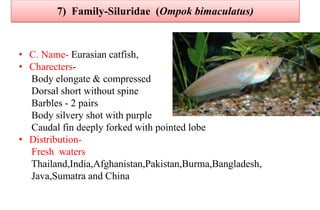
7) Family-Siluridae (Ompok bimaculatus)
• C. Name- Eurasian catfish,
• Charecters-
Body elongate & compressed
Dorsal short without spine
Barbles - 2 pairs
Body silvery shot with purple
Caudal fin deeply forked with pointed lobe
• Distribution-
Fresh waters
Thailand,India,Afghanistan,Pakistan,Burma,Bangladesh,
Java,Sumatra and China
Biology
• Feeding habit: Surface feeder(insects,fish & prawns)
• Growth: 12 to 28 cm.
• Reproduction:
Maturity : one year (100 mm)
Fecundity- 2 to 3 lakh (1.5 to 2.5 Kg fish) (1:1)
Breeding season: June to July.
• Culture: Endangered in Western Ghat Region
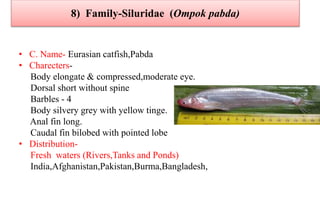
8) Family-Siluridae (Ompok pabda)
• C. Name- Eurasian catfish,Pabda
• Charecters-
Body elongate & compressed,moderate eye.
Dorsal short without spine
Barbles - 4
Body silvery grey with yellow tinge.
Anal fin long.
Caudal fin bilobed with pointed lobe
• Distribution-
Fresh waters (Rivers,Tanks and Ponds)
India,Afghanistan,Pakistan,Burma,Bangladesh,
Biology
• Feeding habit: Surface feeder(insects,fish & prawns)
• Growth: 17 cm. Max length : 30.0 cm TL Freshwater;
• demersal; potamodromous
Adults inhabit clear as well as muddy rivers, streams, ponds and
lakes
• Catch: West Bengal and north-estern states of India.
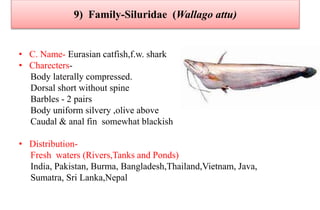
9) Family-Siluridae (Wallago attu)
• C. Name- Eurasian catfish,f.w. shark
• Charecters-
Body laterally compressed.
Dorsal short without spine
Barbles - 2 pairs
Body uniform silvery ,olive above
Caudal & anal fin somewhat blackish
• Distribution-
Fresh waters (Rivers,Tanks and Ponds)
India, Pakistan, Burma, Bangladesh,Thailand,Vietnam, Java,
Sumatra, Sri Lanka,Nepal
Biology
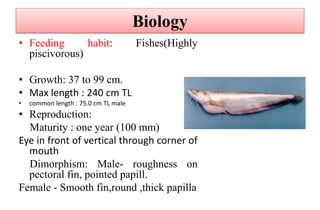
• Feeding habit: Fishes(Highly
piscivorous)
• Growth: 37 to 99 cm.
• Max length : 240 cm TL
• common length : 75.0 cm TL male
• Reproduction:
Maturity : one year (100 mm)
Eye in front of vertical through corner of
mouth
Dimorphism: Male- roughness on
pectoral fin, pointed papill.
Female - Smooth fin,round ,thick papilla
Culture
• Culture system: Pond
• Stocking Density - 1000/ha
• Stocking size - 50 to 100 g
• Feed: Trashfish, forage fish,mussels.
• Culture period : 6 months
• Average Wt. - 0.8 to 1.0 Kg
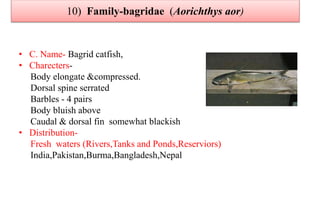
10) Family-bagridae (Aorichthys aor)
• C. Name- Bagrid catfish,
• Charecters-
Body elongate &compressed.
Dorsal spine serrated
Barbles - 4 pairs
Body bluish above
Caudal & dorsal fin somewhat blackish
• Distribution-
Fresh waters (Rivers,Tanks and Ponds,Reserviors)
India,Pakistan,Burma,Bangladesh,Nepal
Biology
• Feeding habit:Carnivorus (insects ,fish and prawns)
• Growth: 33 to 50 cm.
• Reproduction:
Maturity : one year (840 mm)
Fecundity : 0.1 to 1.0 lakh
Breeding season : March to August
Dimorphism: Male- Pink colour pointed papill.
Female - Smooth fin,round ,thick papilla
Parental care - Nest & pits
Culture
• Culture system: Cage. pond.
• Feed: Fish meal,
• RB,GOC (3:1:1)
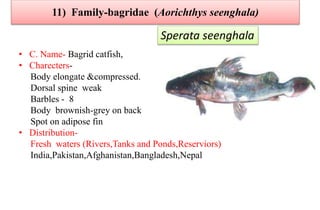
11) Family-bagridae (Aorichthys seenghala)
• C. Name- Bagrid catfish,
• Charecters-
Body elongate &compressed.
Dorsal spine weak
Barbles - 8
Body brownish-grey on back
Spot on adipose fin
• Distribution-
Fresh waters (Rivers,Tanks and Ponds,Reserviors)
India,Pakistan,Afghanistan,Bangladesh,Nepal
Sperata seenghala
Biology
• Feeding habit: Carnivorus (insects ,fish and prawns)
• Growth: 120 to 615 mm.
• Max length : 150 cm TL
• Reproduction:
Maturity : Second year (45 to 50 cm)
• Barbels extend posteriorly to pelvic fins or beyond to anal fin.
• Dorsal spine weakly serrated on its posterior edge; adipose fin base short,
about as long as the rayed dorsal fin base.
• Color is brownish-gray on back, silvery on flanks and belly.
• A dark well-defined spot is on the adipose dorsal fin.
Culture
• Culture system: Cage.pond.
• Stocking density : 10,000/ha
• Feed: Fish meal,RB,GOC (3:1:1)
• Period : 9 months
• Average size : 350 to 700 g
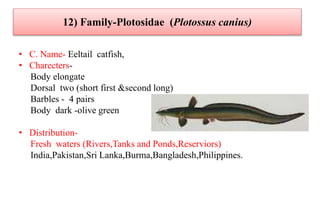
12) Family-Plotosidae (Plotossus canius)
• C. Name- Eeltail catfish,
• Charecters-
Body elongate
Dorsal two (short first &second long)
Barbles - 4 pairs
Body dark -olive green
• Distribution-
Fresh waters (Rivers,Tanks and Ponds,Reserviors)
India,Pakistan,Sri Lanka,Burma,Bangladesh,Philippines.
Biology
• Feeding habit:Carnivorus (Crab and prawns)
• Growth: 200 to 500 mm.
• Reproduction:
Maturity : 337 mm
Season: May to July
Ratio: 2:1
Culture
• Culture : Fresh & brackish water
• Fishery: Hooghly-Maatlah estury.
• Fish: Endemic
• Growth rate: High
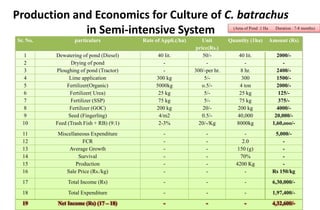
Production and Economics for Culture of C. batrachus
in Semi-intensive System
Sr. No. particulars Rate of Appli.(/ha) Unit
price(Rs.)
Quantity (1ha) Amount (Rs)
1 Dewatering of pond (Diesel) 40 lit. 50/- 40 lit. 2000/-
2 Drying of pond - - - -
3 Ploughing of pond (Tractor) - 300/-per hr. 8 hr. 2400/-
4 Lime application 300 kg 5/- 300 1500/-
5 Fertilizer(Organic) 5000kg o.5/- 4 ton 2000/-
6 Fertilizer( Urea) 25 kg 5/- 25 kg 125/-
7 Fertilizer (SSP) 75 kg 5/- 75 kg 375/-
8 Fertilizer (GOC) 200 kg 20/- 200 kg 4000/-
9 Seed (Fingerling) 4/m2 0.5/- 40,000 20,000/-
10 Feed (Trash Fish + RB) (9:1) 2-3% 20/-/Kg 8000kg 1,60,ooo/-
11 Miscellaneous Expenditure - - - 5,000/-
12 FCR - - 2.0 -
13 Average Growth - - 150 (g) -
14 Survival - - 70% -
15 Production - - 4200 Kg -
16 Sale Price (Rs./kg) - - - Rs 150/kg
17 Total Income (Rs) - - - 6,30,000/-
18 Total Expenditure - - - 1,97,400/-
19 Net Income (Rs) (17 – 18) - - - 4,32,600/-
(Area of Pond :1 Ha Duration : 7-8 months)
References
• Systematics,Biology and culture of catfish
by - H. A. Khan.
• Talwar, P.K. and A.G. Jhingran, 1991. Inland fishes of
India and adjacent countries. Volume 2. A.A.
Balkema, Rotterdam.
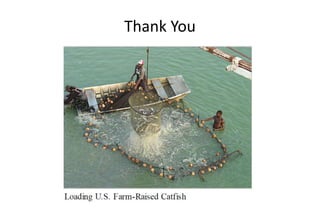
Thank You

Cat fish bio. & culture

  • 1.
    Catfish: Biology and Culture Presentedto Dr. K S Ramesh Professor Dept. of Aquaculture
  • 2.
    Classification Phylum - Chordata S.Phylum - Vertebrata Su. Class - Gnathostomata Grades - Pisces Class - Osteichthyes Sub division - Teleosts Su. Order - Ostariophysi Order - Siluriformes
  • 3.
    Why catfish farming? •Grows fast and feeds on a large variety of agriculture by- products. • Can be raised in high densities resulting in high net yields (6–10 t/ha/year). • Sold live at the market. • Hardy and can tolerate adverse water quality conditions.
  • 5.
    Global commercially cultivablecatfish Spp. • 1) Ictalurus punctatus - (Channel catfish) • 2) Clarias gariepinus- (Thai magur / African sharptooth catfish) • 3) Pangasius sutchi or P. hypophthalmus - (River/silver stripped/sutchi/swai catfish /siamese shark).
  • 6.
    1) Family-Pangasiidae (Pangasius sutchi)or P. hypophthalmus • C. Name- River/silver Stripped/Sutchi/Swai catfish/Siamese shark • Characters- Body elongate & compressed Small adipose dorsal Barbless - 4 Body greyish- Black, white band • Distribution- Fresh waters Thailand, Combodia,Vietnam.
  • 7.
    Production • Viet Nam- world’s largest producer. • producing >1.1 million tonnes in 2010 . • Other producers are Thailand, Cambodia, Lao People's Democratic Republic, Myanmar, Bangladesh and China. • Export price - 2 USD/Kg(2010)
  • 9.
    Biology • Feeding habit:Omnivorus (Cereals & Vegetables) • Growth: Fast growing- 3 to 4 Kg in 2 years. • Reproduction: Fecundity- 2 to 3 lakh (1.5 to 2.5 Kg fish) Breeding season: March to May. Sexing: Female- Big abdomen & pinkish vent Male- orange line on pectoral & ventral fins.
  • 10.
    • Body long,latterly flattened with no scales. • Head relatively small. • Mouth broad with small sharp teeth on jaw • Eyes relatively large. • Two pairs of barbels, upper shorter than the lower. • Fins dark grey or black. • Gill rakers normally developed.
  • 11.
    Culture • Culture system:Cage, Pond, Pen (Thailand, Vietnam) • Cage Size : 4 x 4 m, depth - 2.5 m • Super-intensive culture. • Stocking Density - 90/m3 • Feed: chopped vegetable, RB, forage fish, mussels. • Culture period : 10 months • Production: 3 to 25 ton/year/cage (1600 m3 cage)
  • 12.
    Market and trade •Viet Nam exports P. hypophthalmus to over 80 countries, including several in Europe (especially Poland and Spain), Asian countries, Mexico, Australia, the United States of America, and the Middle East. • New markets such as Russia are emerging. The European Union remains the most significant market (35 percent by volume, 40 percent by value).
  • 13.
    2) Family-Ictaluridae (Ictaluruspunctatus) Common Name Channel catfish ,spotted cat, blue cat, river catfish, fiddler, willow cat Identification: • Four pairs of barbles • Dorsal and pectoral spines are sharp and deeply serrated • Slender body/deeply forked tail • Anal fin curved/24-30 rays (blue has 30+) • Body is bluish silver on the sides and generally has dark spots
  • 14.
    Production 3600 ha ofcatfish ponds in the United States in which production averaged 1400 Kg/ha • • Production : China- 2.0 lakh mt.(2009) USA - 1.5 lakh mt. (2009) • Total - 3.5 lakh mt. (2009) •Export price - 2 USD/Kg
  • 15.
    Channel catfish havebeen introduced into Europe, Russian Federation, Cuba and portions of Latin America. The primary interest in many countries appears to be recreational fishing
  • 16.
    Biology • Feeding Habit:Omnivorous, Nocturnal • Growth: 110 cm (Usually 70 cm) • Reproduction: Maturity- 1 Kg Fecundity- 20,000 to 30,000 • Breeding season- April to July • Parental care : Male nest build, territory, Aeration of eggs
  • 17.
    • Cylindrical bodywith skin lacking in scales • spots on the sides. • Soft fin rays with exception of dorsal and pectoral fins which have spines. • Adipose fin present. • Barbels located below and at the corners of the mouth, with two barbels on the dorsal surface of the head anterior of the eyes and posterior of the snout. Deeply forked • caudal fin and curved anal fin with 24-29 rays.
  • 18.
    Culture Culture System- Intensive Productionsystem-Cage, Pond Tank, Raceway Marketable size-0.5 to 1.5 Kg. Feed- pellets(25-30% protein) FCR- 1.5
  • 19.
    Catfish are grownin 4 to 10 ha earthen ponds with flat bottoms.
  • 20.
    Fry are fedpowdered, crumbled and pelleted feeds.
  • 21.
    Fingerlings are stockedin fattening ponds during January to March. Stocking density is 15,000 to 20,000/ha. Fry stocked in June will reach 10 to 15 cm channel catfish fingerlings by November. Fingerlings are transferred to fattening ponds during January to April when water temperatures are still cold to reduce handling stress. Stocking density is 15,000 to 20,000/ha.
  • 22.
    corn wheat soybean Floatingpellets Floating pellets are distributed by a feed blower mounted on a truck. Catfish feeds contain 90% grains and grain by- products and 10% animal by-products such as fish meal and meat and bone meal.
  • 23.
    The weight offeed placed in each pond is controlled by an electronic scale controlled in the truck cab. A predetermined weight of feed is placed in each pond. When the feed in the container decreases by the amount to be fed, the door to the container is automatically closed and feeding stops. One man can feed 100 ha per day
  • 24.
    Dissolved oxygen concentrationis checked night and day to assure that levels remain above 2 mg/l.
  • 25.
    4,000 to 7,000kg/ha/year Pond yield The weight of catfish harvested yearly will depend on the length of the growing season, the culture system used and the skill of the farmer.
  • 26.
    Mississippi accounts for 65 %of farmed catfish 277,300 MT processed in 2005 Channel catfish harvest
  • 27.
    3) Family-Clariidae (Clariasgariepinus) • C. Name- Air-breathing catfish, Thai magur African sharptooth catfish • Charecters- Large eel- like fish Air-breathing organ Barbles - 4 pairs Barbles reach to gill opening Body dark grey, black on back • Distribution- Fresh & Brackish waters Africa, Middle East
  • 28.
    PRODUCTION • Nigeria thelargest producer of farmed North African catfish. • The Netherlands, Hungary, Kenya, the Syrian Arab Republic, Brazil, Cameroon, Mali and South Africa also produce significant quantities. • Total pro. - 1.9 lakh mt.(2010)
  • 30.
    Biology • Feeding habit:Nocturnal, Highly carnivores. • Growth: 29 Kg • Reproduction: Maturity -one year(160 to 199 mm length) Breeding season: June to August. Breeds - pond also. Sexing: Female- Genital papilla - short & silt like Male- Genital papilla - Long & round Fecundity: 2500 to 20,000 Parental care: No
  • 31.
    Culture • Culture system:Monoculture (tank, pond, cage) • It grows fast and feeds on a large variety of agriculture by- products. • It is hardy and can tolerate adverse water quality conditions. • It can be raised in high densities resulting in high net yields (6–16 t/ha/year). • In most countries it fetch a higher price than tilapia as it can be sold live at the market. • It matures and is relatively easy to reproduce in captivity.
  • 32.
    4) Family-Pangasiidae (Pangasiuspangasius) • C. Name- • Charecters- Body elongate & compressed Dorsal spine strong Barbles - 2 pairs Caudal fin deeply forked • Distribution- Fresh & Brackish waters India,Pakistan ,Bangaladesh,Thailand,Burma, Malay Peninsula and Java.
  • 33.
    Biology • Feeding habit:Omnivorus(insects,molluscs,offal) • Growth: 725 to 802 mm • Reproduction: Maturity -one year(630 to 640 mm length) Fecundity- 0.75 to 1.5 lakh (1.5 to 2.5 Kg fish) Breeding season: March to June. Sexing: Female- Genital papilla - pinkish red & rim like Male- Genital papilla - Small & blunt . Culture: Not that much
  • 34.
    5) Family-Heteropneustidae (Heteropneustesfossilis) • C. Name- Stinging catfish,Singhi • Charecters- Body elongate Dorsal fin short Barbles - 8 Anal fin long • Distribution- India,Pakistan.Nepal,Bangaladesh,Thai land,Burma, Sri Lanka
  • 35.
    Biology • Feeding habit:Protozoa,Crustacea, Insects. Bottom feeder. •Growth: 38 cm (Confined water-20 cm in one year) • Reproduction: Maturity -one year(85 to 120 mm length Fecundity-3000 to 45,ooo
  • 36.
    • Adults foundmainly in ponds, ditches, swamps and marshes, but sometimes occur in muddy rivers. • Can tolerate slightly brackish water. • Omnivorous. • Breed in confined waters during the monsoon months, • but can breed in ponds, derelict ponds and ditches when sufficient rain-water accumulates. • Oviparous, • great demand due to its medicinal value.
  • 37.
    Culture • Culture system:Mono & polyculture • Super intensive culture. • Stocking Density - 50,000/ha • Feed: Trash fish & R. B.(9:1), 2 to 3 % BW • Production: 5 to 6 ton/ha • Harvesting : By hand.hand or scoop nets
  • 38.
    6) Family-Clariidae(Clarias batrachus) •C. Name- Air-breathing catfish,Walking catfish.Indian magur • Charecters- Body elongate Air-breathing organ Barbles - 4 pairs Barbles reach to gill opening • Distribution- Fresh & Brackish waters India,Pakistan ,Bangaladesh,Thailand,Burma, Sri Lanka,Indonesia,Singapore,Indo-China,Phillipines.
  • 39.
    Biology • Feeding habit:Post-larvae - planktophage, Juvenile- Insect(scavenger-omni-carnivorus). • Growth: 175 to 355 mm • Reproduction: Maturity -one year(160 to 199 mm length) Fecundity-3000 to 45,ooo Breeding season: June to August. Sexing: Female- Genital papilla - short & slit like Male- Genital papilla - Long & round Fecundity: 2500 to 20,000 Parental care: Nest - Female, Male - Gaurds eggs
  • 40.
    Culture • Culture system:Mono & polyculture • Superintensive culture. • Stocking Density - 50,000/ha • Feed: Trash fish & R. B.(9:1), 2 to 3 % BW • Average Wt. - 150 g • Production: 5 to 6 ton/ha • Harvesting : By hand.hand or scoop nets
  • 41.
    7) Family-Siluridae (Ompokbimaculatus) • C. Name- Eurasian catfish, • Charecters- Body elongate & compressed Dorsal short without spine Barbles - 2 pairs Body silvery shot with purple Caudal fin deeply forked with pointed lobe • Distribution- Fresh waters Thailand,India,Afghanistan,Pakistan,Burma,Bangladesh, Java,Sumatra and China
  • 42.
    Biology • Feeding habit:Surface feeder(insects,fish & prawns) • Growth: 12 to 28 cm. • Reproduction: Maturity : one year (100 mm) Fecundity- 2 to 3 lakh (1.5 to 2.5 Kg fish) (1:1) Breeding season: June to July. • Culture: Endangered in Western Ghat Region
  • 43.
    8) Family-Siluridae (Ompokpabda) • C. Name- Eurasian catfish,Pabda • Charecters- Body elongate & compressed,moderate eye. Dorsal short without spine Barbles - 4 Body silvery grey with yellow tinge. Anal fin long. Caudal fin bilobed with pointed lobe • Distribution- Fresh waters (Rivers,Tanks and Ponds) India,Afghanistan,Pakistan,Burma,Bangladesh,
  • 44.
    Biology • Feeding habit:Surface feeder(insects,fish & prawns) • Growth: 17 cm. Max length : 30.0 cm TL Freshwater; • demersal; potamodromous Adults inhabit clear as well as muddy rivers, streams, ponds and lakes • Catch: West Bengal and north-estern states of India.
  • 45.
    9) Family-Siluridae (Wallagoattu) • C. Name- Eurasian catfish,f.w. shark • Charecters- Body laterally compressed. Dorsal short without spine Barbles - 2 pairs Body uniform silvery ,olive above Caudal & anal fin somewhat blackish • Distribution- Fresh waters (Rivers,Tanks and Ponds) India, Pakistan, Burma, Bangladesh,Thailand,Vietnam, Java, Sumatra, Sri Lanka,Nepal
  • 46.
    Biology • Feeding habit:Fishes(Highly piscivorous) • Growth: 37 to 99 cm. • Max length : 240 cm TL • common length : 75.0 cm TL male • Reproduction: Maturity : one year (100 mm) Eye in front of vertical through corner of mouth Dimorphism: Male- roughness on pectoral fin, pointed papill. Female - Smooth fin,round ,thick papilla
  • 47.
    Culture • Culture system:Pond • Stocking Density - 1000/ha • Stocking size - 50 to 100 g • Feed: Trashfish, forage fish,mussels. • Culture period : 6 months • Average Wt. - 0.8 to 1.0 Kg
  • 48.
    10) Family-bagridae (Aorichthysaor) • C. Name- Bagrid catfish, • Charecters- Body elongate &compressed. Dorsal spine serrated Barbles - 4 pairs Body bluish above Caudal & dorsal fin somewhat blackish • Distribution- Fresh waters (Rivers,Tanks and Ponds,Reserviors) India,Pakistan,Burma,Bangladesh,Nepal
  • 49.
    Biology • Feeding habit:Carnivorus(insects ,fish and prawns) • Growth: 33 to 50 cm. • Reproduction: Maturity : one year (840 mm) Fecundity : 0.1 to 1.0 lakh Breeding season : March to August Dimorphism: Male- Pink colour pointed papill. Female - Smooth fin,round ,thick papilla Parental care - Nest & pits
  • 50.
    Culture • Culture system:Cage. pond. • Feed: Fish meal, • RB,GOC (3:1:1)
  • 51.
    11) Family-bagridae (Aorichthysseenghala) • C. Name- Bagrid catfish, • Charecters- Body elongate &compressed. Dorsal spine weak Barbles - 8 Body brownish-grey on back Spot on adipose fin • Distribution- Fresh waters (Rivers,Tanks and Ponds,Reserviors) India,Pakistan,Afghanistan,Bangladesh,Nepal Sperata seenghala
  • 52.
    Biology • Feeding habit:Carnivorus (insects ,fish and prawns) • Growth: 120 to 615 mm. • Max length : 150 cm TL • Reproduction: Maturity : Second year (45 to 50 cm) • Barbels extend posteriorly to pelvic fins or beyond to anal fin. • Dorsal spine weakly serrated on its posterior edge; adipose fin base short, about as long as the rayed dorsal fin base. • Color is brownish-gray on back, silvery on flanks and belly. • A dark well-defined spot is on the adipose dorsal fin.
  • 53.
    Culture • Culture system:Cage.pond. • Stocking density : 10,000/ha • Feed: Fish meal,RB,GOC (3:1:1) • Period : 9 months • Average size : 350 to 700 g
  • 54.
    12) Family-Plotosidae (Plotossuscanius) • C. Name- Eeltail catfish, • Charecters- Body elongate Dorsal two (short first &second long) Barbles - 4 pairs Body dark -olive green • Distribution- Fresh waters (Rivers,Tanks and Ponds,Reserviors) India,Pakistan,Sri Lanka,Burma,Bangladesh,Philippines.
  • 55.
    Biology • Feeding habit:Carnivorus(Crab and prawns) • Growth: 200 to 500 mm. • Reproduction: Maturity : 337 mm Season: May to July Ratio: 2:1
  • 56.
    Culture • Culture :Fresh & brackish water • Fishery: Hooghly-Maatlah estury. • Fish: Endemic • Growth rate: High
  • 57.
    Production and Economicsfor Culture of C. batrachus in Semi-intensive System Sr. No. particulars Rate of Appli.(/ha) Unit price(Rs.) Quantity (1ha) Amount (Rs) 1 Dewatering of pond (Diesel) 40 lit. 50/- 40 lit. 2000/- 2 Drying of pond - - - - 3 Ploughing of pond (Tractor) - 300/-per hr. 8 hr. 2400/- 4 Lime application 300 kg 5/- 300 1500/- 5 Fertilizer(Organic) 5000kg o.5/- 4 ton 2000/- 6 Fertilizer( Urea) 25 kg 5/- 25 kg 125/- 7 Fertilizer (SSP) 75 kg 5/- 75 kg 375/- 8 Fertilizer (GOC) 200 kg 20/- 200 kg 4000/- 9 Seed (Fingerling) 4/m2 0.5/- 40,000 20,000/- 10 Feed (Trash Fish + RB) (9:1) 2-3% 20/-/Kg 8000kg 1,60,ooo/- 11 Miscellaneous Expenditure - - - 5,000/- 12 FCR - - 2.0 - 13 Average Growth - - 150 (g) - 14 Survival - - 70% - 15 Production - - 4200 Kg - 16 Sale Price (Rs./kg) - - - Rs 150/kg 17 Total Income (Rs) - - - 6,30,000/- 18 Total Expenditure - - - 1,97,400/- 19 Net Income (Rs) (17 – 18) - - - 4,32,600/- (Area of Pond :1 Ha Duration : 7-8 months)
  • 58.
    References • Systematics,Biology andculture of catfish by - H. A. Khan. • Talwar, P.K. and A.G. Jhingran, 1991. Inland fishes of India and adjacent countries. Volume 2. A.A. Balkema, Rotterdam.
  • 59.