• Describe theLinnaean system of
classification.
• Classify organisms into a hierarchy.
• Use dichotomous keys for identification.
OBJECTIVES
10.
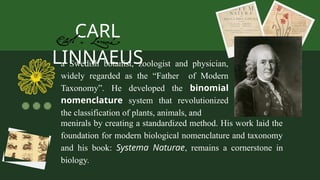
CARL
LINNAEUS
a Swedish botanist,zoologist and physician,
widely regarded as the “Father of Modern
Taxonomy”. He developed the binomial
nomenclature system that revolutionized
the classification of plants, animals, and
menirals by creating a standardized method. His work laid the
foundation for modern biological nomenclature and taxonomy
and his book: Systema Naturae, remains a cornerstone in
biology.
11.
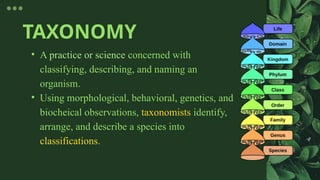
TAXONOMY
• A practiceor science concerned with
classifying, describing, and naming an
organism.
• Using morphological, behavioral, genetics, and
biocheical observations, taxonomists identify,
arrange, and describe a species into
classifications.
12.
TAXONOMY
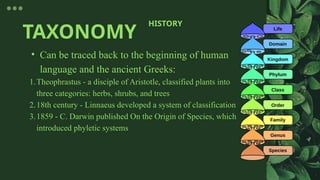
• Can betraced back to the beginning of human
language and the ancient Greeks:
1.Theophrastus - a disciple of Aristotle, classified plants into
three categories: herbs, shrubs, and trees
2.18th century - Linnaeus developed a system of classification
3.1859 - C. Darwin published On the Origin of Species, which
introduced phyletic systems
HISTORY
13.
SYSTEMATICS
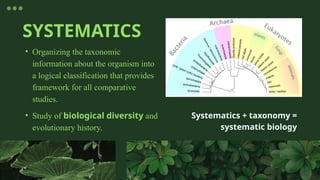
• Organizing thetaxonomic
information about the organism into
a logical classification that provides
framework for all comparative
studies.
• Study of biological diversity and
evolutionary history.
Systematics + taxonomy =
systematic biology
LEVELS OF TAXONOMY
•ALPHA TAXONOMY - includes species
description, taxonomic keys, and diagnoses
• BETA TAXONOMY - identification of natural
groups and biological classes
• GAMMA TAXONOMY - study of evolutionary
processes and patterns
16.
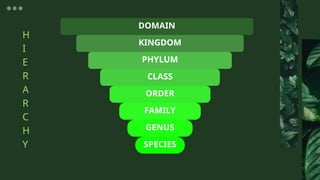
LEVELS OF CLASSIFICATION
•A hierarchical system is used for classifying organisms
• Named groups within the hierarchy are called a TAXA (singular:
Taxon)
• As one processes down to hierarchy, the number of organism in
each taxon decreases and similarities between them increases.
• Lower the taxa, more the characteristics that the
members within the taxon share.
1
DOMAIN
• The highestlevel of biological
classification, and it groups
organisms into three
domains: Bacteria, Archaea,
and Eukarya.
19.
KINGDOM
• THE SECONDHIGHEST TAXONOMIC CATEGORY
THAT GROUPS ORGANISMS INTO BROAD
CATEGORIES.
• EXAMPLES:
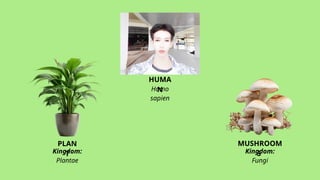
1.KINGDOM PLANTAE (INCLUDES ALL PLANT
SPECIES)
2.KINGDOM ANIMALIA (INCLUDES ALL ANIMALS)
3.MONERA
2
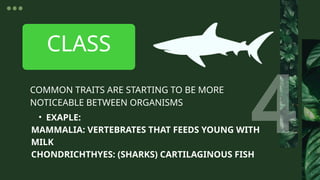
CLASS
4
COMMON TRAITS ARESTARTING TO BE MORE
NOTICEABLE BETWEEN ORGANISMS
• EXAPLE:
MAMMALIA: VERTEBRATES THAT FEEDS YOUNG WITH
MILK
CHONDRICHTHYES: (SHARKS) CARTILAGINOUS FISH
22.
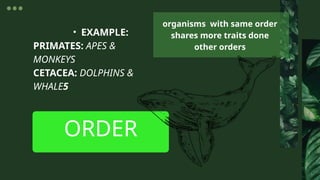
ORDER
• EXAMPLE:
PRIMATES: APES&
MONKEYS
CETACEA: DOLPHINS &
WHALE5
organisms with same order
shares more traits done
other orders
23.
FAMILY
6
EXAMPLE:
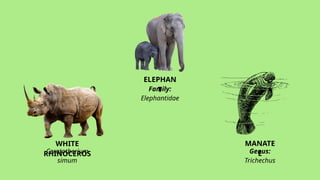
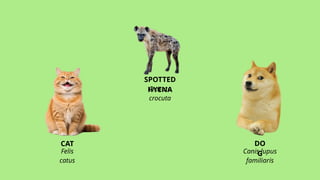
• FELIDAE -CONTAINS CAT
• HOMINIDAE - CONTAINS CHIMPANZEES,
GORILLAS, AND HUMANS
• SOLANACEAE - CONTAINS POTATOES AND
DEADLY NIGHTSHADE
-idae - for
animals
-aceae - for
plants
24.
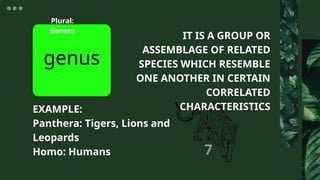
genus
IT IS AGROUP OR
ASSEMBLAGE OF RELATED
SPECIES WHICH RESEMBLE
ONE ANOTHER IN CERTAIN
CORRELATED
CHARACTERISTICS
EXAMPLE:
Panthera: Tigers, Lions and
Leopards
Homo: Humans
Plural:
Genera
7
25.
SPECIES
• In Taxonomy,a species is the fundamental unit
of biological classification, representing a group
of organisms capable of interbreeding and
producing fertile offspring under conditions.
• For Example:
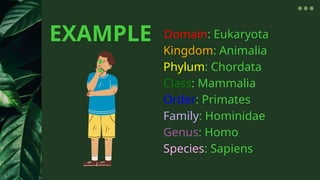
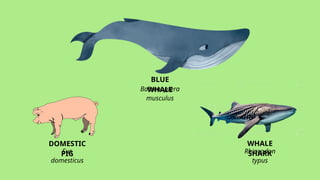
Humans (Homo sapiens) is a species under the
genus Homo and horse (Equus caballus) under the
genus Equus.
8
26.
• Each speciesis given a two-part Latinized name, this
system is known as the BINOMIAL NOMENCLATURE.
• Introduced by Carl Linnaeus in the 18th century, it
provides a standardized way to name and classify an
organism.
• A binomial name consists of two parts:
⚬ Genus name - the first part, always capitalized
⚬ Specific epithet - always lowercase
• A binomial name is always italicized and if it is
handwritten, it should be underlined.
• For example: Rosa rubiginosa (sweet briar rose).
NAMING A SPECIES
27.
ADDITIONAL RANKS
There isan intermediate number of ranks,
as a taxonomist may invent a new rank at
any time; if they feel this is necessary. In
doing so, there are some restrictions, which
will vary with the nomenclature code that
applies.
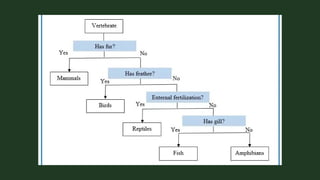
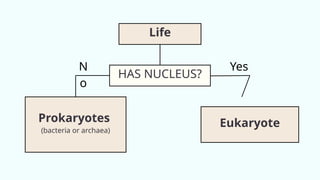
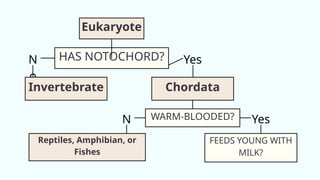
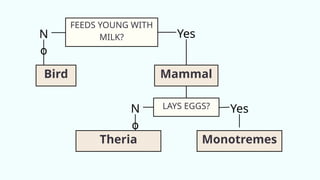
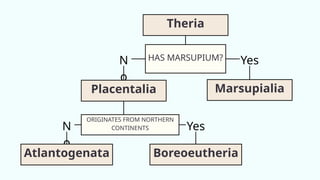
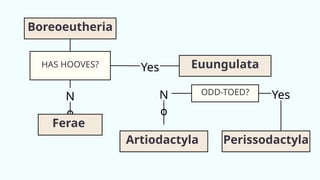
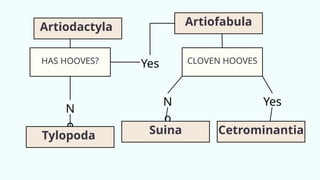
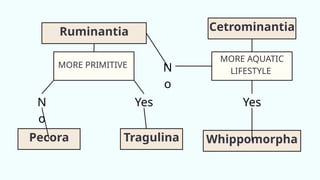
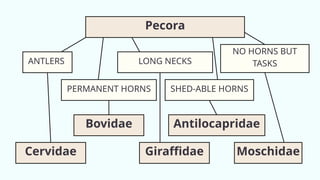
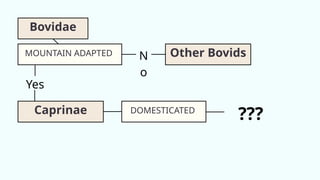
Dichotomous keys arecrucial in taxonomic biology
because they systematically identify organisms based on
observable characteristics. Following a series of choices,
researchers can narrow down the species or group an
organism to which it belongs.
It breaks down the identification process into manageable
steps, making it easier for both beginners and experts to
classify organisms accurately.


 Most read
 Most read
 Most read