 Taxonomy is the branch of biology concerned
with the grouping and naming of organisms.
 From the Greek word “taxis”, meaning
arrangement or division, and nomos, meaning
law.
 Biologists who study this are called
taxonomists.
• people wanted
to organize their
world so they
began grouping,
or classifying
everything they
saw.
• This makes it a
thing, something
we can talk
about, something
we can observe,
something we
can think about,
something we
can protect.
• We can’t act on
the nameless, the
unknown
unknowns, and
we certainly can’t
study them.
-
• To help us study the earth.
-
• To help us organize all the species we discover.
-
• To give every species a name based on a standard method so
scientists from different countries can talk about the same animal
without confusion.
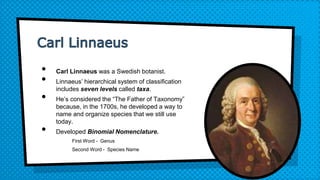
• Carl Linnaeus was a Swedish botanist.
• Linnaeus’ hierarchical system of classification
includes seven levels called taxa.
• He’s considered the “The Father of Taxonomy”
because, in the 1700s, he developed a way to
name and organize species that we still use
today.
• Developed Binomial Nomenclature.
First Word - Genus
Second Word - Species Name
“Deus creavit,
Linnaeus disposuit.”
(God created,
Linnaeus organized.)
~Carl Linnaeus
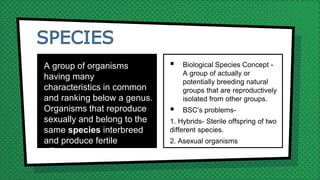
A group of organisms
having many
characteristics in common
and ranking below a genus.
Organisms that reproduce
sexually and belong to the
same species interbreed
and produce fertile
offspring.
 Biological Species Concept -
A group of actually or
potentially breeding natural
groups that are reproductively
isolated from other groups.
 BSC’s problems-
1. Hybrids- Sterile offspring of two
different species.
2. Asexual organisms
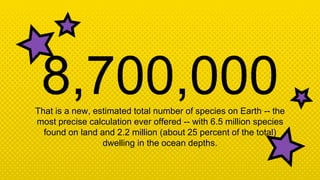
8,700,000That is a new, estimated total number of species on Earth -- the
most precise calculation ever offered -- with 6.5 million species
found on land and 2.2 million (about 25 percent of the total)
dwelling in the ocean depths.
-
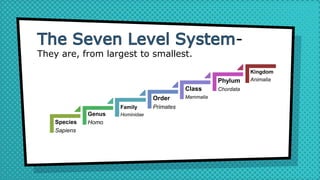
They are, from largest to smallest.
Species
Sapiens
Genus
Homo
x
Family
Hominidae
Order
Primates
x Class
Mammalia
Phylum
Chordata
Kingdom
Animalia
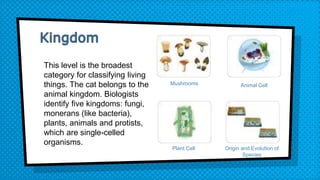
This level is the broadest
category for classifying living
things. The cat belongs to the
animal kingdom. Biologists
identify five kingdoms: fungi,
monerans (like bacteria),
plants, animals and protists,
which are single-celled
organisms.
Mushrooms Animal Cell
Plant Cell Origin and Evolution of
Species
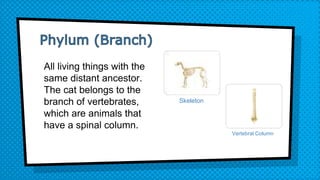
All living things with the
same distant ancestor.
The cat belongs to the
branch of vertebrates,
which are animals that
have a spinal column.
Skeleton
Vertebral Column
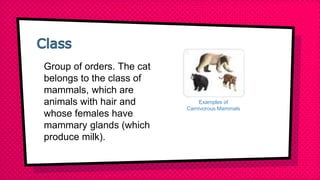
Group of orders. The cat
belongs to the class of
mammals, which are
animals with hair and
whose females have
mammary glands (which
produce milk).
Examples of
Carnivorous Mammals
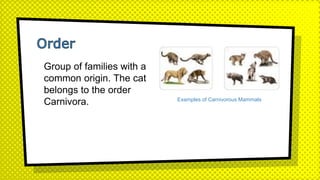
Group of families with a
common origin. The cat
belongs to the order
Carnivora. Examples of Carnivorous Mammals
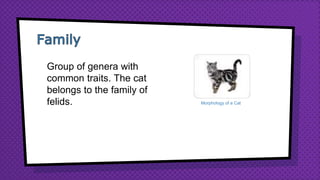
Group of genera with
common traits. The cat
belongs to the family of
felids. Morphology of a Cat
Group of animals with
many common traits.
The cat belongs to the
genus Felis.
Cat’s Head
Extended Claws
Retracted Claw
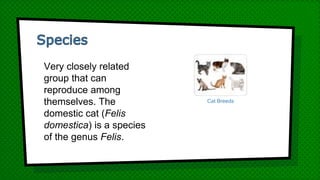
Very closely related
group that can
reproduce among
themselves. The
domestic cat (Felis
domestica) is a species
of the genus Felis.
Cat Breeds
“Nomenclature, the other
foundation of Botany,
should provide the names
as soon as the
classification is made… If
the names are unknown
knowledge of the things
also perishes… For a
single genus, a single
name.”
~Carl Linnaeus
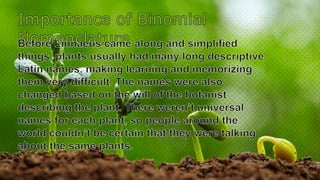
A binomial
nomenclature is
a classification
system using
two names to
identify an
organism.
means two.
means
name.
also called
binominal
nomenclature or
binary
nomenclature.
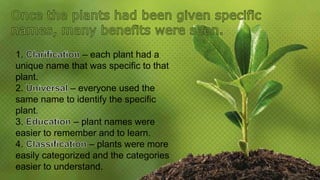
1. – each plant had a
unique name that was specific to that
plant.
2. – everyone used the
same name to identify the specific
plant.
3. – plant names were
easier to remember and to learn.
4. – plants were more
easily categorized and the categories
easier to understand.
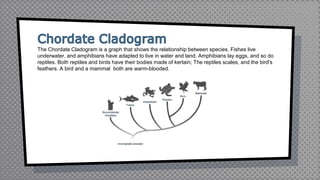
• Graph showing when different groups diverged from a common
ancestral line
• Points where they diverge are often noted with a feature that was
different between ancestral group and a “new” feature in the group
that split off.
• A cladogram is a diagram used to represent a hypothetical
relationship between groups of animals, called a phylogeny.
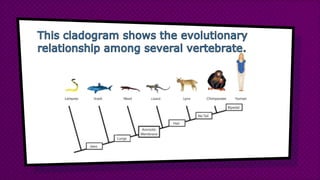
The Chordate Cladogram is a graph that shows the relationship between species. Fishes live
underwater, and amphibians have adapted to live in water and land. Amphibians lay eggs, and so do
reptiles. Both reptiles and birds have their bodies made of kertain; The reptiles scales, and the bird's
feathers. A bird and a mammal both are warm-blooded.
“Words matter, my friends.
They matter because they
allow us to recognize the
diversity of life on earth,
helping us to understand it
more deeply and to better
coexist with it. Indeed,
perhaps more than anywhere
else, words in taxonomy
should not be taken lightly.”
~TeamTaxonomyBSBA1B~
THANK
S!