Jitendra Kumar
Remotely sensed SST, Chlorophyll and
Wind pattern features of Indian seas
used in locating Potential Fish Zones
(PFZ)
Remotely sensed SST, Chlorophyll and
Wind pattern features of Indian seas
used in locating Potential Fish Zones
(PFZ)
Page  2
Remotely sensed SST, Chlorophyll and Wind pattern-
used in locating Potential Fish Zones (PFZ).
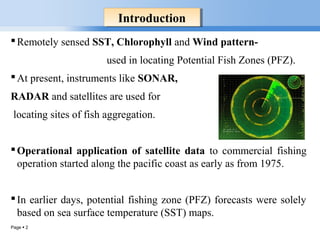
At present, instruments like SONAR,
RADAR and satellites are used for
locating sites of fish aggregation.
Operational application of satellite data to commercial fishing
operation started along the pacific coast as early as from 1975.
In earlier days, potential fishing zone (PFZ) forecasts were solely
based on sea surface temperature (SST) maps.
IntroductionIntroduction
Page  3
For the first time, ocean colour from CZCS (Coastal Zone Color
Scanner) along with SST from NOAA National Oceanographic and
Aerospace Administration), AVHRR (Advanced Very High
Resolution adiometer) was used by Muller &Violate.
They found that the temperature contours and chlorophyll contours
were offset by a few kilometers.
Laurs et al. used CZCS and SST images to study the distribution of
tuna population.
Page  4
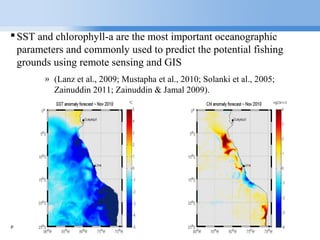
SST and chlorophyll-a are the most important oceanographic
parameters and commonly used to predict the potential fishing
grounds using remote sensing and GIS
» (Lanz et al., 2009; Mustapha et al., 2010; Solanki et al., 2005;
Zainuddin 2011; Zainuddin & Jamal 2009).
Page  5
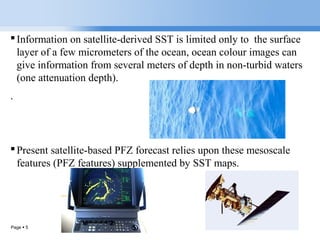
Information on satellite-derived SST is limited only to the surface
layer of a few micrometers of the ocean, ocean colour images can
give information from several meters of depth in non-turbid waters
(one attenuation depth).
.
Present satellite-based PFZ forecast relies upon these mesoscale
features (PFZ features) supplemented by SST maps.
Page  6
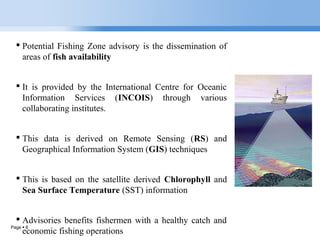
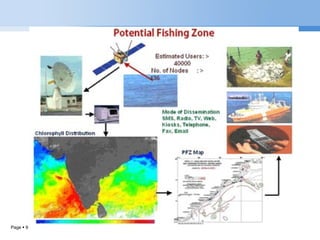
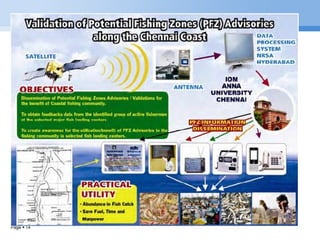
 Potential Fishing Zone advisory is the dissemination of
areas of fish availability
 It is provided by the International Centre for Oceanic
Information Services (INCOIS) through various
collaborating institutes.
 This data is derived on Remote Sensing (RS) and
Geographical Information System (GIS) techniques
 This is based on the satellite derived Chlorophyll and
Sea Surface Temperature (SST) information
 Advisories benefits fishermen with a healthy catch and
economic fishing operations
Page  7
Dissemination
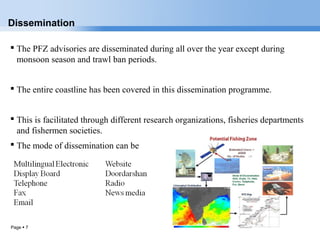
 The PFZ advisories are disseminated during all over the year except during
monsoon season and trawl ban periods.
 The entire coastline has been covered in this dissemination programme.
 This is facilitated through different research organizations, fisheries departments
and fishermen societies.
 The mode of dissemination can be
Page  8
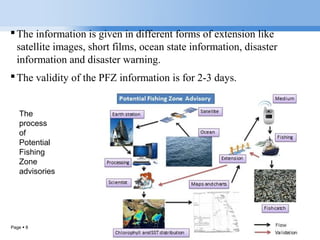
The information is given in different forms of extension like
satellite images, short films, ocean state information, disaster
information and disaster warning.
The validity of the PFZ information is for 2-3 days.
The
process
of
Potential
Fishing
Zone
advisories
Page  9
Page  10
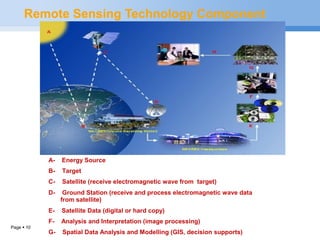
Remote Sensing Technology Component
A- Energy Source
B- Target
C- Satellite (receive electromagnetic wave from target)
D- Ground Station (receive and process electromagnetic wave data
from satellite)
E- Satellite Data (digital or hard copy)
F- Analysis and Interpretation (image processing)
G- Spatial Data Analysis and Modelling (GIS, decision supports)
Page  11
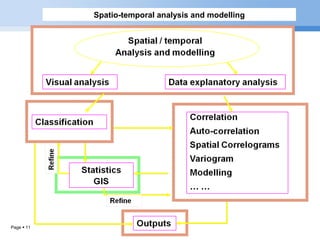
Spatio-temporal analysis and modelling
Page  12
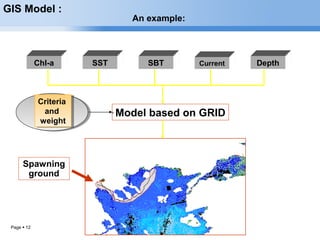
GIS Model :
An example:
Chl-a SST SBT Current Depth
Model based on GRID
Criteria
and
weight
Criteria
and
weight
Spawning
ground
Page  13
Page  14
Page  15
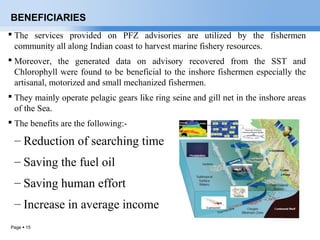
BENEFICIARIES
 The services provided on PFZ advisories are utilized by the fishermen
community all along Indian coast to harvest marine fishery resources.
 Moreover, the generated data on advisory recovered from the SST and
Chlorophyll were found to be beneficial to the inshore fishermen especially the
artisanal, motorized and small mechanized fishermen.
 They mainly operate pelagic gears like ring seine and gill net in the inshore areas
of the Sea.
 The benefits are the following:-
– Reduction of searching time
– Saving the fuel oil
– Saving human effort
– Increase in average income
Page  16
CONCLUSION :
The Potential Fishing Zone advisories is a major tool in
disseminating the satellite based fishery information to the
beneficiary, the fishermen.
Even though the scientific background and analytical platform
behind the PFZ advisories is an evolving field, the anticipated
results are obtained from the advisories with the participation of
fishermen.
 The more refined PFZ advisories will be available for the fishermen in future
with further advancement of the science.
Page  17
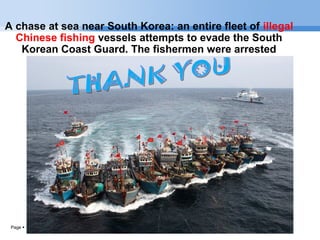
A chase at sea near South Korea: an entire fleet of illegal
Chinese fishing vessels attempts to evade the South
Korean Coast Guard. The fishermen were arrested

Pfz ppt

  • 1.
    Jitendra Kumar Remotely sensedSST, Chlorophyll and Wind pattern features of Indian seas used in locating Potential Fish Zones (PFZ) Remotely sensed SST, Chlorophyll and Wind pattern features of Indian seas used in locating Potential Fish Zones (PFZ)
  • 2.
    Page  2 Remotelysensed SST, Chlorophyll and Wind pattern- used in locating Potential Fish Zones (PFZ). At present, instruments like SONAR, RADAR and satellites are used for locating sites of fish aggregation. Operational application of satellite data to commercial fishing operation started along the pacific coast as early as from 1975. In earlier days, potential fishing zone (PFZ) forecasts were solely based on sea surface temperature (SST) maps. IntroductionIntroduction
  • 3.
    Page  3 Forthe first time, ocean colour from CZCS (Coastal Zone Color Scanner) along with SST from NOAA National Oceanographic and Aerospace Administration), AVHRR (Advanced Very High Resolution adiometer) was used by Muller &Violate. They found that the temperature contours and chlorophyll contours were offset by a few kilometers. Laurs et al. used CZCS and SST images to study the distribution of tuna population.
  • 4.
    Page  4 SSTand chlorophyll-a are the most important oceanographic parameters and commonly used to predict the potential fishing grounds using remote sensing and GIS » (Lanz et al., 2009; Mustapha et al., 2010; Solanki et al., 2005; Zainuddin 2011; Zainuddin & Jamal 2009).
  • 5.
    Page  5 Informationon satellite-derived SST is limited only to the surface layer of a few micrometers of the ocean, ocean colour images can give information from several meters of depth in non-turbid waters (one attenuation depth). . Present satellite-based PFZ forecast relies upon these mesoscale features (PFZ features) supplemented by SST maps.
  • 6.
    Page  6 Potential Fishing Zone advisory is the dissemination of areas of fish availability  It is provided by the International Centre for Oceanic Information Services (INCOIS) through various collaborating institutes.  This data is derived on Remote Sensing (RS) and Geographical Information System (GIS) techniques  This is based on the satellite derived Chlorophyll and Sea Surface Temperature (SST) information  Advisories benefits fishermen with a healthy catch and economic fishing operations
  • 7.
    Page  7 Dissemination The PFZ advisories are disseminated during all over the year except during monsoon season and trawl ban periods.  The entire coastline has been covered in this dissemination programme.  This is facilitated through different research organizations, fisheries departments and fishermen societies.  The mode of dissemination can be
  • 8.
    Page  8 Theinformation is given in different forms of extension like satellite images, short films, ocean state information, disaster information and disaster warning. The validity of the PFZ information is for 2-3 days. The process of Potential Fishing Zone advisories
  • 9.
  • 10.
    Page  10 RemoteSensing Technology Component A- Energy Source B- Target C- Satellite (receive electromagnetic wave from target) D- Ground Station (receive and process electromagnetic wave data from satellite) E- Satellite Data (digital or hard copy) F- Analysis and Interpretation (image processing) G- Spatial Data Analysis and Modelling (GIS, decision supports)
  • 11.
    Page  11 Spatio-temporalanalysis and modelling
  • 12.
    Page  12 GISModel : An example: Chl-a SST SBT Current Depth Model based on GRID Criteria and weight Criteria and weight Spawning ground
  • 13.
  • 14.
  • 15.
    Page  15 BENEFICIARIES The services provided on PFZ advisories are utilized by the fishermen community all along Indian coast to harvest marine fishery resources.  Moreover, the generated data on advisory recovered from the SST and Chlorophyll were found to be beneficial to the inshore fishermen especially the artisanal, motorized and small mechanized fishermen.  They mainly operate pelagic gears like ring seine and gill net in the inshore areas of the Sea.  The benefits are the following:- – Reduction of searching time – Saving the fuel oil – Saving human effort – Increase in average income
  • 16.
    Page  16 CONCLUSION: The Potential Fishing Zone advisories is a major tool in disseminating the satellite based fishery information to the beneficiary, the fishermen. Even though the scientific background and analytical platform behind the PFZ advisories is an evolving field, the anticipated results are obtained from the advisories with the participation of fishermen.  The more refined PFZ advisories will be available for the fishermen in future with further advancement of the science.
  • 17.
    Page  17 Achase at sea near South Korea: an entire fleet of illegal Chinese fishing vessels attempts to evade the South Korean Coast Guard. The fishermen were arrested