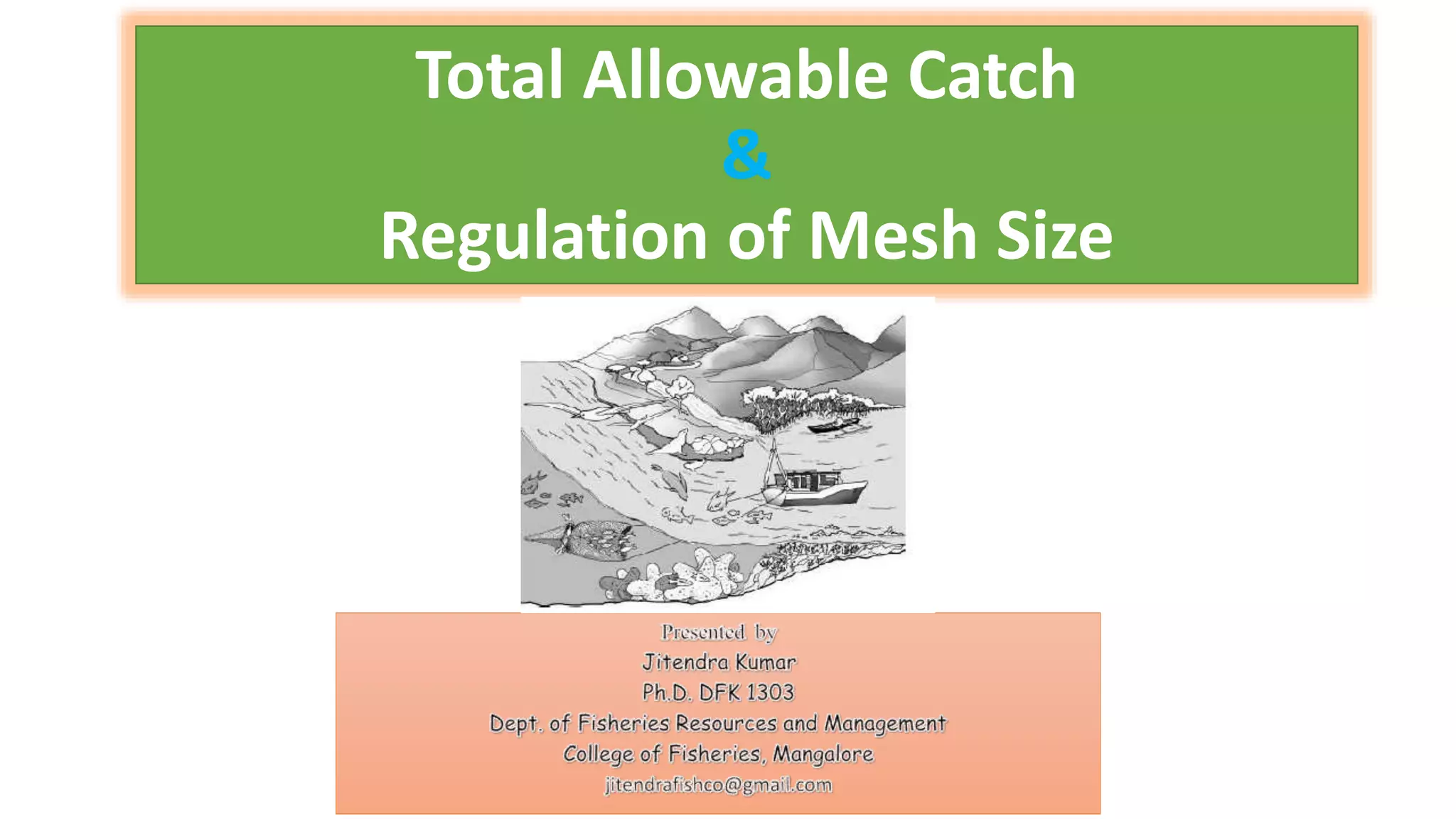

Total Allowable Catch
&
Regulation of Mesh Size
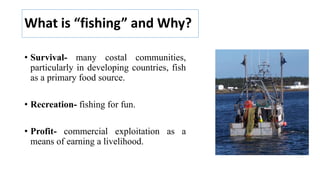
• Survival- many costal communities,
particularly in developing countries, fish
as a primary food source.
• Recreation- fishing for fun.
• Profit- commercial exploitation as a
means of earning a livelihood.
What is “fishing” and Why?
What is “over fishing”?
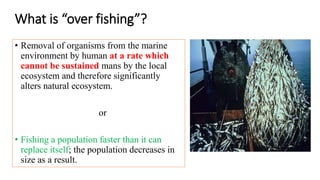
• Removal of organisms from the marine
environment by human at a rate which
cannot be sustained mans by the local
ecosystem and therefore significantly
alters natural ecosystem.
or
• Fishing a population faster than it can
replace itself; the population decreases in
size as a result.
What are some consequences of over fishing?
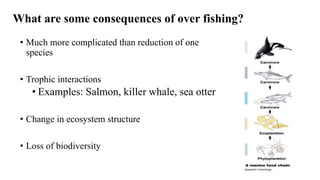
• Much more complicated than reduction of one
species
• Trophic interactions
• Examples: Salmon, killer whale, sea otter
• Change in ecosystem structure
• Loss of biodiversity
5
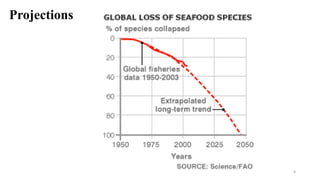
Collapse: End of Global Fish Stock by 2050?
(Source: Globalization 101.org, the Levin Institute)
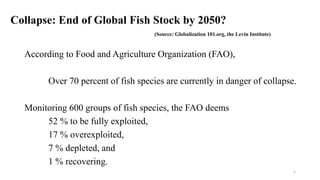
According to Food and Agriculture Organization (FAO),
Over 70 percent of fish species are currently in danger of collapse.
Monitoring 600 groups of fish species, the FAO deems
52 % to be fully exploited,
17 % overexploited,
7 % depleted, and
1 % recovering.
6
Projections
Incentive Blocking Capacity Mitigating
Measures
• Limited entry programs,
• Buyback programs,
• Gear and vessel restrictions,
• Total Allowable Catches,
• Vessel catch limits, and
• Individual effort quotas
FAO, 2002
Definition
TACs are usually expressed in tonnes of live-weight
equivalent, but are sometimes set in terms of numbers of fish.
The total allowable catch (TAC) is a catch limit set for a
particular fishery, generally for a year or a fishing season.
Total Allowable Catches, known as TACs,
are set annually by the European Union Commission
Based on ICES (International Council for the Exploration of
the Sea) scientific advice
(Andersen et al., 2009)
Total allowable catch (TAC)
• The CFP sets quotas for how much of each species can be caught (in a
certain area)
• Each country is given a quota based upon the total available (Total
Allowable Catch, TAC) and their traditional share
• TACs are fixed annually by the Council of Ministers
• After quota are fixed by the Council of Ministers, each EU member state is
responsible for policing its own quota.
• Different countries distribute their quota among fishermen using different
systems.
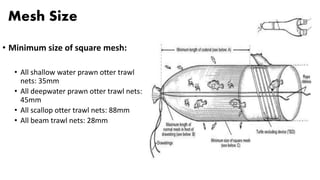
Mesh Size
• Minimum size of square mesh:
• All shallow water prawn otter trawl
nets: 35mm
• All deepwater prawn otter trawl nets:
45mm
• All scallop otter trawl nets: 88mm
• All beam trawl nets: 28mm
In India
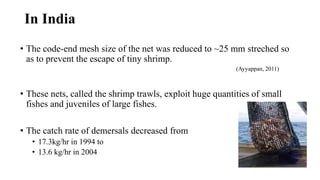
• The code-end mesh size of the net was reduced to ~25 mm streched so
as to prevent the escape of tiny shrimp.
(Ayyappan, 2011)
• These nets, called the shrimp trawls, exploit huge quantities of small
fishes and juveniles of large fishes.
• The catch rate of demersals decreased from
• 17.3kg/hr in 1994 to
• 13.6 kg/hr in 2004
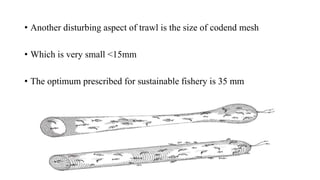
• Another disturbing aspect of trawl is the size of codend mesh
• Which is very small <15mm
• The optimum prescribed for sustainable fishery is 35 mm
Unregulated
OpenAccess
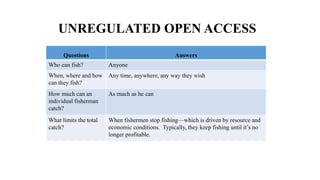
Questions Answers
Who can fish? Anyone
When, where and how
can they fish?
Any time, anywhere, any way they wish
How much can an
individual fisherman
catch?
As much as he can
What limits the total
catch?
When fishermen stop fishing—which is driven by resource and
economic conditions. Typically, they keep fishing until it’s no
longer profitable.
UNREGULATED OPEN ACCESS
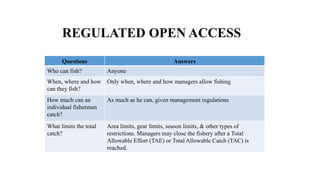
Regulated
OpenAccess
Questions Answers
Who can fish? Anyone
When, where and how
can they fish?
Only when, where and how managers allow fishing
How much can an
individual fisherman
catch?
As much as he can, given management regulations
What limits the total
catch?
Area limits, gear limits, season limits, & other types of
restrictions. Managers may close the fishery after a Total
Allowable Effort (TAE) or Total Allowable Catch (TAC) is
reached.
REGULATED OPEN ACCESS
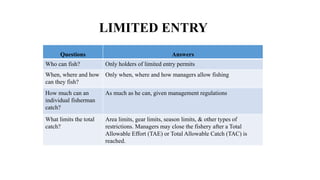
LimitedEntry
Questions Answers
Who can fish? Only holders of limited entry permits
When, where and how
can they fish?
Only when, where and how managers allow fishing
How much can an
individual fisherman
catch?
As much as he can, given management regulations
What limits the total
catch?
Area limits, gear limits, season limits, & other types of
restrictions. Managers may close the fishery after a Total
Allowable Effort (TAE) or Total Allowable Catch (TAC) is
reached.
LIMITED ENTRY
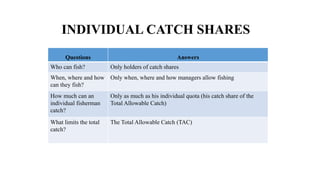
IndividualCatch
Shares
Questions Answers
Who can fish? Only holders of catch shares
When, where and how
can they fish?
Only when, where and how managers allow fishing
How much can an
individual fisherman
catch?
Only as much as his individual quota (his catch share of the
Total Allowable Catch)
What limits the total
catch?
The Total Allowable Catch (TAC)
INDIVIDUAL CATCH SHARES
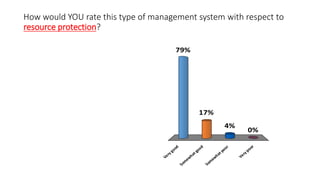
How would YOU rate this type of management system with respect to
resource protection?
Very
good
Som
ew
hatgood
Som
ew
hatpoor
Very
poor
79%
0%
4%
17%
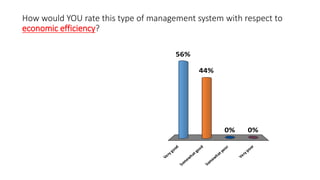
How would YOU rate this type of management system with respect to
economic efficiency?
Very
good
Som
ew
hatgood
Som
ew
hatpoor
Very
poor
56%
0%0%
44%
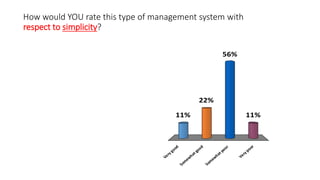
How would YOU rate this type of management system with
respect to simplicity?
Very
good
Som
ew
hatgood
Som
ew
hatpoor
Very
poor
11% 11%
56%
22%
25
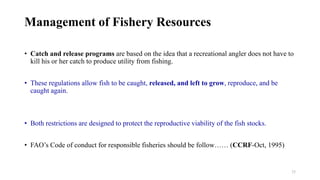
Management of Fishery Resources
• Catch and release programs are based on the idea that a recreational angler does not have to
kill his or her catch to produce utility from fishing.
• These regulations allow fish to be caught, released, and left to grow, reproduce, and be
caught again.
• Both restrictions are designed to protect the reproductive viability of the fish stocks.
• FAO’s Code of conduct for responsible fisheries should be follow…… (CCRF-Oct, 1995)
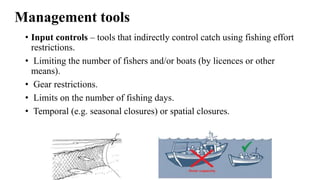
Management tools
• Input controls – tools that indirectly control catch using fishing effort
restrictions.
• Limiting the number of fishers and/or boats (by licences or other
means).
• Gear restrictions.
• Limits on the number of fishing days.
• Temporal (e.g. seasonal closures) or spatial closures.
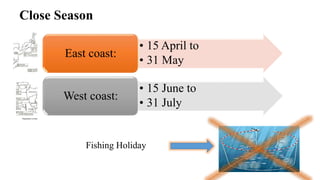
Close Season
27
• 15 April to
• 31 May
East coast:
• 15 June to
• 31 July
West coast:
Fishing Holiday
28
Summary
• Fishery resources are renewable but destructible.
• The destructibility problem is amplified by the open-access nature of many
of the world’s fishery resources.
• For commercial fishing, optimal management strategy requires the
limitation of effort to a level that maximizes the sum of consumers’ surplus,
producers’ surplus, and fishery rent.
MY HYPOTHESIS:
There is no“perfect” fisherymanagement system
• No system performs “best” with respect to all objectives
• Systems that perform well with respect to some objectives
may perform poorly with respect to other objectives
DID YOU AGREE?
My conclusion . . .
For any society, the “best” fishery
management system depends upon the
society’s objectives as well as the specific
circumstances of the society, the fishery,
markets, and technology.
Thank You

Total allowable catch

  • 1.
  • 2.
    • Survival- manycostal communities, particularly in developing countries, fish as a primary food source. • Recreation- fishing for fun. • Profit- commercial exploitation as a means of earning a livelihood. What is “fishing” and Why?
  • 3.
    What is “overfishing”? • Removal of organisms from the marine environment by human at a rate which cannot be sustained mans by the local ecosystem and therefore significantly alters natural ecosystem. or • Fishing a population faster than it can replace itself; the population decreases in size as a result.
  • 4.
    What are someconsequences of over fishing? • Much more complicated than reduction of one species • Trophic interactions • Examples: Salmon, killer whale, sea otter • Change in ecosystem structure • Loss of biodiversity
  • 5.
    5 Collapse: End ofGlobal Fish Stock by 2050? (Source: Globalization 101.org, the Levin Institute) According to Food and Agriculture Organization (FAO), Over 70 percent of fish species are currently in danger of collapse. Monitoring 600 groups of fish species, the FAO deems 52 % to be fully exploited, 17 % overexploited, 7 % depleted, and 1 % recovering.
  • 6.
  • 7.
    Incentive Blocking CapacityMitigating Measures • Limited entry programs, • Buyback programs, • Gear and vessel restrictions, • Total Allowable Catches, • Vessel catch limits, and • Individual effort quotas FAO, 2002
  • 8.
    Definition TACs are usuallyexpressed in tonnes of live-weight equivalent, but are sometimes set in terms of numbers of fish. The total allowable catch (TAC) is a catch limit set for a particular fishery, generally for a year or a fishing season.
  • 9.
    Total Allowable Catches,known as TACs, are set annually by the European Union Commission Based on ICES (International Council for the Exploration of the Sea) scientific advice (Andersen et al., 2009)
  • 10.
    Total allowable catch(TAC) • The CFP sets quotas for how much of each species can be caught (in a certain area) • Each country is given a quota based upon the total available (Total Allowable Catch, TAC) and their traditional share • TACs are fixed annually by the Council of Ministers • After quota are fixed by the Council of Ministers, each EU member state is responsible for policing its own quota. • Different countries distribute their quota among fishermen using different systems.
  • 11.
    Mesh Size • Minimumsize of square mesh: • All shallow water prawn otter trawl nets: 35mm • All deepwater prawn otter trawl nets: 45mm • All scallop otter trawl nets: 88mm • All beam trawl nets: 28mm
  • 12.
    In India • Thecode-end mesh size of the net was reduced to ~25 mm streched so as to prevent the escape of tiny shrimp. (Ayyappan, 2011) • These nets, called the shrimp trawls, exploit huge quantities of small fishes and juveniles of large fishes. • The catch rate of demersals decreased from • 17.3kg/hr in 1994 to • 13.6 kg/hr in 2004
  • 13.
    • Another disturbingaspect of trawl is the size of codend mesh • Which is very small <15mm • The optimum prescribed for sustainable fishery is 35 mm
  • 14.
  • 15.
    Questions Answers Who canfish? Anyone When, where and how can they fish? Any time, anywhere, any way they wish How much can an individual fisherman catch? As much as he can What limits the total catch? When fishermen stop fishing—which is driven by resource and economic conditions. Typically, they keep fishing until it’s no longer profitable. UNREGULATED OPEN ACCESS
  • 16.
  • 17.
    Questions Answers Who canfish? Anyone When, where and how can they fish? Only when, where and how managers allow fishing How much can an individual fisherman catch? As much as he can, given management regulations What limits the total catch? Area limits, gear limits, season limits, & other types of restrictions. Managers may close the fishery after a Total Allowable Effort (TAE) or Total Allowable Catch (TAC) is reached. REGULATED OPEN ACCESS
  • 18.
  • 19.
    Questions Answers Who canfish? Only holders of limited entry permits When, where and how can they fish? Only when, where and how managers allow fishing How much can an individual fisherman catch? As much as he can, given management regulations What limits the total catch? Area limits, gear limits, season limits, & other types of restrictions. Managers may close the fishery after a Total Allowable Effort (TAE) or Total Allowable Catch (TAC) is reached. LIMITED ENTRY
  • 20.
  • 21.
    Questions Answers Who canfish? Only holders of catch shares When, where and how can they fish? Only when, where and how managers allow fishing How much can an individual fisherman catch? Only as much as his individual quota (his catch share of the Total Allowable Catch) What limits the total catch? The Total Allowable Catch (TAC) INDIVIDUAL CATCH SHARES
  • 22.
    How would YOUrate this type of management system with respect to resource protection? Very good Som ew hatgood Som ew hatpoor Very poor 79% 0% 4% 17%
  • 23.
    How would YOUrate this type of management system with respect to economic efficiency? Very good Som ew hatgood Som ew hatpoor Very poor 56% 0%0% 44%
  • 24.
    How would YOUrate this type of management system with respect to simplicity? Very good Som ew hatgood Som ew hatpoor Very poor 11% 11% 56% 22%
  • 25.
    25 Management of FisheryResources • Catch and release programs are based on the idea that a recreational angler does not have to kill his or her catch to produce utility from fishing. • These regulations allow fish to be caught, released, and left to grow, reproduce, and be caught again. • Both restrictions are designed to protect the reproductive viability of the fish stocks. • FAO’s Code of conduct for responsible fisheries should be follow…… (CCRF-Oct, 1995)
  • 26.
    Management tools • Inputcontrols – tools that indirectly control catch using fishing effort restrictions. • Limiting the number of fishers and/or boats (by licences or other means). • Gear restrictions. • Limits on the number of fishing days. • Temporal (e.g. seasonal closures) or spatial closures.
  • 27.
    Close Season 27 • 15April to • 31 May East coast: • 15 June to • 31 July West coast: Fishing Holiday
  • 28.
    28 Summary • Fishery resourcesare renewable but destructible. • The destructibility problem is amplified by the open-access nature of many of the world’s fishery resources. • For commercial fishing, optimal management strategy requires the limitation of effort to a level that maximizes the sum of consumers’ surplus, producers’ surplus, and fishery rent.
  • 29.
    MY HYPOTHESIS: There isno“perfect” fisherymanagement system • No system performs “best” with respect to all objectives • Systems that perform well with respect to some objectives may perform poorly with respect to other objectives DID YOU AGREE?
  • 30.
    My conclusion .. . For any society, the “best” fishery management system depends upon the society’s objectives as well as the specific circumstances of the society, the fishery, markets, and technology.
  • 31.

Editor's Notes

  • #2 Total amount of resource allowed to be taken in a specified period (usually a one-year period), as defined in the management plan. TAC may be allocated to the stakeholders in the form of quotas as specific quantities or proportions.
  • #9 Vessel and license buyback programs are being proposed and increasingly used as a management instrument to reduce excess fish harvesting capacity. Such program literally buy and removes vessels and/or licenses from a fleet to decrease capacity. Many countries have experience in operating buyback programs including Japan, the United States, Canada, Norway, Australia, the European Community, and Taiwan.