Ammonia
Basic Flowsheet Elements
Chemistry of the Ammonia Process
Simplified Block Diagram of a Typical
1000 t/d Ammonia Plant
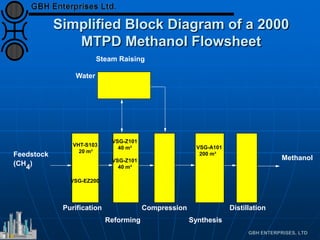
Simplified Block Diagram of a 2000
MTPD Methanol Flowsheet
Methanol
Purification
Reforming
Compression Distillation
Synthesis
Steam Raising
Feedstock
(CH )
4
Water
VHT-S103
20 m³
VSG-EZ200
VSG-Z101
40 m³
VSG-Z101
40 m³
VSG-A101
200 m³
Simplified Block Diagram of a
Hydrogen Flowsheet
Desulfurization
Primary Reforming
High Temperature
CO Shift
VHT-S101
VSG-
Cl101
VSG-
EZ200
VSG-
Z101
VSG-
F101
PSA
etc
SteamNatural Gas Feed
Hydrogen
Simplified Flowsheet for a Typical
Ammonia Plant
Natural
Gas
Steam
superheater
Air
Steam
30
bar
Steam
Steam
raising
350 C
200 C
Heat
Recovery
Steam
raising
Cooling
Cooling
Reboiler
CO
Cooling
Preheater
Heat
Recovery
Steam
Boiler
Process
Condensate
Quench
Quench
Liquid Ammonia
H
Hydrodesulphuriser Primary
Reformer
Secondary
Reformer
High
Temperature
Shift
Low
Temperature
Shift
Ammonia SynthesisMethanator
Carbon Dioxide
Purge Gas
Cooling
400 Co
390 Co
2
790 C
o
550 Co
1000 Co
o
420 Co
150 C
o
400 Co
470 C
o
o
220 C
o
290 Co
330 Co
2
CO Removal2
220 bar
Refrigeration
Condensate
Cooling
Ammonia
Catchpot
Modern Conventional Flowsheets
 Main process steps are the same for all plants
 Main differences in equipment design
 Uhde
 Top fired reformer
 Proprietary exit header design
 Secondary reformer has a riser
 HP loop with radial flow converter
Modern Conventional Flowsheets
 HKBR
 Primary reformer with manifold/riser
 Haldor Topsøe
 Side fired reformer
 Radial flow converter
 S-200
 S-250
Other Flowsheet Options
 Braun Purifier
 ICI AMV
 ICI LCA
 Dual Pressure Uhde Process
 HKBR KAAP (with/without purifier)
 Linde LAC
 H2 Recovery is used on most
modern plants
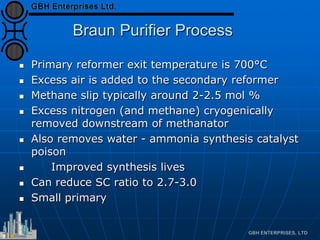
Braun Purifier Process
 Primary reformer exit temperature is 700°C
 Excess air is added to the secondary reformer
 Methane slip typically around 2-2.5 mol %
 Excess nitrogen (and methane) cryogenically
removed downstream of methanator
 Also removes water - ammonia synthesis catalyst
poison
 Improved synthesis lives
 Can reduce SC ratio to 2.7-3.0
 Small primary
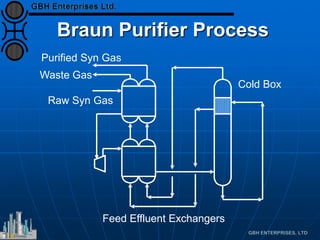
Braun Purifier Process
Cold Box
Purified Syn Gas
Waste Gas
Raw Syn Gas
Feed Effluent Exchangers
ICI AMV Process
 As with Braun - utilizes excess air to secondary
 Excess nitrogen is passed to the loop
 Loop runs at low pressure (80-110 bara)
 Use ICI LP Catalyst (74- Series)
 Uses a saturator to saturate feed gas
 This raises around 50% of the required steam
 Can use SC ratio of 2.8
 H2 Recovery in loop at loop pressure
ICI LCA Process
 Aim at small plant capacities (500 mtpd)
 Uses the GHR-Secondary concept
 Excess air is utilized to close heat balance
 Utilizes an ITS rather than HTS and LTS
 A saturator for steam raising
 A PSA system to remove the CO2 and excess N2
 A low pressure loop (80 bara)
 A tube cooled converter or Casale converter
 No longer actively marketing
Dual Pressure Uhde Process
PGR Unit
Make up gas
from frontend
H2O
Ammonia from once through conversion
HP-
steam
C.W.NH3
NH3
C.W.
C.W.
C.W.
HP-
steam
NH3 NH3
Off-Gas
Ammonia
from
HP loop
HP
casing
LP
casing
First
ammonia
converter
Second
ammonia
converter
Once
through
ammonia
converter
HP-
steam
Note: Molecular
Sieves not shown
Dual Pressure Uhde Process
 Benefits of such a scheme realised at 3,000
mtpd +
 Although this is large capacity - all equipment is
proven
 Note the low pressure converter between stages
of synthesis gas machine
 Makes machine smaller
 Makes loop pipework 24”
 Uses Comp. J catalyst
HKBR Purifier and KAAP
Primary
Reformer
Secondary
Reformer
Shift &
CO2
Removal
Purifier
CompressionKAAP
Meth’n
Dryers
Recycle Purge
To Fuel
Feed
Linde LAC
 Key features are
 No secondary reformer
 Nitrogen is generated cryogenically and
added after a PSA unit
 No HTS/LTS - only Isothermal (ITS) shift
 No methanation
Linde LAC
Desulfurization
Primary Reformer
Isothermal Shift
PSA
Nitrogen Unit
Ammonia Synthesis
Other Flowsheet Options
 Use Gas Turbine to drive process air
compressor
 Can use effluent as combustion air
 Has 16-17% O2 and is at 500°C
 Braun plants
 Install pre reformer
 HT Retrofit
 Many other reasons
 Remove heat from duct
 Uprate plant
Other Flowsheet Options
 Synthesis Gas driers
 Reduces H2O in syn gas
 H2O is a poison
 Activity increases
 Ammonia Wash
 As per Syn Gas driers
 Booster converters
 Drop load on loop and allow overall output
increase
 Quenches in Shifts
Ammonia Flowsheet Data Analysis
Tool - VULCAN CERES
 Looks at all catalytic unit operations
 Highlights potential issues/in-correct data
items
 Functionality to address flowsheet options
 Kellogg risers
 Differential flowsheet conditions (Braun)
 Use as a basis for
 Predictions of future performance
 Predictions of new catalyst options
 Uprates
Ammonia plant flowsheets

Ammonia plant flowsheets

  • 1.
  • 2.
    Chemistry of theAmmonia Process
  • 3.
    Simplified Block Diagramof a Typical 1000 t/d Ammonia Plant
  • 4.
    Simplified Block Diagramof a 2000 MTPD Methanol Flowsheet Methanol Purification Reforming Compression Distillation Synthesis Steam Raising Feedstock (CH ) 4 Water VHT-S103 20 m³ VSG-EZ200 VSG-Z101 40 m³ VSG-Z101 40 m³ VSG-A101 200 m³
  • 5.
    Simplified Block Diagramof a Hydrogen Flowsheet Desulfurization Primary Reforming High Temperature CO Shift VHT-S101 VSG- Cl101 VSG- EZ200 VSG- Z101 VSG- F101 PSA etc SteamNatural Gas Feed Hydrogen
  • 6.
    Simplified Flowsheet fora Typical Ammonia Plant Natural Gas Steam superheater Air Steam 30 bar Steam Steam raising 350 C 200 C Heat Recovery Steam raising Cooling Cooling Reboiler CO Cooling Preheater Heat Recovery Steam Boiler Process Condensate Quench Quench Liquid Ammonia H Hydrodesulphuriser Primary Reformer Secondary Reformer High Temperature Shift Low Temperature Shift Ammonia SynthesisMethanator Carbon Dioxide Purge Gas Cooling 400 Co 390 Co 2 790 C o 550 Co 1000 Co o 420 Co 150 C o 400 Co 470 C o o 220 C o 290 Co 330 Co 2 CO Removal2 220 bar Refrigeration Condensate Cooling Ammonia Catchpot
  • 7.
    Modern Conventional Flowsheets Main process steps are the same for all plants  Main differences in equipment design  Uhde  Top fired reformer  Proprietary exit header design  Secondary reformer has a riser  HP loop with radial flow converter
  • 8.
    Modern Conventional Flowsheets HKBR  Primary reformer with manifold/riser  Haldor Topsøe  Side fired reformer  Radial flow converter  S-200  S-250
  • 9.
    Other Flowsheet Options Braun Purifier  ICI AMV  ICI LCA  Dual Pressure Uhde Process  HKBR KAAP (with/without purifier)  Linde LAC  H2 Recovery is used on most modern plants
  • 10.
    Braun Purifier Process Primary reformer exit temperature is 700°C  Excess air is added to the secondary reformer  Methane slip typically around 2-2.5 mol %  Excess nitrogen (and methane) cryogenically removed downstream of methanator  Also removes water - ammonia synthesis catalyst poison  Improved synthesis lives  Can reduce SC ratio to 2.7-3.0  Small primary
  • 11.
    Braun Purifier Process ColdBox Purified Syn Gas Waste Gas Raw Syn Gas Feed Effluent Exchangers
  • 12.
    ICI AMV Process As with Braun - utilizes excess air to secondary  Excess nitrogen is passed to the loop  Loop runs at low pressure (80-110 bara)  Use ICI LP Catalyst (74- Series)  Uses a saturator to saturate feed gas  This raises around 50% of the required steam  Can use SC ratio of 2.8  H2 Recovery in loop at loop pressure
  • 13.
    ICI LCA Process Aim at small plant capacities (500 mtpd)  Uses the GHR-Secondary concept  Excess air is utilized to close heat balance  Utilizes an ITS rather than HTS and LTS  A saturator for steam raising  A PSA system to remove the CO2 and excess N2  A low pressure loop (80 bara)  A tube cooled converter or Casale converter  No longer actively marketing
  • 14.
    Dual Pressure UhdeProcess PGR Unit Make up gas from frontend H2O Ammonia from once through conversion HP- steam C.W.NH3 NH3 C.W. C.W. C.W. HP- steam NH3 NH3 Off-Gas Ammonia from HP loop HP casing LP casing First ammonia converter Second ammonia converter Once through ammonia converter HP- steam Note: Molecular Sieves not shown
  • 15.
    Dual Pressure UhdeProcess  Benefits of such a scheme realised at 3,000 mtpd +  Although this is large capacity - all equipment is proven  Note the low pressure converter between stages of synthesis gas machine  Makes machine smaller  Makes loop pipework 24”  Uses Comp. J catalyst
  • 16.
    HKBR Purifier andKAAP Primary Reformer Secondary Reformer Shift & CO2 Removal Purifier CompressionKAAP Meth’n Dryers Recycle Purge To Fuel Feed
  • 17.
    Linde LAC  Keyfeatures are  No secondary reformer  Nitrogen is generated cryogenically and added after a PSA unit  No HTS/LTS - only Isothermal (ITS) shift  No methanation
  • 18.
    Linde LAC Desulfurization Primary Reformer IsothermalShift PSA Nitrogen Unit Ammonia Synthesis
  • 19.
    Other Flowsheet Options Use Gas Turbine to drive process air compressor  Can use effluent as combustion air  Has 16-17% O2 and is at 500°C  Braun plants  Install pre reformer  HT Retrofit  Many other reasons  Remove heat from duct  Uprate plant
  • 20.
    Other Flowsheet Options Synthesis Gas driers  Reduces H2O in syn gas  H2O is a poison  Activity increases  Ammonia Wash  As per Syn Gas driers  Booster converters  Drop load on loop and allow overall output increase  Quenches in Shifts
  • 21.
    Ammonia Flowsheet DataAnalysis Tool - VULCAN CERES  Looks at all catalytic unit operations  Highlights potential issues/in-correct data items  Functionality to address flowsheet options  Kellogg risers  Differential flowsheet conditions (Braun)  Use as a basis for  Predictions of future performance  Predictions of new catalyst options  Uprates