Performance & Operation
Improvements using VULCAN Series
VSG-F101 High Temperature Shift
Catalysts
By:
Gerard B. Hawkins
Managing Director, CEO
Improvements in High Temperature
Shift Catalysts
 The high temperature shift duty
 introduction and theory
 HTS catalyst characteristics
 developments over time
 Typical HTS operational problems
 Improved catalysts
 VULCAN Series VSG-F101 Series
 Summary
Improvements in High Temperature
Shift Catalysts
 The high temperature shift duty
 Introduction and theory
 HTS catalyst characteristics
 Typical HTS operational problems
 Improved catalysts and loading regimes
 Summary
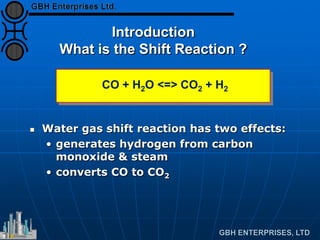
Introduction
What is the Shift Reaction ?
 Water gas shift reaction has two effects:
• generates hydrogen from carbon
monoxide & steam
• converts CO to CO2
CO + H2O <=> CO2 + H2
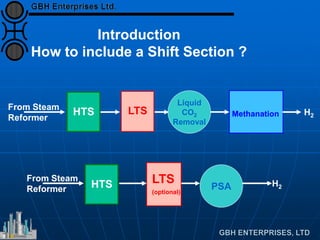
From Steam
Reformer
HTS LTS Methanation
LTS
(optional)
H2
Introduction
How to include a Shift Section ?
Liquid
CO2
Removal
PSAHTS
From Steam
Reformer
H2
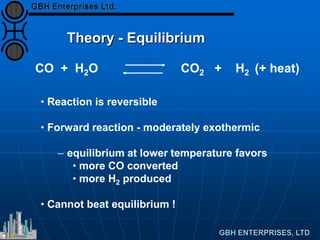
Theory - Equilibrium
CO + H2O CO2 + H2 (+ heat)
• Reaction is reversible
• Forward reaction - moderately exothermic
– equilibrium at lower temperature favors
• more CO converted
• more H2 produced
• Cannot beat equilibrium !
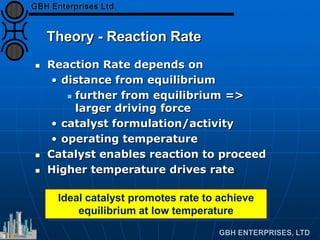
Theory - Reaction Rate
 Reaction Rate depends on
• distance from equilibrium
 further from equilibrium =>
larger driving force
• catalyst formulation/activity
• operating temperature
 Catalyst enables reaction to proceed
 Higher temperature drives rate
Ideal catalyst promotes rate to achieve
equilibrium at low temperature
Improvements in High Temperature
Shift Catalysts
 The high temperature shift duty
 HTS catalyst characteristics
 developments over time
 Typical HTS operational problems
 Improved catalysts and loading regimes
 Summary
High Temperature Shift
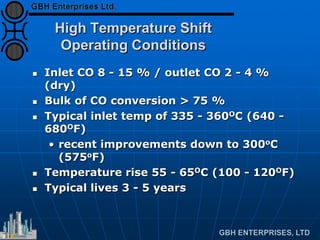
Operating Conditions
 Inlet CO 8 - 15 % / outlet CO 2 - 4 %
(dry)
 Bulk of CO conversion > 75 %
 Typical inlet temp of 335 - 360OC (640 -
680OF)
• recent improvements down to 300oC
(575oF)
 Temperature rise 55 - 65OC (100 - 120OF)
 Typical lives 3 - 5 years
High Temperature Shift
Catalyst Issues
 Over-reduction at low steam/dry gas
ratio
 Cr6+ content
 Sulfur content
 Activity
 Strength
High Temperature Shift
Modern Catalyst Features
 Iron/chromium/copper oxides catalyst
• typical composition 87 % / 10 % / 3% (wt)
 Active phase is magnetite, Fe3O4
• supplied as haematite, Fe2O3
• requires reduction
 Activity supplemented by Cu
• helps avoid over reduction of Fe3O4
 Low Cr6+ and SO4
2-
• typically < 50 (Cr) & < 300 ppmw (S) or better
High Temperature Shift
Catalyst Features
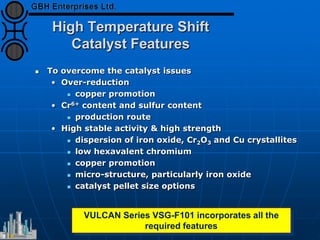
 To overcome the catalyst issues
• Over-reduction
 copper promotion
• Cr6+ content and sulfur content
 production route
• High stable activity & high strength
 dispersion of iron oxide, Cr2O3 and Cu crystallites
 low hexavalent chromium
 copper promotion
 micro-structure, particularly iron oxide
 catalyst pellet size options
VULCAN Series VSG-F101 incorporates all the
required features
High Temperature Shift
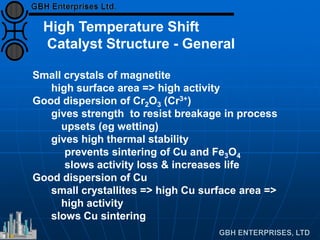
Catalyst Structure - General
Small crystals of magnetite
high surface area => high activity
Good dispersion of Cr2O3 (Cr3+)
gives strength to resist breakage in process
upsets (eg wetting)
gives high thermal stability
prevents sintering of Cu and Fe3O4
slows activity loss & increases life
Good dispersion of Cu
small crystallites => high Cu surface area =>
high activity
slows Cu sintering
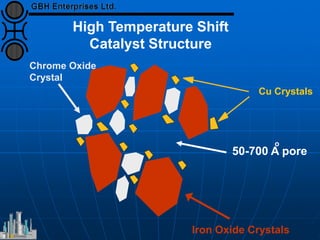
50-700 A pore
o
Chrome Oxide
Crystal
Iron Oxide Crystals
High Temperature Shift
Catalyst Structure
Cu Crystals
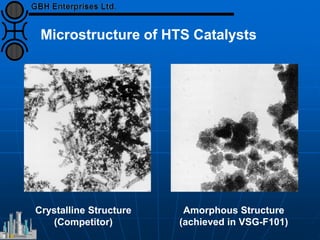
Amorphous Structure
(achieved in VSG-F101)
Microstructure of HTS Catalysts
Crystalline Structure
(Competitor)
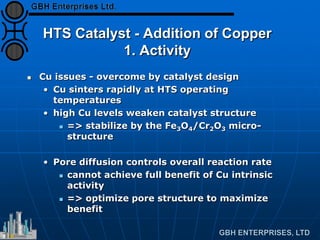
HTS Catalyst - Addition of Copper
1. Activity
 Activity increase due to Cu addition
• much higher intrinsic activity than Fe3O4
• increases shift activity
 Benefits are
• at same SOR inlet temperature, maintain
equilibrium for longer - extend life
• achieve equilibrium at lower SOR inlet
temperature - lower CO slip, higher H2 make,
slower sintering (deactivation)
• for same SOR inlet temperature and life -
decrease catalyst volume
HTS Catalyst - Addition of Copper
1. Activity
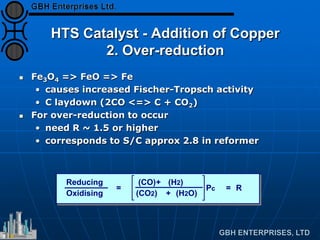
 Cu issues - overcome by catalyst design
• Cu sinters rapidly at HTS operating
temperatures
• high Cu levels weaken catalyst structure
 => stabilize by the Fe3O4/Cr2O3 micro-
structure
• Pore diffusion controls overall reaction rate
 cannot achieve full benefit of Cu intrinsic
activity
 => optimize pore structure to maximize
benefit
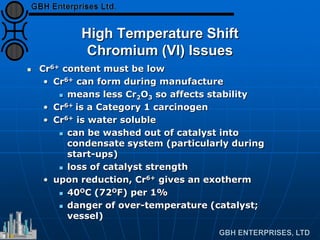
HTS Catalyst - Addition of Copper
2. Over-reduction
 Fe3O4 => FeO => Fe
• causes increased Fischer-Tropsch activity
• C laydown (2CO <=> C + CO2)
 For over-reduction to occur
• need R ~ 1.5 or higher
• corresponds to S/C approx 2.8 in reformer
Reducing (CO)+ (H2)
Oxidising (CO2) + (H2O)
= Pc = R
HTS Catalyst - Addition of Copper
2. Over-reduction
 CO2/CO phase equilibrium
 Cu increases activity
• rapidly increases p[CO2]/decreases p[CO]
300 350 400 450 500 550
0.5
0.7
0.9
1.1
1.3
1.5
1.7
1.9
Temperature (oC)
P[CO2]/P[CO]
Fe
Fe3O4
HTS Catalyst - Addition of Copper
2. Over-reduction
 H2O/H2 phase equilibrium
• rarely close to boundary
• Cu tends towards lower temperature
operation
300 350 400 450 500 550
0.1
0.2
0.3
0.5
0.7
1
Temperature (oC)
P[H2O]/P[H2]
Fe
Fe3O4
FeO
High Temperature Shift
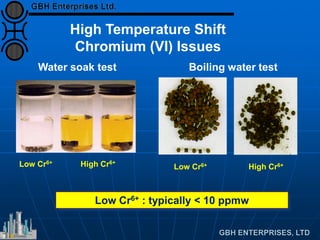
Chromium (VI) Issues
 Cr6+ content must be low
• Cr6+ can form during manufacture
 means less Cr2O3 so affects stability
• Cr6+ is a Category 1 carcinogen
• Cr6+ is water soluble
 can be washed out of catalyst into
condensate system (particularly during
start-ups)
 loss of catalyst strength
• upon reduction, Cr6+ gives an exotherm
 40OC (72OF) per 1%
 danger of over-temperature (catalyst;
vessel)
Low Cr6+ High Cr6+
High Temperature Shift
Chromium (VI) Issues
High Cr6+Low Cr6+
Boiling water testWater soak test
Low Cr6+ : typically < 10 ppmw
High Temperature Shift
Sulfur Removal Issue
 Sulfur source
• residual sulfate from metal salts used in
catalyst manufacture
 Sulfur problem during initial reduction
• liberate H2S during initial catalyst reduction
• poison for LTS catalyst or PSA absorbent
 vent exit gas to prevent poisoning
 if not, consumes up to 1 volume LTS catalyst
per 20 volumes HTS catalyst
• duration depends on catalyst sulfate level
• prolongs commissioning
High Temperature Shift
Sulfur Removal Issue
 Sulfur level
• depends on manufacturing route
 sulfate route (older) ~ 5000 ppmw
 nitrate route (newer) ~ 200 ppmw
 Effect of de-sulfiding on reduction time
• duration depends on catalyst type
 nitrate route: complete in ~4 hours
after process gas
 sulphate route: hold for 5 - 10 hours
extra
Improvements in High
Temperature Shift Catalysts
 The high temperature shift duty
 HTS catalyst characteristics
 Typical HTS operational problems
 Improved catalysts and loading
regimes
 Summary
HTS Operational Problems
Catalyst Start Up
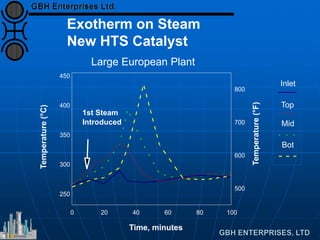
 Exotherm on steam addition
• Temperature “spike” sometimes observed
 new HTS catalyst; all vendors
• often 100 oC (180 oF) and up to 250oC (450oF)
 Root cause analysis
• not understood for many years
• correlated with long hold on N2 flow at >> 200 oC
• catalyst surface becomes “super dry”
• steam re-hydrates surface (heat of hydration)
1st Steam
Introduced
0 20 40 60 80 100
250
300
350
400
450
500
600
700
800
Time, minutes
Temperature(°C)
Temperature(°F)
Inlet
Top
Mid
Bot
Exotherm on Steam
New HTS Catalyst
Large European Plant
HTS Operational Problems
Catalyst Start Up
 Exothermic Rehydration Case Study
• VSG-F101 Series installed
• subsequent performance unaffected
• demonstrates good catalyst thermal
stability
 Rehydration phenomenon
• avoid by controlling drying conditions
during start-up
HTS Operational Problems
Catalyst Start Up
 Exotherm due to H2 ingress
• passing valve allowed H2 entry
 before reduction started
 on hold at 200+ oC
• new VSG-F101 Series installed
• significant exotherm
• subsequent performance unaffected
 on line > 4 years
• demonstrates good catalyst thermal
stability
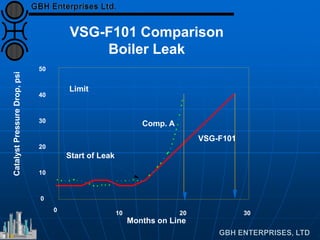
HTS Operational Problems
Upstream Boiler Leaks
 Boiler leaks
• relatively common
• more likely at high plant rates
 Effects
• possible catastrophic catalyst failure due
to thermal shock
• pressure drop increase due to
 boiler solids fouling of the catalyst
 catalyst breakage (droplet
impingement)
HTS Operational Problems
Upstream Boiler Leaks
 Boiler leak case study - background
• large new Syngas plant
• Vulcan Series catalysts throughout
 including VSG-F101
• observed increase in HTS pressure drop
• data consistency check indicated showed
high steam ratio in the shift section
• boiler leak suspected
HTS Operational Problems
Upstream Boiler Leaks
 Boiler leak case study - actions/outcome
• catalyst inspected
• boiler leak confirmed
• catalyst skimmed
• plant restarted at 100% rate with 40%
less HTS catalyst
 space velocity increased to 9000 h-1
• catalyst still achieved maximum
conversion
HTS Operational Problems
Unplanned Catalyst Oxidation
 Exothermic Catalyst Oxidation
• activated (reduced) catalysts
 reacts with air rapidly and exothermically
 catalyst oxidizes with possible thermal
damage
 Case Study from a large syngas plant
• air machine delivery valve failed
• huge HTS catalyst temperatures increase
 middle = 635oC (1175oF) and exit = 540oC
(1100oF)
• temperatures stayed high ~30 minutes
HTS Operational Problems
Unplanned Catalyst Oxidation
 Catalyst Oxidation Case Study - outcomes
• catalyst activity impaired
 flatter reaction profile
 CO slip has increased from < 3% to
>4%
• VSG-F101 remains operable
 capable of an acceptable
performance until a convenient
change is planned
 despite significant over-temperature
Improvements in High Temperature
Shift Catalysts
 The high temperature shift duty
 HTS catalyst characteristics
 Typical HTS operational problems
 Improved catalysts
 VSG-F101 Series
 Summary
VSG-F101 Series
Step change improvement for HTS
 Launched almost three years ago
 Reformulated catalyst
• similar bulk composition to previous grades
• modified iron oxide pore structure
 patented use of acicular iron oxide
 Increased activity by 20%
• reduced diffusion limitation
 Increased in-service strength +100%
VSG-F101 Series
Properties
 Composition
 Fe
 Ni
 Cu
 (+ Al2O3 )
 Form
 VSG-F101 9 mm (dia) x 5 mm pellets
 VSG-F101 5 mm (dia) x 8 mm spheres
 Charged bulk density
 0.8-1.1 kg/l (50-69 lb /ft3)
VSG-F101 Series
Improved HTS Catalyst
 Structural promoter
• Improves strength
 better able to withstand plant upsets such
as boiler leaks
 higher strength through life
• Modifies pore structure
 wider pore distribution
 allows easier diffusion through wide pores
to high surface area active sites in small
pores
 increases activity
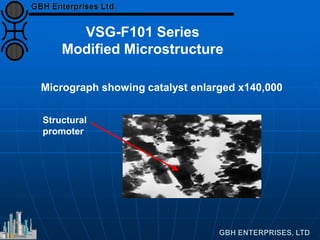
Structural
promoter
Micrograph showing catalyst enlarged x140,000
VSG-F101 Series
Modified Microstructure
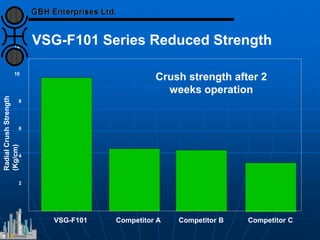
RadialCrushStrength
(Kg/cm)
VSG-F101 Competitor A Competitor B Competitor C
0
2
4
6
8
10
12
VSG-F101 Series Reduced Strength
Crush strength after 2
weeks operation
Months on Line
0
0
10
20
30
40
50
10 20 30
Start of Leak
Comp. A
VSG-F101
Limit
VSG-F101 Comparison
Boiler Leak
Months in Operation
CatalystActivity
2
3
4
5
6
7
8
9
10 20 30 400
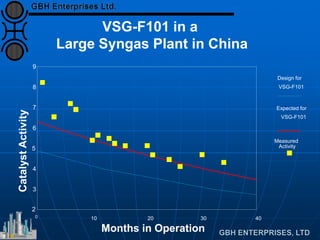
Design for
VSG-F101
Expected for
VSG-F101
Measured
Activity
VSG-F101 in a
Large Syngas Plant in China
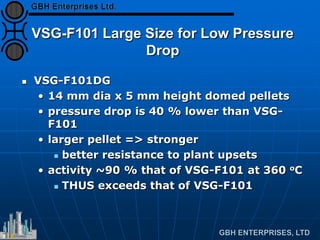
VSG-F101 Large Size for Low Pressure
Drop
 VSG-F101DG
• 14 mm dia x 5 mm height domed pellets
• pressure drop is 40 % lower than VSG-
F101
• larger pellet => stronger
 better resistance to plant upsets
• activity ~90 % that of VSG-F101 at 360 oC
 THUS exceeds that of VSG-F101
Improvements in High Temperature
Shift Catalysts
 The high temperature shift duty
 HTS catalyst characteristics
 Typical HTS operational problems
 Improved catalysts and loading regimes
 Summary
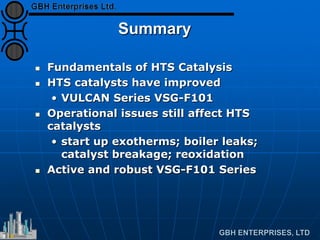
Summary
 Fundamentals of HTS Catalysis
 HTS catalysts have improved
• VULCAN Series VSG-F101
 Operational issues still affect HTS
catalysts
• start up exotherms; boiler leaks;
catalyst breakage; reoxidation
 Active and robust VSG-F101 Series
(HTS) High Temperature Shift Catalyst (VSG-F101) - Comprehensiev Overview

(HTS) High Temperature Shift Catalyst (VSG-F101) - Comprehensiev Overview

  • 1.
    Performance & Operation Improvementsusing VULCAN Series VSG-F101 High Temperature Shift Catalysts By: Gerard B. Hawkins Managing Director, CEO
  • 2.
    Improvements in HighTemperature Shift Catalysts  The high temperature shift duty  introduction and theory  HTS catalyst characteristics  developments over time  Typical HTS operational problems  Improved catalysts  VULCAN Series VSG-F101 Series  Summary
  • 3.
    Improvements in HighTemperature Shift Catalysts  The high temperature shift duty  Introduction and theory  HTS catalyst characteristics  Typical HTS operational problems  Improved catalysts and loading regimes  Summary
  • 4.
    Introduction What is theShift Reaction ?  Water gas shift reaction has two effects: • generates hydrogen from carbon monoxide & steam • converts CO to CO2 CO + H2O <=> CO2 + H2
  • 5.
    From Steam Reformer HTS LTSMethanation LTS (optional) H2 Introduction How to include a Shift Section ? Liquid CO2 Removal PSAHTS From Steam Reformer H2
  • 6.
    Theory - Equilibrium CO+ H2O CO2 + H2 (+ heat) • Reaction is reversible • Forward reaction - moderately exothermic – equilibrium at lower temperature favors • more CO converted • more H2 produced • Cannot beat equilibrium !
  • 7.
    Theory - ReactionRate  Reaction Rate depends on • distance from equilibrium  further from equilibrium => larger driving force • catalyst formulation/activity • operating temperature  Catalyst enables reaction to proceed  Higher temperature drives rate Ideal catalyst promotes rate to achieve equilibrium at low temperature
  • 8.
    Improvements in HighTemperature Shift Catalysts  The high temperature shift duty  HTS catalyst characteristics  developments over time  Typical HTS operational problems  Improved catalysts and loading regimes  Summary
  • 9.
    High Temperature Shift OperatingConditions  Inlet CO 8 - 15 % / outlet CO 2 - 4 % (dry)  Bulk of CO conversion > 75 %  Typical inlet temp of 335 - 360OC (640 - 680OF) • recent improvements down to 300oC (575oF)  Temperature rise 55 - 65OC (100 - 120OF)  Typical lives 3 - 5 years
  • 10.
    High Temperature Shift CatalystIssues  Over-reduction at low steam/dry gas ratio  Cr6+ content  Sulfur content  Activity  Strength
  • 11.
    High Temperature Shift ModernCatalyst Features  Iron/chromium/copper oxides catalyst • typical composition 87 % / 10 % / 3% (wt)  Active phase is magnetite, Fe3O4 • supplied as haematite, Fe2O3 • requires reduction  Activity supplemented by Cu • helps avoid over reduction of Fe3O4  Low Cr6+ and SO4 2- • typically < 50 (Cr) & < 300 ppmw (S) or better
  • 12.
    High Temperature Shift CatalystFeatures  To overcome the catalyst issues • Over-reduction  copper promotion • Cr6+ content and sulfur content  production route • High stable activity & high strength  dispersion of iron oxide, Cr2O3 and Cu crystallites  low hexavalent chromium  copper promotion  micro-structure, particularly iron oxide  catalyst pellet size options VULCAN Series VSG-F101 incorporates all the required features
  • 13.
    High Temperature Shift CatalystStructure - General Small crystals of magnetite high surface area => high activity Good dispersion of Cr2O3 (Cr3+) gives strength to resist breakage in process upsets (eg wetting) gives high thermal stability prevents sintering of Cu and Fe3O4 slows activity loss & increases life Good dispersion of Cu small crystallites => high Cu surface area => high activity slows Cu sintering
  • 14.
    50-700 A pore o ChromeOxide Crystal Iron Oxide Crystals High Temperature Shift Catalyst Structure Cu Crystals
  • 15.
    Amorphous Structure (achieved inVSG-F101) Microstructure of HTS Catalysts Crystalline Structure (Competitor)
  • 16.
    HTS Catalyst -Addition of Copper 1. Activity  Activity increase due to Cu addition • much higher intrinsic activity than Fe3O4 • increases shift activity  Benefits are • at same SOR inlet temperature, maintain equilibrium for longer - extend life • achieve equilibrium at lower SOR inlet temperature - lower CO slip, higher H2 make, slower sintering (deactivation) • for same SOR inlet temperature and life - decrease catalyst volume
  • 17.
    HTS Catalyst -Addition of Copper 1. Activity  Cu issues - overcome by catalyst design • Cu sinters rapidly at HTS operating temperatures • high Cu levels weaken catalyst structure  => stabilize by the Fe3O4/Cr2O3 micro- structure • Pore diffusion controls overall reaction rate  cannot achieve full benefit of Cu intrinsic activity  => optimize pore structure to maximize benefit
  • 18.
    HTS Catalyst -Addition of Copper 2. Over-reduction  Fe3O4 => FeO => Fe • causes increased Fischer-Tropsch activity • C laydown (2CO <=> C + CO2)  For over-reduction to occur • need R ~ 1.5 or higher • corresponds to S/C approx 2.8 in reformer Reducing (CO)+ (H2) Oxidising (CO2) + (H2O) = Pc = R
  • 19.
    HTS Catalyst -Addition of Copper 2. Over-reduction  CO2/CO phase equilibrium  Cu increases activity • rapidly increases p[CO2]/decreases p[CO] 300 350 400 450 500 550 0.5 0.7 0.9 1.1 1.3 1.5 1.7 1.9 Temperature (oC) P[CO2]/P[CO] Fe Fe3O4
  • 20.
    HTS Catalyst -Addition of Copper 2. Over-reduction  H2O/H2 phase equilibrium • rarely close to boundary • Cu tends towards lower temperature operation 300 350 400 450 500 550 0.1 0.2 0.3 0.5 0.7 1 Temperature (oC) P[H2O]/P[H2] Fe Fe3O4 FeO
  • 21.
    High Temperature Shift Chromium(VI) Issues  Cr6+ content must be low • Cr6+ can form during manufacture  means less Cr2O3 so affects stability • Cr6+ is a Category 1 carcinogen • Cr6+ is water soluble  can be washed out of catalyst into condensate system (particularly during start-ups)  loss of catalyst strength • upon reduction, Cr6+ gives an exotherm  40OC (72OF) per 1%  danger of over-temperature (catalyst; vessel)
  • 22.
    Low Cr6+ HighCr6+ High Temperature Shift Chromium (VI) Issues High Cr6+Low Cr6+ Boiling water testWater soak test Low Cr6+ : typically < 10 ppmw
  • 23.
    High Temperature Shift SulfurRemoval Issue  Sulfur source • residual sulfate from metal salts used in catalyst manufacture  Sulfur problem during initial reduction • liberate H2S during initial catalyst reduction • poison for LTS catalyst or PSA absorbent  vent exit gas to prevent poisoning  if not, consumes up to 1 volume LTS catalyst per 20 volumes HTS catalyst • duration depends on catalyst sulfate level • prolongs commissioning
  • 24.
    High Temperature Shift SulfurRemoval Issue  Sulfur level • depends on manufacturing route  sulfate route (older) ~ 5000 ppmw  nitrate route (newer) ~ 200 ppmw  Effect of de-sulfiding on reduction time • duration depends on catalyst type  nitrate route: complete in ~4 hours after process gas  sulphate route: hold for 5 - 10 hours extra
  • 25.
    Improvements in High TemperatureShift Catalysts  The high temperature shift duty  HTS catalyst characteristics  Typical HTS operational problems  Improved catalysts and loading regimes  Summary
  • 26.
    HTS Operational Problems CatalystStart Up  Exotherm on steam addition • Temperature “spike” sometimes observed  new HTS catalyst; all vendors • often 100 oC (180 oF) and up to 250oC (450oF)  Root cause analysis • not understood for many years • correlated with long hold on N2 flow at >> 200 oC • catalyst surface becomes “super dry” • steam re-hydrates surface (heat of hydration)
  • 27.
    1st Steam Introduced 0 2040 60 80 100 250 300 350 400 450 500 600 700 800 Time, minutes Temperature(°C) Temperature(°F) Inlet Top Mid Bot Exotherm on Steam New HTS Catalyst Large European Plant
  • 28.
    HTS Operational Problems CatalystStart Up  Exothermic Rehydration Case Study • VSG-F101 Series installed • subsequent performance unaffected • demonstrates good catalyst thermal stability  Rehydration phenomenon • avoid by controlling drying conditions during start-up
  • 29.
    HTS Operational Problems CatalystStart Up  Exotherm due to H2 ingress • passing valve allowed H2 entry  before reduction started  on hold at 200+ oC • new VSG-F101 Series installed • significant exotherm • subsequent performance unaffected  on line > 4 years • demonstrates good catalyst thermal stability
  • 30.
    HTS Operational Problems UpstreamBoiler Leaks  Boiler leaks • relatively common • more likely at high plant rates  Effects • possible catastrophic catalyst failure due to thermal shock • pressure drop increase due to  boiler solids fouling of the catalyst  catalyst breakage (droplet impingement)
  • 31.
    HTS Operational Problems UpstreamBoiler Leaks  Boiler leak case study - background • large new Syngas plant • Vulcan Series catalysts throughout  including VSG-F101 • observed increase in HTS pressure drop • data consistency check indicated showed high steam ratio in the shift section • boiler leak suspected
  • 32.
    HTS Operational Problems UpstreamBoiler Leaks  Boiler leak case study - actions/outcome • catalyst inspected • boiler leak confirmed • catalyst skimmed • plant restarted at 100% rate with 40% less HTS catalyst  space velocity increased to 9000 h-1 • catalyst still achieved maximum conversion
  • 33.
    HTS Operational Problems UnplannedCatalyst Oxidation  Exothermic Catalyst Oxidation • activated (reduced) catalysts  reacts with air rapidly and exothermically  catalyst oxidizes with possible thermal damage  Case Study from a large syngas plant • air machine delivery valve failed • huge HTS catalyst temperatures increase  middle = 635oC (1175oF) and exit = 540oC (1100oF) • temperatures stayed high ~30 minutes
  • 34.
    HTS Operational Problems UnplannedCatalyst Oxidation  Catalyst Oxidation Case Study - outcomes • catalyst activity impaired  flatter reaction profile  CO slip has increased from < 3% to >4% • VSG-F101 remains operable  capable of an acceptable performance until a convenient change is planned  despite significant over-temperature
  • 35.
    Improvements in HighTemperature Shift Catalysts  The high temperature shift duty  HTS catalyst characteristics  Typical HTS operational problems  Improved catalysts  VSG-F101 Series  Summary
  • 36.
    VSG-F101 Series Step changeimprovement for HTS  Launched almost three years ago  Reformulated catalyst • similar bulk composition to previous grades • modified iron oxide pore structure  patented use of acicular iron oxide  Increased activity by 20% • reduced diffusion limitation  Increased in-service strength +100%
  • 37.
    VSG-F101 Series Properties  Composition Fe  Ni  Cu  (+ Al2O3 )  Form  VSG-F101 9 mm (dia) x 5 mm pellets  VSG-F101 5 mm (dia) x 8 mm spheres  Charged bulk density  0.8-1.1 kg/l (50-69 lb /ft3)
  • 38.
    VSG-F101 Series Improved HTSCatalyst  Structural promoter • Improves strength  better able to withstand plant upsets such as boiler leaks  higher strength through life • Modifies pore structure  wider pore distribution  allows easier diffusion through wide pores to high surface area active sites in small pores  increases activity
  • 39.
    Structural promoter Micrograph showing catalystenlarged x140,000 VSG-F101 Series Modified Microstructure
  • 40.
    RadialCrushStrength (Kg/cm) VSG-F101 Competitor ACompetitor B Competitor C 0 2 4 6 8 10 12 VSG-F101 Series Reduced Strength Crush strength after 2 weeks operation
  • 41.
    Months on Line 0 0 10 20 30 40 50 1020 30 Start of Leak Comp. A VSG-F101 Limit VSG-F101 Comparison Boiler Leak
  • 42.
    Months in Operation CatalystActivity 2 3 4 5 6 7 8 9 1020 30 400 Design for VSG-F101 Expected for VSG-F101 Measured Activity VSG-F101 in a Large Syngas Plant in China
  • 43.
    VSG-F101 Large Sizefor Low Pressure Drop  VSG-F101DG • 14 mm dia x 5 mm height domed pellets • pressure drop is 40 % lower than VSG- F101 • larger pellet => stronger  better resistance to plant upsets • activity ~90 % that of VSG-F101 at 360 oC  THUS exceeds that of VSG-F101
  • 44.
    Improvements in HighTemperature Shift Catalysts  The high temperature shift duty  HTS catalyst characteristics  Typical HTS operational problems  Improved catalysts and loading regimes  Summary
  • 45.
    Summary  Fundamentals ofHTS Catalysis  HTS catalysts have improved • VULCAN Series VSG-F101  Operational issues still affect HTS catalysts • start up exotherms; boiler leaks; catalyst breakage; reoxidation  Active and robust VSG-F101 Series