SRU Problems &Troubleshooting
By:Ahmed S. Omran
M.Sc.Chem. , AMIChemE, MAIChE, ACS Member
5/25/2015 1
Introduction
 Sulfur Chemistry, Physical properties and Safety.
 Importance of SRU troubleshooting.
What can goes wrong?
Conversion loss Vs Pressure Drop.
Problems & Troubleshooting(Case Studies)
5/25/2015 2
Sulfur Recovery Chemistry
• The Claus reaction to convert H2S into elemental sulfur requires the
presence of one mole of SO2 for each two moles of H2S:
(1) 2H2S + SO2 → 3Sx + 2H2O
•
To provide that ratio of components, the first step in the Claus process is
the combustion of one-third of the H2S in the feed gas:
(2) H2S + 1.5 O2 → SO2 + H2O
•
Combining equations (1) and (2), the overall process reaction is:
(3) 3H2S +1.5 O2 → 3Sx + 3H2O
5/25/2015 3
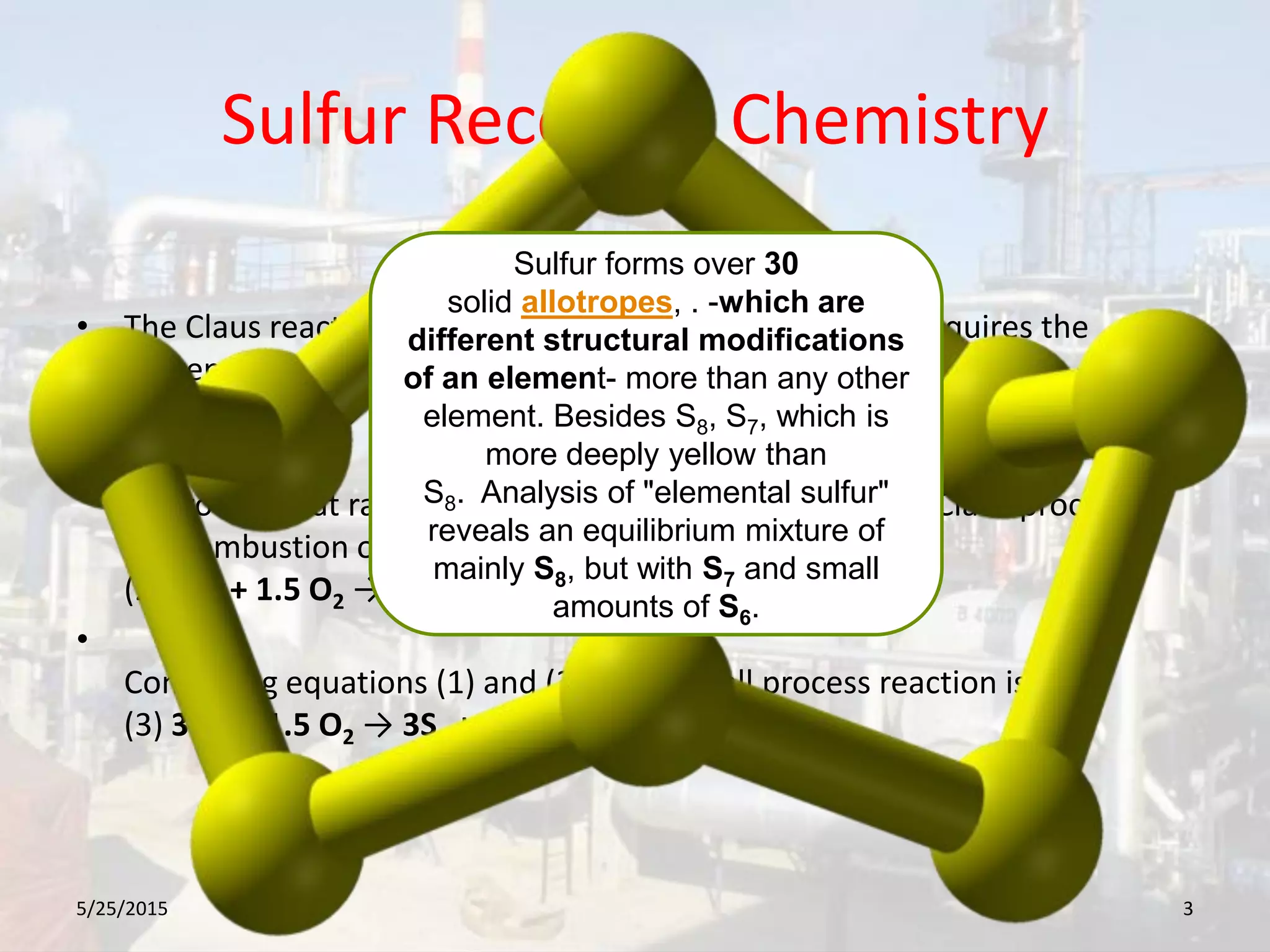
Sulfur forms over 30
solid allotropes, . -which are
different structural modifications
of an element- more than any other
element. Besides S8, S7, which is
more deeply yellow than
S8. Analysis of "elemental sulfur"
reveals an equilibrium mixture of
mainly S8, but with S7 and small
amounts of S6.
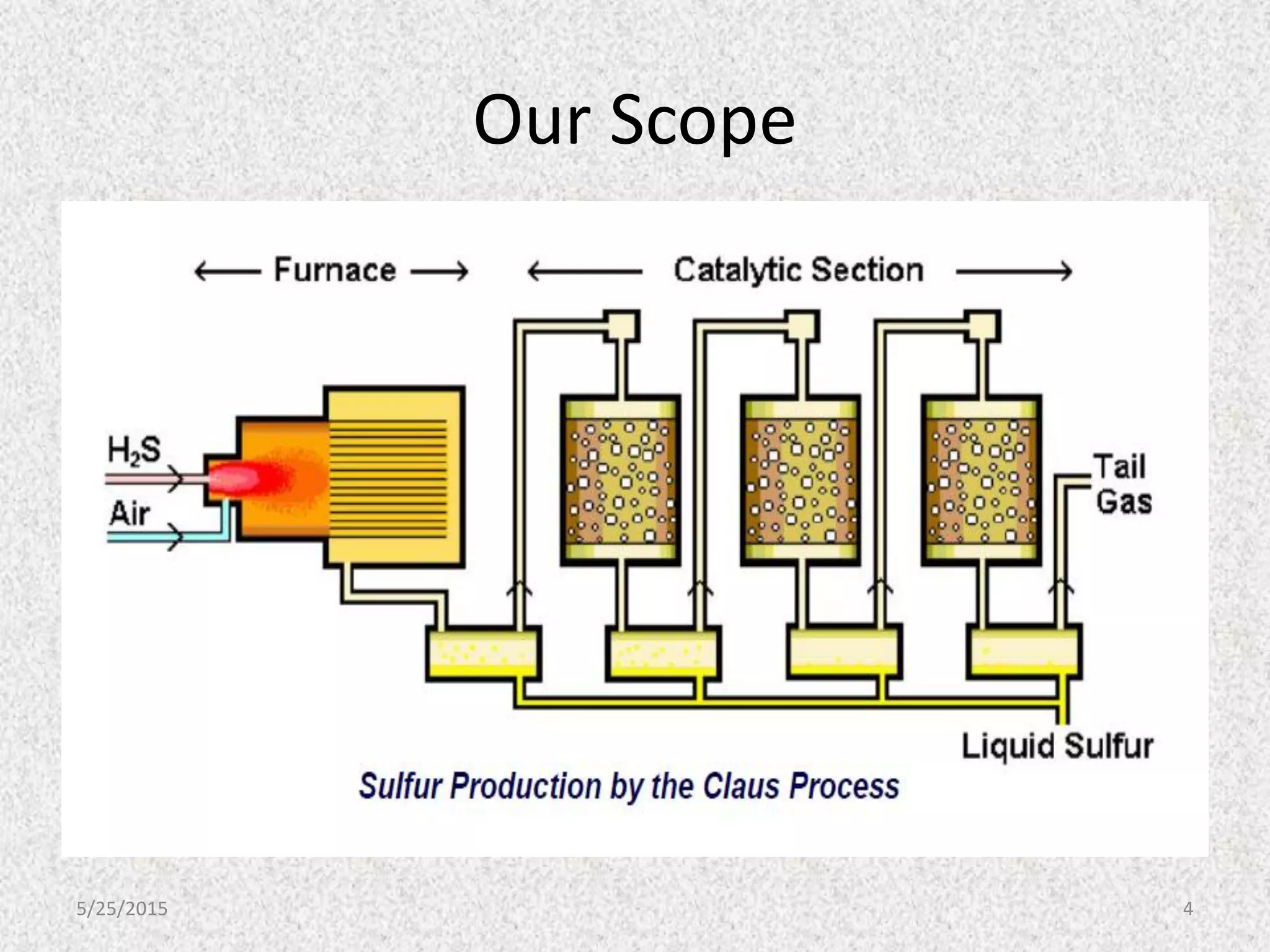
Our Scope
5/25/2015 4
5/25/2015 5
5/25/2015 6
Why
Troubleshooting
SRU?
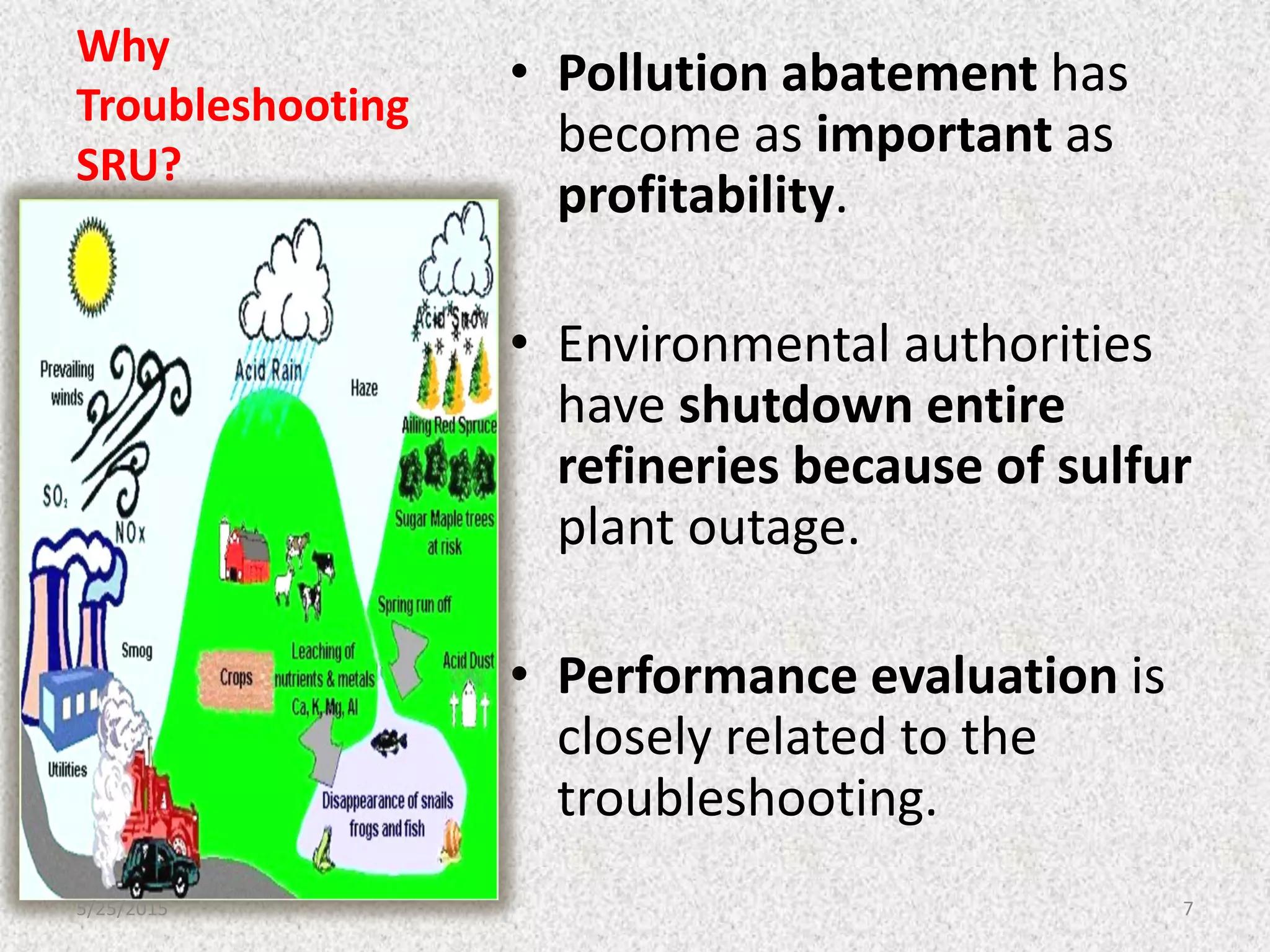
• Pollution abatement has
become as important as
profitability.
• Environmental authorities
have shutdown entire
refineries because of sulfur
plant outage.
• Performance evaluation is
closely related to the
troubleshooting.
5/25/2015 7
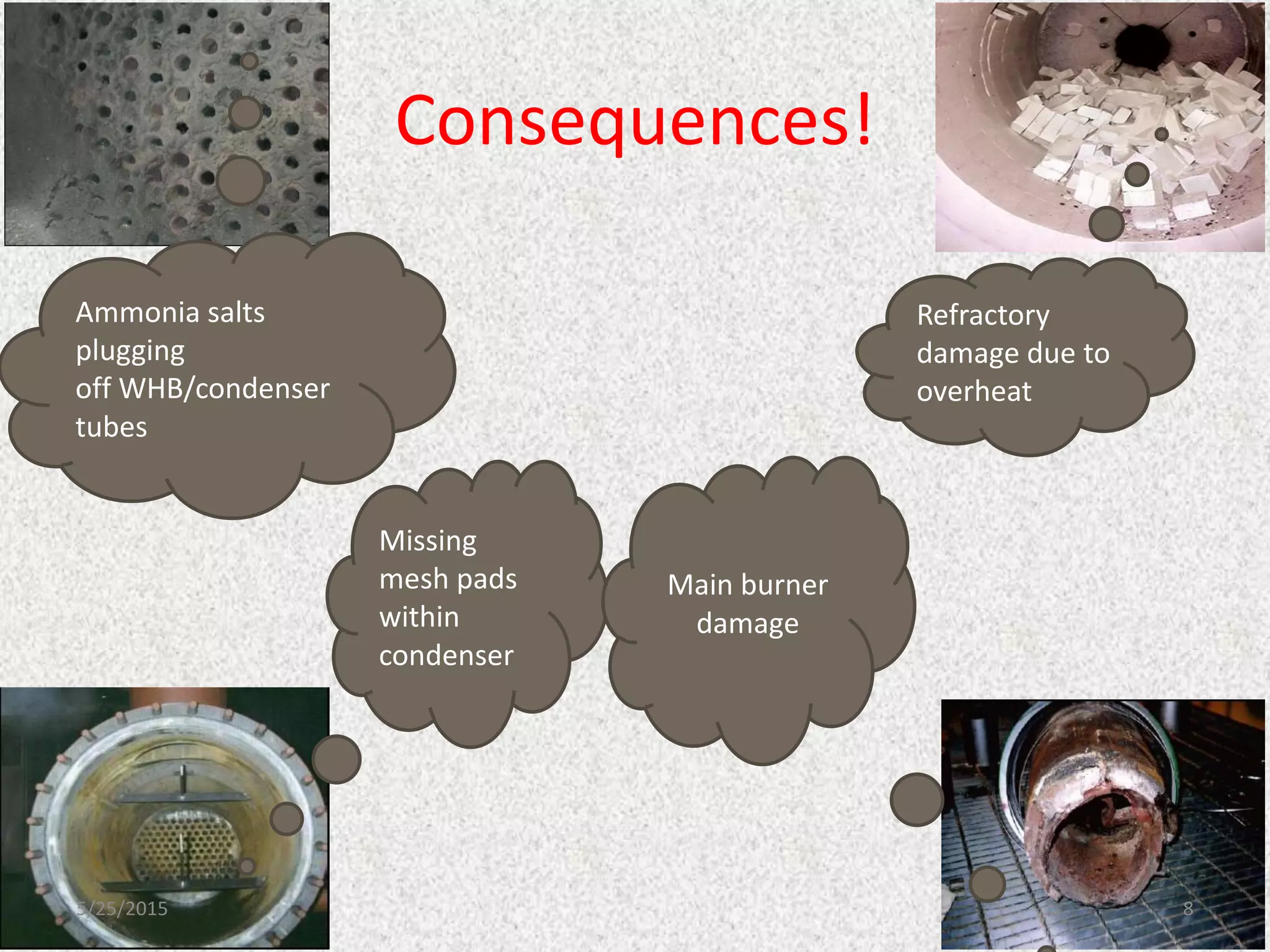
Consequences!
Ammonia salts
plugging
off WHB/condenser
tubes
Missing
mesh pads
within
condenser
Main burner
damage
5/25/2015 8
Refractory
damage due to
overheat
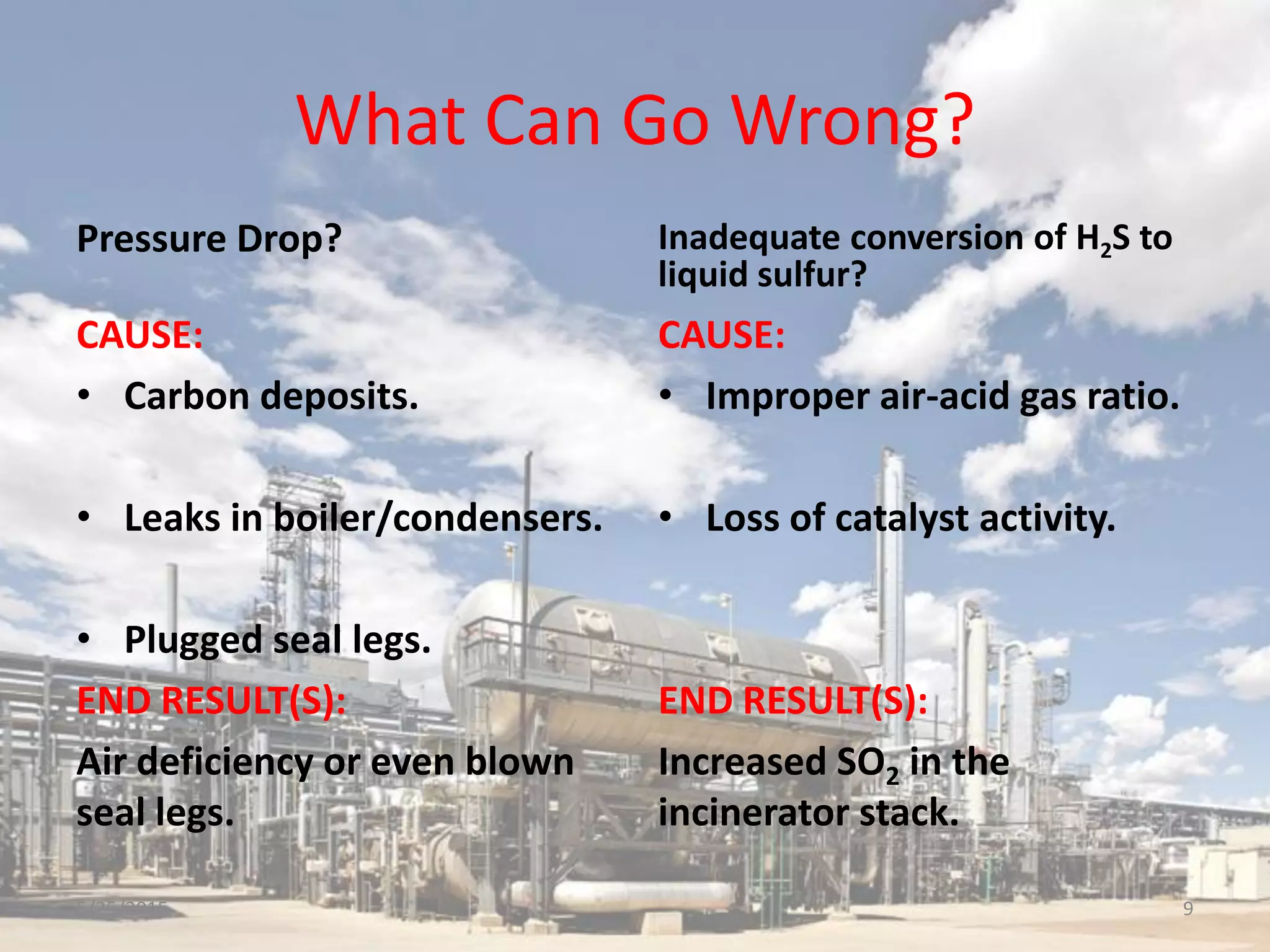
What Can Go Wrong?
Pressure Drop?
CAUSE:
• Carbon deposits.
• Leaks in boiler/condensers.
• Plugged seal legs.
END RESULT(S):
Air deficiency or even blown
seal legs.
Inadequate conversion of H2S to
liquid sulfur?
CAUSE:
• Improper air-acid gas ratio.
• Loss of catalyst activity.
END RESULT(S):
Increased SO2 in the
incinerator stack.
5/25/2015 9
Inadequate conversion of H2S to
liquid sulfur?
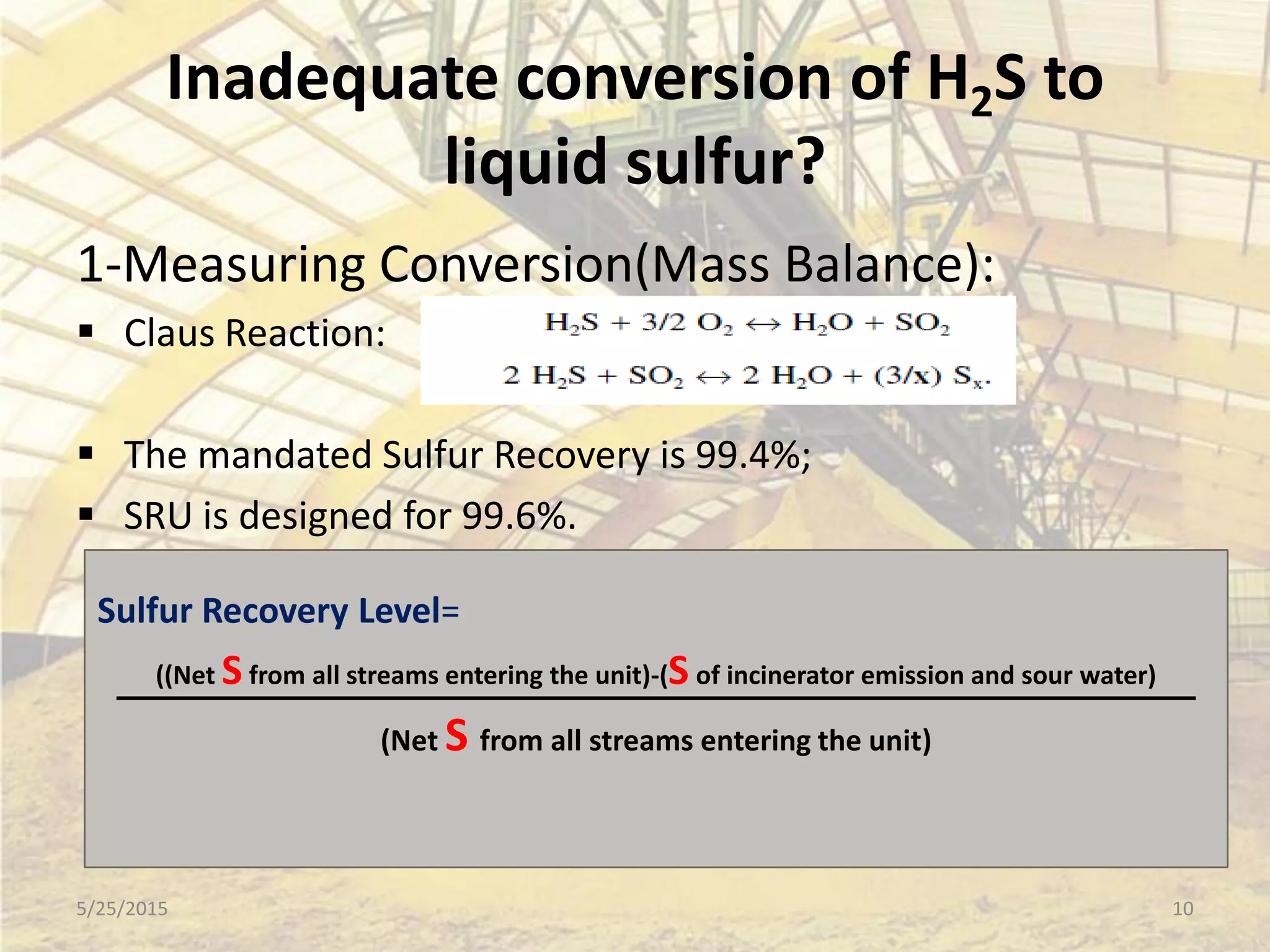
1-Measuring Conversion(Mass Balance):
 Claus Reaction:
 The mandated Sulfur Recovery is 99.4%;
 SRU is designed for 99.6%.
Sulfur Recovery Level=
((Net Sfrom all streams entering the unit)-(S of incinerator emission and sour water)
(Net S from all streams entering the unit)
5/25/2015 10
2-Measuring Conversion(colorimetric
tube):
Check H2S and SO2 in the final condenser
effluent.
How?
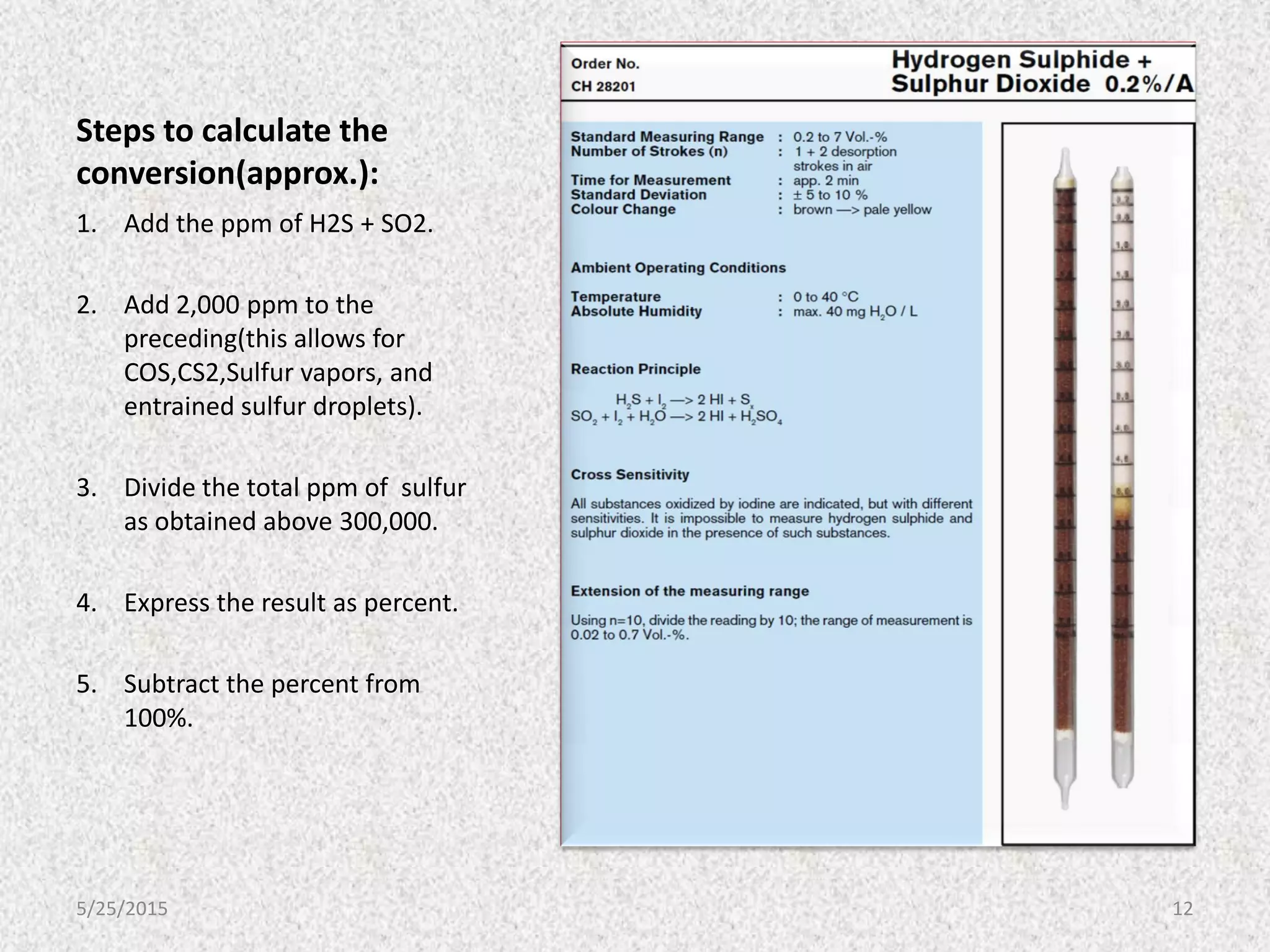
Dräger tubes are a simple and reasonably
accurate.
5/25/2015 11
Steps to calculate the
conversion(approx.):
1. Add the ppm of H2S + SO2.
2. Add 2,000 ppm to the
preceding(this allows for
COS,CS2,Sulfur vapors, and
entrained sulfur droplets).
3. Divide the total ppm of sulfur
as obtained above 300,000.
4. Express the result as percent.
5. Subtract the percent from
100%.
5/25/2015 12
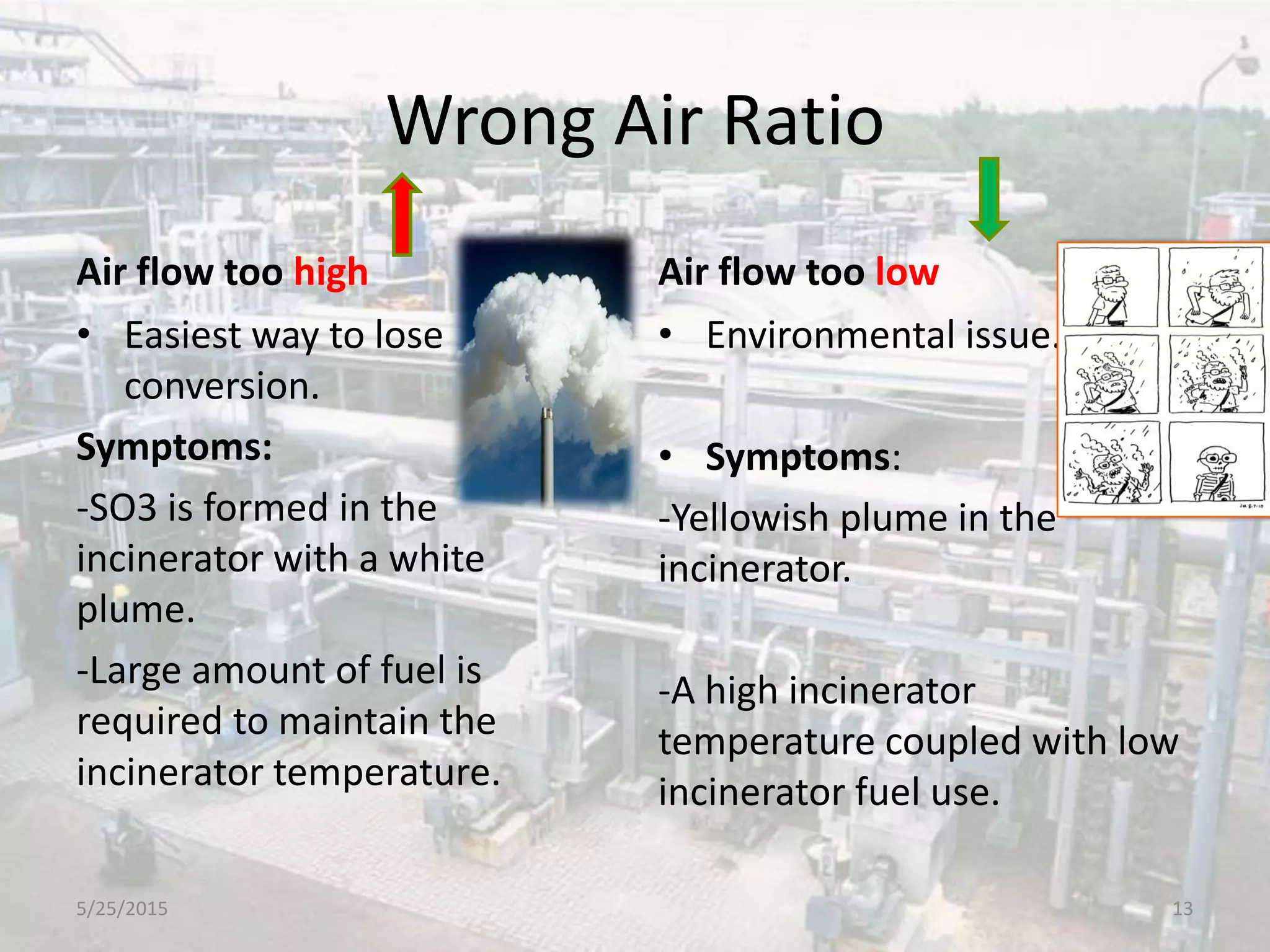
Wrong Air Ratio
Air flow too high
• Easiest way to lose
conversion.
Symptoms:
-SO3 is formed in the
incinerator with a white
plume.
-Large amount of fuel is
required to maintain the
incinerator temperature.
Air flow too low
• Environmental issue.
• Symptoms:
-Yellowish plume in the
incinerator.
-A high incinerator
temperature coupled with low
incinerator fuel use.
5/25/2015 13
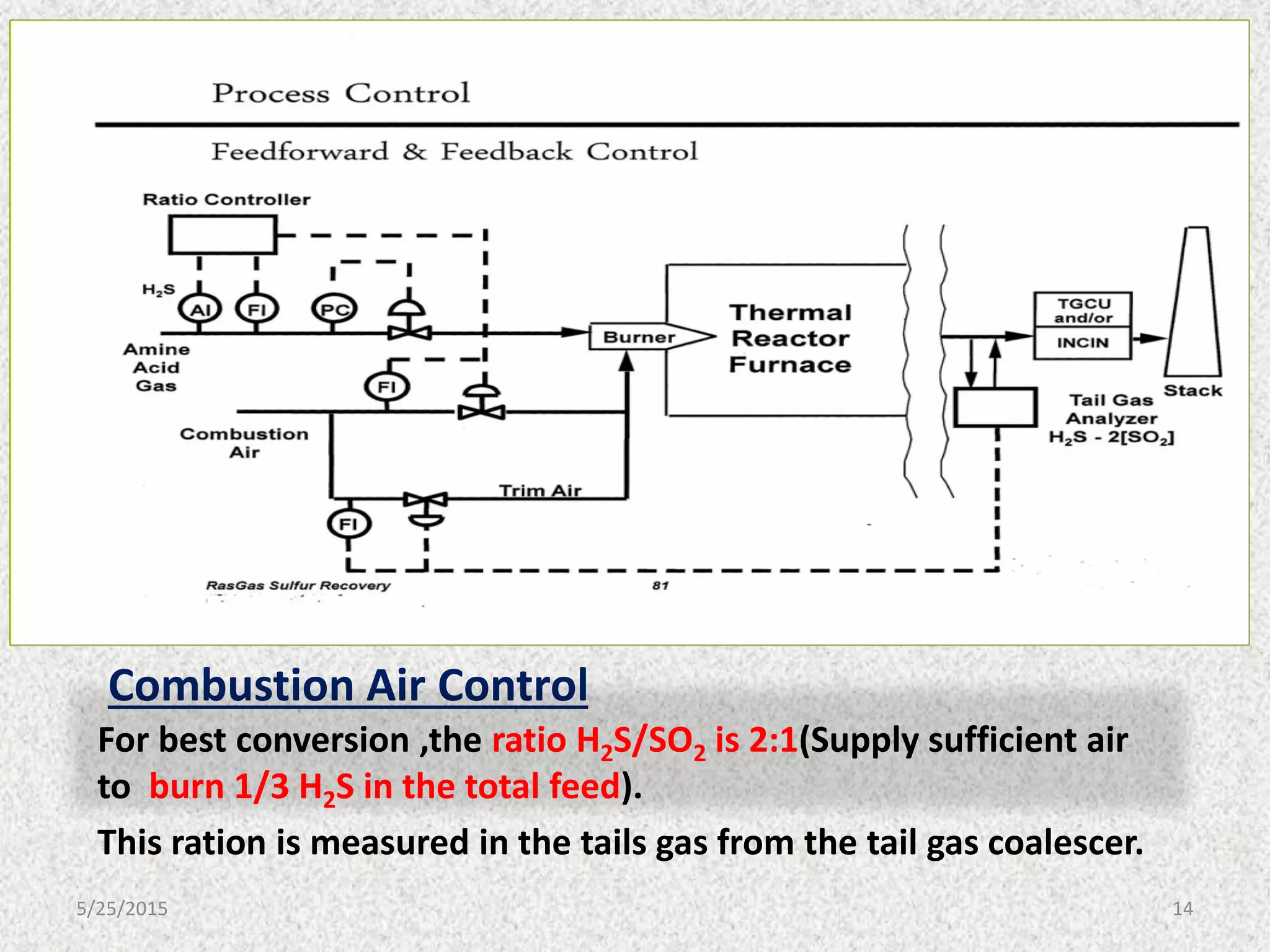
Combustion Air Control
For best conversion ,the ratio H2S/SO2 is 2:1(Supply sufficient air
to burn 1/3 H2S in the total feed).
This ration is measured in the tails gas from the tail gas coalescer.
5/25/2015 14
Reactor Problems
• Catalyst deactivation:
• Symptoms:
1. It is very to do much harm to the catalyst
without causing excessive pressure drop.
2.If you suspect reduced recovery due to lost
catalyst activity check the temperature rise
across the reactor(Outlet-inlet).
5/25/2015 15
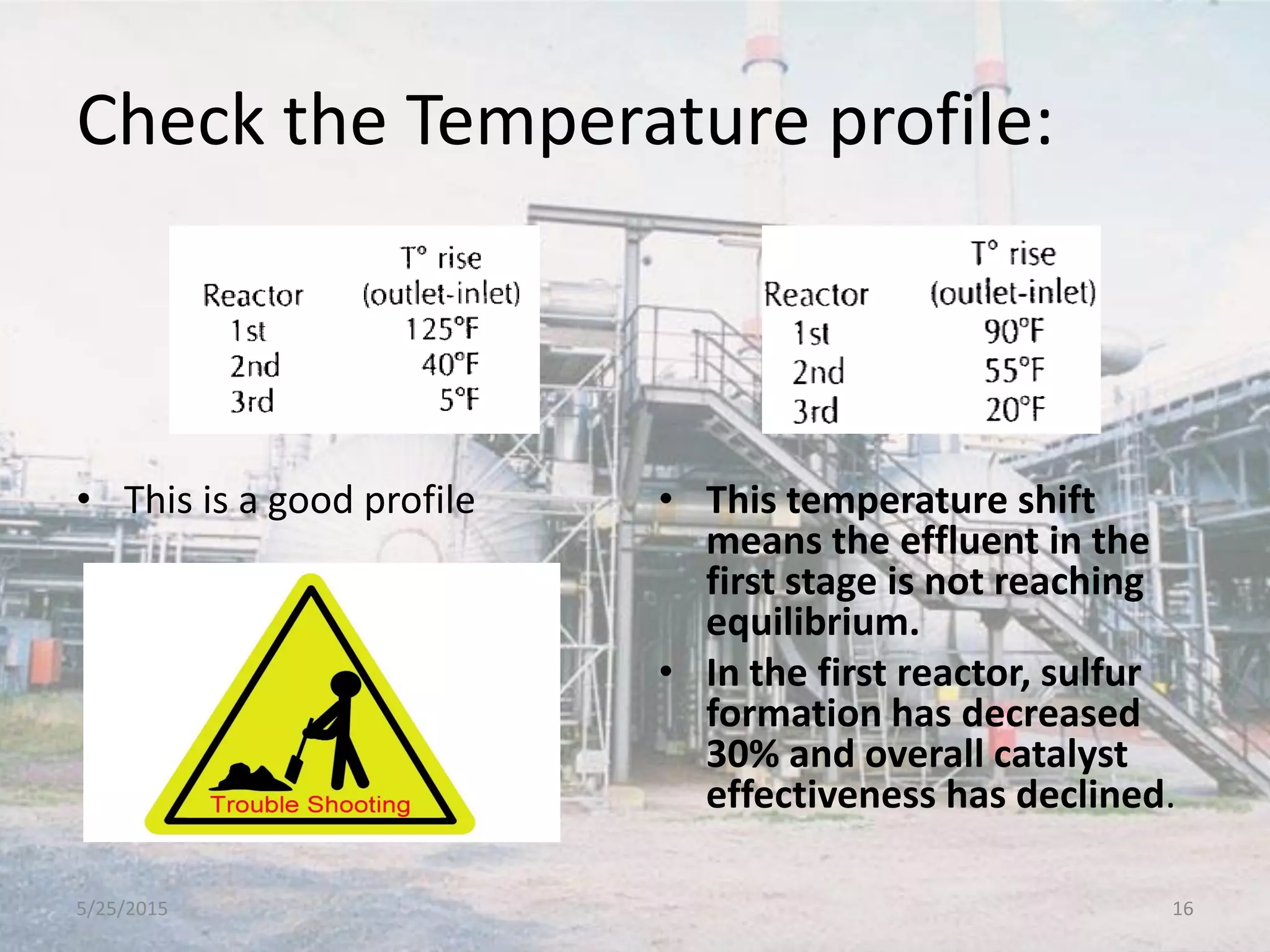
Check the Temperature profile:
• This is a good profile • This temperature shift
means the effluent in the
first stage is not reaching
equilibrium.
• In the first reactor, sulfur
formation has decreased
30% and overall catalyst
effectiveness has declined.
5/25/2015 16
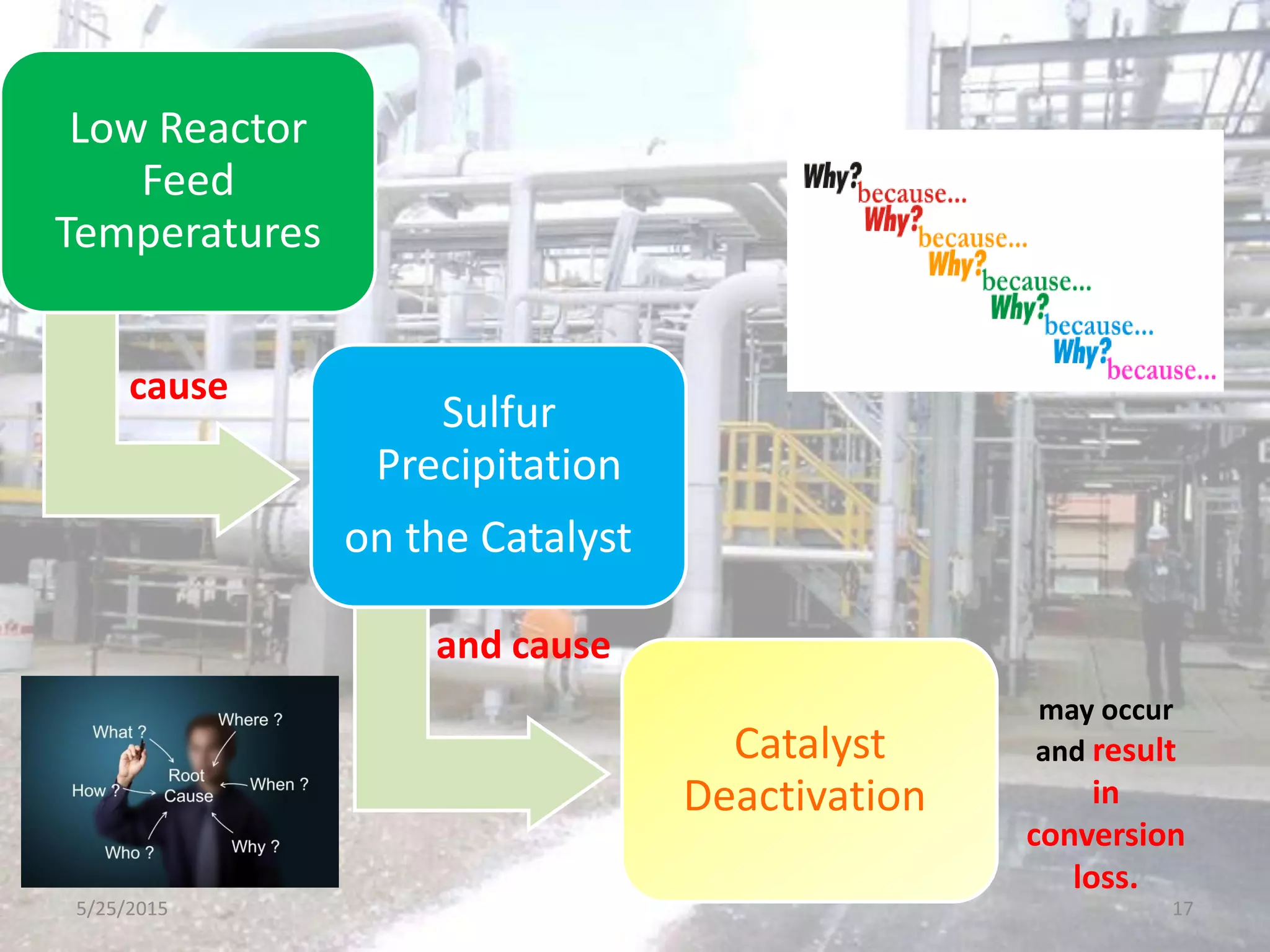
Low Reactor
Feed
Temperatures
Sulfur
Precipitation
on the Catalyst
Catalyst
Deactivation
5/25/2015 17
cause
and cause
may occur
and result
in
conversion
loss.
Troubleshooting
• Troubleshooting: Check the operation of the
reheat exchanger upstream of the reactor
with the reduced temperature rise.
• Solution: Raise the reactor inlet temperature
about 30⁰F (17 ⁰C);this will dissipate the
offending sulfur deposits after few days.
Question: If catalyst
activity has been
irreversibly lost, when
catalyst change may
be considered?
5/25/2015 18
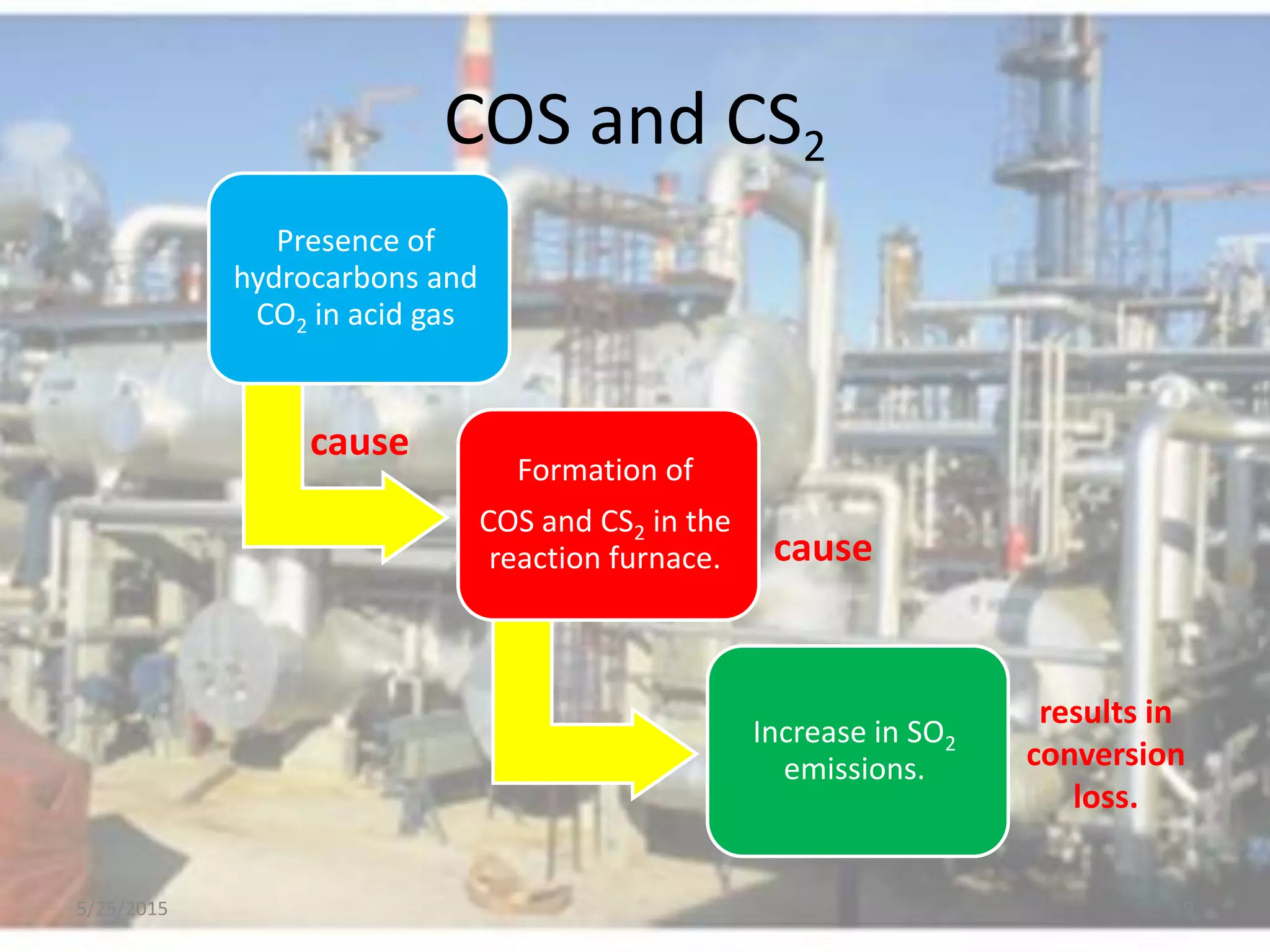
COS and CS2
Presence of
hydrocarbons and
CO2 in acid gas
Formation of
COS and CS2 in the
reaction furnace.
Increase in SO2
emissions.
5/25/2015 19
cause
cause
results in
conversion
loss.
Troubleshooting
• Symptoms:
An increase in the SO2 emission
accompanied by lower than
normal 1st reactor inlet
temperature.
• Problem : COS and CS2 in the
reaction furnace.
• Solution : Destroy both by
operating the 1st reactor at outlet
temperature of 650F (343 C),so
these compounds are hydrolized
to H2S and CO2.
5/25/2015 20
Sulfur Fog/Demister Damage
Cause & Problem:
As the unit charge drop the unit converts a lower percentage of H2S to
sulfur.
Sulfur should condense on the walls of the tubes. However ,at low
tube-side gas velocities, the sulfur precipitates in the gas stream
itself; A sulfur fog formed.
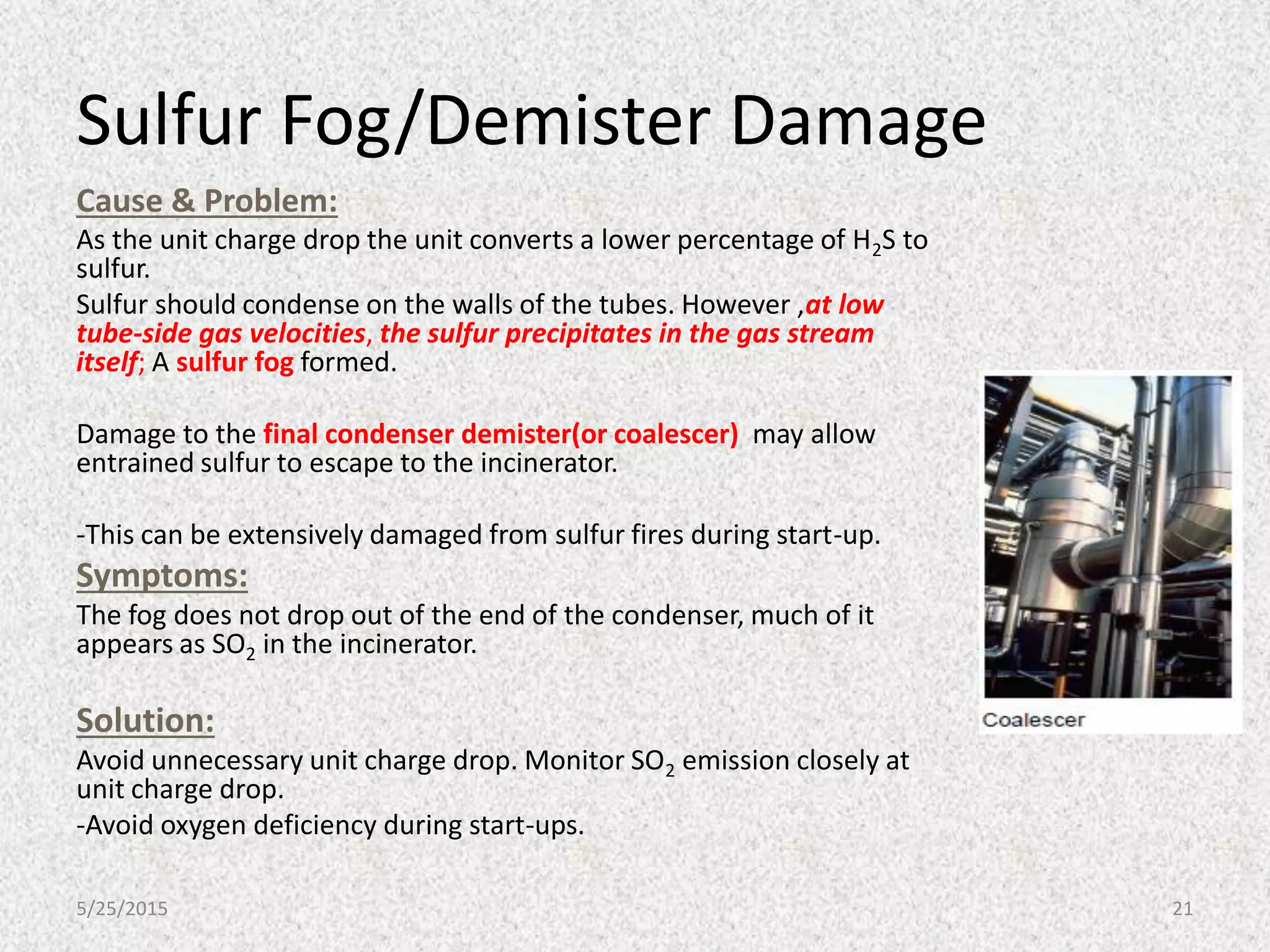
Damage to the final condenser demister(or coalescer) may allow
entrained sulfur to escape to the incinerator.
-This can be extensively damaged from sulfur fires during start-up.
Symptoms:
The fog does not drop out of the end of the condenser, much of it
appears as SO2 in the incinerator.
Solution:
Avoid unnecessary unit charge drop. Monitor SO2 emission closely at
unit charge drop.
-Avoid oxygen deficiency during start-ups.
5/25/2015 21
When to change a catalyst?
A 4 years desired catalyst life in Barzan SRU.
Damage to catalyst and reduced conversion can
be due to many factors besides lost activity:
carbon deposits, leaking condenser tubes,
damaged support screens, sulfuric acid
formation, or operation at the sulfur dew point.
All these problems are invariably associated with
increasing pressure drop.
5/25/2015 22
In case of normal
pressure drop
through the
catalyst bed, Do
we need to change
catalyst during the
unit turnaround?
.
5/25/2015 23
With the adequate
instrumentation
available, a firm
decision can
obtained via a
vertical
temperature
profile through the
1st catalyst bed
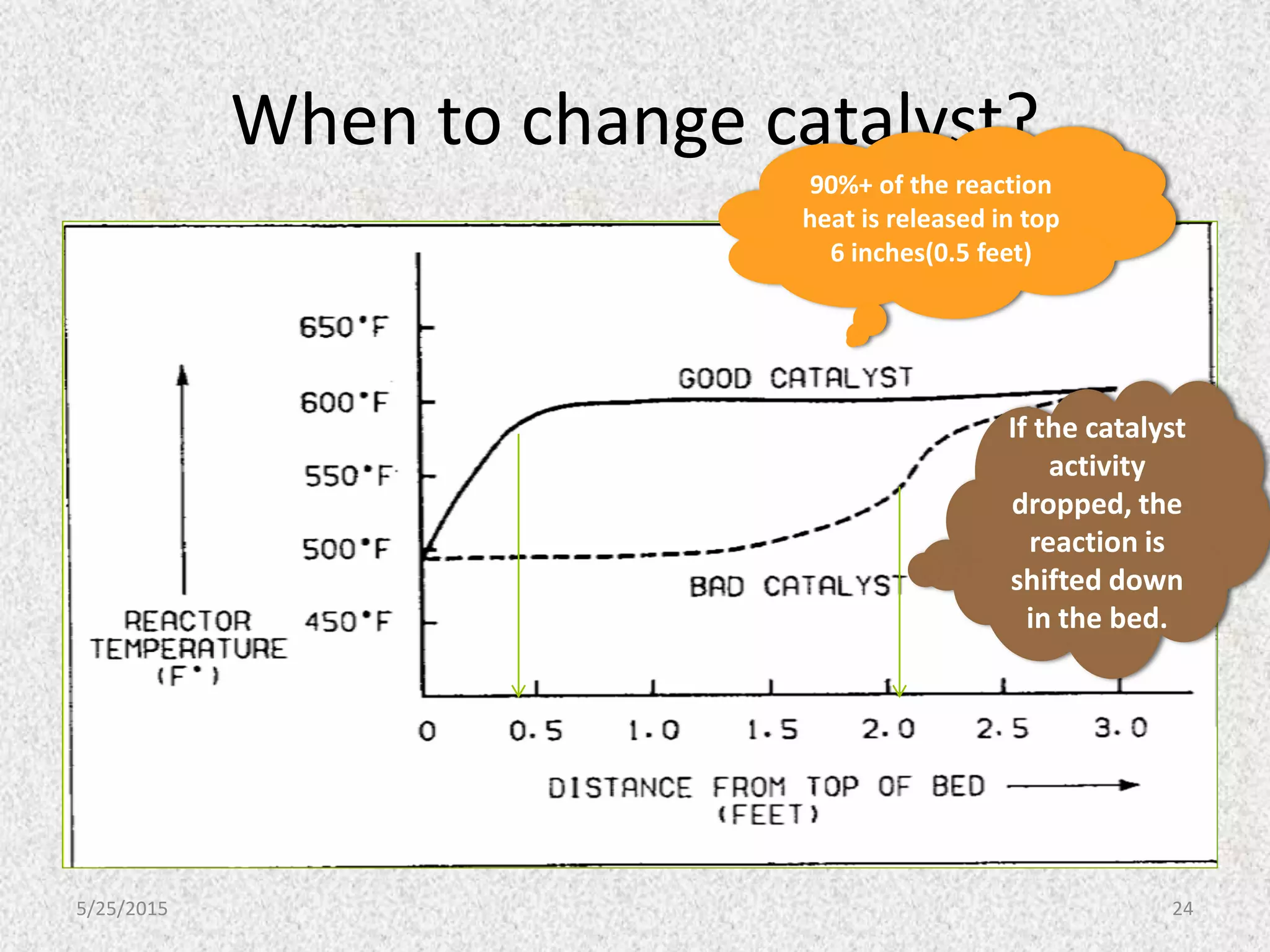
When to change catalyst?
90%+ of the reaction
heat is released in top
6 inches(0.5 feet)
If the catalyst
activity
dropped, the
reaction is
shifted down
in the bed.
5/25/2015 24
Pressure Drop
It is of utmost importance to watch for high-
sulfur plant pressure drop.
Sulfur plants don’t suddenly plug without a
prior pressure drop increase.
However a foresight troubleshooting need
continuous data collection and analysis.
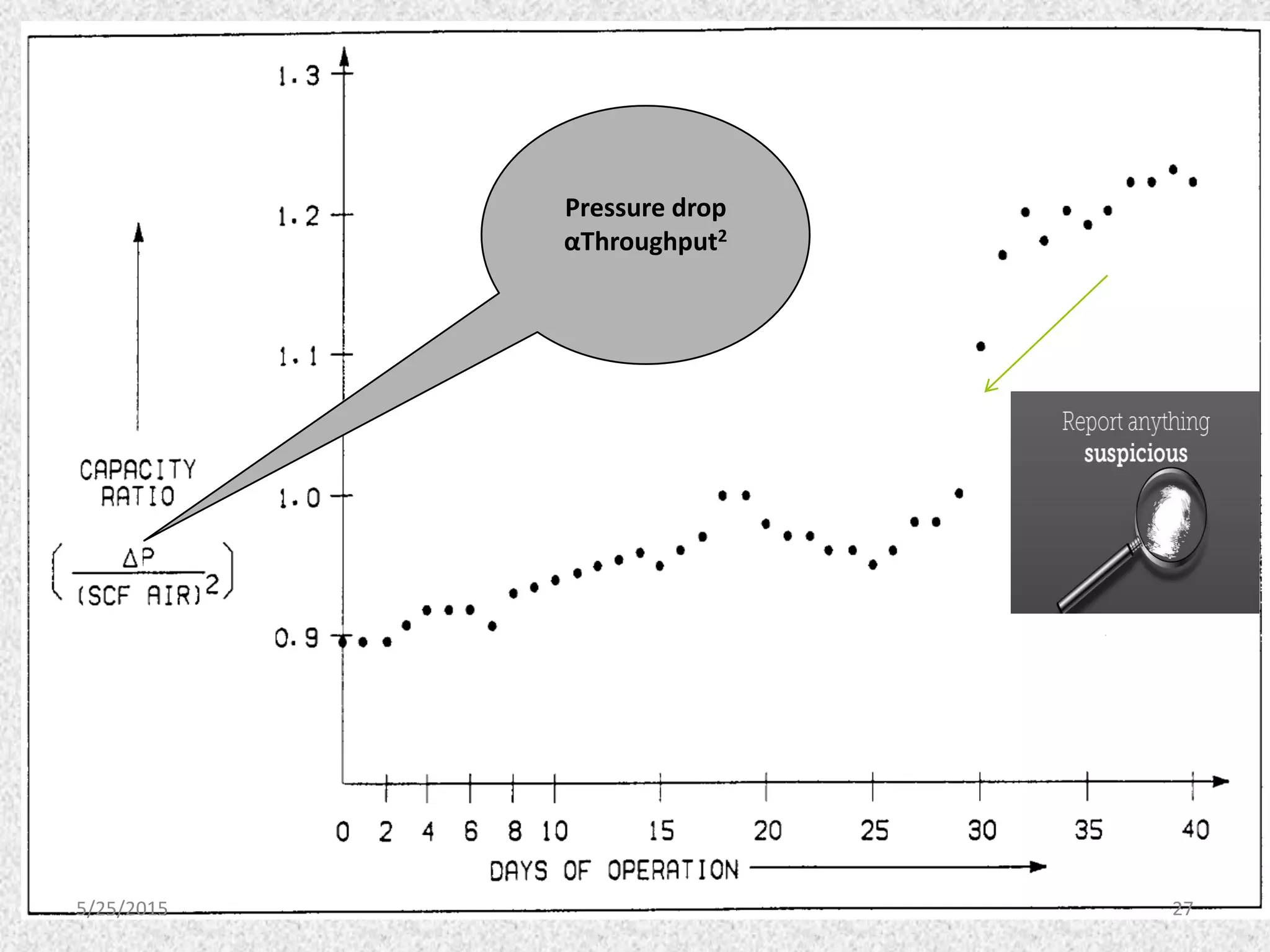
Using the capacity ratio parameter plotted
data can tell a trouble in Claus unit.
5/25/2015 25
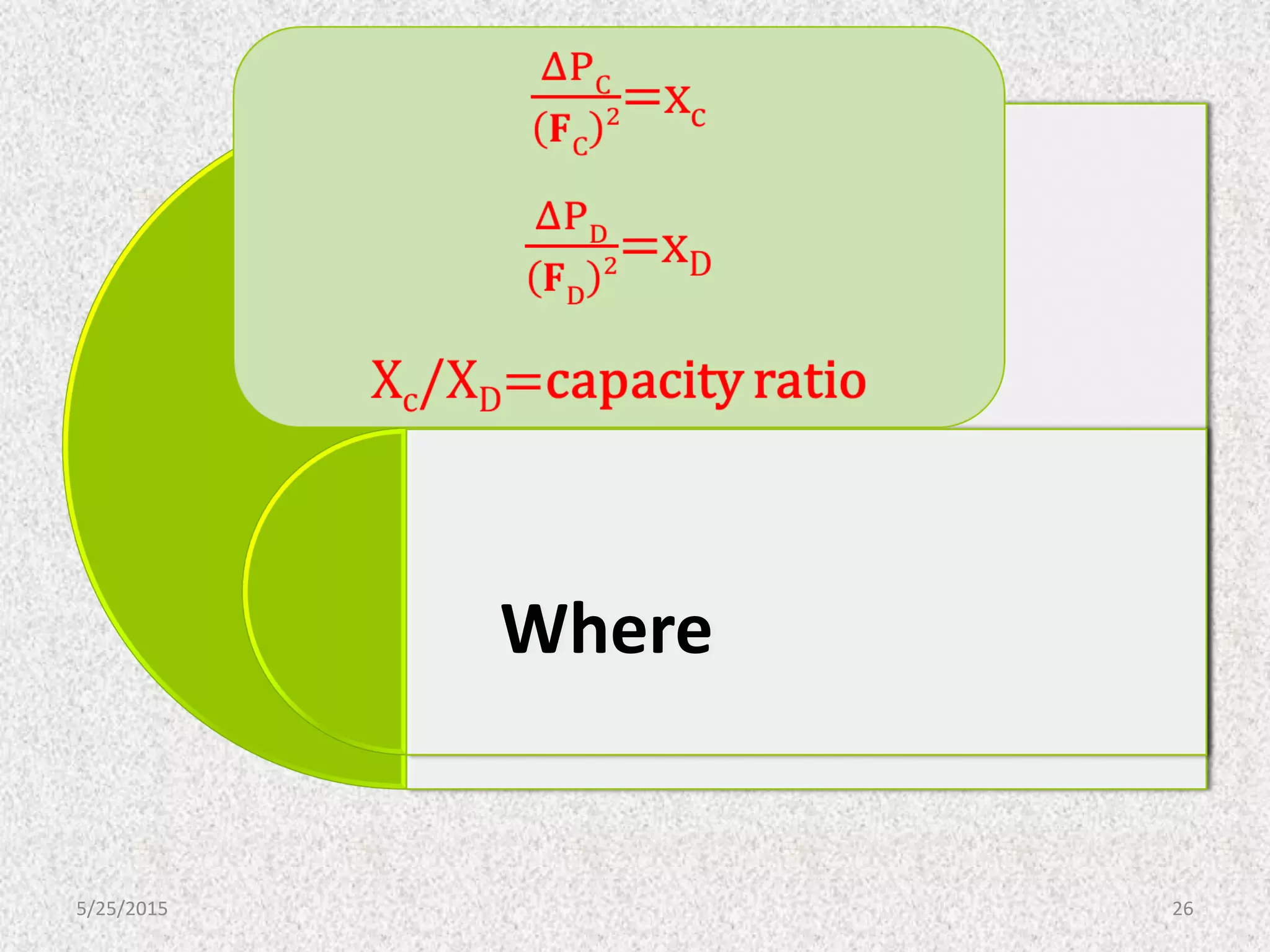
Where
5/25/2015 26
Pressure drop
αThroughput2
5/25/2015 27
5/25/2015 28
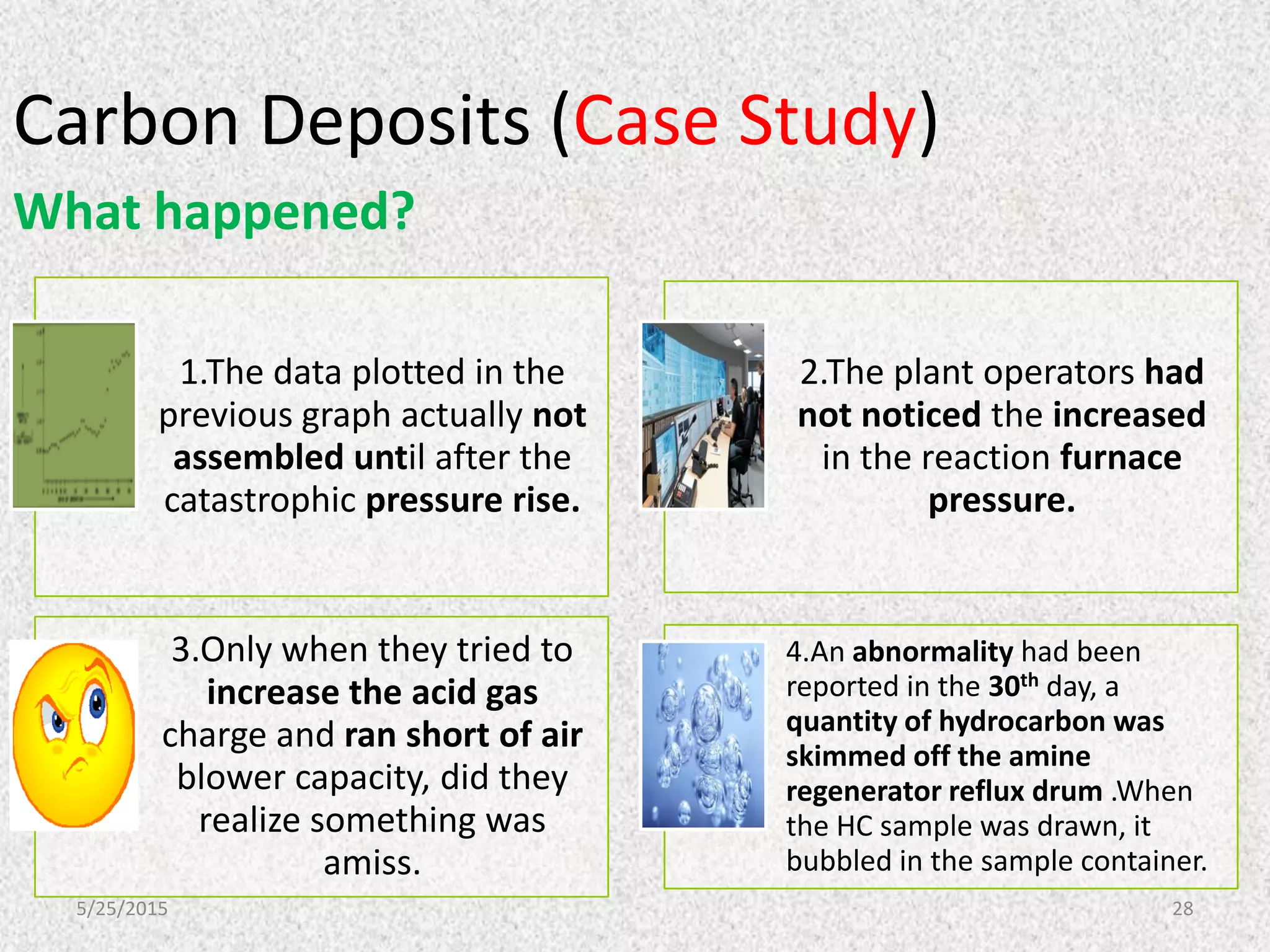
Carbon Deposits (Case Study)
What happened?
1.The data plotted in the
previous graph actually not
assembled until after the
catastrophic pressure rise.
2.The plant operators had
not noticed the increased
in the reaction furnace
pressure.
3.Only when they tried to
increase the acid gas
charge and ran short of air
blower capacity, did they
realize something was
amiss.
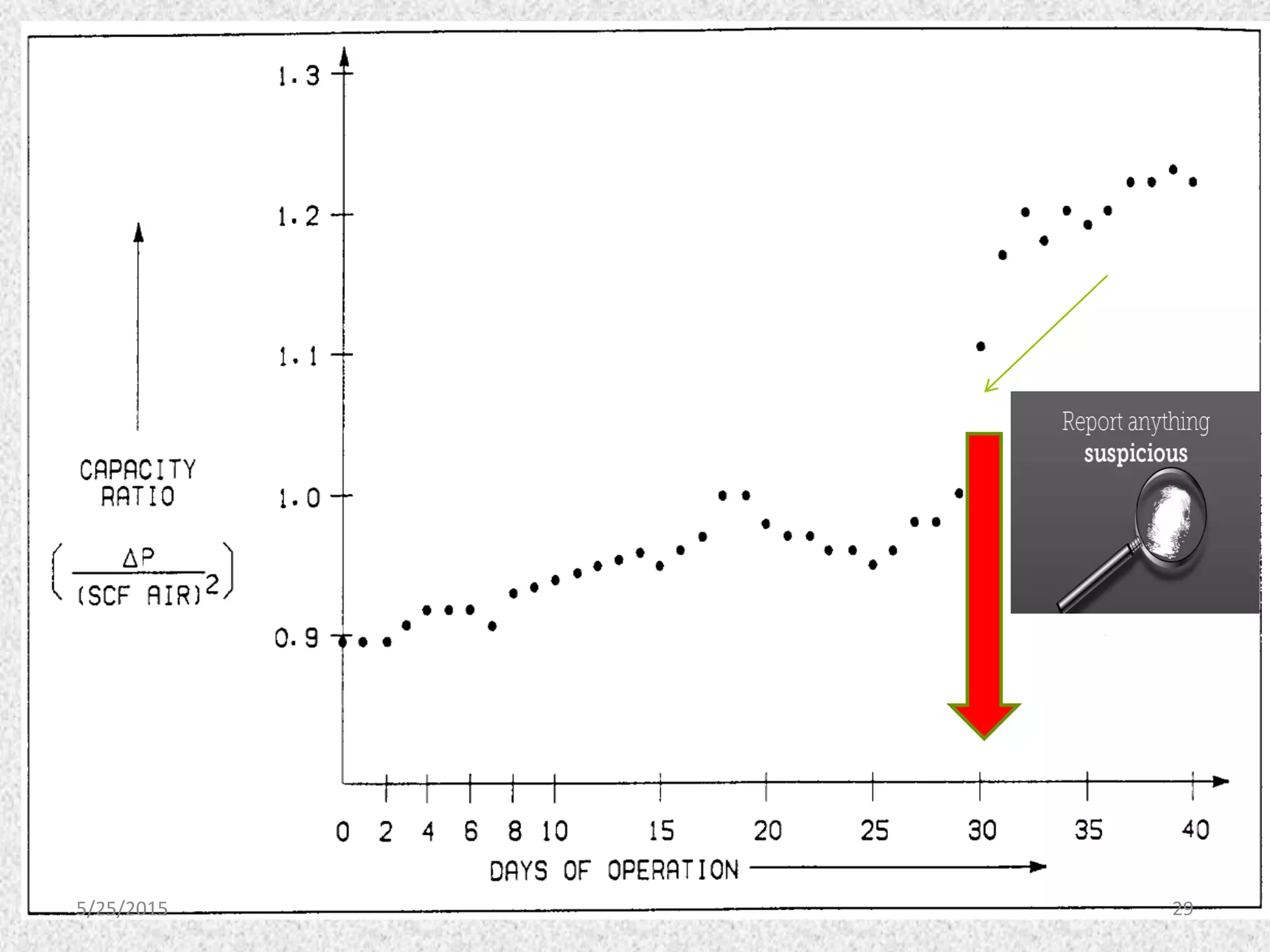
4.An abnormality had been
reported in the 30th day, a
quantity of hydrocarbon was
skimmed off the amine
regenerator reflux drum .When
the HC sample was drawn, it
bubbled in the sample container.
5/25/2015 29
5/25/2015 30
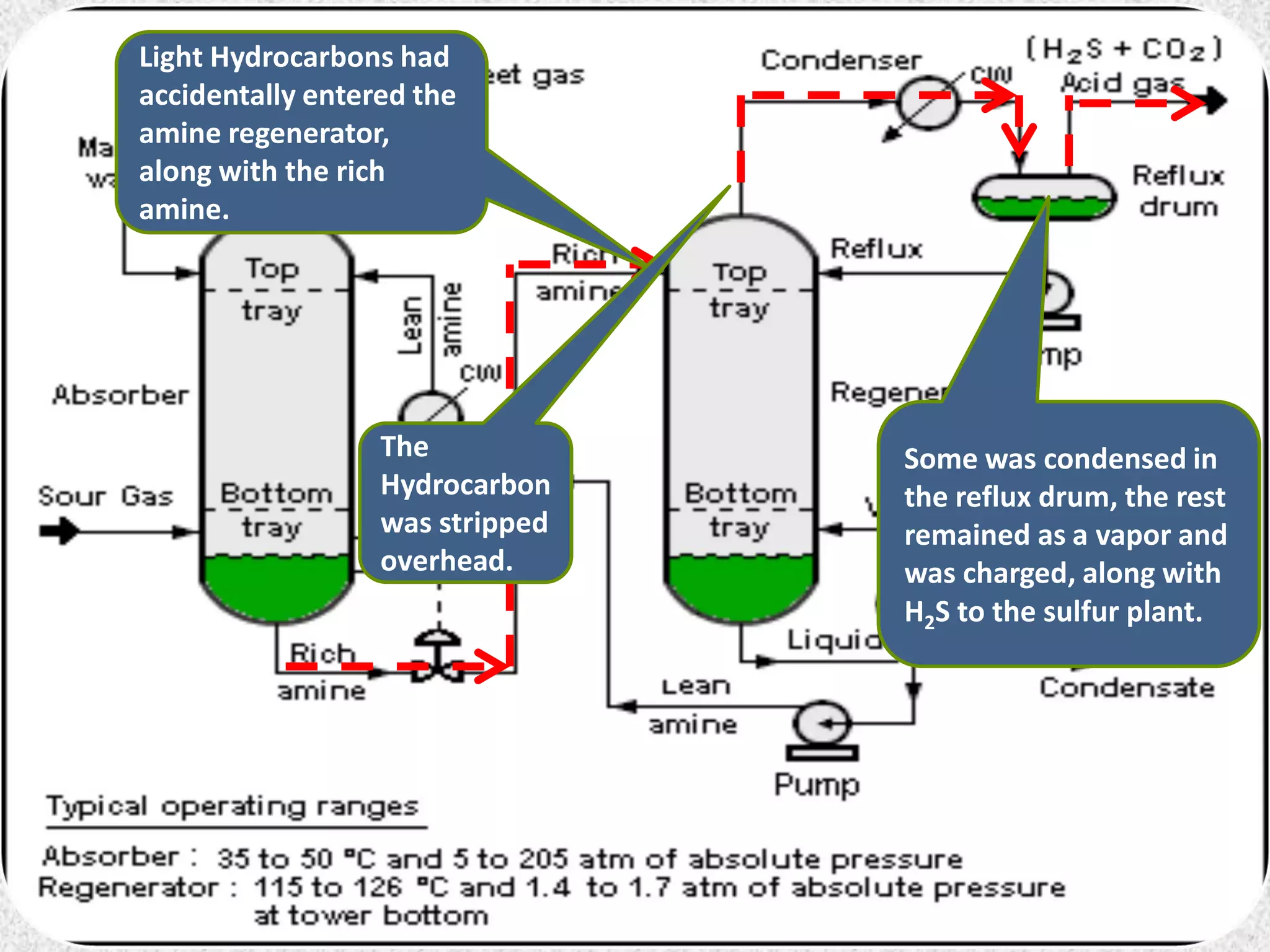
Light Hydrocarbons had
accidentally entered the
amine regenerator,
along with the rich
amine.
The
Hydrocarbon
was stripped
overhead.
Some was condensed in
the reflux drum, the rest
remained as a vapor and
was charged, along with
H2S to the sulfur plant.
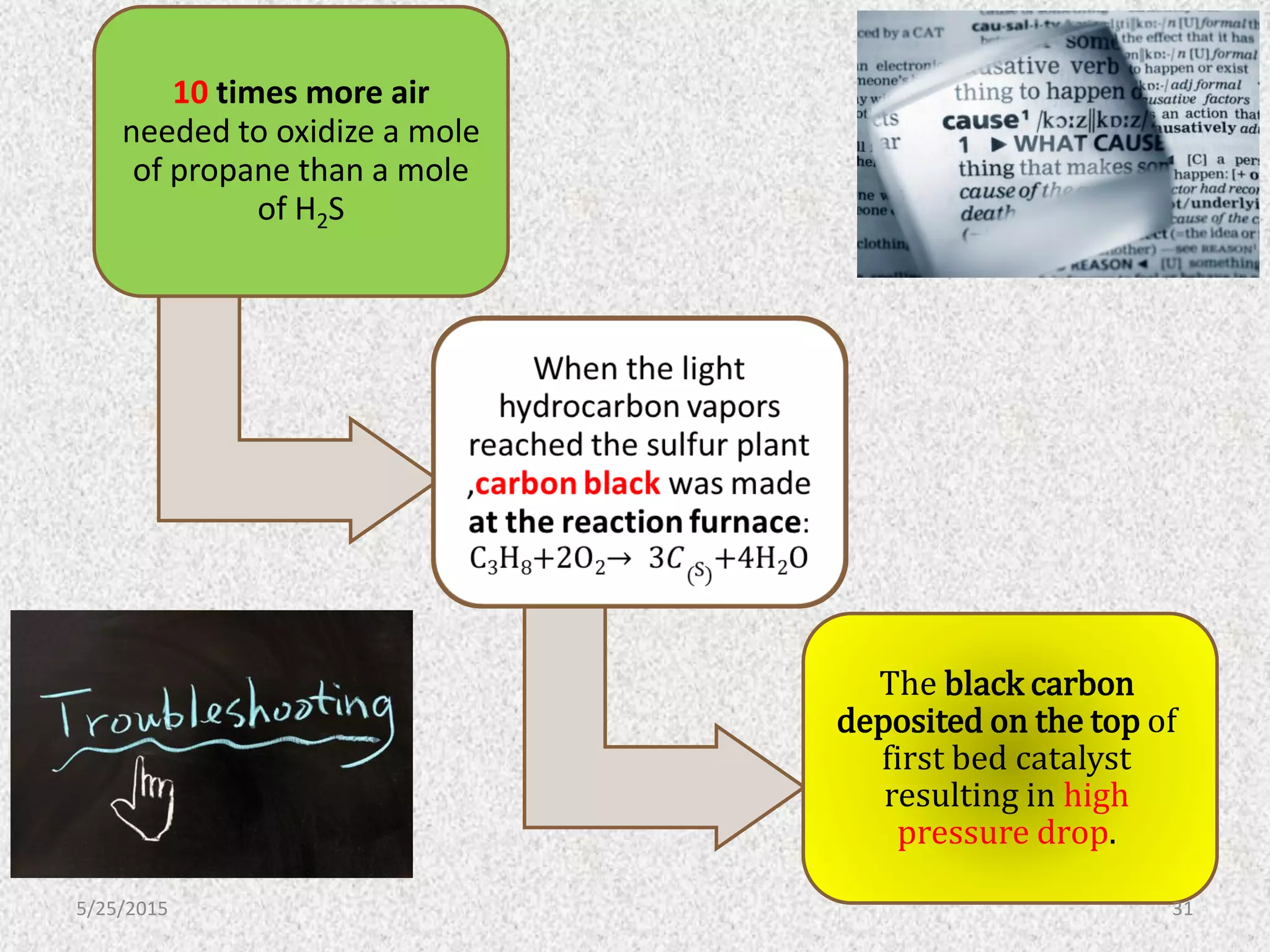
10 times more air
needed to oxidize a mole
of propane than a mole
of H2S
The black carbon
deposited on the top of
first bed catalyst
resulting in high
pressure drop.
5/25/2015 31
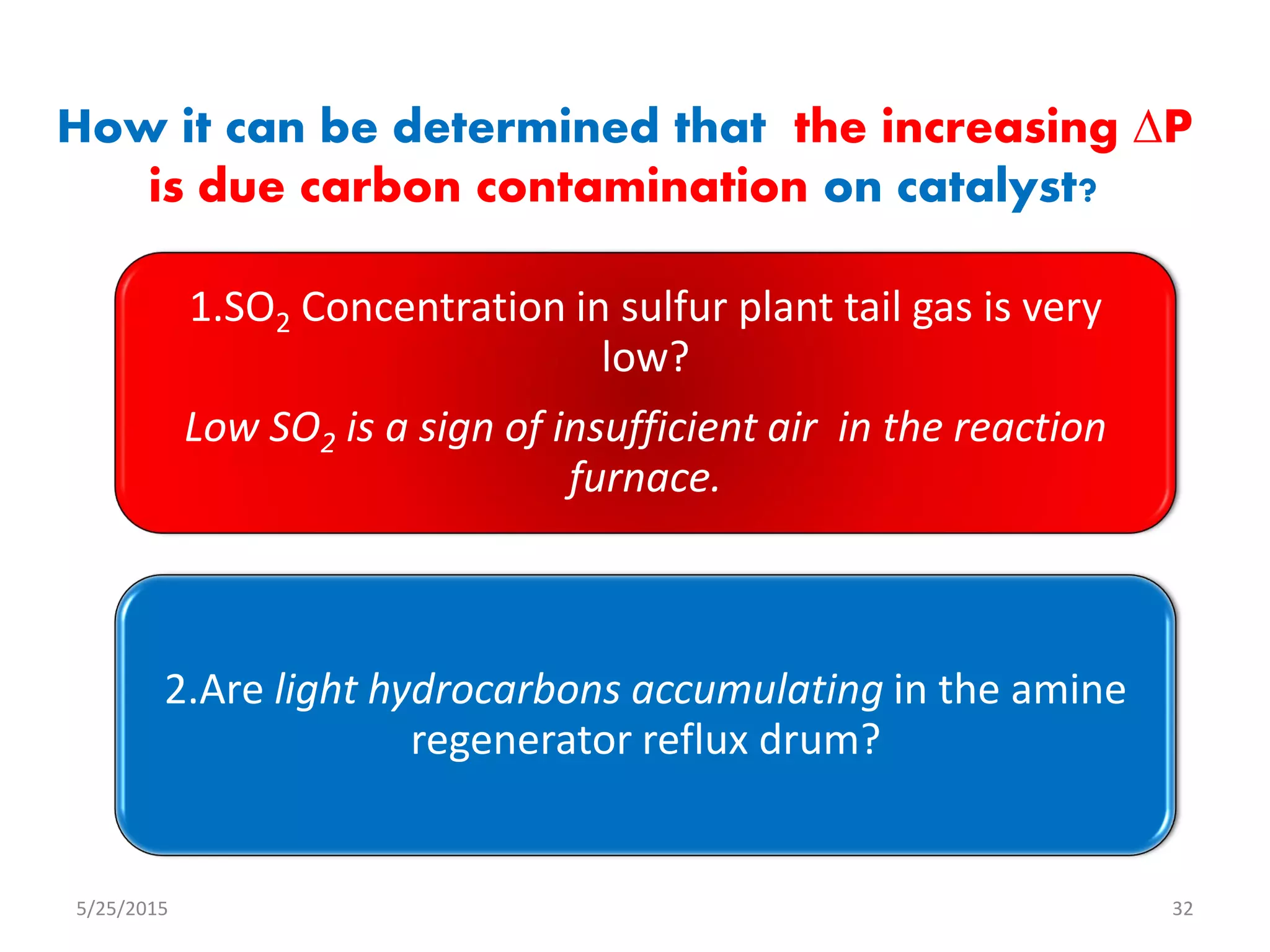
How it can be determined that the increasing ∆P
is due carbon contamination on catalyst?
5/25/2015 32
1.SO2 Concentration in sulfur plant tail gas is very
low?
Low SO2 is a sign of insufficient air in the reaction
furnace.
2.Are light hydrocarbons accumulating in the amine
regenerator reflux drum?
5/25/2015 33
Catalyst has
already plugged
with carbon:
• Over a period of
time,SO2 react with
carbon in a slow
reaction at low
temperature.
• Maximizing reactor
inlet temperature and
SO2 levels will help.
• Significant (10%)
reductions in pressure
drop can take weeks.
• Shutting down and
catalyst change is
more practical.
Keep carbon
black from
forming in the
first place:
• This can be
achieved by
better control via
increasing the air
flow(Tail gas
H2S/SO2 ration
analyzer
automatically or
manually by
alerting the
operators).
Reliable way to
prevent:
• Liquid
hydrocarbons
must be
separated from
reach amine
upstream of
amine
regenerator.
5/25/2015 34
Leaks cause pressure drop (Case Study)
What happened?
1.Observing a high
pressure drop; the plant
operators had suspected a
plugged condenser sulfur
seal leg
2.They opened a drain on
the condenser with intent
of drawing off excess sulfur.
Steam not sulfur,
discharged from the drain.
4.Six days later ,the plant
shutdown with a giant leak
in the high-pressure boiler
tube sheet.
A tube leak in the HP steam boiler can
lead to a DISASTER!
5/25/2015 35
1.The high-pressure water will erode the
metal,and the flow of water into the hot gas
stream will rapidly increase
2.If the direct reheat line is open, sulfur
precipitates on the catalyst; stopping the gas
flow through the plant and can’t be
reestablished
Crash shutdown is the worst thing
that can happened for SRU! Sulfur
plant should be cleared of sulfur by
burning fuel gas instead of H2S before
a shutdown(either ESD or long-
period).Continue flue gas firing(for
longer than 24 hrs) until the molten
sulfur cease to flow from
sultrapsTM(and maintain condition
more 4 hrs to confirm sulfur purge).
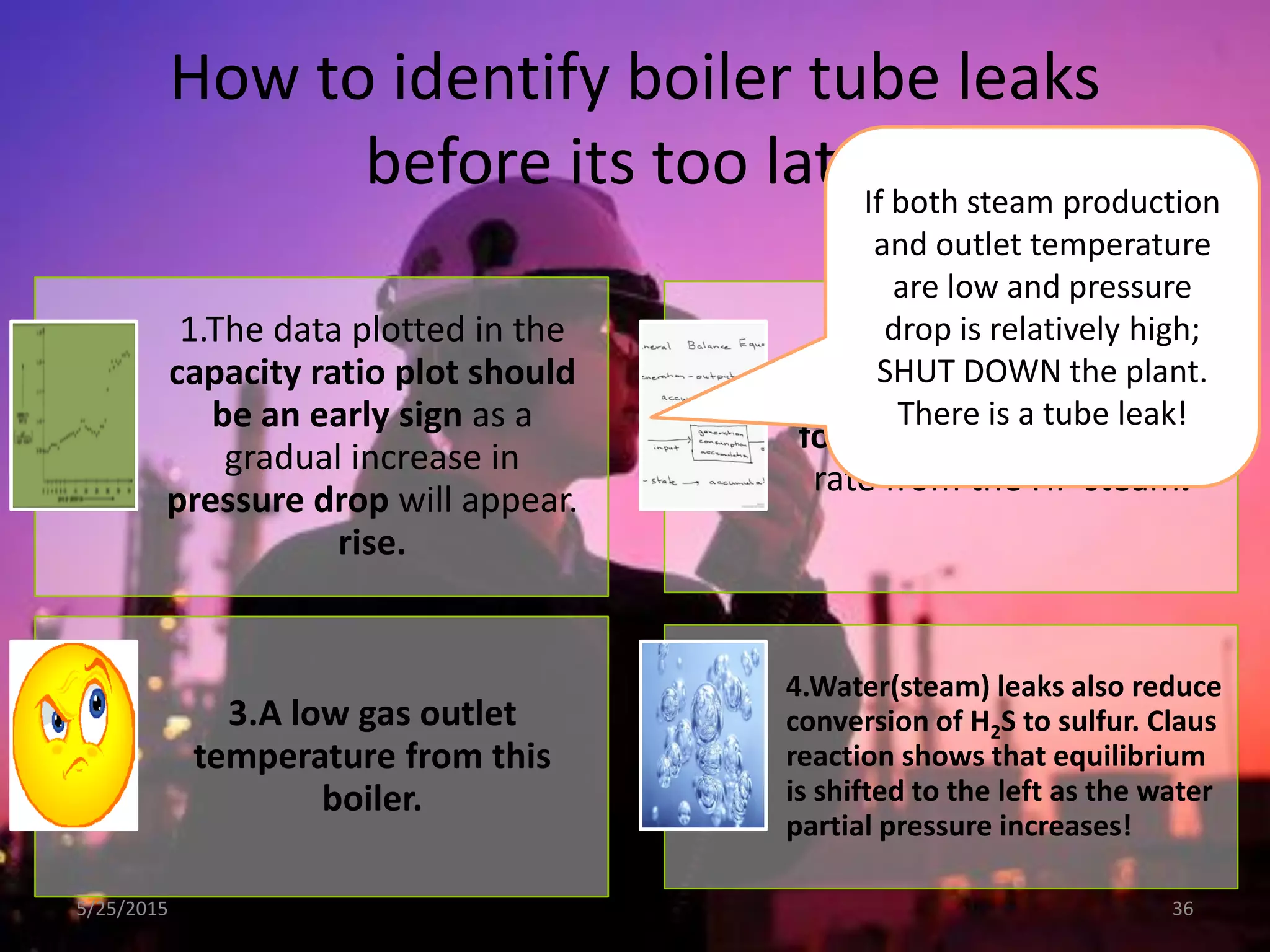
How to identify boiler tube leaks
before its too late?
5/25/2015 36
1.The data plotted in the
capacity ratio plot should
be an early sign as a
gradual increase in
pressure drop will appear.
rise.
2.When this happens check
for low steam production
rate from the HP steam.
3.A low gas outlet
temperature from this
boiler.
4.Water(steam) leaks also reduce
conversion of H2S to sulfur. Claus
reaction shows that equilibrium
is shifted to the left as the water
partial pressure increases!
If both steam production
and outlet temperature
are low and pressure
drop is relatively high;
SHUT DOWN the plant.
There is a tube leak!
5/25/2015 37
Conclusion
5/25/2015 38
References
1. Lieberman, N. (1987). Troubleshooting natural
gas processing: Wellhead to transmission.
2. Kidnay, A. J., Parrish, W. R., & McCartney, D. G.
(2011). Fundamentals of natural gas
processing (Vol. 218). CRC Press.
3. Zachariah, Michael R., and Owen I. Smith.
"Experimental and numerical studies of sulfur
chemistry in H 2/O 2/SO 2 flames." Combustion
and flame69.2 (1987): 125-139.
5/25/2015 39
5/25/2015 40

SRU Troubleshooting

  • 1.
    SRU Problems &Troubleshooting By:AhmedS. Omran M.Sc.Chem. , AMIChemE, MAIChE, ACS Member 5/25/2015 1
  • 2.
    Introduction  Sulfur Chemistry,Physical properties and Safety.  Importance of SRU troubleshooting. What can goes wrong? Conversion loss Vs Pressure Drop. Problems & Troubleshooting(Case Studies) 5/25/2015 2
  • 3.
    Sulfur Recovery Chemistry •The Claus reaction to convert H2S into elemental sulfur requires the presence of one mole of SO2 for each two moles of H2S: (1) 2H2S + SO2 → 3Sx + 2H2O • To provide that ratio of components, the first step in the Claus process is the combustion of one-third of the H2S in the feed gas: (2) H2S + 1.5 O2 → SO2 + H2O • Combining equations (1) and (2), the overall process reaction is: (3) 3H2S +1.5 O2 → 3Sx + 3H2O 5/25/2015 3 Sulfur forms over 30 solid allotropes, . -which are different structural modifications of an element- more than any other element. Besides S8, S7, which is more deeply yellow than S8. Analysis of "elemental sulfur" reveals an equilibrium mixture of mainly S8, but with S7 and small amounts of S6.
  • 4.
  • 5.
  • 6.
  • 7.
    Why Troubleshooting SRU? • Pollution abatementhas become as important as profitability. • Environmental authorities have shutdown entire refineries because of sulfur plant outage. • Performance evaluation is closely related to the troubleshooting. 5/25/2015 7
  • 8.
    Consequences! Ammonia salts plugging off WHB/condenser tubes Missing meshpads within condenser Main burner damage 5/25/2015 8 Refractory damage due to overheat
  • 9.
    What Can GoWrong? Pressure Drop? CAUSE: • Carbon deposits. • Leaks in boiler/condensers. • Plugged seal legs. END RESULT(S): Air deficiency or even blown seal legs. Inadequate conversion of H2S to liquid sulfur? CAUSE: • Improper air-acid gas ratio. • Loss of catalyst activity. END RESULT(S): Increased SO2 in the incinerator stack. 5/25/2015 9
  • 10.
    Inadequate conversion ofH2S to liquid sulfur? 1-Measuring Conversion(Mass Balance):  Claus Reaction:  The mandated Sulfur Recovery is 99.4%;  SRU is designed for 99.6%. Sulfur Recovery Level= ((Net Sfrom all streams entering the unit)-(S of incinerator emission and sour water) (Net S from all streams entering the unit) 5/25/2015 10
  • 11.
    2-Measuring Conversion(colorimetric tube): Check H2Sand SO2 in the final condenser effluent. How? Dräger tubes are a simple and reasonably accurate. 5/25/2015 11
  • 12.
    Steps to calculatethe conversion(approx.): 1. Add the ppm of H2S + SO2. 2. Add 2,000 ppm to the preceding(this allows for COS,CS2,Sulfur vapors, and entrained sulfur droplets). 3. Divide the total ppm of sulfur as obtained above 300,000. 4. Express the result as percent. 5. Subtract the percent from 100%. 5/25/2015 12
  • 13.
    Wrong Air Ratio Airflow too high • Easiest way to lose conversion. Symptoms: -SO3 is formed in the incinerator with a white plume. -Large amount of fuel is required to maintain the incinerator temperature. Air flow too low • Environmental issue. • Symptoms: -Yellowish plume in the incinerator. -A high incinerator temperature coupled with low incinerator fuel use. 5/25/2015 13
  • 14.
    Combustion Air Control Forbest conversion ,the ratio H2S/SO2 is 2:1(Supply sufficient air to burn 1/3 H2S in the total feed). This ration is measured in the tails gas from the tail gas coalescer. 5/25/2015 14
  • 15.
    Reactor Problems • Catalystdeactivation: • Symptoms: 1. It is very to do much harm to the catalyst without causing excessive pressure drop. 2.If you suspect reduced recovery due to lost catalyst activity check the temperature rise across the reactor(Outlet-inlet). 5/25/2015 15
  • 16.
    Check the Temperatureprofile: • This is a good profile • This temperature shift means the effluent in the first stage is not reaching equilibrium. • In the first reactor, sulfur formation has decreased 30% and overall catalyst effectiveness has declined. 5/25/2015 16
  • 17.
    Low Reactor Feed Temperatures Sulfur Precipitation on theCatalyst Catalyst Deactivation 5/25/2015 17 cause and cause may occur and result in conversion loss.
  • 18.
    Troubleshooting • Troubleshooting: Checkthe operation of the reheat exchanger upstream of the reactor with the reduced temperature rise. • Solution: Raise the reactor inlet temperature about 30⁰F (17 ⁰C);this will dissipate the offending sulfur deposits after few days. Question: If catalyst activity has been irreversibly lost, when catalyst change may be considered? 5/25/2015 18
  • 19.
    COS and CS2 Presenceof hydrocarbons and CO2 in acid gas Formation of COS and CS2 in the reaction furnace. Increase in SO2 emissions. 5/25/2015 19 cause cause results in conversion loss.
  • 20.
    Troubleshooting • Symptoms: An increasein the SO2 emission accompanied by lower than normal 1st reactor inlet temperature. • Problem : COS and CS2 in the reaction furnace. • Solution : Destroy both by operating the 1st reactor at outlet temperature of 650F (343 C),so these compounds are hydrolized to H2S and CO2. 5/25/2015 20
  • 21.
    Sulfur Fog/Demister Damage Cause& Problem: As the unit charge drop the unit converts a lower percentage of H2S to sulfur. Sulfur should condense on the walls of the tubes. However ,at low tube-side gas velocities, the sulfur precipitates in the gas stream itself; A sulfur fog formed. Damage to the final condenser demister(or coalescer) may allow entrained sulfur to escape to the incinerator. -This can be extensively damaged from sulfur fires during start-up. Symptoms: The fog does not drop out of the end of the condenser, much of it appears as SO2 in the incinerator. Solution: Avoid unnecessary unit charge drop. Monitor SO2 emission closely at unit charge drop. -Avoid oxygen deficiency during start-ups. 5/25/2015 21
  • 22.
    When to changea catalyst? A 4 years desired catalyst life in Barzan SRU. Damage to catalyst and reduced conversion can be due to many factors besides lost activity: carbon deposits, leaking condenser tubes, damaged support screens, sulfuric acid formation, or operation at the sulfur dew point. All these problems are invariably associated with increasing pressure drop. 5/25/2015 22
  • 23.
    In case ofnormal pressure drop through the catalyst bed, Do we need to change catalyst during the unit turnaround? . 5/25/2015 23 With the adequate instrumentation available, a firm decision can obtained via a vertical temperature profile through the 1st catalyst bed
  • 24.
    When to changecatalyst? 90%+ of the reaction heat is released in top 6 inches(0.5 feet) If the catalyst activity dropped, the reaction is shifted down in the bed. 5/25/2015 24
  • 25.
    Pressure Drop It isof utmost importance to watch for high- sulfur plant pressure drop. Sulfur plants don’t suddenly plug without a prior pressure drop increase. However a foresight troubleshooting need continuous data collection and analysis. Using the capacity ratio parameter plotted data can tell a trouble in Claus unit. 5/25/2015 25
  • 26.
  • 27.
  • 28.
    5/25/2015 28 Carbon Deposits(Case Study) What happened? 1.The data plotted in the previous graph actually not assembled until after the catastrophic pressure rise. 2.The plant operators had not noticed the increased in the reaction furnace pressure. 3.Only when they tried to increase the acid gas charge and ran short of air blower capacity, did they realize something was amiss. 4.An abnormality had been reported in the 30th day, a quantity of hydrocarbon was skimmed off the amine regenerator reflux drum .When the HC sample was drawn, it bubbled in the sample container.
  • 29.
  • 30.
    5/25/2015 30 Light Hydrocarbonshad accidentally entered the amine regenerator, along with the rich amine. The Hydrocarbon was stripped overhead. Some was condensed in the reflux drum, the rest remained as a vapor and was charged, along with H2S to the sulfur plant.
  • 31.
    10 times moreair needed to oxidize a mole of propane than a mole of H2S The black carbon deposited on the top of first bed catalyst resulting in high pressure drop. 5/25/2015 31
  • 32.
    How it canbe determined that the increasing ∆P is due carbon contamination on catalyst? 5/25/2015 32 1.SO2 Concentration in sulfur plant tail gas is very low? Low SO2 is a sign of insufficient air in the reaction furnace. 2.Are light hydrocarbons accumulating in the amine regenerator reflux drum?
  • 33.
    5/25/2015 33 Catalyst has alreadyplugged with carbon: • Over a period of time,SO2 react with carbon in a slow reaction at low temperature. • Maximizing reactor inlet temperature and SO2 levels will help. • Significant (10%) reductions in pressure drop can take weeks. • Shutting down and catalyst change is more practical. Keep carbon black from forming in the first place: • This can be achieved by better control via increasing the air flow(Tail gas H2S/SO2 ration analyzer automatically or manually by alerting the operators). Reliable way to prevent: • Liquid hydrocarbons must be separated from reach amine upstream of amine regenerator.
  • 34.
    5/25/2015 34 Leaks causepressure drop (Case Study) What happened? 1.Observing a high pressure drop; the plant operators had suspected a plugged condenser sulfur seal leg 2.They opened a drain on the condenser with intent of drawing off excess sulfur. Steam not sulfur, discharged from the drain. 4.Six days later ,the plant shutdown with a giant leak in the high-pressure boiler tube sheet.
  • 35.
    A tube leakin the HP steam boiler can lead to a DISASTER! 5/25/2015 35 1.The high-pressure water will erode the metal,and the flow of water into the hot gas stream will rapidly increase 2.If the direct reheat line is open, sulfur precipitates on the catalyst; stopping the gas flow through the plant and can’t be reestablished Crash shutdown is the worst thing that can happened for SRU! Sulfur plant should be cleared of sulfur by burning fuel gas instead of H2S before a shutdown(either ESD or long- period).Continue flue gas firing(for longer than 24 hrs) until the molten sulfur cease to flow from sultrapsTM(and maintain condition more 4 hrs to confirm sulfur purge).

  • 36.
    How to identifyboiler tube leaks before its too late? 5/25/2015 36 1.The data plotted in the capacity ratio plot should be an early sign as a gradual increase in pressure drop will appear. rise. 2.When this happens check for low steam production rate from the HP steam. 3.A low gas outlet temperature from this boiler. 4.Water(steam) leaks also reduce conversion of H2S to sulfur. Claus reaction shows that equilibrium is shifted to the left as the water partial pressure increases! If both steam production and outlet temperature are low and pressure drop is relatively high; SHUT DOWN the plant. There is a tube leak!
  • 37.
  • 38.
  • 39.
    References 1. Lieberman, N.(1987). Troubleshooting natural gas processing: Wellhead to transmission. 2. Kidnay, A. J., Parrish, W. R., & McCartney, D. G. (2011). Fundamentals of natural gas processing (Vol. 218). CRC Press. 3. Zachariah, Michael R., and Owen I. Smith. "Experimental and numerical studies of sulfur chemistry in H 2/O 2/SO 2 flames." Combustion and flame69.2 (1987): 125-139. 5/25/2015 39
  • 40.