Revamps for Ageing Hydrogen Plants
By
Gerard B. Hawkins
Managing Director, CEO
Introduction
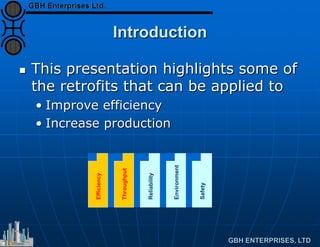
 This presentation highlights some of
the retrofits that can be applied to
• Improve efficiency
• Increase production
Safety
Efficiency
Reliability
Throughput
Environment
Introduction
 For older hydrogen plants, efficiency
is worse than for a modern plant
 To maximize profit must improve
either
• Plant efficiency
• Plant production rate
Site Circumstances
 Hydrogen plants have a wide range of
site circumstances
 Is there value for steam on the site ?
 What are the downstream users ?
 What is the contract basis for the H2
supply
 When conducting a revamp these need
to be carefully considered
 GBHE is in a unique position to fully
understand these issues and design
revamps accordingly
Plant Limitations
 Need to address plant limitations,
such as
• Process side pressure drop
• Maximum tube wall temperature
• Coil design temperatures in duct
• Steam balance
• Fan capacity
Basis for Study
 Old style plant with
• Top Fired SMR - 500 tubes
• Steam to carbon of 3.9
• Duct heat recovery is feed preheat and
steam raising
• HTS
• LTS
• Wet CO2 system
• Methanation
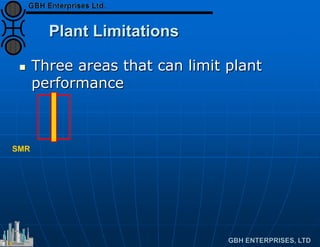
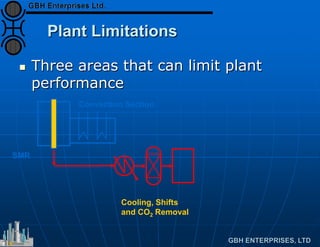
Plant Limitations
 Three areas that can limit plant
performance
SMR
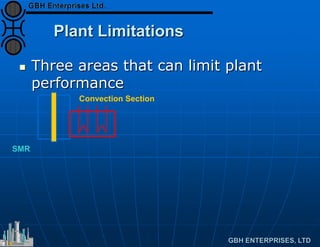
Plant Limitations
 Three areas that can limit plant
performance
SMR
Convection Section
Plant Limitations
 Three areas that can limit plant
performance
SMR
Convection Section
Cooling, Shifts
and CO2 Removal
Change Catalyst Shape and Size
 By optimizing catalyst size can
• Reduce pressure drop by up to 27%
• Reduce carbon formation potential
 By changing to VULCAN Series VSG-Z101
can
• Reduce CH4 slip and increase production by
5%
• Reduce Tube Wall Temperatures by 10°C
• Reduce carbon formation potential
• Reduce pressure drop by 29%
Reduce Steam to Carbon Ratio
 By reducing SC ratio by 0.6 can
• Reduce steam addition by 19 mtphr
• Increase steam export by 9 mtphr
• Reduce pressure drop by 23%
• Reduce TWT by 14°C
• Gain 5.3 GJ/mmSCF
Reduce Steam to Carbon Ratio
 Or increase plant rate
• Reduced DP
• Gain 1.8 GJ/mmSCF
• In some cases can increase rate above
base case
 But must be aware of
• Metal dusting of WHB
• Increased potential for carbon
formation
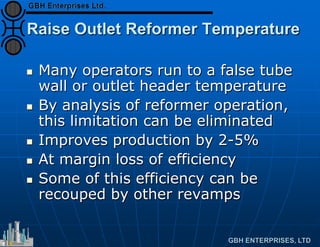
Raise Outlet Reformer Temperature
 Many operators run to a false tube
wall or outlet header temperature
 By analysis of reformer operation,
this limitation can be eliminated
 Improves production by 2-5%
 At margin loss of efficiency
 Some of this efficiency can be
recouped by other revamps
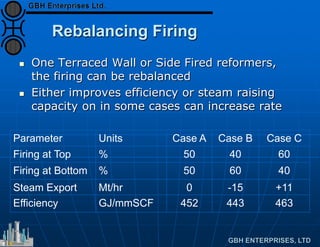
Rebalancing Firing
 One Terraced Wall or Side Fired reformers,
the firing can be rebalanced
 Either improves efficiency or steam raising
capacity on in some cases can increase rate
Parameter Units Case A Case B Case C
Firing at Top % 50 40 60
Firing at Bottom % 50 60 40
Steam Export Mt/hr 0 -15 +11
Efficiency GJ/mmSCF 452 443 463
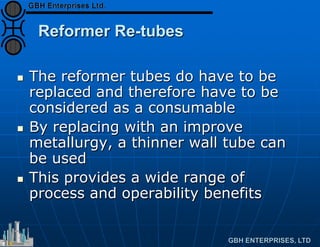
Reformer Re-tubes
 The reformer tubes do have to be
replaced and therefore have to be
considered as a consumable
 By replacing with an improve
metallurgy, a thinner wall tube can
be used
 This provides a wide range of
process and operability benefits
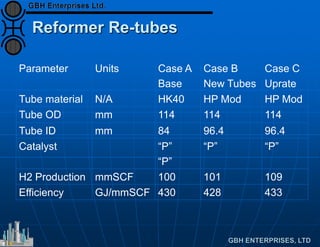
Reformer Re-tubes
Parameter Units Case A
Base
Case B
New Tubes
Case C
Uprate
Tube material N/A HK40 HP Mod HP Mod
Tube OD mm 114 114 114
Tube ID mm 84 96.4 96.4
Catalyst “P”
“P”
“P” “P”
H2 Production mmSCF 100 101 109
Efficiency GJ/mmSCF 430 428 433
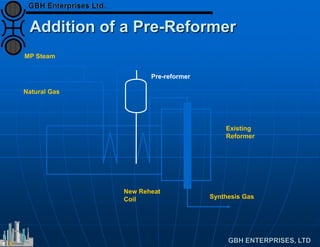
Addition of a Pre-Reformer
MP Steam
Existing
Reformer
Natural Gas
Synthesis Gas
Pre-reformer
New Reheat
Coil
Addition of a Pre-Reformer
 To obtain maximum benefit requires
• Reheat of effluent - an achieve very high
preheat and reheat temperature with latest
generation of pre-reforming catalyst can
recover more heat from duct and reduce
furnace duty significantly
• Must model effect on duct to ensure that
existing demands for heat are fulfilled (HP
Steam Raising)
 Can allow for efficiency improvements of
up to 24 GJ/mmSCF
 Or rate increases of up to 9%
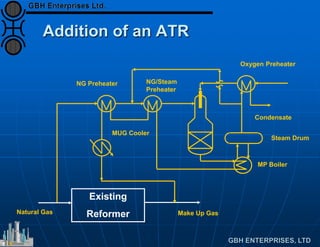
Addition of an ATR
Existing
Reformer
NG Preheater NG/Steam
Preheater
MUG Cooler
Oxygen Preheater
Steam Drum
MP Boiler
Natural Gas Make Up Gas
Condensate
Addition of an ATR or Secondary
 Either in parallel (ATR) or in series
(secondary)
• Parallel ATR has less impact on the main
plant
• Main plant can run when ATR off line
 Can increase production rate by 22%
• More can be achieved depending on plant
design
 Require an oxygen plant (9 mt/hr)
 Energy efficiency improved by 13
GJ/mmSCF
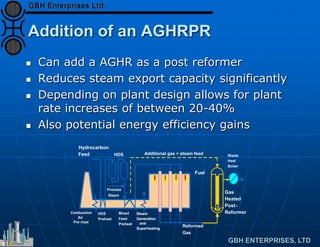
Addition of an AGHRPR
 Can add a AGHR as a post reformer
 Reduces steam export capacity significantly
 Depending on plant design allows for plant
rate increases of between 20-40%
 Also potential energy efficiency gains
Steam
Hydrocarbon
Feed HDS
Fuel
Steam
Generation
and
Superheating
Steam
Generation
and
Superheating
Combustion
Air
Pre-heat
Reformed
Gas
Process
Additional gas + steam feed
Gas
Heated
Post-
Reformer
Waste
Heat
Boiler
HDS
Preheat
Mixed
Feed
Preheat
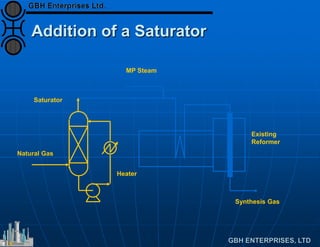
Addition of Saturator
 Recovers low grade heat into the process
 Maximizes quality and quantity
 Up to 13 mt/hr of export steam can be
generated
 Link with CO2 solution change
Addition of a Saturator
MP Steam
Existing
Reformer
Natural Gas
Synthesis Gas
Heater
Saturator
Combustion Air Preheat
 Allows for improvement in heat recovery
from the duct
 Most suitable for top fired furnaces but can
be applied to side fired furnaces
• Cost is higher due to complexity of
ducting
 Will reduce fluegas flow and therefore heat
available in the duct - must model this
carefully
 Improve plant efficiency by 30 GJ/mmSCF
 Can allow for rate increase
VULCAN SG Delta Retrofit for Shift
Vessels
 By installing a specialized support
system can reduce pressure drop
significantly
 GBHE can offer the VULCAN SG Delta
which can reduce pressure drop by
around 50%
 Allows plant rate increases of up to 3%
Other Options
 Use ROG or other streams as a feed
 Use low methanol LTS catalyst
 Preheat fuel
 Change CO2 solution
 Install quench upstream of LTS
 Reduction in excess air in reformer
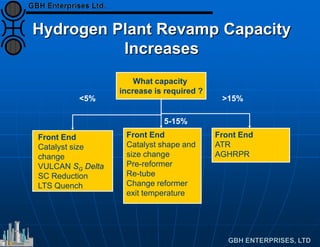
Hydrogen Plant Revamp Capacity
Increases
What capacity
increase is required ?
>15%
Front End
Catalyst size
change
VULCAN SG Delta
SC Reduction
LTS Quench
<5%
Front End
Catalyst shape and
size change
Pre-reformer
Re-tube
Change reformer
exit temperature
5-15%
Front End
ATR
AGHRPR
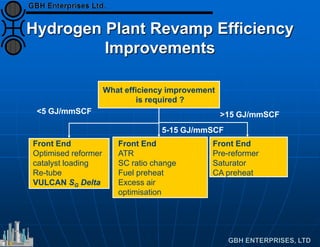
Hydrogen Plant Revamp Efficiency
Improvements
What efficiency improvement
is required ?
>15 GJ/mmSCF<5 GJ/mmSCF
Front End
ATR
SC ratio change
Fuel preheat
Excess air
optimisation
5-15 GJ/mmSCF
Front End
Pre-reformer
Saturator
CA preheat
Front End
Optimised reformer
catalyst loading
Re-tube
VULCAN SG Delta
Problems and Pitfalls
Contractor and Contract
 Must carefully select partners
• Must have domain knowledge
 Design and operations
• Must have correct tools
• Must be able to supply correct level of detail
for study
 Must select appropriate contract type
• LSTK or Reimbursable
• Both have advantages and disadvantages
Problems and Pitfalls
Modelling Capability
 Must use correct tools
 Model the whole plant using a
flowsheeting package
• Must include all unit operations
• Must develop a robust base case
• Must validate against plant data
• Must understand deviations
• Then develop the retrofit case
Problems and Pitfalls
Retrofit Details
 The customer and engineering contractor
must determine
• Precise scope for retrofit
• Responsibilities
• Key deliverables
• A detailed and consistent design basis
• Time scale and milestones
• Review schedules
 Summarize as Good Project Management
Problems and Pitfalls
Design Basis
 Engineering contractor must conduct on
site visit
• Must work with client
• Collect representative plant data
• Model and understand plant data
• Discuss discrepancies and eliminate
• Identify bottlenecks
• Identify opportunities for improvement
 These form the core of the design basis
Problems and Pitfalls
HAZOPs and Commissioning
 Must use systematic review method to
highlight potential problems with retrofit
• HAZOPs are a well proven system
• Requires time and buy in from all parties
• Results as good as quality of people !
 Retrofit will change plant parameters
• Must update PFDs and P&IDs
• Must update operating instructions
• Must take additional care during start up
What Can GBHE Catalysts Offer?
 Detail catalyst unit operation models
such as the world leading VULCAN
REFORMER SIMULATION program
• Also models for other catalyst unit
operations
 Detail non-catalyst unit operation
models such as
• Heat exchange programs
• Finite Element Analysis
• CFD modelling
 One stop shop
What Can GBHE Catalysts Offer?
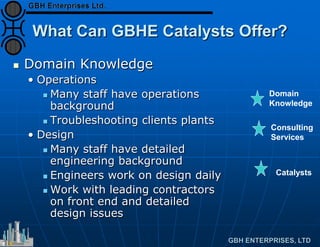
 Domain Knowledge
• Operations
 Many staff have operations
background
 Troubleshooting clients plants
• Design
 Many staff have detailed
engineering background
 Engineers work on design daily
 Work with leading contractors
on front end and detailed
design issues
Catalysts
Consulting
Services
Domain
Knowledge
What Can GBHE Catalysts Offer?
 Can supply any level of detail for
retrofit
 Scoping studies
• Front End
• What are the best options
 Front End Engineering
• Flowsheets and design of key components
 Detailed Engineering
• Design of all components of retrofit
 A one stop shop for your revamp
requirements
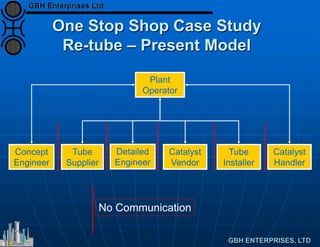
One Stop Shop Case Study
Re-tube – Present Model
Plant
Operator
Concept
Engineer
Tube
Supplier
Catalyst
Vendor
Tube
Installer
Catalyst
Handler
No Communication
Detailed
Engineer
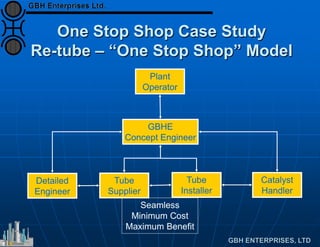
One Stop Shop Case Study
Re-tube – “One Stop Shop” Model
Plant
Operator
GBHE
Concept Engineer
Tube
Supplier
Tube
Installer
Catalyst
Handler
Detailed
Engineer
Seamless
Minimum Cost
Maximum Benefit
Case Study
How GBHE Catalysts Works
 Strong position due to credibility from previous
work
 Uprate projects
• Feasibility Process Uprate study on Naphtha 115%,
130% or 150% cases
• FEEP (Front End Engineering Package, what would be
needed?)
 115% FEEP adopted
• Option evaluations and natural gas feed conversion
 Followed by full Engineering Detail Design
 Also additional design work on Desulfurization
Design Study
Conclusions
 A number of retrofits have been
presented that are suitable for
application to hydrogen plants
 They address all the key limitations that
hydrogen plants typically suffer from
 To take full benefit from some of these
retrofits, others may also be required
 GBHE Catalysts has all the right
expertise and knowledge to develop and
design retrofits
Revamps for Ageing Hydrogen Plants

Revamps for Ageing Hydrogen Plants

  • 1.
    Revamps for AgeingHydrogen Plants By Gerard B. Hawkins Managing Director, CEO
  • 2.
    Introduction  This presentationhighlights some of the retrofits that can be applied to • Improve efficiency • Increase production Safety Efficiency Reliability Throughput Environment
  • 3.
    Introduction  For olderhydrogen plants, efficiency is worse than for a modern plant  To maximize profit must improve either • Plant efficiency • Plant production rate
  • 4.
    Site Circumstances  Hydrogenplants have a wide range of site circumstances  Is there value for steam on the site ?  What are the downstream users ?  What is the contract basis for the H2 supply  When conducting a revamp these need to be carefully considered  GBHE is in a unique position to fully understand these issues and design revamps accordingly
  • 5.
    Plant Limitations  Needto address plant limitations, such as • Process side pressure drop • Maximum tube wall temperature • Coil design temperatures in duct • Steam balance • Fan capacity
  • 6.
    Basis for Study Old style plant with • Top Fired SMR - 500 tubes • Steam to carbon of 3.9 • Duct heat recovery is feed preheat and steam raising • HTS • LTS • Wet CO2 system • Methanation
  • 7.
    Plant Limitations  Threeareas that can limit plant performance SMR
  • 8.
    Plant Limitations  Threeareas that can limit plant performance SMR Convection Section
  • 9.
    Plant Limitations  Threeareas that can limit plant performance SMR Convection Section Cooling, Shifts and CO2 Removal
  • 10.
    Change Catalyst Shapeand Size  By optimizing catalyst size can • Reduce pressure drop by up to 27% • Reduce carbon formation potential  By changing to VULCAN Series VSG-Z101 can • Reduce CH4 slip and increase production by 5% • Reduce Tube Wall Temperatures by 10°C • Reduce carbon formation potential • Reduce pressure drop by 29%
  • 11.
    Reduce Steam toCarbon Ratio  By reducing SC ratio by 0.6 can • Reduce steam addition by 19 mtphr • Increase steam export by 9 mtphr • Reduce pressure drop by 23% • Reduce TWT by 14°C • Gain 5.3 GJ/mmSCF
  • 12.
    Reduce Steam toCarbon Ratio  Or increase plant rate • Reduced DP • Gain 1.8 GJ/mmSCF • In some cases can increase rate above base case  But must be aware of • Metal dusting of WHB • Increased potential for carbon formation
  • 13.
    Raise Outlet ReformerTemperature  Many operators run to a false tube wall or outlet header temperature  By analysis of reformer operation, this limitation can be eliminated  Improves production by 2-5%  At margin loss of efficiency  Some of this efficiency can be recouped by other revamps
  • 14.
    Rebalancing Firing  OneTerraced Wall or Side Fired reformers, the firing can be rebalanced  Either improves efficiency or steam raising capacity on in some cases can increase rate Parameter Units Case A Case B Case C Firing at Top % 50 40 60 Firing at Bottom % 50 60 40 Steam Export Mt/hr 0 -15 +11 Efficiency GJ/mmSCF 452 443 463
  • 15.
    Reformer Re-tubes  Thereformer tubes do have to be replaced and therefore have to be considered as a consumable  By replacing with an improve metallurgy, a thinner wall tube can be used  This provides a wide range of process and operability benefits
  • 16.
    Reformer Re-tubes Parameter UnitsCase A Base Case B New Tubes Case C Uprate Tube material N/A HK40 HP Mod HP Mod Tube OD mm 114 114 114 Tube ID mm 84 96.4 96.4 Catalyst “P” “P” “P” “P” H2 Production mmSCF 100 101 109 Efficiency GJ/mmSCF 430 428 433
  • 17.
    Addition of aPre-Reformer MP Steam Existing Reformer Natural Gas Synthesis Gas Pre-reformer New Reheat Coil
  • 18.
    Addition of aPre-Reformer  To obtain maximum benefit requires • Reheat of effluent - an achieve very high preheat and reheat temperature with latest generation of pre-reforming catalyst can recover more heat from duct and reduce furnace duty significantly • Must model effect on duct to ensure that existing demands for heat are fulfilled (HP Steam Raising)  Can allow for efficiency improvements of up to 24 GJ/mmSCF  Or rate increases of up to 9%
  • 19.
    Addition of anATR Existing Reformer NG Preheater NG/Steam Preheater MUG Cooler Oxygen Preheater Steam Drum MP Boiler Natural Gas Make Up Gas Condensate
  • 20.
    Addition of anATR or Secondary  Either in parallel (ATR) or in series (secondary) • Parallel ATR has less impact on the main plant • Main plant can run when ATR off line  Can increase production rate by 22% • More can be achieved depending on plant design  Require an oxygen plant (9 mt/hr)  Energy efficiency improved by 13 GJ/mmSCF
  • 21.
    Addition of anAGHRPR  Can add a AGHR as a post reformer  Reduces steam export capacity significantly  Depending on plant design allows for plant rate increases of between 20-40%  Also potential energy efficiency gains Steam Hydrocarbon Feed HDS Fuel Steam Generation and Superheating Steam Generation and Superheating Combustion Air Pre-heat Reformed Gas Process Additional gas + steam feed Gas Heated Post- Reformer Waste Heat Boiler HDS Preheat Mixed Feed Preheat
  • 22.
    Addition of Saturator Recovers low grade heat into the process  Maximizes quality and quantity  Up to 13 mt/hr of export steam can be generated  Link with CO2 solution change
  • 23.
    Addition of aSaturator MP Steam Existing Reformer Natural Gas Synthesis Gas Heater Saturator
  • 24.
    Combustion Air Preheat Allows for improvement in heat recovery from the duct  Most suitable for top fired furnaces but can be applied to side fired furnaces • Cost is higher due to complexity of ducting  Will reduce fluegas flow and therefore heat available in the duct - must model this carefully  Improve plant efficiency by 30 GJ/mmSCF  Can allow for rate increase
  • 25.
    VULCAN SG DeltaRetrofit for Shift Vessels  By installing a specialized support system can reduce pressure drop significantly  GBHE can offer the VULCAN SG Delta which can reduce pressure drop by around 50%  Allows plant rate increases of up to 3%
  • 26.
    Other Options  UseROG or other streams as a feed  Use low methanol LTS catalyst  Preheat fuel  Change CO2 solution  Install quench upstream of LTS  Reduction in excess air in reformer
  • 27.
    Hydrogen Plant RevampCapacity Increases What capacity increase is required ? >15% Front End Catalyst size change VULCAN SG Delta SC Reduction LTS Quench <5% Front End Catalyst shape and size change Pre-reformer Re-tube Change reformer exit temperature 5-15% Front End ATR AGHRPR
  • 28.
    Hydrogen Plant RevampEfficiency Improvements What efficiency improvement is required ? >15 GJ/mmSCF<5 GJ/mmSCF Front End ATR SC ratio change Fuel preheat Excess air optimisation 5-15 GJ/mmSCF Front End Pre-reformer Saturator CA preheat Front End Optimised reformer catalyst loading Re-tube VULCAN SG Delta
  • 29.
    Problems and Pitfalls Contractorand Contract  Must carefully select partners • Must have domain knowledge  Design and operations • Must have correct tools • Must be able to supply correct level of detail for study  Must select appropriate contract type • LSTK or Reimbursable • Both have advantages and disadvantages
  • 30.
    Problems and Pitfalls ModellingCapability  Must use correct tools  Model the whole plant using a flowsheeting package • Must include all unit operations • Must develop a robust base case • Must validate against plant data • Must understand deviations • Then develop the retrofit case
  • 31.
    Problems and Pitfalls RetrofitDetails  The customer and engineering contractor must determine • Precise scope for retrofit • Responsibilities • Key deliverables • A detailed and consistent design basis • Time scale and milestones • Review schedules  Summarize as Good Project Management
  • 32.
    Problems and Pitfalls DesignBasis  Engineering contractor must conduct on site visit • Must work with client • Collect representative plant data • Model and understand plant data • Discuss discrepancies and eliminate • Identify bottlenecks • Identify opportunities for improvement  These form the core of the design basis
  • 33.
    Problems and Pitfalls HAZOPsand Commissioning  Must use systematic review method to highlight potential problems with retrofit • HAZOPs are a well proven system • Requires time and buy in from all parties • Results as good as quality of people !  Retrofit will change plant parameters • Must update PFDs and P&IDs • Must update operating instructions • Must take additional care during start up
  • 34.
    What Can GBHECatalysts Offer?  Detail catalyst unit operation models such as the world leading VULCAN REFORMER SIMULATION program • Also models for other catalyst unit operations  Detail non-catalyst unit operation models such as • Heat exchange programs • Finite Element Analysis • CFD modelling  One stop shop
  • 35.
    What Can GBHECatalysts Offer?  Domain Knowledge • Operations  Many staff have operations background  Troubleshooting clients plants • Design  Many staff have detailed engineering background  Engineers work on design daily  Work with leading contractors on front end and detailed design issues Catalysts Consulting Services Domain Knowledge
  • 36.
    What Can GBHECatalysts Offer?  Can supply any level of detail for retrofit  Scoping studies • Front End • What are the best options  Front End Engineering • Flowsheets and design of key components  Detailed Engineering • Design of all components of retrofit  A one stop shop for your revamp requirements
  • 37.
    One Stop ShopCase Study Re-tube – Present Model Plant Operator Concept Engineer Tube Supplier Catalyst Vendor Tube Installer Catalyst Handler No Communication Detailed Engineer
  • 38.
    One Stop ShopCase Study Re-tube – “One Stop Shop” Model Plant Operator GBHE Concept Engineer Tube Supplier Tube Installer Catalyst Handler Detailed Engineer Seamless Minimum Cost Maximum Benefit
  • 39.
    Case Study How GBHECatalysts Works  Strong position due to credibility from previous work  Uprate projects • Feasibility Process Uprate study on Naphtha 115%, 130% or 150% cases • FEEP (Front End Engineering Package, what would be needed?)  115% FEEP adopted • Option evaluations and natural gas feed conversion  Followed by full Engineering Detail Design  Also additional design work on Desulfurization Design Study
  • 40.
    Conclusions  A numberof retrofits have been presented that are suitable for application to hydrogen plants  They address all the key limitations that hydrogen plants typically suffer from  To take full benefit from some of these retrofits, others may also be required  GBHE Catalysts has all the right expertise and knowledge to develop and design retrofits