 Definition of oral surgery
 Developing a surgical diagnosis or pre surgical evaluation
 Basic necessities for surgery or pre surgical preparation
 Asepsis
 Preparation of Patient and Surgeon
 Techniques of sterilization
 Maintainence of sterility
 Surgical staff preparation
 Incisions
 Principles of flap designing and different types of flaps
 Tissue handling
 Hemostasis
 Suture and suturing techniques
 Decontamination and debridement
 Edema control
 Conclusion
 Bibliography
 Oral and maxillofacial surgery is the specialty of
dentistry which includes the diagnosis, surgical and
adjunctive treatment of diseases, injuries and defects
involving both the functional and esthetic aspects of the
hard and soft tissues of the oral and maxillofacial region
 The aim of preoperative evaluation is not to screen
broadly for undiagnosed disease but rather to identify
and quantify any comorbidity that may have an impact
on the operative outcome
 The context in which preoperative preparation is
conducted ranges from an outpatient office visit to
hospital inpatient consultation to emergency
department evaluation of a patient.
 Know your patient
 Examine your patient and gather patient and scientific
data including the use of consultants.
 Look at the data and analyze for hypothesis testing
 Consider the alternatives
 Is picking up a knife the best thing to do?
 To practice evidence based treatment.
It depends on:-
>Adequate access
>Adequate light
>Clean surgical field
 Sepsis- Breakdown of tissue by action of microbes and
is usually accompanied by inflammation
 Antiseptic- Substance that can prevent multiplication
of organism capable of causing infection. Anstiseptics
are applied on living tissues while Disinfectant are
applied on inanimate object.
 Sterility- freedom from viable forms of micro
organisms
 Sanitization –reduction of number of viable organisms
 To minimise wound contamintaion by pathogens
because during a surgery, dentist violates the epithelial
surface which is the most important barrier against an
infection
 During oral surgical procedures dentist, assistant and
equipment become comtaminated with patients blood
and saliva
 By using disposable materials:-
 Surgical field maintaenance
 1. Hand and arm preparation Done by antiseptics with
low toxicity like iodoform, chlorhexidine, and
hexachlorophene
 Two techniques are used for
 A. Clean technique- used in office based surgeries.
Surgeon wears a clean dress and over it long sleeved
laboratory coat or a surgical scrub
 B. Sterile technique- mostly in operating room.
Purpose of it is to minimise the number or micro
organism that can ener the wound site.
 Use a sharp blade of proper size.
 Use firm continuous strokes.
 Avoid cutting vital structures
 Incise perpendicular to the epithelial surface.
 Intraoral incisions should be properly placed.
1. Outlined by a surgical incision
2. Carries its own blood supply
3. Allows surgical access to underlying tissues
4. Can be replaced in the original position
5. Can be maintained with sutures and is expected to
heal
Flap necrosis
Flap Dehiscence
Flap Tearing
Injury to Local Structures
1.Base > Free margin
• to preserve an adequate blood supply
• unless a major artery is present in the base
2.Width of Base > Length of Flap*2
• less critical in oral cavity, but length < width
• a long, straight incision with adequate flap reflection heals
more rapidly than a short, torn incision.
3. An axial blood supply in the base
4. Hold the flap with a retractor resting on intact bone
to prevent tension.
The incisions must be made over intact bone
If the pathologic condition has eroded the buccocortical plate,
the incision must be at least 6 or 8 mm away from it.
The incision should be 6 to 8 mm away from the bony defect
created by surgery.
Gently handle the flap's edges
Do not place the flap under tension
Do not cross bony prominences, ex: canine eminence
• Is a common problem in procedures using a flap that
provides insufficient access
• A proper long flap heals as quickly as a short flap
• Envelope flaps
– an incision around the necks of several teeth.
– extends 2 teeth anterior and 1 tooth posterior.
 If not provide sufficient access…
• Vertical (oblique) releasing incisions:
– extends 1 tooth anterior and 1 tooth posterior.
– started at the line angle of a tooth.
– carried obliquely apically into the unattached gingiva.
– If cross the papilla  localized periodontal problems
 Various types of flaps have been described in oral
surgery, whose name is based mainly upon shape:-
 trapezoidal,
 triangular,
 envelope,
 semilunar,
 The trapezoidal flap is created after a Π shaped incision,
which is formed by a
 Horizontal incision along the gingivae, and two oblique
vertical releasing incisions extending to the buccal
vestibule.
 Vertical releasing incisions always extend to the
interdental papilla and never to the center of the labial or
buccal surface of the tooth.
 This ensures the integrity of the gingiva proper, because if
the incision were to begin at the center of the
tooth,contraction after healing would leave the cervical
area of the tooth exposed.
 Advantages. Provides excellent access, allows surgery
to be performed on more than one or two teeth,
produces no tension in the tissues, allows easy
reapproximation of the flap to its original position and
hastens the healing process.
 Disadvantages. Produces a defect in the attached
gingiva (recession of gingiva).
 This flap is the result of an Lshaped incision with a
horizontal incision made along the gingival sulcus and
a vertical or oblique incision
 The vertical incision begins approximately at the
vestibular fold and extends to the interdental papilla
of the gingiva.
 The triangular flap is performed labially or buccally on
both jaws and is indicated in the surgical removal of
root tips, small cysts, and apicoectomies.
 Advantages. Ensures an adequate blood supply,
satisfactory visualization, very good stability and
reapproximation; it is easily modified with a small
releasing incision, or an additional vertical incision, or
even lengthening of the horizontal incision.
 Disadvantages. Limited access to long roots, tension is
created when the flap is held with a retractor, and it
causes a defect in the attached gingiva
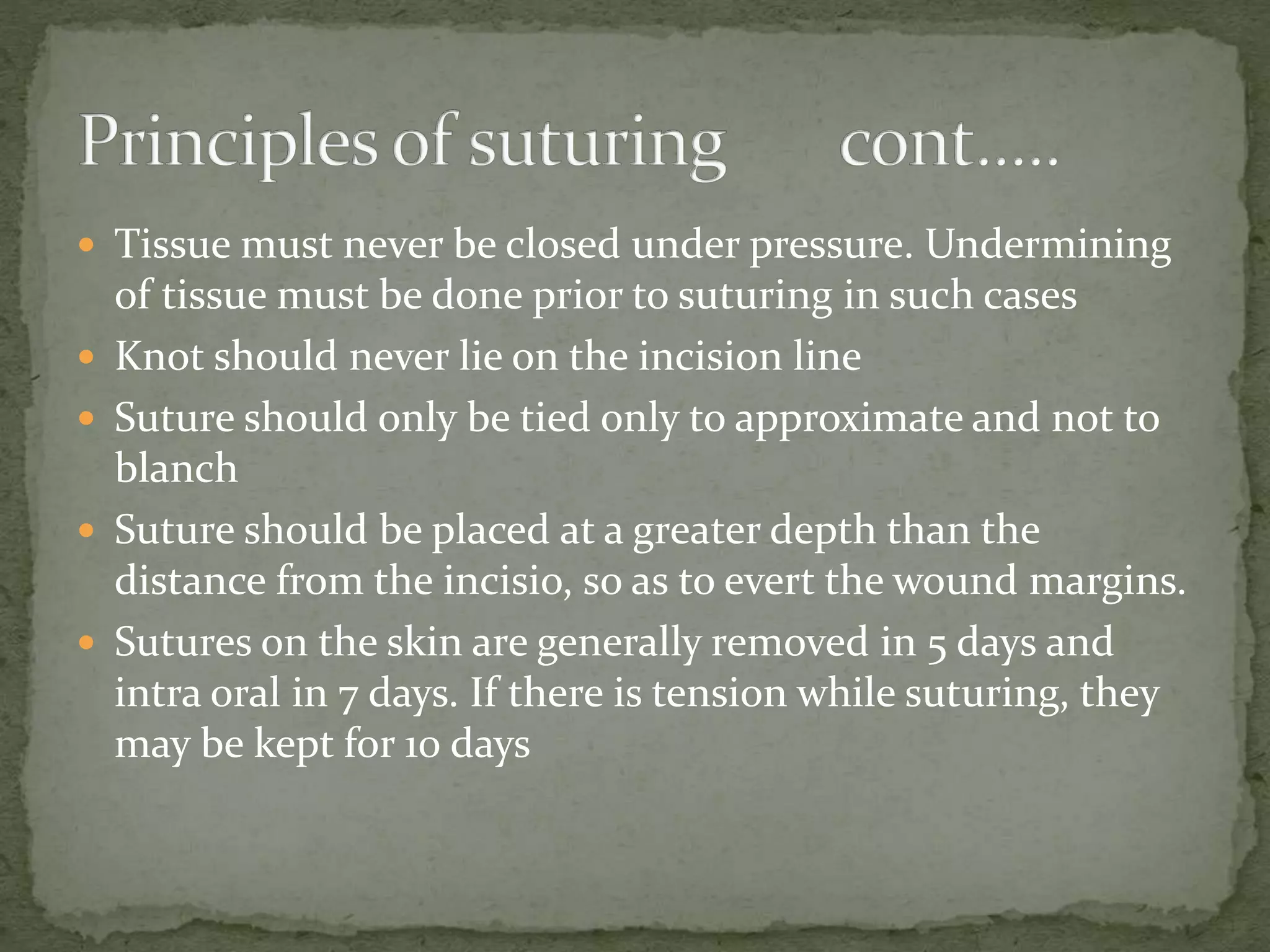
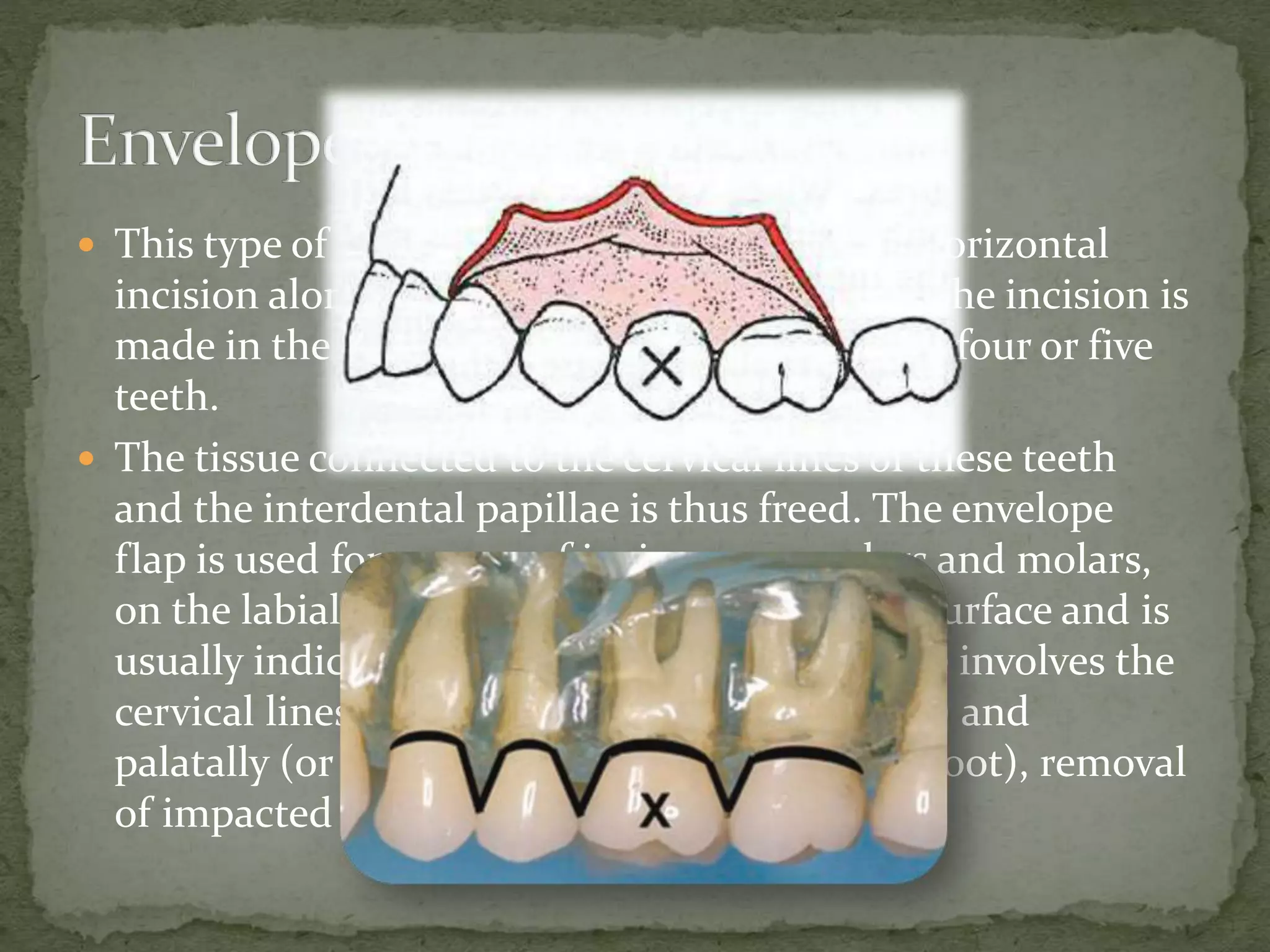
 This type of flap is the result of an extended horizontal
incision along the cervical lines of the teeth. The incision is
made in the gingival sulcus and extends along four or five
teeth.
 The tissue connected to the cervical lines of these teeth
and the interdental papillae is thus freed. The envelope
flap is used for surgery of incisors, premolars and molars,
on the labial or buccal and palatal or lingual surface and is
usually indicated when the surgical procedure involves the
cervical lines of the teeth labially (or buccally) and
palatally (or lingually), apicoectomy (palatal root), removal
of impacted teeth, cysts, etc.
 Advantages. Avoidance of vertical incision and easy
reapproximation to original position.
 Disadvantages. Difficult reflection (mainly palatally),
great tension with a risk of the ends tearing, limited
visualization in apicoectomies, limited access,
possibility of injury of palatal vessels and nerves,
defect of attached gingiva
 This flap is the result of a curved incision, which
begins just beneath the vestibular fold and has a bow
shaped course with the convex part towards the
attached gingiva
 The lowest point of the incision must be at least 0.5 cm
from the gingival margin, so that the blood supply is
not compromised. Each end of the incision must
extend at least one tooth over on each side of the area
of bone removal. The semilunar flap is used in
apicoectomies and removal of small cysts and root
tips.
 Advantages. Small incision and easy reflection, no
recession of gingivae around the prosthetic
restoration, no intervention at the periodontium,
easier oral hygiene compared to other types of flaps
 Disadvantages. Possibility of the incision being
performed right over the bone lesion due to
miscalculation, scarringmainly in the anterior area,
difficulty of reapproximation and suturing due to
absence of specific reference points, limited access and
visualization,tendency to tear.
 Gentle handling of tissue
 Meticulous haemostasis
 Preservation of blood supply
 Strict aseptic technique
 Minimum tension on tissues
 Accurate tissue apposition
 Obliteration of deadspace
 Also called as Halsted's principles, or Tenets of
Halsted
 Is a process which causes bleeding to stop
 Methods of promoting wound hemostasis –
1. Natural hemostatic mechanism
2. Use of sponge and applying pressure
3. these two cause stasis of blood and promote
coagulation. Small vessels 20 to 30 sec. larger vessels
5- 10 min. it should be dabbed rather than wiped
4. Use of electric current –fuses the cut ends
5. Sutures
6. Vasoconstrictors like adrenaline: best if placed in the
site 7 minutes before the surgery begins
 Dead space management: It is any area that remains
devoid of tissue after closure of wound
 It usually fills in with blood and can lead to hematoma
formation
 It can be eliminated in 4 ways
 A. Suturing tissue planes together to minimize post
operative void
 B. Place a pressure dressing. This brings the tissue
planes together until either they are bound by fibrin or
pressed by edema or both(takes uptp 12 to 18 hours
 C. Place a packing in the void and remove when
bleeding stops. Done when surgeon cant tack the
tissue together , eg bony cavity after cyst removal
 D.Through use of drains with or without pressure
packs
 It is a strand of thread that is used to approximate
tissues and to ligate blood vessels
 Tools:
1. Needle
2. Suture material
Source: Ratner et al. 2004
Sutures
Origin
Natural
Synthetic
Absorption
Absorbable
Nonabsorba
ble
Fiber
construction
Multifilame
nt
Monofilame
nt
 Physical
 Tensile Strength, Dimension, Knot-pull strength, Knot
security, Stiffness
 Handling
 Knot-tie down, First throw hold, Tissue drag, Package
memory, Suppleness
 Biological
 Tissue reaction, Absorption, Biocompatibility, Tensile
strength loss
Selection of suture material should be based on healing
charecteristics of the tissue being approximated
A. Rate of tissue healing. –
suture that looses its tensile strength at same rate as the
tissue gain strength.
Tissue that heal slowly are usually closed with non
absorbable sutures
Rapidly healing tissue with absorbable ones
B.Tissue contamination. – contaminated areas should be
sutured with monofilament materials
 C. cosmetic results- close and prolonged apposition of
tissue will produce best results
 D. Cancer patients- synthetic non absorbable sutures
as the the wound can breakdown.
 E. Nutritional status- non absorbable sutures to be
used in undernourished cases as the wound healing
takes longer
 Are of two types :- a. Eyed
b. Eyeless
 Needle should be grasped at approximately 1/3° the
distance from eye or 2/3 from point
 Needle should enter perpendicular to tissue surface
 Needle should pass through the tissue along its curve
 Suture should be passed at an equal depth and
distance from incision on both sides
 Needle always pass from movable to fixed tissue
 Thinner to thicker tissue
 Deeper to superficial tissue
 Tissue must never be closed under pressure. Undermining
of tissue must be done prior to suturing in such cases
 Knot should never lie on the incision line
 Suture should only be tied only to approximate and not to
blanch
 Suture should be placed at a greater depth than the
distance from the incisio, so as to evert the wound margins.
 Sutures on the skin are generally removed in 5 days and
intra oral in 7 days. If there is tension while suturing, they
may be kept for 10 days
1. Suture knot slipping
• Inability of the suture to retain until wound healing complete
• Common in absorbable suture
2. Re-infection
• Site for microbial growth causing re-infection
• the need for suture with antimicrobial activity
3. Failure of wound healing
• Improper suturing technique does not allow collagen
formation
 DECONTAMINATION is done to reduce the bacterial
count and hence reduce risk of infection
 Mostly done by irrigastion under pressure. Saline or
antibiotic solutions can be used
 DEBRIMENT is careful removal of necrotic and
ischemic tissue and foreign material from injured
tissue that would impede wound healing
 Is done where either there is a traumatic injury or
severe tissue damage is done.
 Edema is accumulation of fluid in interstitial space
because of transudation from damaged vessels and
lymphatic obstruction by fibrin
 The degree is determined by :- a. The amount of tissue
damage, b. Looser the connective tissue
 Prevention –
 A. Application of ice
 B. Patient position. Ie patient should keep the head
above the body as much as possible
 C. Short term high dose corticosteroids (only if
administerd before tissue damage is done)
Principles of oral surgery

Principles of oral surgery

  • 3.
     Definition oforal surgery  Developing a surgical diagnosis or pre surgical evaluation  Basic necessities for surgery or pre surgical preparation  Asepsis  Preparation of Patient and Surgeon  Techniques of sterilization  Maintainence of sterility  Surgical staff preparation  Incisions  Principles of flap designing and different types of flaps  Tissue handling  Hemostasis  Suture and suturing techniques  Decontamination and debridement  Edema control  Conclusion  Bibliography
  • 4.
     Oral andmaxillofacial surgery is the specialty of dentistry which includes the diagnosis, surgical and adjunctive treatment of diseases, injuries and defects involving both the functional and esthetic aspects of the hard and soft tissues of the oral and maxillofacial region
  • 5.
     The aimof preoperative evaluation is not to screen broadly for undiagnosed disease but rather to identify and quantify any comorbidity that may have an impact on the operative outcome  The context in which preoperative preparation is conducted ranges from an outpatient office visit to hospital inpatient consultation to emergency department evaluation of a patient.
  • 6.
     Know yourpatient  Examine your patient and gather patient and scientific data including the use of consultants.  Look at the data and analyze for hypothesis testing  Consider the alternatives  Is picking up a knife the best thing to do?  To practice evidence based treatment.
  • 7.
    It depends on:- >Adequateaccess >Adequate light >Clean surgical field
  • 8.
     Sepsis- Breakdownof tissue by action of microbes and is usually accompanied by inflammation  Antiseptic- Substance that can prevent multiplication of organism capable of causing infection. Anstiseptics are applied on living tissues while Disinfectant are applied on inanimate object.  Sterility- freedom from viable forms of micro organisms  Sanitization –reduction of number of viable organisms
  • 9.
     To minimisewound contamintaion by pathogens because during a surgery, dentist violates the epithelial surface which is the most important barrier against an infection  During oral surgical procedures dentist, assistant and equipment become comtaminated with patients blood and saliva
  • 12.
     By usingdisposable materials:-  Surgical field maintaenance
  • 13.
     1. Handand arm preparation Done by antiseptics with low toxicity like iodoform, chlorhexidine, and hexachlorophene  Two techniques are used for  A. Clean technique- used in office based surgeries. Surgeon wears a clean dress and over it long sleeved laboratory coat or a surgical scrub  B. Sterile technique- mostly in operating room. Purpose of it is to minimise the number or micro organism that can ener the wound site.
  • 15.
     Use asharp blade of proper size.  Use firm continuous strokes.  Avoid cutting vital structures  Incise perpendicular to the epithelial surface.  Intraoral incisions should be properly placed.
  • 17.
    1. Outlined bya surgical incision 2. Carries its own blood supply 3. Allows surgical access to underlying tissues 4. Can be replaced in the original position 5. Can be maintained with sutures and is expected to heal
  • 18.
    Flap necrosis Flap Dehiscence FlapTearing Injury to Local Structures
  • 19.
    1.Base > Freemargin • to preserve an adequate blood supply • unless a major artery is present in the base 2.Width of Base > Length of Flap*2 • less critical in oral cavity, but length < width • a long, straight incision with adequate flap reflection heals more rapidly than a short, torn incision. 3. An axial blood supply in the base 4. Hold the flap with a retractor resting on intact bone to prevent tension.
  • 20.
    The incisions mustbe made over intact bone If the pathologic condition has eroded the buccocortical plate, the incision must be at least 6 or 8 mm away from it. The incision should be 6 to 8 mm away from the bony defect created by surgery. Gently handle the flap's edges Do not place the flap under tension Do not cross bony prominences, ex: canine eminence
  • 22.
    • Is acommon problem in procedures using a flap that provides insufficient access • A proper long flap heals as quickly as a short flap • Envelope flaps – an incision around the necks of several teeth. – extends 2 teeth anterior and 1 tooth posterior.  If not provide sufficient access… • Vertical (oblique) releasing incisions: – extends 1 tooth anterior and 1 tooth posterior. – started at the line angle of a tooth. – carried obliquely apically into the unattached gingiva. – If cross the papilla  localized periodontal problems
  • 26.
     Various typesof flaps have been described in oral surgery, whose name is based mainly upon shape:-  trapezoidal,  triangular,  envelope,  semilunar,
  • 27.
     The trapezoidalflap is created after a Π shaped incision, which is formed by a  Horizontal incision along the gingivae, and two oblique vertical releasing incisions extending to the buccal vestibule.  Vertical releasing incisions always extend to the interdental papilla and never to the center of the labial or buccal surface of the tooth.  This ensures the integrity of the gingiva proper, because if the incision were to begin at the center of the tooth,contraction after healing would leave the cervical area of the tooth exposed.
  • 28.
     Advantages. Providesexcellent access, allows surgery to be performed on more than one or two teeth, produces no tension in the tissues, allows easy reapproximation of the flap to its original position and hastens the healing process.  Disadvantages. Produces a defect in the attached gingiva (recession of gingiva).
  • 29.
     This flapis the result of an Lshaped incision with a horizontal incision made along the gingival sulcus and a vertical or oblique incision  The vertical incision begins approximately at the vestibular fold and extends to the interdental papilla of the gingiva.  The triangular flap is performed labially or buccally on both jaws and is indicated in the surgical removal of root tips, small cysts, and apicoectomies.
  • 30.
     Advantages. Ensuresan adequate blood supply, satisfactory visualization, very good stability and reapproximation; it is easily modified with a small releasing incision, or an additional vertical incision, or even lengthening of the horizontal incision.  Disadvantages. Limited access to long roots, tension is created when the flap is held with a retractor, and it causes a defect in the attached gingiva
  • 31.
     This typeof flap is the result of an extended horizontal incision along the cervical lines of the teeth. The incision is made in the gingival sulcus and extends along four or five teeth.  The tissue connected to the cervical lines of these teeth and the interdental papillae is thus freed. The envelope flap is used for surgery of incisors, premolars and molars, on the labial or buccal and palatal or lingual surface and is usually indicated when the surgical procedure involves the cervical lines of the teeth labially (or buccally) and palatally (or lingually), apicoectomy (palatal root), removal of impacted teeth, cysts, etc.
  • 32.
     Advantages. Avoidanceof vertical incision and easy reapproximation to original position.  Disadvantages. Difficult reflection (mainly palatally), great tension with a risk of the ends tearing, limited visualization in apicoectomies, limited access, possibility of injury of palatal vessels and nerves, defect of attached gingiva
  • 33.
     This flapis the result of a curved incision, which begins just beneath the vestibular fold and has a bow shaped course with the convex part towards the attached gingiva  The lowest point of the incision must be at least 0.5 cm from the gingival margin, so that the blood supply is not compromised. Each end of the incision must extend at least one tooth over on each side of the area of bone removal. The semilunar flap is used in apicoectomies and removal of small cysts and root tips.
  • 34.
     Advantages. Smallincision and easy reflection, no recession of gingivae around the prosthetic restoration, no intervention at the periodontium, easier oral hygiene compared to other types of flaps  Disadvantages. Possibility of the incision being performed right over the bone lesion due to miscalculation, scarringmainly in the anterior area, difficulty of reapproximation and suturing due to absence of specific reference points, limited access and visualization,tendency to tear.
  • 35.
     Gentle handlingof tissue  Meticulous haemostasis  Preservation of blood supply  Strict aseptic technique  Minimum tension on tissues  Accurate tissue apposition  Obliteration of deadspace  Also called as Halsted's principles, or Tenets of Halsted
  • 36.
     Is aprocess which causes bleeding to stop  Methods of promoting wound hemostasis – 1. Natural hemostatic mechanism 2. Use of sponge and applying pressure 3. these two cause stasis of blood and promote coagulation. Small vessels 20 to 30 sec. larger vessels 5- 10 min. it should be dabbed rather than wiped 4. Use of electric current –fuses the cut ends 5. Sutures 6. Vasoconstrictors like adrenaline: best if placed in the site 7 minutes before the surgery begins
  • 37.
     Dead spacemanagement: It is any area that remains devoid of tissue after closure of wound  It usually fills in with blood and can lead to hematoma formation  It can be eliminated in 4 ways  A. Suturing tissue planes together to minimize post operative void  B. Place a pressure dressing. This brings the tissue planes together until either they are bound by fibrin or pressed by edema or both(takes uptp 12 to 18 hours
  • 38.
     C. Placea packing in the void and remove when bleeding stops. Done when surgeon cant tack the tissue together , eg bony cavity after cyst removal  D.Through use of drains with or without pressure packs
  • 39.
     It isa strand of thread that is used to approximate tissues and to ligate blood vessels  Tools: 1. Needle 2. Suture material Source: Ratner et al. 2004
  • 40.
  • 42.
     Physical  TensileStrength, Dimension, Knot-pull strength, Knot security, Stiffness  Handling  Knot-tie down, First throw hold, Tissue drag, Package memory, Suppleness  Biological  Tissue reaction, Absorption, Biocompatibility, Tensile strength loss
  • 43.
    Selection of suturematerial should be based on healing charecteristics of the tissue being approximated A. Rate of tissue healing. – suture that looses its tensile strength at same rate as the tissue gain strength. Tissue that heal slowly are usually closed with non absorbable sutures Rapidly healing tissue with absorbable ones B.Tissue contamination. – contaminated areas should be sutured with monofilament materials
  • 44.
     C. cosmeticresults- close and prolonged apposition of tissue will produce best results  D. Cancer patients- synthetic non absorbable sutures as the the wound can breakdown.  E. Nutritional status- non absorbable sutures to be used in undernourished cases as the wound healing takes longer
  • 45.
     Are oftwo types :- a. Eyed b. Eyeless
  • 48.
     Needle shouldbe grasped at approximately 1/3° the distance from eye or 2/3 from point  Needle should enter perpendicular to tissue surface  Needle should pass through the tissue along its curve  Suture should be passed at an equal depth and distance from incision on both sides  Needle always pass from movable to fixed tissue  Thinner to thicker tissue  Deeper to superficial tissue
  • 49.
     Tissue mustnever be closed under pressure. Undermining of tissue must be done prior to suturing in such cases  Knot should never lie on the incision line  Suture should only be tied only to approximate and not to blanch  Suture should be placed at a greater depth than the distance from the incisio, so as to evert the wound margins.  Sutures on the skin are generally removed in 5 days and intra oral in 7 days. If there is tension while suturing, they may be kept for 10 days
  • 50.
    1. Suture knotslipping • Inability of the suture to retain until wound healing complete • Common in absorbable suture 2. Re-infection • Site for microbial growth causing re-infection • the need for suture with antimicrobial activity 3. Failure of wound healing • Improper suturing technique does not allow collagen formation
  • 51.
     DECONTAMINATION isdone to reduce the bacterial count and hence reduce risk of infection  Mostly done by irrigastion under pressure. Saline or antibiotic solutions can be used  DEBRIMENT is careful removal of necrotic and ischemic tissue and foreign material from injured tissue that would impede wound healing  Is done where either there is a traumatic injury or severe tissue damage is done.
  • 52.
     Edema isaccumulation of fluid in interstitial space because of transudation from damaged vessels and lymphatic obstruction by fibrin  The degree is determined by :- a. The amount of tissue damage, b. Looser the connective tissue  Prevention –  A. Application of ice  B. Patient position. Ie patient should keep the head above the body as much as possible  C. Short term high dose corticosteroids (only if administerd before tissue damage is done)

Editor's Notes

  • #3 Human tissue have genetically determined properties that makes their normal responses to injury predictable, because of this predictability principles of surgery that help optimize wound healing environment have been developed thru basic and clinical research. These principles are what makes the difference between the early dentist on the left and a surgeon on the right
  • #7 Examine your patient and gather patient and scientific data including the use of consultants. and not to use incomplete or poor quality data like poor quality radiographs
  • #17 Blade No. 10 – with its curved cutting edge is one of the more traditional blade shapes and is used generally for making small incisions in skin and muscles . The No.10 is often utilised in more specialised surgeries such as harvesting the artery during a coronary artery bypass operation, opening the bronchus during thoracic surgery and for Inguinal hernia repair. Blade No. 11 - is an elongated triangular blade sharpened along the hypotenuse edge and with a strong pointed tip making it ideal for stab incisions. Used in various procedures such as the creation of incisions for chest drains, opening coronary arteries, opening the aorta and removing calcifications in the aortic or mitral valves. Blade No. 12 - is a small, pointed, crescent shaped blade sharpened along the inside edge of the curve. It is sometimes utilised as a suture cutter but also for arteriotomies ( surgical incision of an artery), parotid surgeries (facial salivary glands), mucosal cuts on a septoplasty (repair of nasal septum) and during cleft palate procedures, ureterolithotomies (calculus removal by incision of the ureter) and pyelolithotomies (surgical incision of the renal pelvis of a kidney for the removal of a kidney stone - also known as a pelviolithotomy ). Blade No.12D – (sometimes referred to as the 12B in the USA), is a double edged No. 12 blade sharpened along both sides of the crescent shaped curve. It is used extensively within dental surgery techniques. Blade No. 14 - mostly used in aesthetic procedures that help to rejuvenate the skin's top layers through a method of controlled surgical scraping. Blade No. 15 - has a small curved cutting edge and is the most popular blade shape ideal for making short and precise incisions. It is utilised in a variety of surgical procedures including the excision of a skin lesion or recurrent sebaceous cyst and for opening coronary arteries. Blade No.15C - with a longer cutting edge than the traditional No.15 blade. Mostly used by dentists carrying out periodontal procedures. Blade No.20 - is a large version of the No.10 blade with a curved cutting edge and an unsharpened back edge. Used for orthopaedic and general surgical procedures. Blade No.21 is a large version of the No.10 blade with a curved cutting edge and an unsharpened back edge. Larger than the No.20 but smaller than the No.22. Blade No.22 is a large version of the No.10 blade with a curved cutting edge and an unsharpened back edge. Used for skin incisions in both cardiac and thoracic surgrey and to cut the bronchus in lung resection surgery. Larger than the No.20 and No.21. Blade No.23 has a flat, unsharpened back edge and a curved cutting edge. Used mostly for making long incisions such as an upper midline incision of the abdomen during the repair of a perforated gastric ulcer. Blade No.24 is slightly larger than the No.23 blade and is more semi circular in shape. Used for making long incisions in general surgery and also in autopsy procedures. Blade No.36 is a large blade mostly used in general surgery but also in histology procedures.