SUTURES & SUTURING IN
SURGERY
BY
DR MUKORO DUKE GEORGE
B.SC,MBBS,MCS,HSECERT,ATLS,DTM&HLIVERPOOL
GRADUATE MEMBER NIM
NDUTH,
OUTLINE
o

INTRODUCTION



HISTORICAL BACKGROUND



DEFINITIONS

o QUALITIES OF AN IDEAL SUTURE
o CLASSIFICATION/STRENGTH
o TYPES/USES
o SUTURE SELECTION

o SUTURE ACCESSORIES(NEEDLES)
o STERILIZATION OF SUTURES
o SUTURE REMOVAL
o COMPLICATIONS
o RECENT ADVANCES
o CONCLUSION
o REFERENCES
INTRODUCTION
•

•

DEFINATIONS ⌂ Suturing refers to sewing
together two structure using suture threaded on a
needle. The purpose of suture is to hold tissues
together until strong enough to support itself
during wound healing.
Ligating or ligaturing refers to tying a ductal
structure such as blood vessel simply by means of
a suture thread.
INTRODUCTION
 HISTORICAL BACKGROUND
 Sutures are used to improve & speed healing
 Hx dates back to 550-3000BC
 Early sutures were Flax, Silk, Linen strips & cotton
 Synthetic sutures are now available
DEFINITIONS
 Suture is a material used to approximate living tissues

or xtures together
 Ligature is a suture used to encircle a bld vessel to
arrest or control bleeding
 Tensile strength is the ability of the material or tissues
to resist deformation or breakage
 Elasticity is the ability of the material to regain its
original form or length after deformation
 Pliability is the ability to adjust knot tension & to
secure knot
 Memory is the inherent capability of suture to return or
maintain its original gross shape
QUALITIES OF AN IDEAL SUTURE
by Lord Mogniham (1865 – 1936)
 Sterile and easily sterilizable
 Serve all purpose
 Minimal tissue :non-electrolytic, non-capillary, non-allergenic,
non-carcinogenic (and non-thrombogenic in vascular surgery.
 Easy to handle
 Hold knot securely
 High tensile strength
 Favourable absorption profile
 Resistant to infection
 Available
 Inexpensive
Features of a suture
1)
2)
3)
4)
5)
6)
7)

8)
9)

Suture stength - Measured by instron tensiometer.
Tissue Reactivity
Handling
Knotting
Sterilization
Absorbility
Viability
Elasticity
Size
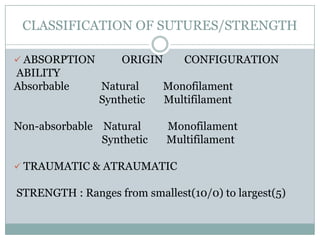
CLASSIFICATION OF SUTURES/STRENGTH
 ABSORPTION

ABILITY
Absorbable

ORIGIN

Natural
Synthetic

Non-absorbable Natural
Synthetic

CONFIGURATION

Monofilament
Multifilament
Monofilament
Multifilament

 TRAUMATIC & ATRAUMATIC

STRENGTH : Ranges from smallest(10/0) to largest(5)
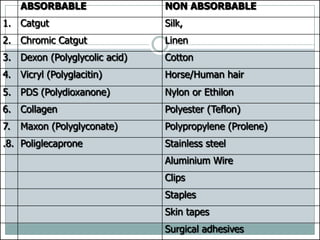
ABSORBABLE

NON ABSORBABLE

1. Catgut

Silk,

2. Chromic Catgut

Linen

3. Dexon (Polyglycolic acid)

Cotton

4. Vicryl (Polyglacitin)

Horse/Human hair

5. PDS (Polydioxanone)

Nylon or Ethilon

6. Collagen

Polyester (Teflon)

7.

Polypropylene (Prolene)

Maxon (Polyglyconate)

.8. Poliglecaprone

Stainless steel
Aluminium Wire
Clips

Staples
Skin tapes
Surgical adhesives
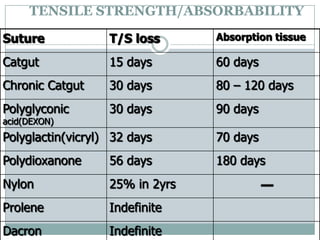
TENSILE STRENGTH/ABSORBABILITY
Suture

T/S loss

Absorption tissue

Catgut

15 days

60 days

Chronic Catgut

30 days

80 – 120 days

Polyglyconic

30 days

90 days

Polyglactin(vicryl) 32 days

70 days

Polydioxanone

56 days

180 days

Nylon

25% in 2yrs

Prolene

Indefinite

Dacron

Indefinite

acid(DEXON)
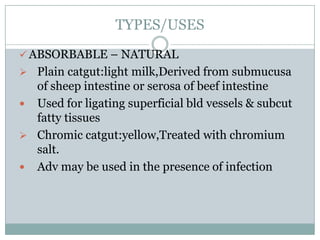
TYPES/USES
 ABSORBABLE – NATURAL
 Plain catgut:light milk,Derived from submucusa

of sheep intestine or serosa of beef intestine
 Used for ligating superficial bld vessels & subcut
fatty tissues
 Chromic catgut:yellow,Treated with chromium
salt.
 Adv may be used in the presence of infection
ABSORBABLE - SYNTHETIC
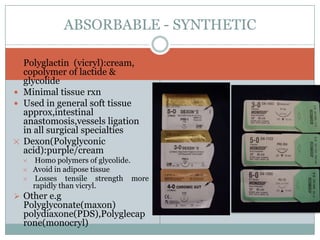
 Polyglactin (vicryl):cream,

copolymer of lactide &
glycolide
 Minimal tissue rxn
 Used in general soft tissue
approx,intestinal
anastomosis,vessels ligation
in all surgical specialties
Dexon(Polyglyconic
acid):purple/cream
Homo polymers of glycolide.
Avoid in adipose tissue
Losses tensile strength more
rapidly than vicryl.

 Other e.g

Polyglyconate(maxon)
polydiaxone(PDS),Polyglecap
rone(monocryl)
NON-ABSORBABLE-NATURAL
 Surgical silk:Black, Derived from the cocoon of the

silk worm larvae, superior handling xtics,Trigger
inflam rxns,Undergo proteolysis & undetected by
2yrs,Used in ligating maj bld ves,tendon repair etc
 Surgical steel & wires
 High tensile strength
 Hold knots very well
 Used in orthopaedic,Neurosurg,& Thoracic surg
 Other e.g Virgin silk,cotton, linen
NON-ABSORBABLE - SYNTHETIC
 Nylon:Is a polyamide polymer,blue
 81% tensile strength at 1yr & 66% at 11yrs
 Elicits minimal tissue rxn
 Has good memory
 Pliable when moist

 Premoistened form is used cosmetic plastic surgery
 Its elasticity makes it useful for skin closure &

Herniorhapy
 Other e.g;Polypropylene(prolene),Polyester
fiber(Mersilene/Dacron,Ethibond)
SYNTHETIC NON-ABSORBABLE (CUT)
Staples and chips:
Faster than traditional suture, in gut anastomosis, vascular
&bronchial closure.

Skin tapes:
Impervious to sweat, wound infection less, avoid suture marks.

Surgical adhesives:
Expanded polytetra fuoroethylene
Monofilament Suture
 Grossly appears as single strand of suture







material; all fibers run parallel
Minimal tissue trauma
Resists harbouring microorganisms
Ties smoothly
Requires more knots than multifilament suture
Possesses memory
Examples:
Monocryl, PDS, Prolene, Nylon
Multifilament Suture
 Fibers are twisted or braided together
 Greater resistance in tissue
 Provides good handling and ease off tying
 Fewer knots required
 Examples:
 Vicryl (braided)
 Chromic (twisted)
 Silk (braided)
SUTURE SELECTION
 Depends on surgeons training & preference
 Smallest suture is preferable
 Tensile strength of suture should not exceed that of

tissues
 Aesthetics should be considered e.g head&neck
 Mobility of the region e.g Limbs & trunk
 Tension of the tissues to be sutured e.g major
musculocutaneous flaps
 Non-absorbable considered in skin,fascia,tendon
 Absorbable considered in rapidly healing tissues
 Monofiliments preferable in contaminated wounds
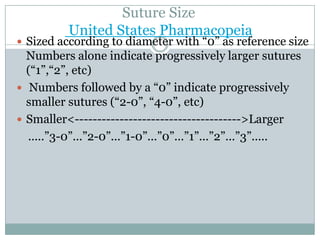
Suture Size
United States Pharmacopeia

 Sized according to diameter with “0” as reference size

Numbers alone indicate progressively larger sutures
(“1”,“2”, etc)
 Numbers followed by a “0” indicate progressively
smaller sutures (“2-0”, “4-0”, etc)
 Smaller<------------------------------------->Larger
.....”3-0”...”2-0”...”1-0”...”0”...”1”...”2”...”3”.....
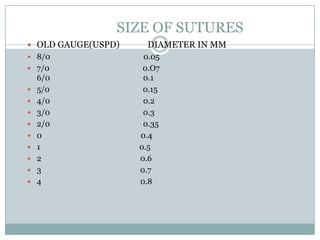
SIZE OF SUTURES
 OLD GAUGE(USPD)
 8/0
 7/0











6/0
5/0
4/0
3/0
2/0
0
1
2
3
4

DIAMETER IN MM
0.05
0.O7
0.1
0.15
0.2
0.3
0.35
0.4
0.5
0.6
0.7
0.8
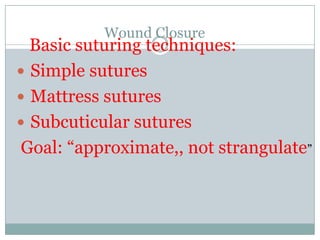
Wound Closure

Basic suturing techniques:
 Simple sutures
 Mattress sutures
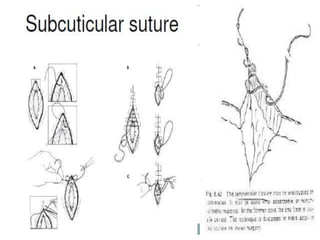
 Subcuticular sutures
Goal: “approximate,, not strangulate”
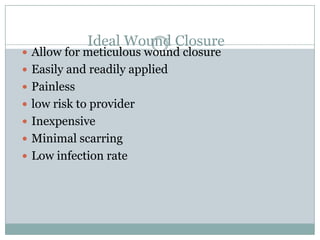
Ideal Wound Closure

 Allow for meticulous wound closure
 Easily and readily applied

 Painless
 low risk to provider
 Inexpensive

 Minimal scarring
 Low infection rate
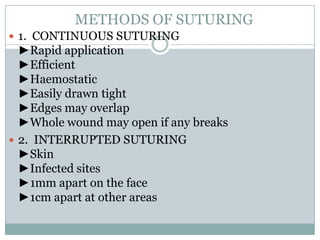
METHODS OF SUTURING
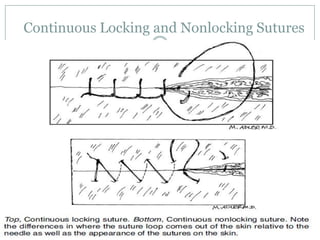
 1. CONTINUOUS SUTURING

►Rapid application
►Efficient
►Haemostatic
►Easily drawn tight
►Edges may overlap
►Whole wound may open if any breaks
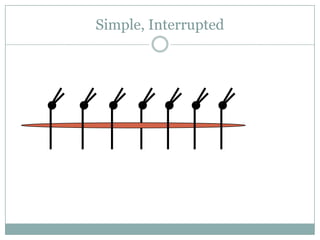
 2. INTERRUPTED SUTURING
►Skin
►Infected sites
►1mm apart on the face
►1cm apart at other areas
Continuous Locking and Nonlocking Sutures
Simple, Interrupted
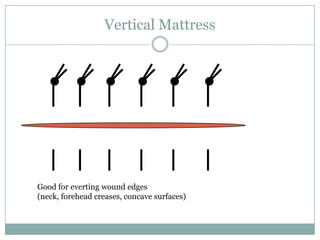
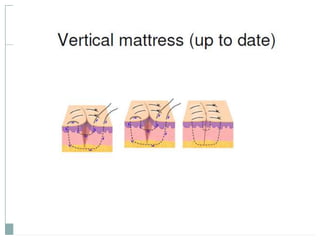
Vertical Mattress

Good for everting wound edges
(neck, forehead creases, concave surfaces)
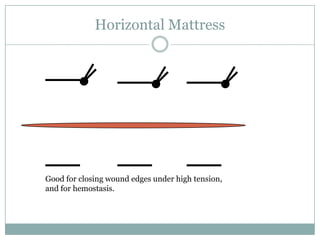
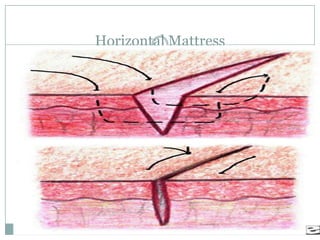
Horizontal Mattress

Good for closing wound edges under high tension,
and for hemostasis.
Horizontal Mattress
SUTURE ACCESSORY-NEEDLES







Ideal surgical needle
High quality stainless steel
Smallest diameter possible
Stable in the grasp of needle holder
Sharp enough to penetrate tissues with minimal
resistance & trauma
Sterile & corrosive resistant
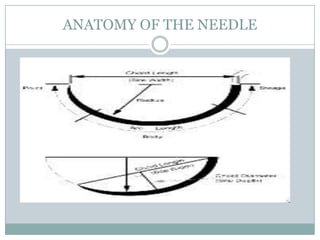
ANATOMY OF THE NEEDLE
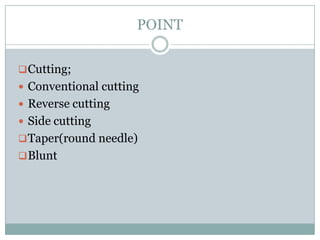
POINT
 Cutting;
 Conventional cutting
 Reverse cutting

 Side cutting
 Taper(round needle)
 Blunt
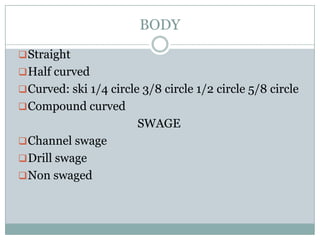
BODY
 Straight
 Half curved
 Curved: ski 1/4 circle 3/8 circle 1/2 circle 5/8 circle

 Compound curved

SWAGE
 Channel swage

 Drill swage
 Non swaged
STERILIZATION OF SUTURES
 May affect suture properties to some extent
 Gamma Radiation
 Ethylene oxide;poisonous gas,is less attractive
 Autoclave
 Sutures are usually stored in sterile pack by the

manufacturers,their integrity must be checked b/4
use
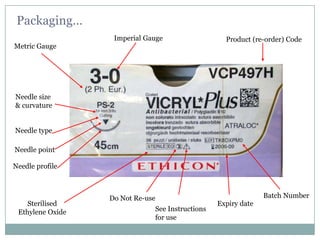
Packaging…
Metric Gauge

Imperial Gauge

Product (re-order) Code

Needle size
& curvature
Needle type
Needle point
Needle profile

Sterilised
Ethylene Oxide

Do Not Re-use
See Instructions
for use

Expiry date

Batch Number
SUTURE REMOVAL
 Sutures on the superficial(skin) wounds are removed







after serving their fxn
Duration depends on the site;
Head & Face = 3-5d
Arms & Hands = 7-10d
Chest
=7-10d
Abdomen =7-1od
Lower limbs/feet =10-14d
COMPLICATIONS
 Usually less if proper selection is followed
 Failure
 Undo
 Tissue rxn
 Infection
 Abscess and sinus formation
 scarring
RECENT ADVANCES
 Staples & Clips

 Formed from high quality stainless steel
 New absorbable clips made of polydiaxone are

available
 Staples are suitable for skin closure
 Stapling gun for bowel anastomosis are popular
 Skin Tapes & Adhesives e.g Dermabond
 Non-suture methods of closing wound edges
 Applied after adequate subcuticular closure
 Minimal infection rate & no tissue rxn
 EXPENSIVE
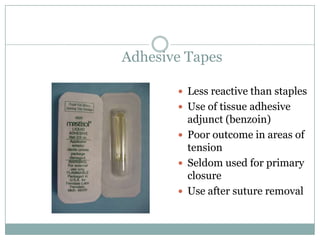
Adhesive Tapes
 Less reactive than staples
 Use of tissue adhesive

adjunct (benzoin)
 Poor outcome in areas of
tension
 Seldom used for primary
closure
 Use after suture removal
Adhesive Tapes

Advantages

• Least
reactive
• Lowest
infection rate
• Rapid
application
• Patient
comfort
• Low cost
• No risk of
needle stick

Disadvantages

• Frequently
falls off
• Lower tensile
strength than
sutures
• Highest rate of
dehiscence
• Requires use
of toxic
adjuncts
• Cannot be
used in areas
of hair
• Cannot get wet
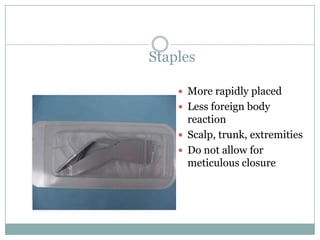
Staples
 More rapidly placed
 Less foreign body

reaction
 Scalp, trunk, extremities
 Do not allow for
meticulous closure
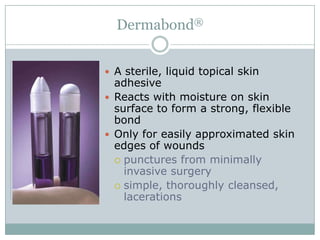
Dermabond®
 A sterile, liquid topical skin

adhesive
 Reacts with moisture on skin
surface to form a strong, flexible
bond
 Only for easily approximated skin
edges of wounds
 punctures from minimally
invasive surgery
 simple, thoroughly cleansed,
lacerations
Dermabond®
 Standard surgical wound prep and dry

 Crack ampule or applicator tip up; invert
 Hold skin edges approximated horizontally
 Gently and evenly apply at least two thin

layers on the surface of the edges with a
brushing motion with at least 30 s between
each layer, hold for 60 s after last layer until
not tacky
 Apply dressing
CONCLUSION
 Human body is very delicate & important.When

surgeries are needed to improve our health is very
important to select a suitable suture.Today we know
alots of biomaterials to select,but is important to
always think of biocompatibility.
REFERENCES
1) Post-graduate surgery, candidates guide M.A.R

Alfallouji,2nd edition
2) Principles & practice of surgery including
pathology in the Tropics, E.A.Badoe etal 3rd edition
3) Clinical surgery Alfred Cusheri etal 2nd edition
4) www.e.medicine.com
THANK YOU
FOR
LISTENING

Sutures and suturing patterns in surgery & modern innovations

  • 1.
    SUTURES & SUTURINGIN SURGERY BY DR MUKORO DUKE GEORGE B.SC,MBBS,MCS,HSECERT,ATLS,DTM&HLIVERPOOL GRADUATE MEMBER NIM NDUTH,
  • 2.
    OUTLINE o INTRODUCTION  HISTORICAL BACKGROUND  DEFINITIONS o QUALITIESOF AN IDEAL SUTURE o CLASSIFICATION/STRENGTH o TYPES/USES o SUTURE SELECTION o SUTURE ACCESSORIES(NEEDLES) o STERILIZATION OF SUTURES o SUTURE REMOVAL o COMPLICATIONS o RECENT ADVANCES o CONCLUSION o REFERENCES
  • 3.
    INTRODUCTION • • DEFINATIONS ⌂ Suturingrefers to sewing together two structure using suture threaded on a needle. The purpose of suture is to hold tissues together until strong enough to support itself during wound healing. Ligating or ligaturing refers to tying a ductal structure such as blood vessel simply by means of a suture thread.
  • 4.
    INTRODUCTION  HISTORICAL BACKGROUND Sutures are used to improve & speed healing  Hx dates back to 550-3000BC  Early sutures were Flax, Silk, Linen strips & cotton  Synthetic sutures are now available
  • 5.
    DEFINITIONS  Suture isa material used to approximate living tissues or xtures together  Ligature is a suture used to encircle a bld vessel to arrest or control bleeding  Tensile strength is the ability of the material or tissues to resist deformation or breakage  Elasticity is the ability of the material to regain its original form or length after deformation  Pliability is the ability to adjust knot tension & to secure knot  Memory is the inherent capability of suture to return or maintain its original gross shape
  • 6.
    QUALITIES OF ANIDEAL SUTURE by Lord Mogniham (1865 – 1936)  Sterile and easily sterilizable  Serve all purpose  Minimal tissue :non-electrolytic, non-capillary, non-allergenic, non-carcinogenic (and non-thrombogenic in vascular surgery.  Easy to handle  Hold knot securely  High tensile strength  Favourable absorption profile  Resistant to infection  Available  Inexpensive
  • 7.
    Features of asuture 1) 2) 3) 4) 5) 6) 7) 8) 9) Suture stength - Measured by instron tensiometer. Tissue Reactivity Handling Knotting Sterilization Absorbility Viability Elasticity Size
  • 8.
    CLASSIFICATION OF SUTURES/STRENGTH ABSORPTION ABILITY Absorbable ORIGIN Natural Synthetic Non-absorbable Natural Synthetic CONFIGURATION Monofilament Multifilament Monofilament Multifilament  TRAUMATIC & ATRAUMATIC STRENGTH : Ranges from smallest(10/0) to largest(5)
  • 9.
    ABSORBABLE NON ABSORBABLE 1. Catgut Silk, 2.Chromic Catgut Linen 3. Dexon (Polyglycolic acid) Cotton 4. Vicryl (Polyglacitin) Horse/Human hair 5. PDS (Polydioxanone) Nylon or Ethilon 6. Collagen Polyester (Teflon) 7. Polypropylene (Prolene) Maxon (Polyglyconate) .8. Poliglecaprone Stainless steel Aluminium Wire Clips Staples Skin tapes Surgical adhesives
  • 10.
    TENSILE STRENGTH/ABSORBABILITY Suture T/S loss Absorptiontissue Catgut 15 days 60 days Chronic Catgut 30 days 80 – 120 days Polyglyconic 30 days 90 days Polyglactin(vicryl) 32 days 70 days Polydioxanone 56 days 180 days Nylon 25% in 2yrs Prolene Indefinite Dacron Indefinite acid(DEXON)
  • 11.
    TYPES/USES  ABSORBABLE –NATURAL  Plain catgut:light milk,Derived from submucusa of sheep intestine or serosa of beef intestine  Used for ligating superficial bld vessels & subcut fatty tissues  Chromic catgut:yellow,Treated with chromium salt.  Adv may be used in the presence of infection
  • 12.
    ABSORBABLE - SYNTHETIC Polyglactin (vicryl):cream, copolymer of lactide & glycolide  Minimal tissue rxn  Used in general soft tissue approx,intestinal anastomosis,vessels ligation in all surgical specialties Dexon(Polyglyconic acid):purple/cream Homo polymers of glycolide. Avoid in adipose tissue Losses tensile strength more rapidly than vicryl.  Other e.g Polyglyconate(maxon) polydiaxone(PDS),Polyglecap rone(monocryl)
  • 13.
    NON-ABSORBABLE-NATURAL  Surgical silk:Black,Derived from the cocoon of the silk worm larvae, superior handling xtics,Trigger inflam rxns,Undergo proteolysis & undetected by 2yrs,Used in ligating maj bld ves,tendon repair etc  Surgical steel & wires  High tensile strength  Hold knots very well  Used in orthopaedic,Neurosurg,& Thoracic surg  Other e.g Virgin silk,cotton, linen
  • 14.
    NON-ABSORBABLE - SYNTHETIC Nylon:Is a polyamide polymer,blue  81% tensile strength at 1yr & 66% at 11yrs  Elicits minimal tissue rxn  Has good memory  Pliable when moist  Premoistened form is used cosmetic plastic surgery  Its elasticity makes it useful for skin closure & Herniorhapy  Other e.g;Polypropylene(prolene),Polyester fiber(Mersilene/Dacron,Ethibond)
  • 15.
    SYNTHETIC NON-ABSORBABLE (CUT) Staplesand chips: Faster than traditional suture, in gut anastomosis, vascular &bronchial closure. Skin tapes: Impervious to sweat, wound infection less, avoid suture marks. Surgical adhesives: Expanded polytetra fuoroethylene
  • 16.
    Monofilament Suture  Grosslyappears as single strand of suture     material; all fibers run parallel Minimal tissue trauma Resists harbouring microorganisms Ties smoothly Requires more knots than multifilament suture Possesses memory Examples: Monocryl, PDS, Prolene, Nylon
  • 17.
    Multifilament Suture  Fibersare twisted or braided together  Greater resistance in tissue  Provides good handling and ease off tying  Fewer knots required  Examples:  Vicryl (braided)  Chromic (twisted)  Silk (braided)
  • 18.
    SUTURE SELECTION  Dependson surgeons training & preference  Smallest suture is preferable  Tensile strength of suture should not exceed that of tissues  Aesthetics should be considered e.g head&neck  Mobility of the region e.g Limbs & trunk  Tension of the tissues to be sutured e.g major musculocutaneous flaps  Non-absorbable considered in skin,fascia,tendon  Absorbable considered in rapidly healing tissues  Monofiliments preferable in contaminated wounds
  • 19.
    Suture Size United StatesPharmacopeia  Sized according to diameter with “0” as reference size Numbers alone indicate progressively larger sutures (“1”,“2”, etc)  Numbers followed by a “0” indicate progressively smaller sutures (“2-0”, “4-0”, etc)  Smaller<------------------------------------->Larger .....”3-0”...”2-0”...”1-0”...”0”...”1”...”2”...”3”.....
  • 20.
    SIZE OF SUTURES OLD GAUGE(USPD)  8/0  7/0          6/0 5/0 4/0 3/0 2/0 0 1 2 3 4 DIAMETER IN MM 0.05 0.O7 0.1 0.15 0.2 0.3 0.35 0.4 0.5 0.6 0.7 0.8
  • 21.
    Wound Closure Basic suturingtechniques:  Simple sutures  Mattress sutures  Subcuticular sutures Goal: “approximate,, not strangulate”
  • 22.
    Ideal Wound Closure Allow for meticulous wound closure  Easily and readily applied  Painless  low risk to provider  Inexpensive  Minimal scarring  Low infection rate
  • 23.
    METHODS OF SUTURING 1. CONTINUOUS SUTURING ►Rapid application ►Efficient ►Haemostatic ►Easily drawn tight ►Edges may overlap ►Whole wound may open if any breaks  2. INTERRUPTED SUTURING ►Skin ►Infected sites ►1mm apart on the face ►1cm apart at other areas
  • 24.
    Continuous Locking andNonlocking Sutures
  • 26.
  • 27.
    Vertical Mattress Good foreverting wound edges (neck, forehead creases, concave surfaces)
  • 29.
    Horizontal Mattress Good forclosing wound edges under high tension, and for hemostasis.
  • 30.
  • 31.
    SUTURE ACCESSORY-NEEDLES      Ideal surgicalneedle High quality stainless steel Smallest diameter possible Stable in the grasp of needle holder Sharp enough to penetrate tissues with minimal resistance & trauma Sterile & corrosive resistant
  • 32.
  • 33.
    POINT  Cutting;  Conventionalcutting  Reverse cutting  Side cutting  Taper(round needle)  Blunt
  • 34.
    BODY  Straight  Halfcurved  Curved: ski 1/4 circle 3/8 circle 1/2 circle 5/8 circle  Compound curved SWAGE  Channel swage  Drill swage  Non swaged
  • 35.
    STERILIZATION OF SUTURES May affect suture properties to some extent  Gamma Radiation  Ethylene oxide;poisonous gas,is less attractive  Autoclave  Sutures are usually stored in sterile pack by the manufacturers,their integrity must be checked b/4 use
  • 36.
    Packaging… Metric Gauge Imperial Gauge Product(re-order) Code Needle size & curvature Needle type Needle point Needle profile Sterilised Ethylene Oxide Do Not Re-use See Instructions for use Expiry date Batch Number
  • 37.
    SUTURE REMOVAL  Sutureson the superficial(skin) wounds are removed       after serving their fxn Duration depends on the site; Head & Face = 3-5d Arms & Hands = 7-10d Chest =7-10d Abdomen =7-1od Lower limbs/feet =10-14d
  • 38.
    COMPLICATIONS  Usually lessif proper selection is followed  Failure  Undo  Tissue rxn  Infection  Abscess and sinus formation  scarring
  • 39.
    RECENT ADVANCES  Staples& Clips  Formed from high quality stainless steel  New absorbable clips made of polydiaxone are available  Staples are suitable for skin closure  Stapling gun for bowel anastomosis are popular  Skin Tapes & Adhesives e.g Dermabond  Non-suture methods of closing wound edges  Applied after adequate subcuticular closure  Minimal infection rate & no tissue rxn  EXPENSIVE
  • 40.
    Adhesive Tapes  Lessreactive than staples  Use of tissue adhesive adjunct (benzoin)  Poor outcome in areas of tension  Seldom used for primary closure  Use after suture removal
  • 41.
    Adhesive Tapes Advantages • Least reactive •Lowest infection rate • Rapid application • Patient comfort • Low cost • No risk of needle stick Disadvantages • Frequently falls off • Lower tensile strength than sutures • Highest rate of dehiscence • Requires use of toxic adjuncts • Cannot be used in areas of hair • Cannot get wet
  • 42.
    Staples  More rapidlyplaced  Less foreign body reaction  Scalp, trunk, extremities  Do not allow for meticulous closure
  • 43.
    Dermabond®  A sterile,liquid topical skin adhesive  Reacts with moisture on skin surface to form a strong, flexible bond  Only for easily approximated skin edges of wounds  punctures from minimally invasive surgery  simple, thoroughly cleansed, lacerations
  • 44.
    Dermabond®  Standard surgicalwound prep and dry  Crack ampule or applicator tip up; invert  Hold skin edges approximated horizontally  Gently and evenly apply at least two thin layers on the surface of the edges with a brushing motion with at least 30 s between each layer, hold for 60 s after last layer until not tacky  Apply dressing
  • 45.
    CONCLUSION  Human bodyis very delicate & important.When surgeries are needed to improve our health is very important to select a suitable suture.Today we know alots of biomaterials to select,but is important to always think of biocompatibility.
  • 46.
    REFERENCES 1) Post-graduate surgery,candidates guide M.A.R Alfallouji,2nd edition 2) Principles & practice of surgery including pathology in the Tropics, E.A.Badoe etal 3rd edition 3) Clinical surgery Alfred Cusheri etal 2nd edition 4) www.e.medicine.com
  • 47.