Flap Design for Minor Oral Surgery Presenter: R1 鄭瑋之  Instructor: VS 陳靜容醫師  2012/2/24
Stages of Operation Retraction Incision Reflection Bone removal access point of elevation removal of obstruction Tooth section Delivery Clean-up Sew-up Check-up Follow-up Write-up
Principles of Flap Design Local flap outlined by a  surgical incision carries its own  blood supply allows surgical  access  to underlying tissues can be replaced in the  original position can be maintained with  sutures  and is expected to  heal Used in oral  surgical, periodontic, and endodontic  procedures to gain access.
Principles of Flap Design Complications Flap necrosis Flap Dehiscence Flap Tearing Injury to Local Structures
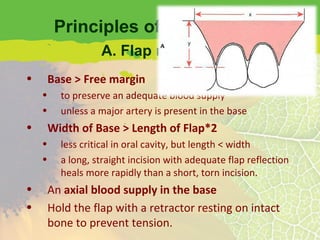
Principles of Flap Design Base > Free margin to preserve an adequate blood supply unless a major artery is present in the base Width of Base > Length of Flap*2 less critical in oral cavity, but length < width a long, straight incision with adequate flap reflection heals more rapidly than a short, torn incision. An  axial blood supply   in the base Hold the flap with a retractor resting on intact bone to prevent tension. A. Flap necrosis
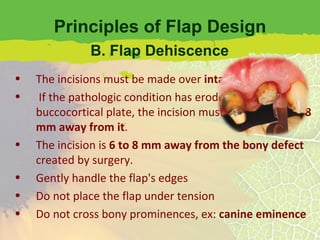
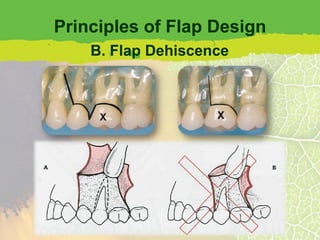
Principles of Flap Design The incisions must be made over  intact bone If the pathologic condition has eroded the buccocortical plate, the incision must be at least  6 or 8 mm away from it . The incision is  6 to 8 mm away from the bony defect  created by surgery. Gently handle the flap's edges Do not place the flap under tension Do not cross bony prominences, ex:  canine eminence B. Flap Dehiscence
Principles of Flap Design B. Flap Dehiscence
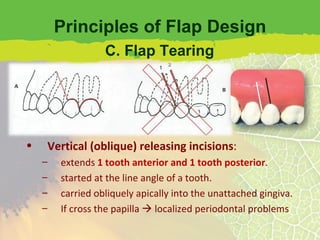
Principles of Flap Design Envelope flaps an incision around the necks of several teeth. extends  2 teeth anterior and 1 tooth posterior . If not provide sufficient access… Vertical (oblique) releasing incisions : extends  1 tooth anterior and 1 tooth posterior . started at the line angle of a tooth. carried obliquely apically into the unattached gingiva. If cross the papilla    localized periodontal problems C. Flap Tearing
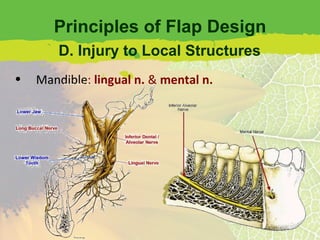
Principles of Flap Design Mandible :  lingual n.  &  mental n. D. Injury to Local Structures
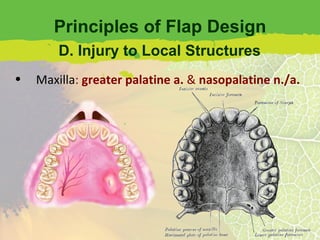
Principles of Flap Design Maxilla :  greater palatine a.  &  nasopalatine n./a. D. Injury to Local Structures
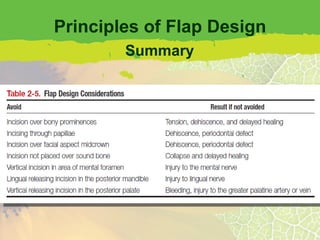
Principles of Flap Design Summary
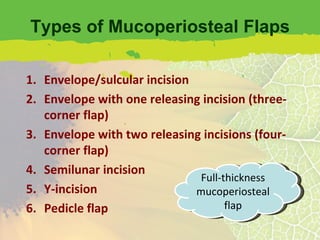
Types of Mucoperiosteal Flaps Envelope/sulcular incision Envelope with one releasing incision (three-corner flap) Envelope with two releasing incisions (four-corner flap) Semilunar incision Y-incision Pedicle flap Full-thickness mucoperiosteal flap
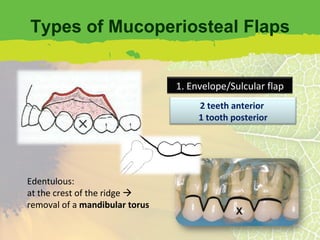
Types of Mucoperiosteal Flaps Edentulous: at the crest of the ridge   removal of a  mandibular torus 2 teeth anterior  1 tooth posterior 1. Envelope/Sulcular flap
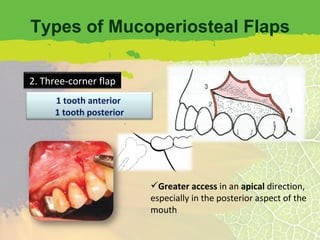
Types of Mucoperiosteal Flaps Greater access  in an  apical  direction, especially in the posterior aspect of the mouth 1 tooth anterior  1 tooth posterior 2. Three-corner flap
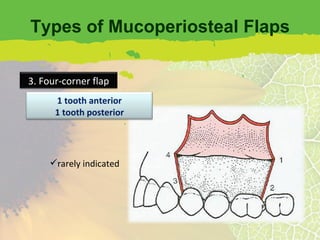
Types of Mucoperiosteal Flaps rarely indicated 1 tooth anterior 1 tooth posterior 3. Four-corner flap
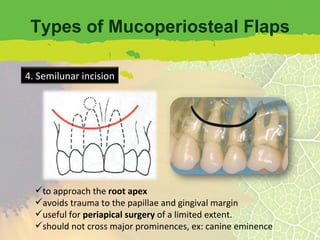
Types of Mucoperiosteal Flaps to approach the  root apex avoids trauma to the papillae and gingival margin useful for  periapical surgery  of a limited extent. should not cross major prominences, ex: canine eminence 4. Semilunar incision
Types of Mucoperiosteal Flaps removal of a  maxillary palatal torus 5. Y-incision
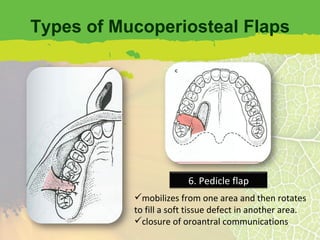
Types of Mucoperiosteal Flaps mobilizes from one area and then rotates to fill a soft tissue defect in another area. closure of oroantral communications 6. Pedicle flap
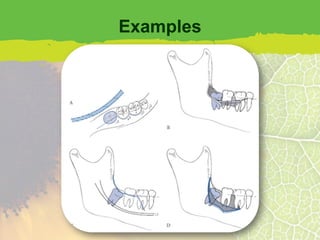
Examples
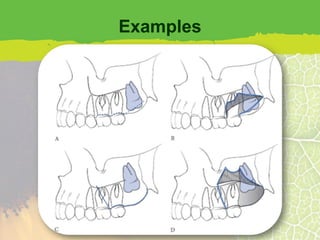
Examples
Reference Contemporary Oral and Maxillofacial Surgery , 4th Edition, Larry J Peterson, DDS, MS, Edward Ellis, III, DDS, MS, James R Hupp, DMD, MD, JD, FACS and Myron R Tucker, DDS Peterson's principles of oral and maxillofacial surgery , Michael Miloro,G. E. Ghali,Peter Larsen,Peter Waite An atlas of minor oral surgery: principles and practice , David A. McGowan Manual of minor oral surgery for the general dentist , Karl R. Koerner
Thanks for your attention!

Flap Design for Minor Oral Surgery

  • 1.
    Flap Design forMinor Oral Surgery Presenter: R1 鄭瑋之 Instructor: VS 陳靜容醫師 2012/2/24
  • 2.
    Stages of OperationRetraction Incision Reflection Bone removal access point of elevation removal of obstruction Tooth section Delivery Clean-up Sew-up Check-up Follow-up Write-up
  • 3.
    Principles of FlapDesign Local flap outlined by a surgical incision carries its own blood supply allows surgical access to underlying tissues can be replaced in the original position can be maintained with sutures and is expected to heal Used in oral surgical, periodontic, and endodontic procedures to gain access.
  • 4.
    Principles of FlapDesign Complications Flap necrosis Flap Dehiscence Flap Tearing Injury to Local Structures
  • 5.
    Principles of FlapDesign Base > Free margin to preserve an adequate blood supply unless a major artery is present in the base Width of Base > Length of Flap*2 less critical in oral cavity, but length < width a long, straight incision with adequate flap reflection heals more rapidly than a short, torn incision. An axial blood supply in the base Hold the flap with a retractor resting on intact bone to prevent tension. A. Flap necrosis
  • 6.
    Principles of FlapDesign The incisions must be made over intact bone If the pathologic condition has eroded the buccocortical plate, the incision must be at least 6 or 8 mm away from it . The incision is 6 to 8 mm away from the bony defect created by surgery. Gently handle the flap's edges Do not place the flap under tension Do not cross bony prominences, ex: canine eminence B. Flap Dehiscence
  • 7.
    Principles of FlapDesign B. Flap Dehiscence
  • 8.
    Principles of FlapDesign Envelope flaps an incision around the necks of several teeth. extends 2 teeth anterior and 1 tooth posterior . If not provide sufficient access… Vertical (oblique) releasing incisions : extends 1 tooth anterior and 1 tooth posterior . started at the line angle of a tooth. carried obliquely apically into the unattached gingiva. If cross the papilla  localized periodontal problems C. Flap Tearing
  • 9.
    Principles of FlapDesign Mandible : lingual n. & mental n. D. Injury to Local Structures
  • 10.
    Principles of FlapDesign Maxilla : greater palatine a. & nasopalatine n./a. D. Injury to Local Structures
  • 11.
    Principles of FlapDesign Summary
  • 12.
    Types of MucoperiostealFlaps Envelope/sulcular incision Envelope with one releasing incision (three-corner flap) Envelope with two releasing incisions (four-corner flap) Semilunar incision Y-incision Pedicle flap Full-thickness mucoperiosteal flap
  • 13.
    Types of MucoperiostealFlaps Edentulous: at the crest of the ridge  removal of a mandibular torus 2 teeth anterior 1 tooth posterior 1. Envelope/Sulcular flap
  • 14.
    Types of MucoperiostealFlaps Greater access in an apical direction, especially in the posterior aspect of the mouth 1 tooth anterior 1 tooth posterior 2. Three-corner flap
  • 15.
    Types of MucoperiostealFlaps rarely indicated 1 tooth anterior 1 tooth posterior 3. Four-corner flap
  • 16.
    Types of MucoperiostealFlaps to approach the root apex avoids trauma to the papillae and gingival margin useful for periapical surgery of a limited extent. should not cross major prominences, ex: canine eminence 4. Semilunar incision
  • 17.
    Types of MucoperiostealFlaps removal of a maxillary palatal torus 5. Y-incision
  • 18.
    Types of MucoperiostealFlaps mobilizes from one area and then rotates to fill a soft tissue defect in another area. closure of oroantral communications 6. Pedicle flap
  • 19.
  • 20.
  • 21.
    Reference Contemporary Oraland Maxillofacial Surgery , 4th Edition, Larry J Peterson, DDS, MS, Edward Ellis, III, DDS, MS, James R Hupp, DMD, MD, JD, FACS and Myron R Tucker, DDS Peterson's principles of oral and maxillofacial surgery , Michael Miloro,G. E. Ghali,Peter Larsen,Peter Waite An atlas of minor oral surgery: principles and practice , David A. McGowan Manual of minor oral surgery for the general dentist , Karl R. Koerner
  • 22.
    Thanks for yourattention!