PRINCIPLES OF MORE COMPLEX EXODONTIA
CHAPTER 8
10/22/2016 1
PRINCIPLES OF FLAP DESIGN, DEVELOPMENT,
AND MANAGEMENT:
The term local flap indicates a section of soft tissue that
(1) is outlined by a surgical incision, (2) carries its own]
blood supply, (3) allows surgical access to underlying
tissues, (4) can be replaced in the original position, and (5]
can be maintained with sutures and is expected to heal,
Soft tissue flaps are frequently used in oral surgical,
periodontic, and endodontic procedures to gain access to
underlying tooth and bone structures. To perform a tooth
extraction properly the dentist must have a clear
understanding of the principles of design, development,
and
management of soft tissue flaps.
10/22/2016 2
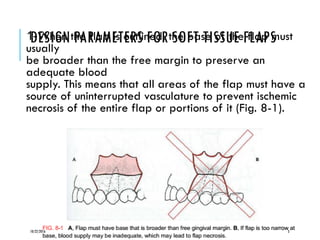
DESIGN PARAMETERS FOR SOFT TISSUE FLAPS-1 When the flap is outlined, the base of the flap must
usually
be broader than the free margin to preserve an
adequate blood
supply. This means that all areas of the flap must have a
source of uninterrupted vasculature to prevent ischemic
necrosis of the entire flap or portions of it (Fig. 8-1).
10/22/2016 3
‫تابع‬
-2 The flap must be of adequate size for several reasons.
Sufficient soft tissue reflection is required to provide necessary
visualization of the area. Adequate access also must
exist for the insertion of instruments required to perform
the surgery.
-3 the flap must be held out of the
operative field by a retractor that must rest on intact bone.
There must be enough flap reflection to permit the retractor
to hold the flap without tension.
-4 a long, straight incision with adequate
flap reflection heals more rapidly than a short, torn incision, which
heals slowly by secondary intention.
10/22/2016 4
‫تابع‬
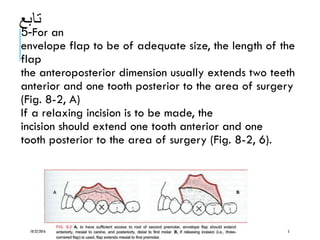
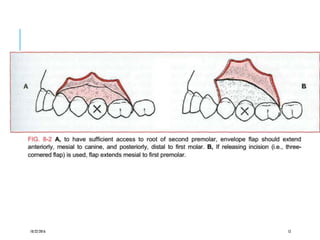
-5 For an
envelope flap to be of adequate size, the length of the
flap
the anteroposterior dimension usually extends two teeth
anterior and one tooth posterior to the area of surgery
(Fig. 8-2, A)
If a relaxing incision is to be made, the
incision should extend one tooth anterior and one
tooth posterior to the area of surgery (Fig. 8-2, 6).
10/22/2016 5
-6 The flap should be a full-thickness
mucoperiosteal flap. This means that the flap
includes the surface mucosa, submucosa, and
periosteum. Because the goal of the surgery is to
remove or reshape the bone, all overlying tissue must
be reflected from it. In addition, full-thickness flaps
are necessary because the periosteum is the primary
tissue responsible for bone healing, and replacement
of the periosteum in its original position hastens that
healing process. In addition, torn, split, and macerated
tissue heals more slowly than a cleanly reflected,
fullthickness flap.
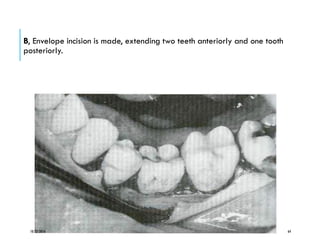
10/22/2016 6
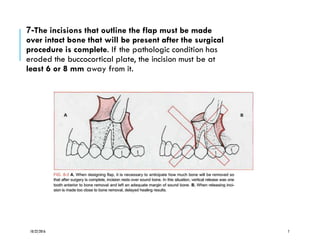
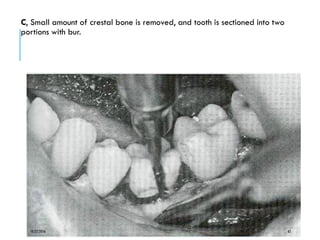
-7 The incisions that outline the flap must be made
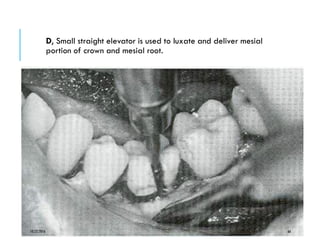
over intact bone that will be present after the surgical
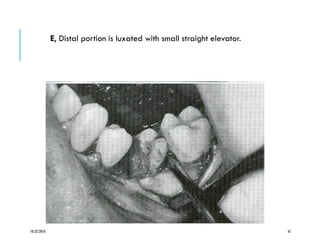
procedure is complete. If the pathologic condition has
eroded the buccocortical plate, the incision must be at
least 6 or 8 mm away from it.
10/22/2016 7
-8 The flap should be designed to avoid injury to local
vital structures in the area of the surgery. The two
most important structures that can be damaged are
both located in the mandible; these are the lingual
nerve and the mental nerve.
-9 Flaps in the maxilla rarely endanger any vital
structures. On the facial aspect of the maxillary
alveolar process, no nerves or arteries exist that are
likely to be damaged.
‫مطمور‬ ‫ناب‬ ‫حالة‬ ‫مثل‬ ‫نيرف‬ ‫النيزوبالتاين‬ ‫عن‬ ‫نستغني‬ ‫احنا‬ ‫ممكن‬ ‫االنتيرير‬ ‫في‬ ‫مثال‬..‫أل‬‫نهم‬
‫ريجينيريشن‬ ‫بصيرلو‬ ‫انه‬ ‫كما‬ ‫المريض‬ ‫على‬ ‫كتير‬ ‫تأثر‬ ‫رح‬ ‫مش‬ ‫انه‬ ‫الحظو‬
‫ينزف‬ ‫رح‬ ‫ارتري‬ ‫بالتاين‬ ‫الجريتر‬ ‫قطعنا‬ ‫لو‬ ‫ألن‬ ‫شوي‬ ‫اعب‬ ‫الوضع‬ ‫البوزتيرير‬ ‫في‬ ‫لكن‬‫و‬
‫منيح‬ ‫نشوف‬ ‫قادرين‬ ‫نبطل‬
10/22/2016 8
10/22/2016 9
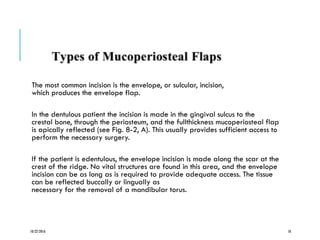
The most common incision is the envelope, or sulcular, incision,
which produces the envelope flap.
In the dentulous patient the incision is made in the gingival sulcus to the
crestal bone, through the periosteum, and the fullthickness mucoperiosteal flap
is apically reflected (see Fig. 8-2, A). This usually provides sufficient access to
perform the necessary surgery.
If the patient is edentulous, the envelope incision is made along the scar at the
crest of the ridge. No vital structures are found in this area, and the envelope
incision can be as long as is required to provide adequate access. The tissue
can be reflected buccally or lingually as
necessary for the removal of a mandibular torus.
10/22/2016 10
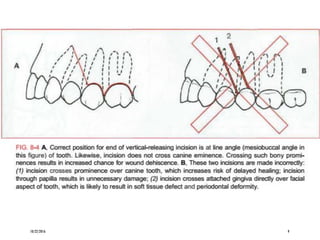
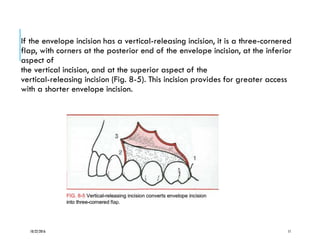
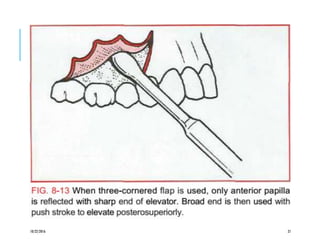
If the envelope incision has a vertical-releasing incision, it is a three-cornered
flap, with corners at the posterior end of the envelope incision, at the inferior
aspect of
the vertical incision, and at the superior aspect of the
vertical-releasing incision (Fig. 8-5). This incision provides for greater access
with a shorter envelope incision.
10/22/2016 11
10/22/2016 12
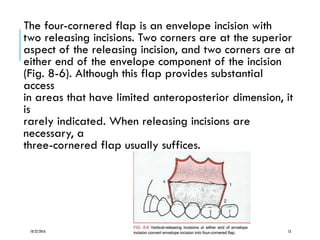
The four-cornered flap is an envelope incision with
two releasing incisions. Two corners are at the superior
aspect of the releasing incision, and two corners are at
either end of the envelope component of the incision
(Fig. 8-6). Although this flap provides substantial
access
in areas that have limited anteroposterior dimension, it
is
rarely indicated. When releasing incisions are
necessary, a
three-cornered flap usually suffices.
10/22/2016 13
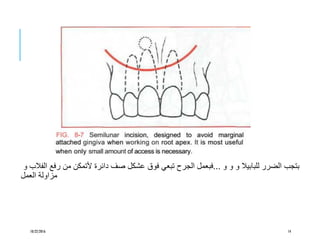
‫و‬ ‫و‬ ‫و‬ ‫للبابيال‬ ‫الضرر‬ ‫بتجب‬...‫الفالب‬ ‫رفع‬ ‫من‬ ‫ألتمكن‬ ‫دائرة‬ ‫صف‬ ‫عشكل‬ ‫فوق‬ ‫تبعي‬ ‫الجرح‬ ‫فبعمل‬‫و‬
‫العمل‬ ‫مزاولة‬
10/22/2016 14
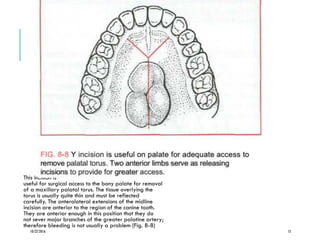
This incision is
useful for surgical access to the bony palate for removal
of a maxillary palatal torus. The tissue overlying the
torus is usually quite thin and must be reflected
carefully. The anterolateral extensions of the midline
incision are anterior to the region of the canine tooth.
They are anterior enough in this position that they do
not sever major branches of the greater palatine artery;
therefore bleeding is not usually a problem (Fig. 8-8)
10/22/2016 15
the pedicle flap
:flap mobilizes from one area and
then rotates to fill a soft tissue defect in another area.
The pedicled palatal flap is used primarily for closure
of oroantral communications
10/22/2016 16
TECHNIQUE FOR DEVELOPING A MUCOPERIOSTEAL
FLAP
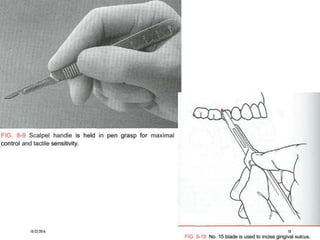
first step is to incise the soft tissue to allow
reflection of the flap.
-no. 15 blade is used on a no. 3 scalpel handle, and it
is held in the pen grasp (Fig. 8-9). The blade is held
at a slight angle to the teeth, and the incision is made
posteriorly to anteriorly in the gingival sulcus by
drawing the knife toward the operator. One smooth
continuous stroke is used while keeping the knife
blade in contact with bone throughout the entire
incision (Figs. 8-10 and 8-11).
10/22/2016 17
10/22/2016 18
The scalpel blade is an extremely sharp instrument,
but it dulls rapidly when it is pressed against bone, such as when
making a mucoperiosteal incision. If more than one flap is to be
reflected, the surgeon should change blades between incisions.
10/22/2016 19
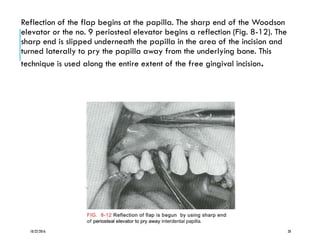
Reflection of the flap begins at the papilla. The sharp end of the Woodson
elevator or the no. 9 periosteal elevator begins a reflection (Fig. 8-12). The
sharp end is slipped underneath the papilla in the area of the incision and
turned laterally to pry the papilla away from the underlying bone. This
technique is used along the entire extent of the free gingival incision.
10/22/2016 20
10/22/2016 21
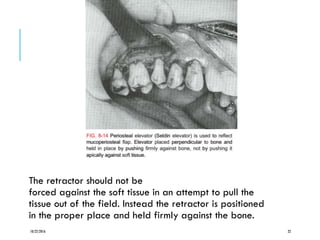
The retractor should not be
forced against the soft tissue in an attempt to pull the
tissue out of the field. Instead the retractor is positioned
in the proper place and held firmly against the bone.
10/22/2016 22
PRINCIPLES OF SUTURING
The most obvious and important function
that sutures perform is to coapt wound margins
The sharper the incision and the less
trauma inflicted on the wound margin, the more
probable is healing by primary intention. If the space
between the two wound edges is minimal, wound
healing will be rapid and complete. If tears or
excessive trauma to the wound edges occur, wound
healing will be by secondary intention.
Sutures also aid in hemostasis. If the underlying
tissue is bleeding, the surface mucosa or skin should
not be closed, because the bleeding in the underlying
tissues may continue and result in the formation of a
hematoma.
10/22/2016 23
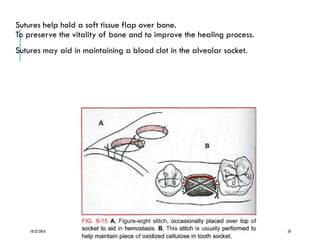
Sutures help hold a soft tissue flap over bone.
To preserve the vitality of bone and to improve the healing process.
Sutures may aid in maintaining a blood clot in the alveolar socket.
10/22/2016 24
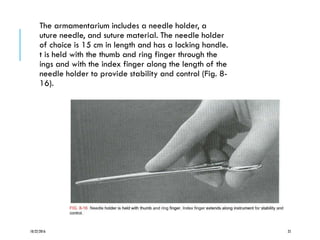
The armamentarium includes a needle holder, a
uture needle, and suture material. The needle holder
of choice is 15 cm in length and has a locking handle.
t is held with the thumb and ring finger through the
ings and with the index finger along the length of the
needle holder to provide stability and control (Fig. 8-
16).
10/22/2016 25
The suture needle usually used in the mouth is a
small three-eighths to one-half circle with a reverse
cutting edge. The cutting edge helps the needle pass
through the relatively tough mucoperiosteal flap.
Sutures are made of a wide variety of materials and
come in several sizes, each designed for a particular
purpose. The two basic types of suture material are
(1) resorbable (i.e., the body is capable of easily
breaking the material down) and (2) nonresorbable.
10/22/2016 26
Three types of resorbable sutures are commonly used
for oral and maxillofacial surgery: (1) gut, (2) polyglycolic acid, and (3)
polyglactin.
Gut is fabricated from the submucosa of sheep intestines or the serosa of
beef intestines. Plain gut sutures retain their strength for
approximately 5 days chromic gut sutures
maintain their strength for 7 to 9 days.
Polyglycolic acid and polyglactin sutures do not enzymatically break
down. Rather, they undergo slow hydrolysis, eventually
being resorbed by macrophages. Polyglycolic and
polyglactin sutures have the advantage of being less
stiff than gut sutures and are more likely to remain tied.
However, they may last too long and are more costly
than gut sutures.
10/22/2016 27
resorbable sutures evoke an intensive inflammatory reaction that may
impede wound healing, occasionally to a clinically significant
extent. This is the reason that neither plain nor chromic
gut is used for suturing the surface of a skin wound.
The most commonly used nonresorbable sutures in
oral and maxillofacial surgery are silk, nylon, polyester,
and polypropylene. Nonresorbable sutures are either
monofilament or multifilament. The multifilament form
increases the strength of the suture, but also increases
suture abrasiveness and is more likely to allow bacteria to
"wick" into the wound. Silk and polyester sutures are
available only in multifilament form. Polypropylene is
produced only as a monofilament, whereas nylon comes
as both a monofilament and a multifilament form.
10/22/2016 28
All nonresorbable sutures have some reactivity. Of the
commonly used nonresorbable sutures, silk revokes the
most intensive inflammatory reaction and nylon is
the least reactive.
any facial laceration, nylon is usually the cutaneous suture of choice.
“less inflam. Response”
Sutures are available in various sizes that range from the
largest diameter, 7, down to the smallest extremely fine
suture size, 11-0.
‫القطر‬ ‫زاد‬ ‫الرقم‬ ‫صغر‬ ‫ما‬ ‫كل‬
. Most oral and maxillofadal surgeons use 3-0 or 4-0 suture
10/22/2016 29
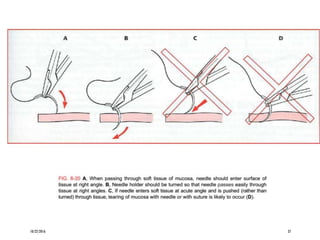
The minimal amount of tissue between the suture and the edge of the
flap
should be 3 mm.
the needle should enter the surface of the mucosa at a right angle
10/22/2016 30
The surgeon must remember that the purpose of the
stitch is merely to reapproximate the tissue, and therefore
the suture should not be tied too tightly. Sutures that are
too tight cause ischemia of the flap margin and result in
tissue necrosis, with tearing of the suture through the tissue. Thus
sutures that are too tightly tied result in wound
dehiscence more frequently than sutures that are loosely
tied. As a clinical guideline, there should be no blanching
or obvious ischemia of the wound edges. If this occurs the
suture should be removed and replaced. The knot should
be positioned so that it does not fall over the incision
line, because this causes additional pressure on the incision.
Therefore the knot should be positioned to the side
of the incision.
10/22/2016 31
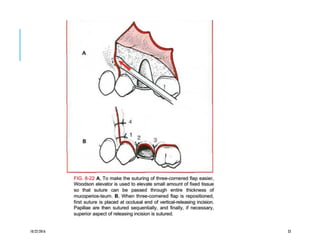
If a three-cornered flap is used, the vertical end of
the
incision must be closed separately. Two sutures usually
are required to close the vertical end properly.
Before the
sutures are inserted, the Woodson periosteal elevator
should be used to elevate slightly the nonflap side of
the
incision, freeing the margin to facilitate passage of
the
needle through the tissue (Fig. 8-22)
10/22/2016 32
10/22/2016 33
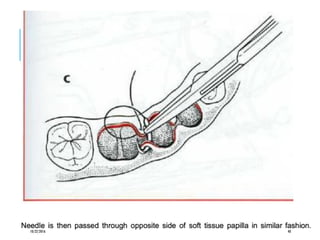
The first suture is
placed across the papilla, where the vertical release
incision was made. This is a known, easily identifiable
landmark that is most important when repositioning a
threecornered flap.
The remainder of the envelope portion of
the incision is then closed, after which the vertical
component is closed. The slight reflection of the
nonflap side
of the incision greatly eases the placing of sutures.
10/22/2016 34
The sutures are left in place for approximately 5 to 7
days. After this time they play no useful role and, in
fact,
probably increase the contamination of the
underlying submucosa.
When sutures are removed, the surface debris that
has collected on them should be cleaned off with a
cottontipped applicator stick soaked in peroxide,
chlorhexidine,
iodophor, or other antiseptic solution.
10/22/2016 35
The suture is cut
with sharp, pointed suture scissors and removed by pulling
it toward the incision line (not away from the suture line).
10/22/2016 36
10/22/2016 37
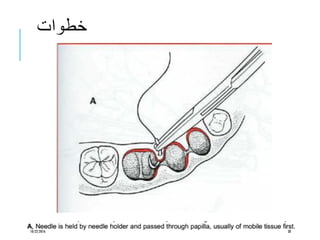
‫خطوات‬
10/22/2016 38
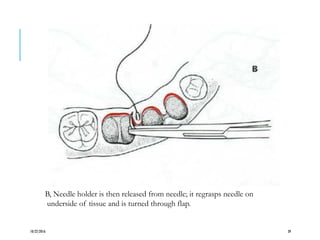
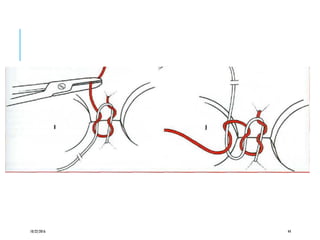
B, Needle holder is then released from needle; it regrasps needle on
underside of tissue and is turned through flap.
10/22/2016 39
10/22/2016 40
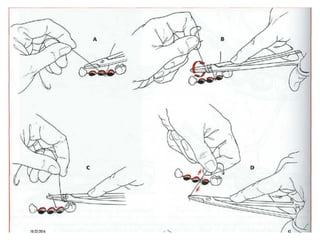
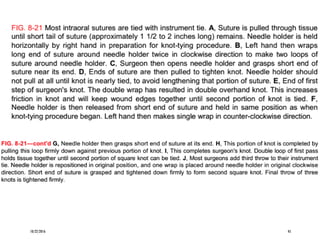
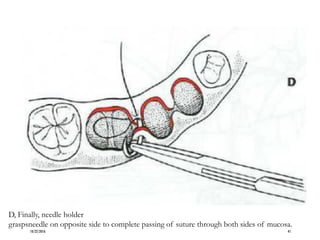
D, Finally, needle holder
graspsneedle on opposite side to complete passing of suture through both sides of mucosa.
10/22/2016 41
10/22/2016 42
10/22/2016 43
10/22/2016 44
10/22/2016 45
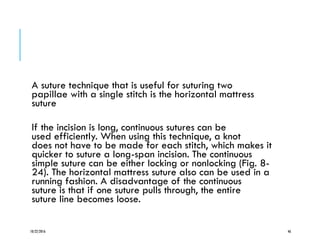
A suture technique that is useful for suturing two
papillae with a single stitch is the horizontal mattress
suture
If the incision is long, continuous sutures can be
used efficiently. When using this technique, a knot
does not have to be made for each stitch, which makes it
quicker to suture a long-span incision. The continuous
simple suture can be either locking or nonlocking (Fig. 8-
24). The horizontal mattress suture also can be used in a
running fashion. A disadvantage of the continuous
suture is that if one suture pulls through, the entire
suture line becomes loose.
10/22/2016 46
The first step is to provide adequate visualization and access by
reflecting a sufficiently large mucoperiosteal flap.
In most situations an envelope flap that is extended two teeth anterior
and one tooth posterior to the tooth to be removed is sufficient. If a
releasing incision is necessary, it should be placed at least one tooth
anterior to the extraction site
10/22/2016 47
1ST OPTION
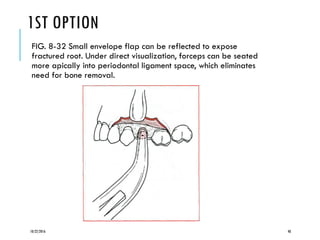
FIG. 8-32 Small envelope flap can be reflected to expose
fractured root. Under direct visualization, forceps can be seated
more apically into periodontal ligament space, which eliminates
need for bone removal.
10/22/2016 48
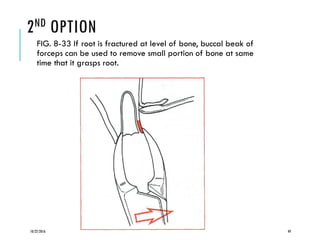
2ND OPTION
FIG. 8-33 If root is fractured at level of bone, buccal beak of
forceps can be used to remove small portion of bone at same
time that it grasps root.
10/22/2016 49
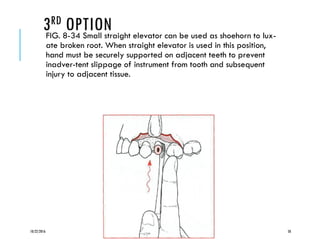
3RD OPTIONFIG. 8-34 Small straight elevator can be used as shoehorn to lux-
ate broken root. When straight elevator is used in this position,
hand must be securely supported on adjacent teeth to prevent
inadver-tent slippage of instrument from tooth and subsequent
injury to adjacent tissue.
10/22/2016 50
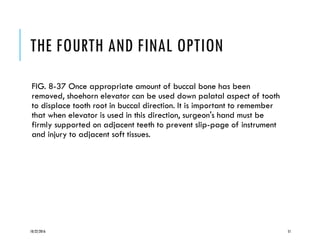
THE FOURTH AND FINAL OPTION
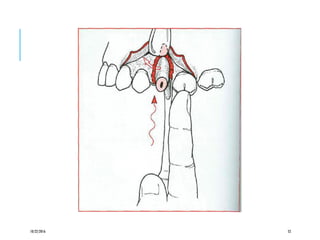
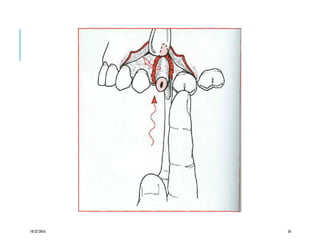
FIG. 8-37 Once appropriate amount of buccal bone has been
removed, shoehorn elevator can be used down palatal aspect of tooth
to displace tooth root in buccal direction. It is important to remember
that when elevator is used in this direction, surgeon's hand must be
firmly supported on adjacent teeth to prevent slip-page of instrument
and injury to adjacent soft tissues.
10/22/2016 51
10/22/2016 52
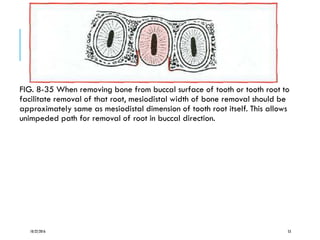
FIG. 8-35 When removing bone from buccal surface of tooth or tooth root to
facilitate removal of that root, mesiodistal width of bone removal should be
approximately same as mesiodistal dimension of tooth root itself. This allows
unimpeded path for removal of root in buccal direction.
10/22/2016 53
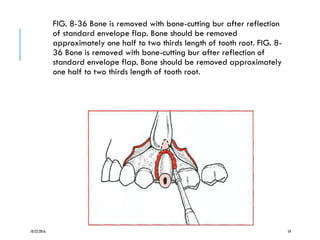
FIG. 8-36 Bone is removed with bone-cutting bur after reflection
of standard envelope flap. Bone should be removed
approximately one half to two thirds length of tooth root. FIG. 8-
36 Bone is removed with bone-cutting bur after reflection of
standard envelope flap. Bone should be removed approximately
one half to two thirds length of tooth root.
10/22/2016 54
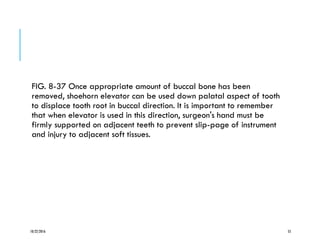
FIG. 8-37 Once appropriate amount of buccal bone has been
removed, shoehorn elevator can be used down palatal aspect of tooth
to displace tooth root in buccal direction. It is important to remember
that when elevator is used in this direction, surgeon's hand must be
firmly supported on adjacent teeth to prevent slip-page of instrument
and injury to adjacent soft tissues.
10/22/2016 55
10/22/2016 56
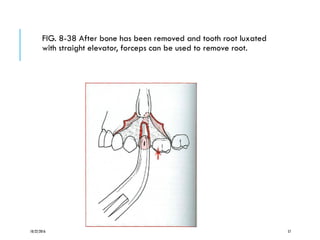
FIG. 8-38 After bone has been removed and tooth root luxated
with straight elevator, forceps can be used to remove root.
10/22/2016 57
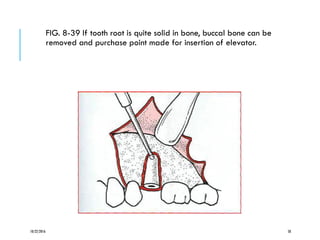
FIG. 8-39 If tooth root is quite solid in bone, buccal bone can be
removed and purchase point made for insertion of elevator.
10/22/2016 58
Once the tooth is delivered, the entire surgical field should be thoroughly irrigated
with copious amounts of saline. Special attention should be directed toward the most
inferior portion of the flap (where it joins the bone), because this is a common place
for debris to set-tle, especially in mandibular extractions. If the debris is not
removed carefully by curettage or irrigation, it can cause delayed healing or even
a small subperiosteal abscess in the ensuing 3 to 4 weeks. The flap is then set in its
original position and sutured into place with 3-0 black silk sutures. If the incision
were properly planned and executed, the suture line will be supported on sound,
intact bone.
10/22/2016 59
TECHNIQUE FOR SURGICAL REMOVAL OF
MULTIROOTED TEETH
the tooth may be divided with a bur to convert a multirooted tooth
into several single-rooted teeth. If the crown of the tooth remains
intact, the crown portion is sectioned in such a way as to facilitate
removal of roots. However, if the crown portion of the tooth is missing
and only the roots remain, the goal is to separate the roots to make
them easier to remove with elevators.
10/22/2016 60
‫بالرسمة‬ ‫تعاد‬ ‫سوف‬
Removal of the lower first molar with an intact crown is usually done by sectioning the
tooth buccolingually and thereby dividing the tooth into a mesial half (with mesial root
and half of the crown) and a distal half. An envelope incision is also made, and a
small amount of crestal bone is removed. Once the tooth is sectioned, it is luxated with
straight elevators to begin the mobilization process. The sectioned tooth is treated as
a lower premo-lar tooth and is removed with a lower universal forceps (Fig. 8-41).
The flap is repositioned and sutured.
10/22/2016 61
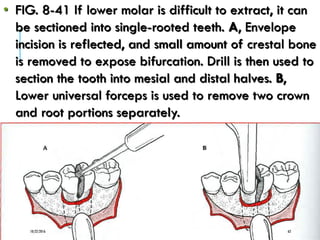
• FIG. 8-41 If lower molar is difficult to extract, it can
be sectioned into single-rooted teeth. A, Envelope
incision is reflected, and small amount of crestal bone
is removed to expose bifurcation. Drill is then used to
section the tooth into mesial and distal halves. B,
Lower universal forceps is used to remove two crown
and root portions separately.
10/22/2016 62
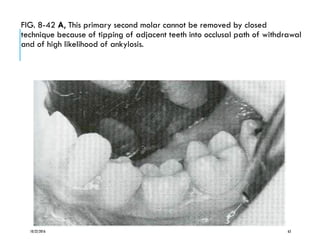
FIG. 8-42 A, This primary second molar cannot be removed by closed
technique because of tipping of adjacent teeth into occlusal path of withdrawal
and of high likelihood of ankylosis.
10/22/2016 63
B, Envelope incision is made, extending two teeth anteriorly and one tooth
posteriorly.
10/22/2016 64
C, Small amount of crestal bone is removed, and tooth is sectioned into two
portions with bur.
10/22/2016 65
D, Small straight elevator is used to luxate and deliver mesial
portion of crown and mesial root.
10/22/2016 66
E, Distal portion is luxated with small straight elevator.
10/22/2016 67
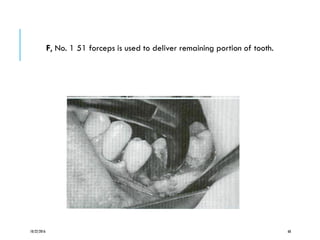
F, No. 1 51 forceps is used to deliver remaining portion of tooth.
10/22/2016 68
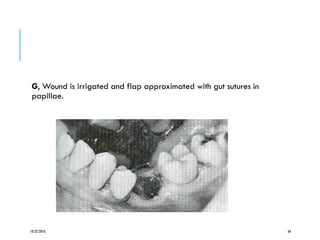
G, Wound is irrigated and flap approximated with gut sutures in
papillae.
10/22/2016 69
REMOVAL OF SMALL ROOT FRAGMENTS
AND ROOT TIPS
If fracture of the apical one third (3 to 4 mm) of the root occurs during
a closed extraction, an orderly procedure should be used to remove
the root tip from the socket. Initial attempts should be made to extract
the root fragment by a closed technique, but the surgeon should begin
a surgical technique if the closed technique is not immediately
successful.
10/22/2016 70
Whichever technique is chosen, two requirements for extraction are critically
important: excellent light and excellent suction, preferably with a suction tip of
small diameter. It is impossible to remove a small root tip fragment unless the
surgeon can clearly visualize it. It is also important that an irrigation syringe be
available to irrigate blood and debris from around the root tip so that it can be
clearly seen.
The closed technique for root tip retrieval is defined as any technique that does
not require reflection of soft tissue flaps and removal of bone.
10/22/2016 71
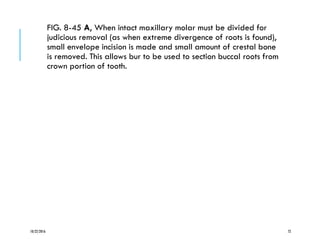
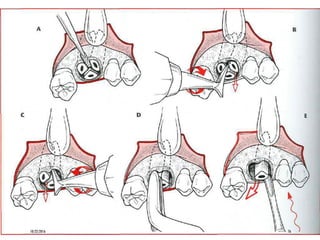
FIG. 8-45 A, When intact maxillary molar must be divided for
judicious removal (as when extreme divergence of roots is found),
small envelope incision is made and small amount of crestal bone
is removed. This allows bur to be used to section buccal roots from
crown portion of tooth.
10/22/2016 72
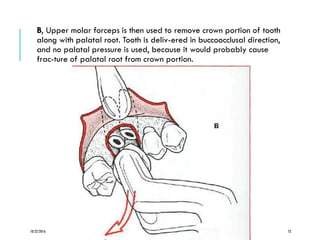
B, Upper molar forceps is then used to remove crown portion of tooth
along with palatal root. Tooth is deliv-ered in buccoocclusal direction,
and no palatal pressure is used, because it would probably cause
frac-ture of palatal root from crown portion.
10/22/2016 73
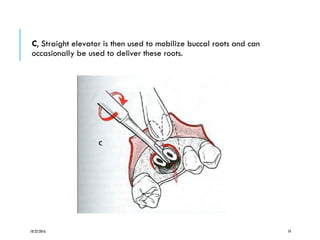
C, Straight elevator is then used to mobilize buccal roots and can
occasionally be used to deliver these roots.
10/22/2016 74
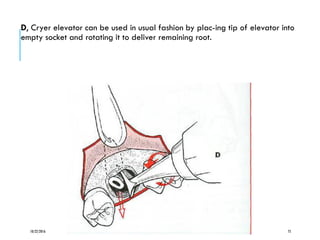
D, Cryer elevator can be used in usual fashion by plac-ing tip of elevator into
empty socket and rotating it to deliver remaining root.
10/22/2016 75
10/22/2016 76
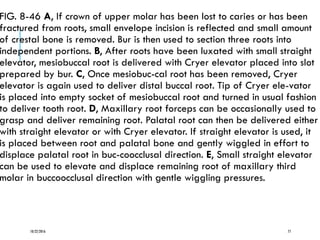
FIG. 8-46 A, If crown of upper molar has been lost to caries or has been
fractured from roots, small envelope incision is reflected and small amount
of crestal bone is removed. Bur is then used to section three roots into
independent portions. B, After roots have been luxated with small straight
elevator, mesiobuccal root is delivered with Cryer elevator placed into slot
prepared by bur. C, Once mesiobuc-cal root has been removed, Cryer
elevator is again used to deliver distal buccal root. Tip of Cryer ele-vator
is placed into empty socket of mesiobuccal root and turned in usual fashion
to deliver tooth root. D, Maxillary root forceps can be occasionally used to
grasp and deliver remaining root. Palatal root can then be delivered either
with straight elevator or with Cryer elevator. If straight elevator is used, it
is placed between root and palatal bone and gently wiggled in effort to
displace palatal root in buc-coocclusal direction. E, Small straight elevator
can be used to elevate and displace remaining root of maxillary third
molar in buccoocclusal direction with gentle wiggling pressures.
10/22/2016 77
socket should be irrigated vigorously and suctioned with a small
suction tip, because the loose tooth fragment occasionally can be
irrigated from the socket. Once irrigation and suction are completed,
the surgeon should inspect the tooth socket carefully to assess whether
the root has been removed from the socket. If the irrigation-suction
technique is unsuccessful, the next step is to tease the loose root apex
from the socket with a root tip pick. A root tip pick is a delicate
instrument and cannot be used as the Cryer elevator can to remove
bone and elevate entire roots. The root tip pick is inserted into the
periodontal ligament space, and the root is teased out of the socket
{Fig. 8- 47).
10/22/2016 78
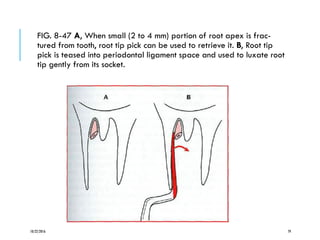
FIG. 8-47 A, When small (2 to 4 mm) portion of root apex is frac-
tured from tooth, root tip pick can be used to retrieve it. B, Root tip
pick is teased into periodontal ligament space and used to luxate root
tip gently from its socket.
10/22/2016 79
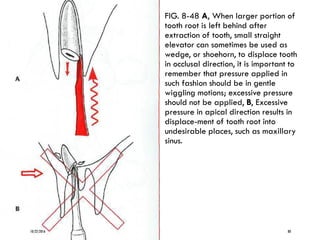
FIG. 8-48 A, When larger portion of
tooth root is left behind after
extraction of tooth, small straight
elevator can sometimes be used as
wedge, or shoehorn, to displace tooth
in occlusal direction, it is important to
remember that pressure applied in
such fashion should be in gentle
wiggling motions; excessive pressure
should not be applied, B, Excessive
pressure in apical direction results in
displace-ment of tooth root into
undesirable places, such as maxillary
sinus.
10/22/2016 80
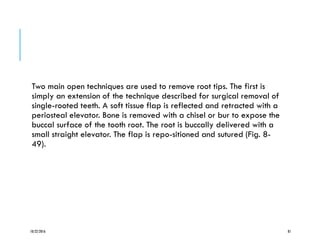
Two main open techniques are used to remove root tips. The first is
simply an extension of the technique described for surgical removal of
single-rooted teeth. A soft tissue flap is reflected and retracted with a
periosteal elevator. Bone is removed with a chisel or bur to expose the
buccal surface of the tooth root. The root is buccally delivered with a
small straight elevator. The flap is repo-sitioned and sutured (Fig. 8-
49).
10/22/2016 81
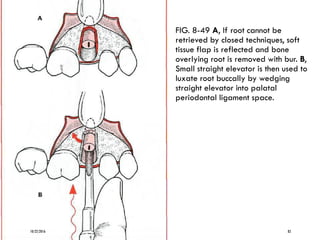
FIG. 8-49 A, If root cannot be
retrieved by closed techniques, soft
tissue flap is reflected and bone
overlying root is removed with bur. B,
Small straight elevator is then used to
luxate root buccally by wedging
straight elevator into palatal
periodontal ligament space.
10/22/2016 82
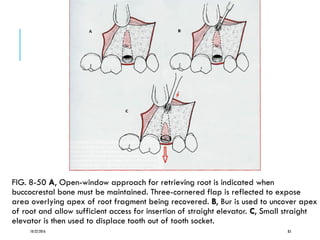
FIG. 8-50 A, Open-window approach for retrieving root is indicated when
buccocrestal bone must be maintained. Three-cornered flap is reflected to expose
area overlying apex of root fragment being recovered. B, Bur is used to uncover apex
of root and allow sufficient access for insertion of straight elevator. C, Small straight
elevator is then used to displace tooth out of tooth socket.
10/22/2016 83
For the surgeon to leave a small, deeply embedded, noninfected
root tip in place, the risk of surgery must be greater than the
benefit. This risk is considered to be greater if one of the
following three conditions exists: First, the risk is too great if
removal of the root will cause excessive destruction of surrounding
tissue; that is, if excessive amounts of bony tissue must be removed
to retrieve the root. For example, reaching a small palatal root tip
of a maxillary first molar may require the removal of large
amounts of bone. Second, the risk is too great if removal of the
root endangers vital structures, most commonly the inferior
alveolar nerve, either at the mental foramen area or along the
course of the canal. If surgical retrieval of a root may result in a
permanent or even a prolonged temporary anesthesia of the
inferior alveolar nerve, the surgeon should seriously consider
leaving the root tip in place.
10/22/2016 84
Finally, the risks outweigh the benefits if attempts at recovering the
root tip can displace the root into tissue spaces or into the maxillary
sinus. The roots most often dis-placed into the maxillary sinus are those
of the maxillary molars.
‫ستركتشر‬ ‫فايتل‬ ‫اي‬ ‫او‬ ‫الساينس‬ ‫عن‬ ‫البعد‬ ‫اقدر‬ ‫و‬ ‫اشوف‬ ‫اشعة‬ ‫لصور‬ ‫بحاجة‬ ‫انا‬
10/22/2016 85
If the surgeon elects to leave a root tip in place, a strict
protocol must be observed. The patient must be informed
that, in the surgeon's judgment, leaving the root in its posi-
tion will do less harm than surgery. In addition, radi-ographic
documentation of the root tip's presence and posi-tion must
be obtained and retained in the patient's record. The fact
that the patient was informed of the decision to leave the
root tip in position must be recorded in the patient's chart. In
addition, the patient must be recalled for several routine
periodic follow-ups over the ensuing year to track the fate of
this root. The patient should be instructed to contact the
surgeon immediately should any problems develop in the
area of the retained root.
10/22/2016 86
MULTIPLE EXTRACTIONS
Treatment Planning In most situations where multiple teeth are to be
removed, preextraction planning regarding replacement of the teeth to
be removed is necessary. This may be a full or removable partial
denture or perhaps placement of a single or multiple implants. Before
the teeth are extracted, the surgeon should communicate with the
restorative dentist and make a determination of the need for such items
as interim partial immediate dentures. The discus-sion should also include
mention of needs for any other type of soft tissue surgery, such as
tuberosity reduction, and hard tissue surgery, such as removal of
undercuts in critical areas. If dental implants are to be placed at some
later time, it may also be desirable to graft the extraction socket so that
healing will be more complete and rapid. In some situations, dental
implants may be placed at the same time as the teeth are removed,
which would require the preparation of a surgical guide stent to assist
the surgeon in aligning the implants appropriately.
10/22/2016 87
EXTRACTION SEQUENCING
maxillary teeth should be removed first :
Because of :-
an infiltration anesthetic has a more rapid onset and also disappears
more rapidly.
because during the extraction process debris such as por-tions of
amalgams, fractured crowns, and bone chips may fall into the empty
sockets of the lower teeth if the lower surgery is performed first
10/22/2016 88
In addition, maxillary teeth are removed with a major component of
buccal force. Little or no vertical traction force is used in removal of
these teeth, as is commonly required with mandibular teeth.
A single minor disadvantage for extracting maxillary teeth first is that
if hemorrhage is not controlled in the maxilla before mandibular teeth
are extracted, the hemorrhage may interfere with visualization during
mandibular surgery
10/22/2016 89
Extraction usually begins with extraction of the most posterior teeth
first. This allows for the more effective use of dental elevators to
luxate and mobilize teeth before the forceps is used to extract the
tooth. The two teeth that are the most difficult to remove, the molar
and canine, should be extracted last. Removal of the teeth on either
side weakens the bony socket on the mesial and distal side of these
teeth, and their subsequent extraction is made easier.
10/22/2016 90
In summary, if a maxillary and mandibular left quad-rant is to be
extracted, the following order is recom-mended: (1) maxillary
posterior teeth, leaving the first molar; (2) maxillary anterior teeth,
leaving the canine; (3) maxillary molar; (4) maxillary canine; (5)
mandibular posterior teeth, leaving the first molar; (6) mandibular
anterior teeth, leaving the canine; (7) mandibular molar; and (8)
mandibular canine.
10/22/2016 91
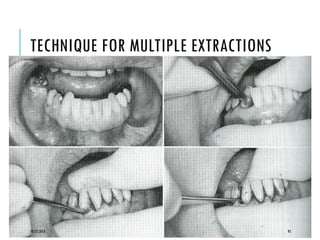
TECHNIQUE FOR MULTIPLE EXTRACTIONS
10/22/2016 92
FIG. 8-51 A, This patient's remaining teeth are to be extracted. The broad zone
of attached gingiva is demonstrated in adequate vestibular depth. B, After
adequate anesthesia is achieved, soft tis-sue attachment to teeth is incised with
no. 15 blade. Incision is car-ried around necks of teeth and through interdental
papilla. C, Woodson elevator is used to reflect labial soft tissue just to crest of
labioalveolar bone. D, Small straight elevator is used to luxate teeth before
forceps is used. Surgeon's opposite hand is reflecting soft tissue and stabilizing
mandible.
10/22/2016 93
10/22/2016 94
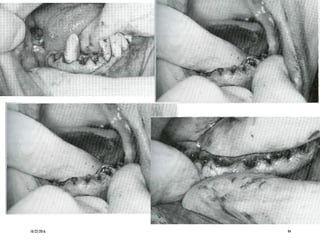
CONT;
E, Teeth adjacent to mandibu-lar canine are extracted
first, which makes extraction of remaining canine tooth
easier to accomplish. F, Alveolar plates are compressed
firmly together to reestablish presurgical buccolingual
width of alveolar process. Because of mild periodontal
disease, excess soft tissue is found, which will be trimmed
to prevent excess flabby tissue on crest of ridge. G,
Rongeur forceps is used to remove only bone that is
sharp and protrudes above reapproximated soft tissue.
H, After soft tissue has been trimmed and sharp bony
projections removed, tissue is checked one final time for
completeness of soft tissue sur-gery.
10/22/2016 95
10/22/2016 96
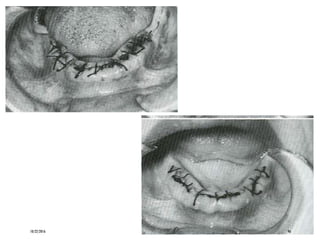
I, Tissue is closed with interrupted black silk sutures across papilla. This
approximates soft tissue at papilla but leaves tooth sock-et open. Soft tissue is
not mobilized to achieve primary closure, because this would tend to reduce
vestibular height. J, Patient returns for suture removal 1 week later. Normal
healing has occurred, and sutures are ready for removal. The broad band of
attached tissue remains on ridge, similar to what existed in preoper-ative
situation (see A).
10/22/2016 97
THANK YOU
Reference : contemporary of oral and maxillofacial surgery
10/22/2016 98

Principles of more complex exdontia By:Cezar Edward

  • 1.
    PRINCIPLES OF MORECOMPLEX EXODONTIA CHAPTER 8 10/22/2016 1
  • 2.
    PRINCIPLES OF FLAPDESIGN, DEVELOPMENT, AND MANAGEMENT: The term local flap indicates a section of soft tissue that (1) is outlined by a surgical incision, (2) carries its own] blood supply, (3) allows surgical access to underlying tissues, (4) can be replaced in the original position, and (5] can be maintained with sutures and is expected to heal, Soft tissue flaps are frequently used in oral surgical, periodontic, and endodontic procedures to gain access to underlying tooth and bone structures. To perform a tooth extraction properly the dentist must have a clear understanding of the principles of design, development, and management of soft tissue flaps. 10/22/2016 2
  • 3.
    DESIGN PARAMETERS FORSOFT TISSUE FLAPS-1 When the flap is outlined, the base of the flap must usually be broader than the free margin to preserve an adequate blood supply. This means that all areas of the flap must have a source of uninterrupted vasculature to prevent ischemic necrosis of the entire flap or portions of it (Fig. 8-1). 10/22/2016 3
  • 4.
    ‫تابع‬ -2 The flapmust be of adequate size for several reasons. Sufficient soft tissue reflection is required to provide necessary visualization of the area. Adequate access also must exist for the insertion of instruments required to perform the surgery. -3 the flap must be held out of the operative field by a retractor that must rest on intact bone. There must be enough flap reflection to permit the retractor to hold the flap without tension. -4 a long, straight incision with adequate flap reflection heals more rapidly than a short, torn incision, which heals slowly by secondary intention. 10/22/2016 4
  • 5.
    ‫تابع‬ -5 For an envelopeflap to be of adequate size, the length of the flap the anteroposterior dimension usually extends two teeth anterior and one tooth posterior to the area of surgery (Fig. 8-2, A) If a relaxing incision is to be made, the incision should extend one tooth anterior and one tooth posterior to the area of surgery (Fig. 8-2, 6). 10/22/2016 5
  • 6.
    -6 The flapshould be a full-thickness mucoperiosteal flap. This means that the flap includes the surface mucosa, submucosa, and periosteum. Because the goal of the surgery is to remove or reshape the bone, all overlying tissue must be reflected from it. In addition, full-thickness flaps are necessary because the periosteum is the primary tissue responsible for bone healing, and replacement of the periosteum in its original position hastens that healing process. In addition, torn, split, and macerated tissue heals more slowly than a cleanly reflected, fullthickness flap. 10/22/2016 6
  • 7.
    -7 The incisionsthat outline the flap must be made over intact bone that will be present after the surgical procedure is complete. If the pathologic condition has eroded the buccocortical plate, the incision must be at least 6 or 8 mm away from it. 10/22/2016 7
  • 8.
    -8 The flapshould be designed to avoid injury to local vital structures in the area of the surgery. The two most important structures that can be damaged are both located in the mandible; these are the lingual nerve and the mental nerve. -9 Flaps in the maxilla rarely endanger any vital structures. On the facial aspect of the maxillary alveolar process, no nerves or arteries exist that are likely to be damaged. ‫مطمور‬ ‫ناب‬ ‫حالة‬ ‫مثل‬ ‫نيرف‬ ‫النيزوبالتاين‬ ‫عن‬ ‫نستغني‬ ‫احنا‬ ‫ممكن‬ ‫االنتيرير‬ ‫في‬ ‫مثال‬..‫أل‬‫نهم‬ ‫ريجينيريشن‬ ‫بصيرلو‬ ‫انه‬ ‫كما‬ ‫المريض‬ ‫على‬ ‫كتير‬ ‫تأثر‬ ‫رح‬ ‫مش‬ ‫انه‬ ‫الحظو‬ ‫ينزف‬ ‫رح‬ ‫ارتري‬ ‫بالتاين‬ ‫الجريتر‬ ‫قطعنا‬ ‫لو‬ ‫ألن‬ ‫شوي‬ ‫اعب‬ ‫الوضع‬ ‫البوزتيرير‬ ‫في‬ ‫لكن‬‫و‬ ‫منيح‬ ‫نشوف‬ ‫قادرين‬ ‫نبطل‬ 10/22/2016 8
  • 9.
  • 10.
    The most commonincision is the envelope, or sulcular, incision, which produces the envelope flap. In the dentulous patient the incision is made in the gingival sulcus to the crestal bone, through the periosteum, and the fullthickness mucoperiosteal flap is apically reflected (see Fig. 8-2, A). This usually provides sufficient access to perform the necessary surgery. If the patient is edentulous, the envelope incision is made along the scar at the crest of the ridge. No vital structures are found in this area, and the envelope incision can be as long as is required to provide adequate access. The tissue can be reflected buccally or lingually as necessary for the removal of a mandibular torus. 10/22/2016 10
  • 11.
    If the envelopeincision has a vertical-releasing incision, it is a three-cornered flap, with corners at the posterior end of the envelope incision, at the inferior aspect of the vertical incision, and at the superior aspect of the vertical-releasing incision (Fig. 8-5). This incision provides for greater access with a shorter envelope incision. 10/22/2016 11
  • 12.
  • 13.
    The four-cornered flapis an envelope incision with two releasing incisions. Two corners are at the superior aspect of the releasing incision, and two corners are at either end of the envelope component of the incision (Fig. 8-6). Although this flap provides substantial access in areas that have limited anteroposterior dimension, it is rarely indicated. When releasing incisions are necessary, a three-cornered flap usually suffices. 10/22/2016 13
  • 14.
    ‫و‬ ‫و‬ ‫و‬‫للبابيال‬ ‫الضرر‬ ‫بتجب‬...‫الفالب‬ ‫رفع‬ ‫من‬ ‫ألتمكن‬ ‫دائرة‬ ‫صف‬ ‫عشكل‬ ‫فوق‬ ‫تبعي‬ ‫الجرح‬ ‫فبعمل‬‫و‬ ‫العمل‬ ‫مزاولة‬ 10/22/2016 14
  • 15.
    This incision is usefulfor surgical access to the bony palate for removal of a maxillary palatal torus. The tissue overlying the torus is usually quite thin and must be reflected carefully. The anterolateral extensions of the midline incision are anterior to the region of the canine tooth. They are anterior enough in this position that they do not sever major branches of the greater palatine artery; therefore bleeding is not usually a problem (Fig. 8-8) 10/22/2016 15
  • 16.
    the pedicle flap :flapmobilizes from one area and then rotates to fill a soft tissue defect in another area. The pedicled palatal flap is used primarily for closure of oroantral communications 10/22/2016 16
  • 17.
    TECHNIQUE FOR DEVELOPINGA MUCOPERIOSTEAL FLAP first step is to incise the soft tissue to allow reflection of the flap. -no. 15 blade is used on a no. 3 scalpel handle, and it is held in the pen grasp (Fig. 8-9). The blade is held at a slight angle to the teeth, and the incision is made posteriorly to anteriorly in the gingival sulcus by drawing the knife toward the operator. One smooth continuous stroke is used while keeping the knife blade in contact with bone throughout the entire incision (Figs. 8-10 and 8-11). 10/22/2016 17
  • 18.
  • 19.
    The scalpel bladeis an extremely sharp instrument, but it dulls rapidly when it is pressed against bone, such as when making a mucoperiosteal incision. If more than one flap is to be reflected, the surgeon should change blades between incisions. 10/22/2016 19
  • 20.
    Reflection of theflap begins at the papilla. The sharp end of the Woodson elevator or the no. 9 periosteal elevator begins a reflection (Fig. 8-12). The sharp end is slipped underneath the papilla in the area of the incision and turned laterally to pry the papilla away from the underlying bone. This technique is used along the entire extent of the free gingival incision. 10/22/2016 20
  • 21.
  • 22.
    The retractor shouldnot be forced against the soft tissue in an attempt to pull the tissue out of the field. Instead the retractor is positioned in the proper place and held firmly against the bone. 10/22/2016 22
  • 23.
    PRINCIPLES OF SUTURING Themost obvious and important function that sutures perform is to coapt wound margins The sharper the incision and the less trauma inflicted on the wound margin, the more probable is healing by primary intention. If the space between the two wound edges is minimal, wound healing will be rapid and complete. If tears or excessive trauma to the wound edges occur, wound healing will be by secondary intention. Sutures also aid in hemostasis. If the underlying tissue is bleeding, the surface mucosa or skin should not be closed, because the bleeding in the underlying tissues may continue and result in the formation of a hematoma. 10/22/2016 23
  • 24.
    Sutures help holda soft tissue flap over bone. To preserve the vitality of bone and to improve the healing process. Sutures may aid in maintaining a blood clot in the alveolar socket. 10/22/2016 24
  • 25.
    The armamentarium includesa needle holder, a uture needle, and suture material. The needle holder of choice is 15 cm in length and has a locking handle. t is held with the thumb and ring finger through the ings and with the index finger along the length of the needle holder to provide stability and control (Fig. 8- 16). 10/22/2016 25
  • 26.
    The suture needleusually used in the mouth is a small three-eighths to one-half circle with a reverse cutting edge. The cutting edge helps the needle pass through the relatively tough mucoperiosteal flap. Sutures are made of a wide variety of materials and come in several sizes, each designed for a particular purpose. The two basic types of suture material are (1) resorbable (i.e., the body is capable of easily breaking the material down) and (2) nonresorbable. 10/22/2016 26
  • 27.
    Three types ofresorbable sutures are commonly used for oral and maxillofacial surgery: (1) gut, (2) polyglycolic acid, and (3) polyglactin. Gut is fabricated from the submucosa of sheep intestines or the serosa of beef intestines. Plain gut sutures retain their strength for approximately 5 days chromic gut sutures maintain their strength for 7 to 9 days. Polyglycolic acid and polyglactin sutures do not enzymatically break down. Rather, they undergo slow hydrolysis, eventually being resorbed by macrophages. Polyglycolic and polyglactin sutures have the advantage of being less stiff than gut sutures and are more likely to remain tied. However, they may last too long and are more costly than gut sutures. 10/22/2016 27
  • 28.
    resorbable sutures evokean intensive inflammatory reaction that may impede wound healing, occasionally to a clinically significant extent. This is the reason that neither plain nor chromic gut is used for suturing the surface of a skin wound. The most commonly used nonresorbable sutures in oral and maxillofacial surgery are silk, nylon, polyester, and polypropylene. Nonresorbable sutures are either monofilament or multifilament. The multifilament form increases the strength of the suture, but also increases suture abrasiveness and is more likely to allow bacteria to "wick" into the wound. Silk and polyester sutures are available only in multifilament form. Polypropylene is produced only as a monofilament, whereas nylon comes as both a monofilament and a multifilament form. 10/22/2016 28
  • 29.
    All nonresorbable sutureshave some reactivity. Of the commonly used nonresorbable sutures, silk revokes the most intensive inflammatory reaction and nylon is the least reactive. any facial laceration, nylon is usually the cutaneous suture of choice. “less inflam. Response” Sutures are available in various sizes that range from the largest diameter, 7, down to the smallest extremely fine suture size, 11-0. ‫القطر‬ ‫زاد‬ ‫الرقم‬ ‫صغر‬ ‫ما‬ ‫كل‬ . Most oral and maxillofadal surgeons use 3-0 or 4-0 suture 10/22/2016 29
  • 30.
    The minimal amountof tissue between the suture and the edge of the flap should be 3 mm. the needle should enter the surface of the mucosa at a right angle 10/22/2016 30
  • 31.
    The surgeon mustremember that the purpose of the stitch is merely to reapproximate the tissue, and therefore the suture should not be tied too tightly. Sutures that are too tight cause ischemia of the flap margin and result in tissue necrosis, with tearing of the suture through the tissue. Thus sutures that are too tightly tied result in wound dehiscence more frequently than sutures that are loosely tied. As a clinical guideline, there should be no blanching or obvious ischemia of the wound edges. If this occurs the suture should be removed and replaced. The knot should be positioned so that it does not fall over the incision line, because this causes additional pressure on the incision. Therefore the knot should be positioned to the side of the incision. 10/22/2016 31
  • 32.
    If a three-corneredflap is used, the vertical end of the incision must be closed separately. Two sutures usually are required to close the vertical end properly. Before the sutures are inserted, the Woodson periosteal elevator should be used to elevate slightly the nonflap side of the incision, freeing the margin to facilitate passage of the needle through the tissue (Fig. 8-22) 10/22/2016 32
  • 33.
  • 34.
    The first sutureis placed across the papilla, where the vertical release incision was made. This is a known, easily identifiable landmark that is most important when repositioning a threecornered flap. The remainder of the envelope portion of the incision is then closed, after which the vertical component is closed. The slight reflection of the nonflap side of the incision greatly eases the placing of sutures. 10/22/2016 34
  • 35.
    The sutures areleft in place for approximately 5 to 7 days. After this time they play no useful role and, in fact, probably increase the contamination of the underlying submucosa. When sutures are removed, the surface debris that has collected on them should be cleaned off with a cottontipped applicator stick soaked in peroxide, chlorhexidine, iodophor, or other antiseptic solution. 10/22/2016 35
  • 36.
    The suture iscut with sharp, pointed suture scissors and removed by pulling it toward the incision line (not away from the suture line). 10/22/2016 36
  • 37.
  • 38.
  • 39.
    B, Needle holderis then released from needle; it regrasps needle on underside of tissue and is turned through flap. 10/22/2016 39
  • 40.
  • 41.
    D, Finally, needleholder graspsneedle on opposite side to complete passing of suture through both sides of mucosa. 10/22/2016 41
  • 42.
  • 43.
  • 44.
  • 45.
  • 46.
    A suture techniquethat is useful for suturing two papillae with a single stitch is the horizontal mattress suture If the incision is long, continuous sutures can be used efficiently. When using this technique, a knot does not have to be made for each stitch, which makes it quicker to suture a long-span incision. The continuous simple suture can be either locking or nonlocking (Fig. 8- 24). The horizontal mattress suture also can be used in a running fashion. A disadvantage of the continuous suture is that if one suture pulls through, the entire suture line becomes loose. 10/22/2016 46
  • 47.
    The first stepis to provide adequate visualization and access by reflecting a sufficiently large mucoperiosteal flap. In most situations an envelope flap that is extended two teeth anterior and one tooth posterior to the tooth to be removed is sufficient. If a releasing incision is necessary, it should be placed at least one tooth anterior to the extraction site 10/22/2016 47
  • 48.
    1ST OPTION FIG. 8-32Small envelope flap can be reflected to expose fractured root. Under direct visualization, forceps can be seated more apically into periodontal ligament space, which eliminates need for bone removal. 10/22/2016 48
  • 49.
    2ND OPTION FIG. 8-33If root is fractured at level of bone, buccal beak of forceps can be used to remove small portion of bone at same time that it grasps root. 10/22/2016 49
  • 50.
    3RD OPTIONFIG. 8-34Small straight elevator can be used as shoehorn to lux- ate broken root. When straight elevator is used in this position, hand must be securely supported on adjacent teeth to prevent inadver-tent slippage of instrument from tooth and subsequent injury to adjacent tissue. 10/22/2016 50
  • 51.
    THE FOURTH ANDFINAL OPTION FIG. 8-37 Once appropriate amount of buccal bone has been removed, shoehorn elevator can be used down palatal aspect of tooth to displace tooth root in buccal direction. It is important to remember that when elevator is used in this direction, surgeon's hand must be firmly supported on adjacent teeth to prevent slip-page of instrument and injury to adjacent soft tissues. 10/22/2016 51
  • 52.
  • 53.
    FIG. 8-35 Whenremoving bone from buccal surface of tooth or tooth root to facilitate removal of that root, mesiodistal width of bone removal should be approximately same as mesiodistal dimension of tooth root itself. This allows unimpeded path for removal of root in buccal direction. 10/22/2016 53
  • 54.
    FIG. 8-36 Boneis removed with bone-cutting bur after reflection of standard envelope flap. Bone should be removed approximately one half to two thirds length of tooth root. FIG. 8- 36 Bone is removed with bone-cutting bur after reflection of standard envelope flap. Bone should be removed approximately one half to two thirds length of tooth root. 10/22/2016 54
  • 55.
    FIG. 8-37 Onceappropriate amount of buccal bone has been removed, shoehorn elevator can be used down palatal aspect of tooth to displace tooth root in buccal direction. It is important to remember that when elevator is used in this direction, surgeon's hand must be firmly supported on adjacent teeth to prevent slip-page of instrument and injury to adjacent soft tissues. 10/22/2016 55
  • 56.
  • 57.
    FIG. 8-38 Afterbone has been removed and tooth root luxated with straight elevator, forceps can be used to remove root. 10/22/2016 57
  • 58.
    FIG. 8-39 Iftooth root is quite solid in bone, buccal bone can be removed and purchase point made for insertion of elevator. 10/22/2016 58
  • 59.
    Once the toothis delivered, the entire surgical field should be thoroughly irrigated with copious amounts of saline. Special attention should be directed toward the most inferior portion of the flap (where it joins the bone), because this is a common place for debris to set-tle, especially in mandibular extractions. If the debris is not removed carefully by curettage or irrigation, it can cause delayed healing or even a small subperiosteal abscess in the ensuing 3 to 4 weeks. The flap is then set in its original position and sutured into place with 3-0 black silk sutures. If the incision were properly planned and executed, the suture line will be supported on sound, intact bone. 10/22/2016 59
  • 60.
    TECHNIQUE FOR SURGICALREMOVAL OF MULTIROOTED TEETH the tooth may be divided with a bur to convert a multirooted tooth into several single-rooted teeth. If the crown of the tooth remains intact, the crown portion is sectioned in such a way as to facilitate removal of roots. However, if the crown portion of the tooth is missing and only the roots remain, the goal is to separate the roots to make them easier to remove with elevators. 10/22/2016 60
  • 61.
    ‫بالرسمة‬ ‫تعاد‬ ‫سوف‬ Removalof the lower first molar with an intact crown is usually done by sectioning the tooth buccolingually and thereby dividing the tooth into a mesial half (with mesial root and half of the crown) and a distal half. An envelope incision is also made, and a small amount of crestal bone is removed. Once the tooth is sectioned, it is luxated with straight elevators to begin the mobilization process. The sectioned tooth is treated as a lower premo-lar tooth and is removed with a lower universal forceps (Fig. 8-41). The flap is repositioned and sutured. 10/22/2016 61
  • 62.
    • FIG. 8-41If lower molar is difficult to extract, it can be sectioned into single-rooted teeth. A, Envelope incision is reflected, and small amount of crestal bone is removed to expose bifurcation. Drill is then used to section the tooth into mesial and distal halves. B, Lower universal forceps is used to remove two crown and root portions separately. 10/22/2016 62
  • 63.
    FIG. 8-42 A,This primary second molar cannot be removed by closed technique because of tipping of adjacent teeth into occlusal path of withdrawal and of high likelihood of ankylosis. 10/22/2016 63
  • 64.
    B, Envelope incisionis made, extending two teeth anteriorly and one tooth posteriorly. 10/22/2016 64
  • 65.
    C, Small amountof crestal bone is removed, and tooth is sectioned into two portions with bur. 10/22/2016 65
  • 66.
    D, Small straightelevator is used to luxate and deliver mesial portion of crown and mesial root. 10/22/2016 66
  • 67.
    E, Distal portionis luxated with small straight elevator. 10/22/2016 67
  • 68.
    F, No. 151 forceps is used to deliver remaining portion of tooth. 10/22/2016 68
  • 69.
    G, Wound isirrigated and flap approximated with gut sutures in papillae. 10/22/2016 69
  • 70.
    REMOVAL OF SMALLROOT FRAGMENTS AND ROOT TIPS If fracture of the apical one third (3 to 4 mm) of the root occurs during a closed extraction, an orderly procedure should be used to remove the root tip from the socket. Initial attempts should be made to extract the root fragment by a closed technique, but the surgeon should begin a surgical technique if the closed technique is not immediately successful. 10/22/2016 70
  • 71.
    Whichever technique ischosen, two requirements for extraction are critically important: excellent light and excellent suction, preferably with a suction tip of small diameter. It is impossible to remove a small root tip fragment unless the surgeon can clearly visualize it. It is also important that an irrigation syringe be available to irrigate blood and debris from around the root tip so that it can be clearly seen. The closed technique for root tip retrieval is defined as any technique that does not require reflection of soft tissue flaps and removal of bone. 10/22/2016 71
  • 72.
    FIG. 8-45 A,When intact maxillary molar must be divided for judicious removal (as when extreme divergence of roots is found), small envelope incision is made and small amount of crestal bone is removed. This allows bur to be used to section buccal roots from crown portion of tooth. 10/22/2016 72
  • 73.
    B, Upper molarforceps is then used to remove crown portion of tooth along with palatal root. Tooth is deliv-ered in buccoocclusal direction, and no palatal pressure is used, because it would probably cause frac-ture of palatal root from crown portion. 10/22/2016 73
  • 74.
    C, Straight elevatoris then used to mobilize buccal roots and can occasionally be used to deliver these roots. 10/22/2016 74
  • 75.
    D, Cryer elevatorcan be used in usual fashion by plac-ing tip of elevator into empty socket and rotating it to deliver remaining root. 10/22/2016 75
  • 76.
  • 77.
    FIG. 8-46 A,If crown of upper molar has been lost to caries or has been fractured from roots, small envelope incision is reflected and small amount of crestal bone is removed. Bur is then used to section three roots into independent portions. B, After roots have been luxated with small straight elevator, mesiobuccal root is delivered with Cryer elevator placed into slot prepared by bur. C, Once mesiobuc-cal root has been removed, Cryer elevator is again used to deliver distal buccal root. Tip of Cryer ele-vator is placed into empty socket of mesiobuccal root and turned in usual fashion to deliver tooth root. D, Maxillary root forceps can be occasionally used to grasp and deliver remaining root. Palatal root can then be delivered either with straight elevator or with Cryer elevator. If straight elevator is used, it is placed between root and palatal bone and gently wiggled in effort to displace palatal root in buc-coocclusal direction. E, Small straight elevator can be used to elevate and displace remaining root of maxillary third molar in buccoocclusal direction with gentle wiggling pressures. 10/22/2016 77
  • 78.
    socket should beirrigated vigorously and suctioned with a small suction tip, because the loose tooth fragment occasionally can be irrigated from the socket. Once irrigation and suction are completed, the surgeon should inspect the tooth socket carefully to assess whether the root has been removed from the socket. If the irrigation-suction technique is unsuccessful, the next step is to tease the loose root apex from the socket with a root tip pick. A root tip pick is a delicate instrument and cannot be used as the Cryer elevator can to remove bone and elevate entire roots. The root tip pick is inserted into the periodontal ligament space, and the root is teased out of the socket {Fig. 8- 47). 10/22/2016 78
  • 79.
    FIG. 8-47 A,When small (2 to 4 mm) portion of root apex is frac- tured from tooth, root tip pick can be used to retrieve it. B, Root tip pick is teased into periodontal ligament space and used to luxate root tip gently from its socket. 10/22/2016 79
  • 80.
    FIG. 8-48 A,When larger portion of tooth root is left behind after extraction of tooth, small straight elevator can sometimes be used as wedge, or shoehorn, to displace tooth in occlusal direction, it is important to remember that pressure applied in such fashion should be in gentle wiggling motions; excessive pressure should not be applied, B, Excessive pressure in apical direction results in displace-ment of tooth root into undesirable places, such as maxillary sinus. 10/22/2016 80
  • 81.
    Two main opentechniques are used to remove root tips. The first is simply an extension of the technique described for surgical removal of single-rooted teeth. A soft tissue flap is reflected and retracted with a periosteal elevator. Bone is removed with a chisel or bur to expose the buccal surface of the tooth root. The root is buccally delivered with a small straight elevator. The flap is repo-sitioned and sutured (Fig. 8- 49). 10/22/2016 81
  • 82.
    FIG. 8-49 A,If root cannot be retrieved by closed techniques, soft tissue flap is reflected and bone overlying root is removed with bur. B, Small straight elevator is then used to luxate root buccally by wedging straight elevator into palatal periodontal ligament space. 10/22/2016 82
  • 83.
    FIG. 8-50 A,Open-window approach for retrieving root is indicated when buccocrestal bone must be maintained. Three-cornered flap is reflected to expose area overlying apex of root fragment being recovered. B, Bur is used to uncover apex of root and allow sufficient access for insertion of straight elevator. C, Small straight elevator is then used to displace tooth out of tooth socket. 10/22/2016 83
  • 84.
    For the surgeonto leave a small, deeply embedded, noninfected root tip in place, the risk of surgery must be greater than the benefit. This risk is considered to be greater if one of the following three conditions exists: First, the risk is too great if removal of the root will cause excessive destruction of surrounding tissue; that is, if excessive amounts of bony tissue must be removed to retrieve the root. For example, reaching a small palatal root tip of a maxillary first molar may require the removal of large amounts of bone. Second, the risk is too great if removal of the root endangers vital structures, most commonly the inferior alveolar nerve, either at the mental foramen area or along the course of the canal. If surgical retrieval of a root may result in a permanent or even a prolonged temporary anesthesia of the inferior alveolar nerve, the surgeon should seriously consider leaving the root tip in place. 10/22/2016 84
  • 85.
    Finally, the risksoutweigh the benefits if attempts at recovering the root tip can displace the root into tissue spaces or into the maxillary sinus. The roots most often dis-placed into the maxillary sinus are those of the maxillary molars. ‫ستركتشر‬ ‫فايتل‬ ‫اي‬ ‫او‬ ‫الساينس‬ ‫عن‬ ‫البعد‬ ‫اقدر‬ ‫و‬ ‫اشوف‬ ‫اشعة‬ ‫لصور‬ ‫بحاجة‬ ‫انا‬ 10/22/2016 85
  • 86.
    If the surgeonelects to leave a root tip in place, a strict protocol must be observed. The patient must be informed that, in the surgeon's judgment, leaving the root in its posi- tion will do less harm than surgery. In addition, radi-ographic documentation of the root tip's presence and posi-tion must be obtained and retained in the patient's record. The fact that the patient was informed of the decision to leave the root tip in position must be recorded in the patient's chart. In addition, the patient must be recalled for several routine periodic follow-ups over the ensuing year to track the fate of this root. The patient should be instructed to contact the surgeon immediately should any problems develop in the area of the retained root. 10/22/2016 86
  • 87.
    MULTIPLE EXTRACTIONS Treatment PlanningIn most situations where multiple teeth are to be removed, preextraction planning regarding replacement of the teeth to be removed is necessary. This may be a full or removable partial denture or perhaps placement of a single or multiple implants. Before the teeth are extracted, the surgeon should communicate with the restorative dentist and make a determination of the need for such items as interim partial immediate dentures. The discus-sion should also include mention of needs for any other type of soft tissue surgery, such as tuberosity reduction, and hard tissue surgery, such as removal of undercuts in critical areas. If dental implants are to be placed at some later time, it may also be desirable to graft the extraction socket so that healing will be more complete and rapid. In some situations, dental implants may be placed at the same time as the teeth are removed, which would require the preparation of a surgical guide stent to assist the surgeon in aligning the implants appropriately. 10/22/2016 87
  • 88.
    EXTRACTION SEQUENCING maxillary teethshould be removed first : Because of :- an infiltration anesthetic has a more rapid onset and also disappears more rapidly. because during the extraction process debris such as por-tions of amalgams, fractured crowns, and bone chips may fall into the empty sockets of the lower teeth if the lower surgery is performed first 10/22/2016 88
  • 89.
    In addition, maxillaryteeth are removed with a major component of buccal force. Little or no vertical traction force is used in removal of these teeth, as is commonly required with mandibular teeth. A single minor disadvantage for extracting maxillary teeth first is that if hemorrhage is not controlled in the maxilla before mandibular teeth are extracted, the hemorrhage may interfere with visualization during mandibular surgery 10/22/2016 89
  • 90.
    Extraction usually beginswith extraction of the most posterior teeth first. This allows for the more effective use of dental elevators to luxate and mobilize teeth before the forceps is used to extract the tooth. The two teeth that are the most difficult to remove, the molar and canine, should be extracted last. Removal of the teeth on either side weakens the bony socket on the mesial and distal side of these teeth, and their subsequent extraction is made easier. 10/22/2016 90
  • 91.
    In summary, ifa maxillary and mandibular left quad-rant is to be extracted, the following order is recom-mended: (1) maxillary posterior teeth, leaving the first molar; (2) maxillary anterior teeth, leaving the canine; (3) maxillary molar; (4) maxillary canine; (5) mandibular posterior teeth, leaving the first molar; (6) mandibular anterior teeth, leaving the canine; (7) mandibular molar; and (8) mandibular canine. 10/22/2016 91
  • 92.
    TECHNIQUE FOR MULTIPLEEXTRACTIONS 10/22/2016 92
  • 93.
    FIG. 8-51 A,This patient's remaining teeth are to be extracted. The broad zone of attached gingiva is demonstrated in adequate vestibular depth. B, After adequate anesthesia is achieved, soft tis-sue attachment to teeth is incised with no. 15 blade. Incision is car-ried around necks of teeth and through interdental papilla. C, Woodson elevator is used to reflect labial soft tissue just to crest of labioalveolar bone. D, Small straight elevator is used to luxate teeth before forceps is used. Surgeon's opposite hand is reflecting soft tissue and stabilizing mandible. 10/22/2016 93
  • 94.
  • 95.
    CONT; E, Teeth adjacentto mandibu-lar canine are extracted first, which makes extraction of remaining canine tooth easier to accomplish. F, Alveolar plates are compressed firmly together to reestablish presurgical buccolingual width of alveolar process. Because of mild periodontal disease, excess soft tissue is found, which will be trimmed to prevent excess flabby tissue on crest of ridge. G, Rongeur forceps is used to remove only bone that is sharp and protrudes above reapproximated soft tissue. H, After soft tissue has been trimmed and sharp bony projections removed, tissue is checked one final time for completeness of soft tissue sur-gery. 10/22/2016 95
  • 96.
  • 97.
    I, Tissue isclosed with interrupted black silk sutures across papilla. This approximates soft tissue at papilla but leaves tooth sock-et open. Soft tissue is not mobilized to achieve primary closure, because this would tend to reduce vestibular height. J, Patient returns for suture removal 1 week later. Normal healing has occurred, and sutures are ready for removal. The broad band of attached tissue remains on ridge, similar to what existed in preoper-ative situation (see A). 10/22/2016 97
  • 98.
    THANK YOU Reference :contemporary of oral and maxillofacial surgery 10/22/2016 98