

 Introduction
 Direct retainers
 Clasps
 I bar removable partial denture
 RPI
RPI stands for:
R       Rest
P       Plate (proximal)
I       I bar clasp
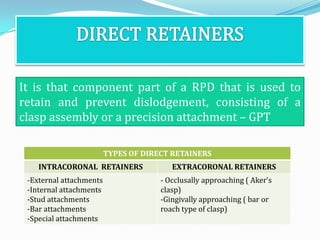
It is that component part of a RPD that is used to
retain and prevent dislodgement, consisting of a
clasp assembly or a precision attachment – GPT

                         TYPES OF DIRECT RETAINERS
    INTRACORONAL RETAINERS               EXTRACORONAL RETAINERS
 -External attachments                - Occlusally approaching ( Aker’s
 -Internal attachments                clasp)
 -Stud attachments                    -Gingivally approaching ( bar or
 -Bar attachments                     roach type of clasp)
 -Special attachments
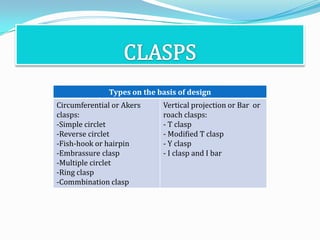
Types on the basis of design
Circumferential or Akers    Vertical projection or Bar or
clasps:                     roach clasps:
-Simple circlet             - T clasp
-Reverse circlet            - Modified T clasp
-Fish-hook or hairpin       - Y clasp
-Embrassure clasp           - I clasp and I bar
-Multiple circlet
-Ring clasp
-Commbination clasp
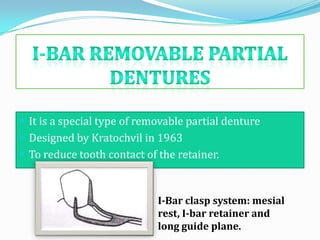
 It is a special type of removable partial denture
 Designed by Kratochvil in 1963
 To reduce tooth contact of the retainer.


                             I-Bar clasp system: mesial
                             rest, I-bar retainer and
                             long guide plane.
I- Bar RPD                                Regular RPD
1. Mesial rest instead of distal rest. In 1. Distal rest
   other words, the rest is on proximal side
   away from edentulous space.


2. I- bar retainer is used for                 2. Occlusally approaching
   direct retention.                              retainer is used

3. Long guide planes           3. Normal guide planes
   extending into tooth tissue
   junction
 I-Bar Partial denture components:
I.     Rest
II.    Proximal plates
III.   Major connectors
IV.    Minor connectors
V.     Denture base connectors
VI.    Retainers
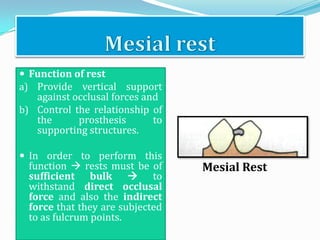
 Function of rest
a) Provide vertical support
   against occlusal forces and
b) Control the relationship of
   the      prosthesis       to
   supporting structures.

 In order to perform this
  function  rests must be of     Mesial Rest
  sufficient bulk  to
  withstand direct occlusal
  force and also the indirect
  force that they are subjected
  to as fulcrum points.
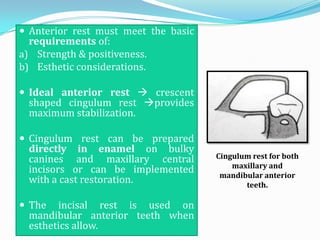
 Anterior rest must meet the basic
  requirements of:
a) Strength & positiveness.
b) Esthetic considerations.

 Ideal anterior rest  crescent
  shaped cingulum rest provides
  maximum stabilization.

 Cingulum rest can be prepared
  directly in enamel on bulky
  canines and maxillary central       Cingulum rest for both
                                          maxillary and
  incisors or can be implemented       mandibular anterior
  with a cast restoration.                   teeth.

 The   incisal rest is used on
  mandibular anterior teeth when
  esthetics allow.
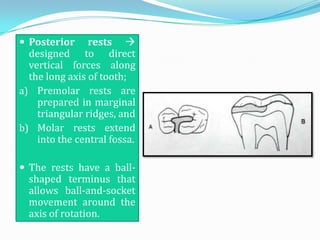
 Posterior     rests 
  designed to direct
  vertical forces along
  the long axis of tooth;
a) Premolar rests are
    prepared in marginal
    triangular ridges, and
b) Molar rests extend
    into the central fossa.

 The rests have a ball-
  shaped terminus that
  allows ball-and-socket
  movement around the
  axis of rotation.
 In distal extension cases the most distal rests are
  placed on the mesial aspect of the abutment teeth for
  the following 2 reasons:

1. Anterior placement of the rest (fulcrum) helps
   verticalize the forces of occlusion on bearing mucosa
   under the denture base extension.

2. The mesial rest directs tipping forces on the
   abutment mesially and tends to move the abutment
   tooth into firm contact with the support of the
   anterior teeth.
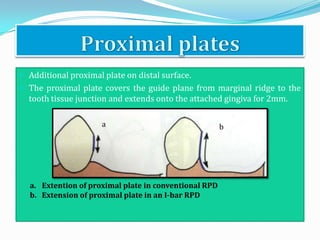
 Additional proximal plate on distal surface.
 The proximal plate covers the guide plane from marginal ridge to the
  tooth tissue junction and extends onto the attached gingiva for 2mm.

                      a                                b


  a. Extention of proximal plate in conventional RPD
  b. Extension of proximal plate in an I-bar RPD
 Advantages:
i.     Provides horizontal stability.
ii.    Reunites & stabilizes the arch
iii.   ↑ retention because of parallelism and because
       dislodgement is limited to the path of insertion.
iv.    Protects the tooth-tissue junction by preventing
       food impaction and because of mental coverage
       in the area
v.     Provides good reciprocation
vi.    Distributes occlusal force throughout the arch.
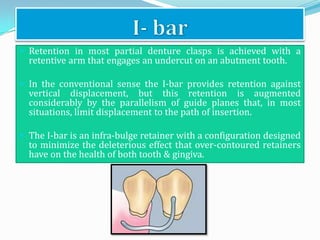
 Retention in most partial denture clasps is achieved with a
  retentive arm that engages an undercut on an abutment tooth.

 In the conventional sense the I-bar provides retention against
  vertical displacement, but this retention is augmented
  considerably by the parallelism of guide planes that, in most
  situations, limit displacement to the path of insertion.

 The I-bar is an infra-bulge retainer with a configuration designed
  to minimize the deleterious effect that over-contoured retainers
  have on the health of both tooth & gingiva.
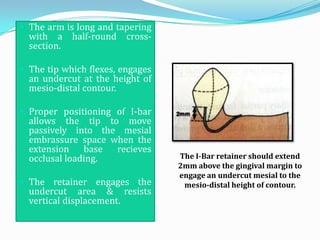
 The arm is long and tapering
  with a half-round      cross-
  section.

 The tip which flexes, engages
  an undercut at the height of
  mesio-distal contour.

 Proper positioning of I-bar
  allows the tip to move
  passively into the mesial
  embrassure space when the
  extension base recieves
  occlusal loading.               The I-Bar retainer should extend
                                  2mm above the gingival margin to
                                  engage an undercut mesial to the
 The retainer engages the         mesio-distal height of contour.
  undercut area & resists
  vertical displacement.
 Advantages of I-bar configuration:
1. Because tooth contour is not altered , food
   accumulation against the tooth surface is minimized.
2. I-bar is passive in relation to the abutment tooth
   except against vertical displacing forces.

 Disadvantages:
1. Reduced retention
2. Less horizontal stability than other retentive
   elements.
Other parts
 Major connector
 Minor connectors
 Denture base connectors
 Rest, Proximal plate and I bar
 Rest, Proximal plate and Aker’s
  clasp
 RPI is a modified I-bar retainer system.


 Krol devised it in 1973.


 All the components of the I-bar assembly were
  modified significantly to fulfill Krol’s design.

 Principle of Krol’s design was – “Stress control with
  minimal tooth & gingival coverage”.
 The speciality of these dentures is that the direct
  retainer is modified such that the retentive and
  reciprocal units of the clasp act in the mesio-distal
  direction ( in conventional design the retentive &
  reciprocal units act buccolingually).

 The advantage of adopting this design is the minimal
  tooth contact. Coverage produced by it.

 Hence, these dentures are more easy to maintain.
Modification of each component of
   I-bar retainer required to form RPI
                  system
 MESIAL REST MODIFICATION
 PROXIMAL PLATE MODIFICATION
 I-BAR MODIFICATION.
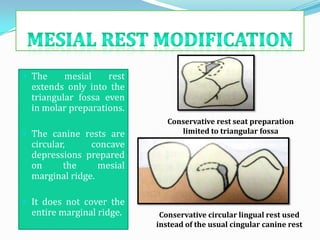
 The     mesial    rest
  extends only into the
  triangular fossa even
  in molar preparations.
                              Conservative rest seat preparation
 The canine rests are           limited to triangular fossa
  circular,     concave
  depressions prepared
  on      the     mesial
  marginal ridge.

 It does not cover the
  entire marginal ridge.    Conservative circular lingual rest used
                           instead of the usual cingular canine rest
 One of the major disadvantages of the I-bar denture
 was the excessive tooth contact produced by the extra
 long proximal plate.

 Krol introduces 3 modifications to the proximal plate.


 Any one of these modifications may be followed while
 designing an RPI retainer.
 The 3 different design modifications of the proximal
   plate are:
i. Design modification I
ii. Design modification II
iii. Design modification III
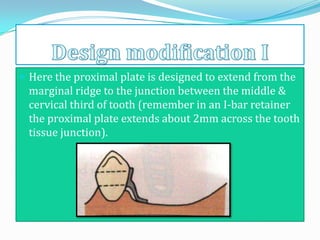
 Here the proximal plate is designed to extend from the
 marginal ridge to the junction between the middle &
 cervical third of tooth (remember in an I-bar retainer
 the proximal plate extends about 2mm across the tooth
 tissue junction).
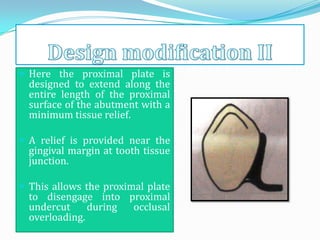
 Here the proximal plate is
  designed to extend along the
  entire length of the proximal
  surface of the abutment with a
  minimum tissue relief.

 A relief is provided near the
  gingival margin at tooth tissue
  junction.

 This allows the proximal plate
  to disengage into proximal
  undercut     during occlusal
  overloading.
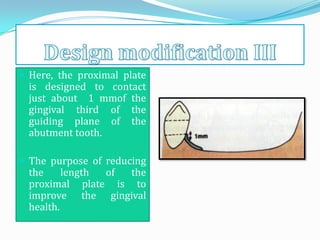
 Here, the proximal plate
 is designed to contact
 just about 1 mmof the
 gingival third of the
 guiding plane of the
 abutment tooth.

 The purpose of reducing
 the     length of the
 proximal plate is to
 improve the gingival
 health.
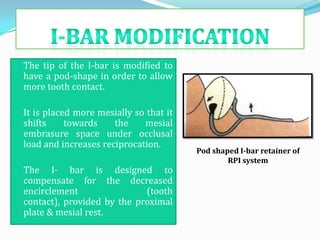
 The tip of the I-bar is modified to
  have a pod-shape in order to allow
  more tooth contact.

 It is placed more mesially so that it
  shifts    towards     the    mesial
  embrasure space under occlusal
  load and increases reciprocation.
                                          Pod shaped I-bar retainer of
                                                  RPI system
 The    I- bar is designed to
  compensate for the decreased
  encirclement                (tooth
  contact), provided by the proximal
  plate & mesial rest.
 Clinical removable partial prosthodontics
           – Stewart Rudd Kuebker
 McCracken’s removable partial prosthodontics
           - Alan B. Carr
           - Glen P. McGivney
           - David T brown
 Internet
Thank You
   ..!!

RPI system

  • 2.
     Introduction  Directretainers  Clasps  I bar removable partial denture  RPI
  • 3.
    RPI stands for: R Rest P Plate (proximal) I I bar clasp
  • 4.
    It is thatcomponent part of a RPD that is used to retain and prevent dislodgement, consisting of a clasp assembly or a precision attachment – GPT TYPES OF DIRECT RETAINERS INTRACORONAL RETAINERS EXTRACORONAL RETAINERS -External attachments - Occlusally approaching ( Aker’s -Internal attachments clasp) -Stud attachments -Gingivally approaching ( bar or -Bar attachments roach type of clasp) -Special attachments
  • 5.
    Types on thebasis of design Circumferential or Akers Vertical projection or Bar or clasps: roach clasps: -Simple circlet - T clasp -Reverse circlet - Modified T clasp -Fish-hook or hairpin - Y clasp -Embrassure clasp - I clasp and I bar -Multiple circlet -Ring clasp -Commbination clasp
  • 6.
     It isa special type of removable partial denture  Designed by Kratochvil in 1963  To reduce tooth contact of the retainer. I-Bar clasp system: mesial rest, I-bar retainer and long guide plane.
  • 7.
    I- Bar RPD Regular RPD 1. Mesial rest instead of distal rest. In 1. Distal rest other words, the rest is on proximal side away from edentulous space. 2. I- bar retainer is used for 2. Occlusally approaching direct retention. retainer is used 3. Long guide planes 3. Normal guide planes extending into tooth tissue junction
  • 8.
     I-Bar Partialdenture components: I. Rest II. Proximal plates III. Major connectors IV. Minor connectors V. Denture base connectors VI. Retainers
  • 9.
     Function ofrest a) Provide vertical support against occlusal forces and b) Control the relationship of the prosthesis to supporting structures.  In order to perform this function  rests must be of Mesial Rest sufficient bulk  to withstand direct occlusal force and also the indirect force that they are subjected to as fulcrum points.
  • 10.
     Anterior restmust meet the basic requirements of: a) Strength & positiveness. b) Esthetic considerations.  Ideal anterior rest  crescent shaped cingulum rest provides maximum stabilization.  Cingulum rest can be prepared directly in enamel on bulky canines and maxillary central Cingulum rest for both maxillary and incisors or can be implemented mandibular anterior with a cast restoration. teeth.  The incisal rest is used on mandibular anterior teeth when esthetics allow.
  • 11.
     Posterior rests  designed to direct vertical forces along the long axis of tooth; a) Premolar rests are prepared in marginal triangular ridges, and b) Molar rests extend into the central fossa.  The rests have a ball- shaped terminus that allows ball-and-socket movement around the axis of rotation.
  • 12.
     In distalextension cases the most distal rests are placed on the mesial aspect of the abutment teeth for the following 2 reasons: 1. Anterior placement of the rest (fulcrum) helps verticalize the forces of occlusion on bearing mucosa under the denture base extension. 2. The mesial rest directs tipping forces on the abutment mesially and tends to move the abutment tooth into firm contact with the support of the anterior teeth.
  • 13.
     Additional proximalplate on distal surface.  The proximal plate covers the guide plane from marginal ridge to the tooth tissue junction and extends onto the attached gingiva for 2mm. a b a. Extention of proximal plate in conventional RPD b. Extension of proximal plate in an I-bar RPD
  • 14.
     Advantages: i. Provides horizontal stability. ii. Reunites & stabilizes the arch iii. ↑ retention because of parallelism and because dislodgement is limited to the path of insertion. iv. Protects the tooth-tissue junction by preventing food impaction and because of mental coverage in the area v. Provides good reciprocation vi. Distributes occlusal force throughout the arch.
  • 15.
     Retention inmost partial denture clasps is achieved with a retentive arm that engages an undercut on an abutment tooth.  In the conventional sense the I-bar provides retention against vertical displacement, but this retention is augmented considerably by the parallelism of guide planes that, in most situations, limit displacement to the path of insertion.  The I-bar is an infra-bulge retainer with a configuration designed to minimize the deleterious effect that over-contoured retainers have on the health of both tooth & gingiva.
  • 16.
     The armis long and tapering with a half-round cross- section.  The tip which flexes, engages an undercut at the height of mesio-distal contour.  Proper positioning of I-bar allows the tip to move passively into the mesial embrassure space when the extension base recieves occlusal loading. The I-Bar retainer should extend 2mm above the gingival margin to engage an undercut mesial to the  The retainer engages the mesio-distal height of contour. undercut area & resists vertical displacement.
  • 17.
     Advantages ofI-bar configuration: 1. Because tooth contour is not altered , food accumulation against the tooth surface is minimized. 2. I-bar is passive in relation to the abutment tooth except against vertical displacing forces.  Disadvantages: 1. Reduced retention 2. Less horizontal stability than other retentive elements.
  • 18.
    Other parts  Majorconnector  Minor connectors  Denture base connectors
  • 19.
     Rest, Proximalplate and I bar  Rest, Proximal plate and Aker’s clasp
  • 20.
     RPI isa modified I-bar retainer system.  Krol devised it in 1973.  All the components of the I-bar assembly were modified significantly to fulfill Krol’s design.  Principle of Krol’s design was – “Stress control with minimal tooth & gingival coverage”.
  • 21.
     The specialityof these dentures is that the direct retainer is modified such that the retentive and reciprocal units of the clasp act in the mesio-distal direction ( in conventional design the retentive & reciprocal units act buccolingually).  The advantage of adopting this design is the minimal tooth contact. Coverage produced by it.  Hence, these dentures are more easy to maintain.
  • 22.
    Modification of eachcomponent of I-bar retainer required to form RPI system  MESIAL REST MODIFICATION  PROXIMAL PLATE MODIFICATION  I-BAR MODIFICATION.
  • 23.
     The mesial rest extends only into the triangular fossa even in molar preparations. Conservative rest seat preparation  The canine rests are limited to triangular fossa circular, concave depressions prepared on the mesial marginal ridge.  It does not cover the entire marginal ridge. Conservative circular lingual rest used instead of the usual cingular canine rest
  • 24.
     One ofthe major disadvantages of the I-bar denture was the excessive tooth contact produced by the extra long proximal plate.  Krol introduces 3 modifications to the proximal plate.  Any one of these modifications may be followed while designing an RPI retainer.
  • 25.
     The 3different design modifications of the proximal plate are: i. Design modification I ii. Design modification II iii. Design modification III
  • 26.
     Here theproximal plate is designed to extend from the marginal ridge to the junction between the middle & cervical third of tooth (remember in an I-bar retainer the proximal plate extends about 2mm across the tooth tissue junction).
  • 27.
     Here theproximal plate is designed to extend along the entire length of the proximal surface of the abutment with a minimum tissue relief.  A relief is provided near the gingival margin at tooth tissue junction.  This allows the proximal plate to disengage into proximal undercut during occlusal overloading.
  • 28.
     Here, theproximal plate is designed to contact just about 1 mmof the gingival third of the guiding plane of the abutment tooth.  The purpose of reducing the length of the proximal plate is to improve the gingival health.
  • 29.
     The tipof the I-bar is modified to have a pod-shape in order to allow more tooth contact.  It is placed more mesially so that it shifts towards the mesial embrasure space under occlusal load and increases reciprocation. Pod shaped I-bar retainer of RPI system  The I- bar is designed to compensate for the decreased encirclement (tooth contact), provided by the proximal plate & mesial rest.
  • 30.
     Clinical removablepartial prosthodontics – Stewart Rudd Kuebker  McCracken’s removable partial prosthodontics - Alan B. Carr - Glen P. McGivney - David T brown  Internet
  • 31.