By samir ali
2014_2015
Surgical Incisions and Flaps
2
The following fundamental rules apply to every surgical
procedure, concerning the incision and flap:
1_The incision must be carried out with a firm,
continuous
stroke, not interrupted strokes. During the
incision, the scalpel should be in constant contact
with bone. Repeated strokes at the same place, many
times, impair wound healing
2_Flap design and incision should be carried out in
such a way that injury of anatomic structures is
avoided
3
3_Vertical releasing incisions should begin approximately
at the buccal vestibule and end at the interdental
papillae of the gingiva.
4_Envelope incisions and semilunar incisions, which
are used in apicoectomies and removal of root tips,
must be at least 0.5 cm from the gingival sulcus.
5_The elliptic incision, which is used for the
excision of various soft tissue lesions, comprises
two convex
incisions joined at an acute angle at each end, while
the depth of the incision is such that there is no tension
when the wound margins are coapted and sutured.
4
6_ The width of the flap must be adequate, so that the
operative field is easily accessible, without creating
tension and trauma during manipulation
7_The base of the flap must be broader than the
free gingival margin, to ensure adequate blood
supply and to promote healing.
8_ The flap itself must be larger than the bone deficit
so that the flap margins, when sutured, are resting
on intact, healthy bone and not over missing or unhealthy
bone, thus preventing flap dehiscence and
tearing
5
9_The mucosa and periosteum must be reflected together.
This is achieved (after a deep incision) when
the elevator is continuously kept and pressed firmly
against the bone.
10_When the incision is not made along the gingival
sulcus, for esthetic reasons, and especially in people
with broad smiles,
11_During the surgical procedure, excessive pulling
and crushing or folding of the flap must be avoided,
because the blood supply is compromised and healing
is delayed.
Types of Flaps
based mainly upon shape
1_Trapezoidal Flap
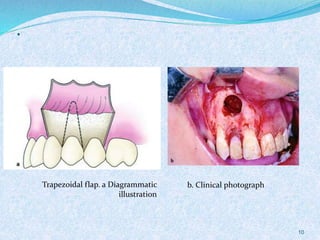
The trapezoidal flap is created after a _ ∏
shaped incision,
which is formed by a horizontal incision along
the gingivae, and two oblique vertical releasing
incisions
extending to the buccal vestibule. The vertical
releasing incisions always extend to the interdental
papilla
and never to the center of the labial or buccal surface
of the tooth
6
This ensures the integrity of the
gingiva
proper, because if the incision were to
begin at the
center of the tooth, contraction after
healing would
leave the cervical area of the tooth
exposed
7
The trapezoidal flap is suitable for
extensive surgical procedures, especially
when the triangular
flap would not provide adequate access.
8
.
The fact that the base of the
resulting flap is broader than its free gingival margin
ensures the necessary adequate blood supply for the
healing process
9
.
Trapezoidal flap. a Diagrammatic
illustration
b. Clinical photograph
10
.
Advantages.
Provides excellent access, allows surgery
to be performed on more than one or two teeth,
produces no tension in the tissues, allows easy
reapproximation
of the flap to its original position and
hastens the healing process.
Disadvantages.
Produces a defect in the attached
gingiva (recession of gingiva).
11
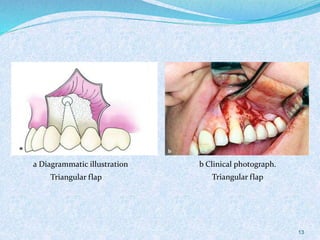
2_Triangular Flap
This flap is the result of an L-shaped incision
with a horizontal incision made along
the gingival sulcus and a vertical or oblique incision.
The vertical incision begins approximately at the
vestibular
fold and extends to the interdental papilla of the
gingiva.
12
Triangular flap
a Diagrammatic illustration b Clinical photograph.
Triangular flap
13
The triangular flap is performed
labially or
buccally on both jaws and is
indicated in the surgical
removal of root tips, small cysts,
and apicoectomies.
#apicoectomies.
a surgical procedure to remove the end of a tooth root in endodontic
therapy.
14
Advantages.
Ensures an adequate blood supply, satisfactory
visualization, very good stability and reapproximation;
it is easily modified with a small releasing
incision, or an additional vertical incision, or even
lengthening of the horizontal incision.
Disadvantages.
Limited access to long roots, tension
is created when the flap is held with a retractor, and it
causes a defect in the attached gingiva.
15
3_Envelope Flap
This type of flap is the result of an
extended horizontal incision along the
cervical lines of the teeth. The incision is
made in the gingival sulcus and extends
along four or five teeth. The tissue
connected to the cervical lines of these
teeth and the interdental papillae is thus
freed. T
16
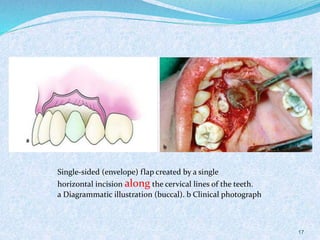
Single-sided (envelope) flap created by a single
horizontal incision along the cervical lines of the teeth.
a Diagrammatic illustration (buccal). b Clinical photograph
17
The envelope flap is used
for surgery of incisors, premolars and molars, on
the labial or buccal and palatal or lingual surface
and is usually indicated when the surgical
procedure involves the cervical lines of the teeth
labially (or buccally) and palatally (or lingually),
apicoectomy
(palatal root), removal of impacted teeth,
cysts,
18
Advantages.
Avoidance of vertical incision and easy
reapproximation to original position.
Disadvantages.
Difficult reflection (mainly palatally), great
tension with a risk of the ends tearing, limited
visualization in apicoectomies, limited access,
possibility of injury of palatal vessels and nerves,
defect of attached gingiva.
19
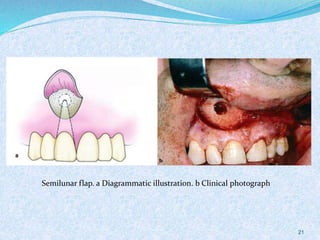
4_Semilunar Flap
This flap is the result of a curved incision, which begins
just beneath the vestibular fold and has a bowshaped
course with the convex part towards the attached
gingiva The lowest point of the
incision must be at least 0.5 cm from the gingival margin,
so that the blood supply is not compromised. Each
end of the incision must extend at least one tooth over
on each side of the area of bone removal.
20
Semilunar flap. a Diagrammatic illustration. b Clinical photograph
21
The semilunar
flap is used in apicoectomies and removal of
small
cysts and root tips.
22
Advantages.
Small incision and easy reflection, no
recession of gingivae around the prosthetic restoration,
no intervention at the periodontium, easier oral
hygiene compared to other types of flaps.
Disadvantages.
Possibility of the incision being performed
right over the bone lesion due to miscalculation,
scarring mainly in the anterior area, difficulty of
reapproximation and suturing due to absence of
specific reference points, limited access and
visualization tendency to tear 23
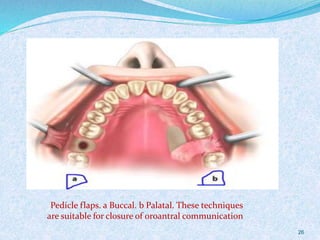
4_Pedicle Flaps
The three main types of pedicle flaps used for closure
of an oroantral communication are: buccal, palatal,
and bridge flaps.
A_Buccal Flap
This is a typical trapezoidal flap created
buccally, corresponding to the area which is to be covered,
and is usually used on dentulous patients. It is
the result of two oblique incisions that diverge upwards,
and extend as far as the tooth socket
24
After creating the flap, the periosteum is incised
transversally,
making it more elastic so that it may cover
the orifice that results from the tooth extraction. The
oblique buccal flap is a variation of the buccal flap. It is
the result of an anteroposterior incision, so that its base
is perpendicular to the buccal area, posterior to the
wound. The flap is rotated about 70°–80° and is placed
over the socket. Both cases require that, before placing
the flap, the wound margins must be debrided.
25
Pedicle flaps. a Buccal. b Palatal. These techniques
are suitable for closure of oroantral communication
26
B_ Palatal Flap.
This type of flap is used in edentulous
patients so that the vestibular depth is maintained
The resulting palatal mucoperiosteal flap is rotated
posteriorly and buccally, always including the vessels
that emerge from the corresponding greater palatine
foramen After rotation, the flap is placed
over the orifice of the socket, the wound margins are
debrided, and the flap is sutured with the buccal tissues.
A gingival dressing is applied for a few days at
the void created and healing is achieved by secondary
intention.
27
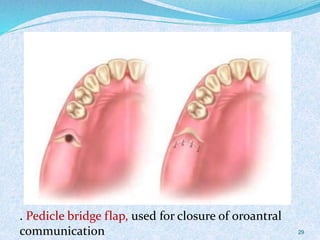
C_Pedicle Bridge Flap.
This flap is palatobuccal and is perpendicular to the
alveolar ridge After creation, the flap is rotated
posteriorly or anteriorly, to cover the orifice of the
oroantral communication,
without compromising the vestibular fold. This type
of flap is used only on edentulous parts of the alveolar
ridge.
28
. Pedicle bridge flap, used for closure of oroantral
communication 29
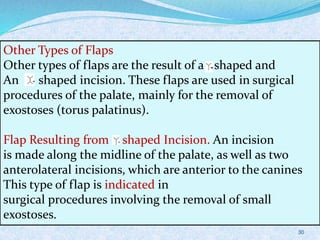
Other Types of Flaps
Other types of flaps are the result of a - shaped and
An - shaped incision. These flaps are used in surgical
procedures of the palate, mainly for the removal of
exostoses (torus palatinus).
Flap Resulting from - shaped Incision. An incision
is made along the midline of the palate, as well as two
anterolateral incisions, which are anterior to the canines
This type of flap is indicated in
surgical procedures involving the removal of small
exostoses.
30
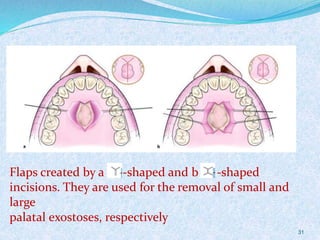
Flaps created by a -shaped and b -shaped
incisions. They are used for the removal of small and
large
palatal exostoses, respectively
31
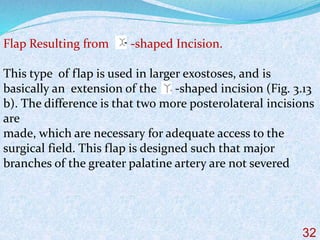
Flap Resulting from -shaped Incision.
This type of flap is used in larger exostoses, and is
basically an extension of the -shaped incision (Fig. 3.13
b). The difference is that two more posterolateral incisions
are
made, which are necessary for adequate access to the
surgical field. This flap is designed such that major
branches of the greater palatine artery are not severed
32
33
Reflection of the Mucoperiosteum
Reflection is performed to separate the
mucoperiosteal
flap from the underlying bone. The elevator is in
direct contact with bone and reflection starts at the
incision, usually at an angle and is completed
with gentle, steady strokes towards the labial or
buccal vestibule, without damaging the tissues. When
the attachment between bone and periosteum is
strong
or if symphysis occurs, then scissors or surgical blades
may be used.
34
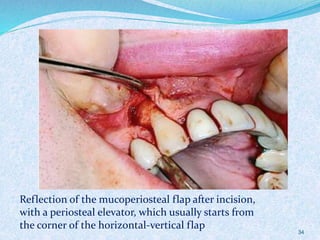
Reflection of the mucoperiosteal flap after incision,
with a periosteal elevator, which usually starts from
the corner of the horizontal-vertical flap

surgical flaps oral surgery

  • 1.
  • 2.
    Surgical Incisions andFlaps 2 The following fundamental rules apply to every surgical procedure, concerning the incision and flap: 1_The incision must be carried out with a firm, continuous stroke, not interrupted strokes. During the incision, the scalpel should be in constant contact with bone. Repeated strokes at the same place, many times, impair wound healing 2_Flap design and incision should be carried out in such a way that injury of anatomic structures is avoided
  • 3.
    3 3_Vertical releasing incisionsshould begin approximately at the buccal vestibule and end at the interdental papillae of the gingiva. 4_Envelope incisions and semilunar incisions, which are used in apicoectomies and removal of root tips, must be at least 0.5 cm from the gingival sulcus. 5_The elliptic incision, which is used for the excision of various soft tissue lesions, comprises two convex incisions joined at an acute angle at each end, while the depth of the incision is such that there is no tension when the wound margins are coapted and sutured.
  • 4.
    4 6_ The widthof the flap must be adequate, so that the operative field is easily accessible, without creating tension and trauma during manipulation 7_The base of the flap must be broader than the free gingival margin, to ensure adequate blood supply and to promote healing. 8_ The flap itself must be larger than the bone deficit so that the flap margins, when sutured, are resting on intact, healthy bone and not over missing or unhealthy bone, thus preventing flap dehiscence and tearing
  • 5.
    5 9_The mucosa andperiosteum must be reflected together. This is achieved (after a deep incision) when the elevator is continuously kept and pressed firmly against the bone. 10_When the incision is not made along the gingival sulcus, for esthetic reasons, and especially in people with broad smiles, 11_During the surgical procedure, excessive pulling and crushing or folding of the flap must be avoided, because the blood supply is compromised and healing is delayed.
  • 6.
    Types of Flaps basedmainly upon shape 1_Trapezoidal Flap The trapezoidal flap is created after a _ ∏ shaped incision, which is formed by a horizontal incision along the gingivae, and two oblique vertical releasing incisions extending to the buccal vestibule. The vertical releasing incisions always extend to the interdental papilla and never to the center of the labial or buccal surface of the tooth 6
  • 7.
    This ensures theintegrity of the gingiva proper, because if the incision were to begin at the center of the tooth, contraction after healing would leave the cervical area of the tooth exposed 7
  • 8.
    The trapezoidal flapis suitable for extensive surgical procedures, especially when the triangular flap would not provide adequate access. 8
  • 9.
    . The fact thatthe base of the resulting flap is broader than its free gingival margin ensures the necessary adequate blood supply for the healing process 9
  • 10.
    . Trapezoidal flap. aDiagrammatic illustration b. Clinical photograph 10
  • 11.
    . Advantages. Provides excellent access,allows surgery to be performed on more than one or two teeth, produces no tension in the tissues, allows easy reapproximation of the flap to its original position and hastens the healing process. Disadvantages. Produces a defect in the attached gingiva (recession of gingiva). 11
  • 12.
    2_Triangular Flap This flapis the result of an L-shaped incision with a horizontal incision made along the gingival sulcus and a vertical or oblique incision. The vertical incision begins approximately at the vestibular fold and extends to the interdental papilla of the gingiva. 12
  • 13.
    Triangular flap a Diagrammaticillustration b Clinical photograph. Triangular flap 13
  • 14.
    The triangular flapis performed labially or buccally on both jaws and is indicated in the surgical removal of root tips, small cysts, and apicoectomies. #apicoectomies. a surgical procedure to remove the end of a tooth root in endodontic therapy. 14
  • 15.
    Advantages. Ensures an adequateblood supply, satisfactory visualization, very good stability and reapproximation; it is easily modified with a small releasing incision, or an additional vertical incision, or even lengthening of the horizontal incision. Disadvantages. Limited access to long roots, tension is created when the flap is held with a retractor, and it causes a defect in the attached gingiva. 15
  • 16.
    3_Envelope Flap This typeof flap is the result of an extended horizontal incision along the cervical lines of the teeth. The incision is made in the gingival sulcus and extends along four or five teeth. The tissue connected to the cervical lines of these teeth and the interdental papillae is thus freed. T 16
  • 17.
    Single-sided (envelope) flapcreated by a single horizontal incision along the cervical lines of the teeth. a Diagrammatic illustration (buccal). b Clinical photograph 17
  • 18.
    The envelope flapis used for surgery of incisors, premolars and molars, on the labial or buccal and palatal or lingual surface and is usually indicated when the surgical procedure involves the cervical lines of the teeth labially (or buccally) and palatally (or lingually), apicoectomy (palatal root), removal of impacted teeth, cysts, 18
  • 19.
    Advantages. Avoidance of verticalincision and easy reapproximation to original position. Disadvantages. Difficult reflection (mainly palatally), great tension with a risk of the ends tearing, limited visualization in apicoectomies, limited access, possibility of injury of palatal vessels and nerves, defect of attached gingiva. 19
  • 20.
    4_Semilunar Flap This flapis the result of a curved incision, which begins just beneath the vestibular fold and has a bowshaped course with the convex part towards the attached gingiva The lowest point of the incision must be at least 0.5 cm from the gingival margin, so that the blood supply is not compromised. Each end of the incision must extend at least one tooth over on each side of the area of bone removal. 20
  • 21.
    Semilunar flap. aDiagrammatic illustration. b Clinical photograph 21
  • 22.
    The semilunar flap isused in apicoectomies and removal of small cysts and root tips. 22
  • 23.
    Advantages. Small incision andeasy reflection, no recession of gingivae around the prosthetic restoration, no intervention at the periodontium, easier oral hygiene compared to other types of flaps. Disadvantages. Possibility of the incision being performed right over the bone lesion due to miscalculation, scarring mainly in the anterior area, difficulty of reapproximation and suturing due to absence of specific reference points, limited access and visualization tendency to tear 23
  • 24.
    4_Pedicle Flaps The threemain types of pedicle flaps used for closure of an oroantral communication are: buccal, palatal, and bridge flaps. A_Buccal Flap This is a typical trapezoidal flap created buccally, corresponding to the area which is to be covered, and is usually used on dentulous patients. It is the result of two oblique incisions that diverge upwards, and extend as far as the tooth socket 24
  • 25.
    After creating theflap, the periosteum is incised transversally, making it more elastic so that it may cover the orifice that results from the tooth extraction. The oblique buccal flap is a variation of the buccal flap. It is the result of an anteroposterior incision, so that its base is perpendicular to the buccal area, posterior to the wound. The flap is rotated about 70°–80° and is placed over the socket. Both cases require that, before placing the flap, the wound margins must be debrided. 25
  • 26.
    Pedicle flaps. aBuccal. b Palatal. These techniques are suitable for closure of oroantral communication 26
  • 27.
    B_ Palatal Flap. Thistype of flap is used in edentulous patients so that the vestibular depth is maintained The resulting palatal mucoperiosteal flap is rotated posteriorly and buccally, always including the vessels that emerge from the corresponding greater palatine foramen After rotation, the flap is placed over the orifice of the socket, the wound margins are debrided, and the flap is sutured with the buccal tissues. A gingival dressing is applied for a few days at the void created and healing is achieved by secondary intention. 27
  • 28.
    C_Pedicle Bridge Flap. Thisflap is palatobuccal and is perpendicular to the alveolar ridge After creation, the flap is rotated posteriorly or anteriorly, to cover the orifice of the oroantral communication, without compromising the vestibular fold. This type of flap is used only on edentulous parts of the alveolar ridge. 28
  • 29.
    . Pedicle bridgeflap, used for closure of oroantral communication 29
  • 30.
    Other Types ofFlaps Other types of flaps are the result of a - shaped and An - shaped incision. These flaps are used in surgical procedures of the palate, mainly for the removal of exostoses (torus palatinus). Flap Resulting from - shaped Incision. An incision is made along the midline of the palate, as well as two anterolateral incisions, which are anterior to the canines This type of flap is indicated in surgical procedures involving the removal of small exostoses. 30
  • 31.
    Flaps created bya -shaped and b -shaped incisions. They are used for the removal of small and large palatal exostoses, respectively 31
  • 32.
    Flap Resulting from-shaped Incision. This type of flap is used in larger exostoses, and is basically an extension of the -shaped incision (Fig. 3.13 b). The difference is that two more posterolateral incisions are made, which are necessary for adequate access to the surgical field. This flap is designed such that major branches of the greater palatine artery are not severed 32
  • 33.
    33 Reflection of theMucoperiosteum Reflection is performed to separate the mucoperiosteal flap from the underlying bone. The elevator is in direct contact with bone and reflection starts at the incision, usually at an angle and is completed with gentle, steady strokes towards the labial or buccal vestibule, without damaging the tissues. When the attachment between bone and periosteum is strong or if symphysis occurs, then scissors or surgical blades may be used.
  • 34.
    34 Reflection of themucoperiosteal flap after incision, with a periosteal elevator, which usually starts from the corner of the horizontal-vertical flap