PERIODONTAL
INSTRUMENTS &
INSTRUMENTATION
SEYED VAHID MALEK HOSSEINI
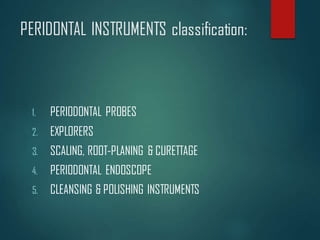
PERIDONTAL INSTRUMENTS classification:
1. PERIODONTAL PROBES
2. EXPLORERS
3. SCALING, ROOT-PLANING & CURETTAGE
4. PERIODONTAL ENDOSCOPE
5. CLEANSING & POLISHING INSTRUMENTS
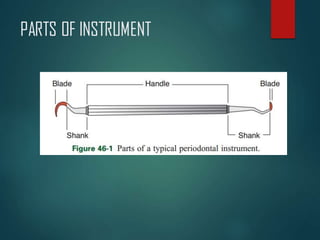
PARTS OF INSTRUMENT
CLASSIFICATION
• PERIODONTAL PROBES
 used to locate, measure and mark pockets as well as
determine their course on individual tooth surfaces
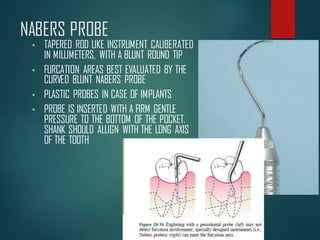
NABERS PROBE
• TAPERED ROD LIKE INSTRUMENT CALIBERATED
IN MILLIMETERS, WITH A BLUNT ROUND TIP
• FURCATION AREAS BEST EVALUATED BY THE
CURVED BLUNT NABERS PROBE
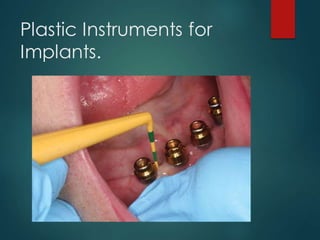
• PLASTIC PROBES IN CASE OF IMPLANTS
• PROBE IS INSERTED WITH A FIRM GENTLE
PRESSURE TO THE BOTTOM OF THE POCKET.
SHANK SHOULD ALLIGN WITH THE LONG AXIS
OF THE TOOTH
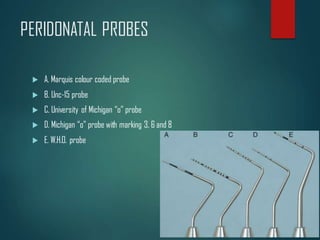
PERIDONATAL PROBES
 A. Marquis colour coded probe
 B. Unc-15 probe
 C. University of Michigan “o” probe
 D. Michigan “o” probe with marking 3, 6 and 8
 E. W.H.O. probe
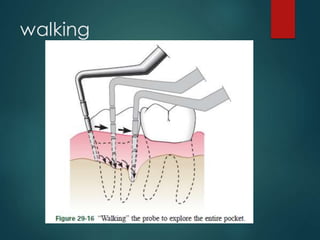
walking
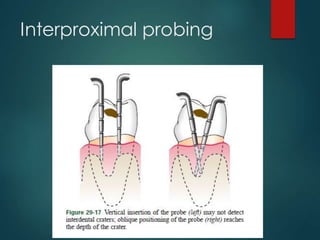
Interproximal probing
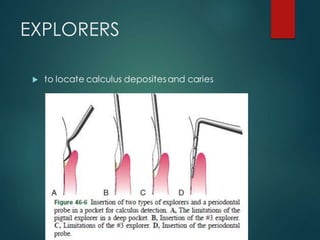
EXPLORERS
 to locate calculus depositesand caries
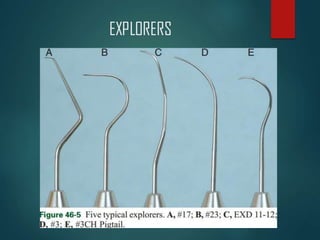
EXPLORERS
SCALING,ROOT-PLANINGAND
CURETTAGEINSTRUMENTS-
• for removal of plaque and calcified deposites from crown
and root of tooth, removal of altered cementum from the
subgingival root surface, and debridement of the soft
tissue lining the pocket.
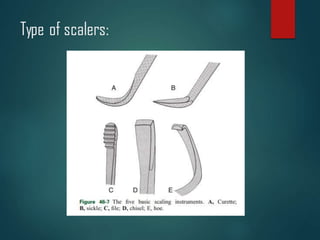
 1-Curettes
 2-sicle
 3-periodontal files
 4-chisel
 5-hoe
Type of scalers:
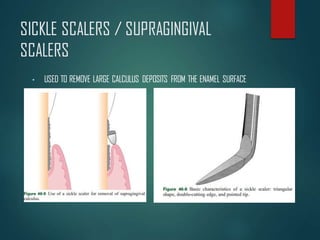
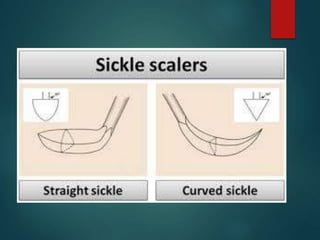
SICKLE SCALERS / SUPRAGINGIVAL
SCALERS
• USED TO REMOVE LARGE CALCULUS DEPOSITS FROM THE ENAMEL SURFACE
• USED WITH A PULL STROKE
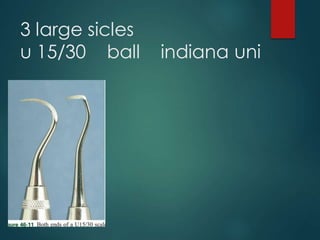
3 large sicles
u 15/30 ball indiana uni
medium-size blades
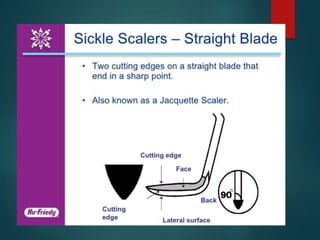
 The Jaquette sickle scalers #1, 2, and 3
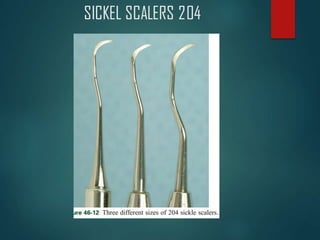
SICKEL SCALERS 204
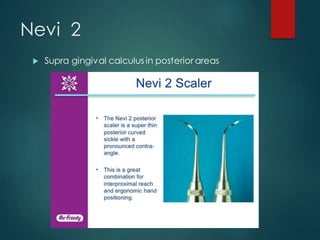
Nevi 2
 Supra gingival calculus in posterior areas
Question ?
Why supragingival ?
curettes
 Curettes- for subgingival scaling, root planing and removal
of the soft tissue lining the pocket
 All curettes share the same common elements:
 Rounded back
 Rounded toe
 Semi-circular cross section
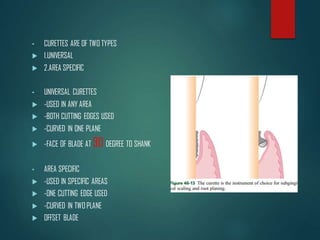
• CURETTES ARE OF TWO TYPES
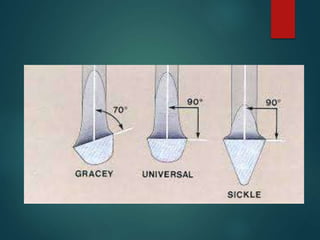
 1.UNIVERSAL
 2.AREA SPECIFIC
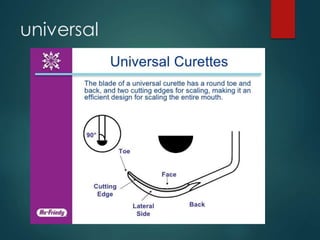
• UNIVERSAL CURETTES
 -USED IN ANY AREA
 -BOTH CUTTING EDGES USED
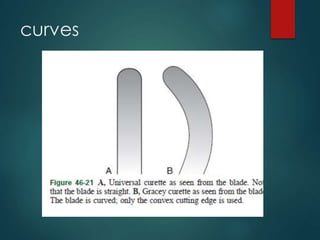
 -CURVED IN ONE PLANE
 -FACE OF BLADE AT 90 DEGREE TO SHANK
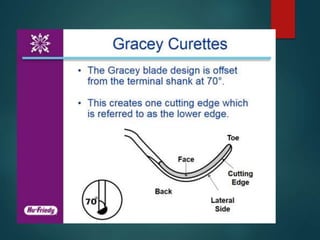
• AREA SPECIFIC
 -USED IN SPECIFIC AREAS
 -ONE CUTTING EDGE USED
 -CURVED IN TWOPLANE
 OFFSET BLADE
universal
curves
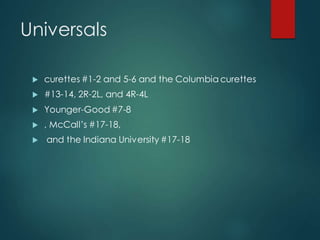
Universals
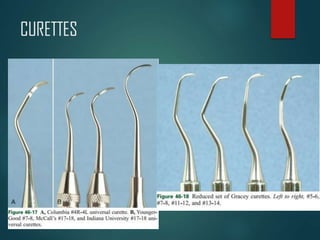
 curettes #1-2 and 5-6 and the Columbia curettes
 #13-14, 2R-2L, and 4R-4L
 Younger-Good #7-8
 , McCall’s #17-18,
 and the Indiana University #17-18
CURETTES
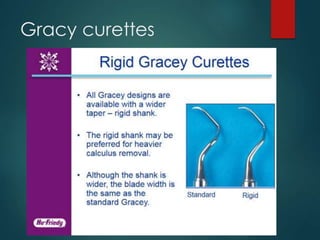
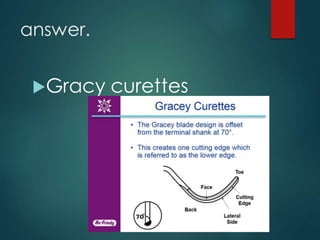
Gracy curettes
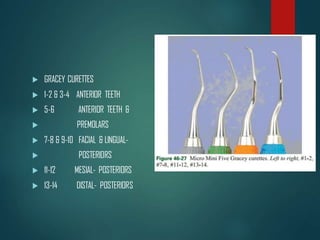
 GRACEY CURETTES
 1-2 & 3-4 ANTERIOR TEETH
 5-6 ANTERIOR TEETH &
 PREMOLARS
 7-8 & 9-10 FACIAL & LINGUAL-
 POSTERIORS
 11-12 MESIAL- POSTERIORS
 13-14 DISTAL- POSTERIORS
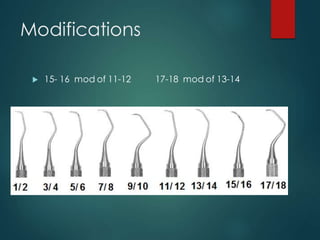
Modifications
 15- 16 mod of 11-12 17-18 mod of 13-14
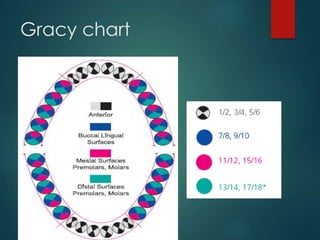
Gracy chart
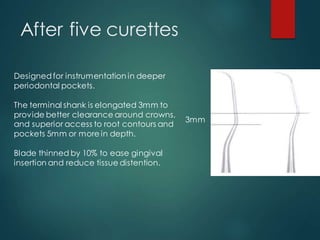
After five curettes
3mm
Designedfor instrumentation in deeper
periodontal pockets.
The terminal shank is elongated 3mm to
provide better clearance around crowns,
and superior access to root contours and
pockets 5mm or more in depth.
Blade thinned by 10% to ease gingival
insertion and reduce tissue distention.
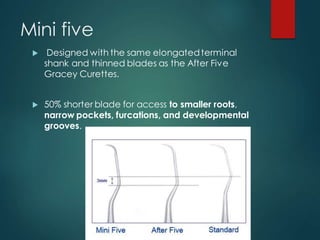
Mini five
 Designed with the same elongatedterminal
shank and thinned blades as the After Five
Gracey Curettes.
 50% shorter blade for access to smaller roots,
narrow pockets, furcations, and developmental
grooves.
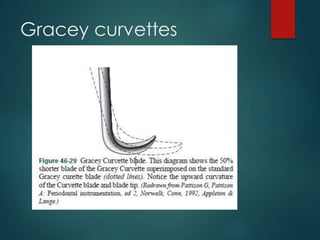
Gracey curvettes
 Mini blade
 length of these instruments is 50% shorter than that
of the conventional Gracey
 blade has been curved slightly upward
 curvature also carries the risk of gouging or
“grooving”
Gracey curvettes
Gracey curvettes
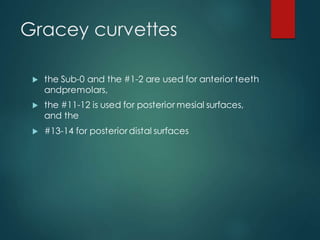
 the Sub-0 and the #1-2 are used for anterior teeth
andpremolars,
 the #11-12 is used for posterior mesial surfaces,
and the
 #13-14 for posteriordistal surfaces
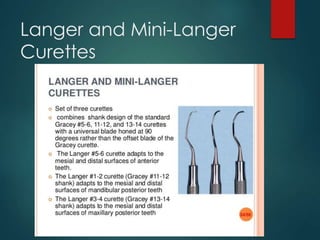
Langer and Mini-Langer
Curettes
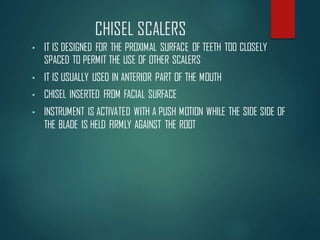
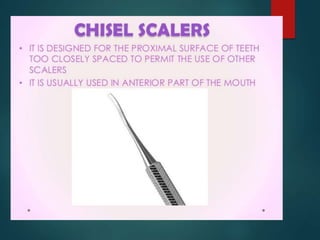
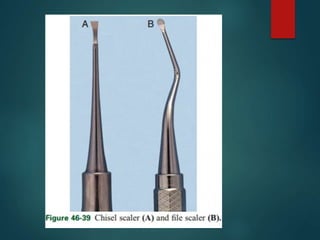
CHISEL SCALERS
• IT IS DESIGNED FOR THE PROXIMAL SURFACE OF TEETH TOO CLOSELY
SPACED TO PERMIT THE USE OF OTHER SCALERS
• IT IS USUALLY USED IN ANTERIOR PART OF THE MOUTH
• CHISEL INSERTED FROM FACIAL SURFACE
• INSTRUMENT IS ACTIVATED WITH A PUSH MOTION WHILE THE SIDE SIDE OF
THE BLADE IS HELD FIRMLY AGAINST THE ROOT
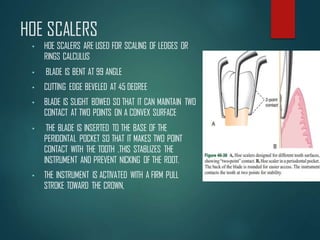
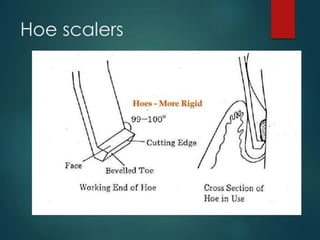
HOE SCALERS
• HOE SCALERS ARE USED FOR SCALING OF LEDGES OR
RINGS CALCULUS
• BLADE IS BENT AT 99 ANGLE
• CUTTING EDGE BEVELED AT 45 DEGREE
• BLADE IS SLIGHT BOWED SO THAT IT CAN MAINTAIN TWO
CONTACT AT TWO POINTS ON A CONVEX SURFACE
• THE BLADE IS INSERTED TO THE BASE OF THE
PERIDONTAL POCKET SO THAT IT MAKES TWO POINT
CONTACT WITH THE TOOTH .THIS STABLIZES THE
INSTRUMENT AND PREVENT NICKING OF THE ROOT.
• THE INSTRUMENT IS ACTIVATED WITH A FIRM PULL
STROKE TOWARD THE CROWN,
Hoe scalers
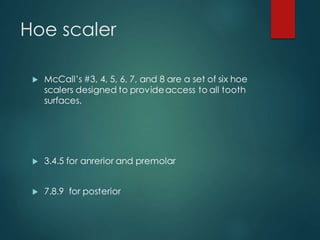
Hoe scaler
 McCall’s #3, 4, 5, 6, 7, and 8 are a set of six hoe
scalers designed to provideaccess to all tooth
surfaces.
 3.4.5 for anrerior and premolar
 7.8.9 for posterior
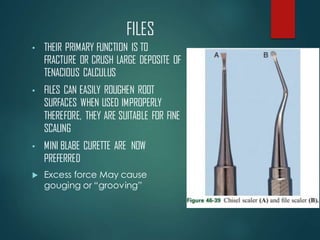
FILES
• THEIR PRIMARY FUNCTION IS TO
FRACTURE OR CRUSH LARGE DEPOSITE OF
TENACIOUS CALCULUS
• FILES CAN EASILY ROUGHEN ROOT
SURFACES WHEN USED IMPROPERLY
THEREFORE, THEY ARE SUITABLE FOR FINE
SCALING
• MINI BLABE CURETTE ARE NOW
PREFERRED
 Excess force May cause
gouging or “grooving”
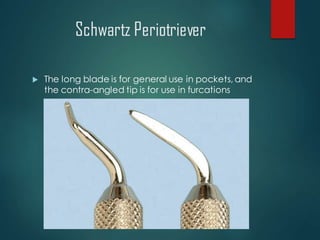
Schwartz Periotriever
 The long blade is for general use in pockets, and
the contra-angled tip is for use in furcations
Plastic Instruments for
Implants.
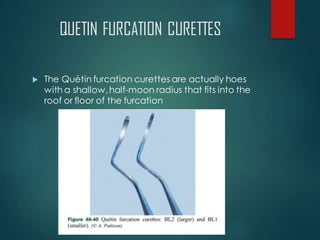
QUETIN FURCATION CURETTES
 The Quétin furcation curettes are actually hoes
with a shallow,half-moon radius that fits into the
roof or floor of the furcation
QUETIN FURCATION CURETTES
 The BL1 (buccal-lingual) and MD1 (mesial-distal)
instrumentsare small and fine, with a 0.9-
mmblade width.forrootplanning
 The BL2 and MD2 instruments are larger and
wider,with a 1.3-mm blade width.
 For scaling
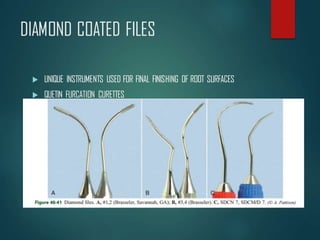
DIAMOND COATED FILES
 UNIQUE INSTRUMENTS USED FOR FINAL FINISHING OF ROOT SURFACES
 QUETIN FURCATION CURETTES
 HOES WITH A SHALLOW, HALF MOON RADIOUS THAT FITS INTO ROOF OR
FLOOR OF FURCATION & DEVELOPMENTAL DEPRESSIONS OF ROOT SURFACE
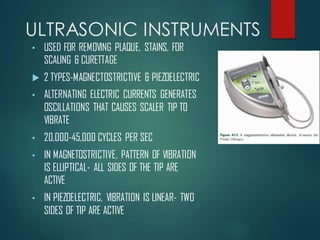
ULTRASONIC INSTRUMENTS
• USED FOR REMOVING PLAQUE, STAINS, FOR
SCALING & CURETTAGE
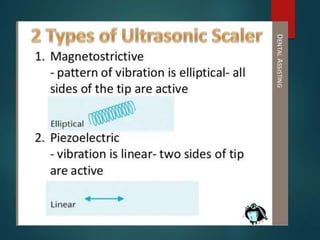
 2 TYPES-MAGNECTOSTRICTIVE & PIEZOELECTRIC
• ALTERNATING ELECTRIC CURRENTS GENERATES
OSCILLATIONS THAT CAUSES SCALER TIP TO
VIBRATE
• 20,000-45,000 CYCLES PER SEC
• IN MAGNETOSTRICTIVE, PATTERN OF VIBRATION
IS ELLIPTICAL- ALL SIDES OF THE TIP ARE
ACTIVE
• IN PIEZOELECTRIC, VIBRATION IS LINEAR- TWO
SIDES OF TIP ARE ACTIVE
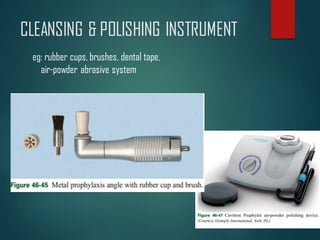
CLEANSING & POLISHING INSTRUMENT
eg: rubber cups, brushes, dental tape,
air-powder abrasive system
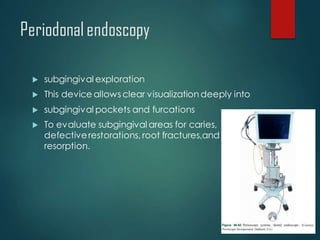
Periodonalendoscopy
 subgingival exploration
 This device allows clear visualization deeply into
 subgingival pockets and furcations
 To evaluate subgingival areas for caries,
defectiverestorations, root fractures,and
resorption.
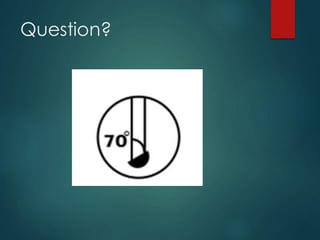
Question?
answer.
Gracy curettes

scaling and root planing instruments

  • 1.
  • 2.
    PERIDONTAL INSTRUMENTS classification: 1.PERIODONTAL PROBES 2. EXPLORERS 3. SCALING, ROOT-PLANING & CURETTAGE 4. PERIODONTAL ENDOSCOPE 5. CLEANSING & POLISHING INSTRUMENTS
  • 3.
  • 4.
    CLASSIFICATION • PERIODONTAL PROBES used to locate, measure and mark pockets as well as determine their course on individual tooth surfaces
  • 5.
    NABERS PROBE • TAPEREDROD LIKE INSTRUMENT CALIBERATED IN MILLIMETERS, WITH A BLUNT ROUND TIP • FURCATION AREAS BEST EVALUATED BY THE CURVED BLUNT NABERS PROBE • PLASTIC PROBES IN CASE OF IMPLANTS • PROBE IS INSERTED WITH A FIRM GENTLE PRESSURE TO THE BOTTOM OF THE POCKET. SHANK SHOULD ALLIGN WITH THE LONG AXIS OF THE TOOTH
  • 6.
    PERIDONATAL PROBES  A.Marquis colour coded probe  B. Unc-15 probe  C. University of Michigan “o” probe  D. Michigan “o” probe with marking 3, 6 and 8  E. W.H.O. probe
  • 7.
  • 8.
  • 9.
    EXPLORERS  to locatecalculus depositesand caries
  • 10.
  • 11.
    SCALING,ROOT-PLANINGAND CURETTAGEINSTRUMENTS- • for removalof plaque and calcified deposites from crown and root of tooth, removal of altered cementum from the subgingival root surface, and debridement of the soft tissue lining the pocket.  1-Curettes  2-sicle  3-periodontal files  4-chisel  5-hoe
  • 12.
  • 13.
    SICKLE SCALERS /SUPRAGINGIVAL SCALERS • USED TO REMOVE LARGE CALCULUS DEPOSITS FROM THE ENAMEL SURFACE • USED WITH A PULL STROKE
  • 16.
    3 large sicles u15/30 ball indiana uni
  • 17.
    medium-size blades  TheJaquette sickle scalers #1, 2, and 3
  • 18.
  • 19.
    Nevi 2  Supragingival calculus in posterior areas
  • 20.
  • 21.
    curettes  Curettes- forsubgingival scaling, root planing and removal of the soft tissue lining the pocket  All curettes share the same common elements:  Rounded back  Rounded toe  Semi-circular cross section
  • 22.
    • CURETTES AREOF TWO TYPES  1.UNIVERSAL  2.AREA SPECIFIC • UNIVERSAL CURETTES  -USED IN ANY AREA  -BOTH CUTTING EDGES USED  -CURVED IN ONE PLANE  -FACE OF BLADE AT 90 DEGREE TO SHANK • AREA SPECIFIC  -USED IN SPECIFIC AREAS  -ONE CUTTING EDGE USED  -CURVED IN TWOPLANE  OFFSET BLADE
  • 23.
  • 26.
  • 27.
    Universals  curettes #1-2and 5-6 and the Columbia curettes  #13-14, 2R-2L, and 4R-4L  Younger-Good #7-8  , McCall’s #17-18,  and the Indiana University #17-18
  • 28.
  • 29.
  • 30.
     GRACEY CURETTES 1-2 & 3-4 ANTERIOR TEETH  5-6 ANTERIOR TEETH &  PREMOLARS  7-8 & 9-10 FACIAL & LINGUAL-  POSTERIORS  11-12 MESIAL- POSTERIORS  13-14 DISTAL- POSTERIORS
  • 31.
    Modifications  15- 16mod of 11-12 17-18 mod of 13-14
  • 32.
  • 33.
    After five curettes 3mm Designedforinstrumentation in deeper periodontal pockets. The terminal shank is elongated 3mm to provide better clearance around crowns, and superior access to root contours and pockets 5mm or more in depth. Blade thinned by 10% to ease gingival insertion and reduce tissue distention.
  • 34.
    Mini five  Designedwith the same elongatedterminal shank and thinned blades as the After Five Gracey Curettes.  50% shorter blade for access to smaller roots, narrow pockets, furcations, and developmental grooves.
  • 35.
    Gracey curvettes  Miniblade  length of these instruments is 50% shorter than that of the conventional Gracey  blade has been curved slightly upward  curvature also carries the risk of gouging or “grooving”
  • 36.
  • 37.
    Gracey curvettes  theSub-0 and the #1-2 are used for anterior teeth andpremolars,  the #11-12 is used for posterior mesial surfaces, and the  #13-14 for posteriordistal surfaces
  • 38.
  • 39.
    CHISEL SCALERS • ITIS DESIGNED FOR THE PROXIMAL SURFACE OF TEETH TOO CLOSELY SPACED TO PERMIT THE USE OF OTHER SCALERS • IT IS USUALLY USED IN ANTERIOR PART OF THE MOUTH • CHISEL INSERTED FROM FACIAL SURFACE • INSTRUMENT IS ACTIVATED WITH A PUSH MOTION WHILE THE SIDE SIDE OF THE BLADE IS HELD FIRMLY AGAINST THE ROOT
  • 42.
    HOE SCALERS • HOESCALERS ARE USED FOR SCALING OF LEDGES OR RINGS CALCULUS • BLADE IS BENT AT 99 ANGLE • CUTTING EDGE BEVELED AT 45 DEGREE • BLADE IS SLIGHT BOWED SO THAT IT CAN MAINTAIN TWO CONTACT AT TWO POINTS ON A CONVEX SURFACE • THE BLADE IS INSERTED TO THE BASE OF THE PERIDONTAL POCKET SO THAT IT MAKES TWO POINT CONTACT WITH THE TOOTH .THIS STABLIZES THE INSTRUMENT AND PREVENT NICKING OF THE ROOT. • THE INSTRUMENT IS ACTIVATED WITH A FIRM PULL STROKE TOWARD THE CROWN,
  • 43.
  • 44.
    Hoe scaler  McCall’s#3, 4, 5, 6, 7, and 8 are a set of six hoe scalers designed to provideaccess to all tooth surfaces.  3.4.5 for anrerior and premolar  7.8.9 for posterior
  • 45.
    FILES • THEIR PRIMARYFUNCTION IS TO FRACTURE OR CRUSH LARGE DEPOSITE OF TENACIOUS CALCULUS • FILES CAN EASILY ROUGHEN ROOT SURFACES WHEN USED IMPROPERLY THEREFORE, THEY ARE SUITABLE FOR FINE SCALING • MINI BLABE CURETTE ARE NOW PREFERRED  Excess force May cause gouging or “grooving”
  • 46.
    Schwartz Periotriever  Thelong blade is for general use in pockets, and the contra-angled tip is for use in furcations
  • 47.
  • 48.
    QUETIN FURCATION CURETTES The Quétin furcation curettes are actually hoes with a shallow,half-moon radius that fits into the roof or floor of the furcation
  • 49.
    QUETIN FURCATION CURETTES The BL1 (buccal-lingual) and MD1 (mesial-distal) instrumentsare small and fine, with a 0.9- mmblade width.forrootplanning  The BL2 and MD2 instruments are larger and wider,with a 1.3-mm blade width.  For scaling
  • 50.
    DIAMOND COATED FILES UNIQUE INSTRUMENTS USED FOR FINAL FINISHING OF ROOT SURFACES  QUETIN FURCATION CURETTES  HOES WITH A SHALLOW, HALF MOON RADIOUS THAT FITS INTO ROOF OR FLOOR OF FURCATION & DEVELOPMENTAL DEPRESSIONS OF ROOT SURFACE
  • 51.
    ULTRASONIC INSTRUMENTS • USEDFOR REMOVING PLAQUE, STAINS, FOR SCALING & CURETTAGE  2 TYPES-MAGNECTOSTRICTIVE & PIEZOELECTRIC • ALTERNATING ELECTRIC CURRENTS GENERATES OSCILLATIONS THAT CAUSES SCALER TIP TO VIBRATE • 20,000-45,000 CYCLES PER SEC • IN MAGNETOSTRICTIVE, PATTERN OF VIBRATION IS ELLIPTICAL- ALL SIDES OF THE TIP ARE ACTIVE • IN PIEZOELECTRIC, VIBRATION IS LINEAR- TWO SIDES OF TIP ARE ACTIVE
  • 54.
    CLEANSING & POLISHINGINSTRUMENT eg: rubber cups, brushes, dental tape, air-powder abrasive system
  • 55.
    Periodonalendoscopy  subgingival exploration This device allows clear visualization deeply into  subgingival pockets and furcations  To evaluate subgingival areas for caries, defectiverestorations, root fractures,and resorption.
  • 56.
  • 57.