ANALYTICAL CHEMISTRY
(Thermogravimetric Analysis)
Dr.S.SURESH
Assistant Professor
Email:avitsureshindia@gmail.com
Thermogravimetric analysis(TGA)
• Principle:
In thermogravimetric analysis, the sample is heated in a
given environment (air, N2, CO2, He, Ar, etc.) at controlled
rate.
The change in the weight of the substance is recorded as a
function of temperature or time. The temperature is
increased at a constant rate for a known initial weight of
the substance and the changes in weights are recorded as
a function of temperature at different time interval.
This plot of weight change against temperature is called
thermogravimetric curve or thermogram, this is the basic
principle of TGA
Example: TGA Curve for AgNO3
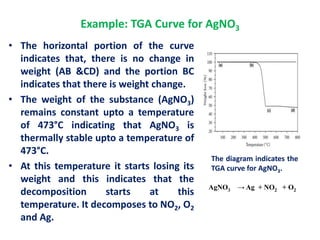
• The horizontal portion of the curve
indicates that, there is no change in
weight (AB &CD) and the portion BC
indicates that there is weight change.
• The weight of the substance (AgNO3)
remains constant upto a temperature
of 473°C indicating that AgNO3 is
thermally stable upto a temperature of
473°C.
• At this temperature it starts losing its
weight and this indicates that the
decomposition starts at this
temperature. It decomposes to NO2, O2
and Ag.
The diagram indicates the
TGA curve for AgNO3.
AgNO3 → Ag + NO2 + O2
TGA Curve for AgNO3
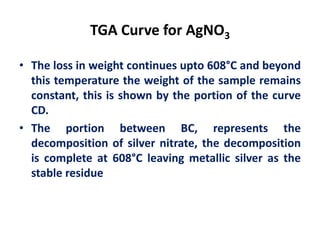
• The loss in weight continues upto 608°C and beyond
this temperature the weight of the sample remains
constant, this is shown by the portion of the curve
CD.
• The portion between BC, represents the
decomposition of silver nitrate, the decomposition
is complete at 608°C leaving metallic silver as the
stable residue
Instrumentation / Block diagram of TGA
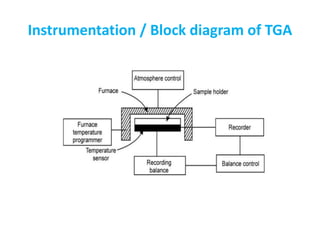
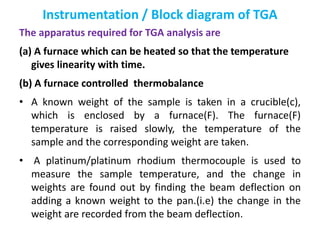
The apparatus required for TGA analysis are
(a) A furnace which can be heated so that the temperature
gives linearity with time.
(b) A furnace controlled thermobalance
• A known weight of the sample is taken in a crucible(c),
which is enclosed by a furnace(F). The furnace(F)
temperature is raised slowly, the temperature of the
sample and the corresponding weight are taken.
• A platinum/platinum rhodium thermocouple is used to
measure the sample temperature, and the change in
weights are found out by finding the beam deflection on
adding a known weight to the pan.(i.e) the change in the
weight are recorded from the beam deflection.
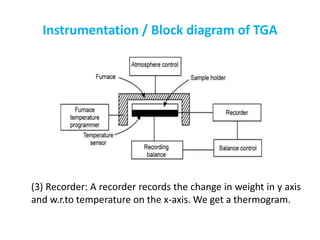
Instrumentation / Block diagram of TGA
(3) Recorder: A recorder records the change in weight in y axis
and w.r.to temperature on the x-axis. We get a thermogram.
TGA of calcium oxalate monohydrate (CaC2O4.H2O)
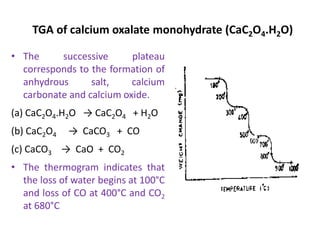
• The successive plateau
corresponds to the formation of
anhydrous salt, calcium
carbonate and calcium oxide.
(a) CaC2O4.H2O → CaC2O4 + H2O
(b) CaC2O4 → CaCO3 + CO
(c) CaCO3 → CaO + CO2
• The thermogram indicates that
the loss of water begins at 100°C
and loss of CO at 400°C and CO2
at 680°C
Factors affecting the TG curve
The factors which may affect the TG curves are
classified into two main groups.
(1) Instrumental factors (2) Sample Characteristics
(1) Instrumental factors
(a) Furnace heating rate
(b) Furnace atmosphere
(2) Sample characteristics includes
(a) Weight of the sample
(b) Sample particle size
Instrumental factors
• Furnace Heating rate: The temperature at which the
compound (or sample) decompose depends upon
the heating rate. When the heating rate is high, the
decomposition temperature is also high. A heating
rate of 3.5°C per minute is usually recommended
for reliable and reproducible TGA.
• Furnace atmosphere: The atmosphere inside the
furnace surrounding the sample has a profound
effect on the decomposition temperature of the
sample. A pure N2 gas from a cylinder passed
through the furnace which provides an inert
atmosphere.
Sample characteristics
(a)Weight of the sample: A small weight of the
sample is recommended using a small weight
eliminates the existence of temperature gradient
throught the sample.
(b) Particle size of the sample: The particle size of
the sample should be small and uniform. The use of
large particle or crystal may result in apparent, very
rapid weight loss during heating
Applications of TGA
• From TGA, we can determine the purity and thermal
stability of both primary and secondary standard.
• Determination of the composition of complex mixture and
decomposition of complex.
• For studying the sublimation behaviour of various
substances.
• TGA is used to study the kinetics of the reaction rate
constant.
• Used in the study of catalyst: The change in the
chemical states of the catalyst may be studied by TGA
techniques. (Zn-ZnCrO4) Zinc-Zinc chromate is used as
the catalyst in the synthesis of methanol.

Thermogravimetric analysis

  • 1.
  • 2.
    Thermogravimetric analysis(TGA) • Principle: Inthermogravimetric analysis, the sample is heated in a given environment (air, N2, CO2, He, Ar, etc.) at controlled rate. The change in the weight of the substance is recorded as a function of temperature or time. The temperature is increased at a constant rate for a known initial weight of the substance and the changes in weights are recorded as a function of temperature at different time interval. This plot of weight change against temperature is called thermogravimetric curve or thermogram, this is the basic principle of TGA
  • 3.
    Example: TGA Curvefor AgNO3 • The horizontal portion of the curve indicates that, there is no change in weight (AB &CD) and the portion BC indicates that there is weight change. • The weight of the substance (AgNO3) remains constant upto a temperature of 473°C indicating that AgNO3 is thermally stable upto a temperature of 473°C. • At this temperature it starts losing its weight and this indicates that the decomposition starts at this temperature. It decomposes to NO2, O2 and Ag. The diagram indicates the TGA curve for AgNO3. AgNO3 → Ag + NO2 + O2
  • 4.
    TGA Curve forAgNO3 • The loss in weight continues upto 608°C and beyond this temperature the weight of the sample remains constant, this is shown by the portion of the curve CD. • The portion between BC, represents the decomposition of silver nitrate, the decomposition is complete at 608°C leaving metallic silver as the stable residue
  • 5.
  • 6.
    Instrumentation / Blockdiagram of TGA The apparatus required for TGA analysis are (a) A furnace which can be heated so that the temperature gives linearity with time. (b) A furnace controlled thermobalance • A known weight of the sample is taken in a crucible(c), which is enclosed by a furnace(F). The furnace(F) temperature is raised slowly, the temperature of the sample and the corresponding weight are taken. • A platinum/platinum rhodium thermocouple is used to measure the sample temperature, and the change in weights are found out by finding the beam deflection on adding a known weight to the pan.(i.e) the change in the weight are recorded from the beam deflection.
  • 7.
    Instrumentation / Blockdiagram of TGA (3) Recorder: A recorder records the change in weight in y axis and w.r.to temperature on the x-axis. We get a thermogram.
  • 8.
    TGA of calciumoxalate monohydrate (CaC2O4.H2O) • The successive plateau corresponds to the formation of anhydrous salt, calcium carbonate and calcium oxide. (a) CaC2O4.H2O → CaC2O4 + H2O (b) CaC2O4 → CaCO3 + CO (c) CaCO3 → CaO + CO2 • The thermogram indicates that the loss of water begins at 100°C and loss of CO at 400°C and CO2 at 680°C
  • 9.
    Factors affecting theTG curve The factors which may affect the TG curves are classified into two main groups. (1) Instrumental factors (2) Sample Characteristics (1) Instrumental factors (a) Furnace heating rate (b) Furnace atmosphere (2) Sample characteristics includes (a) Weight of the sample (b) Sample particle size
  • 10.
    Instrumental factors • FurnaceHeating rate: The temperature at which the compound (or sample) decompose depends upon the heating rate. When the heating rate is high, the decomposition temperature is also high. A heating rate of 3.5°C per minute is usually recommended for reliable and reproducible TGA. • Furnace atmosphere: The atmosphere inside the furnace surrounding the sample has a profound effect on the decomposition temperature of the sample. A pure N2 gas from a cylinder passed through the furnace which provides an inert atmosphere.
  • 11.
    Sample characteristics (a)Weight ofthe sample: A small weight of the sample is recommended using a small weight eliminates the existence of temperature gradient throught the sample. (b) Particle size of the sample: The particle size of the sample should be small and uniform. The use of large particle or crystal may result in apparent, very rapid weight loss during heating
  • 12.
    Applications of TGA •From TGA, we can determine the purity and thermal stability of both primary and secondary standard. • Determination of the composition of complex mixture and decomposition of complex. • For studying the sublimation behaviour of various substances. • TGA is used to study the kinetics of the reaction rate constant. • Used in the study of catalyst: The change in the chemical states of the catalyst may be studied by TGA techniques. (Zn-ZnCrO4) Zinc-Zinc chromate is used as the catalyst in the synthesis of methanol.