Solubility
• Solubility is the amount of solute that will dissolve in a given amount of
solution at a particular temperature (in grams or moles)
• The molar solubility (mol/L) is the number of moles of solute that will dissolve
in 1L of a saturated solution.
• The molarity of the dissolved solute in a saturated solution.
• Solubility (g/L) is the number of grams of solute dissolved in 1 L of a saturated
solution.
• A saturated solution contains the maximum amount of solute possible at a
given temperature in equilibrium with an undissolved excess of the substance.
• A saturated solution is not necessarily a concentrated solution.
• The equilibrium principles in this topic apply to all saturated solutions of
sparingly soluble salts.
Solubility
• Solubility is important in order to predict when precipitates might form.
• E.g. BaSO4 precipitate is swallowed by patients to help provide contrast
for X-rays in the digestive system (diagnosis).
• E.g. Accumulation of CaCO3 or CaSO4 in hot water tanks or pipes.
Solubility
• BaSO4 and other compounds are considered slightly or sparingly soluble
in water
• What happens in water?
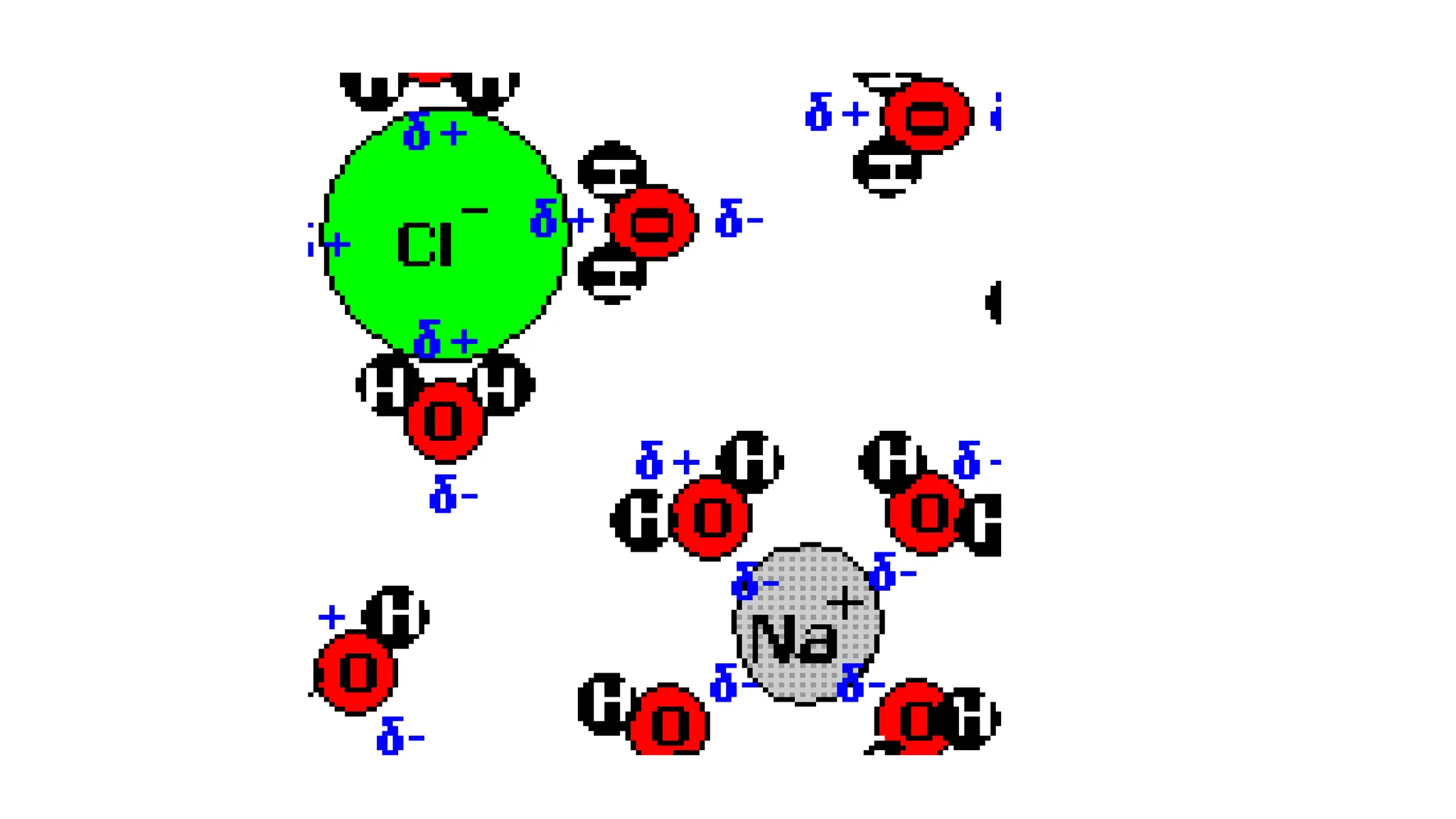
• Sphere of hydration around some ions – hydrogen from H2O pulls off
negatively charged ion;
• O from H2O pulls off positively charged ion.
So what happens to ionic compounds
in water?
• E.g. BaSO4 – barium in digestive tract x-rays
BaSO4(s) Ba2+
(aq) + SO4
2-
(aq)
• At first, the forward reaction dominates, then as more ions are
present, the reverse reaction increases (back to crystals)
• At some point, the rates at which aqueous barium and sulfate ions
precipitate and solid barium sulfate dissolves become equal.
• Concentrations of the ions remain constant.
• This is an example of a heterogeneous solubility equilibrium (solid BaSO4
and aqueous ions)
Solubility Product
• Equilibrium constant for the dissociation of a solid salt into its aqueous ions:
solubility product, Ksp
• For an ionic solid MnXm, the dissociation reaction is:
MnXm(s)  nMm+(aq) + mXn−(aq)
• The solubility product would be
Ksp = [Mm+]n[Xn−]m
The Solubility Product Constant (Ksp)
Similar to what we have seen for the equilibrium constant, K
e.g. the dissolution of BaSO4
K = [Ba2+(aq)] [SO42-(aq)]
[BaSO4(s)]
Do we include the solid?
Solubility Product Constant
• Since the [ ] of solid BaSO4 does not change, then it becomes part of
the Ksp.
Therefore, Ksp = [Ba2+
(aq)] [SO4
2-(aq)]
Ksp is calculated using [ ] in mol/L and is unitless
Ksp varies with temperature
Ksp usually reported for slightly soluble compounds
• Cations and anions with a greater charge are usually less soluble
(e.g. Mg2+ vs. K+ or PO4
3- vs. NO3
-)
• Differentiate between solubility vs. solubility product constant
• Maximum solubility of an ionic compound in a saturated solution
vs. the product of the ion concentrations at equilibrium, which
stays constant at constant T.
Solubility Equilibria
• All ionic compounds dissolve in water to some degree.
• However, many compounds have such low solubility in water that
we classify them as insoluble.
• We can apply the concepts of equilibrium to salts dissolving, and use
the equilibrium constant for the process to measure relative
solubilities in water.
SOLUBILITY EQUILIBRIA
o Calcium phosphate (Ca3(PO4)2) is one of the salts responsible for kidney
stones. Write the solubility product constant (Ksp) equation for the
dissolution of solid Ca3(PO4)2.
Ca3(PO4)2(s) ⮀ 3 Ca2+
(aq) + 2 PO4
3ˉ
(aq)
Ksp = [Ca2+]3 [PO4
3ˉ]2
o Limestone is composed of calcium carbonate (CaCO3). Acid rain causes the
CaCO3 present in limestone to dissociate into its ions. Write the solubility
product constant (Ksp) equation for this process.
Ca CO3(s) ⮀ Ca2+
(aq) + CO3
2ˉ
(aq)
Ksp = [Ca2+] [CO3
2ˉ]
SOLUBILITY EQUILIBRIA
o The size of Ksp indicates the solubility of an ionic compound:
o Substances with a small Ksp are less soluble than substances with a
large Ksp.
o When studying equilibrium in aqueous solutions, chemists may want to
determine any of the following:
o The value of Ksp
o The concentrations of ions present at equilibrium
o The molar solubility of the solute
CALCULATING Ksp
Example1: USING ION CONCENTRATIONS
A piece of solid zinc hydroxide (Zn(OH)2(s)) is placed in a container of water and sealed. A
chemist determines that the concentrations of aqueous zinc ions and aqueous hydroxide
ions is 2.7 x 10⁻⁶ mol/L and 5.4 x 10⁻⁶ mol/L, respectively. Calculate the value of Ksp.
❶Write the balanced equation for the dissociation of zinc hydroxide:
Zn(OH)2(s) ⮀ Zn2+
(aq) + 2 OH1–
(aq)
❷Write the Ksp equation and solve for Ksp:
Ksp = [Zn2+][OH1–]2
= (2.7 x 10⁻⁶)(5.4 x 10⁻⁶)2
= 7.873 x 10-17
= 7.9 x 10⁻¹⁷
❸Write a concluding statement:
The solubility product constant for Zn(OH)2(s) is 7.9 x 10 -17.
CALCULATING Ksp
Example 2: USING MOLAR SOLUBILITY
It has been determined that the molar solubility of silver chloride
(AgCl(s)) is 1.3 × 10⁻⁵ mol/L. What is the value of the solubility-
product constant for this solid?
❶Write the balanced equation for the dissociation of silver chloride:
AgCl (s) ⮀ Ag1+
(aq) + Cl1–
(aq)
❷Use stoichiometry to solve for [Ag1+] and [Cl1–]
Since there is a 1:1:1 in the balanced equation, the ion concentrations are
[AgCl] = [Ag1+] = [Cl1–] = 1.3 x 10⁻⁵ mol/L
❸Write a Ksp equation and solve for Ksp:
Ksp = [Ag1+][Cl1–]
= (1.3 x 10⁻⁵)(1.3 x 10⁻⁵)
= 1.69 x 10-10
= 1.7 x 10⁻¹⁰
❹ Write a concluding statement:
The solubility product
constant for AgCl(s) is
1.7 x 10 -10.
CALCULATING [EQ]
Example 3: USING Ksp
Calculate the concentration of each ion present and the molar solubility
of solid copper (II) iodate (Cu(IO3)2) if Ksp is 6.9 x 10⁻⁸ at 25°C.
❶Write the balanced equation for the dissociation of copper (II) iodate:
Cu(IO3)2(s) ⮀ Cu2+
(aq) + 2 IO3
1–
(aq)
❷Set up an ICE table:
Cu(IO3)2(s) ⮀ Cu2+
(aq) + 2 IO3
1–
(aq)
I -- 0 0
C -- + x + 2x
E -- X 2x
CALCULATING [EQ]
Example 3 CONT’D: USING Ksp
❹Determine [Cu2+] and [IO3
1–]
and molar solubility of
Cu(IO3)2:
[Cu2+] = x
= 2.6 x 10⁻³ mol/L
[IO3
1–] = 2x
= 2(2.6 x 10⁻³)
= 5.12 x 10-3
= 5.1 x 10⁻³ mol/L
[Cu(IO3)2] = [Cu2+] = x
= 2.6 x 10⁻³ mol/L
Which is more soluble: mercury (I) chloride (HgCl) or copper (I) chloride
(CuCl)?
1. Use a table of solubility product constants to find Ksp for each
substance.
2. Write a B.C.E and Ksp expression for HgCl
3. Set up an ICE table and solve for x
4. Write a B.C.E and Ksp expression for CuCl
5. Set up an ICE table and solve for x
6. Compare molar solubility (x) of each compound.
*The larger value represents the more soluble compound
HgCl(s) ⮀ Hg1+
(aq) + Cl1–
(aq)
I -- 0 0
C -- + x + x
E -- (x) x X
HgCl(s) ⮀ Hg1+
(aq) + Cl1–
(aq)
I -- 0 0
C -- + x + x
E -- (x) x X
YOURN TURN! (ANSWERS)
Which is more soluble: mercury (I) chloride (HgCl) or
copper (I) chloride (CuCl)?
❺Since CuCl has a greater molar solubility than HgCl
(since 4.1 x 10⁻⁴ > 1.2 x 10⁻⁹), it is more soluble than
HgCl.
16.6
16.6
What is the solubility of silver chloride in g/L ?
AgCl (s) Ag+ (aq) + Cl- (aq)
Ksp = [Ag+][Cl-]
Initial (M)
Change (M)
Equilibrium (M)
0.00
+s
0.00
+s
s s
Ksp = s2
s = Ksp

s = 1.3 x 10⁻⁵
[Ag+] = 1.3 x 10⁻⁵ M [Cl-] = 1.3 x 10⁻⁵ M
Solubility of AgCl = 1.3 x 10⁻⁵ mol AgCl
1 L soln
143.35 g AgCl
1 mol AgCl
x = 1.9 x 10⁻³ g/L
Ksp = 1.6 x 10⁻¹⁰
If 2.00 mL of 0.200 M NaOH are added to 1.00 L of
0.100 M CaCl2, will a precipitate form?
The ions present in solution are Na+, OH-, Ca2+, Cl-.
Only possible precipitate is Ca(OH)2 (solubility rules).
Is Q > Ksp for Ca(OH)2?
[Ca2+]0 = 0.100 M [OH-]0 = 4.0 x 10⁻⁴ M
Ksp = [Ca2+][OH-]2 = 8.0 x 10⁻⁶
Q = [Ca2+]0[OH-]0
2= 0.10 x (4.0 x 10-4)2 = 1.6 x 10⁻⁸
Q < Ksp No precipitate will form
What concentration of Ag is required to precipitate
ONLY AgBr in a solution that contains both Br- and Cl- at
a concentration of 0.02 M?
AgCl (s) Ag+ (aq) + Cl- (aq)
Ksp = [Ag+][Cl-]
Ksp = 1.6 x 10⁻¹⁰
AgBr (s) Ag+ (aq) + Br- (aq)Ksp = 7.7 x 10⁻¹³
Ksp = [Ag+][Br-]
[Ag+] =
Ksp
[Br-]
7.7 x 10⁻¹³
0.020
= = 3.9 x 10⁻¹¹ M
[Ag+] =
Ksp
[Cl-]
1.6 x 10⁻¹⁰
0.020
= = 8.0 x 10⁻⁹ M
3.9 x 10⁻¹¹ M < [Ag+] < 8.0 x 10⁻⁹ M
28
Calculating Ksp from Solubility
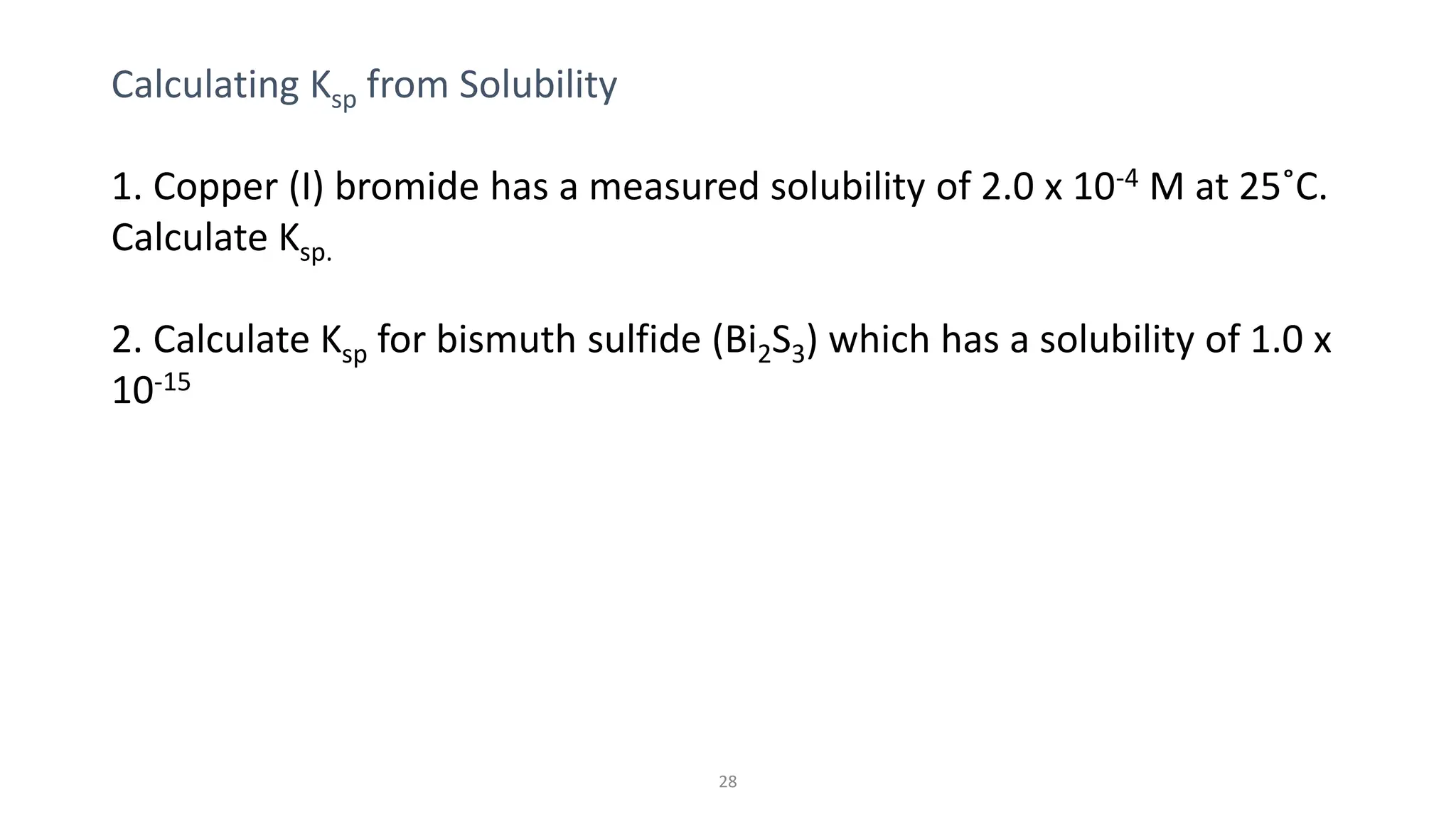
1. Copper (I) bromide has a measured solubility of 2.0 x 10⁻⁴ M at 25˚C.
Calculate Ksp.
2. Calculate Ksp for bismuth sulfide (Bi2S3) which has a solubility of 1.0 x
10-15
Tro, Chemistry: A Molecular Approach 29
Calculating Solubility from Ksp
The Ksp for copper (II) hydroxide is 1.6 x 10⁻¹⁹ at
25˚C. Calculate the solubility, [Cu2+], [OH-].
Ksp and Relative Solubility
• Molar solubility is related to Ksp
• However, you cannot always compare solubilities of
compounds by comparing their Ksps
• In order to compare Ksps, the compounds must have the
same dissociation stoichiometry
The Effect of Common Ion on Solubility
• Addition of a soluble salt that contains one of the ions of the
“insoluble” salt, decreases the solubility of the “insoluble” salt
• For example, addition of NaCl to the solubility equilibrium of solid
PbCl2 decreases the solubility of PbCl2
PbCl2(s)  Pb2+(aq) + 2 Cl−(aq)
addition of Cl− shifts the equilibrium to the left
The Common Ion Effect and Solubility
The presence of a common ion decreases the
solubility of the salt.
What is the molar solubility of AgBr in (a) pure water
and (b) 0.0010 M NaBr?
AgBr (s) Ag+ (aq) + Br- (aq)
Ksp = 7.7 x 10⁻¹³
s2 = Ksp
s = 8.8 x 10⁻⁷
NaBr (s) Na+ (aq) + Br- (aq)
[Br-] = 0.0010 M
AgBr (s) Ag+ (aq) + Br- (aq)
[Ag+] = s
[Br-] = 0.0010 + s  0.0010
Ksp = 0.0010 x s
s = 7.7 x 10⁻¹⁰
1. Calculate the solubility of Ag2CrO4 in pure
water (Ksp = 9.0 x 10⁻¹²)
2. Calculate the solubility of Ag2CrO4 in a 0.1M
solution of AgNO3
The Effect of pH on Solubility
• For insoluble ionic hydroxides, the higher the pH (and
the greater [OH-], the lower the solubility of the ionic
hydroxide
• OH- acts as a common ion,
M(OH)n(s)  Mn+(aq) + nOH−(aq)
• For insoluble ionic compounds that contain anions of
weak acids, the lower the pH, the higher the solubility
M2(CO3)n(s)  2 Mn+(aq) + nCO3
2−(aq)
H3O+(aq) + CO3
2− (aq)  HCO3
− (aq) + H2O(l)
Precipitation
• Precipitation will occur when the concentrations of the
ions exceed the solubility of the ionic compound
• if we compare the reaction quotient, Q, for the current
solution concentrations to the value of Ksp, we can
determine if precipitation will occur
• Q = Ksp, the solution is saturated, no precipitation
• Q < Ksp, the solution is unsaturated, no precipitation
• Q > Ksp, the solution would be above saturation, the salt
above saturation will precipitate
• Some solutions with Q > Ksp will not precipitate unless
disturbed – these are called supersaturated solutions
precipitation occurs
if Q > Ksp
a supersaturated solution will
precipitate if a seed crystal is
added
PREDICTING SOLUBILITY
o The solubility of a substance can be predicted in several ways:
1. Solubility tables predict solubility qualitatively.
2. Trial ion product (Qsp) predicts solubility quantitatively using
equilibrium concentrations of ions.
o Comparing Qsp to Ksp can predict whether a precipitate will
form:
o If Qsp > Ksp: precipitation occurs (equilibrium shifts left)
o If Qsp = Ksp: solution is at equilibrium and no precipitation
occurs
o If Qsp < Ksp: no precipitation occurs (equilibrium shifts right)
PREDICTING SOLUBILITY
Example: Will a precipitate form when 1.0 x 10⁻³ mol/L of aqueous silver nitrate
(AgNO3) is mixed with a 5.0 x 10⁻³ mol/L aqueous solution of potassium bromide
(KBr) at 25°C? If so, identify the precipitate. The Ksp for AgBr is 5.4 x 10⁻¹³
• Write the balanced equation for the double displacement reaction and
determine any possible precipitates:
AgNO3(aq) + KBr(aq) ⮀ AgBr(s) + KNO3(aq)
• Write a dissociation equation for the precipitate (solid) that may form:
AgBr(s) ⮀ Ag1+
(aq) + Br1–
(aq)
• Write the Qsp expression for the precipitate (AgBr):
Qsp = [Ag1+][Br1–]
• Find the concentration of each ion ([Ag1+] and [Br1–]
*To do this, write the dissociation equations for each reactant (AgNO3 and KBr) and use
stoichiometry to find each ion’s concentration.
AgNO3(aq) ⮀ Ag1+
(aq) + NO3
1–
(aq) AND KBr(aq) ⮀ K1+
(aq) + Br1–
(aq)
[Ag1+] = [AgNO3] [Br1–] = [KBr]
= 1.0 x 10⁻³ mol/L = 5.0 x 10⁻³ mol/L
• Calculate Qsp and compare to Ksp:
*Ksp was given in the question. If it isn’t, look for it in the Solubility Product Constant table.
Qsp = [Ag1+][Br1–]
= (1.0 x 10⁻³)(5.0 x 10⁻³)
= 5.0 x 10⁻⁶
• Write a concluding statement:
Yes, a precipitate of silver bromide (AgBr(s)) will form.
Qsp > Ksp
(5.0 x 10⁻⁶ > 5.4 x 10⁻¹³
(precipitation occurs)
Example
Will a precipitate form in an aqueous solution that has a concentration of
copper(I) nitrate(CuNO3(aq)) of 0.015 mol/L and the concentration of potassium
iodide (KI(aq)), of 0.075 mol/L?
1. Write an I.C.E for the reaction and use a solubility table to identify any
possible precipitates.
2. Write the dissociation equation for the precipitate that should form and
its Qsp expression.
3. Write the dissociation equations for both reactants.
4. Use stoichiometry and the reactant concentrations to determine the
concentrations of the ions in the solvent.
5. Calculate Qsp and compare to Ksp to determine if a precipitate will form
(use a Ksp table to find Ksp).
ANSWER
CuNO3(aq) + KI(aq) ⮀ CuI(s) + KNO3(aq)
CuI(s) ⮀ Cu1+
(aq) + I1-
(aq)
Qsp = [Cu1+][I1-]
CuNO3(aq) ⮀ Cu1+
(aq) + NO3
1-
(aq)
KI(aq) ⮀ K1+
(aq) + I1-
(aq)
[Cu1+] = [CuNO3] = 0.015 mol/L
[I1-] = [KI] = 0.075 mol/L
ANSWER
Qsp = [Cu1+][I1-] *Ksp = 1.3 x 10–12
= (0.015)(0.075)
= 1.125 x 10⁻³
Qsp > Ksp (1.125 x 10⁻³ > 1.3 x 10⁻¹²), so a precipitate will
form.
Predicting Precipitation
• Consider the following case:
20.0 mL of 0.025 M Pb(NO3)2 is added to 30.0 mL of 0.10 M NaCl. Predict if
precipitate of PbCl2 will form.
(Ksp for PbCl2 = 1.6 x 10⁻⁵)
Predicting Precipitation
• Calculation:
• [Pb2+
] = (20.0 mL x 0.025 M)/(50.0 mL) = 0.010 M
• [Cl-
] = (30.0 mL x 0.10 M)/(50.0 mL) = 0.060 M
• Qsp = [Pb2+
][Cl-
]2
= (0.010 M)(0.060 M)2
• = 3.6 x 10⁻⁵
• Qsp > Ksp ➔ precipitate of PbCl2 will form.
Tro, Chemistry: A Molecular Approach 45
Practice question
If 10.0 mL of 0.50 M Pb(NO3)2 and 20.0 mL 1.0 M NaI are mixed, will a
precipitate form?
Practical Applications of Solubility Equilibria
• Qualitative Analyses
• Isolation and identification of cations and/or anions in unknown samples
• Synthesis of Ionic Solids of commercial interest
• Selective Precipitation based on Ksp
Qualitative Analysis
• Separation and identification of cations, such as Ag+
, Ba2+
, Cr3+
, Fe3+
,
Cu2+
, etc. can be carried out based on their different solubility and
their ability to form complex ions with specific reagents, such as HCl,
H2SO4, NaOH, NH3, and others.
• Separation and identification of anions, such as Cl-
, Br-
, I-
, SO4
2-
,
CO3
2-
, PO4
3-
, etc., can be accomplished using reagents such as AgNO3,
Ba(NO3)2 under neutral or acidic conditions.
Selective Precipitation
(Mixtures of Metal Ions)
• Use a reagent whose anion forms a precipitate with
only one or a few of the metal ions in the mixture.
• Example:
▪ Solution contains Ba2+ and Ag+ ions.
▪ Adding NaCl will form a precipitate with Ag+ (AgCl),
while still leaving Ba2+ in solution.
Separation of Cu2+ and Hg2+ from Ni2+ and
Mn2+ using H2S
• At a low pH, [S2–] is relatively low and only the very
insoluble HgS and CuS precipitate.
• When OH– is added to lower [H+], the value of [S2–]
increases, and MnS and NiS precipitate.
Separation of Cu2+ and Hg2+ from Ni2+ and Mn2+ using
H2S
Separating the Common Cations by Selective
Precipitation
Synthesis of Ionic Solids
• Chemicals such as AgCl, AgBr, and AgI that are important in
photography are prepared by precipitation method.
• AgNO3(aq) + KBr(aq) → AgBr(s) + KNO3(aq)
Selective Precipitation
• Compounds with different solubility can be selectively precipitated by
adjusting the concentration of the precipitating reagents.
• For example, AgCl has a much lower Ksp than PbCl2
• If Ag+
and Pb2+
are present in the same solution, the Ag+
ion can be
selectively precipitated as AgCl, leaving Pb2+
in solution.
Complex Ion Equilibria
• Complex ions are ions consisting central metal ions and ligands
covalently bonded to the metal ions;
• Ligands can be neutral molecules such as H2O, CO, and NH3, or
anions such as Cl-
, F-
, OH-
, and CN-
;
• For example, in the complex ion [Cu(NH3)4]2+
, four NH3 molecules
are covalently bonded to Cu2+
.
Formation of Complex Ions
• In aqueous solutions, metal ions form complex ions
with water molecules as ligands.
• If stronger ligands are present, ligand exchanges occur
and equilibrium is established.
• For example:
Cu2+
(aq) + 4NH3(aq) ⇌ [Cu(NH3)4]2+
(aq)
13
4
3
2
2
4
3
f 10
x
1.1
]
NH
][
Cu
[
]
)
[Cu(NH
=
= +
+
K
Stepwise Formation of Complex Ion
• At molecular level, ligand molecules or ions combine with
metal ions in stepwise manner;
• Each step has its equilibrium and equilibrium constant;
• For example:
(1) Ag+
(aq) + NH3(aq) ⇌ Ag(NH3)+
(aq)
(2) Ag(NH3)+
(aq) + NH3(aq) ⇌ Ag(NH3)2
+
(aq);
3
3
3
f1 10
x
2.1
]
][NH
[Ag
]
)
[Ag(NH
=
= +
+
K
3
3
3
2
3
2
f 10
x
8.2
]
][NH
)
[Ag(NH
]
)
[Ag(NH
=
= +
+
K
Stepwise Formation of Complex Ion
Individual equilibrium steps:
(1) Ag+
(aq) + NH3(aq) ⇌ Ag(NH3)+
(aq); Kf1 = 2.1 x 10³
(2) Ag(NH3)+
(aq) + NH3(aq) ⇌ Ag(NH3)2
+
(aq); Kf2 = 8.2 x 10³
Combining (1) and (2) yields:
• Ag+
(aq) + 2NH3(aq) ⇌ Ag(NH3)2
+
(aq);
7
f2
f1
2
3
2
3
f 10
x
1.7
x
]
][NH
[Ag
]
)
[Ag(NH
=
=
= +
+
K
K
K
Stepwise complex ion formation for Cu(NH3)4
2+
Individual equilibrium steps:
1. Cu2+(aq) + NH3(aq) ⇌ Cu(NH3)2+(aq); K1 = 1.9 x 10⁴
2. Cu(NH3)2+(aq) + NH3(aq) ⇌ Cu(NH3)2
2+(aq); K2 = 3.9 x 10³
3. Cu(NH3)2
2+(aq) + NH3(aq) ⇌ Cu(NH3)3
2+(aq); K3 = 1.0 x 10³
4. Cu(NH3)3
2+(aq) + NH3(aq) ⇌ Cu(NH3)4
2+(aq); K4 = 1.5 x 10²
Combining equilibrium:
• Cu2+(aq) + 4NH3(aq) ⇌ Cu(NH3)4
2+(aq);
• Kf = K1 x K2 x K3 x K4 = 1.1 x 10¹³
]
][NH
[Cu
]
)
[Cu(NH
4
3
2
2
4
3
f +
+
=
K
Complex Ions and Solubility
• Two strategies for dissolving a water–insoluble ionic
solid.
▪ If the anion of the solid is a good base, the solubility is
greatly increased by acidifying the solution.
▪ In cases where the anion is not sufficiently basic, the ionic
solid often can be dissolved in a solution containing a
ligand that forms stable complex ions with its cation.
Concept Check
(a) Calculate the solubility of silver chloride in
10.0 M ammonia given the following information:
Ksp (AgCl) = 1.6 x 10⁻¹⁰
Ag+ + NH3 AgNH3
+ K = 2.1 x 10³
AgNH3
+ + NH3 Ag(NH3)2
+ K = 8.2 x 10³
(b) Calculate the concentration of NH3 in the final
equilibrium mixture.
Answers: (a) 0.48 M; (b) 9.0 M
Selective Precipitation
• A solution containing several different cations can often be separated
by addition of a solution that will form an insoluble salt with one of
the ions, but not the others

Solubility and Solubility Product Constant

  • 1.
    Solubility • Solubility isthe amount of solute that will dissolve in a given amount of solution at a particular temperature (in grams or moles) • The molar solubility (mol/L) is the number of moles of solute that will dissolve in 1L of a saturated solution. • The molarity of the dissolved solute in a saturated solution. • Solubility (g/L) is the number of grams of solute dissolved in 1 L of a saturated solution. • A saturated solution contains the maximum amount of solute possible at a given temperature in equilibrium with an undissolved excess of the substance. • A saturated solution is not necessarily a concentrated solution. • The equilibrium principles in this topic apply to all saturated solutions of sparingly soluble salts.
  • 2.
    Solubility • Solubility isimportant in order to predict when precipitates might form. • E.g. BaSO4 precipitate is swallowed by patients to help provide contrast for X-rays in the digestive system (diagnosis). • E.g. Accumulation of CaCO3 or CaSO4 in hot water tanks or pipes.
  • 4.
    Solubility • BaSO4 andother compounds are considered slightly or sparingly soluble in water • What happens in water? • Sphere of hydration around some ions – hydrogen from H2O pulls off negatively charged ion; • O from H2O pulls off positively charged ion.
  • 6.
    So what happensto ionic compounds in water? • E.g. BaSO4 – barium in digestive tract x-rays BaSO4(s) Ba2+ (aq) + SO4 2- (aq) • At first, the forward reaction dominates, then as more ions are present, the reverse reaction increases (back to crystals)
  • 7.
    • At somepoint, the rates at which aqueous barium and sulfate ions precipitate and solid barium sulfate dissolves become equal. • Concentrations of the ions remain constant. • This is an example of a heterogeneous solubility equilibrium (solid BaSO4 and aqueous ions)
  • 8.
    Solubility Product • Equilibriumconstant for the dissociation of a solid salt into its aqueous ions: solubility product, Ksp • For an ionic solid MnXm, the dissociation reaction is: MnXm(s)  nMm+(aq) + mXn−(aq) • The solubility product would be Ksp = [Mm+]n[Xn−]m
  • 9.
    The Solubility ProductConstant (Ksp) Similar to what we have seen for the equilibrium constant, K e.g. the dissolution of BaSO4 K = [Ba2+(aq)] [SO42-(aq)] [BaSO4(s)] Do we include the solid?
  • 10.
    Solubility Product Constant •Since the [ ] of solid BaSO4 does not change, then it becomes part of the Ksp. Therefore, Ksp = [Ba2+ (aq)] [SO4 2-(aq)] Ksp is calculated using [ ] in mol/L and is unitless Ksp varies with temperature Ksp usually reported for slightly soluble compounds
  • 11.
    • Cations andanions with a greater charge are usually less soluble (e.g. Mg2+ vs. K+ or PO4 3- vs. NO3 -) • Differentiate between solubility vs. solubility product constant • Maximum solubility of an ionic compound in a saturated solution vs. the product of the ion concentrations at equilibrium, which stays constant at constant T.
  • 12.
    Solubility Equilibria • Allionic compounds dissolve in water to some degree. • However, many compounds have such low solubility in water that we classify them as insoluble. • We can apply the concepts of equilibrium to salts dissolving, and use the equilibrium constant for the process to measure relative solubilities in water.
  • 13.
    SOLUBILITY EQUILIBRIA o Calciumphosphate (Ca3(PO4)2) is one of the salts responsible for kidney stones. Write the solubility product constant (Ksp) equation for the dissolution of solid Ca3(PO4)2. Ca3(PO4)2(s) ⮀ 3 Ca2+ (aq) + 2 PO4 3ˉ (aq) Ksp = [Ca2+]3 [PO4 3ˉ]2 o Limestone is composed of calcium carbonate (CaCO3). Acid rain causes the CaCO3 present in limestone to dissociate into its ions. Write the solubility product constant (Ksp) equation for this process. Ca CO3(s) ⮀ Ca2+ (aq) + CO3 2ˉ (aq) Ksp = [Ca2+] [CO3 2ˉ]
  • 14.
    SOLUBILITY EQUILIBRIA o Thesize of Ksp indicates the solubility of an ionic compound: o Substances with a small Ksp are less soluble than substances with a large Ksp. o When studying equilibrium in aqueous solutions, chemists may want to determine any of the following: o The value of Ksp o The concentrations of ions present at equilibrium o The molar solubility of the solute
  • 15.
    CALCULATING Ksp Example1: USINGION CONCENTRATIONS A piece of solid zinc hydroxide (Zn(OH)2(s)) is placed in a container of water and sealed. A chemist determines that the concentrations of aqueous zinc ions and aqueous hydroxide ions is 2.7 x 10⁻⁶ mol/L and 5.4 x 10⁻⁶ mol/L, respectively. Calculate the value of Ksp. ❶Write the balanced equation for the dissociation of zinc hydroxide: Zn(OH)2(s) ⮀ Zn2+ (aq) + 2 OH1– (aq) ❷Write the Ksp equation and solve for Ksp: Ksp = [Zn2+][OH1–]2 = (2.7 x 10⁻⁶)(5.4 x 10⁻⁶)2 = 7.873 x 10-17 = 7.9 x 10⁻¹⁷ ❸Write a concluding statement: The solubility product constant for Zn(OH)2(s) is 7.9 x 10 -17.
  • 16.
    CALCULATING Ksp Example 2:USING MOLAR SOLUBILITY It has been determined that the molar solubility of silver chloride (AgCl(s)) is 1.3 × 10⁻⁵ mol/L. What is the value of the solubility- product constant for this solid? ❶Write the balanced equation for the dissociation of silver chloride: AgCl (s) ⮀ Ag1+ (aq) + Cl1– (aq) ❷Use stoichiometry to solve for [Ag1+] and [Cl1–] Since there is a 1:1:1 in the balanced equation, the ion concentrations are [AgCl] = [Ag1+] = [Cl1–] = 1.3 x 10⁻⁵ mol/L ❸Write a Ksp equation and solve for Ksp: Ksp = [Ag1+][Cl1–] = (1.3 x 10⁻⁵)(1.3 x 10⁻⁵) = 1.69 x 10-10 = 1.7 x 10⁻¹⁰ ❹ Write a concluding statement: The solubility product constant for AgCl(s) is 1.7 x 10 -10.
  • 17.
    CALCULATING [EQ] Example 3:USING Ksp Calculate the concentration of each ion present and the molar solubility of solid copper (II) iodate (Cu(IO3)2) if Ksp is 6.9 x 10⁻⁸ at 25°C. ❶Write the balanced equation for the dissociation of copper (II) iodate: Cu(IO3)2(s) ⮀ Cu2+ (aq) + 2 IO3 1– (aq) ❷Set up an ICE table: Cu(IO3)2(s) ⮀ Cu2+ (aq) + 2 IO3 1– (aq) I -- 0 0 C -- + x + 2x E -- X 2x
  • 18.
    CALCULATING [EQ] Example 3CONT’D: USING Ksp ❹Determine [Cu2+] and [IO3 1–] and molar solubility of Cu(IO3)2: [Cu2+] = x = 2.6 x 10⁻³ mol/L [IO3 1–] = 2x = 2(2.6 x 10⁻³) = 5.12 x 10-3 = 5.1 x 10⁻³ mol/L [Cu(IO3)2] = [Cu2+] = x = 2.6 x 10⁻³ mol/L
  • 19.
    Which is moresoluble: mercury (I) chloride (HgCl) or copper (I) chloride (CuCl)? 1. Use a table of solubility product constants to find Ksp for each substance. 2. Write a B.C.E and Ksp expression for HgCl 3. Set up an ICE table and solve for x 4. Write a B.C.E and Ksp expression for CuCl 5. Set up an ICE table and solve for x 6. Compare molar solubility (x) of each compound. *The larger value represents the more soluble compound
  • 20.
    HgCl(s) ⮀ Hg1+ (aq)+ Cl1– (aq) I -- 0 0 C -- + x + x E -- (x) x X
  • 21.
    HgCl(s) ⮀ Hg1+ (aq)+ Cl1– (aq) I -- 0 0 C -- + x + x E -- (x) x X
  • 22.
    YOURN TURN! (ANSWERS) Whichis more soluble: mercury (I) chloride (HgCl) or copper (I) chloride (CuCl)? ❺Since CuCl has a greater molar solubility than HgCl (since 4.1 x 10⁻⁴ > 1.2 x 10⁻⁹), it is more soluble than HgCl.
  • 23.
  • 24.
  • 25.
    What is thesolubility of silver chloride in g/L ? AgCl (s) Ag+ (aq) + Cl- (aq) Ksp = [Ag+][Cl-] Initial (M) Change (M) Equilibrium (M) 0.00 +s 0.00 +s s s Ksp = s2 s = Ksp  s = 1.3 x 10⁻⁵ [Ag+] = 1.3 x 10⁻⁵ M [Cl-] = 1.3 x 10⁻⁵ M Solubility of AgCl = 1.3 x 10⁻⁵ mol AgCl 1 L soln 143.35 g AgCl 1 mol AgCl x = 1.9 x 10⁻³ g/L Ksp = 1.6 x 10⁻¹⁰
  • 26.
    If 2.00 mLof 0.200 M NaOH are added to 1.00 L of 0.100 M CaCl2, will a precipitate form? The ions present in solution are Na+, OH-, Ca2+, Cl-. Only possible precipitate is Ca(OH)2 (solubility rules). Is Q > Ksp for Ca(OH)2? [Ca2+]0 = 0.100 M [OH-]0 = 4.0 x 10⁻⁴ M Ksp = [Ca2+][OH-]2 = 8.0 x 10⁻⁶ Q = [Ca2+]0[OH-]0 2= 0.10 x (4.0 x 10-4)2 = 1.6 x 10⁻⁸ Q < Ksp No precipitate will form
  • 27.
    What concentration ofAg is required to precipitate ONLY AgBr in a solution that contains both Br- and Cl- at a concentration of 0.02 M? AgCl (s) Ag+ (aq) + Cl- (aq) Ksp = [Ag+][Cl-] Ksp = 1.6 x 10⁻¹⁰ AgBr (s) Ag+ (aq) + Br- (aq)Ksp = 7.7 x 10⁻¹³ Ksp = [Ag+][Br-] [Ag+] = Ksp [Br-] 7.7 x 10⁻¹³ 0.020 = = 3.9 x 10⁻¹¹ M [Ag+] = Ksp [Cl-] 1.6 x 10⁻¹⁰ 0.020 = = 8.0 x 10⁻⁹ M 3.9 x 10⁻¹¹ M < [Ag+] < 8.0 x 10⁻⁹ M
  • 28.
    28 Calculating Ksp fromSolubility 1. Copper (I) bromide has a measured solubility of 2.0 x 10⁻⁴ M at 25˚C. Calculate Ksp. 2. Calculate Ksp for bismuth sulfide (Bi2S3) which has a solubility of 1.0 x 10⁻¹⁵
  • 29.
    Tro, Chemistry: AMolecular Approach 29 Calculating Solubility from Ksp The Ksp for copper (II) hydroxide is 1.6 x 10⁻¹⁹ at 25˚C. Calculate the solubility, [Cu2+], [OH-].
  • 30.
    Ksp and RelativeSolubility • Molar solubility is related to Ksp • However, you cannot always compare solubilities of compounds by comparing their Ksps • In order to compare Ksps, the compounds must have the same dissociation stoichiometry
  • 31.
    The Effect ofCommon Ion on Solubility • Addition of a soluble salt that contains one of the ions of the “insoluble” salt, decreases the solubility of the “insoluble” salt • For example, addition of NaCl to the solubility equilibrium of solid PbCl2 decreases the solubility of PbCl2 PbCl2(s)  Pb2+(aq) + 2 Cl−(aq) addition of Cl− shifts the equilibrium to the left
  • 32.
    The Common IonEffect and Solubility The presence of a common ion decreases the solubility of the salt. What is the molar solubility of AgBr in (a) pure water and (b) 0.0010 M NaBr? AgBr (s) Ag+ (aq) + Br- (aq) Ksp = 7.7 x 10⁻¹³ s2 = Ksp s = 8.8 x 10⁻⁷ NaBr (s) Na+ (aq) + Br- (aq) [Br-] = 0.0010 M AgBr (s) Ag+ (aq) + Br- (aq) [Ag+] = s [Br-] = 0.0010 + s  0.0010 Ksp = 0.0010 x s s = 7.7 x 10⁻¹⁰
  • 33.
    1. Calculate thesolubility of Ag2CrO4 in pure water (Ksp = 9.0 x 10⁻¹²) 2. Calculate the solubility of Ag2CrO4 in a 0.1M solution of AgNO3
  • 34.
    The Effect ofpH on Solubility • For insoluble ionic hydroxides, the higher the pH (and the greater [OH-], the lower the solubility of the ionic hydroxide • OH- acts as a common ion, M(OH)n(s)  Mn+(aq) + nOH−(aq) • For insoluble ionic compounds that contain anions of weak acids, the lower the pH, the higher the solubility M2(CO3)n(s)  2 Mn+(aq) + nCO3 2−(aq) H3O+(aq) + CO3 2− (aq)  HCO3 − (aq) + H2O(l)
  • 35.
    Precipitation • Precipitation willoccur when the concentrations of the ions exceed the solubility of the ionic compound • if we compare the reaction quotient, Q, for the current solution concentrations to the value of Ksp, we can determine if precipitation will occur • Q = Ksp, the solution is saturated, no precipitation • Q < Ksp, the solution is unsaturated, no precipitation • Q > Ksp, the solution would be above saturation, the salt above saturation will precipitate • Some solutions with Q > Ksp will not precipitate unless disturbed – these are called supersaturated solutions
  • 36.
    precipitation occurs if Q> Ksp a supersaturated solution will precipitate if a seed crystal is added
  • 37.
    PREDICTING SOLUBILITY o Thesolubility of a substance can be predicted in several ways: 1. Solubility tables predict solubility qualitatively. 2. Trial ion product (Qsp) predicts solubility quantitatively using equilibrium concentrations of ions. o Comparing Qsp to Ksp can predict whether a precipitate will form: o If Qsp > Ksp: precipitation occurs (equilibrium shifts left) o If Qsp = Ksp: solution is at equilibrium and no precipitation occurs o If Qsp < Ksp: no precipitation occurs (equilibrium shifts right)
  • 38.
    PREDICTING SOLUBILITY Example: Willa precipitate form when 1.0 x 10⁻³ mol/L of aqueous silver nitrate (AgNO3) is mixed with a 5.0 x 10⁻³ mol/L aqueous solution of potassium bromide (KBr) at 25°C? If so, identify the precipitate. The Ksp for AgBr is 5.4 x 10⁻¹³ • Write the balanced equation for the double displacement reaction and determine any possible precipitates: AgNO3(aq) + KBr(aq) ⮀ AgBr(s) + KNO3(aq) • Write a dissociation equation for the precipitate (solid) that may form: AgBr(s) ⮀ Ag1+ (aq) + Br1– (aq) • Write the Qsp expression for the precipitate (AgBr): Qsp = [Ag1+][Br1–]
  • 39.
    • Find theconcentration of each ion ([Ag1+] and [Br1–] *To do this, write the dissociation equations for each reactant (AgNO3 and KBr) and use stoichiometry to find each ion’s concentration. AgNO3(aq) ⮀ Ag1+ (aq) + NO3 1– (aq) AND KBr(aq) ⮀ K1+ (aq) + Br1– (aq) [Ag1+] = [AgNO3] [Br1–] = [KBr] = 1.0 x 10⁻³ mol/L = 5.0 x 10⁻³ mol/L • Calculate Qsp and compare to Ksp: *Ksp was given in the question. If it isn’t, look for it in the Solubility Product Constant table. Qsp = [Ag1+][Br1–] = (1.0 x 10⁻³)(5.0 x 10⁻³) = 5.0 x 10⁻⁶ • Write a concluding statement: Yes, a precipitate of silver bromide (AgBr(s)) will form. Qsp > Ksp (5.0 x 10⁻⁶ > 5.4 x 10⁻¹³ (precipitation occurs)
  • 40.
    Example Will a precipitateform in an aqueous solution that has a concentration of copper(I) nitrate(CuNO3(aq)) of 0.015 mol/L and the concentration of potassium iodide (KI(aq)), of 0.075 mol/L? 1. Write an I.C.E for the reaction and use a solubility table to identify any possible precipitates. 2. Write the dissociation equation for the precipitate that should form and its Qsp expression. 3. Write the dissociation equations for both reactants. 4. Use stoichiometry and the reactant concentrations to determine the concentrations of the ions in the solvent. 5. Calculate Qsp and compare to Ksp to determine if a precipitate will form (use a Ksp table to find Ksp).
  • 41.
    ANSWER CuNO3(aq) + KI(aq)⮀ CuI(s) + KNO3(aq) CuI(s) ⮀ Cu1+ (aq) + I1- (aq) Qsp = [Cu1+][I1-] CuNO3(aq) ⮀ Cu1+ (aq) + NO3 1- (aq) KI(aq) ⮀ K1+ (aq) + I1- (aq) [Cu1+] = [CuNO3] = 0.015 mol/L [I1-] = [KI] = 0.075 mol/L
  • 42.
    ANSWER Qsp = [Cu1+][I1-]*Ksp = 1.3 x 10–12 = (0.015)(0.075) = 1.125 x 10⁻³ Qsp > Ksp (1.125 x 10⁻³ > 1.3 x 10⁻¹²), so a precipitate will form.
  • 43.
    Predicting Precipitation • Considerthe following case: 20.0 mL of 0.025 M Pb(NO3)2 is added to 30.0 mL of 0.10 M NaCl. Predict if precipitate of PbCl2 will form. (Ksp for PbCl2 = 1.6 x 10⁻⁵)
  • 44.
    Predicting Precipitation • Calculation: •[Pb2+ ] = (20.0 mL x 0.025 M)/(50.0 mL) = 0.010 M • [Cl- ] = (30.0 mL x 0.10 M)/(50.0 mL) = 0.060 M • Qsp = [Pb2+ ][Cl- ]2 = (0.010 M)(0.060 M)2 • = 3.6 x 10⁻⁵ • Qsp > Ksp ➔ precipitate of PbCl2 will form.
  • 45.
    Tro, Chemistry: AMolecular Approach 45 Practice question If 10.0 mL of 0.50 M Pb(NO3)2 and 20.0 mL 1.0 M NaI are mixed, will a precipitate form?
  • 46.
    Practical Applications ofSolubility Equilibria • Qualitative Analyses • Isolation and identification of cations and/or anions in unknown samples • Synthesis of Ionic Solids of commercial interest • Selective Precipitation based on Ksp
  • 47.
    Qualitative Analysis • Separationand identification of cations, such as Ag+ , Ba2+ , Cr3+ , Fe3+ , Cu2+ , etc. can be carried out based on their different solubility and their ability to form complex ions with specific reagents, such as HCl, H2SO4, NaOH, NH3, and others. • Separation and identification of anions, such as Cl- , Br- , I- , SO4 2- , CO3 2- , PO4 3- , etc., can be accomplished using reagents such as AgNO3, Ba(NO3)2 under neutral or acidic conditions.
  • 48.
    Selective Precipitation (Mixtures ofMetal Ions) • Use a reagent whose anion forms a precipitate with only one or a few of the metal ions in the mixture. • Example: ▪ Solution contains Ba2+ and Ag+ ions. ▪ Adding NaCl will form a precipitate with Ag+ (AgCl), while still leaving Ba2+ in solution.
  • 49.
    Separation of Cu2+and Hg2+ from Ni2+ and Mn2+ using H2S • At a low pH, [S2–] is relatively low and only the very insoluble HgS and CuS precipitate. • When OH– is added to lower [H+], the value of [S2–] increases, and MnS and NiS precipitate.
  • 50.
    Separation of Cu2+and Hg2+ from Ni2+ and Mn2+ using H2S
  • 51.
    Separating the CommonCations by Selective Precipitation
  • 52.
    Synthesis of IonicSolids • Chemicals such as AgCl, AgBr, and AgI that are important in photography are prepared by precipitation method. • AgNO3(aq) + KBr(aq) → AgBr(s) + KNO3(aq)
  • 53.
    Selective Precipitation • Compoundswith different solubility can be selectively precipitated by adjusting the concentration of the precipitating reagents. • For example, AgCl has a much lower Ksp than PbCl2 • If Ag+ and Pb2+ are present in the same solution, the Ag+ ion can be selectively precipitated as AgCl, leaving Pb2+ in solution.
  • 54.
    Complex Ion Equilibria •Complex ions are ions consisting central metal ions and ligands covalently bonded to the metal ions; • Ligands can be neutral molecules such as H2O, CO, and NH3, or anions such as Cl- , F- , OH- , and CN- ; • For example, in the complex ion [Cu(NH3)4]2+ , four NH3 molecules are covalently bonded to Cu2+ .
  • 55.
    Formation of ComplexIons • In aqueous solutions, metal ions form complex ions with water molecules as ligands. • If stronger ligands are present, ligand exchanges occur and equilibrium is established. • For example: Cu2+ (aq) + 4NH3(aq) ⇌ [Cu(NH3)4]2+ (aq) 13 4 3 2 2 4 3 f 10 x 1.1 ] NH ][ Cu [ ] ) [Cu(NH = = + + K
  • 56.
    Stepwise Formation ofComplex Ion • At molecular level, ligand molecules or ions combine with metal ions in stepwise manner; • Each step has its equilibrium and equilibrium constant; • For example: (1) Ag+ (aq) + NH3(aq) ⇌ Ag(NH3)+ (aq) (2) Ag(NH3)+ (aq) + NH3(aq) ⇌ Ag(NH3)2 + (aq); 3 3 3 f1 10 x 2.1 ] ][NH [Ag ] ) [Ag(NH = = + + K 3 3 3 2 3 2 f 10 x 8.2 ] ][NH ) [Ag(NH ] ) [Ag(NH = = + + K
  • 57.
    Stepwise Formation ofComplex Ion Individual equilibrium steps: (1) Ag+ (aq) + NH3(aq) ⇌ Ag(NH3)+ (aq); Kf1 = 2.1 x 10³ (2) Ag(NH3)+ (aq) + NH3(aq) ⇌ Ag(NH3)2 + (aq); Kf2 = 8.2 x 10³ Combining (1) and (2) yields: • Ag+ (aq) + 2NH3(aq) ⇌ Ag(NH3)2 + (aq); 7 f2 f1 2 3 2 3 f 10 x 1.7 x ] ][NH [Ag ] ) [Ag(NH = = = + + K K K
  • 58.
    Stepwise complex ionformation for Cu(NH3)4 2+ Individual equilibrium steps: 1. Cu2+(aq) + NH3(aq) ⇌ Cu(NH3)2+(aq); K1 = 1.9 x 10⁴ 2. Cu(NH3)2+(aq) + NH3(aq) ⇌ Cu(NH3)2 2+(aq); K2 = 3.9 x 10³ 3. Cu(NH3)2 2+(aq) + NH3(aq) ⇌ Cu(NH3)3 2+(aq); K3 = 1.0 x 10³ 4. Cu(NH3)3 2+(aq) + NH3(aq) ⇌ Cu(NH3)4 2+(aq); K4 = 1.5 x 10² Combining equilibrium: • Cu2+(aq) + 4NH3(aq) ⇌ Cu(NH3)4 2+(aq); • Kf = K1 x K2 x K3 x K4 = 1.1 x 10¹³ ] ][NH [Cu ] ) [Cu(NH 4 3 2 2 4 3 f + + = K
  • 59.
    Complex Ions andSolubility • Two strategies for dissolving a water–insoluble ionic solid. ▪ If the anion of the solid is a good base, the solubility is greatly increased by acidifying the solution. ▪ In cases where the anion is not sufficiently basic, the ionic solid often can be dissolved in a solution containing a ligand that forms stable complex ions with its cation.
  • 60.
    Concept Check (a) Calculatethe solubility of silver chloride in 10.0 M ammonia given the following information: Ksp (AgCl) = 1.6 x 10⁻¹⁰ Ag+ + NH3 AgNH3 + K = 2.1 x 10³ AgNH3 + + NH3 Ag(NH3)2 + K = 8.2 x 10³ (b) Calculate the concentration of NH3 in the final equilibrium mixture. Answers: (a) 0.48 M; (b) 9.0 M
  • 61.
    Selective Precipitation • Asolution containing several different cations can often be separated by addition of a solution that will form an insoluble salt with one of the ions, but not the others