Precipitation Titrations
K G. Baheti
Y. B. Chavan College of Pharmacy
Aurangabad
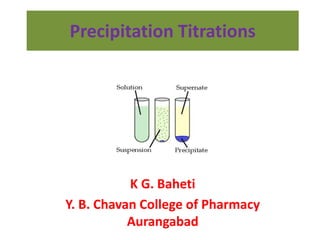
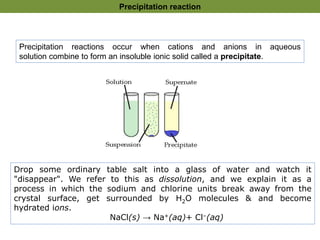
Precipitation reactions occur when cations and anions in aqueous
solution combine to form an insoluble ionic solid called a precipitate.
Precipitation reaction
Drop some ordinary table salt into a glass of water and watch it
"disappear". We refer to this as dissolution, and we explain it as a
process in which the sodium and chlorine units break away from the
crystal surface, get surrounded by H2O molecules & and become
hydrated ions.
NaCl(s) → Na+(aq)+ Cl–(aq)
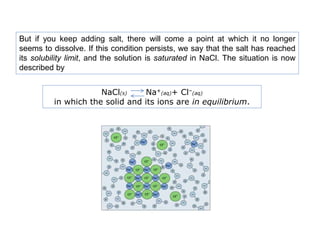
But if you keep adding salt, there will come a point at which it no longer
seems to dissolve. If this condition persists, we say that the salt has reached
its solubility limit, and the solution is saturated in NaCl. The situation is now
described by
NaCl(s) Na+(aq)+ Cl–(aq)
in which the solid and its ions are in equilibrium.
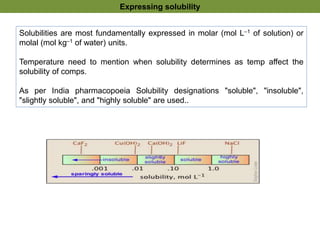
Solubilities are most fundamentally expressed in molar (mol L–1 of solution) or
molal (mol kg–1 of water) units.
Temperature need to mention when solubility determines as temp affect the
solubility of comps.
As per India pharmacopoeia Solubility designations "soluble", "insoluble",
"slightly soluble", and "highly soluble" are used..
Expressing solubility
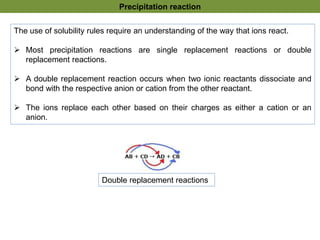
The use of solubility rules require an understanding of the way that ions react.
 Most precipitation reactions are single replacement reactions or double
replacement reactions.
 A double replacement reaction occurs when two ionic reactants dissociate and
bond with the respective anion or cation from the other reactant.
 The ions replace each other based on their charges as either a cation or an
anion.
Double replacement reactions
Precipitation reaction
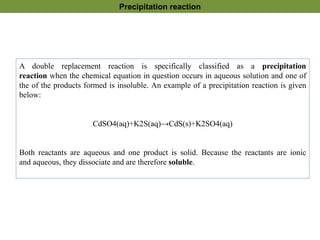
A double replacement reaction is specifically classified as a precipitation
reaction when the chemical equation in question occurs in aqueous solution and one of
the of the products formed is insoluble. An example of a precipitation reaction is given
below:
CdSO4(aq)+K2S(aq)→CdS(s)+K2SO4(aq)
Both reactants are aqueous and one product is solid. Because the reactants are ionic
and aqueous, they dissociate and are therefore soluble.
Precipitation reaction
Solution process and solubility product:
Solubility depend upon the breaking up of solute solute interaction by solute
solvent interactions. When solvent overcome the solute forces of crystal then
crystal get soluble.
Like dissolve like
During precipitation the opposite condition as mentioned above is desired.
Intermolecular forces between molecules are high and solute forces replaces
the solute solvent forces.
Solubility product for the reaction
AB A+ + B-
K sp = [A+ ] + [B-]
Substance will precipitate out when the product of ionic concentration exceeds
the Ksp value i.e. in above equation of Ksp, the BA will precipitate out when the
product of out of [A+ ] [B-] exceed Ksp
Theory of precipitation
Precipitation titration
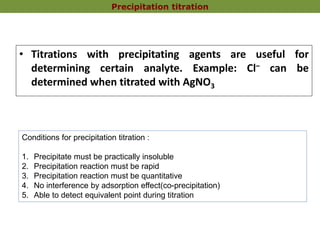
• Titrations with precipitating agents are useful for
determining certain analyte. Example: Cl– can be
determined when titrated with AgNO3
Conditions for precipitation titration :
1. Precipitate must be practically insoluble
2. Precipitation reaction must be rapid
3. Precipitation reaction must be quantitative
4. No interference by adsorption effect(co-precipitation)
5. Able to detect equivalent point during titration
Factors affecting solubility
1. Common ion effect
2. Effect of pH
3. Effect of temperature
4. Effect of solvent
Calculations of solubility product
Steps for calculations are given below
1. Write equation
2. Express solubility product of electrolyte
3. Calculate molar solubility
4. Calculate conc of each ion
5. Substitute values and calculate Ksp
Example: Calculate Ksp of MgCO3 if 1lit of its saturated solution contain
0.533gms of MgCO3 at 20oC
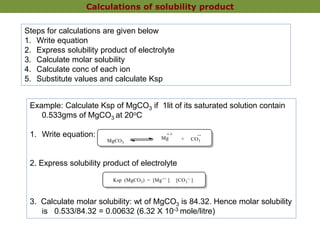
1. Write equation:
2. Express solubility product of electrolyte
3. Calculate molar solubility: wt of MgCO3 is 84.32. Hence molar solubility
is 0.533/84.32 = 0.00632 (6.32 X 10⁻³ mole/litre)
4. Calculate conc of each ion:
Each mole of magnesium carbonate dissociate and form 1 gm ion of magnesium
and 1 gm ion of carbonate. Hence both ion have same concentration equal to
molar solubility
[Mg++ ] = [CO3- - ] = 6.32 x10⁻³
5. Substitute values and calculate Ksp
Ksp = 6.32 x10-3 X 6.32 x10-3
Ksp + 4 X10⁻⁶
Calculations of solubility product
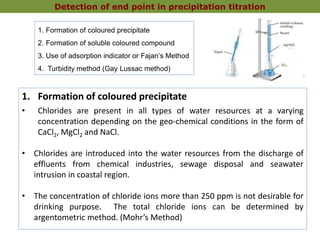
1. Formation of coloured precipitate
• Chlorides are present in all types of water resources at a varying
concentration depending on the geo-chemical conditions in the form of
CaCl2, MgCl2 and NaCl.
• Chlorides are introduced into the water resources from the discharge of
effluents from chemical industries, sewage disposal and seawater
intrusion in coastal region.
• The concentration of chloride ions more than 250 ppm is not desirable for
drinking purpose. The total chloride ions can be determined by
argentometric method. (Mohr’s Method)
Detection of end point in precipitation titration
1. Formation of coloured precipitate
2. Formation of soluble coloured compound
3. Use of adsorption indicator or Fajan’s Method
4. Turbidity method (Gay Lussac method)
Detection of end point in precipitation titration
In this method, first the analyte react with the titrant after the analyte is reacted
completely the next drop if titrant react with indicator and formed small quantity
of colored precipitate which indicate end point of titration (Mohr’s method)
Example:
Assay of NaCl with silver nitrate with dilute potassium chromate solution as
indicator.
Ksp(AgCl) = 1.2 x 10-10 = [Ag+] [Cl-]
Ksp(Ag2CrO4) =1.7 x 10-12 = [Ag+2] [CrO4
-2]
We expect that the salt with smaller Ksp should precipitate first, this is true if both
salt dissociate to yield same number of ions. But in this case the chloride ions
are in excess than that of chromate ion and concentration of chromate ion very
dilute i.e. 0.0014M, hence the chloride precipitate first and then chromate will
precipitate as colured compound
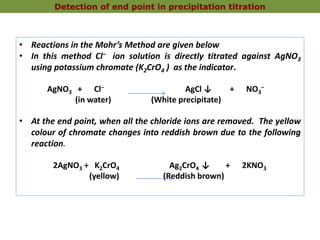
• Reactions in the Mohr’s Method are given below
• In this method Cl‒ ion solution is directly titrated against AgNO3
using potassium chromate (K2CrO4 ) as the indicator.
AgNO3 + Cl‒ AgCl ↓ + NO3
‒
(in water) (White precipitate)
• At the end point, when all the chloride ions are removed. The yellow
colour of chromate changes into reddish brown due to the following
reaction.
2AgNO3 + K2CrO4 Ag2CrO4 ↓ + 2KNO3
(yellow) (Reddish brown)
Detection of end point in precipitation titration
Conditions for Mohr’s method
1. Very dilute solution of pot chromate should be used
2. The titration should be carried out neutral or slight alkaline condition i.e. pH
6.5 to 9. In acidic condition, hydrogen chromate will be formed and in highly
alkaline condition silver hydroxide(Ksp =2.3 X 10⁻⁸)
3. Solubility product of silver chromate increase with rise in temperature.
Ammonium salt, iodide salts and thocyanate salt can not be done by Mohr’s
method because
1. In the presence of ammonium salt, the ammonia do have effect of solubility
of silver salt due to increase in pH
2. AgI and AgSCN adsorb chromate strongly hence false , indistinct end point
results
Detection of end point in precipitation titration
Assay of sodium chloride by Mohr’s Method:
Preparation and standardization of 0.1 N Silver nitrate solution
Preparation of potassium chromate indicator solution
Application : Determination of NaCl, KCl, Sodium chloride injection
Formation of soluble Precipitate
(Determination of chloride by Volhard Method)
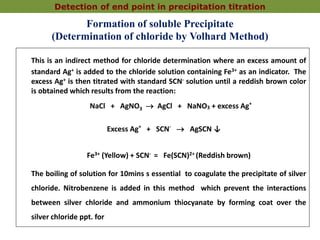
This is an indirect method for chloride determination where an excess amount of
standard Ag+ is added to the chloride solution containing Fe3+ as an indicator. The
excess Ag+ is then titrated with standard SCN- solution until a reddish brown color
is obtained which results from the reaction:
NaCl + AgNO3  AgCl + NaNO3 + excess Ag+
Excess Ag+
+ SCN-
 AgSCN ↓
Fe3+ (Yellow) + SCN- = Fe(SCN)2+ (Reddish brown)
The boiling of solution for 10mins s essential to coagulate the precipitate of silver
chloride. Nitrobenzene is added in this method which prevent the interactions
between silver chloride and ammonium thiocyanate by forming coat over the
silver chloride ppt. for
Detection of end point in precipitation titration
Assay of Ammonium chloride and sodium chloride by Volhard Method
Preparation and standardization of 0.1 N Silver nitrate solution
Preparation and standardization of 0.1 N ammonium thiocyanate solution
Volhard’s method
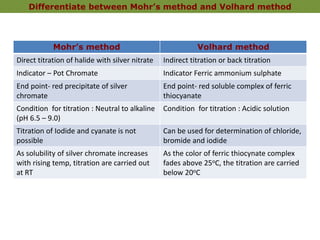
Differentiate between Mohr’s method and Volhard method
Mohr’s method Volhard method
Direct titration of halide with silver nitrate Indirect titration or back titration
Indicator – Pot Chromate Indicator Ferric ammonium sulphate
End point- red precipitate of silver
chromate
End point- red soluble complex of ferric
thiocyanate
Condition for titration : Neutral to alkaline
(pH 6.5 – 9.0)
Condition for titration : Acidic solution
Titration of Iodide and cyanate is not
possible
Can be used for determination of chloride,
bromide and iodide
As solubility of silver chromate increases
with rising temp, titration are carried out
at RT
As the color of ferric thiocynate complex
fades above 25oC, the titration are carried
below 20oC
Use of adsorption indicator or K Fajan’s method
In this method indicator adsorb on the surface of precipitate at equivalent
point with color change
Examples: Acidic dye Fluorescin, eosin or basic dyes rhodamine.
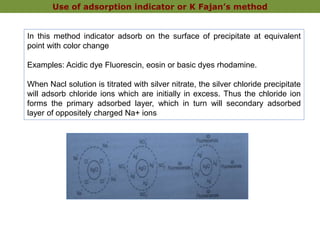
When Nacl solution is titrated with silver nitrate, the silver chloride precipitate
will adsorb chloride ions which are initially in excess. Thus the chloride ion
forms the primary adsorbed layer, which in turn will secondary adsorbed
layer of oppositely charged Na+ ions
• The precipitation titration in which silver ions is titrated with halide or thiocyanate
ions in presence of adsorption indicator is called fajan’s method. The indicator, which
is a dye, exists in solution as the ionized form, usually an anion.
• The method is generally used for the quantitative analysis of halide ions or
thiocyanate ions .
• In the titration of Cl– ions with AgNO3 in presence of adsorption indicator here
AgNO3 is kept in burette and the Cl– ion solution with indicator is taken in titration
flask
a) Before the equivalence point :before the eqv.point ,colloidal particles of AgCl are
negatively charged due to the adsorption of Cl– from the solution . The adsorbed Cl–
from the primary layer which attract the positively charged Na+ ions from the solution
to form a more loosely held secondary layer as shown in figure on previous slide
b) After the eqv. point ,excess of silver ions Ag+ displace the Cl– ions and form the
primary layer which attract the negatively charged nitrate ions NO3
– .
c) At the end point ,anion of indicator in (weak organic acid or base )replace the
negatively charged ion NO3
– from the second layer and give the intense color . This
intense color gives the end point of titration
Use of adsorption indicator or K Fajan’s method
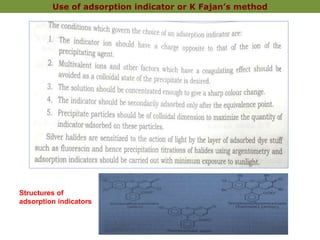
Structures of
adsorption indicators
Use of adsorption indicator or K Fajan’s method
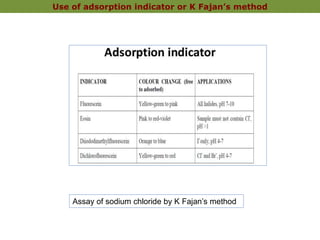
Assay of sodium chloride by K Fajan’s method
Turbidity Method : Gay Lussac Method
This is the turbidity procedure for determination of Ag+ with Cl- or vice versa.
It was introduced by Gay Lussac in 1832.
In this method standard solution of sodium chloride is treated with solution of
silver nitrate or vice versa.
This method is based of formation of turbidity due to precipitation. After eq. point,
the precipitation reaction ceases and addition of extra drop will not result in
turbidity.
Example.
Determination of silver nitrate with standard sodium chloride solution, is carried out in the
presence of free nitric acid and small qty of barium nitrate (it help in coagulation) .
Procedure: Weight 0.4 gm of silver nitrate in well stopper the bottle, add 100ml of water, a
few drops of conc. Nitric acid and small crystal of barium nitrate. Titrate it with standard
0.1M sodium chloride solution, by adding 20ml at once. Seal the bottle with stopper and
shake vigorously until the precipitate of silver chloride has coagulated and settled, leaving a
clear solution. Still the silver ions are in excess. Continue to add sodium chloride solution,
01ml at one time and shake after each addition till no turbidity is produced. Note the volume
of sodium chloride consumed. It is pilot reading. Repeat the titration by adding 01ml less
than the pilot reading and continue adding 0.02ml after that. Note the end pilot where no
turbidity is produced.
Nephelo-turbidity method can also be used.
Thank you : Any questions??????

Precipitation Titrations

  • 1.
    Precipitation Titrations K G.Baheti Y. B. Chavan College of Pharmacy Aurangabad
  • 2.
    Precipitation reactions occurwhen cations and anions in aqueous solution combine to form an insoluble ionic solid called a precipitate. Precipitation reaction Drop some ordinary table salt into a glass of water and watch it "disappear". We refer to this as dissolution, and we explain it as a process in which the sodium and chlorine units break away from the crystal surface, get surrounded by H2O molecules & and become hydrated ions. NaCl(s) → Na+(aq)+ Cl–(aq)
  • 3.
    But if youkeep adding salt, there will come a point at which it no longer seems to dissolve. If this condition persists, we say that the salt has reached its solubility limit, and the solution is saturated in NaCl. The situation is now described by NaCl(s) Na+(aq)+ Cl–(aq) in which the solid and its ions are in equilibrium.
  • 4.
    Solubilities are mostfundamentally expressed in molar (mol L–1 of solution) or molal (mol kg–1 of water) units. Temperature need to mention when solubility determines as temp affect the solubility of comps. As per India pharmacopoeia Solubility designations "soluble", "insoluble", "slightly soluble", and "highly soluble" are used.. Expressing solubility
  • 5.
    The use ofsolubility rules require an understanding of the way that ions react.  Most precipitation reactions are single replacement reactions or double replacement reactions.  A double replacement reaction occurs when two ionic reactants dissociate and bond with the respective anion or cation from the other reactant.  The ions replace each other based on their charges as either a cation or an anion. Double replacement reactions Precipitation reaction
  • 6.
    A double replacementreaction is specifically classified as a precipitation reaction when the chemical equation in question occurs in aqueous solution and one of the of the products formed is insoluble. An example of a precipitation reaction is given below: CdSO4(aq)+K2S(aq)→CdS(s)+K2SO4(aq) Both reactants are aqueous and one product is solid. Because the reactants are ionic and aqueous, they dissociate and are therefore soluble. Precipitation reaction
  • 7.
    Solution process andsolubility product: Solubility depend upon the breaking up of solute solute interaction by solute solvent interactions. When solvent overcome the solute forces of crystal then crystal get soluble. Like dissolve like During precipitation the opposite condition as mentioned above is desired. Intermolecular forces between molecules are high and solute forces replaces the solute solvent forces. Solubility product for the reaction AB A+ + B- K sp = [A+ ] + [B-] Substance will precipitate out when the product of ionic concentration exceeds the Ksp value i.e. in above equation of Ksp, the BA will precipitate out when the product of out of [A+ ] [B-] exceed Ksp Theory of precipitation
  • 8.
    Precipitation titration • Titrationswith precipitating agents are useful for determining certain analyte. Example: Cl– can be determined when titrated with AgNO3 Conditions for precipitation titration : 1. Precipitate must be practically insoluble 2. Precipitation reaction must be rapid 3. Precipitation reaction must be quantitative 4. No interference by adsorption effect(co-precipitation) 5. Able to detect equivalent point during titration
  • 9.
    Factors affecting solubility 1.Common ion effect 2. Effect of pH 3. Effect of temperature 4. Effect of solvent
  • 10.
    Calculations of solubilityproduct Steps for calculations are given below 1. Write equation 2. Express solubility product of electrolyte 3. Calculate molar solubility 4. Calculate conc of each ion 5. Substitute values and calculate Ksp Example: Calculate Ksp of MgCO3 if 1lit of its saturated solution contain 0.533gms of MgCO3 at 20oC 1. Write equation: 2. Express solubility product of electrolyte 3. Calculate molar solubility: wt of MgCO3 is 84.32. Hence molar solubility is 0.533/84.32 = 0.00632 (6.32 X 10⁻³ mole/litre)
  • 11.
    4. Calculate concof each ion: Each mole of magnesium carbonate dissociate and form 1 gm ion of magnesium and 1 gm ion of carbonate. Hence both ion have same concentration equal to molar solubility [Mg++ ] = [CO3- - ] = 6.32 x10⁻³ 5. Substitute values and calculate Ksp Ksp = 6.32 x10-3 X 6.32 x10-3 Ksp + 4 X10⁻⁶ Calculations of solubility product
  • 12.
    1. Formation ofcoloured precipitate • Chlorides are present in all types of water resources at a varying concentration depending on the geo-chemical conditions in the form of CaCl2, MgCl2 and NaCl. • Chlorides are introduced into the water resources from the discharge of effluents from chemical industries, sewage disposal and seawater intrusion in coastal region. • The concentration of chloride ions more than 250 ppm is not desirable for drinking purpose. The total chloride ions can be determined by argentometric method. (Mohr’s Method) Detection of end point in precipitation titration 1. Formation of coloured precipitate 2. Formation of soluble coloured compound 3. Use of adsorption indicator or Fajan’s Method 4. Turbidity method (Gay Lussac method)
  • 13.
    Detection of endpoint in precipitation titration In this method, first the analyte react with the titrant after the analyte is reacted completely the next drop if titrant react with indicator and formed small quantity of colored precipitate which indicate end point of titration (Mohr’s method) Example: Assay of NaCl with silver nitrate with dilute potassium chromate solution as indicator. Ksp(AgCl) = 1.2 x 10-10 = [Ag+] [Cl-] Ksp(Ag2CrO4) =1.7 x 10-12 = [Ag+2] [CrO4 -2] We expect that the salt with smaller Ksp should precipitate first, this is true if both salt dissociate to yield same number of ions. But in this case the chloride ions are in excess than that of chromate ion and concentration of chromate ion very dilute i.e. 0.0014M, hence the chloride precipitate first and then chromate will precipitate as colured compound
  • 14.
    • Reactions inthe Mohr’s Method are given below • In this method Cl‒ ion solution is directly titrated against AgNO3 using potassium chromate (K2CrO4 ) as the indicator. AgNO3 + Cl‒ AgCl ↓ + NO3 ‒ (in water) (White precipitate) • At the end point, when all the chloride ions are removed. The yellow colour of chromate changes into reddish brown due to the following reaction. 2AgNO3 + K2CrO4 Ag2CrO4 ↓ + 2KNO3 (yellow) (Reddish brown) Detection of end point in precipitation titration
  • 15.
    Detection of endpoint in precipitation titration Conditions for Mohr’s method 1. Very dilute solution of pot chromate should be used 2. The titration should be carried out neutral or slight alkaline condition i.e. pH 6.5 to 9. In acidic condition, hydrogen chromate will be formed and in highly alkaline condition silver hydroxide(Ksp =2.3 X 10⁻⁸) 3. Solubility product of silver chromate increase with rise in temperature. Ammonium salt, iodide salts and thocyanate salt can not be done by Mohr’s method because 1. In the presence of ammonium salt, the ammonia do have effect of solubility of silver salt due to increase in pH 2. AgI and AgSCN adsorb chromate strongly hence false , indistinct end point results
  • 16.
    Detection of endpoint in precipitation titration Assay of sodium chloride by Mohr’s Method: Preparation and standardization of 0.1 N Silver nitrate solution Preparation of potassium chromate indicator solution Application : Determination of NaCl, KCl, Sodium chloride injection
  • 17.
    Formation of solublePrecipitate (Determination of chloride by Volhard Method) This is an indirect method for chloride determination where an excess amount of standard Ag+ is added to the chloride solution containing Fe3+ as an indicator. The excess Ag+ is then titrated with standard SCN- solution until a reddish brown color is obtained which results from the reaction: NaCl + AgNO3  AgCl + NaNO3 + excess Ag+ Excess Ag+ + SCN-  AgSCN ↓ Fe3+ (Yellow) + SCN- = Fe(SCN)2+ (Reddish brown) The boiling of solution for 10mins s essential to coagulate the precipitate of silver chloride. Nitrobenzene is added in this method which prevent the interactions between silver chloride and ammonium thiocyanate by forming coat over the silver chloride ppt. for Detection of end point in precipitation titration
  • 18.
    Assay of Ammoniumchloride and sodium chloride by Volhard Method Preparation and standardization of 0.1 N Silver nitrate solution Preparation and standardization of 0.1 N ammonium thiocyanate solution Volhard’s method
  • 19.
    Differentiate between Mohr’smethod and Volhard method Mohr’s method Volhard method Direct titration of halide with silver nitrate Indirect titration or back titration Indicator – Pot Chromate Indicator Ferric ammonium sulphate End point- red precipitate of silver chromate End point- red soluble complex of ferric thiocyanate Condition for titration : Neutral to alkaline (pH 6.5 – 9.0) Condition for titration : Acidic solution Titration of Iodide and cyanate is not possible Can be used for determination of chloride, bromide and iodide As solubility of silver chromate increases with rising temp, titration are carried out at RT As the color of ferric thiocynate complex fades above 25oC, the titration are carried below 20oC
  • 20.
    Use of adsorptionindicator or K Fajan’s method In this method indicator adsorb on the surface of precipitate at equivalent point with color change Examples: Acidic dye Fluorescin, eosin or basic dyes rhodamine. When Nacl solution is titrated with silver nitrate, the silver chloride precipitate will adsorb chloride ions which are initially in excess. Thus the chloride ion forms the primary adsorbed layer, which in turn will secondary adsorbed layer of oppositely charged Na+ ions
  • 21.
    • The precipitationtitration in which silver ions is titrated with halide or thiocyanate ions in presence of adsorption indicator is called fajan’s method. The indicator, which is a dye, exists in solution as the ionized form, usually an anion. • The method is generally used for the quantitative analysis of halide ions or thiocyanate ions . • In the titration of Cl– ions with AgNO3 in presence of adsorption indicator here AgNO3 is kept in burette and the Cl– ion solution with indicator is taken in titration flask a) Before the equivalence point :before the eqv.point ,colloidal particles of AgCl are negatively charged due to the adsorption of Cl– from the solution . The adsorbed Cl– from the primary layer which attract the positively charged Na+ ions from the solution to form a more loosely held secondary layer as shown in figure on previous slide b) After the eqv. point ,excess of silver ions Ag+ displace the Cl– ions and form the primary layer which attract the negatively charged nitrate ions NO3 – . c) At the end point ,anion of indicator in (weak organic acid or base )replace the negatively charged ion NO3 – from the second layer and give the intense color . This intense color gives the end point of titration Use of adsorption indicator or K Fajan’s method
  • 22.
    Use of adsorptionindicator or K Fajan’s method Structures of adsorption indicators
  • 23.
    Use of adsorptionindicator or K Fajan’s method Assay of sodium chloride by K Fajan’s method
  • 24.
    Turbidity Method :Gay Lussac Method This is the turbidity procedure for determination of Ag+ with Cl- or vice versa. It was introduced by Gay Lussac in 1832. In this method standard solution of sodium chloride is treated with solution of silver nitrate or vice versa. This method is based of formation of turbidity due to precipitation. After eq. point, the precipitation reaction ceases and addition of extra drop will not result in turbidity. Example. Determination of silver nitrate with standard sodium chloride solution, is carried out in the presence of free nitric acid and small qty of barium nitrate (it help in coagulation) . Procedure: Weight 0.4 gm of silver nitrate in well stopper the bottle, add 100ml of water, a few drops of conc. Nitric acid and small crystal of barium nitrate. Titrate it with standard 0.1M sodium chloride solution, by adding 20ml at once. Seal the bottle with stopper and shake vigorously until the precipitate of silver chloride has coagulated and settled, leaving a clear solution. Still the silver ions are in excess. Continue to add sodium chloride solution, 01ml at one time and shake after each addition till no turbidity is produced. Note the volume of sodium chloride consumed. It is pilot reading. Repeat the titration by adding 01ml less than the pilot reading and continue adding 0.02ml after that. Note the end pilot where no turbidity is produced. Nephelo-turbidity method can also be used.
  • 25.
    Thank you :Any questions??????