Justice And Fairness
Ethics
ACRON, RONDEL JOVA, ROBERT
DINGAL, JAY-AR LANUGAN, CHRISTOPHER JOHN
ESCABAL, EDMEL MANLIMOS, RICHIE JR.
FERNANDEZ, AURELIO JR. RED, JUDE MICHAEL
PINCA, JUNEL
JUSTICE and FAIRNESS ETHICS
 Justice means giving each person what he or she deserves
or, in more traditional terms, giving each person his or her
due. Justice and fairness are closely related terms that are
often today used interchangeably. While justice usually has
been used with reference to a standard of rightness, fairness
often has been used with regard to an ability to judge
without reference to one's feelings or interests; fairness has
also been used to refer to the ability to make judgments that
are not overly general but that are concrete and specific to a
particular case.
JUSTICE and FAIRNESS ETHICS
 When people differ over what they believe should be given, or
when decisions have to be made about how benefits and
burdens should be distributed among a group of people,
questions of justice or fairness inevitably arise. In fact, most
ethicists today hold the view that there would be no point of
talking about justice or fairness if it were not for the conflicts of
interest that are created when goods and services are scarce
and people differ over who should get what. When such
conflicts arise in our society, we need principles of justice that
we can all accept as reasonable and fair standards for
determining what people deserve.
JUSTICE ETHICS
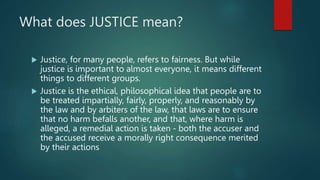
What does JUSTICE mean?
 Justice, for many people, refers to fairness. But while
justice is important to almost everyone, it means different
things to different groups.
 Justice is the ethical, philosophical idea that people are to
be treated impartially, fairly, properly, and reasonably by
the law and by arbiters of the law, that laws are to ensure
that no harm befalls another, and that, where harm is
alleged, a remedial action is taken - both the accuser and
the accused receive a morally right consequence merited
by their actions
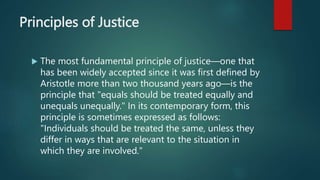
Principles of Justice
 The most fundamental principle of justice—one that
has been widely accepted since it was first defined by
Aristotle more than two thousand years ago—is the
principle that "equals should be treated equally and
unequals unequally." In its contemporary form, this
principle is sometimes expressed as follows:
"Individuals should be treated the same, unless they
differ in ways that are relevant to the situation in
which they are involved."
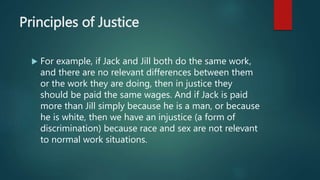
Principles of Justice
 For example, if Jack and Jill both do the same work,
and there are no relevant differences between them
or the work they are doing, then in justice they
should be paid the same wages. And if Jack is paid
more than Jill simply because he is a man, or because
he is white, then we have an injustice (a form of
discrimination) because race and sex are not relevant
to normal work situations.
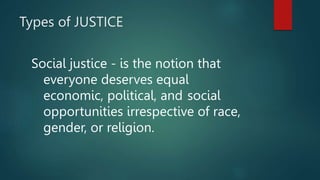
Types of JUSTICE
Social justice - is the notion that
everyone deserves equal
economic, political, and social
opportunities irrespective of race,
gender, or religion.
Types of JUSTICE
Distributive justice - refers to the
equitable allocation of assets in society.
Environmental justice - is the fair
treatment of all people with regard to
environmental burdens and benefits.
Types of JUSTICE
 Restorative or corrective justice seeks to make whole
those who have suffered unfairly.
 Retributive justice seeks to punish wrongdoers
objectively and proportionately.
 Procedural justice refers to implementing legal
decisions in accordance with fair and unbiased
processes
JUSTICE ETHICS in Everyday Life
 Justice, then, is a central part of ethics and should be
given due consideration in our moral lives. In
evaluating any moral decision, we must ask whether
our actions treat all persons equally. If not, we must
determine whether the difference in treatment is
justified: are the criteria we are using relevant to the
situation at hand? But justice is not the only principle
to consider in making ethical decisions.
JUSTICE in Everyday Life
 Sometimes principles of justice may need to
be overridden in favor of other kinds of moral
claims such as rights or society's welfare.
Nevertheless, justice is an expression of our
mutual recognition of each other's basic
dignity, and an acknowledgement that if we
are to live together in an interdependent
community we must treat each other as
equals.
FAIRNESS ETHICS
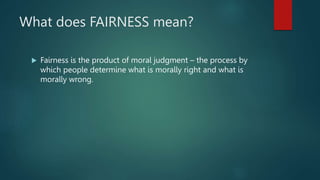
What does FAIRNESS mean?
 Fairness is the product of moral judgment – the process by
which people determine what is morally right and what is
morally wrong.
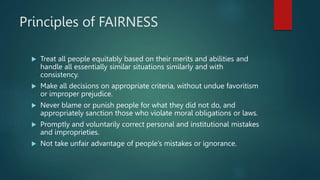
Principles of FAIRNESS
 Treat all people equitably based on their merits and abilities and
handle all essentially similar situations similarly and with
consistency.
 Make all decisions on appropriate criteria, without undue favoritism
or improper prejudice.
 Never blame or punish people for what they did not do, and
appropriately sanction those who violate moral obligations or laws.
 Promptly and voluntarily correct personal and institutional mistakes
and improprieties.
 Not take unfair advantage of people’s mistakes or ignorance.
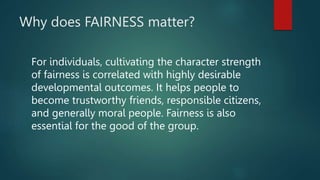
Why does FAIRNESS matter?
For individuals, cultivating the character strength
of fairness is correlated with highly desirable
developmental outcomes. It helps people to
become trustworthy friends, responsible citizens,
and generally moral people. Fairness is also
essential for the good of the group.
Why does FAIRNESS matter
 As individuals develop the capacity for moral reason
they often find a strengthening of: the aptitude for
self-reflection; self-awareness and self-confidence;
and perspective taking (i.e. the ability to “put
themselves in another’s shoes”). When taken
together, these skills significantly enhance a person’s
ability to solve interpersonal and group relationship
problems.
FAIRNESS in everyday life
 Fairness is important. It takes place in all our lives. If we did
not have fairness our lives would be different. Fairness is when
everyone is treated equally and no one is left out. People that
are fair follow the rules in sports, games, activities, and in their
community. They are honest and trustworthy. They follow
Eleanor Roosevelt’s quote “It is not fair to ask of others what
you are unwilling to do yourself.” Fairness is very important in
a community. Everyone needs to follow the rules, be
respectful of one another and work together to build a strong
and beautiful community.
THAT IS ALL, THANK YOU!!
By: Ethically Gwapo Group

justice-and-fairness-ethics with example

  • 1.
    Justice And Fairness Ethics ACRON,RONDEL JOVA, ROBERT DINGAL, JAY-AR LANUGAN, CHRISTOPHER JOHN ESCABAL, EDMEL MANLIMOS, RICHIE JR. FERNANDEZ, AURELIO JR. RED, JUDE MICHAEL PINCA, JUNEL
  • 2.
    JUSTICE and FAIRNESSETHICS  Justice means giving each person what he or she deserves or, in more traditional terms, giving each person his or her due. Justice and fairness are closely related terms that are often today used interchangeably. While justice usually has been used with reference to a standard of rightness, fairness often has been used with regard to an ability to judge without reference to one's feelings or interests; fairness has also been used to refer to the ability to make judgments that are not overly general but that are concrete and specific to a particular case.
  • 3.
    JUSTICE and FAIRNESSETHICS  When people differ over what they believe should be given, or when decisions have to be made about how benefits and burdens should be distributed among a group of people, questions of justice or fairness inevitably arise. In fact, most ethicists today hold the view that there would be no point of talking about justice or fairness if it were not for the conflicts of interest that are created when goods and services are scarce and people differ over who should get what. When such conflicts arise in our society, we need principles of justice that we can all accept as reasonable and fair standards for determining what people deserve.
  • 4.
  • 5.
    What does JUSTICEmean?  Justice, for many people, refers to fairness. But while justice is important to almost everyone, it means different things to different groups.  Justice is the ethical, philosophical idea that people are to be treated impartially, fairly, properly, and reasonably by the law and by arbiters of the law, that laws are to ensure that no harm befalls another, and that, where harm is alleged, a remedial action is taken - both the accuser and the accused receive a morally right consequence merited by their actions
  • 6.
    Principles of Justice The most fundamental principle of justice—one that has been widely accepted since it was first defined by Aristotle more than two thousand years ago—is the principle that "equals should be treated equally and unequals unequally." In its contemporary form, this principle is sometimes expressed as follows: "Individuals should be treated the same, unless they differ in ways that are relevant to the situation in which they are involved."
  • 7.
    Principles of Justice For example, if Jack and Jill both do the same work, and there are no relevant differences between them or the work they are doing, then in justice they should be paid the same wages. And if Jack is paid more than Jill simply because he is a man, or because he is white, then we have an injustice (a form of discrimination) because race and sex are not relevant to normal work situations.
  • 8.
    Types of JUSTICE Socialjustice - is the notion that everyone deserves equal economic, political, and social opportunities irrespective of race, gender, or religion.
  • 9.
    Types of JUSTICE Distributivejustice - refers to the equitable allocation of assets in society. Environmental justice - is the fair treatment of all people with regard to environmental burdens and benefits.
  • 10.
    Types of JUSTICE Restorative or corrective justice seeks to make whole those who have suffered unfairly.  Retributive justice seeks to punish wrongdoers objectively and proportionately.  Procedural justice refers to implementing legal decisions in accordance with fair and unbiased processes
  • 11.
    JUSTICE ETHICS inEveryday Life  Justice, then, is a central part of ethics and should be given due consideration in our moral lives. In evaluating any moral decision, we must ask whether our actions treat all persons equally. If not, we must determine whether the difference in treatment is justified: are the criteria we are using relevant to the situation at hand? But justice is not the only principle to consider in making ethical decisions.
  • 12.
    JUSTICE in EverydayLife  Sometimes principles of justice may need to be overridden in favor of other kinds of moral claims such as rights or society's welfare. Nevertheless, justice is an expression of our mutual recognition of each other's basic dignity, and an acknowledgement that if we are to live together in an interdependent community we must treat each other as equals.
  • 13.
  • 14.
    What does FAIRNESSmean?  Fairness is the product of moral judgment – the process by which people determine what is morally right and what is morally wrong.
  • 15.
    Principles of FAIRNESS Treat all people equitably based on their merits and abilities and handle all essentially similar situations similarly and with consistency.  Make all decisions on appropriate criteria, without undue favoritism or improper prejudice.  Never blame or punish people for what they did not do, and appropriately sanction those who violate moral obligations or laws.  Promptly and voluntarily correct personal and institutional mistakes and improprieties.  Not take unfair advantage of people’s mistakes or ignorance.
  • 16.
    Why does FAIRNESSmatter? For individuals, cultivating the character strength of fairness is correlated with highly desirable developmental outcomes. It helps people to become trustworthy friends, responsible citizens, and generally moral people. Fairness is also essential for the good of the group.
  • 17.
    Why does FAIRNESSmatter  As individuals develop the capacity for moral reason they often find a strengthening of: the aptitude for self-reflection; self-awareness and self-confidence; and perspective taking (i.e. the ability to “put themselves in another’s shoes”). When taken together, these skills significantly enhance a person’s ability to solve interpersonal and group relationship problems.
  • 18.
    FAIRNESS in everydaylife  Fairness is important. It takes place in all our lives. If we did not have fairness our lives would be different. Fairness is when everyone is treated equally and no one is left out. People that are fair follow the rules in sports, games, activities, and in their community. They are honest and trustworthy. They follow Eleanor Roosevelt’s quote “It is not fair to ask of others what you are unwilling to do yourself.” Fairness is very important in a community. Everyone needs to follow the rules, be respectful of one another and work together to build a strong and beautiful community.
  • 19.
    THAT IS ALL,THANK YOU!! By: Ethically Gwapo Group