Introduction 
• Finger millet is an annual plant widely grown as 
a cereal 
• Originally native to the Ethiopian highlands 
• Cultivate in more than 25 countries in; 
– Africa (eastern and southern) 
– Asia (from Near East to Far East) 
• As a staple food grain 
• The major producers are Uganda, India, Nepal, 
and China
Nutrient Composition of Finger Millet 
Moisture - 13.24 % 
Protein - 7.6 % 
Carbohydrate - 74.36 % 
Fiber - 1.52 % 
Minerals - 2.35 % 
Fat - 1.35 % 
Energy - 341.6 cal/100 g
Scientific classification 
Kingdom : Plantae 
Order : Poales 
Family : Poaceae 
Subfamily : Chloridoideae 
Genus : Eleusine 
Species : E. coracana 
Botanical name: Eleusine coracana
In Sri Lanka…… 
• Average yield : 1324 kg/ha 
• Extent : 5665 ha (2001-DOA) 
• Production : 4212 mt (2001-DOA) 
• Grown in rain fed uplands in the Dry zone and 
Intermediate zone of Sri Lanka 
• Can be grown during in low land paddy fields during 
yala season
• Major growing areas: 
– Anuradhapura 
– Monoragala 
– Hambanthota 
– Kegalle 
– Rathnapura 
– Nuwaraeliya 
– Ampara 
– Badulla 
– Jaffna
Ecological Requirements 
• Climatic conditions 
– Finger millet grows best with medium 
rainfall 
– Annual temperature range of 11 to 27°C 
– Low relative humidity
• Soil 
– well-drained soils silt loams 
– grows well on 
• Reddish brown earth 
• Calcic red yellow latasols 
• Sandy regosols 
– Soil pH of 5.0 - 8.2
Recommended Varieties 
Variety Days to maturity 
• Ravi 90 - 100 
• Ravana 90 - 100
Land preparation 
•Traditionally grown on Chenas during Maha 
season 
•Usually planted without land preparation 
•Soil is worked to a fine tilth with a disc harrow or 
mammoty for higher yield 
•Upland seeds should be planted in moist soil and 
protected them biological hazards
Seed Establishment 
•Can done in 3 ways 
-Broad casting 
-Row seeding 
-Transplanting 
• In Sri Lanka normally done broad casting 
•In row seeding seeds are sawn with 30 cm spacing 
•In transplanting, 20-25 days old seedlings can be 
transplanted
Fertilizer application 
•Basal Urea 50 kg/ha 
•TSP 50 kg/ha 
•MOP 50 kg/ha 
•Top dressing- apply 50 kg /ha of Urea at 3-4 weeks 
after planting 
•To apply fertilizers their should be moisture in the soil
Irrigation 
•Irrigate the field once in every 4-5 days until 
seedlings are establish 
•During dry period supplementary irrigation 
is provided at weekly interval's 
•Raise beds or the basin systems can be 
adapted for irrigation
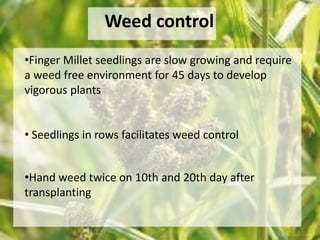
Weed control 
•Finger Millet seedlings are slow growing and require 
a weed free environment for 45 days to develop 
vigorous plants 
• Seedlings in rows facilitates weed control 
•Hand weed twice on 10th and 20th day after 
transplanting
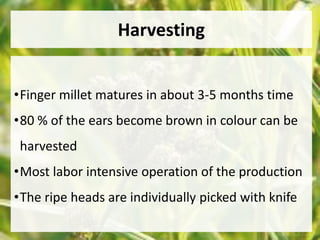
Harvesting 
•Finger millet matures in about 3-5 months time 
•80 % of the ears become brown in colour can be 
harvested 
•Most labor intensive operation of the production 
•The ripe heads are individually picked with knife
Cont’d… 
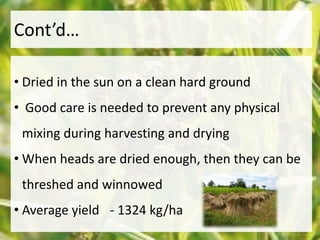
• Dried in the sun on a clean hard ground 
• Good care is needed to prevent any physical 
mixing during harvesting and drying 
• When heads are dried enough, then they can be 
threshed and winnowed 
• Average yield - 1324 kg/ha
Storage 
• Finger millet is piled in heaps for a few days and 
stored as heads 
• If kept dry, it can store for as long as five years 
• During storage, insect pests do not attack it 
• At onset of rain, the grain springs to life and can 
be ready to harvest in just 45 days
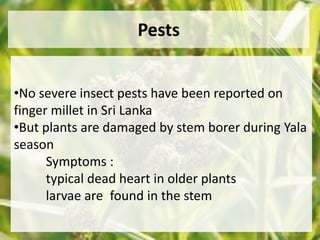
Pests 
•No severe insect pests have been reported on 
finger millet in Sri Lanka 
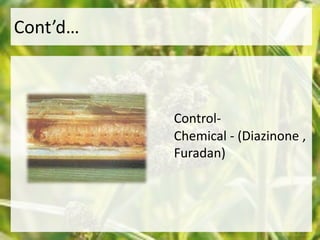
•But plants are damaged by stem borer during Yala 
season 
Symptoms : 
typical dead heart in older plants 
larvae are found in the stem
Control- 
Chemical - (Diazinone , 
Furadan) 
Cont’d…
Diseases 
•Bacterial Blast (Pyricularia spp) : 
Plants are affected by blast mainly during 
maha season 
Symptoms – 
Diamond shaped, greyish white lesions bordered 
by a brown margin develop on leaves
Cont’d 
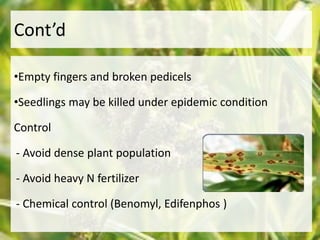
•Empty fingers and broken pedicels 
•Seedlings may be killed under epidemic condition 
Control 
- Avoid dense plant population 
- Avoid heavy N fertilizer 
- Chemical control (Benomyl, Edifenphos )
Uses 
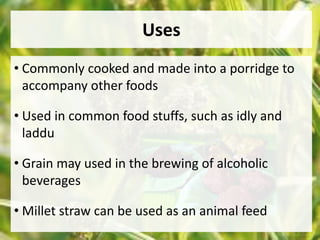
• Commonly cooked and made into a porridge to 
accompany other foods 
• Used in common food stuffs, such as idly and 
laddu 
• Grain may used in the brewing of alcoholic 
beverages 
• Millet straw can be used as an animal feed
Medicinal values 
• Great source to extract energy 
• Helps in bone development 
• For losing weight 
• Aid for diabetics 
• Treatment of anaemia 
• Reduces blood cholesterol 
• Relaxes body
Present status 
•Current annual production of finger millet is 
about 6,400 mt 
•Present productivity is about 1.1 mt/ha 
•Annual extent of cultivation of finger millet 
remains at 5,900 ha. 
•About 3,200 mt of finger millet is imported to the 
country annually
Cont’d 
• Import of finger millet seeds is to fulfill the 
pure seeds requirements of the industries 
-due to shortage of local products 
• Finger millet seeds are exported in small 
amount which is negligible 
• Price (Rs./kg) - Rs.24.00 – 30.00
Cont’d 
•FCRDI has released high yielding variety of finger 
millets 
-yield above 3.00 mt/ha under good 
management conditions 
•With little more efforts to practice proper 
management conditions, we will be able to 
achieve self-sufficiency with the existing 
cultivated extent of finger millet
Group Members 
•A.M.N.S.K.Abeysinghe UWU/EAG/11/0005 
•A.P.Kariyawasam UWU/EAG/11/0006 
•U.L.D.M.S.Gunasinghe UWU/EAG/11/0007 
•R.M.M.K.Wijerathna UWU/EAG/11/0012
THANK YOU

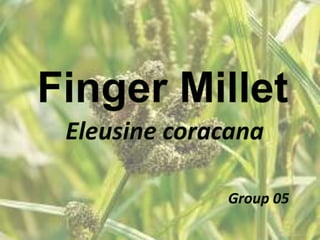
Finger Millet

  • 2.
    Introduction • Fingermillet is an annual plant widely grown as a cereal • Originally native to the Ethiopian highlands • Cultivate in more than 25 countries in; – Africa (eastern and southern) – Asia (from Near East to Far East) • As a staple food grain • The major producers are Uganda, India, Nepal, and China
  • 3.
    Nutrient Composition ofFinger Millet Moisture - 13.24 % Protein - 7.6 % Carbohydrate - 74.36 % Fiber - 1.52 % Minerals - 2.35 % Fat - 1.35 % Energy - 341.6 cal/100 g
  • 4.
    Scientific classification Kingdom: Plantae Order : Poales Family : Poaceae Subfamily : Chloridoideae Genus : Eleusine Species : E. coracana Botanical name: Eleusine coracana
  • 5.
    In Sri Lanka…… • Average yield : 1324 kg/ha • Extent : 5665 ha (2001-DOA) • Production : 4212 mt (2001-DOA) • Grown in rain fed uplands in the Dry zone and Intermediate zone of Sri Lanka • Can be grown during in low land paddy fields during yala season
  • 6.
    • Major growingareas: – Anuradhapura – Monoragala – Hambanthota – Kegalle – Rathnapura – Nuwaraeliya – Ampara – Badulla – Jaffna
  • 7.
    Ecological Requirements •Climatic conditions – Finger millet grows best with medium rainfall – Annual temperature range of 11 to 27°C – Low relative humidity
  • 8.
    • Soil –well-drained soils silt loams – grows well on • Reddish brown earth • Calcic red yellow latasols • Sandy regosols – Soil pH of 5.0 - 8.2
  • 9.
    Recommended Varieties VarietyDays to maturity • Ravi 90 - 100 • Ravana 90 - 100
  • 10.
    Land preparation •Traditionallygrown on Chenas during Maha season •Usually planted without land preparation •Soil is worked to a fine tilth with a disc harrow or mammoty for higher yield •Upland seeds should be planted in moist soil and protected them biological hazards
  • 11.
    Seed Establishment •Candone in 3 ways -Broad casting -Row seeding -Transplanting • In Sri Lanka normally done broad casting •In row seeding seeds are sawn with 30 cm spacing •In transplanting, 20-25 days old seedlings can be transplanted
  • 12.
    Fertilizer application •BasalUrea 50 kg/ha •TSP 50 kg/ha •MOP 50 kg/ha •Top dressing- apply 50 kg /ha of Urea at 3-4 weeks after planting •To apply fertilizers their should be moisture in the soil
  • 13.
    Irrigation •Irrigate thefield once in every 4-5 days until seedlings are establish •During dry period supplementary irrigation is provided at weekly interval's •Raise beds or the basin systems can be adapted for irrigation
  • 14.
    Weed control •FingerMillet seedlings are slow growing and require a weed free environment for 45 days to develop vigorous plants • Seedlings in rows facilitates weed control •Hand weed twice on 10th and 20th day after transplanting
  • 15.
    Harvesting •Finger milletmatures in about 3-5 months time •80 % of the ears become brown in colour can be harvested •Most labor intensive operation of the production •The ripe heads are individually picked with knife
  • 16.
    Cont’d… • Driedin the sun on a clean hard ground • Good care is needed to prevent any physical mixing during harvesting and drying • When heads are dried enough, then they can be threshed and winnowed • Average yield - 1324 kg/ha
  • 17.
    Storage • Fingermillet is piled in heaps for a few days and stored as heads • If kept dry, it can store for as long as five years • During storage, insect pests do not attack it • At onset of rain, the grain springs to life and can be ready to harvest in just 45 days
  • 18.
    Pests •No severeinsect pests have been reported on finger millet in Sri Lanka •But plants are damaged by stem borer during Yala season Symptoms : typical dead heart in older plants larvae are found in the stem
  • 19.
    Control- Chemical -(Diazinone , Furadan) Cont’d…
  • 20.
    Diseases •Bacterial Blast(Pyricularia spp) : Plants are affected by blast mainly during maha season Symptoms – Diamond shaped, greyish white lesions bordered by a brown margin develop on leaves
  • 21.
    Cont’d •Empty fingersand broken pedicels •Seedlings may be killed under epidemic condition Control - Avoid dense plant population - Avoid heavy N fertilizer - Chemical control (Benomyl, Edifenphos )
  • 22.
    Uses • Commonlycooked and made into a porridge to accompany other foods • Used in common food stuffs, such as idly and laddu • Grain may used in the brewing of alcoholic beverages • Millet straw can be used as an animal feed
  • 23.
    Medicinal values •Great source to extract energy • Helps in bone development • For losing weight • Aid for diabetics • Treatment of anaemia • Reduces blood cholesterol • Relaxes body
  • 24.
    Present status •Currentannual production of finger millet is about 6,400 mt •Present productivity is about 1.1 mt/ha •Annual extent of cultivation of finger millet remains at 5,900 ha. •About 3,200 mt of finger millet is imported to the country annually
  • 25.
    Cont’d • Importof finger millet seeds is to fulfill the pure seeds requirements of the industries -due to shortage of local products • Finger millet seeds are exported in small amount which is negligible • Price (Rs./kg) - Rs.24.00 – 30.00
  • 26.
    Cont’d •FCRDI hasreleased high yielding variety of finger millets -yield above 3.00 mt/ha under good management conditions •With little more efforts to practice proper management conditions, we will be able to achieve self-sufficiency with the existing cultivated extent of finger millet
  • 27.
    Group Members •A.M.N.S.K.AbeysingheUWU/EAG/11/0005 •A.P.Kariyawasam UWU/EAG/11/0006 •U.L.D.M.S.Gunasinghe UWU/EAG/11/0007 •R.M.M.K.Wijerathna UWU/EAG/11/0012
  • 28.