
Sub.:- Principles of Seed Technology
Course No. :- APB- 5221
Credit hours:- 3(1+2)
Lec. Topic:- Purity and Germination tests (Prac.)
Presented by:-
Indira Gandhi Krishi Vishwavidyalaya
Raipur, C.G.
Presented by:-
Lt. Roshan Parihar, Asstt. Professor (GPB)
Deptt. of Genetics & Plant Breeding
BTC College of Agriculture & Research Station
,Sarkanda, Bilaspur,(CG)-495001
Seed PuritySeed Purity
Seed Blower
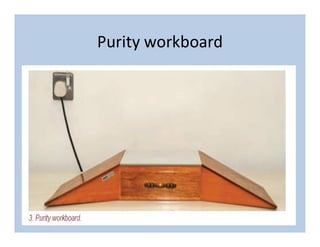
Purity workboard
Steps of Purity Analysis
1. Remove debris from seeds by graded sieves ,
ensuring that small sized seeds in the sample
are not discarded.
2. Separate lightweight material and empty
glumes by gentle winnowing or using the seed
blower.
3. Spread the seeds on a flat well-lit surface of3. Spread the seeds on a flat well-lit surface of
contrasting color such as an illuminated table
and examine the seeds for any physical
damage or infestation with insects and fungi .
4. Discard any visually damaged, shriveled,
infected or infested seeds.
5. Destroy any waste material to prevent the
spread of the disease or insects to other
material.
Calculations
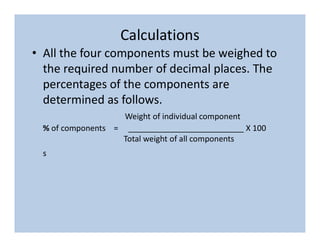
• All the four components must be weighed to
the required number of decimal places. The
percentages of the components are
determined as follows.
Weight of individual component
% of components = __________________________ X 100% of components = __________________________ X 100
Total weight of all components
s
Determination of Obj. Weeds, OCS,ISP &ODV
Number of seeds found
No. of Seeds/Kg = ________________________ X 1000
weight of seeds in grams(WS)
Eg. for Argemone mexicana in mustard
15
No. of Seeds/Kg = ________________________ X 1000No. of Seeds/Kg = ________________________ X 1000
16 gm (Working Sample)
No. of Seeds/Kg = 938 seeds/ kg of mustard seeds
• AS PER IMSCS for Mustard FS & CS obj weed
must be 5 and 10 no/kg hence the above lot will
be rejected.
SEED GERMINATION
What is Seed germination ?
• Literally germination is the
activation of germ tissues
(Embryo), its morphogenesis
and development into
essential structures whichessential structures which
led to field emergence of
miniature plant population
over the stratum.
Principle of seed germination
• Germination test shall be carried
with pure seed fraction.
• A mimimum of 400 seeds are
required in four replicates of 100
seeds each or 8 replicate of 50seeds each or 8 replicate of 50
seeds or 16 replicates of 25 seeds
depending upon the seed and size
of container.
• The test is conducted under
favourable conditions of
moisture,temperature,suitab
le substratum and light if
necessary. No pretreatment
to the seed is given except
necessary. No pretreatment
to the seed is given except
for those recommendeb by
ISTA
Materials required
• Substratum (Medium of moisture)
– Sand must pass through 0.80mm
seive but retained by 0.05mm
seive,washed and autoclaved .
– Paper (Filter paper,blotter or towel– Paper (Filter paper,blotter or towel
,kraft paper), has capillary action (30
mm rise per minute) moisture retaine
– Soil or artificial compost in limited
cases with the recommendation.
• Germination tray
– 22.5 x 22.5x 4.0 cm dimension
zinc,plastic or steel tray are used .
• Method of seed placement.
– TS top of sand method where seed
are placed with space and covered
with 1-2 cm sand layer.with 1-2 cm sand layer.
– Spacing must be 1-5 times width of
seed.
– Water must be 50 % WHC for cereals
and 60 % WHC for large legumes and
maize.
– TP Top of paper ,seeds are placed
on top of paperon filter paper on
petridishes coved with lid and placed
on germination cabinet.
– BP Between paper method or paper
towel method seeds are place
between the layers and moistened
with water and placedwrapped andwith water and placedwrapped and
tied with thread and kept in upright
position on the tray on germination
cabinet.
• Germination cabinet
– Temp and RH are maintained with
biological oxygen supply.
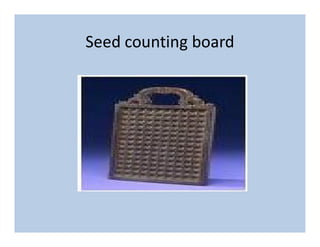
• Seed counting board.
– Used for seed counting have two
plates one basal is fixed and upper is
stationary, upper has 50/100 holes.stationary, upper has 50/100 holes.
• Vaccum seed counter
– It has head ,pipe and wall.head has
plates with 50 or 100 holes, when
vaccum is created exact seed are
taken and place over the substrate.
• Germination cabinet
– Temp and RH are maintained with
biological oxygen supply.
• Seed counting board.
– Used for seed counting have two
plates one basal is fixed and upper is
stationary, upper has 50/100 holes.stationary, upper has 50/100 holes.
• Vaccum seed counter
– It has head ,pipe and wall.head has
plates with 50 or 100 holes, when
vaccum is created exact seed are
taken and place over the substrate.
Sample size
• Use a minimum of two replicates each of 50 or
100 seeds for testing initial germination and two
replicates each of 25 or 50 seeds for subsequent
tests, depending on available seed quantity.tests, depending on available seed quantity.
• Take a random sample of seeds from the
container.
• If the seeds are very dry (moisture content <8%)
expose them to ambient atmosphere for 24 h to
raise the moisture content before testing for
germination.
• Two methods are used for testing
germination:
• A. Top of paper method for millets.
• B. Between paper (Rolled towel) method for• B. Between paper (Rolled towel) method for
sorghum, chickpea, pigeonpea and groundnut.
• Paper towel is used as substrate for
germination in both these methods.
• Quality of paper towel
• The paper used as substrate should not be
toxic to developing seedlings.
• It should be able to absorb and supply• It should be able to absorb and supply
sufficient moisture to the seeds to germinate.
• It should be strong enough not to fall apart
when handled and not to be penetrated by
the roots of developing seedlings.
Simple test for paper quality
Presence of toxic substances
• Cut the paper to size and place in a 9-cm petri dish.
• Moisten the paper with sufficient water.
• Test the seeds of sensitive species like Bermuda grass (Cynodon dactylon), if
available, or finger millet (Eleucine coracana) for germination on the moistened
paper:
• Evaluate the root development after 5 days. classic symptoms of paper toxicity
are shortened and discolored root tips.are shortened and discolored root tips.
Paper strength
• Moisten the paper and hold it in the air from one corner. paper should not fall
apart.
Moisture absorption
• Cut the paper into strips about 10 mm wide.
• Hold vertically with about 20 mm of the paper immersed in water.
• Measure the height above the water level that the moisture has risen to.
minimum standard is a 30 mm rise in 2 min.
Top of paper method
• Seeds are germinated on top of moist paper
(Whatman Grade 181) in a petri dish (Fig.
• Place the paper in 9-cm petri dishes.
• Moisten it with about 4 ml of distilled water.
• Put a label in the petri dish with accession
number, number of replicate and date of the test.
• Spread the seeds at regular distance on the• Spread the seeds at regular distance on the
surface of the paper.
• Cover the petri dishes and keep them in a plastic
bag to prevent drying.
• Place the petri dishes in an incubator maintained
at the recommended optimum temperature.
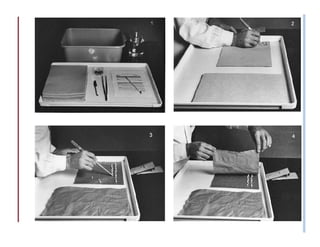
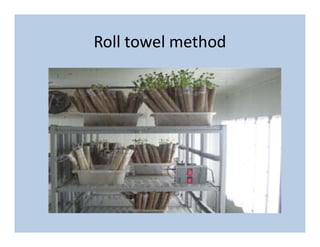
Between Paper (Paper Towel) method
• Seeds are germinated between two layers of
moist paper towels (Fig. 4D.1.2.1-7).
• Cut the paper to a convenient size to hold one
replicate of the seeds (Fig. 4D.1.2.1.1).
• Label the paper on the outside at one end with• Label the paper on the outside at one end with
the accession number, replicate number and the
date of testing (Fig. 4D.1.2.1.2).
• Moisten the paper towels with water.
• Arrange the seeds in rows at regular intervals 4
cm from the top edge, leaving 3–4 cm gap on the
sides (Fig. 4D.1.2.1.3).
Mechanical Scarification
• Scarify (puncture the seed coat with a razor blade or
scalpel without damaging the embryo) the seeds of
Cicer and Cajanus species before sowing.
• Cover the seeds with another sheet of dry paper towel.
• Roll the paper loosely from the label end .
• Put a paper clip to hold the rolled paper towels from
falling apart .
• Put a paper clip to hold the rolled paper towels from
falling apart .
• Keep the rolls in a plastic tray .
• Add sufficient quantity of distilled water (covering the
bottom 3-cm of rolls) to the tray.
• Place the tray in an incubator maintained at
recommended temperature .
Precautions during experiment
• Use proper spacing of seeds — increase the distance
between seeds and use greater number of replicates.
• Provide optimum environment for germination —
temperature regime should be suitable and the test
environment must be well aerated.
• Ensure cleanliness of germination test media and
containers — making sure that these are not sources of
• Ensure cleanliness of germination test media and
containers — making sure that these are not sources of
inoculum.
• Avoid imbibition injury (by prior humidification of the
seeds) that could lead to leakage of cell contents and
provide source of nutrients to fungi.
• Promptly remove decaying seeds to prevent the spread
of fungi to neighboring seeds.
• Remove seed covering structures before tests
when these are found to be sources of
infection.
• Remove sprouted seeds (seeds that
germinated before harvest and subsequently
dried), which can be a source of severedried), which can be a source of severe
infection.
• Treat seed with Thiram (tetramethyl
thioperoxy dicarbonic diamide).
Evaluation of germination tests
• Evaluate the seedlings 7 days after sowing.
• Scarify the hard and ungerminated seeds of chickpea
and pigeonpea and evaluate at 14 days after sowing.
• Classify the seedlings removed during course of
germination test as normal seedlings and abnormal
seedlings.
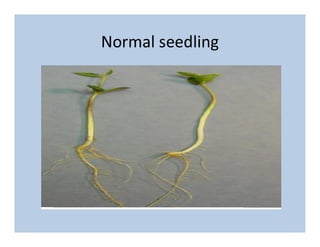
• normal seedlings are capable of developing into
plants given favorable conditions and possess
adequate root and shoot structures,
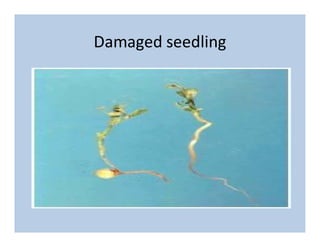
• abnormal seedlings are those incapable of further
development and suffer deficiency, decay or
weakness in their root or shoot system.
Seedlings with the following defects
are classified as abnormal
• Roots
primary root stunted, stubby, missing, broken, split
from the tip, spindly, trapped in the seed coat, with
negative geotropism, glassy, decayed due to primary
infection, and with less than two secondary roots.
• Shoot (hypocotyl, epicotyl and mesocotyl)• Shoot (hypocotyl, epicotyl and mesocotyl)
short and thick, split right through, missing,
constricted, twisted, glassy, and decayed due to
primary infection.
• Terminal bud/leaves
deformed, damaged, missing, and decayed due to
primary infection
Germination tray
Sand method
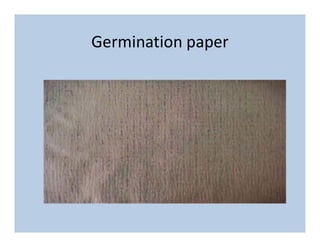
Germination paper
Seeds germinated on paper
Roll towel method
Plant growth chamber
Seed Germinator
Seed counting board
Vaccum seed counter
Impression board
Normal seedling
Features of Normal seedling
• It is of two types
a. Intact seedling.
b. Seedling with slight defects.
1. Features of intact seedlings.
a. Well developed long & slender roota. Well developed long & slender root
with root hairs.
b. Secondary roots with primary roots.
c. Seminal roots instead of one primary
roots in Hordeum ,Avena ,Secale ,Triticum
d. Straight ,slender developed shoot axis
& elongated hypocotyl in hypogeal.
e. Elongated hypocotyl & epicotyl in epigeal
germination.
f. Elongated mesocotyl in certain genera if
Graminae.
g. Green expanding primary leaves.
h. One primary leaves & few scale leaves .
i. Terminal bud with shoot apex.
j. Well developed straight coleoptile inj. Well developed straight coleoptile in
graminae.
2. Seedling with slight defects:
a. Seedlings show slight defects of their
essential structure.
b. Primary root with limited damage or slight
growth retardation.
c. Primary root defective but sufficient
secondary roots.
d. Only two seminal roots in avena etc
mentioned above.
e. Limited damage on hypocotyl,epicotyl or
mesocotyl with limited damage (if half or
more of total tissue area is left functioning
normally (50 % rule).normally (50 % rule).
Abnormal Seedling
Damaged seedling
Decayed seedlings
Hard seeds
FUS (Fresh ungerminated seeds)
Dead seeds
Seed Physical purity & germination tests

Seed Physical purity & germination tests

  • 1.
    Sub.:- Principles ofSeed Technology Course No. :- APB- 5221 Credit hours:- 3(1+2) Lec. Topic:- Purity and Germination tests (Prac.) Presented by:- Indira Gandhi Krishi Vishwavidyalaya Raipur, C.G. Presented by:- Lt. Roshan Parihar, Asstt. Professor (GPB) Deptt. of Genetics & Plant Breeding BTC College of Agriculture & Research Station ,Sarkanda, Bilaspur,(CG)-495001
  • 2.
  • 3.
  • 4.
  • 5.
    Steps of PurityAnalysis 1. Remove debris from seeds by graded sieves , ensuring that small sized seeds in the sample are not discarded. 2. Separate lightweight material and empty glumes by gentle winnowing or using the seed blower. 3. Spread the seeds on a flat well-lit surface of3. Spread the seeds on a flat well-lit surface of contrasting color such as an illuminated table and examine the seeds for any physical damage or infestation with insects and fungi . 4. Discard any visually damaged, shriveled, infected or infested seeds. 5. Destroy any waste material to prevent the spread of the disease or insects to other material.
  • 6.
    Calculations • All thefour components must be weighed to the required number of decimal places. The percentages of the components are determined as follows. Weight of individual component % of components = __________________________ X 100% of components = __________________________ X 100 Total weight of all components s
  • 7.
    Determination of Obj.Weeds, OCS,ISP &ODV Number of seeds found No. of Seeds/Kg = ________________________ X 1000 weight of seeds in grams(WS) Eg. for Argemone mexicana in mustard 15 No. of Seeds/Kg = ________________________ X 1000No. of Seeds/Kg = ________________________ X 1000 16 gm (Working Sample) No. of Seeds/Kg = 938 seeds/ kg of mustard seeds • AS PER IMSCS for Mustard FS & CS obj weed must be 5 and 10 no/kg hence the above lot will be rejected.
  • 8.
  • 9.
    What is Seedgermination ? • Literally germination is the activation of germ tissues (Embryo), its morphogenesis and development into essential structures whichessential structures which led to field emergence of miniature plant population over the stratum.
  • 10.
    Principle of seedgermination • Germination test shall be carried with pure seed fraction. • A mimimum of 400 seeds are required in four replicates of 100 seeds each or 8 replicate of 50seeds each or 8 replicate of 50 seeds or 16 replicates of 25 seeds depending upon the seed and size of container.
  • 11.
    • The testis conducted under favourable conditions of moisture,temperature,suitab le substratum and light if necessary. No pretreatment to the seed is given except necessary. No pretreatment to the seed is given except for those recommendeb by ISTA
  • 12.
    Materials required • Substratum(Medium of moisture) – Sand must pass through 0.80mm seive but retained by 0.05mm seive,washed and autoclaved . – Paper (Filter paper,blotter or towel– Paper (Filter paper,blotter or towel ,kraft paper), has capillary action (30 mm rise per minute) moisture retaine – Soil or artificial compost in limited cases with the recommendation.
  • 13.
    • Germination tray –22.5 x 22.5x 4.0 cm dimension zinc,plastic or steel tray are used . • Method of seed placement. – TS top of sand method where seed are placed with space and covered with 1-2 cm sand layer.with 1-2 cm sand layer. – Spacing must be 1-5 times width of seed. – Water must be 50 % WHC for cereals and 60 % WHC for large legumes and maize.
  • 14.
    – TP Topof paper ,seeds are placed on top of paperon filter paper on petridishes coved with lid and placed on germination cabinet. – BP Between paper method or paper towel method seeds are place between the layers and moistened with water and placedwrapped andwith water and placedwrapped and tied with thread and kept in upright position on the tray on germination cabinet.
  • 17.
    • Germination cabinet –Temp and RH are maintained with biological oxygen supply. • Seed counting board. – Used for seed counting have two plates one basal is fixed and upper is stationary, upper has 50/100 holes.stationary, upper has 50/100 holes. • Vaccum seed counter – It has head ,pipe and wall.head has plates with 50 or 100 holes, when vaccum is created exact seed are taken and place over the substrate.
  • 18.
    • Germination cabinet –Temp and RH are maintained with biological oxygen supply. • Seed counting board. – Used for seed counting have two plates one basal is fixed and upper is stationary, upper has 50/100 holes.stationary, upper has 50/100 holes. • Vaccum seed counter – It has head ,pipe and wall.head has plates with 50 or 100 holes, when vaccum is created exact seed are taken and place over the substrate.
  • 21.
    Sample size • Usea minimum of two replicates each of 50 or 100 seeds for testing initial germination and two replicates each of 25 or 50 seeds for subsequent tests, depending on available seed quantity.tests, depending on available seed quantity. • Take a random sample of seeds from the container. • If the seeds are very dry (moisture content <8%) expose them to ambient atmosphere for 24 h to raise the moisture content before testing for germination.
  • 22.
    • Two methodsare used for testing germination: • A. Top of paper method for millets. • B. Between paper (Rolled towel) method for• B. Between paper (Rolled towel) method for sorghum, chickpea, pigeonpea and groundnut. • Paper towel is used as substrate for germination in both these methods.
  • 23.
    • Quality ofpaper towel • The paper used as substrate should not be toxic to developing seedlings. • It should be able to absorb and supply• It should be able to absorb and supply sufficient moisture to the seeds to germinate. • It should be strong enough not to fall apart when handled and not to be penetrated by the roots of developing seedlings.
  • 24.
    Simple test forpaper quality Presence of toxic substances • Cut the paper to size and place in a 9-cm petri dish. • Moisten the paper with sufficient water. • Test the seeds of sensitive species like Bermuda grass (Cynodon dactylon), if available, or finger millet (Eleucine coracana) for germination on the moistened paper: • Evaluate the root development after 5 days. classic symptoms of paper toxicity are shortened and discolored root tips.are shortened and discolored root tips. Paper strength • Moisten the paper and hold it in the air from one corner. paper should not fall apart. Moisture absorption • Cut the paper into strips about 10 mm wide. • Hold vertically with about 20 mm of the paper immersed in water. • Measure the height above the water level that the moisture has risen to. minimum standard is a 30 mm rise in 2 min.
  • 25.
    Top of papermethod • Seeds are germinated on top of moist paper (Whatman Grade 181) in a petri dish (Fig. • Place the paper in 9-cm petri dishes. • Moisten it with about 4 ml of distilled water. • Put a label in the petri dish with accession number, number of replicate and date of the test. • Spread the seeds at regular distance on the• Spread the seeds at regular distance on the surface of the paper. • Cover the petri dishes and keep them in a plastic bag to prevent drying. • Place the petri dishes in an incubator maintained at the recommended optimum temperature.
  • 26.
    Between Paper (PaperTowel) method • Seeds are germinated between two layers of moist paper towels (Fig. 4D.1.2.1-7). • Cut the paper to a convenient size to hold one replicate of the seeds (Fig. 4D.1.2.1.1). • Label the paper on the outside at one end with• Label the paper on the outside at one end with the accession number, replicate number and the date of testing (Fig. 4D.1.2.1.2). • Moisten the paper towels with water. • Arrange the seeds in rows at regular intervals 4 cm from the top edge, leaving 3–4 cm gap on the sides (Fig. 4D.1.2.1.3).
  • 27.
    Mechanical Scarification • Scarify(puncture the seed coat with a razor blade or scalpel without damaging the embryo) the seeds of Cicer and Cajanus species before sowing. • Cover the seeds with another sheet of dry paper towel. • Roll the paper loosely from the label end . • Put a paper clip to hold the rolled paper towels from falling apart . • Put a paper clip to hold the rolled paper towels from falling apart . • Keep the rolls in a plastic tray . • Add sufficient quantity of distilled water (covering the bottom 3-cm of rolls) to the tray. • Place the tray in an incubator maintained at recommended temperature .
  • 28.
    Precautions during experiment •Use proper spacing of seeds — increase the distance between seeds and use greater number of replicates. • Provide optimum environment for germination — temperature regime should be suitable and the test environment must be well aerated. • Ensure cleanliness of germination test media and containers — making sure that these are not sources of • Ensure cleanliness of germination test media and containers — making sure that these are not sources of inoculum. • Avoid imbibition injury (by prior humidification of the seeds) that could lead to leakage of cell contents and provide source of nutrients to fungi. • Promptly remove decaying seeds to prevent the spread of fungi to neighboring seeds.
  • 29.
    • Remove seedcovering structures before tests when these are found to be sources of infection. • Remove sprouted seeds (seeds that germinated before harvest and subsequently dried), which can be a source of severedried), which can be a source of severe infection. • Treat seed with Thiram (tetramethyl thioperoxy dicarbonic diamide).
  • 30.
    Evaluation of germinationtests • Evaluate the seedlings 7 days after sowing. • Scarify the hard and ungerminated seeds of chickpea and pigeonpea and evaluate at 14 days after sowing. • Classify the seedlings removed during course of germination test as normal seedlings and abnormal seedlings. • normal seedlings are capable of developing into plants given favorable conditions and possess adequate root and shoot structures, • abnormal seedlings are those incapable of further development and suffer deficiency, decay or weakness in their root or shoot system.
  • 31.
    Seedlings with thefollowing defects are classified as abnormal • Roots primary root stunted, stubby, missing, broken, split from the tip, spindly, trapped in the seed coat, with negative geotropism, glassy, decayed due to primary infection, and with less than two secondary roots. • Shoot (hypocotyl, epicotyl and mesocotyl)• Shoot (hypocotyl, epicotyl and mesocotyl) short and thick, split right through, missing, constricted, twisted, glassy, and decayed due to primary infection. • Terminal bud/leaves deformed, damaged, missing, and decayed due to primary infection
  • 32.
  • 33.
  • 34.
  • 35.
  • 36.
  • 37.
  • 38.
  • 39.
  • 40.
  • 41.
  • 42.
  • 44.
    Features of Normalseedling • It is of two types a. Intact seedling. b. Seedling with slight defects. 1. Features of intact seedlings. a. Well developed long & slender roota. Well developed long & slender root with root hairs. b. Secondary roots with primary roots. c. Seminal roots instead of one primary roots in Hordeum ,Avena ,Secale ,Triticum d. Straight ,slender developed shoot axis & elongated hypocotyl in hypogeal.
  • 45.
    e. Elongated hypocotyl& epicotyl in epigeal germination. f. Elongated mesocotyl in certain genera if Graminae. g. Green expanding primary leaves. h. One primary leaves & few scale leaves . i. Terminal bud with shoot apex. j. Well developed straight coleoptile inj. Well developed straight coleoptile in graminae. 2. Seedling with slight defects: a. Seedlings show slight defects of their essential structure. b. Primary root with limited damage or slight growth retardation.
  • 46.
    c. Primary rootdefective but sufficient secondary roots. d. Only two seminal roots in avena etc mentioned above. e. Limited damage on hypocotyl,epicotyl or mesocotyl with limited damage (if half or more of total tissue area is left functioning normally (50 % rule).normally (50 % rule).
  • 47.
  • 49.
  • 50.
  • 51.
  • 52.
  • 53.