‘Training and Pruning of Fruit Trees’
Dr. Sunil Prajapati
Assistant Professor (Horticulture)
Declaration: All the compiled content taken from various e-sources for teaching purpose not for
publication or any other commercial uses.
o Horticultural plants are grown for their produce like fruits,
vegetable, flowers, medicinal components, spices, aromatic etc.
o Therefore, these plants should be managed in such a way that
human desires for the purpose of growing them are fully satisfied
in terms of quality and quantity of produce.
o This demands direct manipulation of plant growth itself or plant
environment through various inputs.
o In manipulation of plant development, training and pruning are
important.
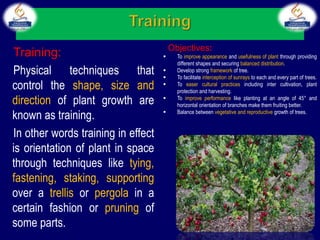
Training:
Physical techniques that
control the shape, size and
direction of plant growth are
known as training.
In other words training in effect
is orientation of plant in space
through techniques like tying,
fastening, staking, supporting
over a trellis or pergola in a
certain fashion or pruning of
some parts.
Objectives:
 To improve appearance and usefulness of plant through providing
different shapes and securing balanced distribution.
 Develop strong framework of tree.
 To facilitate interception of sunrays to each and every part of trees.
 To easer cultural practices including inter cultivation, plant
protection and harvesting.
 To improve performance like planting at an angle of 45° and
horizontal orientation of branches make them fruiting better.
 Balance between vegetative and reproductive growth of trees.
Principles of Training:
• Training should be started vey begging age of plant.
• Prefer single stem system/multi-stemmed training system.
• The terminal bud should be removed to facilitate emergence
of side shoots.
• Water sprout should be removed.
• The shoots having narrower crotch angle are discarded.
• Dropping branch must be need to removed.
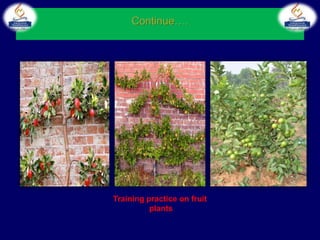
Training practice on fruit
plants
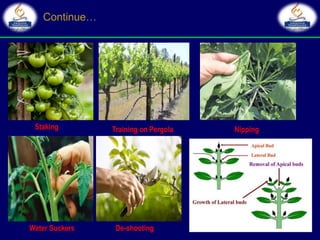
Staking Training on Pergola Nipping
Water Suckers De-shooting
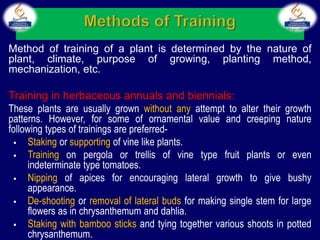
Method of training of a plant is determined by the nature of
plant, climate, purpose of growing, planting method,
mechanization, etc.
Training in herbaceous annuals and biennials:
These plants are usually grown without any attempt to alter their growth
patterns. However, for some of ornamental value and creeping nature
following types of trainings are preferred-
 Staking or supporting of vine like plants.
 Training on pergola or trellis of vine type fruit plants or even
indeterminate type tomatoes.
 Nipping of apices for encouraging lateral growth to give bushy
appearance.
 De-shooting or removal of lateral buds for making single stem for large
flowers as in chrysanthemum and dahlia.
 Staking with bamboo sticks and tying together various shoots in potted
chrysanthemum.
Training of woody perennials trees:
The woody perennials, which are widely spaced and remain on a
place for a long duration, are trained for develop strong
framework for sustainable production of quality produce and for
ornamental beauty in different shapes (topiary).
In these plants following types of training are followed as-
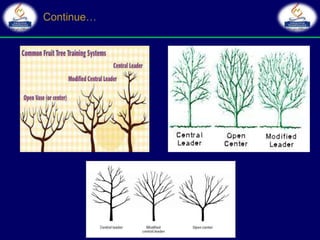
1) Open centre system
2) Central leader system
3) Modified leader system
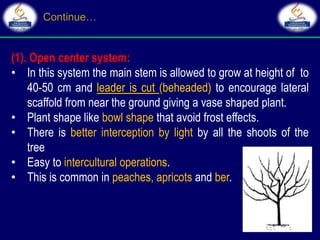
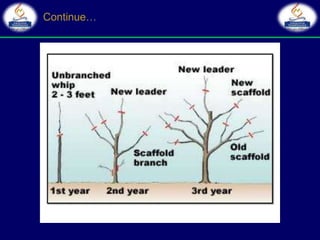
(1). Open center system:
• In this system the main stem is allowed to grow at height of to
40-50 cm and leader is cut (beheaded) to encourage lateral
scaffold from near the ground giving a vase shaped plant.
• Plant shape like bowl shape that avoid frost effects.
• There is better interception by light by all the shoots of the
tree
• Easy to intercultural operations.
• This is common in peaches, apricots and ber.
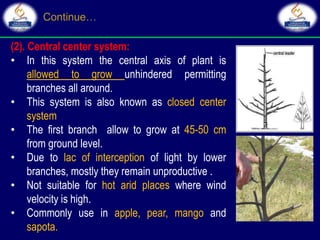
(2). Central center system:
• In this system the central axis of plant is
allowed to grow unhindered permitting
branches all around.
• This system is also known as closed center
system
• The first branch allow to grow at 45-50 cm
from ground level.
• Due to lac of interception of light by lower
branches, mostly they remain unproductive .
• Not suitable for hot arid places where wind
velocity is high.
• Commonly use in apple, pear, mango and
sapota.
(3). Modified center system:
• This system is in between open center and central leader system
wherein central axis is allowed to grow unhindered up to 4-5 years and
then the central stem is headed back and laterals are permitted 4-5
branches located at a distance between 15-20 cm all around the main
stem.
• The plant trained through this system, attain the moderate height.
• This system facilitates essay carrying out of orchard operations.
• It is common in apple, pear, cherry, plum, guava.
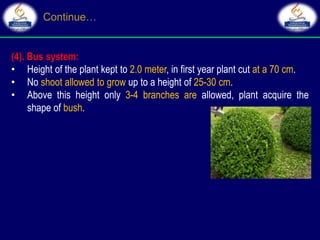
(4). Bus system:
• Height of the plant kept to 2.0 meter, in first year plant cut at a 70 cm.
• No shoot allowed to grow up to a height of 25-30 cm.
• Above this height only 3-4 branches are allowed, plant acquire the
shape of bush.
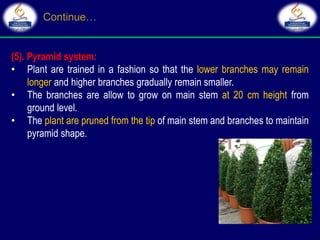
(5). Pyramid system:
• Plant are trained in a fashion so that the lower branches may remain
longer and higher branches gradually remain smaller.
• The branches are allow to grow on main stem at 20 cm height from
ground level.
• The plant are pruned from the tip of main stem and branches to maintain
pyramid shape.
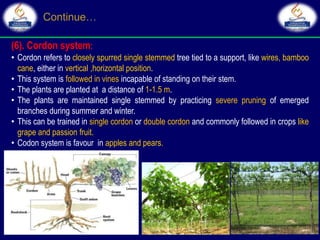
(6). Cordon system:
• Cordon refers to closely spurred single stemmed tree tied to a support, like wires, bamboo
cane, either in vertical ,horizontal position.
• This system is followed in vines incapable of standing on their stem.
• The plants are planted at a distance of 1-1.5 m.
• The plants are maintained single stemmed by practicing severe pruning of emerged
branches during summer and winter.
• This can be trained in single cordon or double cordon and commonly followed in crops like
grape and passion fruit.
• Codon system is favour in apples and pears.
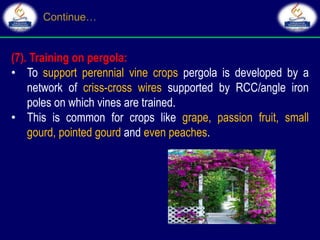
(7). Training on pergola:
• To support perennial vine crops pergola is developed by a
network of criss-cross wires supported by RCC/angle iron
poles on which vines are trained.
• This is common for crops like grape, passion fruit, small
gourd, pointed gourd and even peaches.
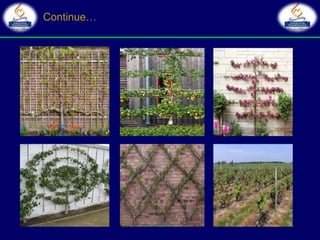
(6). Training in different shapes:
• Generally ornamental bushes are trained in different shapes
for the purpose of enhancing beauty of places.
• These shapes could be vase, cone, cylindrical and
rectangular box, flat and trapezoid.
• Presently for the convenience of mechanization these shapes
are being utilized in fruit trees. Such shapes are given to
adjust the geometry of plantation like hedge row system, box,
unclipped natural in fruits like guava, mango, sapota and
citrus.
(6). Training in different shapes:
• Generally ornamental bushes are trained in different shapes
for the purpose of enhancing beauty of places.
• These shapes could be vase, cone, cylindrical and
rectangular box, flat and trapezoid.
• Presently for the convenience of mechanization these shapes
are being utilized in fruit trees. Such shapes are given to
adjust the geometry of plantation like hedge row system, box,
unclipped natural in fruits like guava, mango, sapota and
citrus.
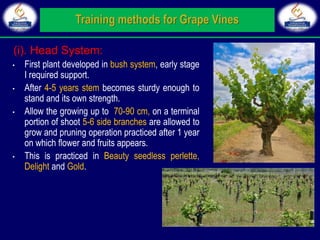
(i). Head System:
• First plant developed in bush system, early stage
I required support.
• After 4-5 years stem becomes sturdy enough to
stand and its own strength.
• Allow the growing up to 70-90 cm, on a terminal
portion of shoot 5-6 side branches are allowed to
grow and pruning operation practiced after 1 year
on which flower and fruits appears.
• This is practiced in Beauty seedless perlette,
Delight and Gold.
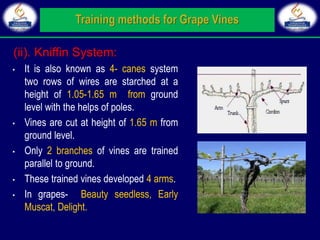
(ii). Kniffin System:
• It is also known as 4- canes system
two rows of wires are starched at a
height of 1.05-1.65 m from ground
level with the helps of poles.
• Vines are cut at height of 1.65 m from
ground level.
• Only 2 branches of vines are trained
parallel to ground.
• These trained vines developed 4 arms.
• In grapes- Beauty seedless, Early
Muscat, Delight.
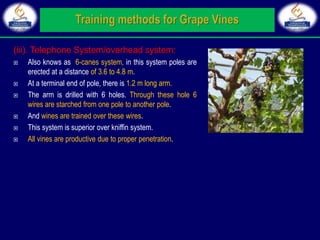
(iii). Telephone System/overhead system:
 Also knows as 6-canes system, in this system poles are
erected at a distance of 3.6 to 4.8 m.
 At a terminal end of pole, there is 1.2 m long arm.
 The arm is drilled with 6 holes. Through these hole 6
wires are starched from one pole to another pole.
 And wines are trained over these wires.
 This system is superior over kniffin system.
 All vines are productive due to proper penetration.
(iv). Bower system:
 This system is very suitable for vigorous cultivar of grape.
 the vines are trained on criss-cross network of wires.
 To create network of wires, poles are fixed at a distance
of 4.5-6.0 m. the pole height are 2.1-2.4 m from ground
level.
 Angles iron are fixed through poles to develop roof like
structure. At a distance of 60 cm , holes are drilled in
angle iron.
Pruning:
“It refers to removal of plant part
like bud, shoot, root etc. to strike
a balance between vegetative
growth and production. This may
also be done to adjust fruit load
on the tree.”
‘‘Judicious removal of plant part to
obtain better and qualitative yield
is termed as pruning’’.
Pruning is started in later part of
plant life. When its become
capable to produce flower and
fruits.
Objectives:
• To control plant size and shape.
• Establishment of transplant where
leaves/shoots are pruned to strike a
balance between root and shoot.
• Improvement in productivity and quality by
regulating the load of the crop and extent of
flowering.
• Pruning practice for flower and fruit quality.
• Elimination of non-productive vegetative
growth like water sprouts, suckers, dead
and diseased wood.
• In case of forest trees production of knot
free timber.
 Remove water sprouts from plants.
 To thinning out excess flowers and fruits from plants.
 To remove diseased, damaged, insect infested and weak
shoots.
 To ensure access to sunlight to fruit bearing shoots.
 To have a balance between vegetative and reproductive
growths.
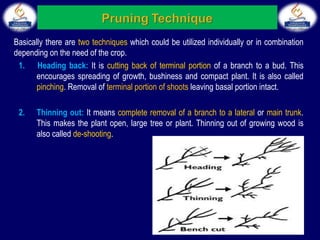
Basically there are two techniques which could be utilized individually or in combination
depending on the need of the crop.
1. Heading back: It is cutting back of terminal portion of a branch to a bud. This
encourages spreading of growth, bushiness and compact plant. It is also called
pinching. Removal of terminal portion of shoots leaving basal portion intact.
2. Thinning out: It means complete removal of a branch to a lateral or main trunk.
This makes the plant open, large tree or plant. Thinning out of growing wood is
also called de-shooting.
3. Ringing/ Girdling:
• A circular ring of bark about 3 cm length is removed.
• It hasten the flowering and fruiting by allowing greater accumulation of
photosynthesis in upward portion of the plant.
4. Notching:
• Making a notch above a bud by removing a wedge shape piece of bark.
• It check the influence of hormone and encourage growth.
5. Nicking:
• Making a notch below a bud by removing a wedge shape piece of bark.
• It ensures the accumulation of carbohydrates from the leaves to bud and
may results in the formation of fruit bud.
 Use good and sharp equipment.
 Cut should be small, smooth and slanting so that water
does not accumulate on cut end.
 Large wounds should be treated with antifungal
chemicals like Bordeaux paste.
 Shoots from rootstock should be removed regularly.
 Removal of deadwood, parasites, ferns, climbing vines.
 Nests of bees, wasps, ants, termites should also
become part of pruning.
In some of the tree species pruning as a regular feature in bearing trees is
done to strike a balance between vegetative growth and production so that
farmers get sustained production uniformly with optimum quality of produce.
To achieve this one should consider the following factors-
(i) Time at which buds are differentiated in relation to blooming.
(ii) The age of the wood that produces the most abundant and highest quality
of fruit buds.
In consideration of these factors our knowledge about bearing habit of the
tree/plant should be complete. Bearing habit means relative
position of a fruit with reference to its potential bud giving rise to flower or
inflorescence in the shoot. This habit varies from plant to plant.
Generally pruning should be done in such a time that physiology of plant is
disturbed to the minimum and it should not interfere with the principal function of
the plant. Thus,
I. Fruit trees are pruned for fruiting when dormant i.e. late winter in case of
temperate fruits and soon after harvest in evergreen if required. Some times
the trees are subjected to stress to induce dormancy before pruning as in
bahar treatment.
II. Pruning for structural adjustment is done when plant is making growth i.e.
summer pruning.
Generally pruning is regularly done in temperate fruit crops like apple, pear,
peach, plum, cherry, walnut, apricot, grape and sub-tropical crops like
pomegranate, lemon, ber, guava.
Evergreens like mango, sapota and litchi are rarely pruned except thinning of
branches to avoid overcrowding and removal of deadwood. However, now this
concept is under change.
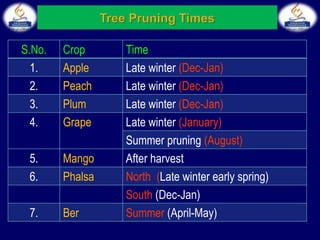
S.No. Crop Time
1. Apple Late winter (Dec-Jan)
2. Peach Late winter (Dec-Jan)
3. Plum Late winter (Dec-Jan)
4. Grape Late winter (January)
Summer pruning (August)
5. Mango After harvest
6. Phalsa North (Late winter early spring)
South (Dec-Jan)
7. Ber Summer (April-May)
Courtesy : SFRI Jabalpur
Training and Pruning  of Fruit Crops

Training and Pruning of Fruit Crops

  • 1.
    ‘Training and Pruningof Fruit Trees’ Dr. Sunil Prajapati Assistant Professor (Horticulture) Declaration: All the compiled content taken from various e-sources for teaching purpose not for publication or any other commercial uses.
  • 2.
    o Horticultural plantsare grown for their produce like fruits, vegetable, flowers, medicinal components, spices, aromatic etc. o Therefore, these plants should be managed in such a way that human desires for the purpose of growing them are fully satisfied in terms of quality and quantity of produce. o This demands direct manipulation of plant growth itself or plant environment through various inputs. o In manipulation of plant development, training and pruning are important.
  • 3.
    Training: Physical techniques that controlthe shape, size and direction of plant growth are known as training. In other words training in effect is orientation of plant in space through techniques like tying, fastening, staking, supporting over a trellis or pergola in a certain fashion or pruning of some parts. Objectives:  To improve appearance and usefulness of plant through providing different shapes and securing balanced distribution.  Develop strong framework of tree.  To facilitate interception of sunrays to each and every part of trees.  To easer cultural practices including inter cultivation, plant protection and harvesting.  To improve performance like planting at an angle of 45° and horizontal orientation of branches make them fruiting better.  Balance between vegetative and reproductive growth of trees.
  • 4.
    Principles of Training: •Training should be started vey begging age of plant. • Prefer single stem system/multi-stemmed training system. • The terminal bud should be removed to facilitate emergence of side shoots. • Water sprout should be removed. • The shoots having narrower crotch angle are discarded. • Dropping branch must be need to removed.
  • 5.
  • 6.
    Staking Training onPergola Nipping Water Suckers De-shooting
  • 7.
    Method of trainingof a plant is determined by the nature of plant, climate, purpose of growing, planting method, mechanization, etc. Training in herbaceous annuals and biennials: These plants are usually grown without any attempt to alter their growth patterns. However, for some of ornamental value and creeping nature following types of trainings are preferred-  Staking or supporting of vine like plants.  Training on pergola or trellis of vine type fruit plants or even indeterminate type tomatoes.  Nipping of apices for encouraging lateral growth to give bushy appearance.  De-shooting or removal of lateral buds for making single stem for large flowers as in chrysanthemum and dahlia.  Staking with bamboo sticks and tying together various shoots in potted chrysanthemum.
  • 8.
    Training of woodyperennials trees: The woody perennials, which are widely spaced and remain on a place for a long duration, are trained for develop strong framework for sustainable production of quality produce and for ornamental beauty in different shapes (topiary). In these plants following types of training are followed as- 1) Open centre system 2) Central leader system 3) Modified leader system
  • 10.
    (1). Open centersystem: • In this system the main stem is allowed to grow at height of to 40-50 cm and leader is cut (beheaded) to encourage lateral scaffold from near the ground giving a vase shaped plant. • Plant shape like bowl shape that avoid frost effects. • There is better interception by light by all the shoots of the tree • Easy to intercultural operations. • This is common in peaches, apricots and ber.
  • 12.
    (2). Central centersystem: • In this system the central axis of plant is allowed to grow unhindered permitting branches all around. • This system is also known as closed center system • The first branch allow to grow at 45-50 cm from ground level. • Due to lac of interception of light by lower branches, mostly they remain unproductive . • Not suitable for hot arid places where wind velocity is high. • Commonly use in apple, pear, mango and sapota.
  • 13.
    (3). Modified centersystem: • This system is in between open center and central leader system wherein central axis is allowed to grow unhindered up to 4-5 years and then the central stem is headed back and laterals are permitted 4-5 branches located at a distance between 15-20 cm all around the main stem. • The plant trained through this system, attain the moderate height. • This system facilitates essay carrying out of orchard operations. • It is common in apple, pear, cherry, plum, guava.
  • 14.
    (4). Bus system: •Height of the plant kept to 2.0 meter, in first year plant cut at a 70 cm. • No shoot allowed to grow up to a height of 25-30 cm. • Above this height only 3-4 branches are allowed, plant acquire the shape of bush.
  • 15.
    (5). Pyramid system: •Plant are trained in a fashion so that the lower branches may remain longer and higher branches gradually remain smaller. • The branches are allow to grow on main stem at 20 cm height from ground level. • The plant are pruned from the tip of main stem and branches to maintain pyramid shape.
  • 16.
    (6). Cordon system: •Cordon refers to closely spurred single stemmed tree tied to a support, like wires, bamboo cane, either in vertical ,horizontal position. • This system is followed in vines incapable of standing on their stem. • The plants are planted at a distance of 1-1.5 m. • The plants are maintained single stemmed by practicing severe pruning of emerged branches during summer and winter. • This can be trained in single cordon or double cordon and commonly followed in crops like grape and passion fruit. • Codon system is favour in apples and pears.
  • 17.
    (7). Training onpergola: • To support perennial vine crops pergola is developed by a network of criss-cross wires supported by RCC/angle iron poles on which vines are trained. • This is common for crops like grape, passion fruit, small gourd, pointed gourd and even peaches.
  • 18.
    (6). Training indifferent shapes: • Generally ornamental bushes are trained in different shapes for the purpose of enhancing beauty of places. • These shapes could be vase, cone, cylindrical and rectangular box, flat and trapezoid. • Presently for the convenience of mechanization these shapes are being utilized in fruit trees. Such shapes are given to adjust the geometry of plantation like hedge row system, box, unclipped natural in fruits like guava, mango, sapota and citrus.
  • 19.
    (6). Training indifferent shapes: • Generally ornamental bushes are trained in different shapes for the purpose of enhancing beauty of places. • These shapes could be vase, cone, cylindrical and rectangular box, flat and trapezoid. • Presently for the convenience of mechanization these shapes are being utilized in fruit trees. Such shapes are given to adjust the geometry of plantation like hedge row system, box, unclipped natural in fruits like guava, mango, sapota and citrus.
  • 21.
    (i). Head System: •First plant developed in bush system, early stage I required support. • After 4-5 years stem becomes sturdy enough to stand and its own strength. • Allow the growing up to 70-90 cm, on a terminal portion of shoot 5-6 side branches are allowed to grow and pruning operation practiced after 1 year on which flower and fruits appears. • This is practiced in Beauty seedless perlette, Delight and Gold.
  • 22.
    (ii). Kniffin System: •It is also known as 4- canes system two rows of wires are starched at a height of 1.05-1.65 m from ground level with the helps of poles. • Vines are cut at height of 1.65 m from ground level. • Only 2 branches of vines are trained parallel to ground. • These trained vines developed 4 arms. • In grapes- Beauty seedless, Early Muscat, Delight.
  • 23.
    (iii). Telephone System/overheadsystem:  Also knows as 6-canes system, in this system poles are erected at a distance of 3.6 to 4.8 m.  At a terminal end of pole, there is 1.2 m long arm.  The arm is drilled with 6 holes. Through these hole 6 wires are starched from one pole to another pole.  And wines are trained over these wires.  This system is superior over kniffin system.  All vines are productive due to proper penetration.
  • 24.
    (iv). Bower system: This system is very suitable for vigorous cultivar of grape.  the vines are trained on criss-cross network of wires.  To create network of wires, poles are fixed at a distance of 4.5-6.0 m. the pole height are 2.1-2.4 m from ground level.  Angles iron are fixed through poles to develop roof like structure. At a distance of 60 cm , holes are drilled in angle iron.
  • 25.
    Pruning: “It refers toremoval of plant part like bud, shoot, root etc. to strike a balance between vegetative growth and production. This may also be done to adjust fruit load on the tree.” ‘‘Judicious removal of plant part to obtain better and qualitative yield is termed as pruning’’. Pruning is started in later part of plant life. When its become capable to produce flower and fruits. Objectives: • To control plant size and shape. • Establishment of transplant where leaves/shoots are pruned to strike a balance between root and shoot. • Improvement in productivity and quality by regulating the load of the crop and extent of flowering. • Pruning practice for flower and fruit quality. • Elimination of non-productive vegetative growth like water sprouts, suckers, dead and diseased wood. • In case of forest trees production of knot free timber.
  • 26.
     Remove watersprouts from plants.  To thinning out excess flowers and fruits from plants.  To remove diseased, damaged, insect infested and weak shoots.  To ensure access to sunlight to fruit bearing shoots.  To have a balance between vegetative and reproductive growths.
  • 28.
    Basically there aretwo techniques which could be utilized individually or in combination depending on the need of the crop. 1. Heading back: It is cutting back of terminal portion of a branch to a bud. This encourages spreading of growth, bushiness and compact plant. It is also called pinching. Removal of terminal portion of shoots leaving basal portion intact. 2. Thinning out: It means complete removal of a branch to a lateral or main trunk. This makes the plant open, large tree or plant. Thinning out of growing wood is also called de-shooting.
  • 29.
    3. Ringing/ Girdling: •A circular ring of bark about 3 cm length is removed. • It hasten the flowering and fruiting by allowing greater accumulation of photosynthesis in upward portion of the plant. 4. Notching: • Making a notch above a bud by removing a wedge shape piece of bark. • It check the influence of hormone and encourage growth. 5. Nicking: • Making a notch below a bud by removing a wedge shape piece of bark. • It ensures the accumulation of carbohydrates from the leaves to bud and may results in the formation of fruit bud.
  • 30.
     Use goodand sharp equipment.  Cut should be small, smooth and slanting so that water does not accumulate on cut end.  Large wounds should be treated with antifungal chemicals like Bordeaux paste.  Shoots from rootstock should be removed regularly.  Removal of deadwood, parasites, ferns, climbing vines.  Nests of bees, wasps, ants, termites should also become part of pruning.
  • 31.
    In some ofthe tree species pruning as a regular feature in bearing trees is done to strike a balance between vegetative growth and production so that farmers get sustained production uniformly with optimum quality of produce. To achieve this one should consider the following factors- (i) Time at which buds are differentiated in relation to blooming. (ii) The age of the wood that produces the most abundant and highest quality of fruit buds. In consideration of these factors our knowledge about bearing habit of the tree/plant should be complete. Bearing habit means relative position of a fruit with reference to its potential bud giving rise to flower or inflorescence in the shoot. This habit varies from plant to plant.
  • 32.
    Generally pruning shouldbe done in such a time that physiology of plant is disturbed to the minimum and it should not interfere with the principal function of the plant. Thus, I. Fruit trees are pruned for fruiting when dormant i.e. late winter in case of temperate fruits and soon after harvest in evergreen if required. Some times the trees are subjected to stress to induce dormancy before pruning as in bahar treatment. II. Pruning for structural adjustment is done when plant is making growth i.e. summer pruning. Generally pruning is regularly done in temperate fruit crops like apple, pear, peach, plum, cherry, walnut, apricot, grape and sub-tropical crops like pomegranate, lemon, ber, guava. Evergreens like mango, sapota and litchi are rarely pruned except thinning of branches to avoid overcrowding and removal of deadwood. However, now this concept is under change.

  • 33.
    S.No. Crop Time 1.Apple Late winter (Dec-Jan) 2. Peach Late winter (Dec-Jan) 3. Plum Late winter (Dec-Jan) 4. Grape Late winter (January) Summer pruning (August) 5. Mango After harvest 6. Phalsa North (Late winter early spring) South (Dec-Jan) 7. Ber Summer (April-May)
  • 35.