Production Technology of Potato in Afganistan
1
Amirullah mokhles
A-2015-30-073
DEPARTMENT OF VEGETABLE SCIENCE
CSKHPKV, Palampur (H.P.) 176062
 Potato Solanum tuberosum L an important food crop
of the word is also a very popular vegetable crop.
 And potato is fourth major food crop after rice, wheat
and maize in the world.
 Potato is a native of tropical south America.
The agro-climatic conditions of Afghanistan are
ideally suitable for good quality potato production.
 Production is concentrated in nine provinces:
Bamyan, Nangarhar Panjsher, Parwan, Samangan,
Sarepul, Takhar, Uruzgan and Wardak, although more
than 70 percent of production comes from Bamyan
province alone.
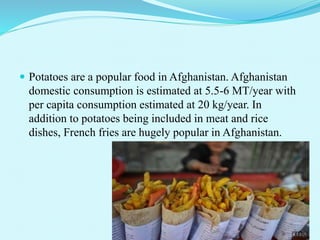
 Potatoes are a popular food in Afghanistan. Afghanistan
domestic consumption is estimated at 5.5-6 MT/year with
per capita consumption estimated at 20 kg/year. In
addition to potatoes being included in meat and rice
dishes, French fries are hugely popular in Afghanistan.
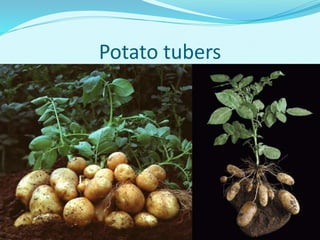
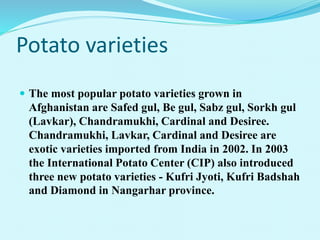
Potato tubers
Potato varieties
 The most popular potato varieties grown in
Afghanistan are Safed gul, Be gul, Sabz gul, Sorkh gul
(Lavkar), Chandramukhi, Cardinal and Desiree.
Chandramukhi, Lavkar, Cardinal and Desiree are
exotic varieties imported from India in 2002. In 2003
the International Potato Center (CIP) also introduced
three new potato varieties - Kufri Jyoti, Kufri Badshah
and Diamond in Nangarhar province.
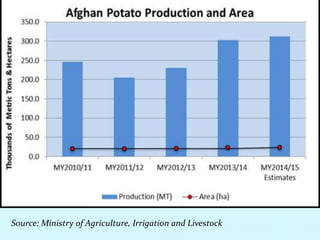
Production and productivity
Area for potato cultivation in
Afghanistan is estimated at nearly
23,500 ha with an average yield of
13.5 MT/ha in MY 2014/15. Bamyan
and Nangarhar provinces typically
have the highest yield at
approximately 20-22 MT/ha.
Source: Ministry of Agriculture, Irrigation and Livestock
Climate
 Potatoes are mostly grown during spring in high mountain
valleys and during fall in the plains on irrigated lands.
 Seed potatoes are obtained from the spring mountain
potatoes and retained for both the fall planting and the
following spring
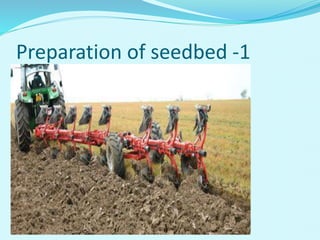
Preparation of seedbed -1
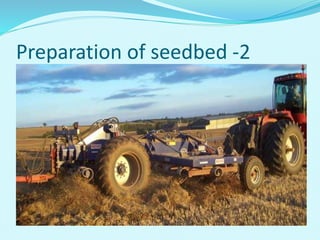
Preparation of seedbed -2
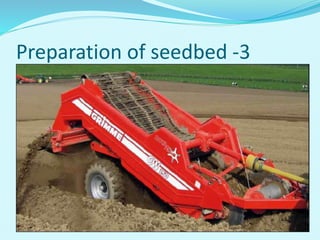
Preparation of seedbed -3
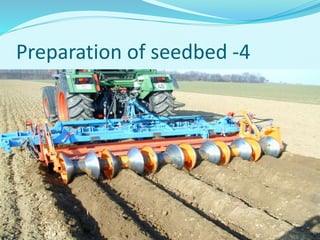
Preparation of seedbed -4
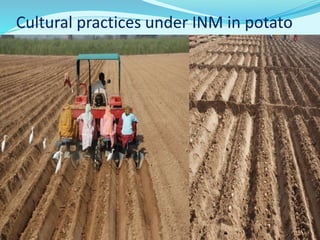
Cultural practices under INM in potato
Soil
 Light soils, like loam and sandy loam rich in organic
matter and friable are ideal for growing potatoes.
 Heavy clay soil is not suitable for cultivation of potatoes.
 The ideal soil PH for potato is 5.5-7.5 .
Planting
 Potato is grown vegetatively from tubers.
 The seed planting in to two characters
 In surface land
 In hills
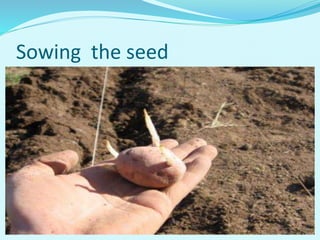
 The seed tubers are cut about 7 to 10 days before planting
and treat with fungicides by dipping them for 10 minutes
in 0.2% solution of Mancozeb and spread at a cool place
for suberization of cut surfaces to prevent rotting.
Sowing the seed
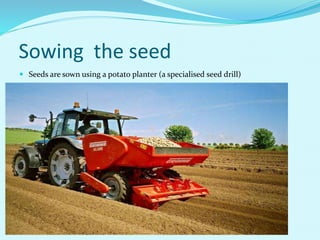
 Seeds are sown using a potato planter (a specialised seed drill)
Sowing the seed
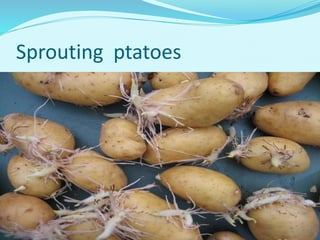
Sprouting ptatoes
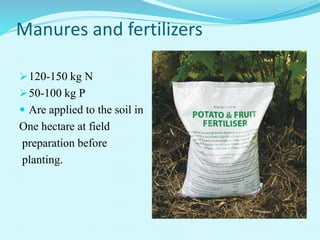
Manures and fertilizers
120-150 kg N
50-100 kg P
 Are applied to the soil in
One hectare at field
preparation before
planting.
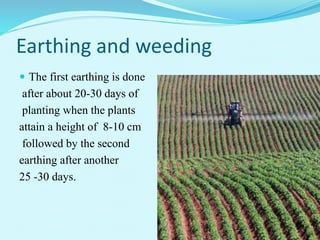
Earthing and weeding
 The first earthing is done
after about 20-30 days of
planting when the plants
attain a height of 8-10 cm
followed by the second
earthing after another
25 -30 days.
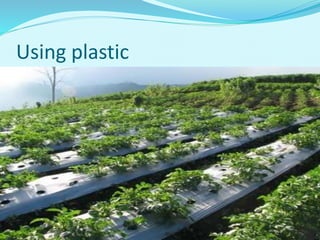
Using plastic
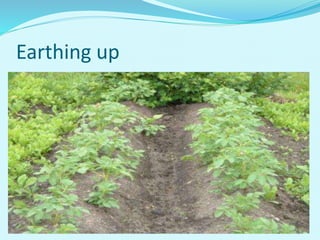
Earthing up
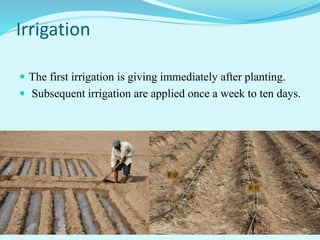
Irrigation
 The first irrigation is giving immediately after planting.
 Subsequent irrigation are applied once a week to ten days.
Harvesting
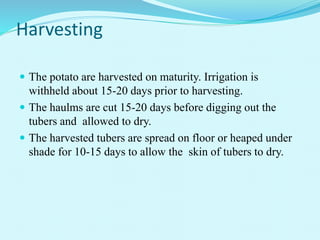
 The potato are harvested on maturity. Irrigation is
withheld about 15-20 days prior to harvesting.
 The haulms are cut 15-20 days before digging out the
tubers and allowed to dry.
 The harvested tubers are spread on floor or heaped under
shade for 10-15 days to allow the skin of tubers to dry.
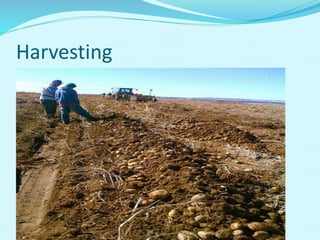
Harvesting
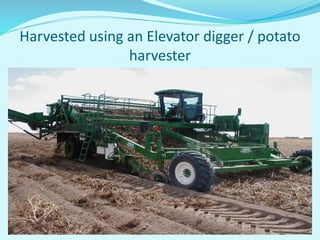
Harvested using an Elevator digger / potato
harvester
Yield
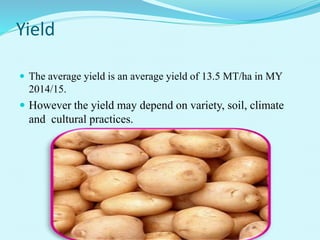
 The average yield is an average yield of 13.5 MT/ha in MY
2014/15.
 However the yield may depend on variety, soil, climate
and cultural practices.
Storage
 Seed potatoes are stored primarily in hand-dug
underground storage areas. There is little to no
refrigerated storage in the country. However, in recent
years the international community has provided
training in proper seed production and storage
techniques, and some private companies have
established seed storages in Afghanistan.
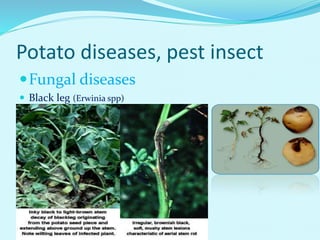
Potato diseases, pest insect
Fungal diseases
 Black leg (Erwinia spp)
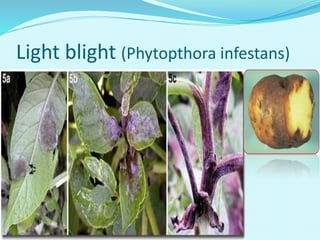
Light blight (Phytopthora infestans)
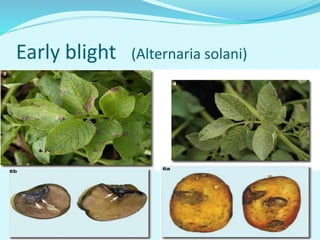
Early blight (Alternaria solani)
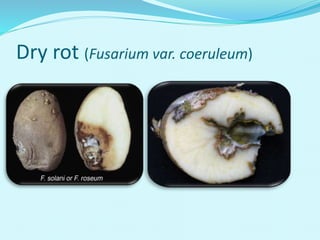
Dry rot (Fusarium var. coeruleum)
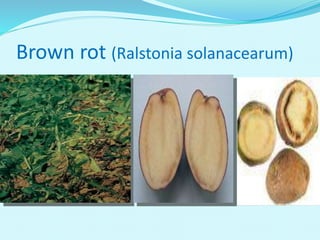
Brown rot (Ralstonia solanacearum)
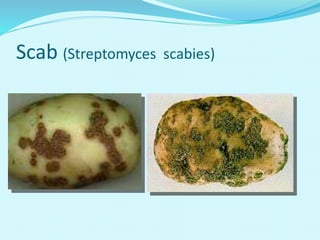
Scab (Streptomyces scabies)
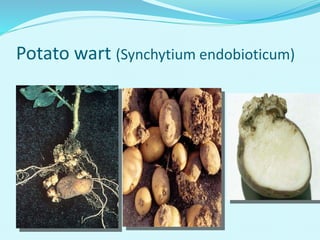
Potato wart (Synchytium endobioticum)
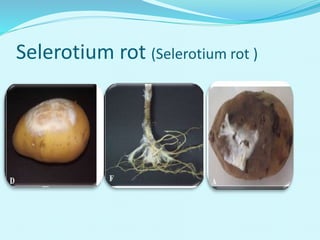
Selerotium rot (Selerotium rot )
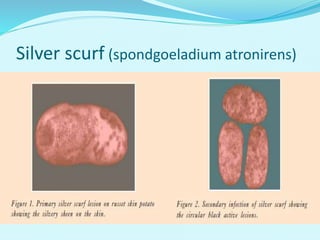
Silver scurf (spondgoeladium atronirens)
Bacterial diseases
 Bacterial wilt
 Common scab
Viral diseases
• potato mosaic
Pest insect
 Aphid  jassid
 Hadda beetle
 Potato tuber moth
 White grub
 Cut worms
 Root knot nematode
Thanks

Potato assignment

  • 1.
    Production Technology ofPotato in Afganistan 1 Amirullah mokhles A-2015-30-073 DEPARTMENT OF VEGETABLE SCIENCE CSKHPKV, Palampur (H.P.) 176062
  • 2.
     Potato Solanumtuberosum L an important food crop of the word is also a very popular vegetable crop.  And potato is fourth major food crop after rice, wheat and maize in the world.  Potato is a native of tropical south America. The agro-climatic conditions of Afghanistan are ideally suitable for good quality potato production.  Production is concentrated in nine provinces: Bamyan, Nangarhar Panjsher, Parwan, Samangan, Sarepul, Takhar, Uruzgan and Wardak, although more than 70 percent of production comes from Bamyan province alone.
  • 3.
     Potatoes area popular food in Afghanistan. Afghanistan domestic consumption is estimated at 5.5-6 MT/year with per capita consumption estimated at 20 kg/year. In addition to potatoes being included in meat and rice dishes, French fries are hugely popular in Afghanistan.
  • 4.
  • 5.
    Potato varieties  Themost popular potato varieties grown in Afghanistan are Safed gul, Be gul, Sabz gul, Sorkh gul (Lavkar), Chandramukhi, Cardinal and Desiree. Chandramukhi, Lavkar, Cardinal and Desiree are exotic varieties imported from India in 2002. In 2003 the International Potato Center (CIP) also introduced three new potato varieties - Kufri Jyoti, Kufri Badshah and Diamond in Nangarhar province.
  • 6.
    Production and productivity Areafor potato cultivation in Afghanistan is estimated at nearly 23,500 ha with an average yield of 13.5 MT/ha in MY 2014/15. Bamyan and Nangarhar provinces typically have the highest yield at approximately 20-22 MT/ha.
  • 7.
    Source: Ministry ofAgriculture, Irrigation and Livestock
  • 8.
    Climate  Potatoes aremostly grown during spring in high mountain valleys and during fall in the plains on irrigated lands.  Seed potatoes are obtained from the spring mountain potatoes and retained for both the fall planting and the following spring
  • 9.
  • 10.
  • 11.
  • 12.
  • 13.
  • 14.
    Soil  Light soils,like loam and sandy loam rich in organic matter and friable are ideal for growing potatoes.  Heavy clay soil is not suitable for cultivation of potatoes.  The ideal soil PH for potato is 5.5-7.5 .
  • 15.
    Planting  Potato isgrown vegetatively from tubers.  The seed planting in to two characters  In surface land  In hills  The seed tubers are cut about 7 to 10 days before planting and treat with fungicides by dipping them for 10 minutes in 0.2% solution of Mancozeb and spread at a cool place for suberization of cut surfaces to prevent rotting.
  • 16.
    Sowing the seed Seeds are sown using a potato planter (a specialised seed drill)
  • 17.
  • 18.
  • 19.
    Manures and fertilizers 120-150kg N 50-100 kg P  Are applied to the soil in One hectare at field preparation before planting.
  • 20.
    Earthing and weeding The first earthing is done after about 20-30 days of planting when the plants attain a height of 8-10 cm followed by the second earthing after another 25 -30 days.
  • 21.
  • 22.
  • 23.
    Irrigation  The firstirrigation is giving immediately after planting.  Subsequent irrigation are applied once a week to ten days.
  • 24.
    Harvesting  The potatoare harvested on maturity. Irrigation is withheld about 15-20 days prior to harvesting.  The haulms are cut 15-20 days before digging out the tubers and allowed to dry.  The harvested tubers are spread on floor or heaped under shade for 10-15 days to allow the skin of tubers to dry.
  • 25.
  • 26.
    Harvested using anElevator digger / potato harvester
  • 27.
    Yield  The averageyield is an average yield of 13.5 MT/ha in MY 2014/15.  However the yield may depend on variety, soil, climate and cultural practices.
  • 28.
    Storage  Seed potatoesare stored primarily in hand-dug underground storage areas. There is little to no refrigerated storage in the country. However, in recent years the international community has provided training in proper seed production and storage techniques, and some private companies have established seed storages in Afghanistan.
  • 29.
    Potato diseases, pestinsect Fungal diseases  Black leg (Erwinia spp)
  • 30.
  • 31.
  • 32.
    Dry rot (Fusariumvar. coeruleum)
  • 33.
    Brown rot (Ralstoniasolanacearum)
  • 34.
  • 35.
  • 36.
  • 37.
  • 38.
    Bacterial diseases  Bacterialwilt  Common scab Viral diseases • potato mosaic Pest insect  Aphid jassid  Hadda beetle  Potato tuber moth  White grub  Cut worms  Root knot nematode
  • 39.