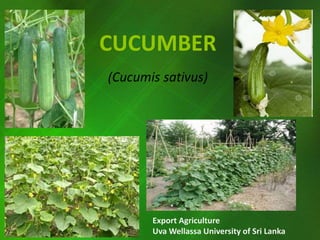
Export Agriculture
Uva Wellassa University of Sri Lanka
CONTENTS
• INTRODUCTION
• MORPHOLOGY
• RECOMMENDED VARIETIES
• SOIL & CLIMATIC REQUIREMENT
• FIELD ESTABLISHMENT
• HARVESTING
• STORAGE & POST- HARVEST
• USES
• PEST & DISEASES
• REFERANCES
2
INTRODUCTION
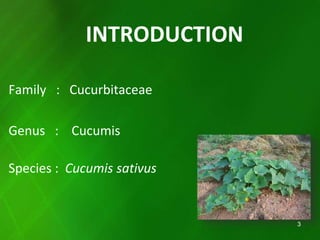
Family : Cucurbitaceae
Genus : Cucumis
Species : Cucumis sativus
3
• The cucumber is a warm season crop
• Originated from Northern India
• In Sri Lanka, best eaten sliced as a salad
• Appetizer with other vegetables because of its
distinct flavor and texture
4
Major growing areas
• Throughout the year in the wet-zone
• During Maha season in the dry-zone
Identified districts
• Kurunegala
• Matale
• Hambantota
Potential districts
• Puttlum, Colombo, Matara, Badulla,
Moneragala, Polonnaruwa ,Anuradhapura
5
MORPHOLOGY
• Cucumber is a monoecious annual vegetable
• It is a sprawling vine with large leaves and curling
tendrils
• The leaves are arranged alternately on the vines
6
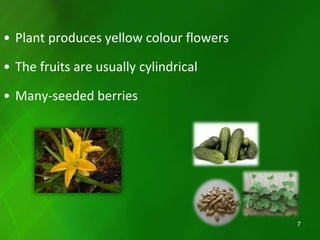
• Plant produces yellow colour flowers
• The fruits are usually cylindrical
• Many-seeded berries
7
RECOMMENDED VARIETIES
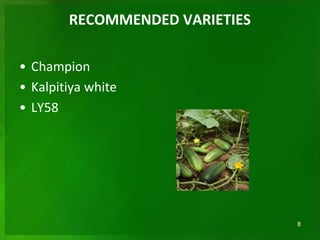
• Champion
• Kalpitiya white
• LY58
8
• Special features of
• Champion
•Salad cucumber
• Kalpitiya white
•Local selection
•Salad cucumber
• LY58
•Yield potential 25Mt/ha
•Recommended for Dry and Wet zones
9
In 2012 release New hybrid variety HORDI
Green F1
• Fruit taste-Crispy
• Moisture- 96.2%
• External skin colour -Yellow green
• Internal skin colour -Green white
• Reaction to pests- No serious pest infestation
10
SOIL & CLIMATIC REQUIREMENT
• Rainfall
Wet zone 2500 mm
Dry zone1200 - 1900 mm
• Soil – Any soil
high water-holding capacity
good drainage
• pH range
5.5 to 7.0
• Temperature
25–30˚С
11
FIELD ESTABLISHMENT
Land preparation
• Prepare the field at least one month before
planting
• Follow each plowing with harrowing
12
• For wet season cropping, prepare raised beds
• One week before planting, make holes 30 cm
apart
• Apply well-decomposed animal manure
• Mix the manure thoroughly with soil
13
Planting
• Sow 3-4 seeds/hills and cover with a thin layer
of soil
• About 2-3 kg of seeds are required for one
hectare
• Irrigate the field right after sowing
• 5 to 7 days after germination, rogue excess
seedlings and maintain only two plants/hill
14
Trellising
• Ipil-ipil posts spaced 3-4 m apart are laid out
in the field
• Wires can be used to connect the poles along
each furrow
• synthetic straw can be used for vine training
15
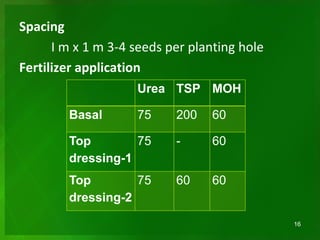
Spacing
I m x 1 m 3-4 seeds per planting hole
Fertilizer application
Urea TSP MOH
Basal 75 200 60
Top
dressing-1
75 - 60
Top
dressing-2
75 60 60
16
Irrigation
• During the dry season, water regularly every
10-14 days
• Depending on the soil type and weather
condition
• watering in the morning hours
• Avoid too much water
• Use drip irrigation system
17
Weed control
• The beds should be kept free of weeds,
especially in the early stages
• Later on, rapidly spreading vines suppress the
weeds
18
HARVESTING
• Most cucumber varieties will produce fruit
ready for harvest in 50 to 60 days
• The peak cucumber production months during
the Maha season
• Check vines daily as the fruit starts to appear
• pick cucumbers whenever it big enough to use
19
STORAGE & POST- HARVEST
• Cucumber has over 90 % water
• Wrap tightly by a plastic wrap to retain
moisture
• They can keep for a week to 10 days when
stored properly in the refrigerate
20
USES
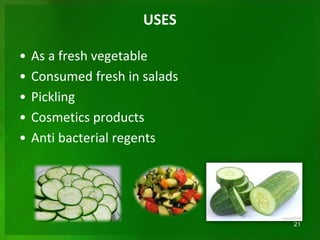
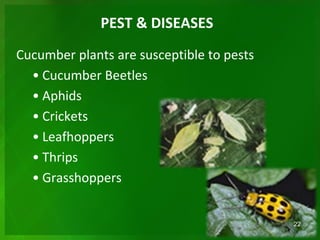
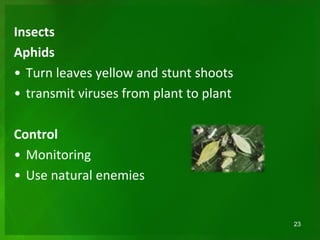
• As a fresh vegetable
• Consumed fresh in salads
• Pickling
• Cosmetics products
• Anti bacterial regents
21
PEST & DISEASES
Cucumber plants are susceptible to pests
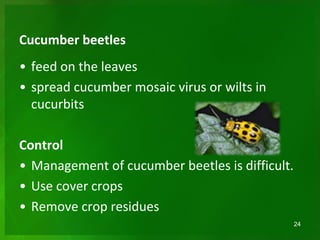
• Cucumber Beetles
• Aphids
• Crickets
• Leafhoppers
• Thrips
• Grasshoppers
22
Insects
Aphids
• Turn leaves yellow and stunt shoots
• transmit viruses from plant to plant
Control
• Monitoring
• Use natural enemies
23
Cucumber beetles
• feed on the leaves
• spread cucumber mosaic virus or wilts in
cucurbits
Control
• Management of cucumber beetles is difficult.
• Use cover crops
• Remove crop residues
24
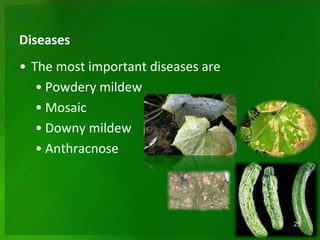
Diseases
• The most important diseases are
• Powdery mildew
• Mosaic
• Downy mildew
• Anthracnose
25
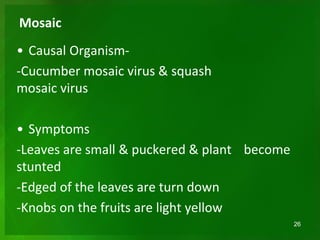
Mosaic
• Causal Organism-
-Cucumber mosaic virus & squash
mosaic virus
• Symptoms
-Leaves are small & puckered & plant become
stunted
-Edged of the leaves are turn down
-Knobs on the fruits are light yellow
26
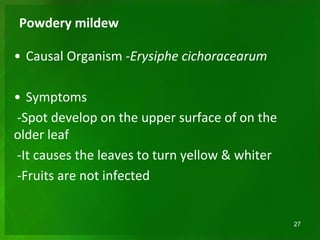
Powdery mildew
• Causal Organism -Erysiphe cichoracearum
• Symptoms
-Spot develop on the upper surface of on the
older leaf
-It causes the leaves to turn yellow & whiter
-Fruits are not infected
27
Control
• Used fungicide sprays
• Cultural control- using good quality seed
• Remove alternate of host aphids
• Don’t plant cucurbits near to wood
• Control weeds
• Use insecticide
28
REFERANCES
• http://www.semena.org/agro/Cucumber-e.htm
• http://www.agridept.gov.lk/index.php/en/crop-
recommendations/984
• http://www.backyard-vegetable-
gardening.com/cucumber-diseases.html
• http://www.ipm.ucdavis.edu/PMG/GARDEN/VEGES/PE
STS/cucumberbeet.html
• https://www.plantvillage.com/topics/cucumber/infos
• http://www.darfu4b.da.gov.ph/cucumber.html
29
GROUP MEMBERS
• B.M.S.K. Ekanayake UWU/EAG/11/0004
• K.A.M.Y.C. Jayathissa UWU/EAG/11/0010
30
THANK YOU !
31

Cucumber

  • 1.
    Export Agriculture Uva WellassaUniversity of Sri Lanka
  • 2.
    CONTENTS • INTRODUCTION • MORPHOLOGY •RECOMMENDED VARIETIES • SOIL & CLIMATIC REQUIREMENT • FIELD ESTABLISHMENT • HARVESTING • STORAGE & POST- HARVEST • USES • PEST & DISEASES • REFERANCES 2
  • 3.
    INTRODUCTION Family : Cucurbitaceae Genus: Cucumis Species : Cucumis sativus 3
  • 4.
    • The cucumberis a warm season crop • Originated from Northern India • In Sri Lanka, best eaten sliced as a salad • Appetizer with other vegetables because of its distinct flavor and texture 4
  • 5.
    Major growing areas •Throughout the year in the wet-zone • During Maha season in the dry-zone Identified districts • Kurunegala • Matale • Hambantota Potential districts • Puttlum, Colombo, Matara, Badulla, Moneragala, Polonnaruwa ,Anuradhapura 5
  • 6.
    MORPHOLOGY • Cucumber isa monoecious annual vegetable • It is a sprawling vine with large leaves and curling tendrils • The leaves are arranged alternately on the vines 6
  • 7.
    • Plant producesyellow colour flowers • The fruits are usually cylindrical • Many-seeded berries 7
  • 8.
    RECOMMENDED VARIETIES • Champion •Kalpitiya white • LY58 8
  • 9.
    • Special featuresof • Champion •Salad cucumber • Kalpitiya white •Local selection •Salad cucumber • LY58 •Yield potential 25Mt/ha •Recommended for Dry and Wet zones 9
  • 10.
    In 2012 releaseNew hybrid variety HORDI Green F1 • Fruit taste-Crispy • Moisture- 96.2% • External skin colour -Yellow green • Internal skin colour -Green white • Reaction to pests- No serious pest infestation 10
  • 11.
    SOIL & CLIMATICREQUIREMENT • Rainfall Wet zone 2500 mm Dry zone1200 - 1900 mm • Soil – Any soil high water-holding capacity good drainage • pH range 5.5 to 7.0 • Temperature 25–30˚С 11
  • 12.
    FIELD ESTABLISHMENT Land preparation •Prepare the field at least one month before planting • Follow each plowing with harrowing 12
  • 13.
    • For wetseason cropping, prepare raised beds • One week before planting, make holes 30 cm apart • Apply well-decomposed animal manure • Mix the manure thoroughly with soil 13
  • 14.
    Planting • Sow 3-4seeds/hills and cover with a thin layer of soil • About 2-3 kg of seeds are required for one hectare • Irrigate the field right after sowing • 5 to 7 days after germination, rogue excess seedlings and maintain only two plants/hill 14
  • 15.
    Trellising • Ipil-ipil postsspaced 3-4 m apart are laid out in the field • Wires can be used to connect the poles along each furrow • synthetic straw can be used for vine training 15
  • 16.
    Spacing I m x1 m 3-4 seeds per planting hole Fertilizer application Urea TSP MOH Basal 75 200 60 Top dressing-1 75 - 60 Top dressing-2 75 60 60 16
  • 17.
    Irrigation • During thedry season, water regularly every 10-14 days • Depending on the soil type and weather condition • watering in the morning hours • Avoid too much water • Use drip irrigation system 17
  • 18.
    Weed control • Thebeds should be kept free of weeds, especially in the early stages • Later on, rapidly spreading vines suppress the weeds 18
  • 19.
    HARVESTING • Most cucumbervarieties will produce fruit ready for harvest in 50 to 60 days • The peak cucumber production months during the Maha season • Check vines daily as the fruit starts to appear • pick cucumbers whenever it big enough to use 19
  • 20.
    STORAGE & POST-HARVEST • Cucumber has over 90 % water • Wrap tightly by a plastic wrap to retain moisture • They can keep for a week to 10 days when stored properly in the refrigerate 20
  • 21.
    USES • As afresh vegetable • Consumed fresh in salads • Pickling • Cosmetics products • Anti bacterial regents 21
  • 22.
    PEST & DISEASES Cucumberplants are susceptible to pests • Cucumber Beetles • Aphids • Crickets • Leafhoppers • Thrips • Grasshoppers 22
  • 23.
    Insects Aphids • Turn leavesyellow and stunt shoots • transmit viruses from plant to plant Control • Monitoring • Use natural enemies 23
  • 24.
    Cucumber beetles • feedon the leaves • spread cucumber mosaic virus or wilts in cucurbits Control • Management of cucumber beetles is difficult. • Use cover crops • Remove crop residues 24
  • 25.
    Diseases • The mostimportant diseases are • Powdery mildew • Mosaic • Downy mildew • Anthracnose 25
  • 26.
    Mosaic • Causal Organism- -Cucumbermosaic virus & squash mosaic virus • Symptoms -Leaves are small & puckered & plant become stunted -Edged of the leaves are turn down -Knobs on the fruits are light yellow 26
  • 27.
    Powdery mildew • CausalOrganism -Erysiphe cichoracearum • Symptoms -Spot develop on the upper surface of on the older leaf -It causes the leaves to turn yellow & whiter -Fruits are not infected 27
  • 28.
    Control • Used fungicidesprays • Cultural control- using good quality seed • Remove alternate of host aphids • Don’t plant cucurbits near to wood • Control weeds • Use insecticide 28
  • 29.
    REFERANCES • http://www.semena.org/agro/Cucumber-e.htm • http://www.agridept.gov.lk/index.php/en/crop- recommendations/984 •http://www.backyard-vegetable- gardening.com/cucumber-diseases.html • http://www.ipm.ucdavis.edu/PMG/GARDEN/VEGES/PE STS/cucumberbeet.html • https://www.plantvillage.com/topics/cucumber/infos • http://www.darfu4b.da.gov.ph/cucumber.html 29
  • 30.
    GROUP MEMBERS • B.M.S.K.Ekanayake UWU/EAG/11/0004 • K.A.M.Y.C. Jayathissa UWU/EAG/11/0010 30
  • 31.

Editor's Notes

  • #5 or as an appetizer with other vegetables
  • #7 because of its distinct flavor and texture.