KNOL KHOL
PRESENTED BY :- N.U.M.PERERA
UWU/EAG/11/0041
V.P.A.DILRUKSHI
UWU/EAG/11/0040
(Brassica caulorapa)
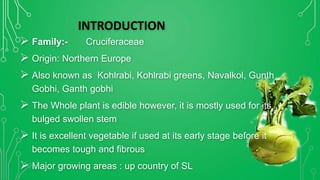
INTRODUCTION
 Family:- Cruciferaceae
 Origin: Northern Europe
 Also known as Kohlrabi, Kohlrabi greens, Navalkol, Gunth
Gobhi, Ganth gobhi
 The Whole plant is edible however, it is mostly used for its
bulged swollen stem
 It is excellent vegetable if used at its early stage before it
becomes tough and fibrous
 Major growing areas : up country of SL
MORPHOLOGY
• formation of knob (tuber) which arises from a thickening of the
stem tissue above the cotyledons
• The fleshy edible proration is an enlargement of the stem, which
develops entirely above ground and is used as a vegetable
• The edible portion is globular to a slightly flattened stem
Climatic Requirement
 cool season crop
Temperature
 It can withstand extreme cold and frost better
than other cool season crop
 Germination - 15 0C to 300C
 Tuber production- 100C to 200C
 The low temperature - develops anthocyanin
pigments on knobs or plant parts
 Continuous hot weather is detrimental which
induce knob development
 soil
 successfully grown on all types of soil
 But the sandy loam and clay loam soils are best
suitable
 pH 5.5-6.8
 A soil rich in manures and fertilizers produces
excellent knobs
 does not grow well in highly acidic soil
VARIETIES
• White Vienna
• Purple Vienna
• Grand Duke
• Gigante Purple Danube
• White Danube
WHITE VIENNA :
• variety this is an early variety with globular, light green, smooth,
tender, medium-sized knobs having creamy-white tender flesh
with delicate flavor
• plants are dwarf, leaves and stems are medium green
• yield potential of 150–200q/ha
• It matures 55–65 days after transplanting
• takes 50–60 days for knob formation
PURPLE VIENNA
• Medium size
• one week later than White Vienna
• Knobs are purplish-blue with greenish-white flesh
• It has purple leaves
• . It requires 55–65 days for knob formation with slightly better
yield potential than White Vienna
KING OF NORTH
• plant height of 20–30cm foliage is dark green, knob flattish-
round, leaf sheath large and well-spread over the knob
• It matures 60–65 days after transplanting
• . Early varieties mature 30–45 days after planting & characterized
by the horizontal position of the lower leaves
• The late varieties mature 70–100 days after planting
LAND PREPARATION
• The land should be well prepared and of good tilth for
sowing of Knol- Knol, 5- 6 ploughing should be given to
prepare a good tilth
• planking is essential to make soil pulverized and leveled
• The beds and channels are prepared to facilitate irrigation
• weeds and stubbles of previous crop should be removed
before the transplanting of this crop
NURSERY MANAGEMENT
• usually propagated by seed
• can also be propagated by cuttings such as tip cutting and
leaf cutting
• 60cm wide and 2.5m long nursery beds are prepared
• For minimizing the seedling damage, the nursery beds
should be treated with formalin (40% formaldehyde diluted
in 5–6 parts of water or captan )
• Then covering nursery beds for 2 days
• Soil is aerated well for at least 4 days before sowing
• Seeds are sown in rows at a distance of 5–6cm for ease in
manual hoeing, weeding and thinning
• A depth of 1.5–2cm is optimum since deeper sowing
delays the germination
• Time of Sowing:
Variety Time of sowing seed in
Nursery
Time of transplanting in
the main field
Early August September
Main September October
Late October November
• Then nursery bed is covered with grass to conserve
moisture for uniform germination
• Watering according to whether condition
• mulch is removed just before the seed germination to control
damping off
TRANSPLANTING
• 3 to 4 week old seedlings become ready for transplanting
• Ridges and furrow type beds used
• spacing 25cm × 25cm, 25cm × 30cm, 25cm × 40cm or
30cm × 45cm depending on climatic condition
• seedlings should be watered and protection may be given
from sun rays for 4 – 5 days
MANURING AND FERTILIZATION
• Knol-khol responds well to manuring, as it is a heavy feeder
• At the time of transplanting add N - 75 kg/ha , P - 50 kg/ ha
• second dose of 50 kg N should be given 1 ½ months after
transplanting
AFTER CARE
• Weeds are removed from field by hand weeding
• generally 2-3 weeding are done in the initial stage of growth
• the field must be kept free from weeds
• plant should be earthen up after 25 – 30 days of
transplantation
• The knobs may become elongated - in close spacing due to
lack of light as in knobs growing in the shade
• The production of elongated knobs may also be induced by
high temperature and excess of N
IRRIGATION
• Knol-khol requires a continuous supply of moisture for
uniform growth and development of knobs
• after transplanting, should be watered for 4 to 5 days(as
stated the seedlings, after transplanting, should be watered
for four to five days)
• should be given an interval of 6 to 7 days
• thereafter irrigation is done when needed, depending on soil
and weather conditions
PEST & DISEASES
Pests
• Aphids
• Thrips
• Mustard saw fly
• Semi looper
• Nematods
• Caterpillars & beetles
Thrips
Aphids
Mustard saw fly
Semi looper
DISEASES
• Damping off
• Leaf spot & blight
• Club root
• Black rot
• Root fly
PEST & DISEASES CONTROL
• Pruning of the old leaves
• Weed control & clean of field
• Use chemical & organic pesticides (foliar spray of garlic
extract at 3% concentration, Spray Trichoderma at 2-3 %
against root fly & black rot)
HARVESTING
• knobs are harvested by cutting the stem just below it by a
sharp knife or sickle before they are fully grown
• should be harvested when swollen stem reach a diameter of
5 to 7 cm and before it becomes tough and woody
• The plants are pulled out from the land
• generally marketed after removing both leaves and roots
Storage
• It can be stored in 3 – 4 days under ordinary conditions
• Cold storage can be stored for more number of days wrapped
knobs store well with better quality comparatively unwrapped
knobs
HEALTH BENEFITS OF KOHLRABI (KNOL-KHOL)
• rich in the antioxidant , so helps fight cancer
• contains high amounts of vitamins C, E and carotene
• considered good sources of dietary fiber
• contains sulphoraphanes and other isothiocyanates, which
are believed to stimulate the production of protective
enzymes in the body
• have antidiabetic activity
Knol khol

Knol khol

  • 1.
    KNOL KHOL PRESENTED BY:- N.U.M.PERERA UWU/EAG/11/0041 V.P.A.DILRUKSHI UWU/EAG/11/0040 (Brassica caulorapa)
  • 2.
    INTRODUCTION  Family:- Cruciferaceae Origin: Northern Europe  Also known as Kohlrabi, Kohlrabi greens, Navalkol, Gunth Gobhi, Ganth gobhi  The Whole plant is edible however, it is mostly used for its bulged swollen stem  It is excellent vegetable if used at its early stage before it becomes tough and fibrous  Major growing areas : up country of SL
  • 3.
    MORPHOLOGY • formation ofknob (tuber) which arises from a thickening of the stem tissue above the cotyledons • The fleshy edible proration is an enlargement of the stem, which develops entirely above ground and is used as a vegetable • The edible portion is globular to a slightly flattened stem
  • 4.
    Climatic Requirement  coolseason crop Temperature  It can withstand extreme cold and frost better than other cool season crop  Germination - 15 0C to 300C  Tuber production- 100C to 200C  The low temperature - develops anthocyanin pigments on knobs or plant parts  Continuous hot weather is detrimental which induce knob development
  • 5.
     soil  successfullygrown on all types of soil  But the sandy loam and clay loam soils are best suitable  pH 5.5-6.8  A soil rich in manures and fertilizers produces excellent knobs  does not grow well in highly acidic soil
  • 6.
    VARIETIES • White Vienna •Purple Vienna • Grand Duke • Gigante Purple Danube • White Danube
  • 7.
    WHITE VIENNA : •variety this is an early variety with globular, light green, smooth, tender, medium-sized knobs having creamy-white tender flesh with delicate flavor • plants are dwarf, leaves and stems are medium green • yield potential of 150–200q/ha • It matures 55–65 days after transplanting • takes 50–60 days for knob formation
  • 8.
    PURPLE VIENNA • Mediumsize • one week later than White Vienna • Knobs are purplish-blue with greenish-white flesh • It has purple leaves • . It requires 55–65 days for knob formation with slightly better yield potential than White Vienna
  • 9.
    KING OF NORTH •plant height of 20–30cm foliage is dark green, knob flattish- round, leaf sheath large and well-spread over the knob • It matures 60–65 days after transplanting • . Early varieties mature 30–45 days after planting & characterized by the horizontal position of the lower leaves • The late varieties mature 70–100 days after planting
  • 10.
    LAND PREPARATION • Theland should be well prepared and of good tilth for sowing of Knol- Knol, 5- 6 ploughing should be given to prepare a good tilth • planking is essential to make soil pulverized and leveled • The beds and channels are prepared to facilitate irrigation • weeds and stubbles of previous crop should be removed before the transplanting of this crop
  • 11.
    NURSERY MANAGEMENT • usuallypropagated by seed • can also be propagated by cuttings such as tip cutting and leaf cutting • 60cm wide and 2.5m long nursery beds are prepared • For minimizing the seedling damage, the nursery beds should be treated with formalin (40% formaldehyde diluted in 5–6 parts of water or captan ) • Then covering nursery beds for 2 days
  • 12.
    • Soil isaerated well for at least 4 days before sowing • Seeds are sown in rows at a distance of 5–6cm for ease in manual hoeing, weeding and thinning • A depth of 1.5–2cm is optimum since deeper sowing delays the germination • Time of Sowing: Variety Time of sowing seed in Nursery Time of transplanting in the main field Early August September Main September October Late October November
  • 13.
    • Then nurserybed is covered with grass to conserve moisture for uniform germination • Watering according to whether condition • mulch is removed just before the seed germination to control damping off
  • 14.
    TRANSPLANTING • 3 to4 week old seedlings become ready for transplanting • Ridges and furrow type beds used • spacing 25cm × 25cm, 25cm × 30cm, 25cm × 40cm or 30cm × 45cm depending on climatic condition • seedlings should be watered and protection may be given from sun rays for 4 – 5 days
  • 15.
    MANURING AND FERTILIZATION •Knol-khol responds well to manuring, as it is a heavy feeder • At the time of transplanting add N - 75 kg/ha , P - 50 kg/ ha • second dose of 50 kg N should be given 1 ½ months after transplanting
  • 16.
    AFTER CARE • Weedsare removed from field by hand weeding • generally 2-3 weeding are done in the initial stage of growth • the field must be kept free from weeds • plant should be earthen up after 25 – 30 days of transplantation
  • 17.
    • The knobsmay become elongated - in close spacing due to lack of light as in knobs growing in the shade • The production of elongated knobs may also be induced by high temperature and excess of N
  • 18.
    IRRIGATION • Knol-khol requiresa continuous supply of moisture for uniform growth and development of knobs • after transplanting, should be watered for 4 to 5 days(as stated the seedlings, after transplanting, should be watered for four to five days) • should be given an interval of 6 to 7 days • thereafter irrigation is done when needed, depending on soil and weather conditions
  • 19.
    PEST & DISEASES Pests •Aphids • Thrips • Mustard saw fly • Semi looper • Nematods • Caterpillars & beetles
  • 20.
  • 21.
    DISEASES • Damping off •Leaf spot & blight • Club root • Black rot • Root fly
  • 22.
    PEST & DISEASESCONTROL • Pruning of the old leaves • Weed control & clean of field • Use chemical & organic pesticides (foliar spray of garlic extract at 3% concentration, Spray Trichoderma at 2-3 % against root fly & black rot)
  • 23.
    HARVESTING • knobs areharvested by cutting the stem just below it by a sharp knife or sickle before they are fully grown • should be harvested when swollen stem reach a diameter of 5 to 7 cm and before it becomes tough and woody • The plants are pulled out from the land • generally marketed after removing both leaves and roots
  • 24.
    Storage • It canbe stored in 3 – 4 days under ordinary conditions • Cold storage can be stored for more number of days wrapped knobs store well with better quality comparatively unwrapped knobs
  • 25.
    HEALTH BENEFITS OFKOHLRABI (KNOL-KHOL) • rich in the antioxidant , so helps fight cancer • contains high amounts of vitamins C, E and carotene • considered good sources of dietary fiber • contains sulphoraphanes and other isothiocyanates, which are believed to stimulate the production of protective enzymes in the body • have antidiabetic activity