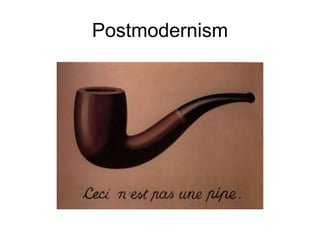
Postmodernism
Two Examples of Postmodernism
https://www.youtube.com/watch?v=R
q9eM4ZXRgs
https://www.youtube.com/watch?v=2U
uRFr0GnHM
What is Postmodernism?
• Postmodernism is
notoriously vague.
• Different people
have different
understandings of
postmodernism.
What is Postmodernism?
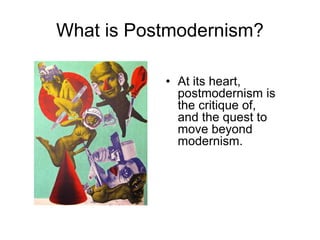
• At its heart,
postmodernism is
the critique of,
and the quest to
move beyond
modernism.
What are the Origins of
Postmodernism?
Premodernism
• Original meaning is
possessed by
authority (e.g. the
Catholic Church).
• The individual is
dominated by
tradition.
Modernism
• The enlightenment rejection of tradition and authority
in favour of reason and natural science.
• This is founded upon the assumption of the individual
as the sole source of meaning and truth.
Modernism
• Modernists
pictured the
physical world
as a machine
whose laws and
regularity could
be discerned by
the human
mind.
Modernism
• Under the banner of
the "Enlightenment,"
philosophers and
scientists sought to
unlock the secrets of
the universe, in order
to master nature for
human benefit and to
create a better world.
Modernism
• This quest led to the modern, technological
society of the twentieth century with its attempt to
bring rational management to life in order to
improve the quality of life.
Grand Narratives
• Modernists were also dedicated to grand
narratives, abstract ideas that were supposed to
offer comprehensive explanations of historical
experience.
Examples of Grand Narratives
• Historical Accounts
– universal or culture
• Philosophical World Models
– Western metaphysics
• Redemptive Ideologies
– religion, Marxism
• Explicative Narratives
– science, psychoanalysis
• Narratives of Heroism or Love
– romantic novels, action movies
So What is Postmodernism?
• Postmodernism
represents a
questioning or
rejection of
Modernism.
• It challenges the
basic assumptions
upon which it was
built, namely, that
knowledge is
certain, objective
and inherently good.
Relative Truth
• Postmodernism is
highly skeptical of
explanations which
claim to be valid for
all groups, cultures,
traditions, or races,
and instead focuses
on the relative truths
of each person.
Interpretation
• In Postmodernsim, interpretation is everything;
reality only comes into being through our
interpretations of what the world means to us
individually.
Dali & Picasso Painting the Same Egg
Universality
• Consequently,
Postmodernism
marks the end of a
single world view. It
resists unified, all-
encompassing and
universally valid
explanations.
Respect for Difference
• Postmodernism replaces this unified world
view with a respect for difference and a
celebration of the local and particular at the
expense of the universal.
Rejection of Rationality & Science
• Postmodernism
likewise entails a
rejection of the
emphasis on rational
discovery through
the scientific method
which provided the
intellectual
foundation for the
modern attempt to
construct a "better"
world.
Rejection of Rationality & Science
Postmodern Questionnaire
Popular Culture vs. Scientific Inquiry
• Question: Do you
know more about “the
Bachelor" than
Einstein's Theory of
Relativity?
• Answer: For
Postmodernists,
meaning is found in
the messages seen in
popular culture rather
than through scientific
inquiry.
Value Systems
• Question: Do you
believe that
values are
"whatever works
for you?"
• Answer: The
Postmodernist sees
rules as being good for
the rule giver, but not
for the one who has to
follow the rules.
• Each person, in the
Postmodern view, has
the right to create his or
her own value system.
Choice and Personalization
• Question: Would you
rather have ten
options than one
when purchasing a
product (such as a
TV, car, or
dishwasher)?
• Answer: The epitome
of the Modern Era
was the Model-T
Ford. Everyone could
be happy with the
same model. The
Postmodernist wants
options. Choice and
personalization are
everything.
Multiculturalism
• Question: Do you
think that African
history, Asian
history, and Native
American history
are as important as
European/American
history?
• Answer:
Postmodernists are
multicultural. They
believe that no one
culture is superior to
another. Each has
contributed to the
development of the
human race.
Electronic Media
• Question: Do you rely
on electronic media?
• Answer: A constant
stream of information,
both positive and
negative, keeps
Postmodernists
plugged into the beat of
humanity.
• Answer:
Postmodernists are
connected to the world
through a variety of
electronic
communication devices
in a way never seen
before in history.
Postmodern Theorists
Jacques Derrida
• “Deconstruction -- a
method of critical analysis
of philosophical and
literary language that
emphasizes the internal
workings of language and
conceptual systems, the
relational quality of
meaning, and the
assumptions implicit in
forms of expression.”
Michel Foucault
Jean-Francois Lyotard
Jean Baudrillard
Jacques Lacan
• “The unconscious is
structured like a
language.’
How Does Postmodernism Apply to
Literature?
What Impact has Postmodernism had
on Literature?
• Postmodernism has
helped change people's
ideas about what we can
classify as literature.
• Some people would like
to stick with the old
emphasis on "serious,"
"highbrow" texts, but
Postmodernism has
made a major dent on
traditional ideas about
literature, art, and culture.
What are the Characteristics of
Postmodernism Literature?
Irony
• A form of humour in which the real meaning is
concealed or contradicted by the words used.
Parody
• A form of
satire that
imitates
another work
of art in order
to ridicule it.
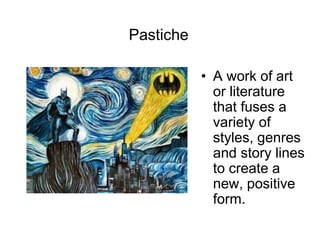
Pastiche
• A work of art
or literature
that fuses a
variety of
styles, genres
and story lines
to create a
new, positive
form.
Intertexuality
• Intertexuality: An
implicit relation of
a text to other
texts
• Usually involves
pastiche, parody,
irony
• e.g. The
Simpsons
Mixed Genres
• Genre hybridity and
genre-bending
• e.g. Pulp Fiction
combines gangster
flicks with a variety
of other genres.
Questioning the “Real”
• Blurring of
boundaries
between fiction
and ‘truth’
• e.g. The Matrix
blurs the
boundary
between a
fictitious
computerized
world and reality.
Self-Reflexivity
• When a work of art
refers back to itself or
similar works, often in
the form of a parody.
• Self-reflexive films are
often “narratives about
narratives” (films
about filmmaking or
storytelling)
Examples of Self-Reflexivity
• e.g. -
“Adaptation” is
a movie about
the making a
movie
• e.g. - in
“Scream,” two
characters
debate the
rules of horror
films…in a
horror film
Anti-Narrative
• When
structural
devices
prevent the
chronological
telling of story
• e.g. the
movies
“Memento”
and “Betrayal”
are both told
backwards.
Breakdown between High and Low Art
• Postmodern art inserts “low art” or popular content
into “high art” films
• e.g. the name “Pulp Fiction” refers to trashy movies
from the fifties, but Tarantino’s approach is anything
but trashy
Retro
• Postmodernism is
fascinated with styles
from the past
• These styles and
fashions, however, are
used completely out of
context
• e.g. Charlie's Angels,
Scooby Doo, Brady
Bunch
A Response to Late Capitalism
• Postmodernism emphasizes
the dominance of capitalism
• Paranoia narratives are
common, especially
pertaining to technological
advances (e.g. surveillance
technology)
• e.g. Bladerunner, X-Files,
Matrix, Minority Report
Disorientation
• Postmodernism attempts
to disorient the
subject/viewer
• e.g. stories with ‘truth’
revelations at end that
disrupt previous
beliefs/knowledge
• e.g. The Sixth Sense, The
Others, Unbreakable, The
Matrix
Postmodern Authors
Kurt Vonnegut
Bret Easton Ellis
William S. Burroughs
Ursula K. Leguin
Philip K. Dick
Art Spiegelman
Questions Postmodern Critics Ask
about Literary Works
Role of Language
• How is language
thrown into free-play
or questioned in the
work?
• e.g. How does
Anthony Burgess
plays with language in
A Clockwork Orange?
Undermining Truth
• How does the work
undermine or
contradict generally
accepted truths?
• e.g. The Matrix
Reconstructing Memory
• How does the
author (or a
character) omit,
change, or
reconstruct memory
and identity?
• e.g. Memento
Challenging Genre Conventions
• How does a work
fulfill or move outside
the established
conventions of its
genre?
• e.g. Pulp Fiction
Separation between Writer & Work
• How does the work
deal with the
separation (or lack
thereof) between
writer, work, and
reader?
• e.g. Slaughterhouse
Five
Ideology
• What ideology does
the text seem to
promote?
• e.g. Feminism in
Margaret Atwood’s
The Handmaid’s Tale
• e.g. Marxism in T.C.
Boyle’s The Tortilla
Curtain
What’s Left Out?
• What is left out of the
text that if included
might undermine the
goal of the work?
• e.g. The “Madwoman
in the Attic" in Jane
Eyre
What is the Future of
Postmodernism?
Post-Post Modernism
• Since the late 1990s
there has been a
small but growing
feeling both in popular
culture and in
academia that
postmodernism has
gone out of fashion.
Post-Post Modernism
• A common positive theme of current attempts to
define post-postmodernism is that faith, trust,
dialogue, performance and sincerity can work to
transcend postmodern irony.
• A term used to describe music, aesthetics, film
criticism, poetry, literary criticism and philosophy.
• It describes art that run against prevailing modes
of postmodernist irony or cynicism, representing
a partial return to modernism.
New Sincerity
• The New Sincerity was
popularized in the
1990s by David Foster
Wallace.
– The Broom of the
System (1987)
– Infinite Jest (1996)
– The Pale King (2011)
This is Water
https://www.youtube.com/watch?v=pfw2Qf1VfJo
Thanks for Paying Attention!

Postmodernism presentation

  • 1.
  • 2.
    Two Examples ofPostmodernism https://www.youtube.com/watch?v=R q9eM4ZXRgs https://www.youtube.com/watch?v=2U uRFr0GnHM
  • 3.
    What is Postmodernism? •Postmodernism is notoriously vague. • Different people have different understandings of postmodernism.
  • 4.
    What is Postmodernism? •At its heart, postmodernism is the critique of, and the quest to move beyond modernism.
  • 5.
    What are theOrigins of Postmodernism?
  • 6.
    Premodernism • Original meaningis possessed by authority (e.g. the Catholic Church). • The individual is dominated by tradition.
  • 7.
    Modernism • The enlightenmentrejection of tradition and authority in favour of reason and natural science. • This is founded upon the assumption of the individual as the sole source of meaning and truth.
  • 8.
    Modernism • Modernists pictured the physicalworld as a machine whose laws and regularity could be discerned by the human mind.
  • 9.
    Modernism • Under thebanner of the "Enlightenment," philosophers and scientists sought to unlock the secrets of the universe, in order to master nature for human benefit and to create a better world.
  • 10.
    Modernism • This questled to the modern, technological society of the twentieth century with its attempt to bring rational management to life in order to improve the quality of life.
  • 11.
    Grand Narratives • Modernistswere also dedicated to grand narratives, abstract ideas that were supposed to offer comprehensive explanations of historical experience.
  • 12.
    Examples of GrandNarratives • Historical Accounts – universal or culture • Philosophical World Models – Western metaphysics • Redemptive Ideologies – religion, Marxism • Explicative Narratives – science, psychoanalysis • Narratives of Heroism or Love – romantic novels, action movies
  • 13.
    So What isPostmodernism? • Postmodernism represents a questioning or rejection of Modernism. • It challenges the basic assumptions upon which it was built, namely, that knowledge is certain, objective and inherently good.
  • 14.
    Relative Truth • Postmodernismis highly skeptical of explanations which claim to be valid for all groups, cultures, traditions, or races, and instead focuses on the relative truths of each person.
  • 15.
    Interpretation • In Postmodernsim,interpretation is everything; reality only comes into being through our interpretations of what the world means to us individually.
  • 16.
    Dali & PicassoPainting the Same Egg
  • 17.
    Universality • Consequently, Postmodernism marks theend of a single world view. It resists unified, all- encompassing and universally valid explanations.
  • 18.
    Respect for Difference •Postmodernism replaces this unified world view with a respect for difference and a celebration of the local and particular at the expense of the universal.
  • 19.
    Rejection of Rationality& Science • Postmodernism likewise entails a rejection of the emphasis on rational discovery through the scientific method which provided the intellectual foundation for the modern attempt to construct a "better" world.
  • 20.
  • 21.
  • 22.
    Popular Culture vs.Scientific Inquiry • Question: Do you know more about “the Bachelor" than Einstein's Theory of Relativity? • Answer: For Postmodernists, meaning is found in the messages seen in popular culture rather than through scientific inquiry.
  • 23.
    Value Systems • Question:Do you believe that values are "whatever works for you?" • Answer: The Postmodernist sees rules as being good for the rule giver, but not for the one who has to follow the rules. • Each person, in the Postmodern view, has the right to create his or her own value system.
  • 24.
    Choice and Personalization •Question: Would you rather have ten options than one when purchasing a product (such as a TV, car, or dishwasher)? • Answer: The epitome of the Modern Era was the Model-T Ford. Everyone could be happy with the same model. The Postmodernist wants options. Choice and personalization are everything.
  • 25.
    Multiculturalism • Question: Doyou think that African history, Asian history, and Native American history are as important as European/American history? • Answer: Postmodernists are multicultural. They believe that no one culture is superior to another. Each has contributed to the development of the human race.
  • 26.
    Electronic Media • Question:Do you rely on electronic media? • Answer: A constant stream of information, both positive and negative, keeps Postmodernists plugged into the beat of humanity. • Answer: Postmodernists are connected to the world through a variety of electronic communication devices in a way never seen before in history.
  • 27.
  • 28.
    Jacques Derrida • “Deconstruction-- a method of critical analysis of philosophical and literary language that emphasizes the internal workings of language and conceptual systems, the relational quality of meaning, and the assumptions implicit in forms of expression.”
  • 29.
  • 30.
  • 31.
  • 32.
    Jacques Lacan • “Theunconscious is structured like a language.’
  • 33.
    How Does PostmodernismApply to Literature?
  • 34.
    What Impact hasPostmodernism had on Literature? • Postmodernism has helped change people's ideas about what we can classify as literature. • Some people would like to stick with the old emphasis on "serious," "highbrow" texts, but Postmodernism has made a major dent on traditional ideas about literature, art, and culture.
  • 35.
    What are theCharacteristics of Postmodernism Literature?
  • 36.
    Irony • A formof humour in which the real meaning is concealed or contradicted by the words used.
  • 37.
    Parody • A formof satire that imitates another work of art in order to ridicule it.
  • 38.
    Pastiche • A workof art or literature that fuses a variety of styles, genres and story lines to create a new, positive form.
  • 39.
    Intertexuality • Intertexuality: An implicitrelation of a text to other texts • Usually involves pastiche, parody, irony • e.g. The Simpsons
  • 40.
    Mixed Genres • Genrehybridity and genre-bending • e.g. Pulp Fiction combines gangster flicks with a variety of other genres.
  • 41.
    Questioning the “Real” •Blurring of boundaries between fiction and ‘truth’ • e.g. The Matrix blurs the boundary between a fictitious computerized world and reality.
  • 42.
    Self-Reflexivity • When awork of art refers back to itself or similar works, often in the form of a parody. • Self-reflexive films are often “narratives about narratives” (films about filmmaking or storytelling)
  • 43.
    Examples of Self-Reflexivity •e.g. - “Adaptation” is a movie about the making a movie • e.g. - in “Scream,” two characters debate the rules of horror films…in a horror film
  • 44.
    Anti-Narrative • When structural devices prevent the chronological tellingof story • e.g. the movies “Memento” and “Betrayal” are both told backwards.
  • 45.
    Breakdown between Highand Low Art • Postmodern art inserts “low art” or popular content into “high art” films • e.g. the name “Pulp Fiction” refers to trashy movies from the fifties, but Tarantino’s approach is anything but trashy
  • 46.
    Retro • Postmodernism is fascinatedwith styles from the past • These styles and fashions, however, are used completely out of context • e.g. Charlie's Angels, Scooby Doo, Brady Bunch
  • 47.
    A Response toLate Capitalism • Postmodernism emphasizes the dominance of capitalism • Paranoia narratives are common, especially pertaining to technological advances (e.g. surveillance technology) • e.g. Bladerunner, X-Files, Matrix, Minority Report
  • 48.
    Disorientation • Postmodernism attempts todisorient the subject/viewer • e.g. stories with ‘truth’ revelations at end that disrupt previous beliefs/knowledge • e.g. The Sixth Sense, The Others, Unbreakable, The Matrix
  • 49.
  • 50.
  • 51.
  • 52.
  • 53.
  • 54.
  • 55.
  • 56.
    Questions Postmodern CriticsAsk about Literary Works
  • 57.
    Role of Language •How is language thrown into free-play or questioned in the work? • e.g. How does Anthony Burgess plays with language in A Clockwork Orange?
  • 58.
    Undermining Truth • Howdoes the work undermine or contradict generally accepted truths? • e.g. The Matrix
  • 59.
    Reconstructing Memory • Howdoes the author (or a character) omit, change, or reconstruct memory and identity? • e.g. Memento
  • 60.
    Challenging Genre Conventions •How does a work fulfill or move outside the established conventions of its genre? • e.g. Pulp Fiction
  • 61.
    Separation between Writer& Work • How does the work deal with the separation (or lack thereof) between writer, work, and reader? • e.g. Slaughterhouse Five
  • 62.
    Ideology • What ideologydoes the text seem to promote? • e.g. Feminism in Margaret Atwood’s The Handmaid’s Tale • e.g. Marxism in T.C. Boyle’s The Tortilla Curtain
  • 63.
    What’s Left Out? •What is left out of the text that if included might undermine the goal of the work? • e.g. The “Madwoman in the Attic" in Jane Eyre
  • 64.
    What is theFuture of Postmodernism?
  • 65.
    Post-Post Modernism • Sincethe late 1990s there has been a small but growing feeling both in popular culture and in academia that postmodernism has gone out of fashion.
  • 66.
    Post-Post Modernism • Acommon positive theme of current attempts to define post-postmodernism is that faith, trust, dialogue, performance and sincerity can work to transcend postmodern irony.
  • 67.
    • A termused to describe music, aesthetics, film criticism, poetry, literary criticism and philosophy. • It describes art that run against prevailing modes of postmodernist irony or cynicism, representing a partial return to modernism.
  • 68.
    New Sincerity • TheNew Sincerity was popularized in the 1990s by David Foster Wallace. – The Broom of the System (1987) – Infinite Jest (1996) – The Pale King (2011)
  • 69.
  • 70.