Archetypal
Literary
Criticism
Historical Context
• Based on works of Carl Jung and Joseph Campbell (and
myth itself)
• Popular in 1950s and ‘60s due to Canadian, Northrop Frye
Definition
• Archetypal critics
believe that literature
is based on recurring
images, characters,
narrative designs and
themes.
• Origins of western
literature in Judeo-
Christian scripture
and Greco-Roman
mythology
What is an archetype?
• Arche “first” and typos
“form”
• An original model or
pattern from which copies
are made
Fundamental Plot Archetype
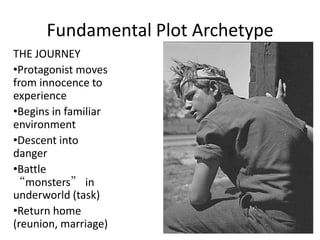
THE JOURNEY
•Protagonist moves
from innocence to
experience
•Begins in familiar
environment
•Descent into
danger
•Battle
“monsters” in
underworld (task)
•Return home
(reunion, marriage)
Key Terms
• Anima
• Animus
• Collective Unconscious
• Persona
• Shadow
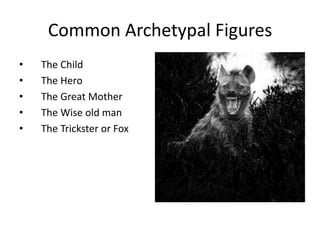
Common Archetypal Figures
• The Child
• The Hero
• The Great Mother
• The Wise old man
• The Trickster or Fox
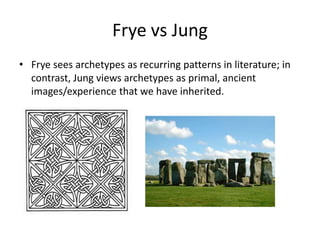
Frye vs Jung
• Frye sees archetypes as recurring patterns in literature; in
contrast, Jung views archetypes as primal, ancient
images/experience that we have inherited.
Objections
• Limits personal interpretation
• Only analyses one aspect of literature (archetypes
Story time
In the fairy tale, Hansel and Gretel are loved by their father
but resented by their step-mother, who insists on a journey
into the woods with the intent of losing them. In the woods,
the children meet evil in the guise of a witch who tries to kill
them. But they outwit her, kill her, and return to their father.
Their step-mother in some versions dies mysteriously at the
same time as the witch. Familiar order is restored.
Re-write
• In groups of 3-4, write
a modern version of
this fairy tale. Make
sure your modern tale
does not alter the
original theme or
message. Note how
you used the
archetypes within this
tale. Be prepared to
present to the rest of
the class.

Archetypal literary criticism

  • 1.
  • 2.
    Historical Context • Basedon works of Carl Jung and Joseph Campbell (and myth itself) • Popular in 1950s and ‘60s due to Canadian, Northrop Frye
  • 3.
    Definition • Archetypal critics believethat literature is based on recurring images, characters, narrative designs and themes. • Origins of western literature in Judeo- Christian scripture and Greco-Roman mythology
  • 4.
    What is anarchetype? • Arche “first” and typos “form” • An original model or pattern from which copies are made
  • 5.
    Fundamental Plot Archetype THEJOURNEY •Protagonist moves from innocence to experience •Begins in familiar environment •Descent into danger •Battle “monsters” in underworld (task) •Return home (reunion, marriage)
  • 6.
    Key Terms • Anima •Animus • Collective Unconscious • Persona • Shadow
  • 7.
    Common Archetypal Figures •The Child • The Hero • The Great Mother • The Wise old man • The Trickster or Fox
  • 8.
    Frye vs Jung •Frye sees archetypes as recurring patterns in literature; in contrast, Jung views archetypes as primal, ancient images/experience that we have inherited.
  • 9.
    Objections • Limits personalinterpretation • Only analyses one aspect of literature (archetypes
  • 10.
    Story time In thefairy tale, Hansel and Gretel are loved by their father but resented by their step-mother, who insists on a journey into the woods with the intent of losing them. In the woods, the children meet evil in the guise of a witch who tries to kill them. But they outwit her, kill her, and return to their father. Their step-mother in some versions dies mysteriously at the same time as the witch. Familiar order is restored.
  • 11.
    Re-write • In groupsof 3-4, write a modern version of this fairy tale. Make sure your modern tale does not alter the original theme or message. Note how you used the archetypes within this tale. Be prepared to present to the rest of the class.