POSTMODERNISM AND HISTORY M Esterman, 2009
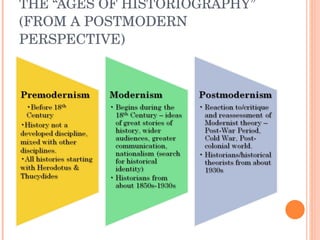
THE “AGES OF HISTORIOGRAPHY”  (FROM A POSTMODERN PERSPECTIVE)
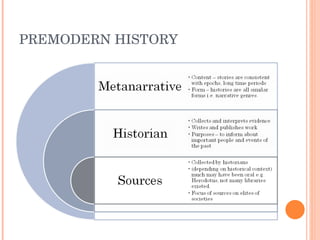
PREMODERN HISTORY
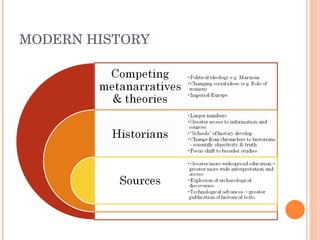
MODERN HISTORY
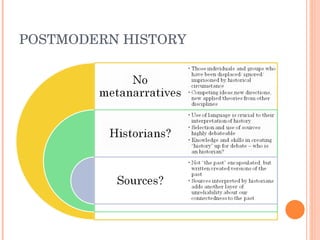
POSTMODERN HISTORY
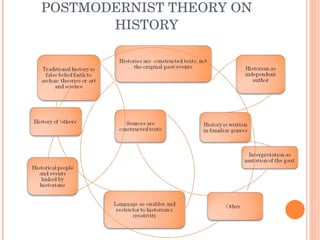
POSTMODERNIST THEORY ON HISTORY
IS THERE SUCH A THING AS A POSTMODERNIST “SCHOOL”? “ Postmodern” Historians
POSTMODERN HISTORIANS AND HISTORICAL THINKERS Do not share all common traits, methodology or purpose Are not all historians but rather apply other theories to history (e.g. Literary, gender etc) Often have competing views about the focus of history/meanings of history Use varying methodologies – not all are trained historians Are from different contexts (time, historiographical, philosophical etc) Have different aims – some to destroy past assumptions, some to question, some to enhance
“ POSTMODERN” HISTORIANS – WEBB,  EXTENSION HISTORY: THE HISTORIANS Paul Carter,  Lost Subjects  (1999): Presents his history by means of a series of ‘voices’. No omniscient narrator. (much like Herodotus?) Simon Schama,  Dead Certainties  (1991): Admits that parts of the history is a “work of the imagination that chronicles historical events” – either his own interpretation of a variety of sources combined OR entirely his ideas based on what he understands was likely to have happened.  Richard Price,  Alabi’s World , (1990): Using different  fonts  to give the idea of different voices – requires reader to imagine various accents, voices etc. Norman Davies,  The Isles  (1999): Doesn’t use national teminology i.e. “Britain” as he says it detracts from the contribution of other groups Uses various other time-neutral imaginary terms e.g. “Midnight Isles” Mixes traditional sources (Celtic archaeology) with non-traditional (myths, ancient Irish literature & modern songs)

Postmodernism and history

  • 1.
    POSTMODERNISM AND HISTORYM Esterman, 2009
  • 2.
    THE “AGES OFHISTORIOGRAPHY” (FROM A POSTMODERN PERSPECTIVE)
  • 3.
  • 4.
  • 5.
  • 6.
  • 7.
    IS THERE SUCHA THING AS A POSTMODERNIST “SCHOOL”? “ Postmodern” Historians
  • 8.
    POSTMODERN HISTORIANS ANDHISTORICAL THINKERS Do not share all common traits, methodology or purpose Are not all historians but rather apply other theories to history (e.g. Literary, gender etc) Often have competing views about the focus of history/meanings of history Use varying methodologies – not all are trained historians Are from different contexts (time, historiographical, philosophical etc) Have different aims – some to destroy past assumptions, some to question, some to enhance
  • 9.
    “ POSTMODERN” HISTORIANS– WEBB, EXTENSION HISTORY: THE HISTORIANS Paul Carter, Lost Subjects (1999): Presents his history by means of a series of ‘voices’. No omniscient narrator. (much like Herodotus?) Simon Schama, Dead Certainties (1991): Admits that parts of the history is a “work of the imagination that chronicles historical events” – either his own interpretation of a variety of sources combined OR entirely his ideas based on what he understands was likely to have happened. Richard Price, Alabi’s World , (1990): Using different fonts to give the idea of different voices – requires reader to imagine various accents, voices etc. Norman Davies, The Isles (1999): Doesn’t use national teminology i.e. “Britain” as he says it detracts from the contribution of other groups Uses various other time-neutral imaginary terms e.g. “Midnight Isles” Mixes traditional sources (Celtic archaeology) with non-traditional (myths, ancient Irish literature & modern songs)