Postmodernism
 for beginners

      c deakin, 2005
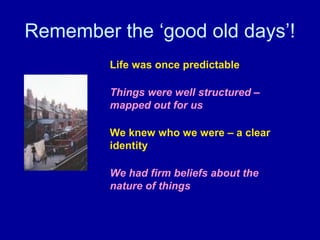
Remember the ‘good old days’!
         Life was once predictable

         Things were well structured –
         mapped out for us

         We knew who we were – a clear
         identity

         We had firm beliefs about the
         nature of things
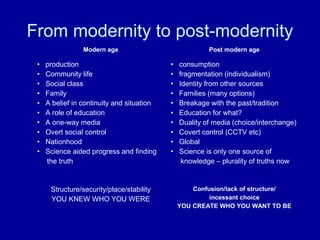
From modernity to post-modernity
                 Modern age                              Post modern age

 •   production                             •   consumption
 •   Community life                         •   fragmentation (individualism)
 •   Social class                           •   Identity from other sources
 •   Family                                 •   Families (many options)
 •   A belief in continuity and situation   •   Breakage with the past/tradition
 •   A role of education                    •   Education for what?
 •   A one-way media                        •   Duality of media (choice/interchange)
 •   Overt social control                   •   Covert control (CCTV etc)
 •   Nationhood                             •   Global
 •   Science aided progress and finding     •   Science is only one source of
     the truth                                   knowledge – plurality of truths now


      Structure/security/place/stability            Confusion/lack of structure/
      YOU KNEW WHO YOU WERE                              incessant choice
                                                YOU CREATE WHO YOU WANT TO BE
Key features of post-modernism
•   Truth is relative
•   Consumerism is all
•   Transformation of the self (‘pick ‘n’ mix’)
•   Disillusionment with the idea of progress
•   Uncertainty
•   Fragmentation of social life
•   Incessant choice
•   Globalisation
•   The impact of ICT on social life
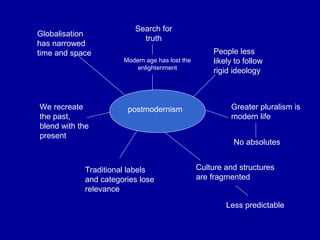
Search for
Globalisation
                           truth
has narrowed
time and space                                      People less
                      Modern age has lost the       likely to follow
                          enlightenment
                                                    rigid ideology


We recreate            postmodernism                     Greater pluralism is
the past,                                                modern life
blend with the
present
                                                          No absolutes


            Traditional labels                  Culture and structures
            and categories lose                 are fragmented
            relevance

                                                        Less predictable
Further thoughts…
                                     Progress is now a
Science no longer has the          questionable enterprise
        answers


 Post modern society
       feeds upon                   Cultural cohesion
  itself..recreating the           comes from sharing
 past, entwining it with             the same media
the present, with some
 self mocking humour
                                       Accepting many realities
                                         and that all the big
  Each cultural identity can co-
                                        explanations are only
   exist…giving the individual
                                           bigger stories
      many ways of being
10 points of post-modernism & style
1.     Emphasis on the centrality of style, at the expense of substance
2.     Recycling past cultures and styles – pastiche
3.     Playful use of ‘useless’ decoration
4.     Celebration of complexity and contradiction. Mixture of high and
       low culture.
5.     Sensitivity to the subtleties of image, language and signs
6.     Intermixing – different styles – collaging
7.     Accepting the collapse of distinction and difference
8.     Rejection of monolithic definitions of culture – celebrate pluralism
       and diversity
9.     Scepticism towards metanarratives and ‘absolutism’
10.    Decline of the idea of only one source of meaning –truth.
Faith could re-emerge as scientific
         thinking loses significance

• Science and progress always undermined
  faith (see Comte and the demise of the
  theological stage)
• As technical and bureaucratic (Weber)
  thinking/living lose favour
• Think about the acceptance of the
  alternative ‘spiritual’
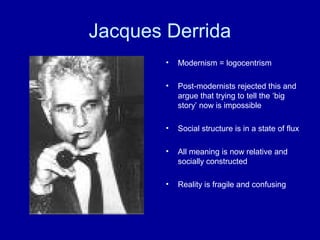
Jacques Derrida
        •   Modernism = logocentrism

        •   Post-modernists rejected this and
            argue that trying to tell the ‘big
            story’ now is impossible

        •   Social structure is in a state of flux

        •   All meaning is now relative and
            socially constructed

        •   Reality is fragile and confusing
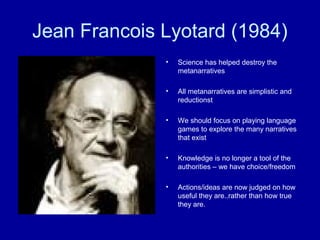
Jean Francois Lyotard (1984)
              •   Science has helped destroy the
                  metanarratives

              •   All metanarratives are simplistic and
                  reductionst

              •   We should focus on playing language
                  games to explore the many narratives
                  that exist

              •   Knowledge is no longer a tool of the
                  authorities – we have choice/freedom

              •   Actions/ideas are now judged on how
                  useful they are..rather than how true
                  they are.
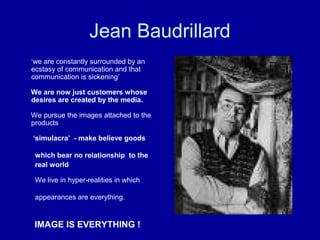
Jean Baudrillard
‘we are constantly surrounded by an
ecstasy of communication and that
communication is sickening’

We are now just customers whose
desires are created by the media.

We pursue the images attached to the
products

‘simulacra’ - make believe goods

 which bear no relationship to the
 real world

 We live in hyper-realities in which

 appearances are everything.


 IMAGE IS EVERYTHING !
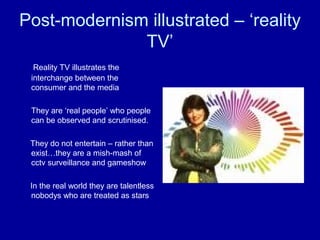
Post-modernism illustrated – ‘reality
              TV’
  Reality TV illustrates the
 interchange between the
 consumer and the media

 They are ‘real people’ who people
 can be observed and scrutinised.

 They do not entertain – rather than
 exist…they are a mish-mash of
 cctv surveillance and gameshow

 In the real world they are talentless
 nobodys who are treated as stars
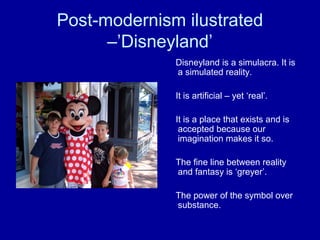
Post-modernism ilustrated
      –’Disneyland’
              Disneyland is a simulacra. It is
              a simulated reality.

              It is artificial – yet ‘real’.

              It is a place that exists and is
               accepted because our
               imagination makes it so.

              The fine line between reality
              and fantasy is ‘greyer’.

              The power of the symbol over
              substance.
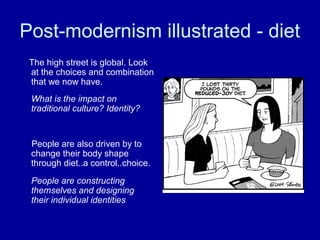
Post-modernism illustrated - diet
 The high street is global. Look
 at the choices and combination
 that we now have.
 What is the impact on
 traditional culture? Identity?


 People are also driven by to
 change their body shape
 through diet..a control..choice.
 People are constructing
 themselves and designing
 their individual identities
Religion in a post-modern age
•   Faith could re-emerge as scientific thinking loses significance
•   Religious symbols have new life in new contexts
•   Faith is now ‘up for grabs’ in the absence of absolute truth
•   People can blend elements of various faiths to suit their lifestyle
•   Globalisation has divorced faiths from locations and cultures
•   fundamentalism is a response to a moral vacuum
•   People can make choices which are more personal and meaningful
•   Collective worship no longer needs to be based on ‘face to face’
    interaction
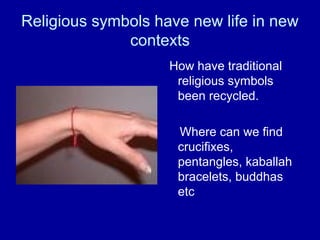
Religious symbols have new life in new
              contexts
                    How have traditional
                     religious symbols
                     been recycled.

                     Where can we find
                     crucifixes,
                     pentangles, kaballah
                     bracelets, buddhas
                     etc
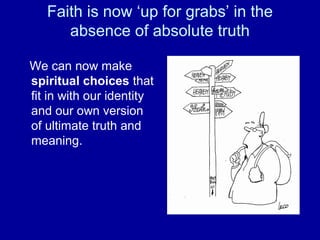
Faith is now ‘up for grabs’ in the
      absence of absolute truth

We can now make
spiritual choices that
fit in with our identity
and our own version
of ultimate truth and
meaning.
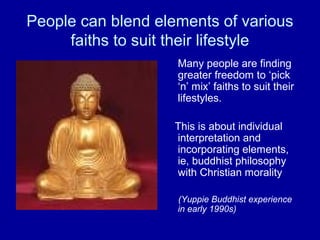
People can blend elements of various
     faiths to suit their lifestyle
                    Many people are finding
                    greater freedom to ‘pick
                    ‘n’ mix’ faiths to suit their
                    lifestyles.

                    This is about individual
                    interpretation and
                    incorporating elements,
                    ie, buddhist philosophy
                    with Christian morality

                    (Yuppie Buddhist experience
                    in early 1990s)
Globalisation has divorced faiths from
        locations and cultures

 Religion is now more
universal and there
are less barriers to
hold people back from
joining faiths that
differ to tradition
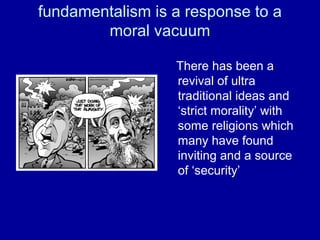
fundamentalism is a response to a
        moral vacuum

                  There has been a
                  revival of ultra
                  traditional ideas and
                  ‘strict morality’ with
                  some religions which
                  many have found
                  inviting and a source
                  of ‘security’
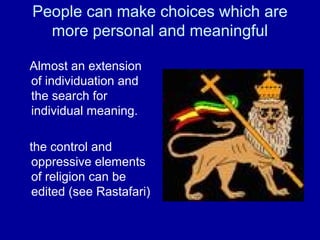
People can make choices which are
  more personal and meaningful

Almost an extension
of individuation and
the search for
individual meaning.

the control and
oppressive elements
of religion can be
edited (see Rastafari)
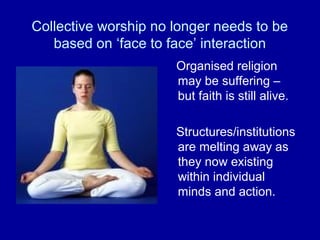
Collective worship no longer needs to be
   based on ‘face to face’ interaction
                      Organised religion
                      may be suffering –
                      but faith is still alive.

                      Structures/institutions
                      are melting away as
                      they now existing
                      within individual
                      minds and action.

Postmodernism for Beginners

  • 1.
  • 2.
    Remember the ‘goodold days’! Life was once predictable Things were well structured – mapped out for us We knew who we were – a clear identity We had firm beliefs about the nature of things
  • 4.
    From modernity topost-modernity Modern age Post modern age • production • consumption • Community life • fragmentation (individualism) • Social class • Identity from other sources • Family • Families (many options) • A belief in continuity and situation • Breakage with the past/tradition • A role of education • Education for what? • A one-way media • Duality of media (choice/interchange) • Overt social control • Covert control (CCTV etc) • Nationhood • Global • Science aided progress and finding • Science is only one source of the truth knowledge – plurality of truths now Structure/security/place/stability Confusion/lack of structure/ YOU KNEW WHO YOU WERE incessant choice YOU CREATE WHO YOU WANT TO BE
  • 5.
    Key features ofpost-modernism • Truth is relative • Consumerism is all • Transformation of the self (‘pick ‘n’ mix’) • Disillusionment with the idea of progress • Uncertainty • Fragmentation of social life • Incessant choice • Globalisation • The impact of ICT on social life
  • 6.
    Search for Globalisation truth has narrowed time and space People less Modern age has lost the likely to follow enlightenment rigid ideology We recreate postmodernism Greater pluralism is the past, modern life blend with the present No absolutes Traditional labels Culture and structures and categories lose are fragmented relevance Less predictable
  • 7.
    Further thoughts… Progress is now a Science no longer has the questionable enterprise answers Post modern society feeds upon Cultural cohesion itself..recreating the comes from sharing past, entwining it with the same media the present, with some self mocking humour Accepting many realities and that all the big Each cultural identity can co- explanations are only exist…giving the individual bigger stories many ways of being
  • 8.
    10 points ofpost-modernism & style 1. Emphasis on the centrality of style, at the expense of substance 2. Recycling past cultures and styles – pastiche 3. Playful use of ‘useless’ decoration 4. Celebration of complexity and contradiction. Mixture of high and low culture. 5. Sensitivity to the subtleties of image, language and signs 6. Intermixing – different styles – collaging 7. Accepting the collapse of distinction and difference 8. Rejection of monolithic definitions of culture – celebrate pluralism and diversity 9. Scepticism towards metanarratives and ‘absolutism’ 10. Decline of the idea of only one source of meaning –truth.
  • 9.
    Faith could re-emergeas scientific thinking loses significance • Science and progress always undermined faith (see Comte and the demise of the theological stage) • As technical and bureaucratic (Weber) thinking/living lose favour • Think about the acceptance of the alternative ‘spiritual’
  • 10.
    Jacques Derrida • Modernism = logocentrism • Post-modernists rejected this and argue that trying to tell the ‘big story’ now is impossible • Social structure is in a state of flux • All meaning is now relative and socially constructed • Reality is fragile and confusing
  • 11.
    Jean Francois Lyotard(1984) • Science has helped destroy the metanarratives • All metanarratives are simplistic and reductionst • We should focus on playing language games to explore the many narratives that exist • Knowledge is no longer a tool of the authorities – we have choice/freedom • Actions/ideas are now judged on how useful they are..rather than how true they are.
  • 12.
    Jean Baudrillard ‘we areconstantly surrounded by an ecstasy of communication and that communication is sickening’ We are now just customers whose desires are created by the media. We pursue the images attached to the products ‘simulacra’ - make believe goods which bear no relationship to the real world We live in hyper-realities in which appearances are everything. IMAGE IS EVERYTHING !
  • 13.
    Post-modernism illustrated –‘reality TV’ Reality TV illustrates the interchange between the consumer and the media They are ‘real people’ who people can be observed and scrutinised. They do not entertain – rather than exist…they are a mish-mash of cctv surveillance and gameshow In the real world they are talentless nobodys who are treated as stars
  • 14.
    Post-modernism ilustrated –’Disneyland’ Disneyland is a simulacra. It is a simulated reality. It is artificial – yet ‘real’. It is a place that exists and is accepted because our imagination makes it so. The fine line between reality and fantasy is ‘greyer’. The power of the symbol over substance.
  • 15.
    Post-modernism illustrated -diet The high street is global. Look at the choices and combination that we now have. What is the impact on traditional culture? Identity? People are also driven by to change their body shape through diet..a control..choice. People are constructing themselves and designing their individual identities
  • 16.
    Religion in apost-modern age • Faith could re-emerge as scientific thinking loses significance • Religious symbols have new life in new contexts • Faith is now ‘up for grabs’ in the absence of absolute truth • People can blend elements of various faiths to suit their lifestyle • Globalisation has divorced faiths from locations and cultures • fundamentalism is a response to a moral vacuum • People can make choices which are more personal and meaningful • Collective worship no longer needs to be based on ‘face to face’ interaction
  • 17.
    Religious symbols havenew life in new contexts How have traditional religious symbols been recycled. Where can we find crucifixes, pentangles, kaballah bracelets, buddhas etc
  • 18.
    Faith is now‘up for grabs’ in the absence of absolute truth We can now make spiritual choices that fit in with our identity and our own version of ultimate truth and meaning.
  • 19.
    People can blendelements of various faiths to suit their lifestyle Many people are finding greater freedom to ‘pick ‘n’ mix’ faiths to suit their lifestyles. This is about individual interpretation and incorporating elements, ie, buddhist philosophy with Christian morality (Yuppie Buddhist experience in early 1990s)
  • 20.
    Globalisation has divorcedfaiths from locations and cultures Religion is now more universal and there are less barriers to hold people back from joining faiths that differ to tradition
  • 21.
    fundamentalism is aresponse to a moral vacuum There has been a revival of ultra traditional ideas and ‘strict morality’ with some religions which many have found inviting and a source of ‘security’
  • 22.
    People can makechoices which are more personal and meaningful Almost an extension of individuation and the search for individual meaning. the control and oppressive elements of religion can be edited (see Rastafari)
  • 23.
    Collective worship nolonger needs to be based on ‘face to face’ interaction Organised religion may be suffering – but faith is still alive. Structures/institutions are melting away as they now existing within individual minds and action.