DERRIDA’S -POST
STRUCTURALISM
SUBMITTED BY
ALEESHA ABDULLA CB.CM.P2CMN15001
SEETHA LAKSHMI R CB.CM.P2CMN15008
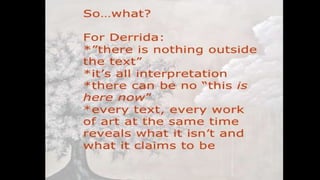
Derridas statement-there is nothing beyond
text
• Derrida shows that any text can be read as
saying something quite different from what it
appears to be saying, and that it may be read
as saying many different things which may
well be contradictory. Therefore, there is no
single or stable meaning inherent in a text, as
it can possess many different
meanings. Speech also has these same
instabilities as writing. Deconstruction
therefore has had a profound effect on
literary criticism, as literary studies have
traditionally been concerned with revealing
the “meaning” behind the text. If the
method of deconstruction is applied then no
ultimate and final meaning can ever be
arrived at.
• The French philosopher Jacques Derrida was born in 1930 in
Algeria. Derrida has gainmed a reputation, even outside the academy, for
his theories of deconstructionist analysis, and of his other contributions to
post-structuralist thought. Derrida's body of work begins with his early
publications in 1962 , and his work continues to be debated amongst critics
and theorists. His first breakthrough publication was a 1966 paper entitled
“Structure, Sign, and play in the Discourse of the Human Sciences”, and
with this paper began a new movement that attacked structuralist theory
and became what we now know as post-structuralism. Post-structuralist
criticism tends to concentrate on philosophical argument and speculation
around language and textuality. Deconstruction is a feature of this kind of
philosophical inquiry.
Post-structuralism
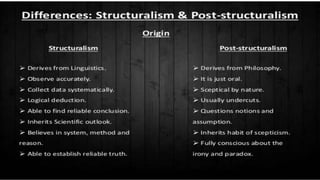
• Post-structuralism is a label formulated by American academics to
denote the heterogeneous works of a series of mid-20th-century
French and continental philosophers and critical theorists who came
to international prominence in the 1960s and '70s.
• Post-structuralist authors all present different critiques of
structuralism, but common themes include the rejection of the self-
sufficiency of the structures that structuralism posits and an
interrogation of the binary oppositions that constitute those
structures.
History
• Two key figures in the early post-structuralist movement were Jacques
Derrida and Roland Barthes. In a 1966 lecture "Structure, Sign, and Play in the
Discourse of the Human Sciences", Jacques Derrida presented a thesis on an
apparent rupture in intellectual life. Derrida interpreted this event as a
"decentering" of the former intellectual cosmos. Instead of progress or
divergence from an identified centre, Derrida described this "event" as a kind of
"play.“
• Post-structuralist philosophers like Derrida and Foucault did not form a self-
conscious group, but each responded to the traditions
of phenomenology and structuralism. Phenomenology, often associated with two
German philosophers Edmund Husserl and Martin Heidegger, rejected previous
systems of knowledge and attempted to examine life "just as it appears" (as
phenomena). Both movements rejected the idea that knowledge could be
centred on the human knower, and sought what they considered a more secure
foundation for knowledge.
Derrida's lecture at Johns Hopkins
• The occasional designation of post-structuralism as a movement can be tied to the fact
that mounting criticism of structuralism became evident at approximately the same time
that structuralism became a topic of interest in universities in the United States. This
interest led to a colloquium being held at Johns Hopkins University in 1966 titled "The
Languages of Criticism and the Sciences of Man" which saw such French scholars such as
Derrida, Barthes, and Lacan invited to speak.
• Derrida's lecture at that conference, "Structure, Sign, and Play in the Human Sciences,"
often appears in collections as a manifesto against structuralism. Derrida's essay was one
of the earliest to propose some theoretical limitations to structuralism, and to attempt to
theorize on terms that were clearly no longer structuralist.
• The element of "play" in the title of Derrida's essay is often erroneously interpreted as
"play" in a linguistic sense, based on a general tendency towards puns and humour,
whilesocial constructionism as developed in the later work of Michel Foucault is said to
create a sense of strategic agency by laying bare the levers of historical change. Many see
the importance of Foucault's work as in its synthesis of this social/historical account of
the operations of power
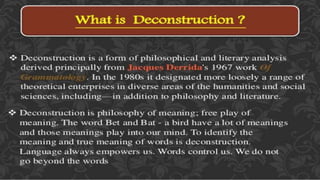
• “Deconstruction” is a form of textual analysis that deconstructs the
language of the text and focuses on the self-referential aspects of
language. Drawing on semiotics (theory of sign systems in language),
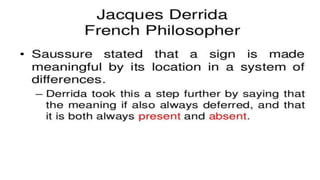
Derrida invented the term différance to convey the divided nature of
the sign, and how meaning is both a matter of difference and
deferring. In other words, meaning is the result of difference
between sign and signifier, but it is also deferred, there is always an
element of undecidability in the unstable sign.
• Derrida combines spatial and temporal difference into one process—difference
spelled with an a, or différance. This neologism is significant because in French
one cannot hear the a when one pronounces the word. The a, in other words,
cannot be made present. It thus resembles the way difference in time and space
gives rise to presence (of the present moment, of the thing in its presence)
without itself assuming the form of presence.
• Derrida contends that all being and all thought is made possible by différance. In
order for difference to be operative in language, there must, he argues, be at
work in being a more primordial process that distinguishes one thing from
another in time and space. It has no identity of its own, but it makes all identity
possible. All things thus bear the mark or trace of other things from which they
differ and to which they relate or are connected in their very constitution.
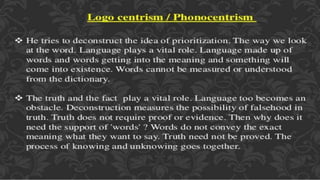
• Another key term when reading Derrida is “logocentrism”, which is a
form of rationalism that presupposes a “presence” behind language
and text. That presence can take the form of an idea, an intention, a
truth, a meaning or a reference for which language acts as a
subservient vehicle of expression. For Derrida, logocentrism is the
foundation of Western philosophical thought. Through
deconstruction, he argues that the search for this fixed presence
behind language and text is misguided.
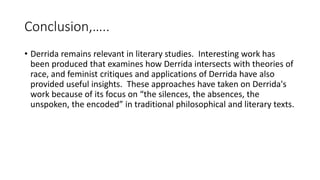
Conclusion,…..
• Derrida remains relevant in literary studies. Interesting work has
been produced that examines how Derrida intersects with theories of
race, and feminist critiques and applications of Derrida have also
provided useful insights. These approaches have taken on Derrida's
work because of its focus on “the silences, the absences, the
unspoken, the encoded” in traditional philosophical and literary texts.
Derrida’s  post structuralism

Derrida’s post structuralism

  • 1.
    DERRIDA’S -POST STRUCTURALISM SUBMITTED BY ALEESHAABDULLA CB.CM.P2CMN15001 SEETHA LAKSHMI R CB.CM.P2CMN15008
  • 3.
    Derridas statement-there isnothing beyond text • Derrida shows that any text can be read as saying something quite different from what it appears to be saying, and that it may be read as saying many different things which may well be contradictory. Therefore, there is no single or stable meaning inherent in a text, as it can possess many different meanings. Speech also has these same instabilities as writing. Deconstruction therefore has had a profound effect on literary criticism, as literary studies have traditionally been concerned with revealing the “meaning” behind the text. If the method of deconstruction is applied then no ultimate and final meaning can ever be arrived at.
  • 4.
    • The Frenchphilosopher Jacques Derrida was born in 1930 in Algeria. Derrida has gainmed a reputation, even outside the academy, for his theories of deconstructionist analysis, and of his other contributions to post-structuralist thought. Derrida's body of work begins with his early publications in 1962 , and his work continues to be debated amongst critics and theorists. His first breakthrough publication was a 1966 paper entitled “Structure, Sign, and play in the Discourse of the Human Sciences”, and with this paper began a new movement that attacked structuralist theory and became what we now know as post-structuralism. Post-structuralist criticism tends to concentrate on philosophical argument and speculation around language and textuality. Deconstruction is a feature of this kind of philosophical inquiry.
  • 5.
    Post-structuralism • Post-structuralism isa label formulated by American academics to denote the heterogeneous works of a series of mid-20th-century French and continental philosophers and critical theorists who came to international prominence in the 1960s and '70s. • Post-structuralist authors all present different critiques of structuralism, but common themes include the rejection of the self- sufficiency of the structures that structuralism posits and an interrogation of the binary oppositions that constitute those structures.
  • 7.
    History • Two keyfigures in the early post-structuralist movement were Jacques Derrida and Roland Barthes. In a 1966 lecture "Structure, Sign, and Play in the Discourse of the Human Sciences", Jacques Derrida presented a thesis on an apparent rupture in intellectual life. Derrida interpreted this event as a "decentering" of the former intellectual cosmos. Instead of progress or divergence from an identified centre, Derrida described this "event" as a kind of "play.“ • Post-structuralist philosophers like Derrida and Foucault did not form a self- conscious group, but each responded to the traditions of phenomenology and structuralism. Phenomenology, often associated with two German philosophers Edmund Husserl and Martin Heidegger, rejected previous systems of knowledge and attempted to examine life "just as it appears" (as phenomena). Both movements rejected the idea that knowledge could be centred on the human knower, and sought what they considered a more secure foundation for knowledge.
  • 8.
    Derrida's lecture atJohns Hopkins • The occasional designation of post-structuralism as a movement can be tied to the fact that mounting criticism of structuralism became evident at approximately the same time that structuralism became a topic of interest in universities in the United States. This interest led to a colloquium being held at Johns Hopkins University in 1966 titled "The Languages of Criticism and the Sciences of Man" which saw such French scholars such as Derrida, Barthes, and Lacan invited to speak. • Derrida's lecture at that conference, "Structure, Sign, and Play in the Human Sciences," often appears in collections as a manifesto against structuralism. Derrida's essay was one of the earliest to propose some theoretical limitations to structuralism, and to attempt to theorize on terms that were clearly no longer structuralist. • The element of "play" in the title of Derrida's essay is often erroneously interpreted as "play" in a linguistic sense, based on a general tendency towards puns and humour, whilesocial constructionism as developed in the later work of Michel Foucault is said to create a sense of strategic agency by laying bare the levers of historical change. Many see the importance of Foucault's work as in its synthesis of this social/historical account of the operations of power
  • 14.
    • “Deconstruction” isa form of textual analysis that deconstructs the language of the text and focuses on the self-referential aspects of language. Drawing on semiotics (theory of sign systems in language), Derrida invented the term différance to convey the divided nature of the sign, and how meaning is both a matter of difference and deferring. In other words, meaning is the result of difference between sign and signifier, but it is also deferred, there is always an element of undecidability in the unstable sign.
  • 15.
    • Derrida combinesspatial and temporal difference into one process—difference spelled with an a, or différance. This neologism is significant because in French one cannot hear the a when one pronounces the word. The a, in other words, cannot be made present. It thus resembles the way difference in time and space gives rise to presence (of the present moment, of the thing in its presence) without itself assuming the form of presence. • Derrida contends that all being and all thought is made possible by différance. In order for difference to be operative in language, there must, he argues, be at work in being a more primordial process that distinguishes one thing from another in time and space. It has no identity of its own, but it makes all identity possible. All things thus bear the mark or trace of other things from which they differ and to which they relate or are connected in their very constitution.
  • 17.
    • Another keyterm when reading Derrida is “logocentrism”, which is a form of rationalism that presupposes a “presence” behind language and text. That presence can take the form of an idea, an intention, a truth, a meaning or a reference for which language acts as a subservient vehicle of expression. For Derrida, logocentrism is the foundation of Western philosophical thought. Through deconstruction, he argues that the search for this fixed presence behind language and text is misguided.
  • 20.
    Conclusion,….. • Derrida remainsrelevant in literary studies. Interesting work has been produced that examines how Derrida intersects with theories of race, and feminist critiques and applications of Derrida have also provided useful insights. These approaches have taken on Derrida's work because of its focus on “the silences, the absences, the unspoken, the encoded” in traditional philosophical and literary texts.