1 . What is postmodernism? 2. Why should we care about it? 3. What does postmodernism have to say about  the  identity? 5. What does postmodernism have to say about truth, beauty and goodness? 6. How postmodernism is influencing education, religion, the arts, and our daily lives.
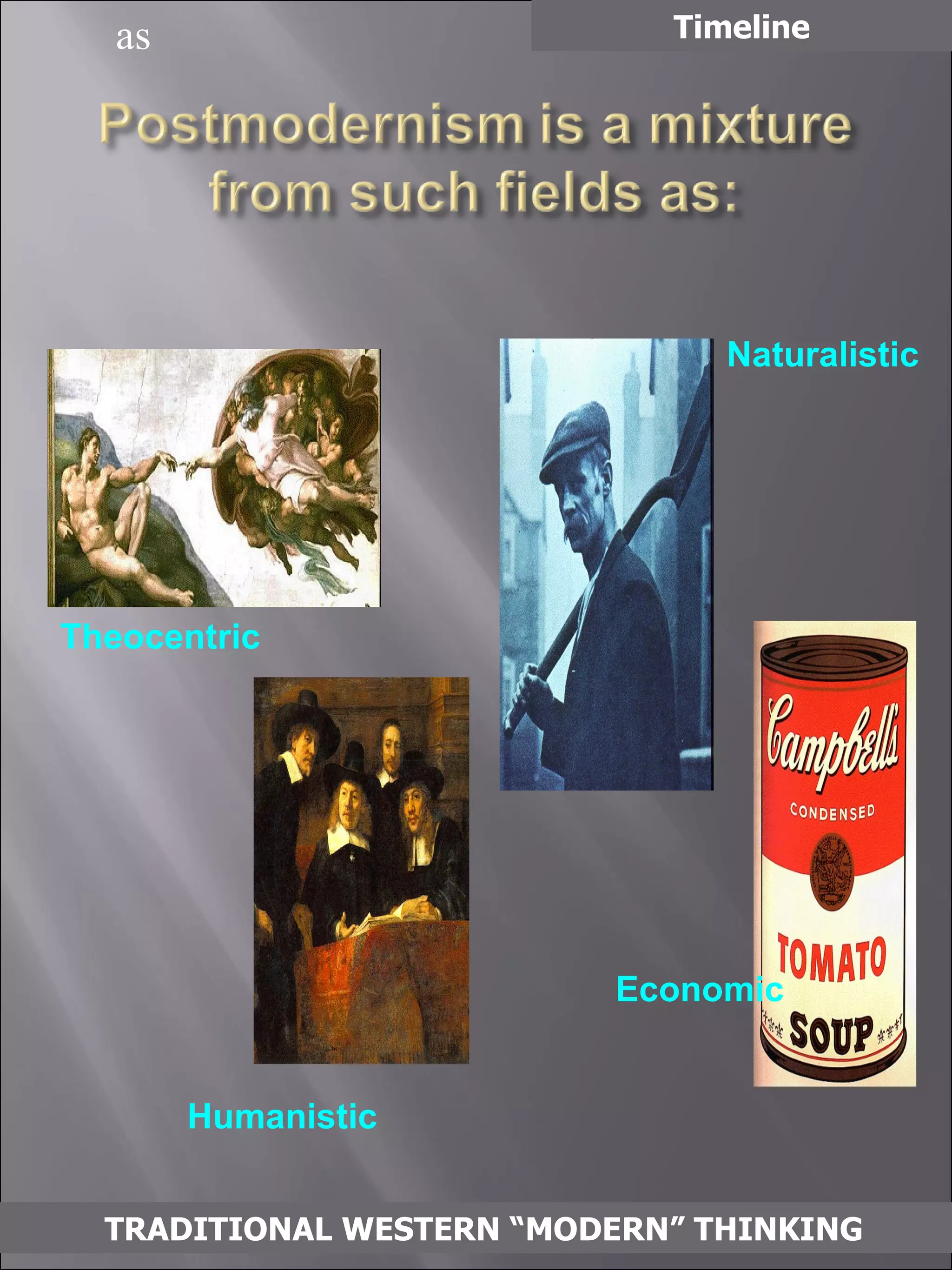
Timeline as TRADITIONAL WESTERN “MODERN” THINKING Theocentric Humanistic Economic Naturalistic
Early modernity:   Renaissance to  Industrial  Revolution  Modernity: Industrial  Revolution Post- Modernity: Period of mass  media Timeline TRADITIONAL WESTERN “MODERN” THINKING
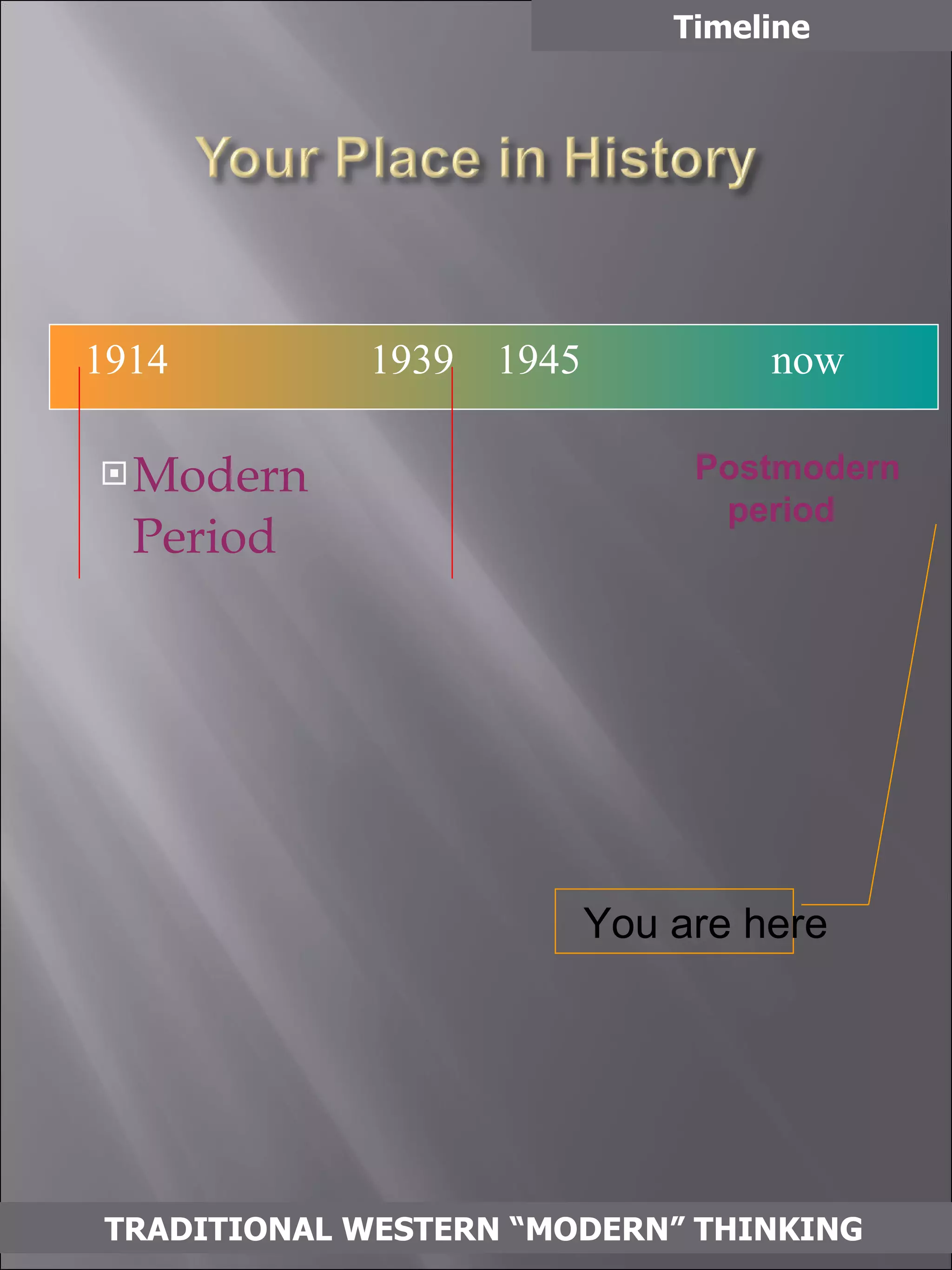
Modern Period Timeline TRADITIONAL WESTERN “MODERN” THINKING Postmodern period 1914   1939  1945  now  You are here
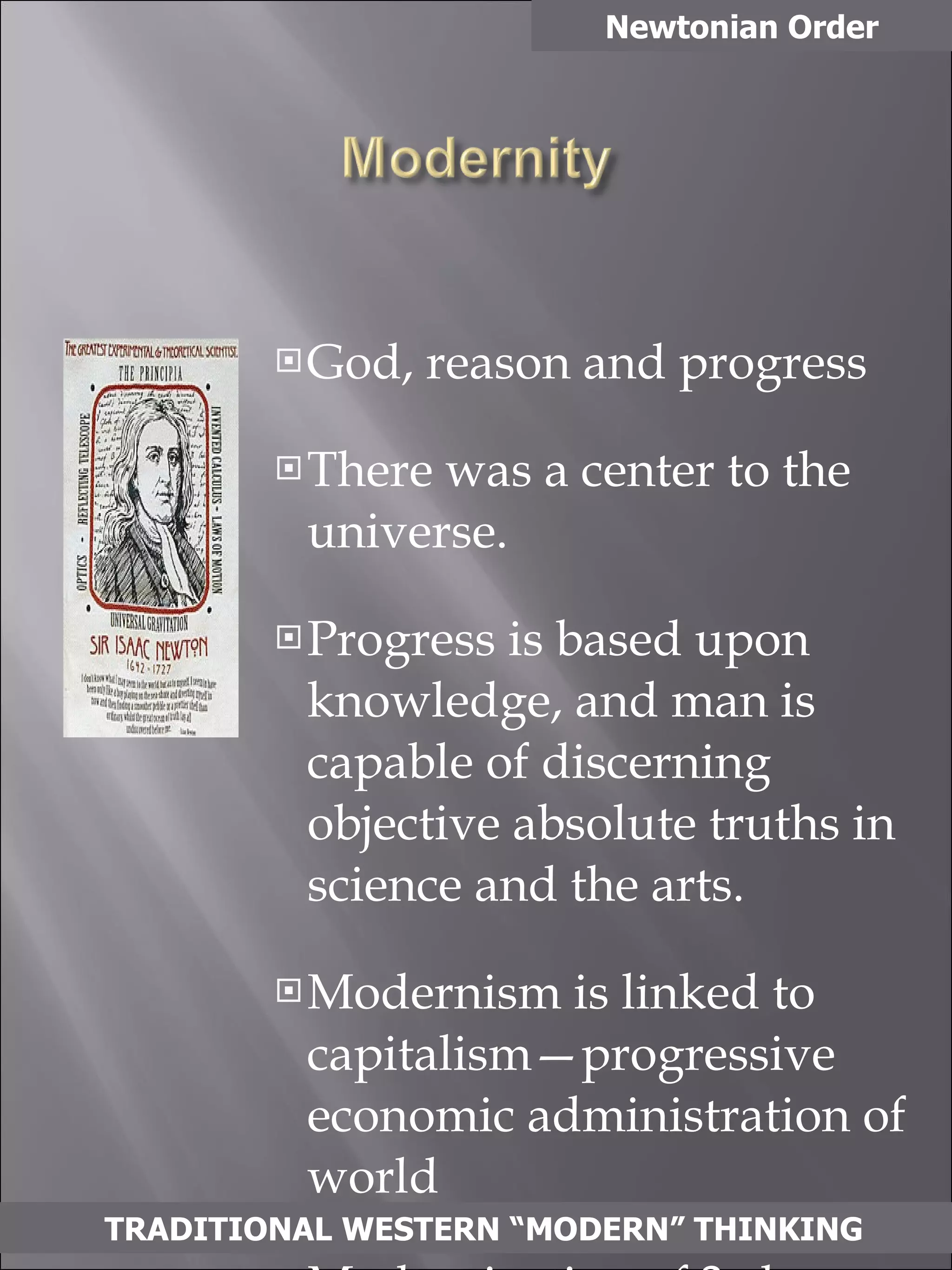
God, reason and progress There was a center to the universe. Progress is based upon knowledge, and man is capable of discerning objective absolute truths in science and the arts.  Modernism is linked to capitalism—progressive economic administration of world Modernization of 3rd world countries (imposition of modern Western values) Newtonian Order TRADITIONAL WESTERN “MODERN” THINKING
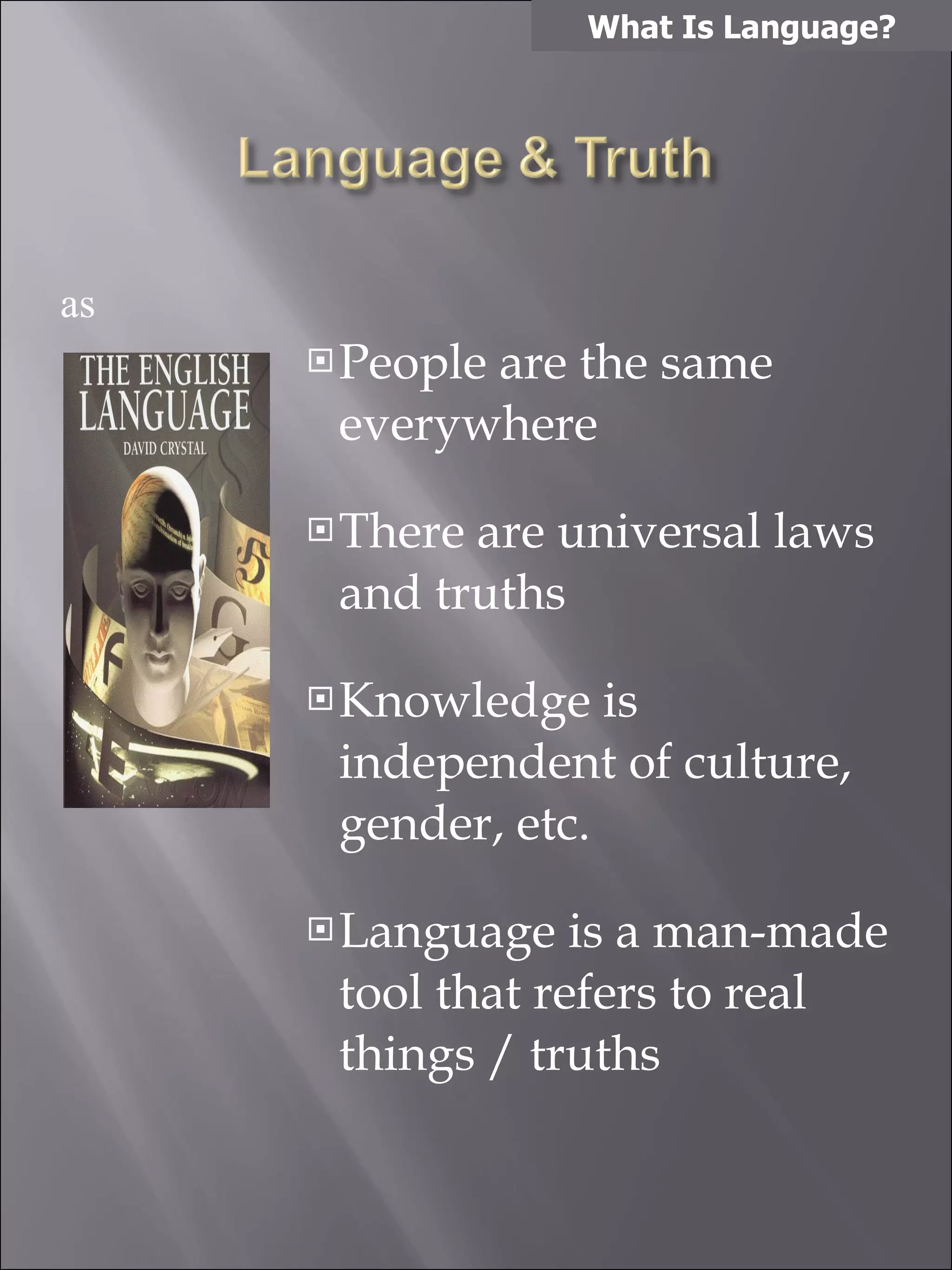
People are the same everywhere There are universal laws and truths Knowledge is independent of culture, gender, etc. Language is a man-made tool that refers to real things / truths What Is Language? as
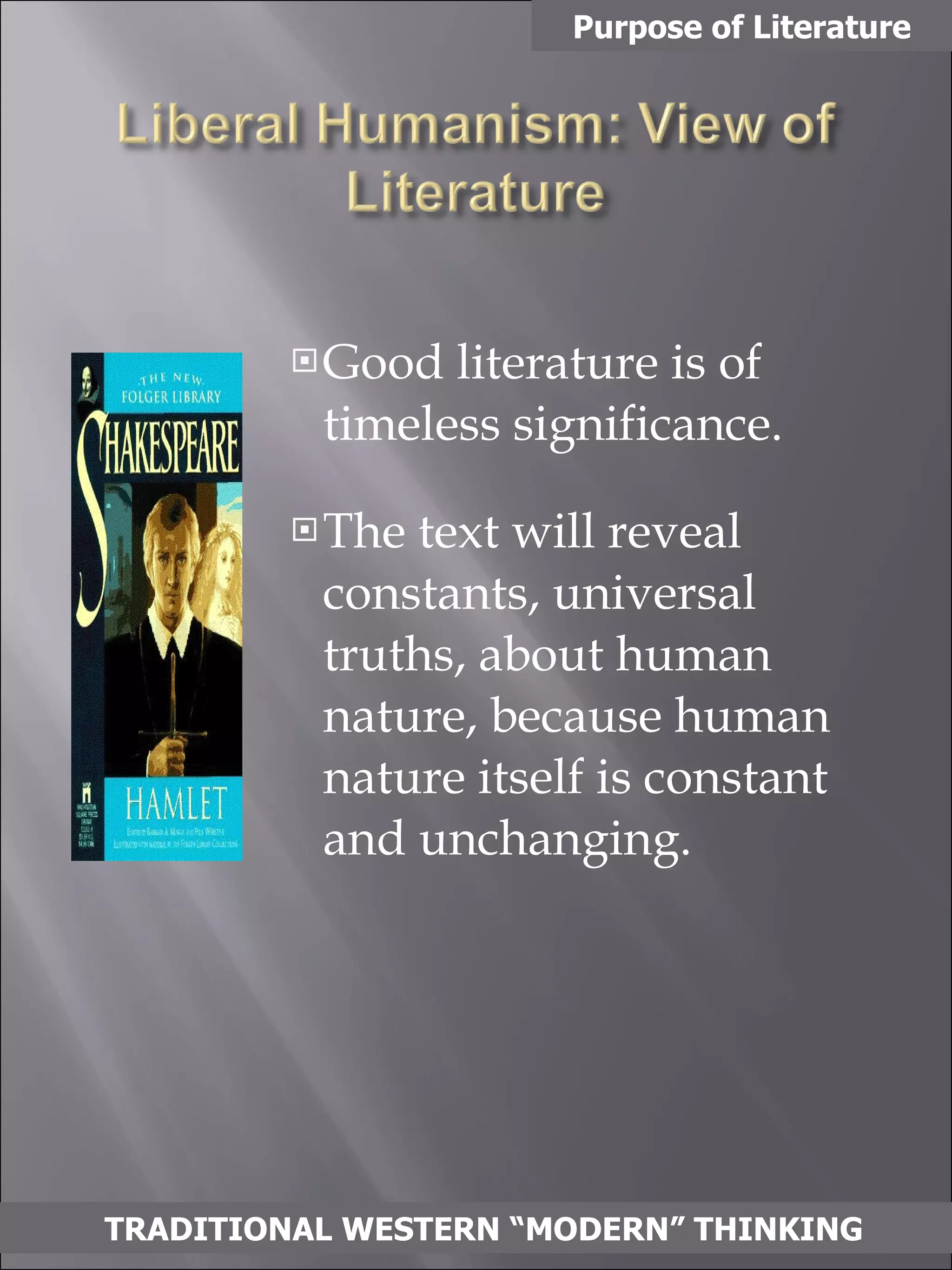
Good literature is of timeless significance.  The text will reveal constants, universal truths, about human nature, because human nature itself is constant and unchanging.  Purpose of Literature TRADITIONAL WESTERN “MODERN” THINKING
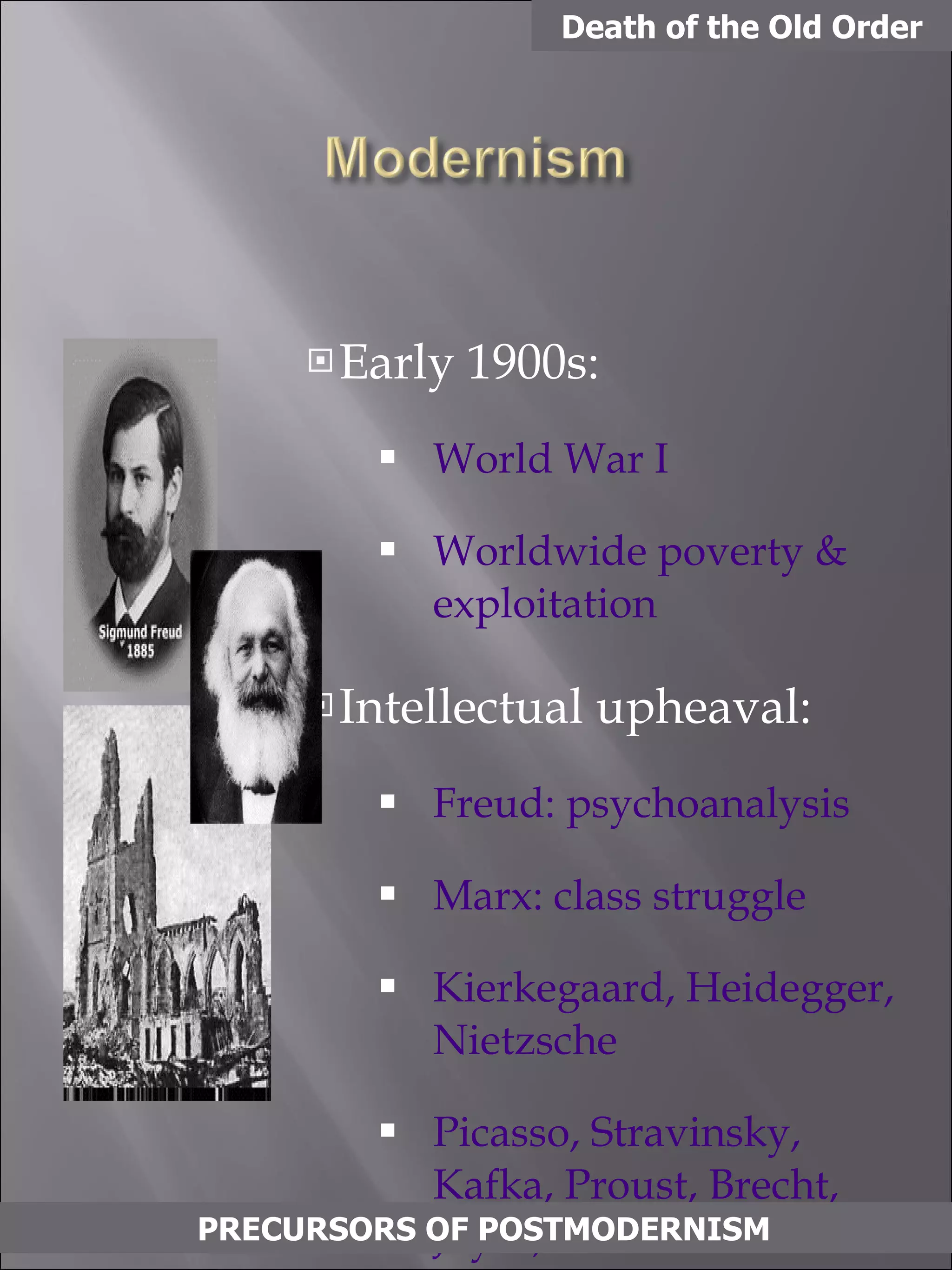
Early 1900s: World War I Worldwide poverty & exploitation Intellectual upheaval: Freud: psychoanalysis Marx: class struggle Kierkegaard, Heidegger, Nietzsche Picasso, Stravinsky, Kafka, Proust, Brecht, Joyce, Eliot Death of the Old Order PRECURSORS OF POSTMODERNISM
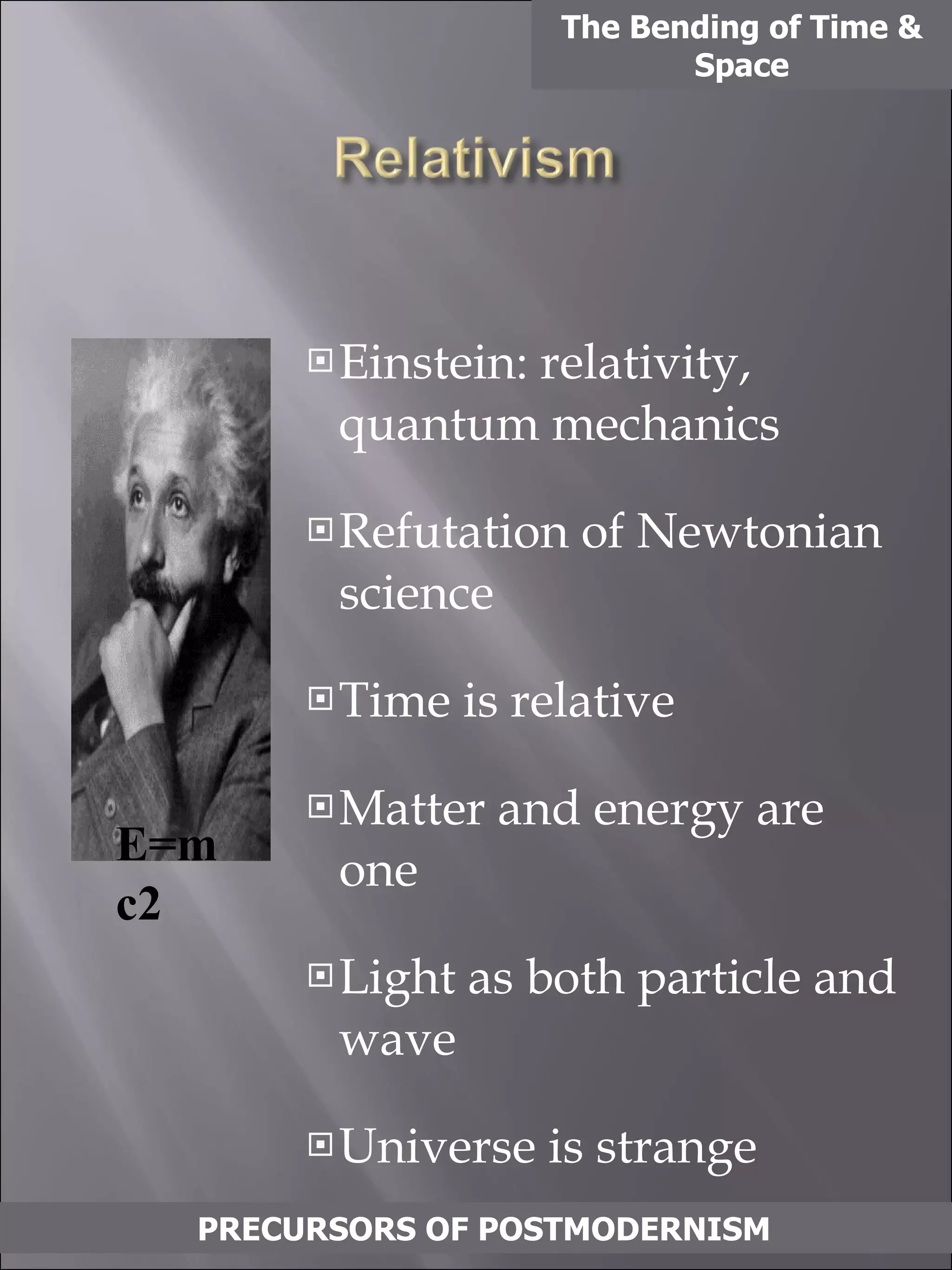
Einstein: relativity, quantum mechanics Refutation of Newtonian science Time is relative Matter and energy are one Light as both particle and wave Universe is strange The Bending of Time & Space TRADITIONAL WESTERN “MODERN” THINKING PRECURSORS OF POSTMODERNISM E=mc2
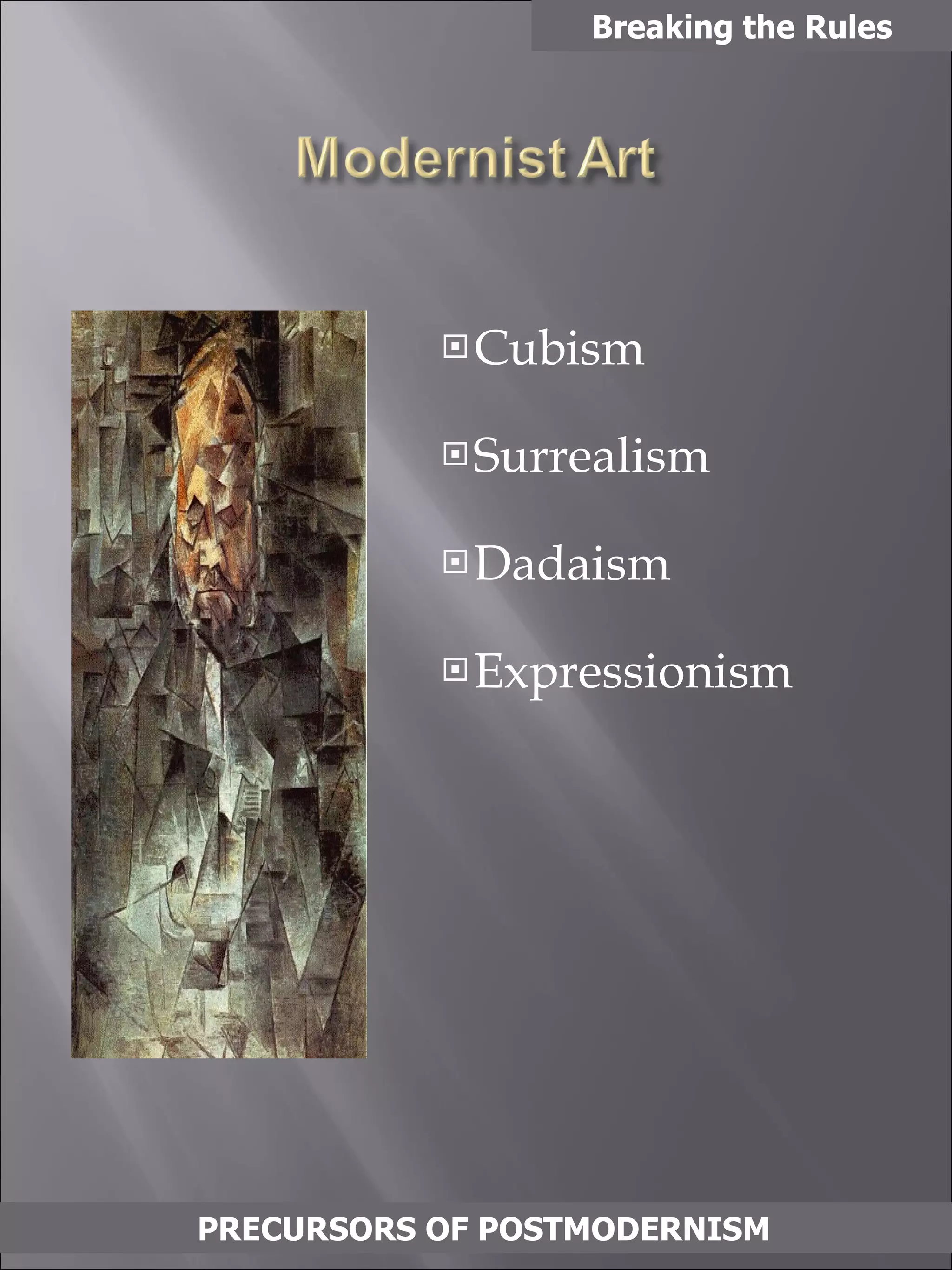
Cubism Surrealism Dadaism Expressionism Breaking the Rules PRECURSORS OF POSTMODERNISM
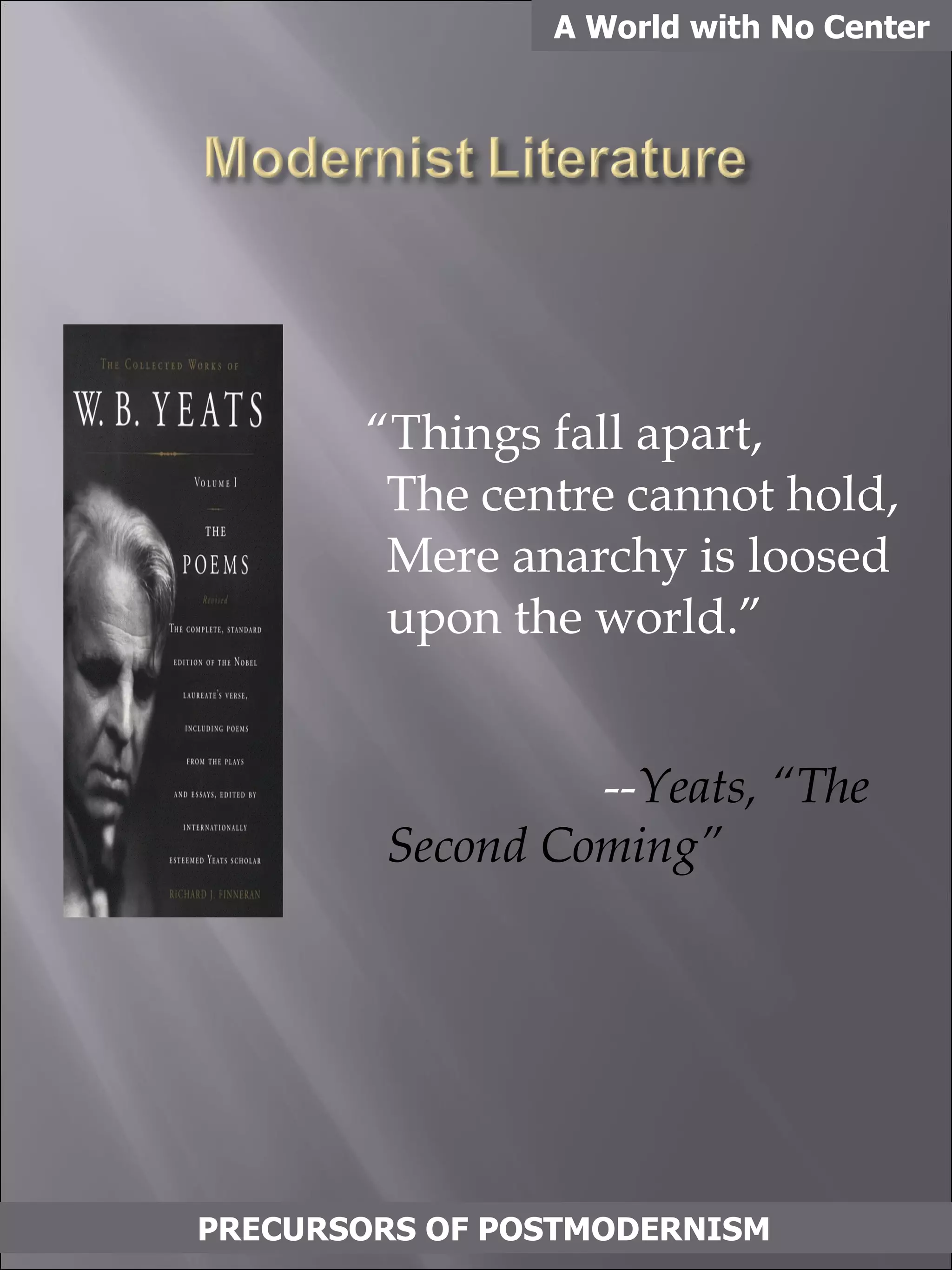
“ Things fall apart, The centre cannot hold, Mere anarchy is loosed upon the world.”   -- Yeats, “The Second Coming” A World with No Center PRECURSORS OF POSTMODERNISM
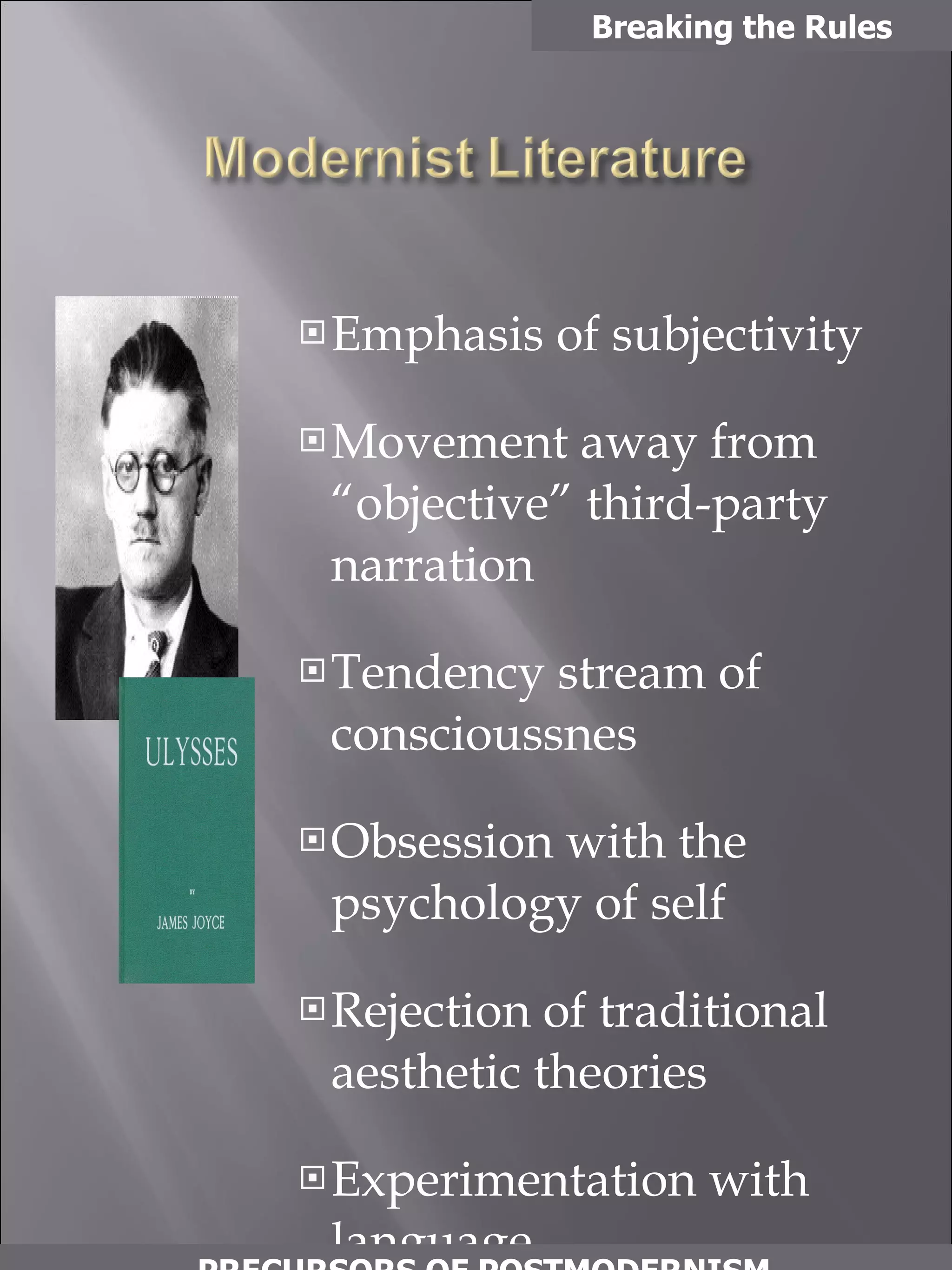
Emphasis of subjectivity Movement away from “objective” third-party narration Tendency stream of conscioussnes  Obsession with the psychology of self Rejection of traditional aesthetic theories Experimentation with language Breaking the Rules PRECURSORS OF POSTMODERNISM
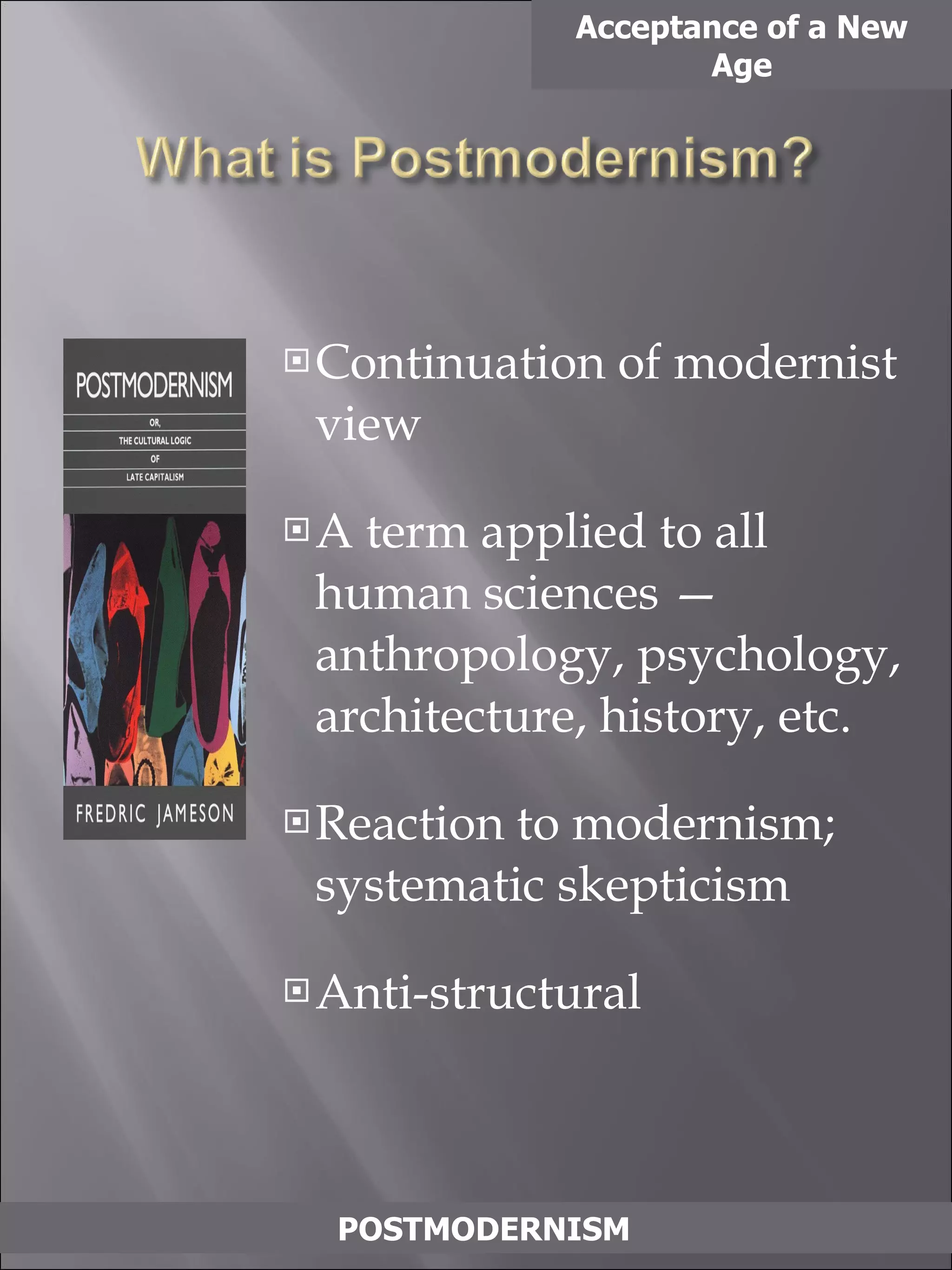
Continuation of modernist view A term applied to all human sciences —anthropology, psychology, architecture, history, etc. Reaction to modernism; systematic skepticism Anti-structural Acceptance of a New Age POSTMODERNISM
The Enlightenment project is dead. Acceptance of a New Age POSTMODERNISM
Modernism and postmodernism are cultural formations that accompany specific stages of capitalism 1. Market capitalism:  18th-19th C. Steam locomotive Realism 2. Monopoly capitalism: Late 19th C to WWII Electricity and automobile Modernism 3. Multinational/consumer capitalism Nuclear and electronics Postmodernism Culture & Capital POSTMODERNISM
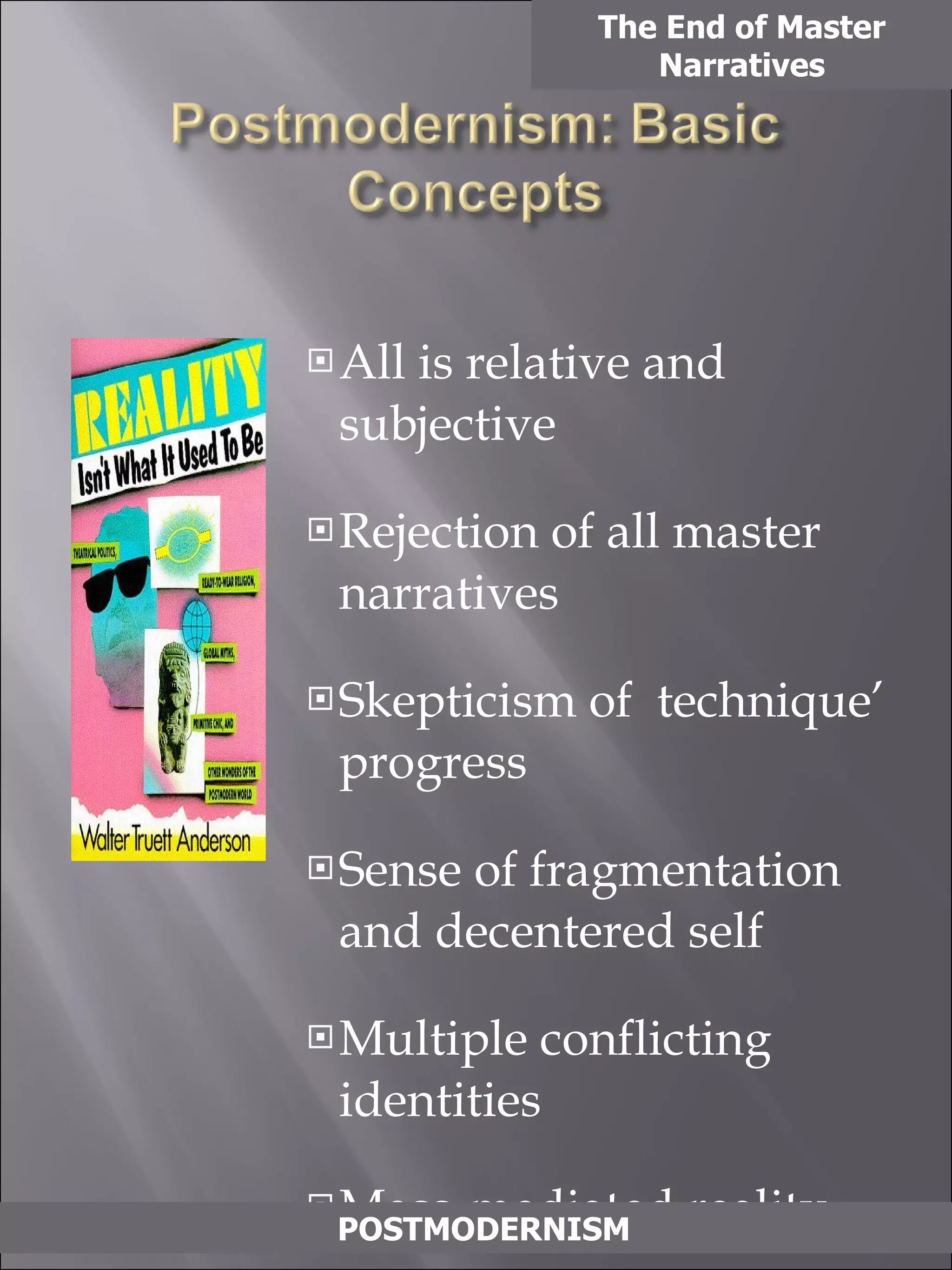
All is relative and subjective Rejection of all master narratives Skepticism of  technique’ progress Sense of fragmentation and decentered self Multiple conflicting identities Mass-mediated reality The End of Master Narratives POSTMODERNISM
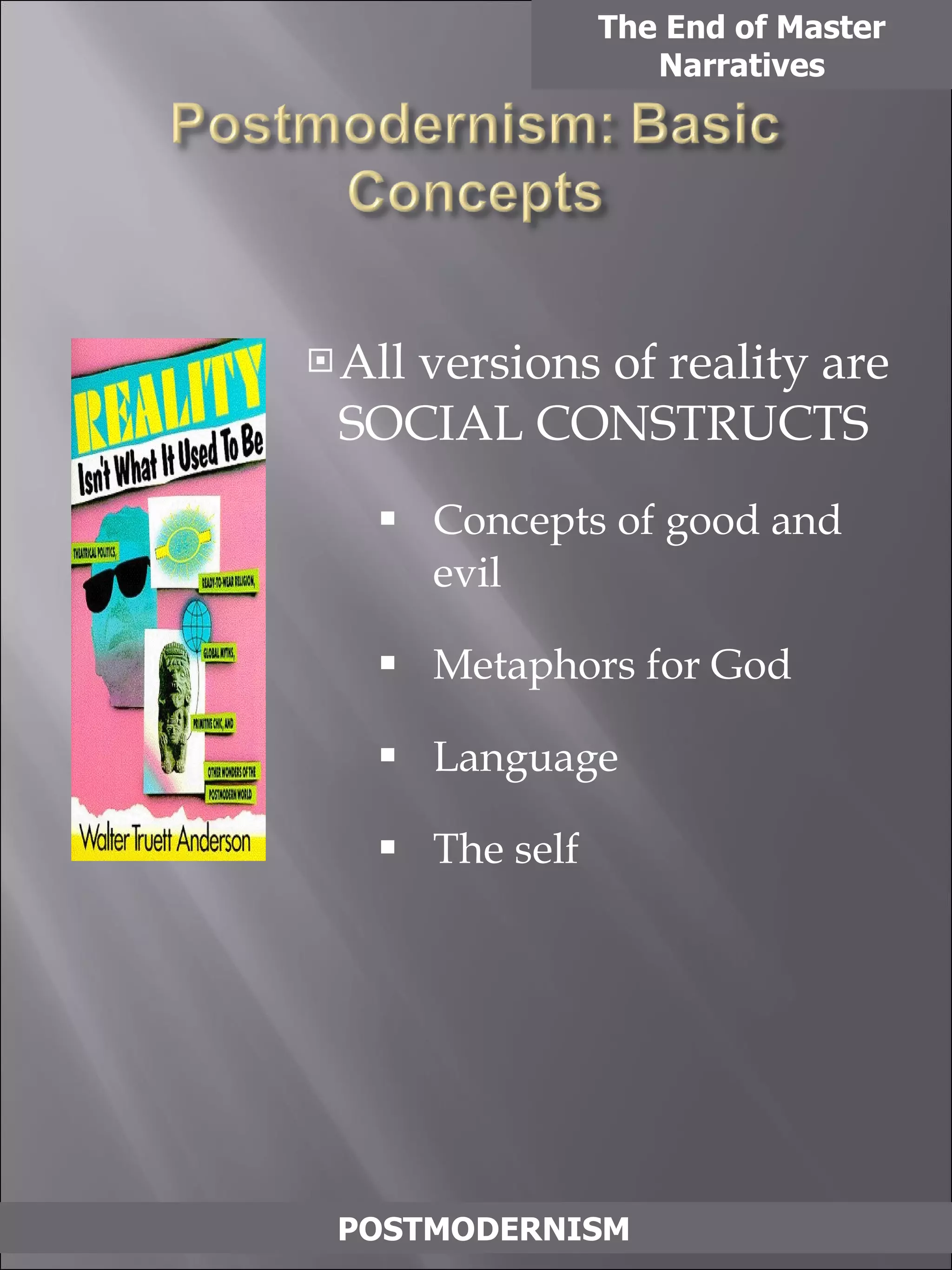
All versions of reality are SOCIAL CONSTRUCTS Concepts of good and evil Metaphors for God Language The self The End of Master Narratives POSTMODERNISM
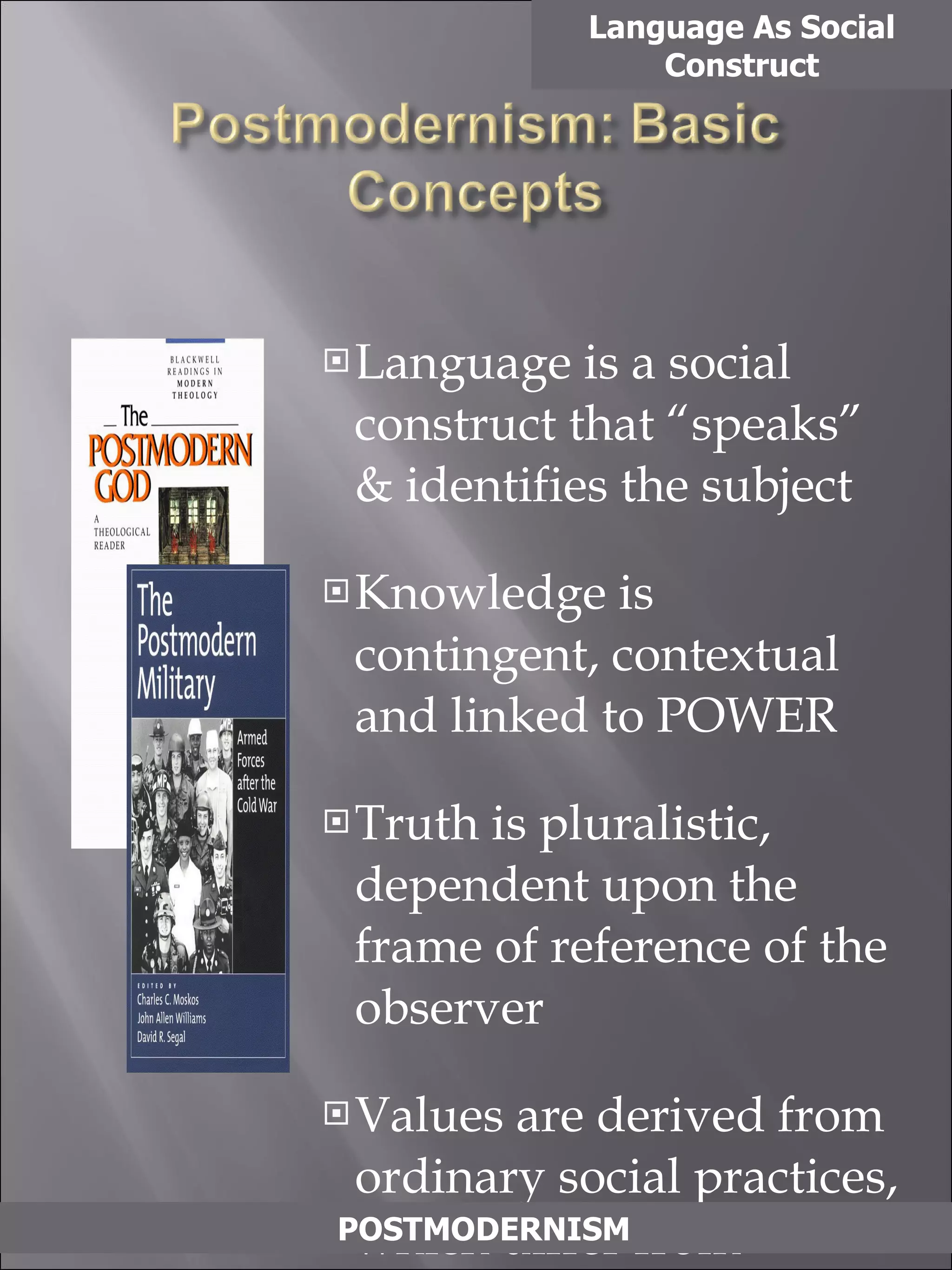
Language is a social construct that “speaks” & identifies the subject Knowledge is contingent, contextual and linked to POWER Truth is pluralistic, dependent upon the frame of reference of the observer Values are derived from ordinary social practices, which differ from culture to culture and change with time. Values are determined by manipulation and domination Language As Social Construct POSTMODERNISM
Observer is a participant/part of what is observed Receiver of message is a component of the message Information becomes information only when contextualized The individual (the subject) is a cultural construct Consider role of own culture when examining others All interpretation is conditioned by cultural perspective and mediated by symbols and practice The Observer is King POSTMODERNISM
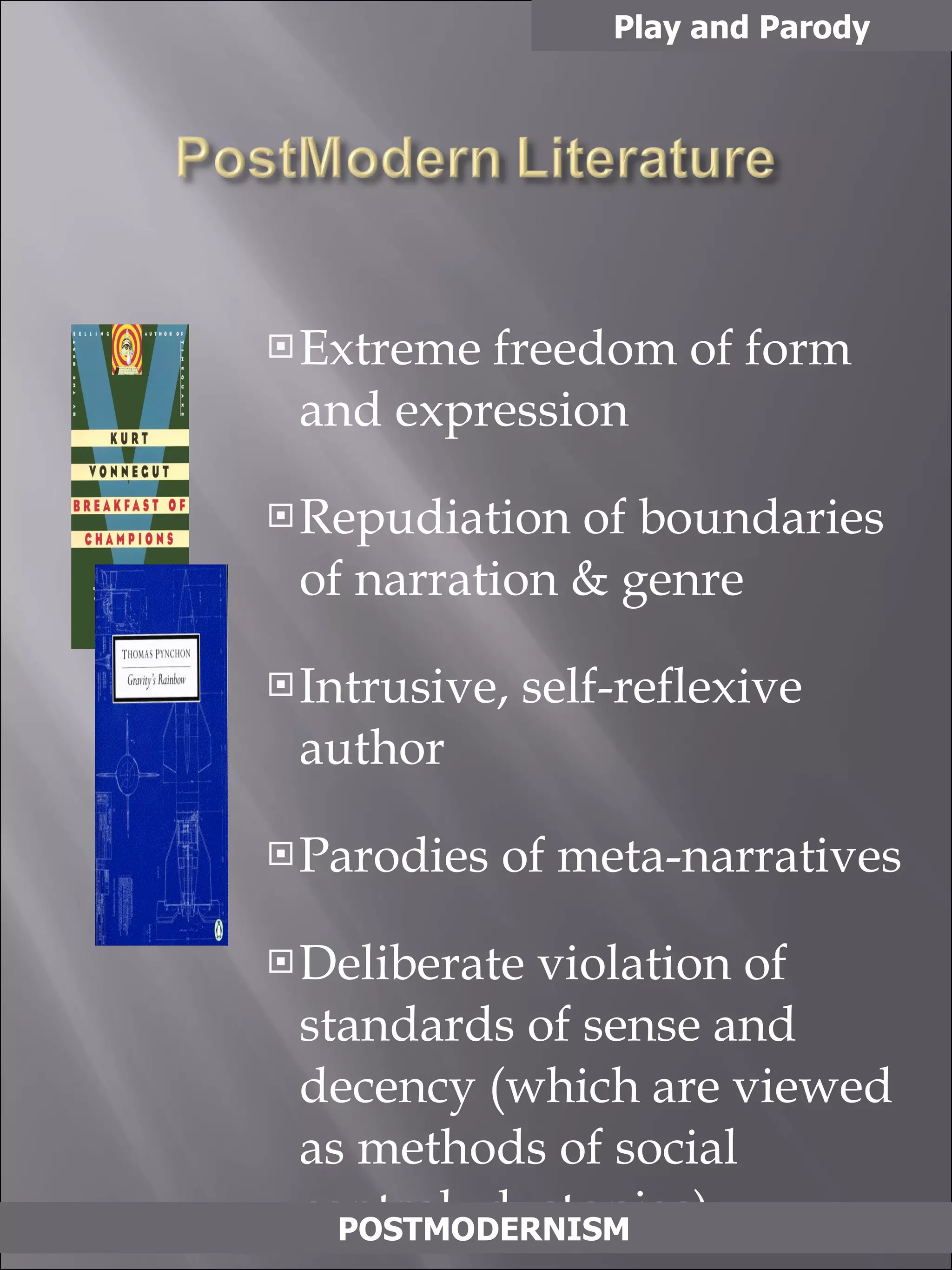
Extreme freedom of form and expression Repudiation of boundaries of narration & genre Intrusive, self-reflexive author Parodies of meta-narratives Deliberate violation of standards of sense and  decency (which are viewed as methods of social  control- dystopias)  Integration of everyday experience, pop culture Play and Parody POSTMODERNISM
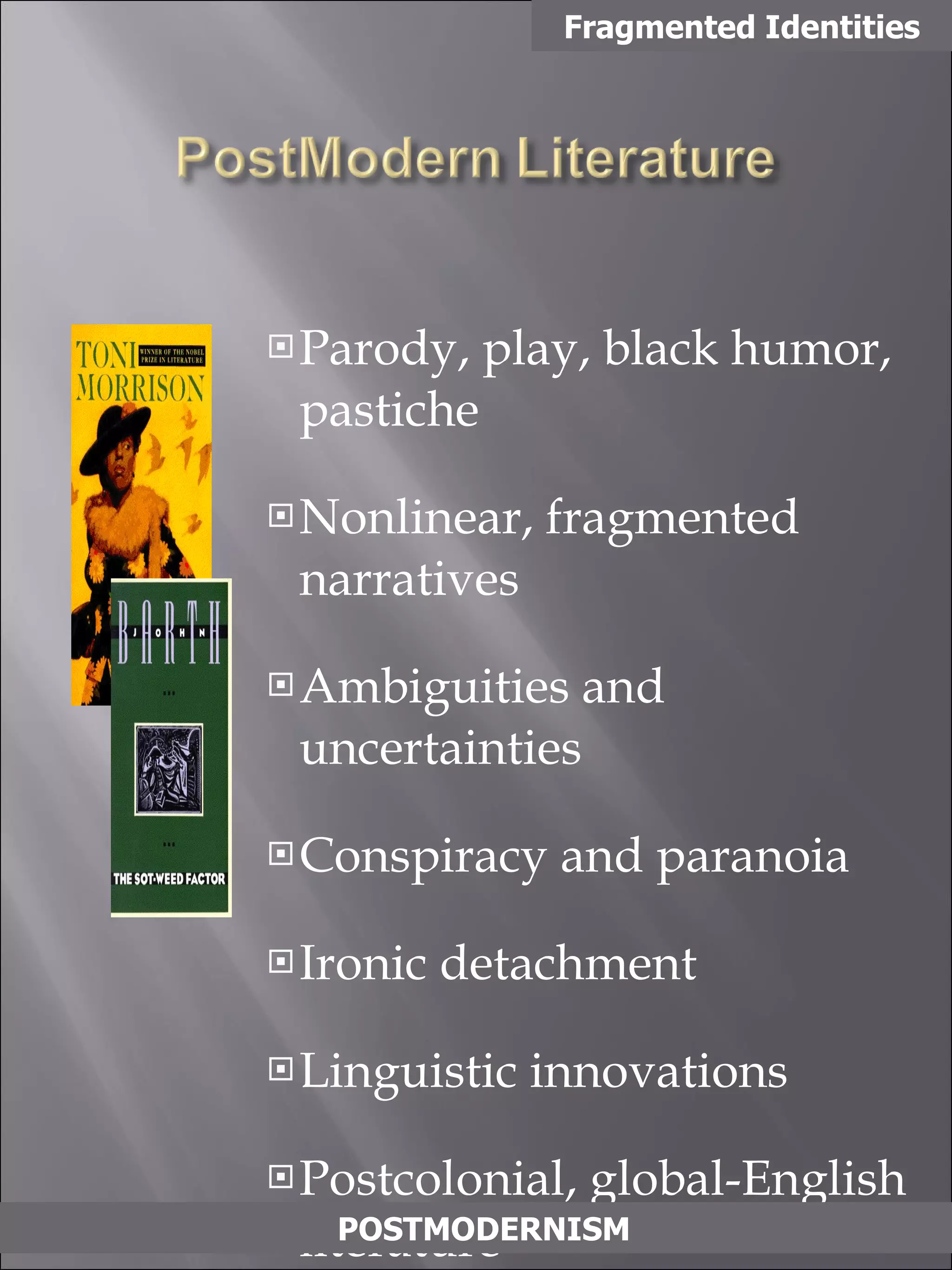
Parody, play, black humor, pastiche  Nonlinear, fragmented narratives Ambiguities and uncertainties Conspiracy and paranoia Ironic detachment Linguistic innovations Postcolonial, global-English literature Fragmented Identities POSTMODERNISM
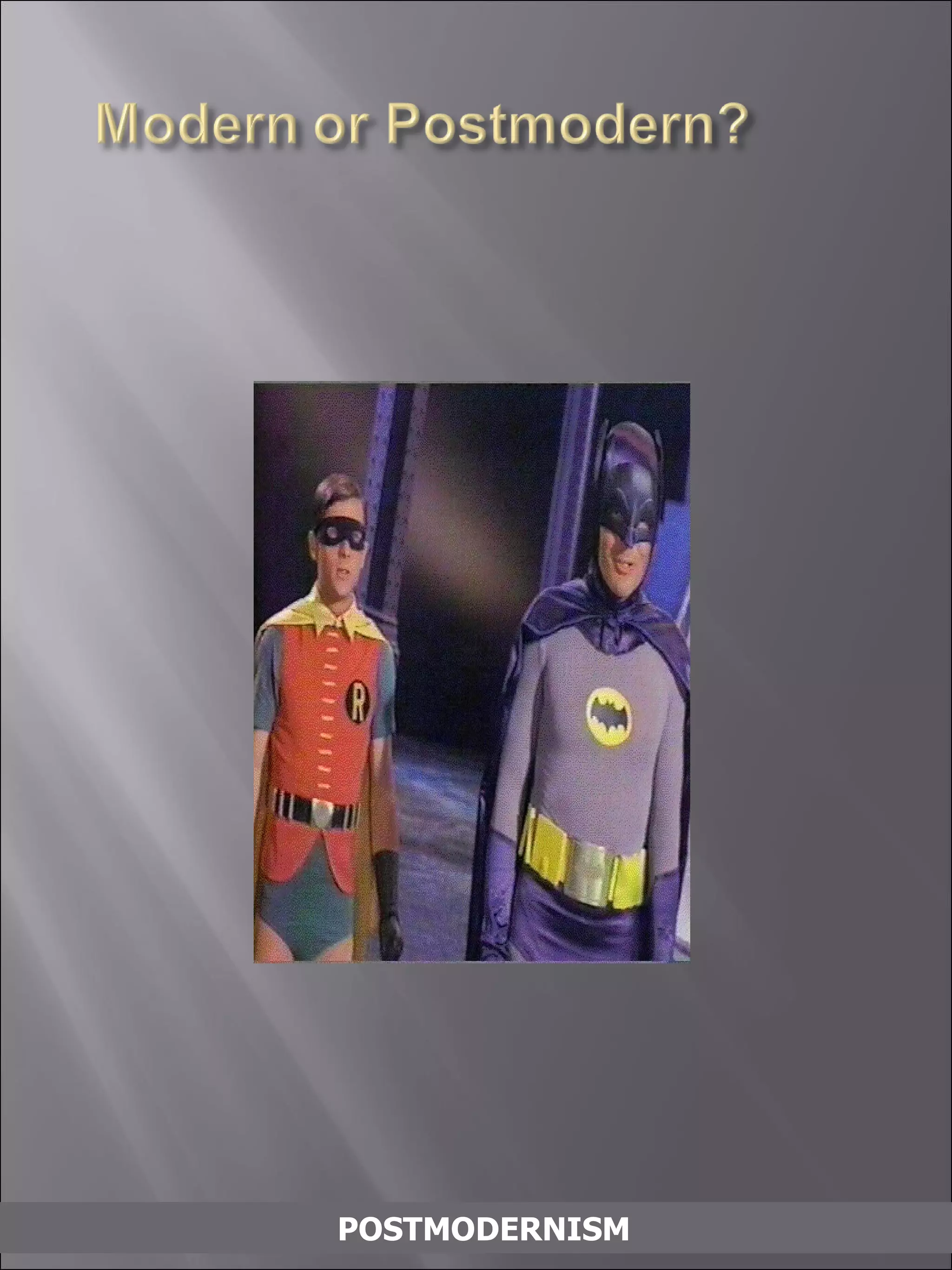
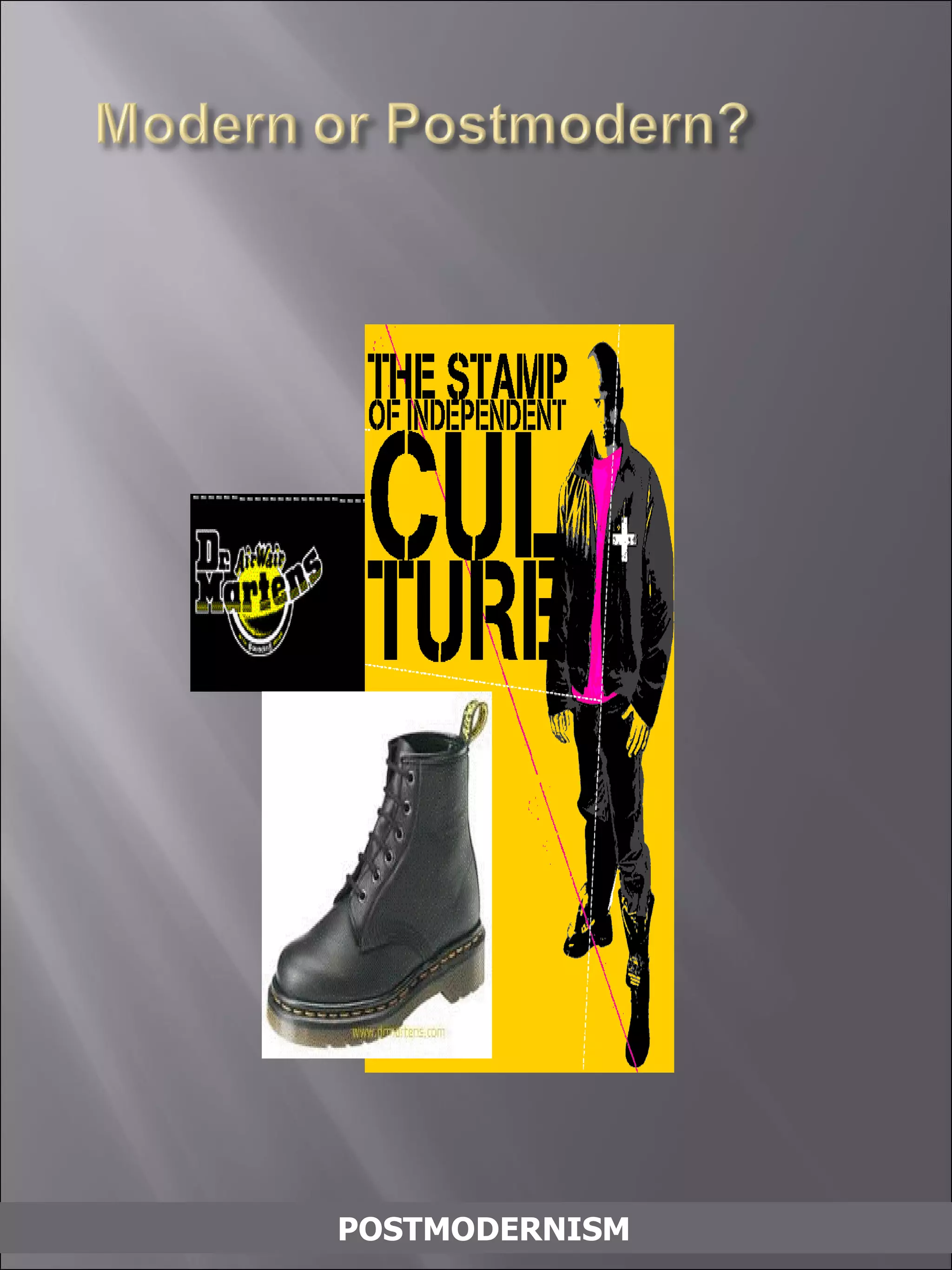
History as fact Faith in social order Family as central unit Authenticity of originals Mass consumption Binary Oppositions POSTMODERNISM Written by the victors Cultural pluralism Alternate families Hyper-reality (MTV) small group identity
POSTMODERNISM
POSTMODERNISM
POSTMODERNISM A gay Southern Baptist who practices Buddhist meditation and believes in the Big Bang theory.
POSTMODERNISM
POSTMODERNISM
POSTMODERNISM
POSTMODERNISM
POSTMODERNISM
POSTMODERNISM
POSTMODERNISM
POSTMODERNISM
POSTMODERNISM
“ The narrative is unravelled, the author is dead, the Enlightenment project is toast, and history is history.” “ An epochal shift in the basic condition in being.”   --Geoffrey Nunberg An Epochal Shift in Thinking POSTMODERNISM
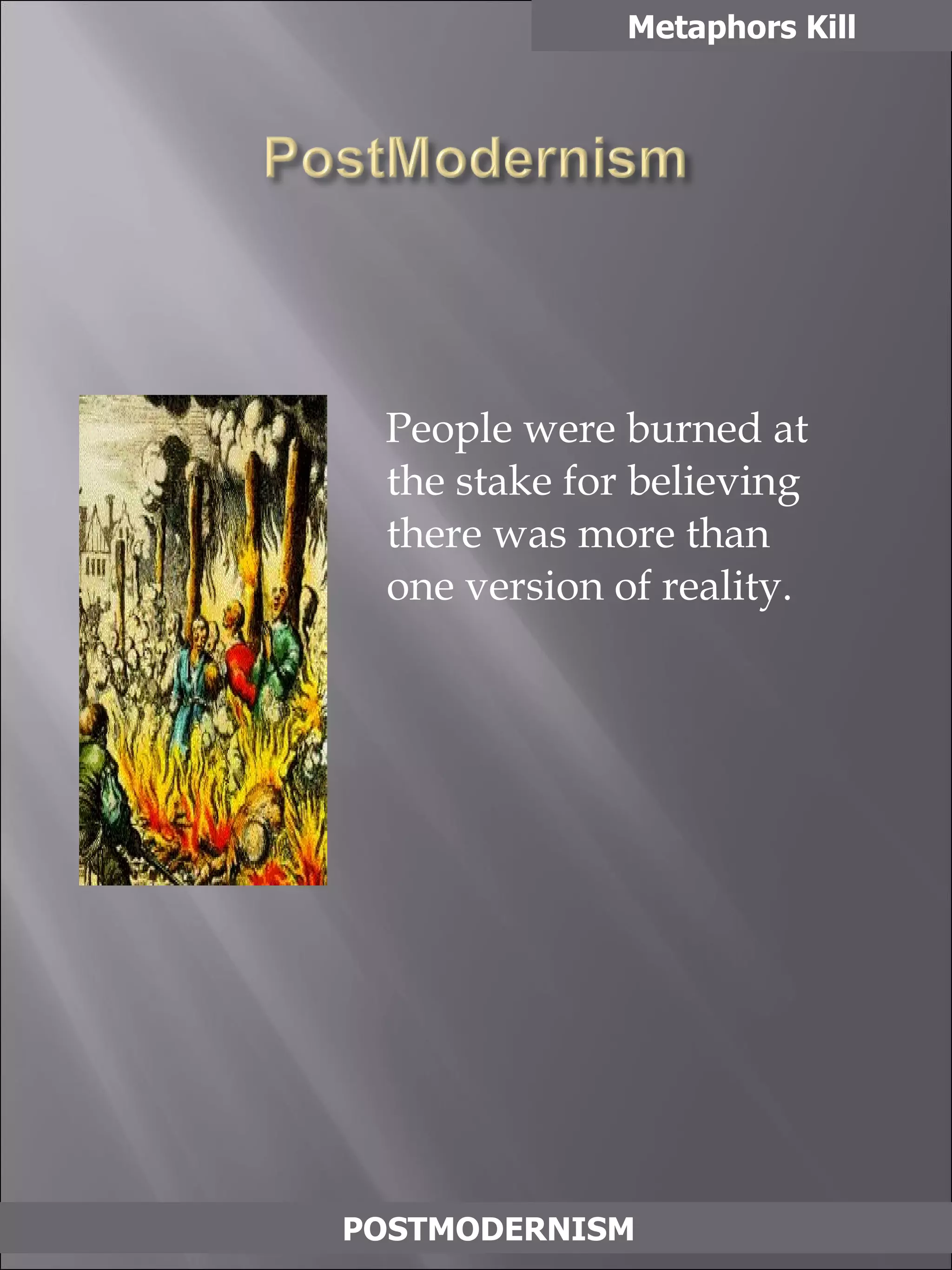
People were burned at the stake for believing there was more than one version of reality. Metaphors Kill POSTMODERNISM
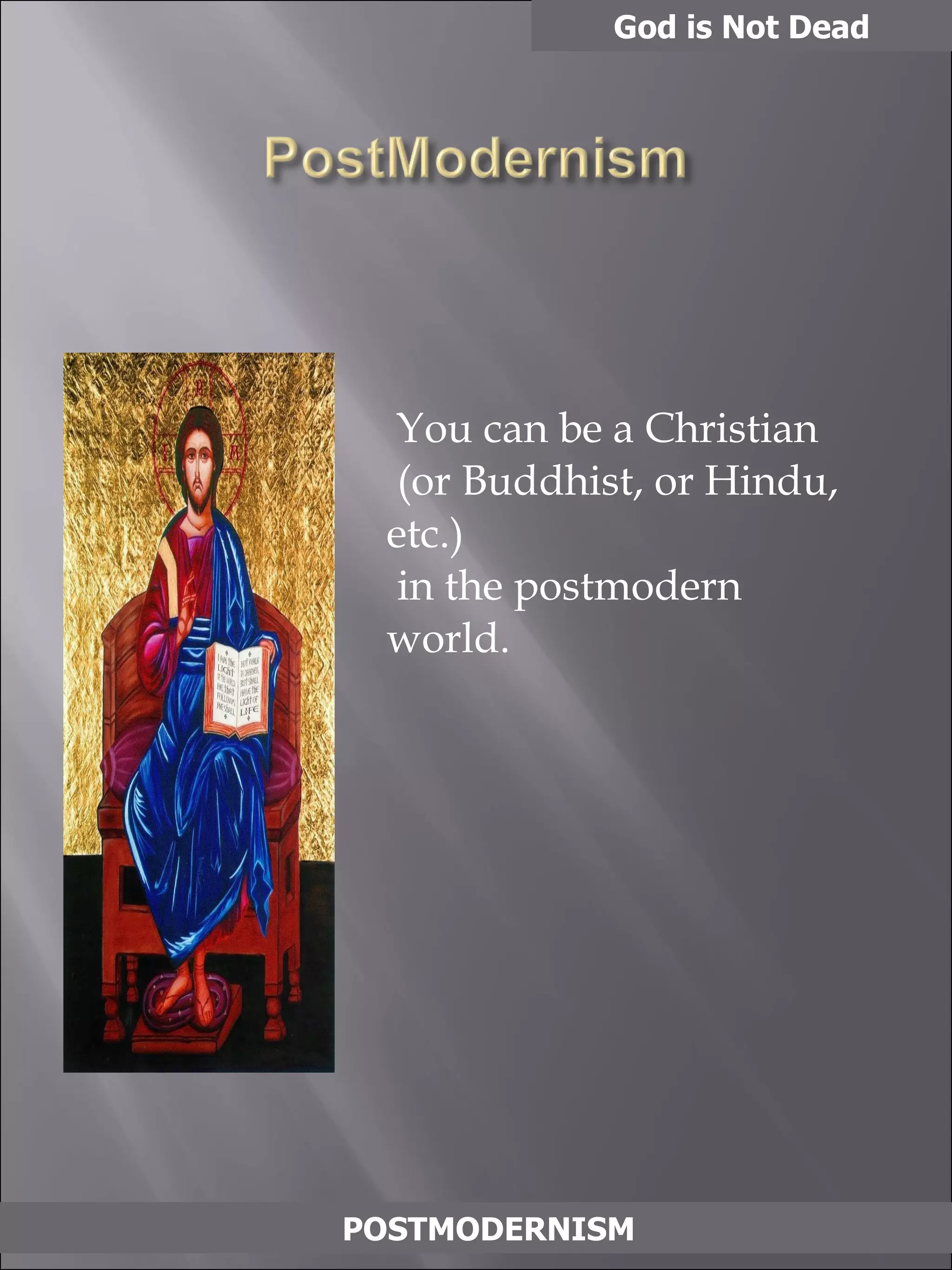
You can be a Christian   (or Buddhist, or Hindu, etc.)  in the postmodern world.  God is Not Dead POSTMODERNISM
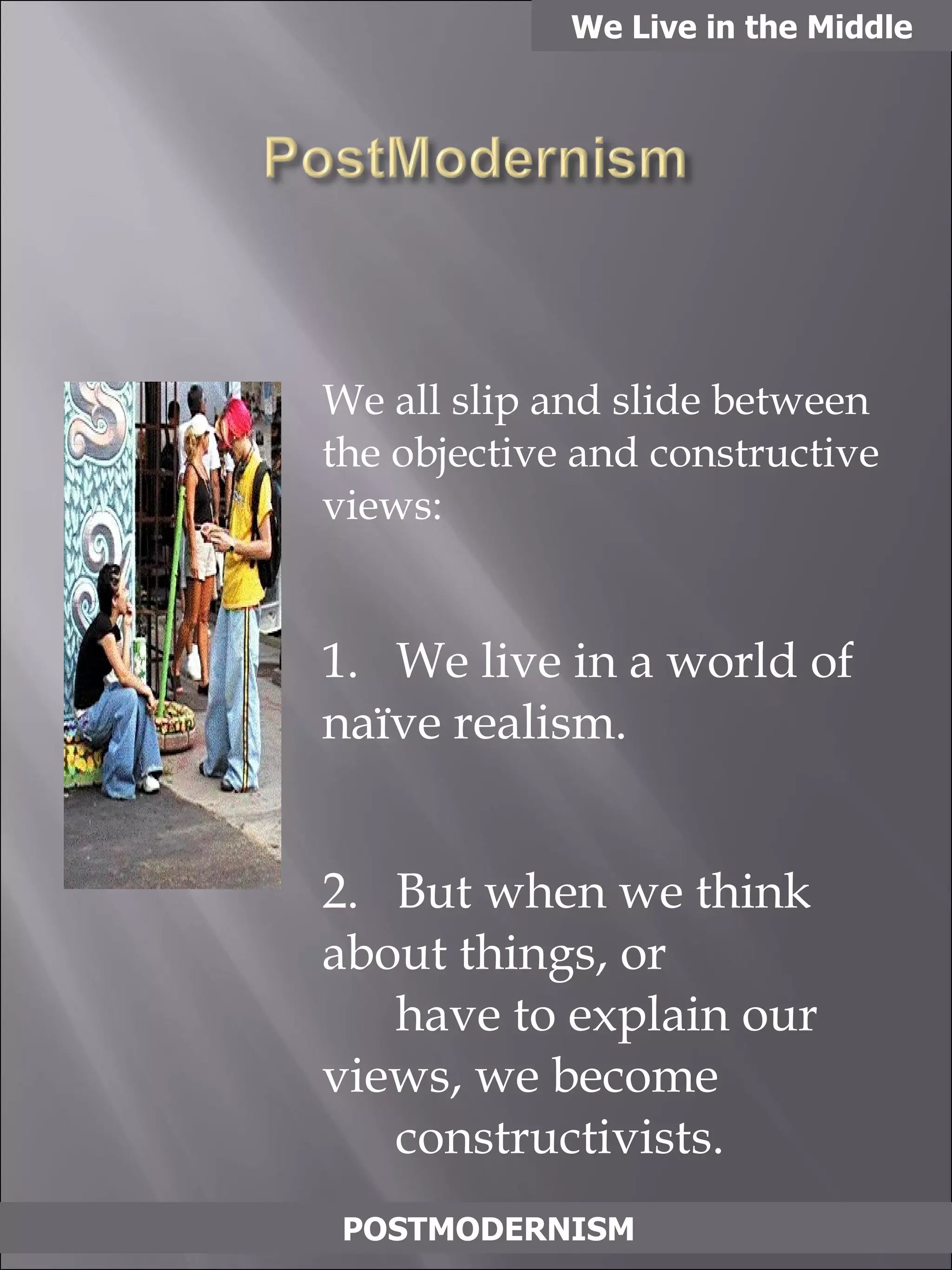
We all slip and slide between the objective and constructive views: 1.  We live in a world of naïve realism. 2.  But when we think about things, or    have to explain our views, we become   constructivists. We Live in the Middle POSTMODERNISM
THE HOPE OF POSTMODERNISTS: The deconstruction of foundational views will lead to a recognition and acceptance of a pluralistic worldview. Create a truly global civilization. Celebrating Diversity POSTMODERNISM
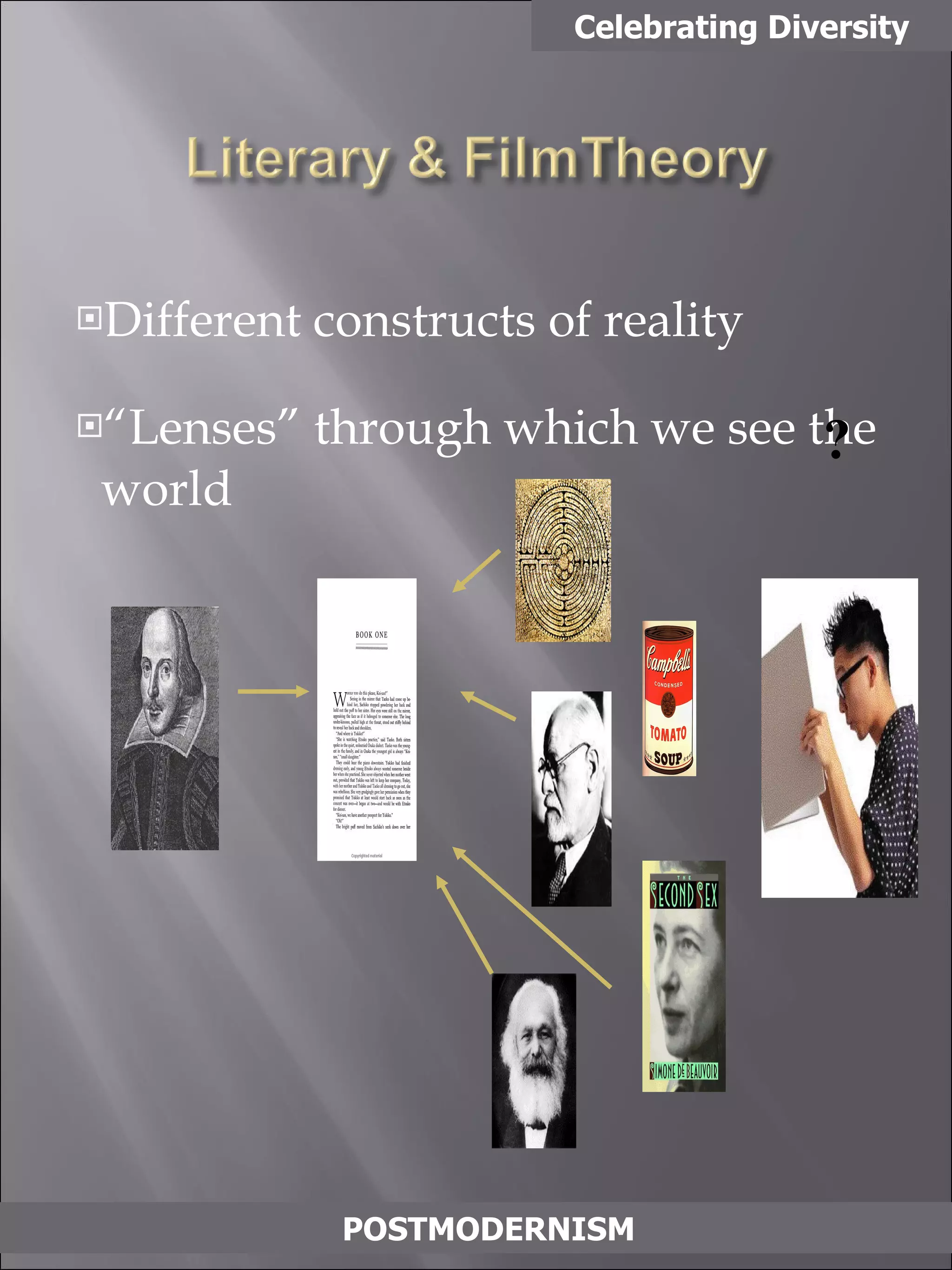
Different constructs of reality “ Lenses” through which we see the world Celebrating Diversity POSTMODERNISM ?

Introduction to postmodernism

  • 1.
  • 2.
  • 3.
    1 . Whatis postmodernism? 2. Why should we care about it? 3. What does postmodernism have to say about the identity? 5. What does postmodernism have to say about truth, beauty and goodness? 6. How postmodernism is influencing education, religion, the arts, and our daily lives.
  • 4.
    Timeline as TRADITIONALWESTERN “MODERN” THINKING Theocentric Humanistic Economic Naturalistic
  • 5.
    Early modernity: Renaissance to Industrial Revolution Modernity: Industrial Revolution Post- Modernity: Period of mass media Timeline TRADITIONAL WESTERN “MODERN” THINKING
  • 6.
    Modern Period TimelineTRADITIONAL WESTERN “MODERN” THINKING Postmodern period 1914 1939 1945 now You are here
  • 7.
    God, reason andprogress There was a center to the universe. Progress is based upon knowledge, and man is capable of discerning objective absolute truths in science and the arts. Modernism is linked to capitalism—progressive economic administration of world Modernization of 3rd world countries (imposition of modern Western values) Newtonian Order TRADITIONAL WESTERN “MODERN” THINKING
  • 8.
    People are thesame everywhere There are universal laws and truths Knowledge is independent of culture, gender, etc. Language is a man-made tool that refers to real things / truths What Is Language? as
  • 9.
    Good literature isof timeless significance. The text will reveal constants, universal truths, about human nature, because human nature itself is constant and unchanging. Purpose of Literature TRADITIONAL WESTERN “MODERN” THINKING
  • 10.
    Early 1900s: WorldWar I Worldwide poverty & exploitation Intellectual upheaval: Freud: psychoanalysis Marx: class struggle Kierkegaard, Heidegger, Nietzsche Picasso, Stravinsky, Kafka, Proust, Brecht, Joyce, Eliot Death of the Old Order PRECURSORS OF POSTMODERNISM
  • 11.
    Einstein: relativity, quantummechanics Refutation of Newtonian science Time is relative Matter and energy are one Light as both particle and wave Universe is strange The Bending of Time & Space TRADITIONAL WESTERN “MODERN” THINKING PRECURSORS OF POSTMODERNISM E=mc2
  • 12.
    Cubism Surrealism DadaismExpressionism Breaking the Rules PRECURSORS OF POSTMODERNISM
  • 13.
    “ Things fallapart, The centre cannot hold, Mere anarchy is loosed upon the world.” -- Yeats, “The Second Coming” A World with No Center PRECURSORS OF POSTMODERNISM
  • 14.
    Emphasis of subjectivityMovement away from “objective” third-party narration Tendency stream of conscioussnes Obsession with the psychology of self Rejection of traditional aesthetic theories Experimentation with language Breaking the Rules PRECURSORS OF POSTMODERNISM
  • 15.
    Continuation of modernistview A term applied to all human sciences —anthropology, psychology, architecture, history, etc. Reaction to modernism; systematic skepticism Anti-structural Acceptance of a New Age POSTMODERNISM
  • 16.
    The Enlightenment projectis dead. Acceptance of a New Age POSTMODERNISM
  • 17.
    Modernism and postmodernismare cultural formations that accompany specific stages of capitalism 1. Market capitalism: 18th-19th C. Steam locomotive Realism 2. Monopoly capitalism: Late 19th C to WWII Electricity and automobile Modernism 3. Multinational/consumer capitalism Nuclear and electronics Postmodernism Culture & Capital POSTMODERNISM
  • 18.
    All is relativeand subjective Rejection of all master narratives Skepticism of technique’ progress Sense of fragmentation and decentered self Multiple conflicting identities Mass-mediated reality The End of Master Narratives POSTMODERNISM
  • 19.
    All versions ofreality are SOCIAL CONSTRUCTS Concepts of good and evil Metaphors for God Language The self The End of Master Narratives POSTMODERNISM
  • 20.
    Language is asocial construct that “speaks” & identifies the subject Knowledge is contingent, contextual and linked to POWER Truth is pluralistic, dependent upon the frame of reference of the observer Values are derived from ordinary social practices, which differ from culture to culture and change with time. Values are determined by manipulation and domination Language As Social Construct POSTMODERNISM
  • 21.
    Observer is aparticipant/part of what is observed Receiver of message is a component of the message Information becomes information only when contextualized The individual (the subject) is a cultural construct Consider role of own culture when examining others All interpretation is conditioned by cultural perspective and mediated by symbols and practice The Observer is King POSTMODERNISM
  • 22.
    Extreme freedom ofform and expression Repudiation of boundaries of narration & genre Intrusive, self-reflexive author Parodies of meta-narratives Deliberate violation of standards of sense and decency (which are viewed as methods of social control- dystopias) Integration of everyday experience, pop culture Play and Parody POSTMODERNISM
  • 23.
    Parody, play, blackhumor, pastiche Nonlinear, fragmented narratives Ambiguities and uncertainties Conspiracy and paranoia Ironic detachment Linguistic innovations Postcolonial, global-English literature Fragmented Identities POSTMODERNISM
  • 24.
    History as factFaith in social order Family as central unit Authenticity of originals Mass consumption Binary Oppositions POSTMODERNISM Written by the victors Cultural pluralism Alternate families Hyper-reality (MTV) small group identity
  • 25.
  • 26.
  • 27.
    POSTMODERNISM A gaySouthern Baptist who practices Buddhist meditation and believes in the Big Bang theory.
  • 28.
  • 29.
  • 30.
  • 31.
  • 32.
  • 33.
  • 34.
  • 35.
  • 36.
  • 37.
    “ The narrativeis unravelled, the author is dead, the Enlightenment project is toast, and history is history.” “ An epochal shift in the basic condition in being.” --Geoffrey Nunberg An Epochal Shift in Thinking POSTMODERNISM
  • 38.
    People were burnedat the stake for believing there was more than one version of reality. Metaphors Kill POSTMODERNISM
  • 39.
    You can bea Christian (or Buddhist, or Hindu, etc.) in the postmodern world. God is Not Dead POSTMODERNISM
  • 40.
    We all slipand slide between the objective and constructive views: 1. We live in a world of naïve realism. 2. But when we think about things, or have to explain our views, we become constructivists. We Live in the Middle POSTMODERNISM
  • 41.
    THE HOPE OFPOSTMODERNISTS: The deconstruction of foundational views will lead to a recognition and acceptance of a pluralistic worldview. Create a truly global civilization. Celebrating Diversity POSTMODERNISM
  • 42.
    Different constructs ofreality “ Lenses” through which we see the world Celebrating Diversity POSTMODERNISM ?

Editor's Notes

  • #5 THEOCENTRIC--Hamlet tells us "There is a Divinity that shapes our ends...” Western art. HUMANISTIC--"Man is the measure of all things." We chart our own destiny. NATURALISTIC--We are shaped by our environment, for the good or bad. Darwinian influence of survival of the fittest. ECONOMIC--Social power lies in money and weath. As Marx said, history is the story of class struggles in which the 'have-nots' struggle to dispossess the 'haves' who naturally will fight to keep what they own. Those who have economic power control cultures, language and shape us as consumers.
  • #6 “ Modernity" is older than "modernism;" the label "modern," first articulated in nineteenth-century sociology, was meant to distinguish the present era from the previous one, which was labeled "antiquity." Scholars are always debating when exactly the "modern" period began, and how to distinguish between what is modern and what is not modern; it seems like the modern period starts earlier and earlier every time historians look at it. But generally, the "modern" era is associated with the European Enlightenment, which begins roughly in the middle of the eighteenth century . (Other historians trace elements of enlightenment thought back to the Renaissance or earlier, and one could argue that Enlightenment thinking begins with the eighteenth century. BAUDRILLARD
  • #7 ACTUALLY, WHEN TALKING ABOUT THE HISTORY OF WESTERN INTELLECTUALISM AND ART, YOU NEED TO DISTINGUISH BETWEEN three ERAs: MODERN MODERNISM OR MODERNIST POSTMODERN You are in the midst of this revolution WHERE MOD AND POMO BEGINS AND ENDS IS FUZZY
  • #8 TO UNDERSTAND POSTMODERNISM, FIRST NEED TO UNDERSTAND WHAT IS MEANT MY MODERNITY AND MODERNISM WHAT IS MODERNITY? BASIC PRINCIPLES
  • #9 THIS PHILOSOPHY OF LIFE SUGGESTED A PHILSOPHY OF LANGUAGE AND HOW WE VIEW OURSELVES
  • #10 And this is THE CLASS MODERN VIEW OF LITERATURE LITERATURE IS UNIVERSAL TRUTHS
  • #11 THERE WAS INTELLECTUAL UPHEAVAL IN THE EARLY 1900s Sigmund Freud's view of the unconscious as the determinant of motivation and behavior Karl Marx's view of consciousness as a product of sociohistorical factors Friedrich Nietzsche's annunciation of the death of God Devastation of the war , modernism embodies a lack of faith in Western civilization and culture -- its humanism and rationalism. Picasso, Kafka, Joyce, Dadaism and surrealis, existentialism, search for meaning Rise of fascism, anarchy, nihilism Rebellion against liberal humanism, positivism, reason, progress, god-centric world
  • #12 Revolution in science AT THE SAME TIME Bend the rules of science Observer’s position effects interpretation of reality
  • #13 IN THE WORLD OF ART, THE REVOLT AGAINST MODERN RATIONAL THINKING BECAME VERY EVIDENT REVOLT AGAINST REPRESENTIONAL ART Antiprepresentational "Modernism can be thought of as the self-conscious response in the arts to the experience of modernity "a radically altered aesthetic form and perspective: the modernist stress upon art as a self-referential construct instead of as a mirror of nature or society" Cubism--different perspectives of reality
  • #14 In literature, POETS, NOVELISTS AND PLAYWRIGHTS BECAME TO PROCLAIM THE END OF THE RATIONAL WORLD EXISTENTIAL THEMES BEGAN TO APPEAR LIFE WITH NO CENTER YEATS LANDMARK POEM THE NEW ORDER OF THINGS WAS AWORLD WITH NO CENTER
  • #15 In writers such as HEMINGWAY, FAULKNER, VIRGINIA WOOLF, FROST AND JAMES JOYCE, existential themes bgean to appear WHOLE DIFFERENT TYPE OF LITERATURE MIRRORED WHAT WAS HAPPENING IN VISUAL ARTS Exploration of man as an alienated individual, inward looking Focus on impressionism, and subjectivity Movement away from tradition 3rd party ways of story telling Self consciousness bred a new style called stream of consciousness Spontaneity and discovery in creation Experimentation Still reflected western tradition Eliot--rich language and symbols of experience The Lost Generation--Gertrude Stein, Fitzgerald
  • #16 THAT IS THE MODERNIST VIEW OF THE WORLD LESS REALISM AND NATURALISTIC INTERPRETATION EMPHASIS ON THE SUBCONSCIOUSNESS EXPERIMENTATION IN AESTHETICS HOW DOES POSMODERNISM DIFFER? Not opposite to--an extension of BULLETS
  • #17 THAT IS THE MODERNIST VIEW OF THE WORLD LESS REALISM AND NATURALISTIC INTERPRETATION EMPHASIS ON THE SUBCONSCIOUSNESS EXPERIMENTATION IN AESTHETICS HOW DOES POSMODERNISM DIFFER? Not opposite to--an extension of BULLETS
  • #18 ANOTHER WAY OF LOOKING AT IT JAMESON OFTEN GIVEN CREIDT FOR POPULARIZING PM AN AMERICAN MARXIST--NOT IN POLITICAL BUT LITERARY SENSE CULTURAL MATERIALIST ECONOMICS DICTATE REALITY
  • #19 THESE ARE SOME BASIC CONCEPTS THAT CUT ACROSS ALL ASPECTS OF POSTMODERNISM On objective essence, no central truths Don’t mourn or worry about it--that’s just the way life is
  • #20 Even marriage Islam Mormons of the 19th c Chinese concubines Family Motherhood Plato China one-child India--girls are bad
  • #21 THIS VIEW OF THE WORLD HAS A BIG IMPACT UPON KNOWLEDGE AND LANGUAGE THEORY HOW DO WE KNOW WHAT WE KNOW? HOW DOES LANGUAGE MEAN? HERE ARE SOME KEY PRINCIPLES: BULLETS POSTMODERNISM CHANGES EVERYTHING VIEW OF THEOLOGY PSYCHOLOGY MILITARY
  • #22 HERE ARE SOME OF THE UNDERLYING ASSUMPTIONS OF PM THEORY ABOUT LANGUAGE AND LITERATURE--ALSO APPLIES TO HISTORY AND PSYCHOLOGY
  • #23 WHICH BRINGS US TO POSTMODERNIST LITERATURE? HAVE YOU READ VONNEGUT? BARTH? PYNCHEON? ATWOOD? Experiments with modes to create a stream of consciousness so vivid that the author disappears Experimented within traditional frameworks POSTMODERNIST Challenged the traditional narrative and genre boundaries Creates ruptures, gaps and ironies that continue to remind the reader that the author is present See traditional linear representatives of reality false Challenge structures and taboos of contemporary society SEE THE WORKINGS But Quixote self-reflective Many current novels very traditional
  • #24 Mixed techniques--essay--newsreels (Dos Passos), memos,, etc. Kundera Pycheon: Gravity’s rainbow: ambiguous unresolvable allegory Conspiracy and paranoia are common themes, biting social critique (Kurt V) Workings of the machine are visible BARTH, BRAUTIGAN, BURROUGHS, DOCTOROW, ECO, HELLER, GASS, MAILER, MORRISON, OATES, PYNCHON, ROTH, GAO, KUNDERA
  • #25 The encyclopedia Web Architecture of NY LA and Vegas Phallic order Queer sexual identities
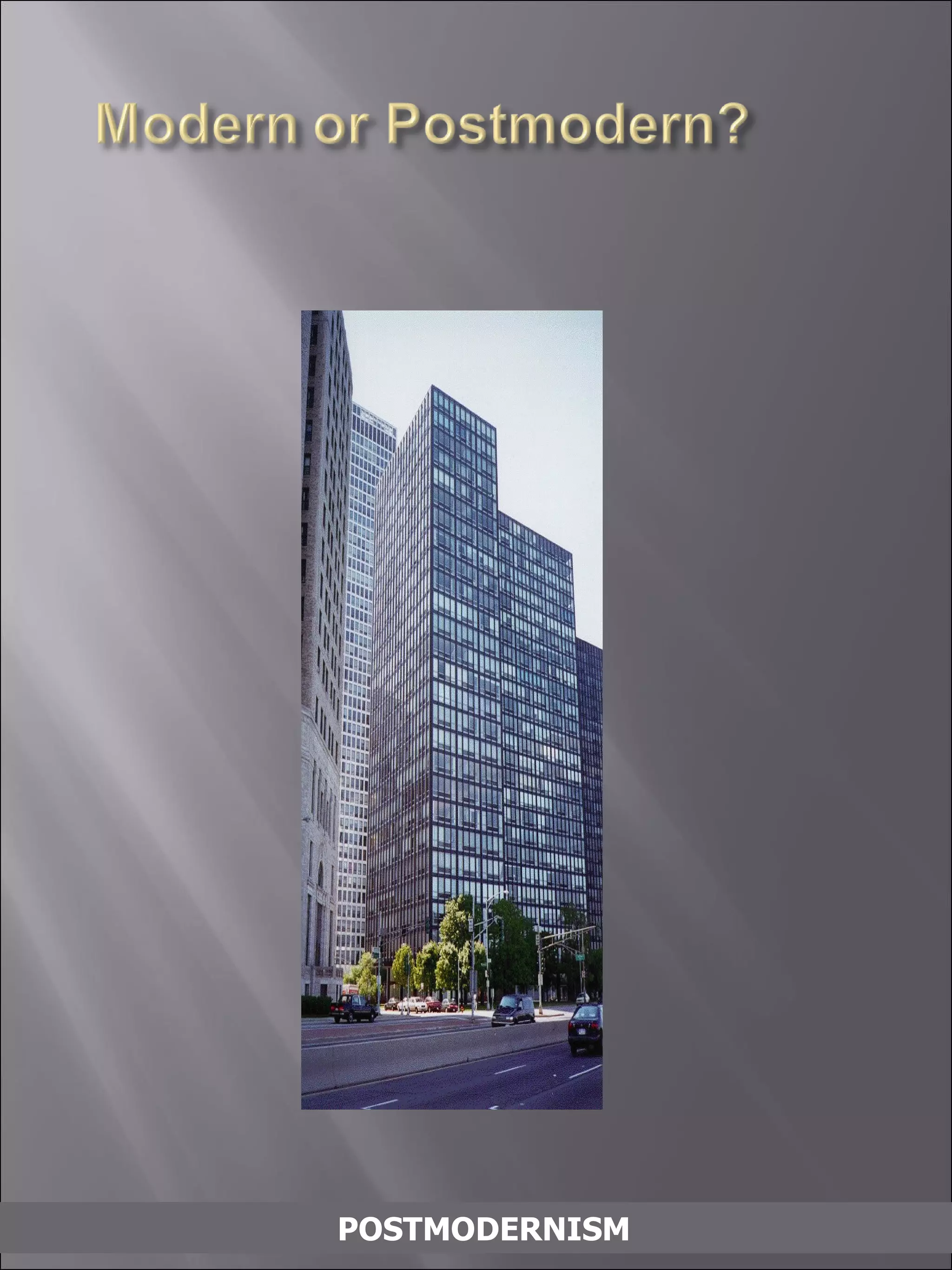
  • #29 Lake Shore apartments in Chicago Built in 1948--changed the look of every American citY Originally, the term comes from architecture, where modern architecture denotes the familiar glass, steel and concrete buildings with their straight, rectangular, geometric shapes. This led in the 1960's to a reaction by younger architects, who included different decorative elements inspired by earlier periods in their design. This eclectic mixture of styles was called "postmodern architecture ". From there the term "postmodern" quickly spread to art, where it denoted a departure from the radicalism and abstraction of the old avant-garde, replacing them by a fusion of different popular and traditional elements, like Warhol's Pop Art or rock music incorporating African and oriental motives.
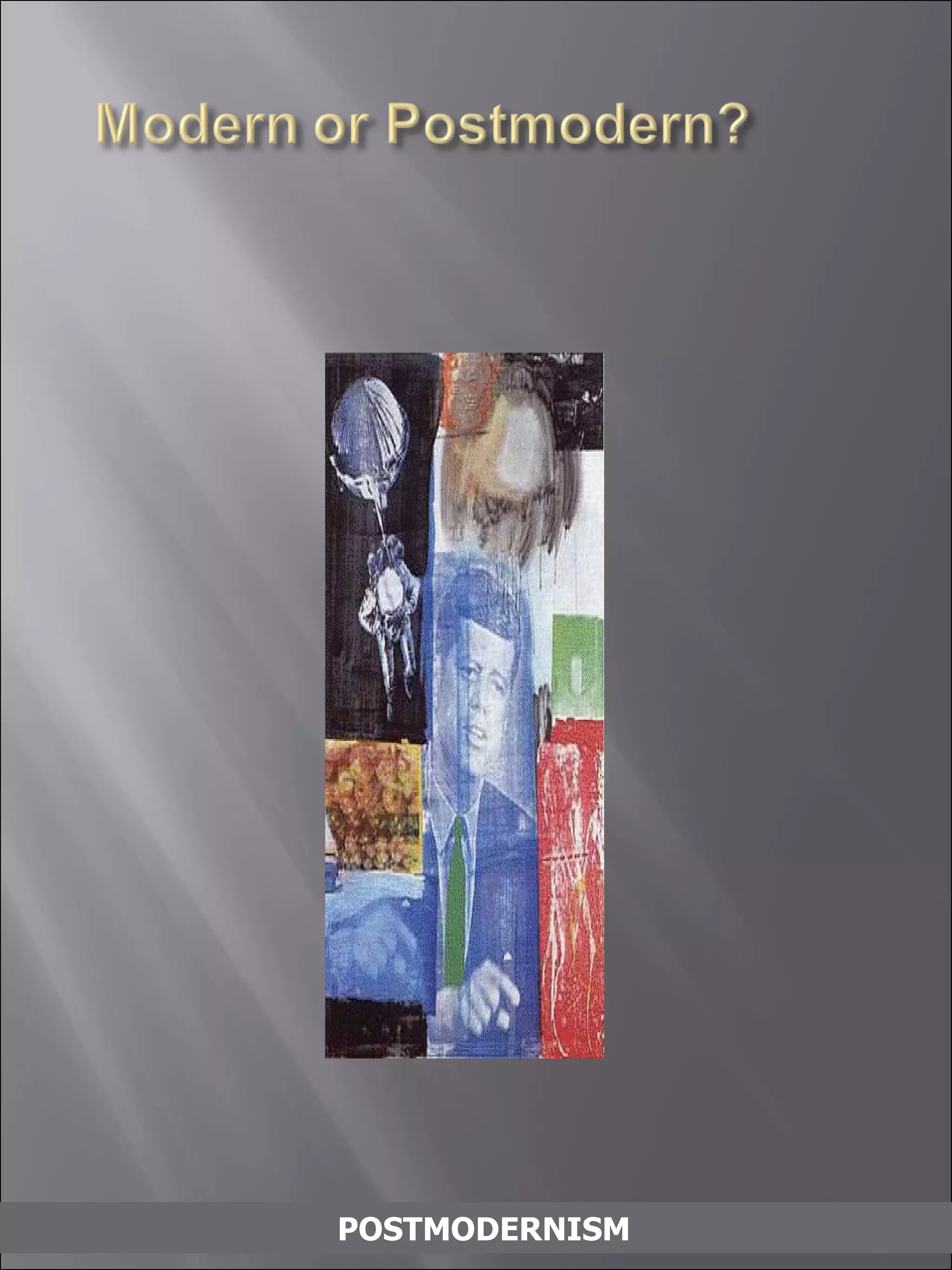
  • #30 Simplicity Form should follow function Le Corbusier church Expressionist modern
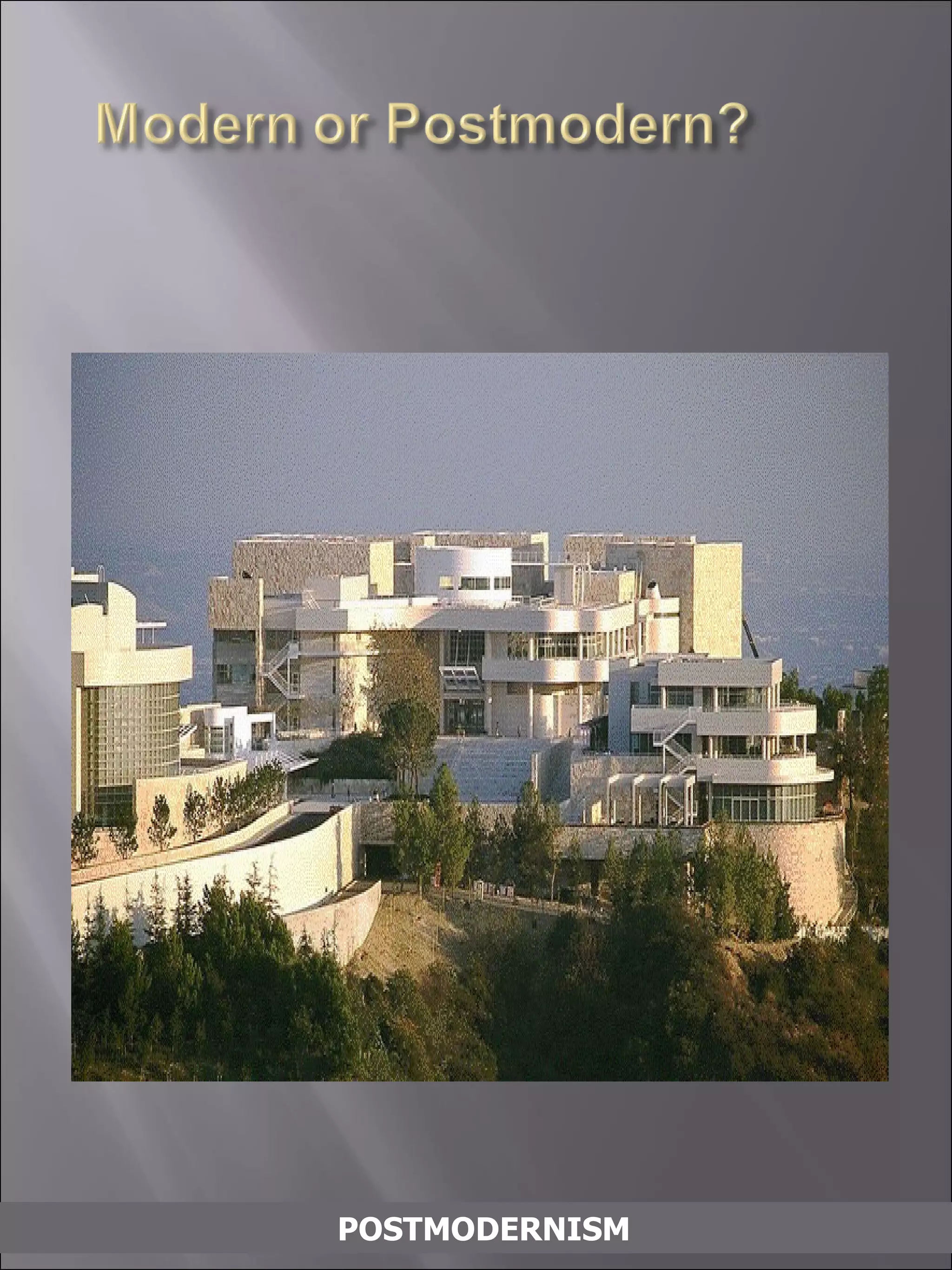
  • #31 More responsive to its context Many styles Fragmented, seemingly disjointed JP Getty Museum in LA
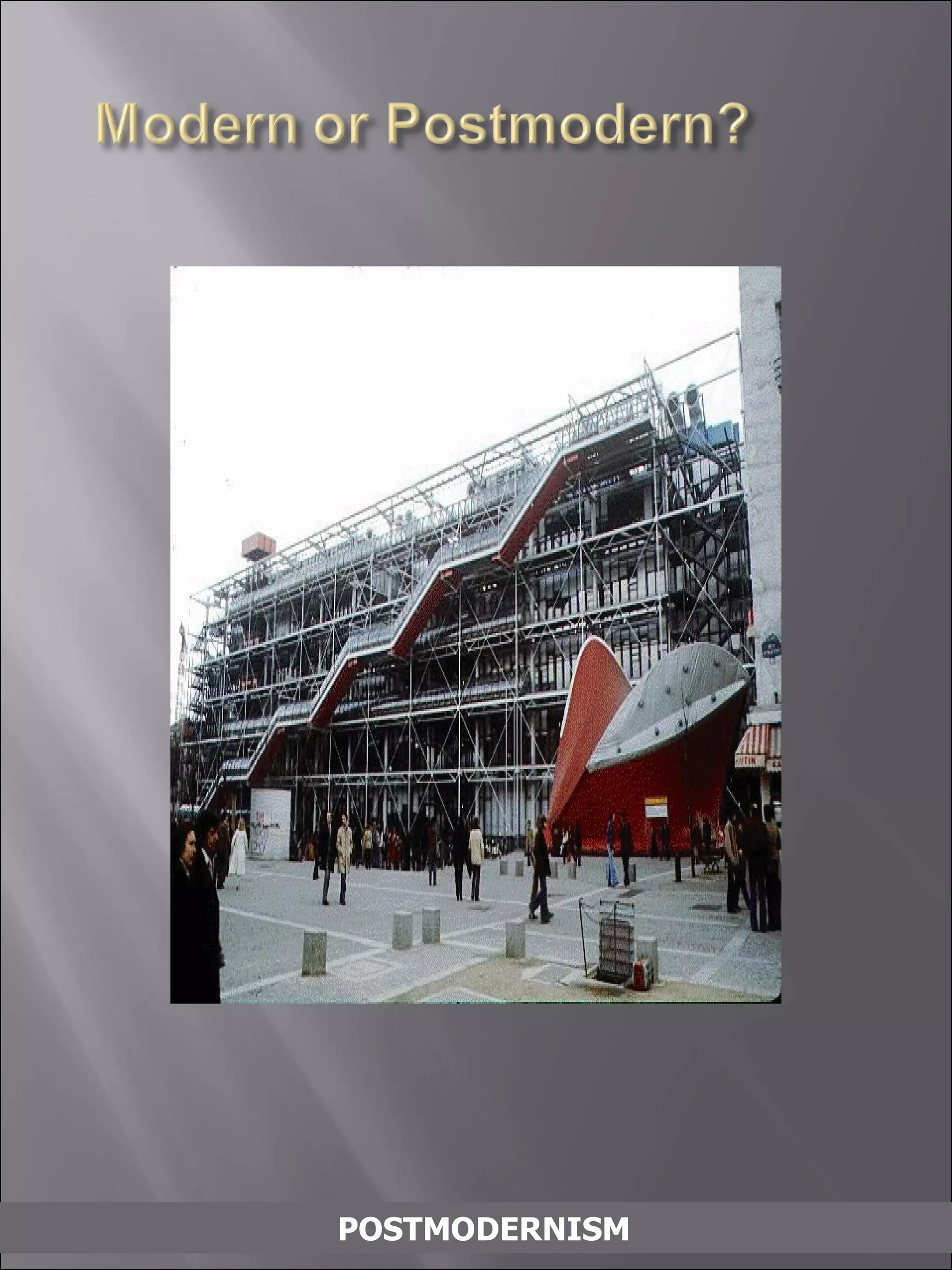
  • #32 Art Museum in Paris Le Boo Boo
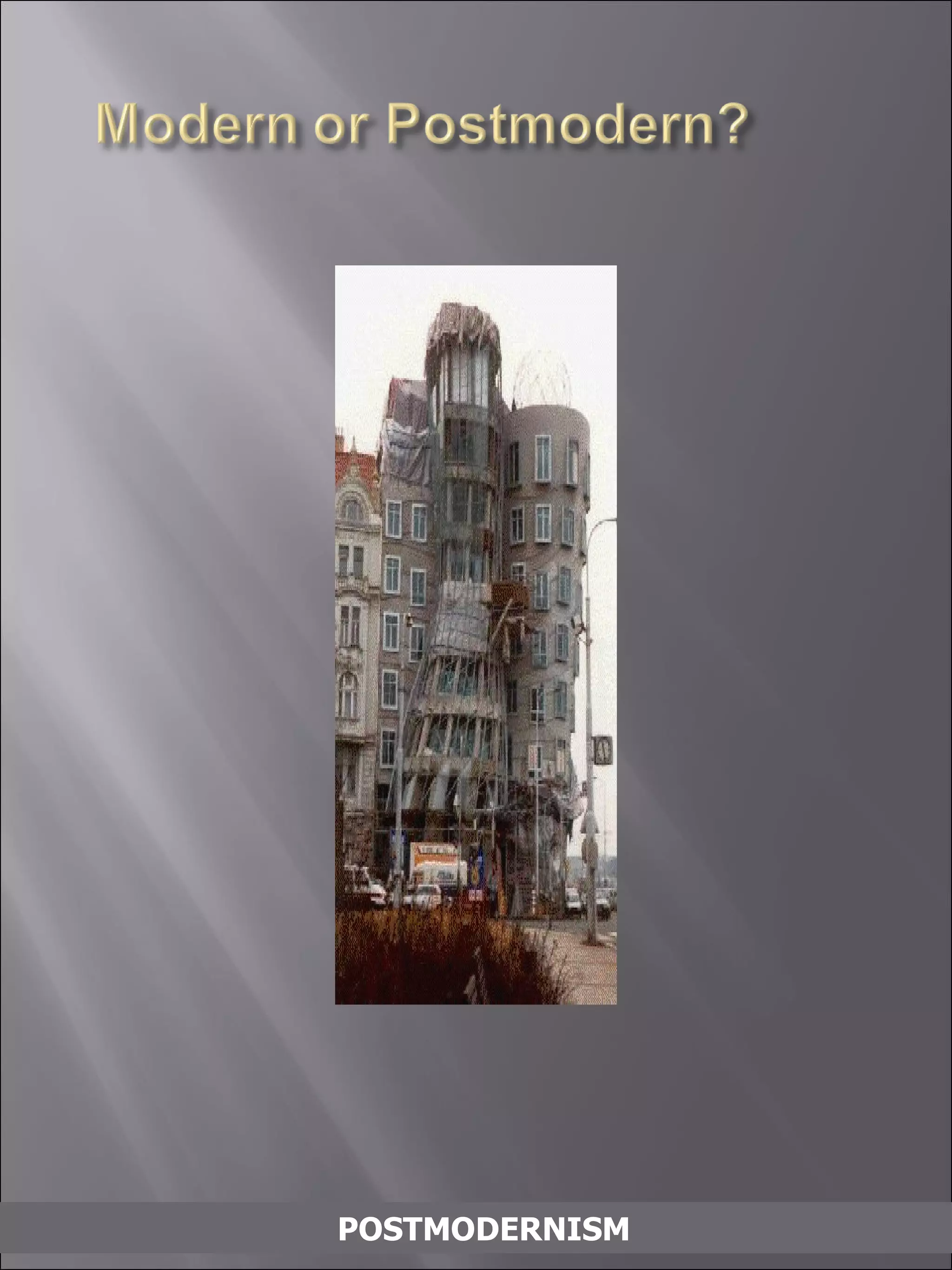
  • #33 Frank Gehring /Prague
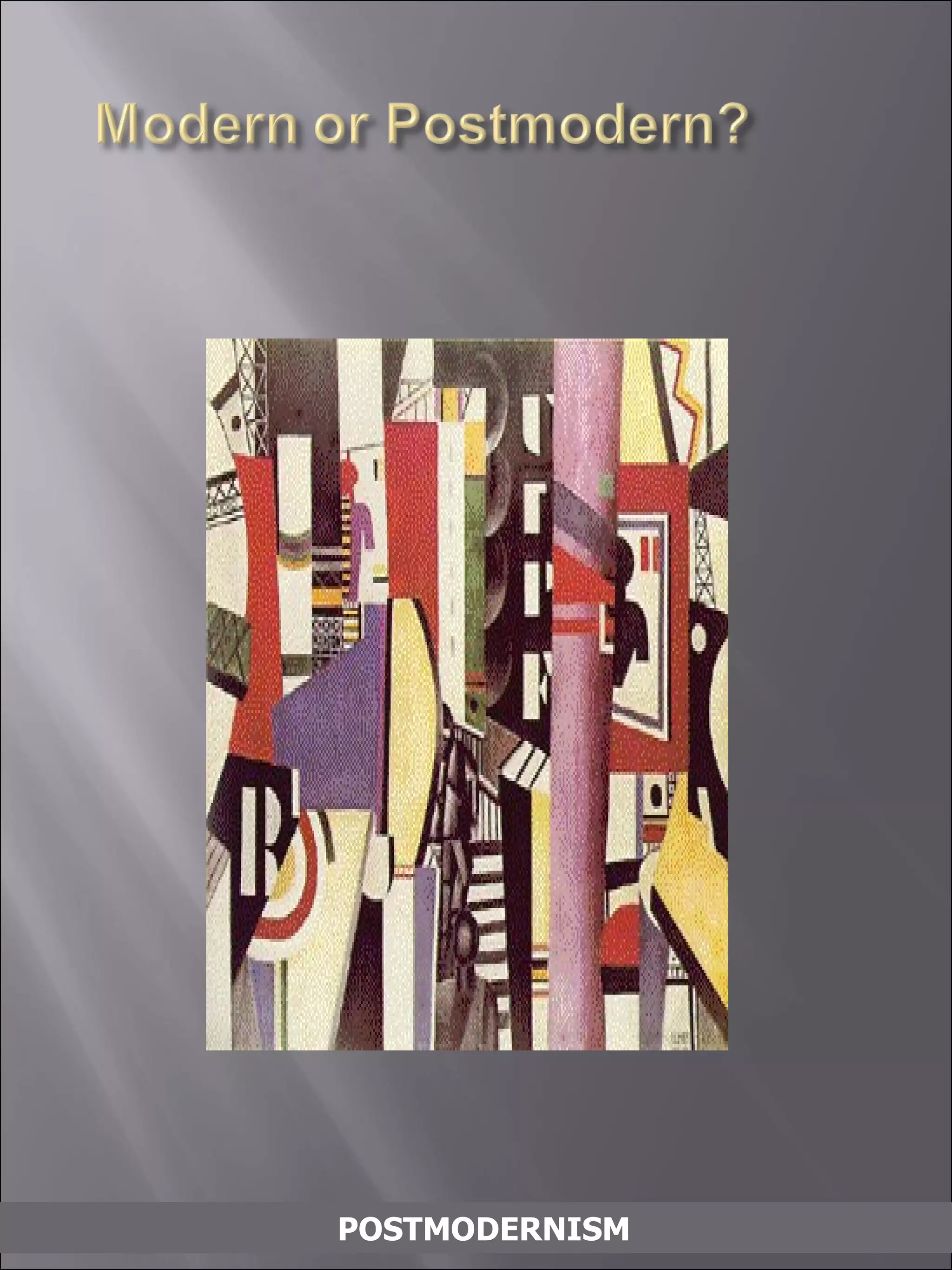
  • #34 Cubism New way of looking at reality
  • #35 American Robert Rauschenberg Throws into question idea of creativity and originality Silk-screen canvases and montages Fragments From production to reproduction ART DISPENSES WITH AURA ANDY WARHOL AS WELL Frank plagarism, repetition of existing images
  • #36 MacNewspaper Sound bites
  • #37 Reality as entertainment
  • #38 Andy Warhol Body Piercings Boy George Annie Sprinkle MTV Videos Madonna Gus Gus Rap Levi's Commercials The X Files Blade Runner Frankenhooker Jerry Springer Real World Cops Bill Clinton on MTV Body modification The Web Salon Cyberpunk Affinity group credit cards Arugala salads with duck meat, goat cheese and pine nuts
  • #39 THIS IS POWERFUL STUFF NOT ACADEMIC BABBLE Galileo Spanish Inquisitions McCarthy with hunts Dissenters during Prague Spring China Tianamen Square Taliban
  • #40 All I am saying is that our society is no longer White Christian Male centric 1950s Ten Commandments in school Women knew their place in the home Hindus, Blacks, Gays were others Communists were evil Sex not talked about or exploited What was good for GM was good for America Now Still be Christian But recognize that there are other world views IN FACT--NEVER HAVE BEEN MORE RELIGIONS AND CULTS POSTMODERNISM HAS GIVEN RISE TO MORE CHRISTIAN DENOMINATIONS, EASTERN ORIENTED FAITHS, NEW AGE, SHAMANISM, DRUIDS, SATANISM, CULTS--PEOPLE ARE FRAGMENTED SEARCHING FOR MEANING--RESULT OF NO CENTER TO THE WORLD CHALLENGE TO CATHOLIC CHURCH--ABSOLUTISTS AND THOSE VIEW CATHOLICISM AS A CAFETERIA--POSTMODERN CHALLENGES
  • #41 Assume that the world is the way we experience it. MOST US ARE UNFORMED CITIZENS OF THE POSTMODERN WORLD CONFUSED, UNLEAR OF OUR OWN CENTERS WANT THE GOOD OLD DAYS CREATED POLARIZATION--RELIGIOUS RIGHT, WHITE SUPREMACIST, ISLAMIC EXTREMISTS--PEOPLE WHO CANNOT DEAL WITH THE POST MODERN WORLD We accept social rules of the group--go along with them--accept external reality.
  • #42 The forces of postmodernism will prevent will ultimately defeat any power trying to corral people into a single world view. Afghanistan
  • #43 The forces of postmodernism will prevent will ultimately defeat any power trying to corral people into a single world view. Afghanistan